Pharma Change Control
Strategies for Successful
Company-Wide Implementation
ing electronic or facsimile transmission, scanning or electronic storage is a violation of federal copyright law and is strictly prohibited without the publisher’s express written permission. Subscribers registered with the Copyright Clearance Center (CCC) may reproduce articles for internal use only. For more information, contact CCC at www.copyright.com or call
Pharma Change Control:
Strategies for Successful Company-Wide Implementation
Table of Contents
About the Authors
Principles of Change Control ...3
Introduction and Operation of Change Control Programs ...6
Parallel Programs ...7
Company-Wide Programs ...7
Grading the Changes ...8
Trials ...10
Deviations ...10
Change Control Committee ...10
Documentation ...12
Change Requests ...12
Appendices ...21 A. CMS’ Change Control Management Plan Version 1.0
B. Change Management Plan Version 1.0
Dr. Michael Hiob has worked for the State of Schleswig-Holstein (Germany) in Drug Control since 1991 as Head of the Laboratory for Drug Analysis and later as GMP Inspector for the Regional Authori-ties for Health and Occupational Safety of the State of Schleswig Since 2006 he has been working with the Ministry for Social Affairs, Health, Family, Youth and Senior Citizens as supervising surveillance
member of the expert group on “Qualification/Validation.” He is also active in international committees,
including as expert for the FMEA and the International Conference on Harmonization (ICH).
Thomas L. Peither is a GMP consultant for 18 years and an expert in the European GMPs. He co-founded the GMP publishing company Maas & Peither (Germany, USA) and the midsize pharma con-sulting company Halfmann Goetsch Peither (Switzerland, Germany, Singapore), which advises numer-ous pharmaceutical companies.
Principles of Change Control
As a rule, before a company can manufacture a drug, it must first gain approval from the appropriate federal agency to make sure it meets quality, efficacy and safety requirements.
But in order to follow Good Manufacturing Practices (GMP), manufacturers must comply with nu-merous requirements. Firms must document instructions for manufacture and quality control procedures.
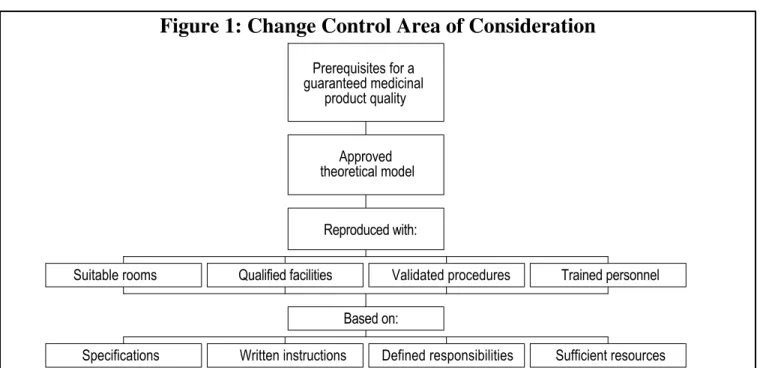
They must specify materials needed and define the basic conditions required for a reproducible quality, such as suitable rooms, qualified facilities, trained personnel and type of documentation (See Figure 1).
Before a company can implement these requirements, it needs a regulatory body to review their suit-ability for the intended purpose. In the theoretical approval model, regulatory authorities carry out the review as part of an authorization procedure. If approved, applicants receive a notice that the product is suitable and authorized for use. Pharmaceutical manufacturing companies must prove the suitability
of apparatus/facilities and procedures with qualification/validation. In these cases, someone responsible must sign the qualification/validation report confirming suitability and authorization for use.
The principle that companies must adhere to suitable requirements is not only valid the first time a drug is manufactured or the first time a facility follows a procedure. They must follow and adhere to
these requirements throughout the whole history of a drug or procedure.
Just as firms must document the entire batch history, they must also document requirements, such as written specifications for materials or directions for procedures. Firms must also document each change
control for the requirements.
As a result of scientific/technical development, changes to the legal basic conditions, or business re
-straints, manufacturers typically have to redefine, modify, enhance, or cancel requirements again and again
in practice. In turn, this change to previously approved requirements requires a review and authorization
Suitable rooms Qualified facilities Validated procedures Trained personnel
Specifications Written instructions Defined responsibilities Sufficient resources Based on: Reproduced with: Approved theoretical model Prerequisites for a guaranteed medicinal product quality
Change control programs are considered essential elements of pharmaceutical quality assurance
sys-tems. The glossary to Annex 15 of the EU GMP Guidelines defines “change control” as:
“A formal system by which qualified representatives of appropriate disciplines review proposed or actual changes that might affect the validated status of facilities, systems, equipment or processes. The intent is to determine the need for action that would ensure and document that the system is maintained in a validated state.”
Chapter 5.23 of the EU GMP Guidelines says this about the handling of changes:
“Significant amendments to the manufacturing process, including any change in equipment or materials, which may affect product quality and/or the reproducibility of the process should be validated.”
There are also two brief notes in the Code of Federal Regulations (CFR) on the topic of “change
control” (21 CFR, 211.100 and 21 CFR, 211.160):
§ 211.100 Written procedures; deviations.
(a) “There shall be written procedures for production and process control designed to assure that the drug products have the identity, strength, quality, and purity they pur-port or are represented to possess. Such procedures shall include all requirements in this subpart. These written procedures, including any changes, shall be drafted, reviewed, and approved by the appropriate organizational units and reviewed and approved by the quality control unit.”
§ 211.160 General requirements.
(a) “The establishment of any specifications, standards, sampling plans, test proce-dures, or other laboratory control mechanisms required by this subpart, including any change in such specifications, standards, sampling plans, test procedures, or other labo-ratory control mechanisms, shall be drafted by the appropriate organizational unit and reviewed and approved by the quality control unit. The requirements in this subpart shall be followed and shall be documented at the time of performance. Any deviation from the written specifications, standards, sampling plans, test procedures, or other laboratory control mechanisms shall be recorded and justified.”
In the US the quality control unit is responsible for the verification and authorization of changes.
The responsibility is not assigned in the relevant EU regulations. However, as change control is consid-ered an essential element of the pharmaceutical quality assurance system, it makes sense to transfer the responsibility for the function of the change control program to the person responsible for quality assur-ance (QA representative, QA head).
Change control is not department-specific, rather the task of the whole company. This is due to the
wide area of application of change control, as described in both Annex 15 and in The Pharmaceutical Inspection Convention and Pharmaceutical Inspection Co-operation Scheme (PIC/S) document PI 006-2.
“Written procedures should be in place to describe the actions to be taken if a change is proposed to a starting material, product component, process equipment, process en-vironment (or site), method of production or testing or any other change that may affect
product quality or reproducibility of the process. Change control procedures should en-sure that sufficient supporting data are generated to demonstrate that the revised process will result in a product of the desired quality, consistent with the approved specifications. “(Annex 15, no. 43)
“Change control is an important element in any Quality Assurance system. Written procedures should be in place to describe the actions to be taken if a change is proposed to a product component, process equipment, process environment (or site), method of production or testing or any other change that may affect product quality or support sys-tem operation.” (PIC/S document PI 006, section 6.7.1)
In this way, the change control monitors all types of changes which can influence the process reli -ability or product quality, evaluates them in reference to the relevant established requirements, and determines the measures necessary for implementing the change or decides that a change should not be implemented. The change control therefore ensures that a system remains in its suitable state.
Introduction and Operation of Change Control
Programs
“Commitment of the company to control change to premises, supporting utilities, materials, equipment and processes used in the manufacture of medicinal products is essential to ensure a continued validation status of the systems concerned. This commit-ment should be stated in the relevant company docucommit-mentation. For example, the Quality Manual, Quality Policy Documents or the Validation Master Plan. As part of its Quality Management System the company should have a defined and formalised Change Control Procedure.” (PIC/S document PI 006, section 2.6)
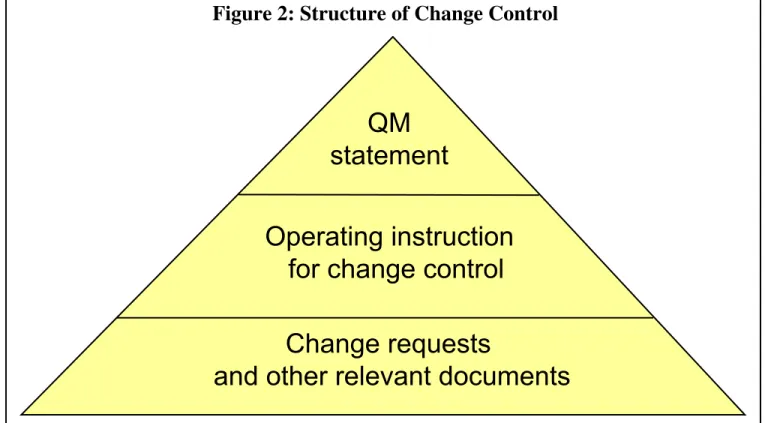
In order to successfully introduce a change control program, you must have the support of the com-pany’s top managers. The program also needs a corresponding statement for quality management (see Figure 2).
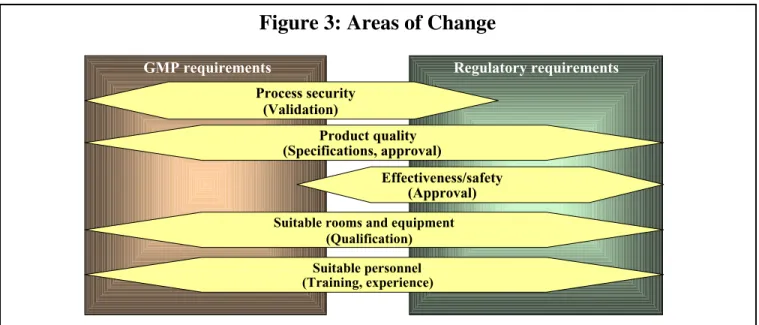
Many types of changes affect several regulation areas simultaneously (e.g. GMP requirements, authorization requirements, and employment protection requirements).Quality-relevant changes can affect several areas of a company (e.g. research/development, regulatory affairs, manufacture, quality control, engineering, and marketing); therefore, the control must be a task for the whole company (see Figure 3).
Change requests
and other relevant documents
Operating
instruction
for change control
QM
statement
Parallel Programs
As a rule, don’t operate different parallel and independently working interdepartment change control programs. In the past, companies didn’t recognize the need for change control as a quality assurance task for their entire staff. Instead separate departments handled their own change control. Some companies are still making this mistake and work with parallel change control programs: a change control program for the (electronic data processing) (EDP) area, a change control program for the regulatory affairs de-partment, and a change control program for the engineering department.
The problem with this method is that different departments don’t always collaborate on change con-trol. For example, control software was changed in the manufacturing area, without the head of produc-tion being aware of this because he or she was not a member of the change control committee for the EDP department that implemented this change autonomously.
Independent change control programs cause an unwanted attitude in the department, expressed as delimitations of responsibility, ineffective inter-department communication, and unfavorable procedure- and target-oriented attitudes. In addition, decision procedures and documentation formats/contents are not always consistent and not well suited.
Company-Wide Programs
The central processing of change procedures, coordinated by the quality assurance department, has several advantages compared to the handling of change control within various departments:
• There is a common understanding of what a change represents;
• The classification schemes used by the staff involved to grade changes are consistent; • The risks connected with the change can be evaluated in a multi-disciplinary manner; and
• There is a uniform documentation and authorization procedure.
GMP requirements Regulatory requirements
Process security (Validation) Product quality (Specifications, approval) Effectiveness/safety (Approval)
Suitable rooms and equipment (Qualification)
Suitable personnel (Training, experience)
The main requirement for the introduction of a change control program is high-quality awareness and an understanding for the functionality of quality assurance systems among the staff. Change control
can therefore not be assigned “from above,” and instead managers must communicate the significance and benefits of the program as part of an intensive training. Changes that require control must be first recognized as such “on site” so that the company can initiate necessary procedures. Only when staff
are motivated to continuously improve the quality of the product they manufacture will they accept the change control as a suitable tool and not reject it as bureaucratic formality.
The type and scope of a change control program must comply with the individual company requirements:
• In classical GMP-relevant areas, the change control serves to maintain the validated and
speci-fied status. Validated processes and qualispeci-fied facilities can be influenced in their state by changes so that the drugs manufactured no longer certainly comply with specifications. The same applies for changes to material specifications. A complete revalidation/requalification can
then be necessary. In these cases, companies need a formalized procedure to evaluate the risks associated with the change, determine the measures necessary to maintain the validation status, and authorize the change after successful revalidation.
• Holders of marketing authorizations must guarantee that for changes requiring reporting or
agreement, the necessary regulatory prerequisites are first met. Contract manufacturers that do
not have their own authorizations and resulting obligations for reporting must guarantee that
the contract giver is informed of the company-internal changes that could have an influence on
their application documentation. This requires that the contract giver is included in the change control program of the contract manufacturer. Conversely, it is frequently the holder of the authorization that causes the corresponding subsequent changes with the contract manufacturer because he or she changed authorization. Change control is in this case not only a task that ap-plies within the company, rather a task that apap-plies across companies. This is valid in particular for multi-national companies: changes can affect the approval status in different countries or affect the utilities at different manufacturing sites.
• In areas where drugs are developed, processes are optimized, or clinical research takes place, it’s not always necessary to comply with the strict reporting obligations linked with the approv-al. However, persons working in this area expect their work to be comprehensible. Changes in these areas should also be evaluated and documented in accordance with a described procedure. During the approval procedure at the latest or during inspections before the approval (pre-ap-proval-inspection), the development of a drug or process must be consistently proved.
Grading the Changes
According to the area of consideration (e.g. approval conformity or validation status), it may be nec-essary to use different change procedures as a base. This is the way many companies deal with changes to printed packaging material (information for use, folding cartons, and labels) in accordance with a special change control procedure, because these changes occur relatively frequently in practice and the process sequences can be standardized easily. In these cases, the sequences and the criteria used are not independent, but are carefully matched to suit and coordinate with each other.
The examples (lists, flow charts) for grading the changes, as used in many companies, can and
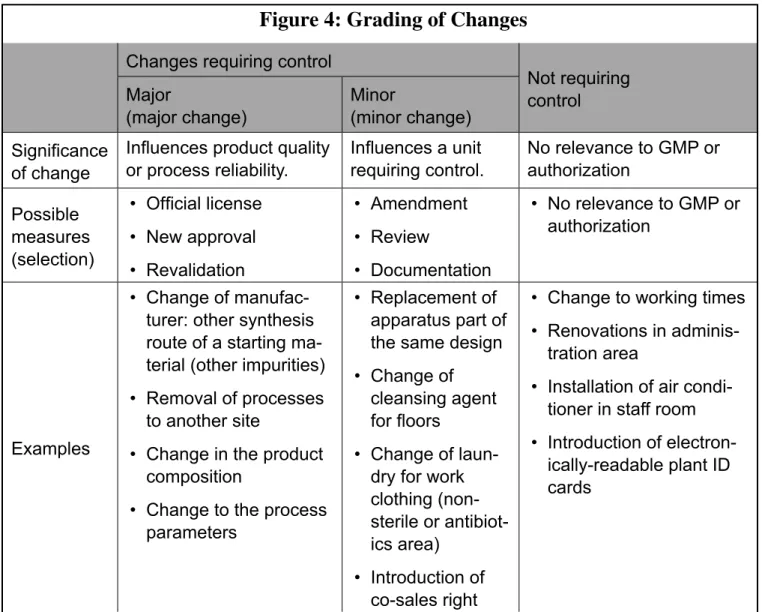
The example in Figure 4 only shows one way to grade changes. Some companies use different and ex-tensive grading categories. Others have exex-tensive lists of possible changes and their grades. The display
of change procedures contains large flow charts, which are often complicated and hard to understand. These companies have previously tried to show all potential types of changes and define the required
sequences in diagrams. Such a procedure is not incorrect because it shows the scope of consideration of the change control and example help in the introduction phase for evaluation and development of chang-es. This can however deceive one into thinking everything is regulated. After the introduction phase,
most companies find that changes do not always fit into a prefabricated chart and instead it’s important
to rely on experience and know-how for particular cases.
Other classifications not included in Figure 4 are possible. It is not decisive which and how many
change classes a company has determined, but how it is guaranteed that changes requiring control are
recognized as such and implemented according to a defined procedure.
See the PIC/S document PI 006 for notes on grading changes. In chapter 6.7.4., there is a list of changes that may make a revalidation necessary, including:
Figure 4: Grading of Changes
Changes requiring control
Not requiring control
Major
(major change) Minor (minor change) Significance
of change
Influences product quality
or process reliability. Influences a unit requiring control. No relevance to GMP or authorization Possible measures (selection) • Official license • New approval • Revalidation • Amendment • Review • Documentation • No relevance to GMP or authorization Examples • Change of manufac-turer: other synthesis route of a starting ma-terial (other impurities) • Removal of processes
to another site
• Change in the product composition
• Change to the process parameters
• Replacement of apparatus part of the same design • Change of
cleansing agent for floors
• Change of laun-dry for work clothing (non-sterile or antibiot -ics area)
• Introduction of co-sales right
• Change to working times
• Renovations in adminis
-tration area
• Installation of air condi -tioner in staff room • Introduction of electron
-ically-readable plant ID cards
• Origin of the starting material (change of supplier)
• Packaging material (e.g. replacement of plastic with glass)
• Process changes (e.g. mixing times, drying temperatures)
• Equipment (e.g. introduction of an automatic detection system)
• Production area and supply systems (e.g. new water plant)
• Moving manufacturing into a new building Trials
The so called “trials” cause a problem area in change control. Trials are preliminary, temporary
changes which can be permanently established or revoked after a trial period. With trials, there is a risk that these intended temporary changes gradually become permanent changes, without a formal change control procedure being carried out. Regardless of how long a trial is retained and whether it is with-drawn after a trial phase or introduced permanently, trials should be dealt with according to the same procedure as all other changes. Before the trial phase starts, the company should implement an analo-gous change control procedure.
Deviations
Deviations should not be treated as changes, not even when deviations become changes after the
company clarifies the failure. A deviation is an unplanned and undesirable variation from a requirement.
It does not correspond with the aim and procedure of change control and should be dealt with according to a special procedure about handling deviations.
Change Control Committee
An important function as part of the change control program is fulfilled by the change control com -mittee (also known as: change control team, change control panel). This permanent com-mittee generally consists of the head of quality assurance, who frequently also chairs and the heads of manufacturing, quality control, sales, regulatory affairs and the information representative. If necessary, further depart-ments (e.g. research/development, EDP, and engineering) also become involved. The task of the com-mittee is to evaluate changes, determine the measures required, coordinate measures for the departments
affected by the change, and provide final authorization.
A major problem, especially during the introduction phase of the change control system, is the issue of
which changes the change control committee should deal with first. It is obvious that this committee can -not deal with all changes in a company due to capacity reasons. As a matter of fact, the committee should process only changes requiring control. These are changes relevant for the regulatory status and involve
reporting or authorization procedures. They are also changes that could have an influence on the attributes of a GMP-relevant system, facility, apparatus, material/product, or a procedure/process. This influence may be critical as it regards the product quality/process reliability and may require a revalidation/requalification
or the compilation/update of documentation. The change control committee is also involved in changes for which their implementation is often extensive and coordinating measures are necessary. The committee should also deal with all changes whose grade or implementation is unclear or questionable.
The question of how the committee members communicate with each other is significant. Not all
change control procedures urgently require the convening of a meeting, at which many important func-tion heads must often be present in person. For cases that will involve an easy decision, it is also worth considering traditional paper-based circulation procedures (serial or parallel), e-mail agreements, or common access to Intranet-based forms.
The committee can only deal with change applications if they are actually assigned. A high involve-ment is transferred to the other staff in the company. If no one evaluates a critical change and fails to introduce a formalized change control procedure, this can cause severe problems with quality.
When a company has introduced a change control program, the committee can review the effective-ness of the system using data, which is easy to determine. It includes:
• Number of completed change procedures/year
• Number of prematurely terminated procedures of procedure deviations
• Work expenditure/change type
• Duration of procedure: from application to completion
• Number of grading problems/total number of change procedures
• Number of OOS results/year
• Number of internal or external complaints/year
• Stability problems/batch reviews/recalls
It can measure the functionality of the system by taking into account the effort and speed of change procedures, for example, or by examining the deviations. The effectiveness of a change control program depends on the knowledge and experiences of the staff involved. The regular training about change con-trol procedures is therefore extremely important. Committees should structure documentation procedures and communication sequences as simply as possible to enable rapid implementation.
Deviations are unplanned and generally unwanted changes. They are expressed in the form of inter-nal and exterinter-nal complaints, stability problems, or batch recalls. If they occur, this can be an indication that the change control program has failed. It is possible that the change to a critical process parameter
or material specification has been overlooked or a negative trend in the development of process data has
Documentation
“All changes should be formally requested, documented and accepted by representa-tives of Production, QC/QA, R&D, Engineering and Regulatory Affairs as appropriate. The likely impact (risk assessment) of the change on the product should be evaluated and the need for, and the extent of Re-validation discussed. The change control system should ensure that all notified or requested changes are satisfactorily investigated, documented and authorised.” (PIC/S document PI 006, section 6.7.2)
“All changes that may affect product quality or reproducibility of the process should be formally requested, documented and accepted. The likely impact of the change of facil-ities, systems and equipment on the product should be evaluated, including risk analysis. The need for, and the extent of, re-qualification and re-validation should be determined.” (Annex 15, no. 44)
Change control requires a written procedure (change control program) to regulate at least the follow-ing points:
• What types of changes does change control take into account; for which areas does this operat-ing instruction apply?
• Who can suggest/initiate changes?
• How are changes requested (forms, methods of communication)?
• How are changes graded, who is responsible for the grading?
• How are the measures necessary for carrying out the change determined; who compiles the directions required?
• Who is responsible for the execution and monitoring of all necessary measures?
• How is the change control committee assembled; what are the duties of the committee?
• How is the change documented (format, content, storage)?
• Who is responsible for authorizing changes?
• What are the special regulations for urgent changes?
If the change affects a manufacturing or testing process, then the qualified person must take this into
consideration when releasing the batch (cf. PIC/S document PI 006, chapter 6.7.3).
He or she should document all quality-relevant changes in full to ensure that they are comprehen-sible. The records can be archived in paper form or electronically. Keep in mind that when storing these records, you need to have raw data and other relevant documents accessible.
Change Requests
Changes requiring control are generally documented in the form of a change request, in which the
measures for carrying out the change, and requests that and the change is authorized or declined by the change control committee. The documentation for the change procedure should prove that the change was
evaluated (risk analysis) and the subsequently defined measures were implemented as predetermined. When
implementing the change, you will need to coordinate several measures regarding timing and contents. A clear display of the individual measures for a project plan is useful for the coordination of complex changes.
The “change control” operating instruction describes the procedure of change control and contains
an application form for documenting the change procedure. See the example below.
[Company] Change control procedures Page/pages x of y
Document number:
[Enter document no.] Version: [Enter version no.] valid from: valid to: [Enter date] [Enter date] File name/path:
[Enter file name/path] Area of application:
Changes to materials, products, facilities/apparatus, processes/procedures and systems in the areas of pur-chasing, manufacture, quality control, engineering, research/development, marketing authorization, sales, EDP, contract manufacturing and external testing places, excluding changes to printed packaging materials Key words:
Change, procedure
Replaces version: from:
[Enter version no.] [Enter date] Changes made since last version: [Enter main content of changes] Cross references:
[Valid documents: Enter document no.] References:
EU GMP Guideline, Annex 15, PIC/S document PI-006-2, Appendix I of the regulation (EC) no. 1084/2003 Distribution list:
[Enter recipients of document] Compiled by:
[Name/signature of person who compiled it]
on:
[Date of compilation]
Checked by:
[Name/signature of person carrying out check]
on:
[Date of check]
Approved by:
[Name/signature of person giving au-thorization]
on: [Date of approval]
[Company] Change control procedures Page/pages x of y Document number:
[Enter document no.] Version: [Enter version no.] valid from: valid to: [Enter date] [Enter date]
1. Purpose of the instruction:
Internal requirements are specified in order to comply with the legal drug product provisions and the GMP Guideline, as well as to ensure that the quality of the medicinal product complies with the ap-proval and is reproducible. These requirements cover the entire manufacturing process and the quality control for a medicinal product, including the materials and facilities/apparatus used. The purpose of this instruction is to ensure that the quality of the medicinal product, the safety of facilities/apparatus, the safety of procedures/process and conformity with the applicable application files for marketing authorization are maintained in the event of changes to these requirements.
2. Definitions/abbreviations:
Deviations: unplanned and undesirable deviation from a requirement CCC: change control committee
Change: planned deviation (extension, replacement, removal, addition) as part of a requirement Change control: system with which qualified representatives from corresponding departments evalu-ate current or planned changes in terms of their effects with regard to a specific status. The aim is to establish precautions that are necessary to prove and document compliance with the specific status. Facility: total of all apparatus linked together with a common purpose.
Applicant: person who is initiating a change with a change request
Apparatus: object characterized by the technical processes carried out in it.
Minor change: change which fulfills the conditions of Appendix I of Regulation (EC) no. 1084/2003 or which affects the attributes of a system, facility, apparatus, material/product or procedure/process. Impairment of the product quality/process reliability is not likely. Minor changes may require notifica-tion to the regulatory or supervisory authorities.
Major change: change which cannot be classified as a minor change or which may affect the critical attributes of a system, facility, apparatus, material/product or procedure/process. Impairment of the product quality/process reliability is likely. Major changes may require authorization by the relevant regulatory or supervisory authorities and/or prior revalidation or requalification.
Process: set of interrelated methods and activities which convert an input into results. System: total of all facilities linked together with a common purpose.
Procedure: established way of carrying out an activity.
[Company] Change control procedures Page/pages x of y Document number:
[Enter document no.] Version: [Enter version no.] valid from: valid to: [Enter date] [Enter date]
3. Responsibilities:
3.1. Responsibilities for the established procedures
3.1.1. The legal medicinal product responsibility for proper planning, implementation and authoriza-tion of changes is borne by the head of producauthoriza-tion, the head of quality control, the sales manager and the information representatives for their relevant area. In particular, they must ensure that:
the qualification status of the rooms and facilities that are affected by a change is maintained or that a requalification is implemented
the validation status of the processes/procedures that are affected by a change is maintained or that a revalidation is implemented
changes to manufacturing, analysis and labeling of a medicinal product are based on a valid approval/ registration
the documentation required for the change is compiled or updated
3.1.2. The organizational processing and documentation of change control procedures is conferred to the change control committee (CCC). The CCC comprises those in the roles mentioned above and the head of regulatory affairs and the QA representative. Other heads of department or experts may be called in at the wish of one of the members. The committee has the following tasks:
Risk evaluation of the change request Authorization or rejection of the application Establishing and scheduling necessary measures
3.1.3. The chairman of the CCC is the QA representative. He has the following tasks: Calling the CCC meetings and taking minutes
Coordination of circulation procedure
Maintenance of the database of change control procedures Formal control of the change requests
Monitoring compliance with deadlines Archiving the completed change requests
3.2. Responsibility for the revision of this instruction
The QA representative is responsible for checking this instruction regularly to make sure it is up to date and for revising it if necessary. He must release a new version at least every two years.
[Company] Change control procedures Page/pages x of y Document number:
[Enter document no.] Version: [Enter version no.] valid from: valid to: [Enter date] [Enter date]
4. Procedure
4.1. Basic principles
4.1.1. GMP or approval-relevant changes must only be implemented if they have been previously requested in writing and authorized.
4.1.2. Trials are also subject to this procedure.
4.1.3. Deviations are not subject to this procedure, but to operating instruction [enter doc. no. /ver-sion no.] “Handling deviations”.
4.1.4. Changes can be requested by any staff member using the form in Appendix 1.
4.1.5. Changes of which the grade is debatable or unclear must also be requested using this procedure. 4.2. Implementation of change control procedures
4.2.1. Forms for change control procedure are issued by the QA department. If a new form is issued, a change number is automatically allocated to the change procedure by the change database and is entered on the form.
4.2.2. The applicant should specify the object of the change and the significant reasons and circum-stances of the change in no. 1 on the change request. He should then sign and date it.
4.2.3. The heads of area affected by the change should have the opportunity to give their opinion on the intended change, to identify any risks and to suggest necessary measures and schedules. In any case, they should be acquainted with the planned change. This is documented in no. 2 on the change request.
4.2.4. The QA representative transfers the data required to identify the procedure into the change control database.
4.2.5. The members of the CCC jointly carry out a risk analysis of the change request under no. 3.1, classify the change under no. 3.2 and give their decision to authorize or reject the change application under no. 3.3. Authorization may be associated with a time scale. The applicant and his head of area are informed of the decision via a copy of the completed change request.
4.2.6. A decision by the change control committee in accordance with 4.2.5 may only be made if all the information and documents relevant to the decision are submitted. If necessary, the request may be returned to the applicant for completion.
4.2.7. If the change is authorized, the CCC can establish a measures plan in no. 3.4 of the change request (tasks, responsibilities, schedule). This must be completed and authorized for the change pro-cedure to be completed.
4.2.8. Those responsible in accordance with the measures plan shall each receive a copy of section 3.4 and shall inform the QA representative when the established measures have been completed.
[Company] Change control procedures Page/pages x of y Document number:
[Enter document no.] Version: [Enter version no.] valid from: valid to: [Enter date] [Enter date]
4.2.9. The QA representative shall collect all the completed measures plans, check them for successful completion of each task and include them with the original change request. The completed change request is archived and the result and date of the completion is entered in the change database. 4.2.10. In simple cases, in which the applicant can implement the change himself without requiring any scheduling, an electronic copy of the request may be distributed to the CCC via the in-ternal e-mail system instead of at a meeting (circulation procedure). Each CCC member then gives his written vote regarding the change request via e-mail with electronic signature. The change request and electronic voting from the CCC member are to be archived in accordance with chapter 4.3. If there is no unanimous decision, the QA representative calls a meeting about the request.
4.3. Documentation
4.3.1. The procedure in accordance with chapter 4.2 must be documented on the “change request” form in Appendix 1.
4.3.2. If necessary, documents relevant to the decision should be added to the change request. 4.3.3. The change request and documents relevant to the decision must be kept indefinitely in the “quality assurance” area of the department.
4.3.4. If necessary for capacity reasons, the paper copy of the change request and its associated docu-ments may be replaced with an electronic archive file.
4.4. Deviation from the procedure
4.4.1. It is permissible to deviate from the regulations in chapter 4.2 only if: an immediate change is urgently required for operational or staff safety or
an immediate change has considerable significance for the unit, the need for it was not foreseeable and it was not possible to comply with the formal procedure in chapter 4.2 in the time available.
4.4.2. In the cases in chapter 4.4.1, the consent of the responsible head of area or his representative should be sought before the change is implemented.
4.4.3. Once the change has been implemented, the procedure in chapter 4.2 must be followed at the earliest opportunity.
5. Appendices
Appendix 1: change request form
[Company] Change control procedure
Appendix 1 Page/pages x of y
Document number:
[Enter document no.] Version: [Enter version no.] valid from: [Enter date] valid to: [Enter date] Company Change request [Cross reference to the operating instruction on which
it is based]
Page/pages [enter page no.] Change no.:
(to be entered by QA) Change designation: (to be entered by QA) 1. Applicant
Name … Department …
1.1. Object of the change (mark with a cross)
• Rooms
• Manufacturing facilities
• Quality control facilities
• Media supply • Computer-assisted system • Organization • Contract acceptor/giver • Supplier • Marketing authorization • Documentation • Manufacturing procedure • Test procedure • Cleaning procedure • Other procedure • Starting materials • Packaging material • Semi-manufactured/bulk product
• Finished medicinal product
• Other material
• … 1.2. Description of change:
• Cause, reason for the change
• Products, procedures, facilities affected
• Necessary time frames
• Suggestion for implementing the change
• Estimated costs
• Alternatives
• Cross reference to ap-pendices where necessary. Date and signature of the applicant: ...
2. Area head
Response/risk assessment of the affected areas
Area:
Date and signature of the person responsible: Area:
Date and signature of the person responsible: Area:
[Company] Change control procedure
Appendix 1 Page/pages x of y
Document number:
[Enter document no.] Version: [Enter version no.] valid from: [Enter date] valid to: [Enter date]
3. Change control committee:
3.1. Additional risk assessments: 3.2. Grade of change
o Major change o Minor change
o No major or minor change 3.3. Decision:
o The change is authorized. Time limit for the implementation: o The measures list in no. 3.4 must be observed.
o The change is not authorized. Rationale: Date and signatures of the CCC members Head of Production:
Head of Quality Control: Sales manager:
Information representative: Head of regulatory affairs: QA representative:
[Company] Change control procedure
Appendix 1 Page/pages x of y
Document number:
[Enter document no.] Version: [Enter version no.] valid from: [Enter date] valid to: [Enter date] 3.4. Measures list
Directions for implementing and document-ing the measure
Cross references to affected documents that require revision
Extensive directions or project planning may
be recorded in separate documents Responsible … Time limit … Completed on … Signatur
e …
4. QA head
Completion of procedure
• The procedure has been completed correctly.
• The procedure has not been completed correctly. It should be abandoned and not continued. Rationale:
• The procedure has not been completed correctly. Deviations occurred and measures required for procedure completion:
Appendices
A. CMS’ Change Control Management Plan Version 1.0 B. Change Management Plan Version 1.0
Appendic A.docx Page 2 of 13 February 12, 2013
DATE REV AUTHOR DESCRIPTION
1. Purpose ...4 2. Scope...4 3. Definitions ...4 4. Roles and Responsibilities ...5 5. Process...5 Appendix A: Attributes Stored for Each Issue... 10 Appendix B: Change Control Board Charter Template ... 12
List of Tables
Table 1: Roles and Responsibilities ...5 Table 2: Process Summary ...6 Table 3: Change Management Process Steps ...8
List of Figures
Appendic A.docx Page 4 of 13 February 12, 2013 maintained by the ICD-10 project team members. These changes may apply to any area
impacted by ICD-10, including policies, processes, and systems. This process will allow for the following:
• Facilitate communication regarding requested changes among the stakeholders of the project team;
• Provide a common process for resolving requested changes and reported problems; and
• Reduce the uncertainty around the existence, state, and outcome of a change that has been requested in a work product.
2. Scope
Any stakeholder of the ICD-10 project can submit the following types of change requests for consideration:
• Requests for scope, schedule, or resource changes that may affect program administration;
• Requests for requirements changes (additions, deletions, modifications, deferrals) in software currently under development;
• Reports of problems in current production or test environments;
• Requests for enhancements in current production systems; and
• Requests for new development projects.
This change control process applies to baselined deliverables/work products created or managed by the members of the ICD-10 project team, including:
• Software that has been released to production or is in beta test;
• Requirements specifications for MMIS or other systems impacted by ICD-10;
• Group procedures and processes; and
• User and technical documentation.
The following work product classes are exempted from this change control process:
• Work products that are still under development, except for requirements changes requested in new projects;
• Interim or temporary work products created during the course of a project; and
• Any work products intended for individual use only.
3. Definitions
Change Request (CR): An item submitted by a stakeholder for consideration through the change control process.
All ICD-10 project team members play a role in change management and should understand the impacts and opportunities of ICD-10 on their business areas (see Table 1). In addition, the project manager, or designee, should include consideration of Change Control Board (CCB) inputs and outputs on the ICD-10 project scope, cost, and schedule.
Table 1: Roles and Responsibilities
Role Activity
ICD-10 Steering
Committee The group that charters the CCB and approves or rejects ICD-10 project changes where either CCB consensus is not reached or program administration may be affected (e.g., scope, schedule, or costs).
CCB The group that approves or rejects proposed changes for the project. CCB Chair Chairperson of the CCB; has decision-making authority as granted by
charter (e.g., may have final decision-making authority if the CCB does not reach agreement); directs someone to be the Evaluator for each CR; and directs someone to be the Modifier for each approved CR.
Evaluator The person whom the CCB Chair asks to analyze the impact of a proposed change.
Modifier The person who is assigned responsibility for making changes in a work product in response to an approved CR; updates the status of the request over time.
Originator The person who submits a new change request.
Project Manager The person who is responsible for overall planning and tracking of the development project activities.
Verifier The person who determines whether a change was made correctly.
5. Process
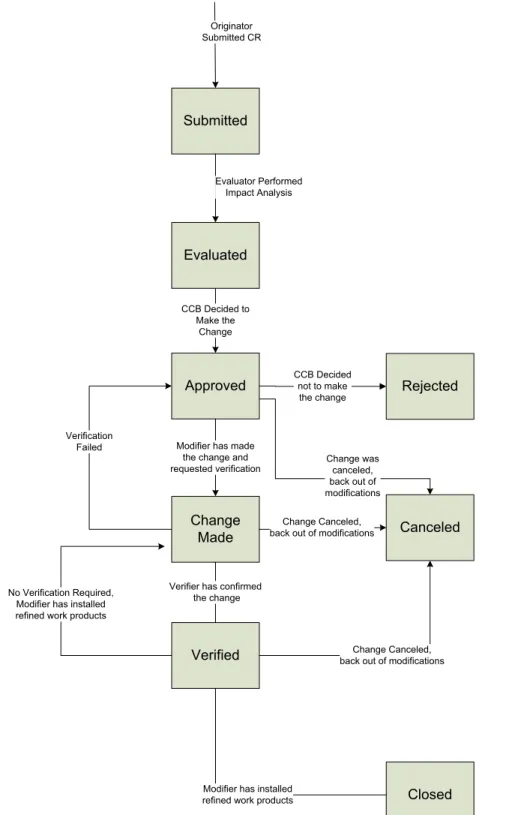
Outlined in Table 2 and Figure 1, the change management process begins when a stakeholder, at any ICD-10 program level, submits a change request for consideration by the CCB.
Appendic A.docx Page 6 of 13 February 12, 2013
Inputs Process Outputs
•Charters (e.g., Program, Project, and CCB)
•Baselined work products
•Project Plan
•Risk Assessment Checklist
•Business/User Requirements •Schedule/WBS •Valid CR submitted on standard form Regularly scheduled CCB meetings to EvaluateCRs; Modifypolicies, processes, and systems; and Verifyany approved changes were made correctly. [See Figure 1 and Table 3]
•Change Management Log reflecting status of issue is either ‘Rejected’ or ‘Closed’
•Modified work products
•Updated requirements, including traceability information
•Status Reports Note: The Change Management Log is managed at the Workgroup or Project Level.
Submitted Evaluated Approved Change Made Canceled Verified Closed Evaluator Performed Impact Analysis Rejected CCB Decided not to make the change CCB Decided to Make the Change Change was canceled, back out of modifications Modifier has made
the change and requested verification
Verification
Failed
Change Canceled,
back out of modifications
Verifier has confirmed
the change
No Verification Required,
Modifier has installed refined work products
Change Canceled,
back out of modifications
Modifier has installed refined work products
Appendic A.docx Page 8 of 13 February 12, 2013
Role Action
Originator 1. Documents CR using standard change request form
2. Stakeholder consults with project team lead (Workgroup/Project Level) about CR
3. Stakeholder and/or project team lead submit CR to CCB
CCB 4. Sets initial CR status to ‘Submitted’
5. Assigns CR to Evaluator
Evaluator 6. Assesses the CR as to feasibility, whether it really pertains to the indicated project, whether a reported problem can be reproduced, an estimate of the labor hours needed to implement the change, and other criteria as decided upon by CCB charter.
7. Change CR status to ‘Evaluated’
CCB 8. The CCB decides whether the requested change should be made (or the
reported problem fixed) at this time, at some point in the future, or not at all. Input should be solicited from others potentially affected by the change before making the decision.
9. If the change was accepted, the CCB Chair assigns a Modifier, sets the status to ‘Approved,’ enters any explanation in the Response attribute, and schedules the work. The Project Manager negotiates any necessary changes in project commitments with affected stakeholders. Communication is sent to the assigned Modifier and the Originator.
10. If the change was rejected, the CCB Chair sets the status to ‘Rejected’ and enters an explanation of why in the Response attribute. Communication is sent to the Originator and CCB.
11. The CCB Chair and the Originator determine whether formal verification of the change will be required, following the procedure in the Verification section. If so, they select the verification method to be used and the CCB Chair assigns a Verifier.
Modifier 12. Makes the necessary changes in the affected work products and notifies any other affected parties if corresponding changes need to be made, such as user documentation, help screens, and tests.
Workgroup Lead Project Manager
13. Updates the project plans, task lists, and schedules to reflect the impact of the change on project work remaining to be done. The Project Manager revises any task dependencies as necessary.
Modifier 14. If it becomes apparent during the work that the requested change is not feasible after all, the Modifier notifies the CCB Chair, who may then set the status to ‘Canceled.’ The Modifier backs out of any modifications made, restoring the work products to their previous baseline. Communication is sent to the Originator, CCB Chair, Modifier, and Project Manager.
15. When the change is completed, the Modifier sets the status to ‘Change Made,’ updates the issue in the database with appropriate notes in the Response attribute, and enters the hours of effort that were required to make the change in the Actual Hours attribute. Communication is sent to the Originator and CCB Chair.
16. Notifies the Originator and Verifier (if one was assigned) that the change has been made and makes all modified work products available to the people responsible for verification.
Verifier 17. Performs the agreed-upon verification steps.
18. If verification is successful, the Verifier sets the status to ‘Verified.’ Communication is sent to the Originator and Modifier.
19. If verification is not successful, the Verifier sets the status back to ‘Approved’ and describes the problem in the Response attribute. Communication is sent to the Originator and Modifier. The procedure continues back at step 12.
Modifier 20. For a problem report CR or an enhancement request CR, the Modifier installs the modified work product as appropriate and updates the product baseline. For requirements changes, the Modifier updates version numbers on all modified work products per the project’s version control procedure, checks them back into the version control system, updates requirements traceability information, and requirements status attributes as necessary, and updates the requirements baseline.
21. Sets the status to ‘Closed.’ Communication is sent to the Originator and CCB Chair.
Appendic A.docx Page 10 of 13 February 12, 2013
Field How Set Contents
Actual Hours Modifier Actual labor hours of effort needed to implement the change. Description Originator Free-form text description of the change being requested. This
cannot be changed after it is entered. If reporting a problem, enter the exact error message text observed here.
Date Submitted System Date this CR was submitted to the CCB. Date Updated System Date this CR was most recently updated.
Estimated Hours Modifier Estimated labor hours of effort needed to implement the change. Implementation
Priority CCB Chair Relative importance of making the change: Low (default), Medium, High. CR ID System Sequence number assigned to the CR.
CR Type Originator Type of change request: Scope, Schedule, Resources, Problem, Enhancement, Requirement Change, New Project.
Modifier CCB Chair Person who is assigned responsibility for implementing change. Originator Originator Originator’s name.
Originator
E-Mail Originator Originator’s e-mail address.
Originator
Phone Originator Originator’s phone number. Originator
Priority Originator Originator’s relative importance of change: Low, Medium, High. Planned Release CCB Chair Product release number for which this approved change is
scheduled, determined by CCB.
Product Originator Name of the product or project in which a change is being requested or a problem reported.
Problem
Severity Originator MinorFor a problem report, set severity of the change (see below). - Cosmetic problem, usability improvement, unclear error messages; customer can live with the problem (default)
Major - Problem adversely affects product functioning, but a workaround is available; customer will be annoyed; serious usability impairment; problem blocks some testing
Critical- Product does not function at all or crashes; wrong results are generated; further testing of application is not possible
Emergency/Escalated- Anything that requires a change to be made immediately, bypassing the change control process temporarily for executive sponsor review
Response CCB
Chair, Modifier
Free-form text log of responses made to the change request.
Status Originator,
Modifier Update current status of the change request as it moves through the states described in the Change Request Status section. Title Originator One-line description of the CR.
Verifier CCB Chair Name of individual who is responsible for verifying that changes were made correctly.
Appendic A.docx Page 12 of 13 February 12, 2013 Purpose
<Describe the objectives of the CCB. This section may read: “The Change Control Board (CCB) represents the interests of program and project management by ensuring that a structured process is used to consider proposed changes and incorporate them into a specified release of a product. The CCB shall request that impact analysis of proposed changes be performed, review change requests, make decisions, and communicate decisions made to affected groups and individuals.” Define the relationship of this CCB to any other CCBs in the organization or other decision-making bodies, such as a project steering committee.>
Scope of Authority
<Indicate the scope of decisions that the CCB makes. This scope could be over a specific organizational range; a project, group of projects (program), or subproject; a maximum budget or schedule impact. This scope boundary separates decisions that this CCB can make from those that it must escalate to a higher-level CCB or manager for resolution.>
Membership
<List the members of this CCB. The CCB typically includes representatives from program management, project management, software engineering, hardware engineering, testing, documentation, customer support, and marketing. One individual is designated as the CCB Chair. Keep the CCB as small as possible, to facilitate its ability to make rapid decisions, but make sure that the critical perspectives are represented. Indicate who should be responsible for escalated changes (e.g., scope, schedule, and resources).>
Operating Procedures
<State the frequency of regularly scheduled CCB meetings and the conditions that will trigger a special meeting. Describe how meetings will be conducted, the number of CCB members who constitute a quorum to make decisions at a meeting, and the roles that must be represented for the meeting to proceed. Identify whether guest participants may attend, such as the individuals who proposed the change requests being considered at a specific meeting.>
Decision-Making Process
<Describe how the CCB will make its decisions. Indicate whether voting, consensus, unanimity, delegation to a specific individual, or some other decision rule is used to make decisions. State whether the CCB Chair or another manager is permitted to overrule the CCB’s collective decision.>
Communicating Status
<Describe how each decision that the CCB makes will be communicated to the individual who requested the change, senior management, project management, affected team members who
<PROJECT NAME>
CHANGE MANAGEMENT PLAN
Version
Number: 1.0
Change Management Plan (v1.0) Page 1 of 9
[Insert appropriate disclaimer(s)]
Notes to the Author
[This document is a template of a Change Management Plan document for a project. The template includes instructions to the author, boilerplate text, and fields that should be replaced with the values specific to the project.
• Blue italicized text enclosed in square brackets ([text]) provides instructions to the document author, or describes the intent, assumptions and context for content included in this document.
• Blue italicized text enclosed in angle brackets (<text>) indicates a field that should be replaced with information specific to a particular project.
• Text and tables in black are provided as boilerplate examples of wording and formats that may be used or modified as appropriate to a specific project. These are offered only as suggestions to assist in developing project documents; they are not mandatory formats.
When using this template, the following steps are recommended:
1. Replace all text enclosed in angle brackets (e.g., <Project Name>) with the correct field document values. These angle brackets appear in both the body of the document and in headers and footers. To customize fields in Microsoft Word (which display a gray background when selected) select File->Properties->Summary and fill in the appropriate fields within the Summary and Custom tabs.
After clicking OK to close the dialog box, update all fields throughout the document selecting Edit>Select All (or Ctrl-A) and pressing F9. Or you can update each field individually by clicking on it and pressing F9.
These actions must be done separately for any fields contained with the document’s Header and Footer.
2. Modify boilerplate text as appropriate for the specific project.
3. To add any new sections to the document, ensure that the appropriate header and body text styles are maintained. Styles used for the Section Headings are Heading 1, Heading 2 and Heading 3. Style used for boilerplate text is Body Text.
4. To update the Table of Contents, rightclick on it and select “Update field” and choose the option -“Update entire table”.
5. Before submission of the first draft of this document, delete this instruction section “Notes to the Author” and all instructions to the author throughout the entire document.
VERSION HISTORY
[Provide information on how the development and distribution of the Change Management Plan will be controlled and tracked. Use the table below to provide the version number, the author implementing the version, the date of the version, the name of the person approving the version, the date that particular version was approved, and a brief description of the reason for creating the revised version.]
Version
Number ImplementedBy RevisionDate ApprovedBy ApprovalDate Description ofChange
Change Management Plan (v1.0) Page 3 of 9
[Insert appropriate disclaimer(s)]
TABLE OF CONTENTS
1 INTRODUCTION... 4
1.1 Purpose of The Change Management Plan... 4
2 CHANGE MANAGEMENT PROCESS ... 4
2.1 Change Request Process Flow Requirements... 4
2.2 Change Request Form and Change Management Log... 5
2.3 Evaluating and Authorizing Change Requests... 5
2.3.1 Change Control Board... 6
3 RESPONSIBILITIES ... 6
APPENDIX A: CHANGE MANAGEMENT PLAN APPROVAL...7
APPENDIX B: REFERENCES...8
1 INTRODUCTION
1.1 PURPOSE OF THE CHANGE MANAGEMENT PLAN
[Provide the purpose of the Change Management Plan. This document should be tailored to fit the particular project needs.]
The Change Management Plan documents and tacks the necessary information required to effectively manage project change from project inception to delivery. The Change Management Plan is created during the Planning Phase of the project. Its intended audience is the project manager, project team, project sponsor and any senior leaders whose support is needed to carry out the plan.
2 CHANGE MANAGEMENT PROCESS
The Change Management process establishes an orderly and effective procedure for tracking the submission, coordination, review, evaluation, categorization, and approval for release of all changes to the project’s baselines.
2.1 CHANGE REQUEST PROCESS FLOW REQUIREMENTS
[Outline the project team’s agreed upon change request (CR) process flow. The following outlines a generic change request process flow.]
Step Description
Generate CR A submitter completes a CR Form and sends the completed form to the Change Manager
Log CR Status The Change Manager enters the CR into the CR Log. The CR’s status is updated throughout the CR process as needed.
Evaluate CR Project personnel review the CR and provide an estimated level of effort to process, and develop a proposed solution for the suggested change Authorize Approval to move forward with incorporating the suggested change into
the project/product
Implement If approved, make the necessary adjustments to carry out the requested change and communicate CR status to the submitter and other
stakeholders
Generate CR
Report Status Log Updated Status
Implement CR
Authorize CR Evaluate CR
Change Management Plan (v1.0) Page 5 of 9
[Insert appropriate disclaimer(s)]
2.2 CHANGE REQUEST FORM AND CHANGE MANAGEMENT LOG
[List and define the data elements the project team needs to include on the Change Request Form and in the Change Management Log. At a minimum, the following data should be included on the project’s Change Request Form and Change Management Log.]
Element Description
Date The date the CR was created CR# Assigned by the Change Manager Title A brief description of the change request
Description Description of the desired change, the impact, or benefits of a change should also be described
Submitter Name of the person completing the CR Form and who can answer questions regarding the suggested change
Phone Phone number of the submitter E-Mail Email of the submitter
Product The product that the suggested change is for Version The product version that the suggested change is for
Priority A code that provides a recommended categorization of the urgency of the requested change (High, Medium, Low)
2.3 EVALUATING AND AUTHORIZING CHANGE REQUESTS
[In order to evaluate and prioritize a change request, the “priority” and “type” of the change are taken into consideration. Use the first and second tables below to list and define the “priority” and “type” data elements that are applicable for the project. The third table provides examples of commonly used project status types. The list of elements is at the discretion of the project manager.]
Change requests are evaluated using the following priority criteria:
Priority Description
High <Insert the definition the project assigns to a high priority CR>
Medium <Insert the definition the project assigns to a medium priority CR>
Low <Insert the definition the project assigns to a low priority CR> <priority> <Insert the definition the project assigns to this level of priority CR>
Change requests are evaluated and assigned one or more of the following change types:
Type Description
Scope Change affecting scope Time Change affecting time Duration Change affecting duration
Cost Change affecting cost Resources Change affecting resources Deliverables Change affecting deliverables
Product Change affecting product Processes Change affecting process Quality Change affecting quality
Change requests are evaluated and assigned one of the following status types:
Status Description
Open Entered/Open but not yet approved or assigned Work in
Progress CR approved, assigned, and work is progressing In Review CR work is completed and in final review prior to testing
Testing CR work has been reviewed and is being tested
Closed CR work is complete, has passed all tests, and updates have been released.
<status type> <define this status type CR> 2.3.1 Change Control Board
[A Change Control Board (CCB) is a formally constituted group of stakeholders responsible for approving or rejecting changes to the project baselines. This group may meet on a predefined schedule or on an as needed basis. The table below provides a brief description of personnel acting as the Change Control Board (CCB) and their role/level of authority within that group.]
Role Name Contact Description
[Insert Role] [Insert Name] [Insert Contact #] [Insert Role Description] 3 RESPONSIBILITIES
[Provide a brief description of persons responsible for each step of the change management process for the project.]
Role Name Contact Description
Project Manager Change Manager
Change Management Plan (v1.0) Page 7 of 9
[Insert appropriate disclaimer(s)]
Appendix A: Change Management Plan Approval
The undersigned acknowledge that they have reviewed the <Project Name>
Change Management Plan and agree with the information presented within this document. Changes to this Change Management Plan will be coordinated with, and approved by,the undersigned,or their designated representatives.
[List the individuals whose signatures are desired. Examples of such individuals are Business Owner, Project Manager (if identified), and any appropriate stakeholders. Add additional lines for signature as necessary.]
Signature: Date: Print Name: Title: Role: Signature: Date: Print Name: Title: Role: Signature: Date: Print Name: Title: Role:
APPENDIX B: REFERENCES
[Insert the name, version number, description, and physical location of any documents referenced in this document. Add rows to the table as necessary.]
The following table summarizes the documents referenced in this document.
Document Name Description Location
<Document Name and
Change Management Plan (v1.0) Page 9 of 9
[Insert appropriate disclaimer(s)]
APPENDIX C: KEY TERMS
The following table provides definitions and explanations for terms and acronyms
relevant to the content presented within this document.
Term Definition
[Insert Term] <Provide definition of term and acronyms used in this document.>
Appendix C: EMA Questions and Answers on
Post Approval Change Management Protocols
7 Westferry Circus ● Canary Wharf ● London E14 4HB ● United Kingdom
Telephone +44 (0)20 7418 8400 Facsimile +44 (0)20 7418 8416
E-mail [email protected] Website www.ema.europa.eu An agency of the European Union
© European Medicines Agency, 2012. Reproduction is authorised provided the source is acknowledged.
Questions and answers on post approval change
management protocols
Draft agreed by CHMP / CVMP Quality Working Party 9 September 2010
Adopted by CHMP for release for consultation 23 September 2010
Adopted by CVMP for release for consultation 14 October 2010
End of consultation (deadline for comments) 28 February 2011
Agreed by CHMP / CVMP Quality Working Party 2 February 2012
Adopted by CVMP 8 March 2012
Adopted by CHMP 15 March 2012
Date for coming into effect 1 October 2012