dslbook.org
Markus Voelter
with
Sebastian Benz, Christian Dietrich, Birgit Engelmann
Mats Helander, Lennart Kats, Eelco Visser, Guido Wachsmuth
DSL Engineering
Designing, Implementing and Using
Domain-Specific Languages
Intentional Software’s
Excerpt: Ch. 22, Business DSLs
D S L E n g i n e e r i n g
Designing, Implementing and Using
Domain-Specific Languages
Markus Voelter with Sebastian Benz Christian Dietrich Birgit Engelmann Mats Helander Lennart Kats Eelco Visser Guido Wachsmuth (c)2010-2013Markus VoelterFeedback, Slides, and other updates at
http://dslbook.org
This PDF is an excerpt of the full DSL book that contains only the chapter on Business DSLs, contributed by Intentional Software.
You can get the full book (PDF or printed version) via
http://dslbook.org
ISBN-13:978-1481218580
DSLs for Business Users
This chapter has been written by Intentional’s Mats Helander. You can reach him via[email protected].
In this chapter we will examine using DSLs for business professionals. The example is a system in the healthcare do-main – essentially a system for defining questionnaires and the business rules to process them. A secondary purpose of this chapter is to provide an impression of Intentional Soft-ware’s technology for defining DSL: the example system is built with the Intentional Domain Workbench.
22
.
1
Intentional Software
Intentional Software was one of the first companies to create a language workbench1, and their focus has been on business
1Intentional Software was started by
Charles Simonyi after he left Microsoft. There he had been one of the early employees and served as the chief ar-chitect for Excel and Word, introducing the principle of WYSIWYG. During his later years he ran the Intentional Programming research project in Mi-crosoft Research (which is described very well in Czarnecki and Eisenecker’s Generative Programming book ). His company, Intentional Software, contin-ues to work on the ideas pioneered by Intentional Programming.
professionals and less on programmers as users for the DSLs2.
2This has always been a focus of DSLs.
However, as we will see in this chapter, focussing on non-programmers leads to different tradeoffs in the design of the languages and the tools.
Business professionals are often the source of domain knowl-edge. Today this knowledge has to be captured and explained to software engineers for it to be actionable. Agile principles help bridge this gap, but this communication gap remains the biggest obstacle in software development today. DSLs for busi-ness professionals have the potential to bridge this gap.
22
.
2
The Project Challenge
This case study describes an application in which domain knowl-edge is captured and maintained directly by the domain ex-perts using DSLs, validated at the domain level, and used for
code generation to create an executable application3. The do- 3The DSL iscomplete: no manual coding
of "business logic" is required. If that were necessary, the premise of a DSL for business professionals would be infeasible.
main is tele-health, where patients with chronic conditions or diseases like diabetes, hypertension or obesity stay at home, and are provided with daily recommendations based on ob-served values of various daily measurements of the patient. A medical professional has defined which values to observe for each particular patient, and the rules for the daily individual
recommendations based on those values4. The input from the 4This is not an expert system. All
de-cisions are made originally by medical doctors.
patient at home is provided through sensors, medical devices and patient interactions with the system through mobile de-vices, set-top boxes or web interfaces. The system needs to be flexible enough to address the requirements of multiple health care providers that will have different sets of criteria for differ-ent patidiffer-ents.
The system described in this chapter replaces a legacy sys-tem developed using a traditional approach in which domain knowledge was captured in big Excel documents that encoded the physician’s rules. A typical rule looked like this:
if WHtR < 46 and (LDL < 100 and No LDL Meds) and (SBP < 125 and No BP Meds) and
(HgbA1c >= 6.5 and No Glucose Meds)
This Excel text should be interpreted as:
ifthe patient
has a Weight Height ratio of less than 46
and
a cholesterol LDL level below 100anddoes not take LDL medications
and
the systolic blood pressure level is less than 125
anddoes not take blood pressure medication
and
the hemoglobin A1c test is equal or greater than 6.5
anddoes not take glucose medication
then <advice according to diabetes plan>.
The Excel spreadsheet had hundreds of rules like this. The repetition resulting from lack of abstractions available to the rules programmer meant that for each new observable attribute
the number of rules doubled5. Each rule was then transformed 5The lack type checks, testing,
refactor-ings, and all the other amenities we are used from an real IDE also hampered productivity and maintainability. by a programmer into rules for a Drools rules engine. The
patient data had a similar workflow, in which information for the patient-recorded data was captured also in Excel sheets. Once this information was confirmed with the doctor, XML documents were created for this data to feed a custom web
application application to be used by the patient to fill in the data.
The medical professional was overwhelmed with the com-plexity. It was clear that the doctors knew exactly what in-tentions they wanted to express, but the complexity to express them became a big bottleneck. Furthermore, when the doctor wanted to add or make any changes to the application, it had to go through a convoluted process, with limited traceability, to update XML documents, Drools rules, database schemas and other application-dependent logic.
22
.
3
The DSL-Based Solution
22
.
3
.
1
Intentional Domain Workbench
Intentional Software provides a knowledge processing plat-form to allow business professionals to turn their specialized expertise into software. The development environment, the In-tentional Domain Workbench (IDW), is a language workbench for building DSL-oriented applications for business users. These applications can be run stand-alone, and can optionally also generate applications using various languages and runtimes (such as XML and Drools in this example).
The Intentional platform provides a number of key technolo-gies that make the DSLs especially suited for business users. In particular, this includes a projectional editor that allows lan-guages to be edited in multiple syntactical forms, and with multiple semantic interpretations. It can use and mix textual, tabular and graphical notations to approximate the needs of a
business domain as closely as possible6. The projections of a 6As we will see, it also supports Word
document-like headings, and more generally, looks a bit like Microsoft Office. This also helps acceptance with business users.
language can potentially be ambiguous, but that does not cause a problem, because they are just projections of an underlying consistent representation, and a user can always switch to an-other projection to resolve any ambiguity. The platform also allows for combination and interaction across languages. A single projection can integrate knowledge represented in mul-tiple disparate languages.
22
.
3
.
2
Overview of the Solution
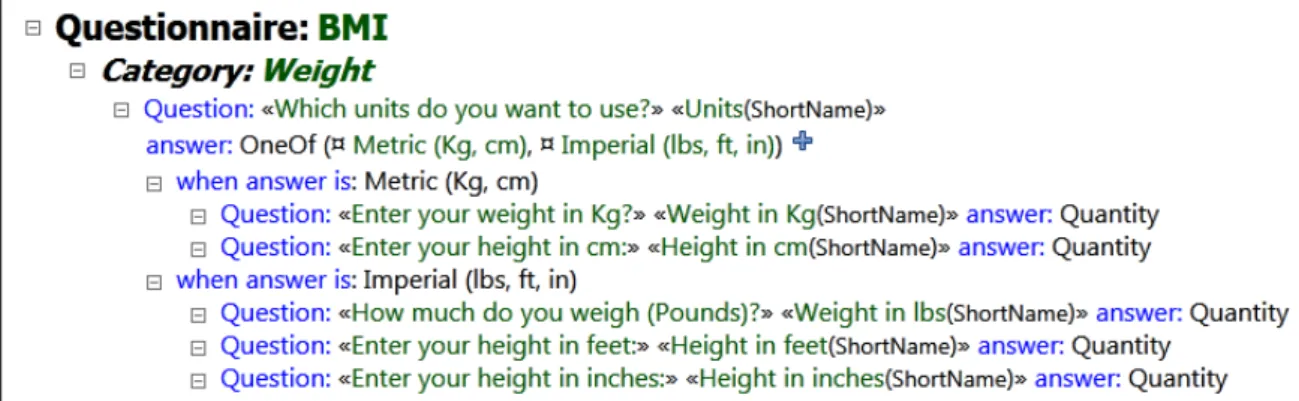
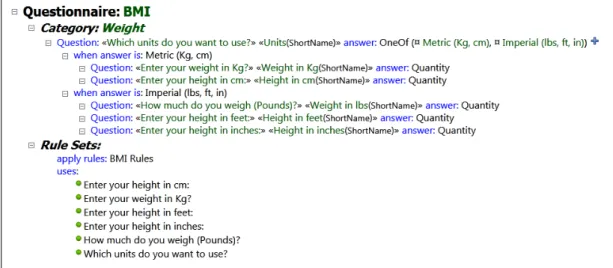
The purpose of the custom language workbench application examined in this case study is to let business experts edit ques-tionnaire definitions that are used as input to a web application that in turn allows end users to fill out their answers. Fig.22.1
Figure22.1: An example questionnaire, as seen and edited by the medical pro-fessional. Questionnaires are essentially trees of questions with the possible an-swers, as well as dependencies between questions (when answer is...). In addition to defining the questions, the medical professional
can also define business rules that should be applied to the questionnaires, as well as tests to ensure that the business rules are working correctly. Fig.22.2shows an example of such rules; we will get back to testing later.
22
.
3
.
3
Implementation
To implement this, we have used IDW to define a set of domain schemas7along with logic for validation, transformations,
eval-7A schema is the structure definition
of a domain. It roughly corresponds to the abstract syntax or meta model, even though the meta meta model of the IDW is substantially different from EMF or MPS’ structure definition. uation, code generation and projectional editors. All of these
concerns are implemented with a custom language supported by IDW that extends C# with additional operators and
key-words that are useful for working with tree structures8. The 8This approach is similar to MPS:
MPS’ BaseLangauage extends Java with constructs useful for working on the meta level of languages.
language also contains several dedicated DSLs for defining do-main schemas, validators or projections9. The result of
com-9This is similar to MPS and Spoofax,
which also come with a set of DSLs specific to various aspects of language definition.
piling the language definition is a custom workbench: a stan-dalone Windows application that lets the business experts edit the defined domains in a projectional editor where all the rules for validation, projection layout and such are applied. Fig.22.2
shows the editor for business rules with definition expressions, assessment tables, choice lists and results.
As its output the workbench in this case study generates files that are fed into a web application that executes the
ques-tionnaires and applies the business rules10. The web applica- 10The patient interacts with this web
application in addition to the sensors mentioned earlier.
tion itself is developed separately and consists of web pages with JavaScript that consumes the XML files generated by the workbench. The JavaScript then uses these XML files to
pro-duce a dynamic user interface11. The workbench also generates 11The web application acts as an
in-terpreter for an intermediate language whose serialization format is XML business rule files in a format that the Drools business rule
en-gine can consume, and the web application can in turn call the Drools engine to access the running rules.
Figure22.2: This screenshot shows how the medical professional sees and edits business rules for questionnaire questions. In this example, the body mass index is calculated.
⌅Domain Structure The IDW is very suitable for modulariz-ing, reusing and composing languages ("domains" in the termi-nology of Intentional Software). Consequently, the application consists of several domains, some of them specific to the
appli-cation discussed here, others more general12. 12Some are generalized because future
reuse is anticipated, others are existing languages reused in this application. We use two domains that are motivated by the
underly-ing technology: to generate the XML, we employ a reusable XHTML domain that comes with IDW. To generate the Drools rules, we have created a Drools domain (which may be reused for other applications in the future).
Similarly, the domains that are closer to the business do-main are also modularized. The medical professionals in this case study have a particular subject they want to create ques-tionnaires about, but the questionnaire domain itself is general
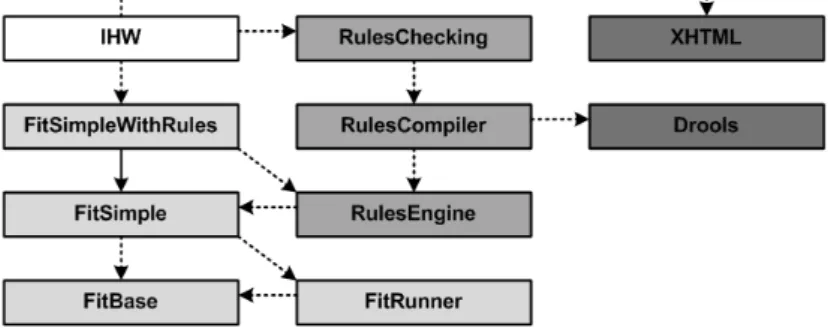
and has high potential for reuse. The business rules are also general enough to be reused on their own, independent of the questionnaires. This results in two main domains: the ques-tionnaire domain and the business rule domain. These are in turn divided into subdomains to allow selection of features to reuse. We then complement this with an adapter domain that includes the reusable questionnaire and business rule domains, and define how they should work together. Finally, we have an overarching domain for the application that we call Intentional Health Workbench (IHW), which adapts the combined ques-tionnaire and business rule domains to the particular customer requirements. In total we end up with ten domains (Fig. 22.3
shows an overview of the relationships between them):
FitBase: The generic questionnaire domain13. Contains abstrac- 13The prefix "Fit" stands for Forms,
Interview, Tables. tions such as interviews, questions and answers.
FitRunner: In-workbench execution of the generic questionnaire domain FitBase, allowing the business expert editing the questionnaires to experiment with filling out answers inside the workbench.
FitSimple: A simplification of the generic questionnaire domain FitBase to a subset suitable for combination with the busi-ness rules domain and intuitive editing.
RulesEngine: The generic business rule domain, with table-style editing and in-workbench evaluation of business rules. RulesChecking: Consistency validation of the rules in the generic
business rule domain RulesEngine.
RulesCompiler: Generates the business rules from RulesEngine to files that the Drools business rule engine can use.
FitSimpleWithRules: Combines the simplified subset of the ques-tionnaire domain FitSimple with the generic business rule domain RulesEngine.
Drools: Provides abstractions from the Drools business rules engine domain. Supports generation to the Drools file for-mat.
XHTML: Provides abstractions from the XML and HTML do-mains. Supports generation of XHTML and XML files. IHW: The workbench that ties all the other domains together.
When compiled, this results in the workbench application that lets business users edit questionnaires and business rules,
test them and generate output for the web application and the Drools business rule engine.
Figure22.3: Dependencies between the ten domains that make up the system described in this chapter. The arrows represent anincludesrelationship. Like theextendsrelationship in MPS,
includesis generic in the sense that it may be an actual include in terms of language concepts, or it represents a generic dependency. An example is the
RulesCompiler. Its relationship with theDroolsdomain captures the fact that it generates Drools rules. ⌅Defining a Domain The schema for each language is
de-fined using a DSL for schema definition. Because no parser is involved, we only have to define the data structure of the tree that the user will edit. IDW provides a default projection for all domains until you create custom projections, so you can start editing and experimenting with your structures inside the editor as soon as you have defined them14.
14This is a very useful feature, because
it allows the incremental definition of concrete syntax. Also, if a concrete syntax definition is broken (in the sense that it has a bug) or is ambiguous, the program tree can always be unambigu-ously rendered in this tree view like default notation (even if that notation is not necessarily as elegant as a custom projection).
Defining a schema for a domain is all about deciding what types of nodes there may be in the tree structure and what types of child nodes to expect under them. To define the tree structure schema for a domain, we use the keywordsdomaindef,
defandfielddef. Adomaindefis used for defining a new do-main, defdefines a new type of node that can be used in the
domain15andfielddefdefines a field under adefwhere new 15It is essentially what’s called a lan-guage conceptin this book.
child nodes can be added.
Whiledefs andfielddefs are similar toEClasses and EFea-tures in EMF (and consequently also quite similar to MPS’ structure definition), there are a few differences. For exam-ple, afielddefcan be assigned more than one type. In EMF, accepting a range of types in a field would require the cre-ation of a supertype that the field would use as its type. A
fielddef will take a list of types that are all considered ac-ceptable. If the same list of types is used in several places, we can package them in a reusable way using the typedef key-word. We can also reuse field definitions in multiple defs with the includefield keyword, potentially overriding (lim-iting, extending) their type16.
16In all the other tools described in
this book, fields are always owned by a language concepts. In IDW they can stand on their own and can be included indefs. This provides an additional level of modularization and reuse. This design also allows associating additional specifications with a field, such as constraints or projections. These can be reused along with the field. As we are working with tree structures, the default
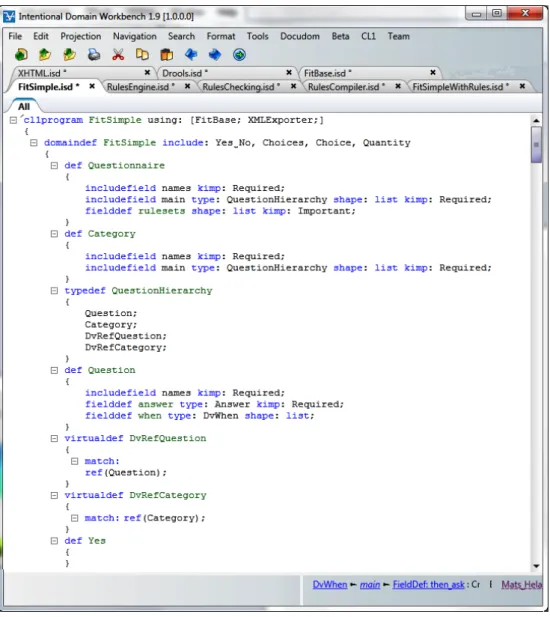
contain-Figure22.4: Adomaindefdefines a new domain/language. It caninclude
other domains, making their contents available to the domain. Adefdefines a new language concept.defs contain fields. New fields are defined with
fielddef, existing fields are included viaincludefield. Each field defines a shape (list, set, single element) and a type (one or more otherdefs). When including a field, these can be overrid-den. Themainfield is reused by many
defs and has special editing support.
virtualdefs use amatchpattern to select existing nodes. Based on this
virtualdef, projection rules or other aspects can be defined.
ment. The Questiondef, for example, has an answerfielddef with theAnswerdef as its type. Just using adefdirectly im-plies containment. Let us now look at references.
TheCategorydef reuses themainfield (a commonly reused fielddef that comes with IDW) and overrides its type; it expects those types listed in the QuestionHierarchy typedef. When we look for the definitions of the types in that list we discover that two of them are not defs, but use the virtualdef key-word. A virtualdef can use an arbitrary match pattern (not
justref). This allows a new virtual defto be assigned to any node that matches the match clause. You can then define pro-jections or constraints for this new virtualdef. They will
ap-ply to all nodes that match the match clause in thevirtualdef.
In this case DvRefQuestion defines a type for references to
Question nodes, and DvRefCategory defines a type for ref-erences toCategorynodes, allowing questions and categories to be reused in multiple places.
⌅Constraints and Behavior Defining the basic shape of the tree that users should edit will usually be done in a declara-tive fashion using the schema DSL. However, in many cases, additional constraints are required. These are typically imple-mented invalidators. Validators can enforce scoping rules (that the referenced variable is available in the scope), scan for ille-gal names or naming collisions, and ensure that any number of domain-specific business rules for the DSL are adhered to by users when they edit their DSL code. Fig.22.5shows a sim-ple validator that ensures that the length of a name does not exceed a specified maximum.
Figure22.5: This constraint checks for the maximum length of all kinds of names. Notice how the error message itself is represented as adef: it is of categoryMessage.catrepresents structural subtyping, in the sense that all the fields ofMessageare also added toCategory
Here are some more examples of constraints: "categories should not be nested more than five levels deep", "questions may not be modified once they are published" or "negative answer op-tions should be displayed in red".
The first constraint, about level nesting, could be imple-mented using the DSL for writing validators that comes with IDW17. A code snippet showing how such a validator could be
17Validators run over the tree structure
as it is edited and assert conditions that go beyond what is reasonable to define in the declarative schema language, such as a recursive check to determine nesting levels. When a validator fails, an error message is produced, which is shown together with any error messages that the system generates if the user breaks the schema constraints defined in the schema DSL.
implemented is shown below.
validator implfor: FitSimpleWithRulesets {
validatenode :sequence(Book)procedure Vnode(varDmx dmx, varNode node) {
code:
varlevel = 0;
varparent = node.Parent;
while(parent !=null) {
if(parent.Isa == ‘(Category)) { level++;
}
parent = parent.Parent; }
assertlevel < 5 elseCategory too deeply nested; }
}
The second constraint, about preventing modification to pub-lished questions, could be implemented using the DSL for be-haviors. Behaviors are a bit like database triggers, in that they contain code that is triggered to run on events that signal chan-ges to the tree structure, such as when nodes are inserted, mod-ified or deleted. In this case we could use behaviors to asso-ciate code that should be run onmodifyanddeleteevents for
Questioninstances. The code would check if the question has been published and if so, prevent the modification or delete operation from executing. The following code snippet shows a possible implementation18.
18overprocoverrides an existing,
predefined procedure.Execresis a type that signifies whether something is successful or not.ErrorandSuccess
are subtypes.rhis essentially thethis
pointer.
def behavior implfor: Question {
overproc: Execresprocedure CanEdit() {
if(rh->published) {
returnError("May not modify published question!"); }
return Success(); }
}
The third constraint, about showing negative answer options in red, could be implemented in the presentation for the Answer-Optionnodes using IDW’s DSL for defining. The code respon-sible for showing theAnswerOptionnode on screen would sim-ply use the C#ifstatement to check whether the option is neg-ative (such as the No answer option to a Yes/No question) and if so, present the node on screen using a red color. We will see examples of code using conditionals in a projection later on.
While we would use three different DSLs to define the three constraints described above, we would also mix that DSL code with standard C# code. The DSLs that come with IDW extend C#, so in addition to the DSL keywords for defining schemas, validators, behaviors and projections, it is also possible to write standard C# classes, and even to mix C# code into declarative DSLs, such as the projection DSL. Some DSLs, such as the val-idator and behavior DSLs, expect to be implemented using C#
and have no declarative way to be implemented. The projec-tion for C# code uses a textual notaprojec-tion that looks basically like standard C#, but because it is a tree projection, albeit one that looks like text, there are a few differences from what the same code would look like in a text editor. Consider the following example code:
program RulesChecking using: [RulesEngine, FitBase, FitSimple, Validation, Gen, DL, Core, mscorlib, System] {
regionRulesTesting { [SerializableAttribute()]
public class DcsUnique : Dcs {
static var intcounter = 0;
var int index = 0;
publicconstructor DcsUnique() {
this.index = counter++; }
public override bool procedureEquals( varObject obj ) {
varDcsUnique that = obj as DcsUnique;
returnthat != null && Equals(this.index, that.index); }
public override int procedure GetHashCode() {
return this.index; }
publicKselection property kselection {
get{
return Crown; }
}
publicKend property kend {
get{ return Nil; } } } } }
In contrast to C#, there is the procedure keyword. This is shown in the projection simply to give the user something to click on if they want to select the whole procedure (ormethodas
they are more commonly referred to in C#)19. Clicking on the 19In IDW, theprocedurekeyword
would be known as thecrownof a subtree.
publickeyword lets the user change that keyword to for exam-ple private, and lets the user enter additional modifiers such asstatic. Clicking on the name lets the user change the name. But if the user wants to delete the whole method, they just click on theprocedurekeyword to select the whole method and hit theDeletekey. In the tree structure, the name, the modifiers and the whole method body are child nodes contained by the procedure node, so deleting that node will delete all the con-tained child nodes as well. Theconstructorkeyword is there for the same reason – something to click on to select the whole thing – as is the var keyword in the field definitions. When
generated to C# source code for compilation, these additional keywords are not included in the output.
Another use case for validators is to verify the types in ex-pressions edited by users. Depending on the DSL, the expres-sion1 + Truemay or may not be illegal, but many languages would prevent the addition of a Boolean value to an integer. IDW includes a DSL for defining the rules for the type calculus in a mix of declarative and C# code, and uses recursive evalu-ation to determine the resulting type from an expression. The validator will then call the recursive IDW type calculator, and if a problem is discovered an appropriate error shows up in the error pane. In this customer case the workbench has a lot of expressions in the business rules and they are all validated for type consistency.
⌅Projection The ability to write C# is not only useful when writing utility classes; several of the DSLs included with IDW support the ability to mix C# code into the DSL code. The projections are one example, where some projections are writ-ten in an entirely declarative manner using just the keywords from the projection DSL, while others make use of mixed in C# to produce dynamic behaviors. Before looking at examples of such mixed code we will examine a couple of purely declara-tive projections first.
Eachdef20(Category,Question, orAnswer) comes with its 20Projections can also be defined
forvirtualdefs. This allows nodes in a specific context to be projected differently.
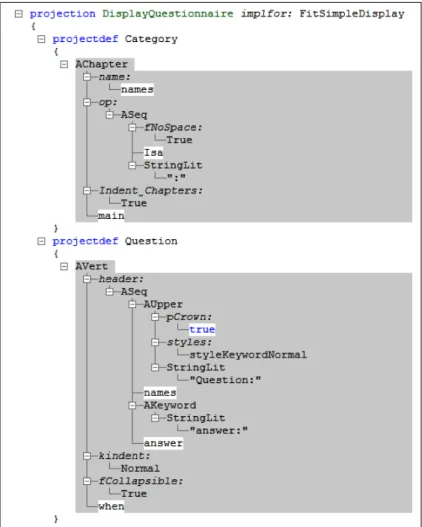
own projection rules. The projection of the overall tree is then a composition of the projections of all involved nodes. The projection for each type is defined in a declarative fashion, where a template is specified that defines how nodes of that type should be presented to the user (Fig.22.6). The parts with gray background in Fig.22.6 constitute the template, whereas the parts with white background are either references to fields that should be projected in place or full blocks of imperative code.
Projection works by mapping domaindefs to concepts from the Abstract Projection Language (whose concepts all have names beginning withAto make them easily identifiable). These con-cepts are then transformed further, until, at least conceptually,
we arrive at the level of pixels on the screen21. Some of the A 21As a language developer, you don’t
have to care about anything below the
Alevel. You just map your domain con-cepts to concon-cepts from theAlanguage. constructs are quite primitive, such asAVert, which only
spec-ifies that its contents should be displayed as a vertical list, or
Figure22.6: The projection rules for
CategoryandQuestion. The one for
Categorycreates anAChapter(which is rendered with large, bold font text) whose text is made up of the name of the category (cf. thenamesfield under thename), and then a colon, with no space separating the two. In the chapter’s ownmainfield we put themainfield of theCategory
(which contains all the questions in that category).
a sequence – horizontal or vertical is up to the presentation en-gine and depends on available screen estate. Others are more high-level, such as AChapter, which presents its contents in the form of a word processor-style chapter (thick text, optional chapter numbering and indentation, etc). To project something as a graph, we just have to use the AGraph, AGraphNode and
AGraphEdge constructs. To project something as a table, we use ATable, ARow and ACell. AImage displays a bitmap im-age. AButtonandAHyperLinkmake it possible to add buttons and links to the projections that execute C# code or move focus to a different place in the projection when clicked, providing an alternative to having the user type everything in with the keyboard22.
22Of course developers can define new,
higher level projection concepts that are in turn transformed toAconcepts. It is also possible to define new concepts on the abstraction level ofAand then project them manually to the next finer level.
Each A Language construct has a number of fields where values can be entered in the template. Sometimes this will be literal information that should be displayed, such as the
string literals "Question:" and "answer:" in the projection for the Question def. Other literals control the behavior of the projection, such as theTruevalue under theIndent_Chapters
field in theAChapterprojection for theCategorydef. To make the child nodes of the projected type show up in the projection, we just put a reference to the relevant fielddefs in the
appro-priate places in the projection definition23. 23These references get a white
back-ground in the definition where the rest is gray.
Templates are a good fit for a declarative DSL, because pro-jections can often be defined in an entirely declarative way. When there is demand for dynamic behavior, the declarative context of the template can be broken out from using the Back-Quote()function: standard C# can be entered inside it. The C# code should end by returning a new "piece of tree" that is in-serted into the hosting template in the place of theBackQuote.
A new piece of tree can be created with the BookQuote()24, 24ABookis a basically a subtree literal
that can be inserted into another tree. inside of which declarative structures can be created.
There are many cases in which dynamic behaviors in projec-tions are useful. Common examples include changing the color depending on the displayed values, showing or hiding some of the values depending on editing modes or access rights, and even displaying the results from dynamic evaluation of
expres-sions and values that the end users type in25. 25This can be used nicely for hooking
interpreters that execute tests based on the data entered by the user.
⌅Dynamic Schemas Another case is when the DSLs that end users edit influence each other dynamically, such as when one DSL is the schema language for a second DSL. Consider for example an Entities DSL in which users can define entity types with attributes. A second DSL allows users to define instances of the entities, specifying values for the attributes. The schema language allows this by letting us hook in C# code to dynami-cally determine the fields that the schema should consider un-der adefor avirtualdef.
Let us look at an example. When creating a program ex-pressed in the second DSL, a user may want to create an in-stance of the Person entity defined with the first DSL. The
Person entity in turn contains firstName and lastName at-tributes. The editor should then read the definition for the
Personentity and go on to present two fields under the new instance, label themfirstNameandlastName, and let the user enter the names for their newPersoninstance. This works by hooking in code into the Instances DSL that returnsfielddefs for each attribute under the entity referenced in thetypefield26
26Here we assume that eachInstance
in the instances DSL references the
Entityit instantiates in a field called
of the instance, and potentially from any supertypes of that en-tity. The IDW default projection would detect this and present
firstName and lastName fields ready to be edited under a
Person entity. In a custom projection dynamic code would be used to iterate over the appropriate fields and create projec-tions for them.
In the case of the workbench in this case study we have a
Ruledef, which has one fielddef calledoutcomethat is declar-atively defined in the standard schema DSL; the rest of its fields are determined dynamically, as described above. In the projec-tion we want to display each rule as a row in a table and each dynamic field under a rule as its own cell. The outcomefield should also get its own cell, which is defined in the declara-tive way in the template, but for the dynamic fields we have to break out from the declarative template context and write some C# code. Fig.22.7shows the respective code.
Figure22.7: The projection rule for a
Rule. The gray parts are declarative templates that are inserted "as is" into the projected screen representation of a
Rule. The white parts, and in particular, theBackQuotes, use procedural C# code to dynamically project a part of the tree. Inside this procedural code,BookQuotes are used to escape to literal mode, where, again in gray, we construct little "pieces of tree" (calledBooks) in IDW) which are in turn inserted into the resulting projection.
The schema of the projected node can be accessed with the ex-pression ehi.GetDmx().Rgdf(), where ehi is the input node to the projection, GetDmx()retrieves domain context informa-tion about it and Rgdf() returns the fields that are expected under the node. Normally Rgdf()will only return the fields we have declared in the schema DSL, but in this case it has been overridden for the Ruledef to return a set of fields that
are determined dynamically by other input to the Rule DSL. The C# code in the projection definition for the Rule (shown in Fig. 22.7) iterates over the fields that should go under the
Ruledef according to the schema and our overriding code, then uses theBookQuote()function to create a piece of tree with an
ACellin each one27. A simple C# expression (ehi.Index + 1) 27theBut taking care to avoid doing so foroutcomefielddef, which is already
projected in the declarative part of the projection rule.
is also used to display the row index in a leading cell for each row.
The ability to mix C# into projections opens up the possi-bility of creating very powerful dynamic projections including DSL evaluation, and even running of test cases for a DSL di-rectly in the editor for that DSL. Projections can also be com-bined with transformations, such that the tree structure edited by the user undergoes a series of transformations before being projected onto the screen28. These transformations are
two-28In fact, projections, transformations
and code generation work essentially the same way in IDW. As we will see later, code generators in IDW are im-plemented as transformations between a source domain and a target domain. Projections are in turn just transforma-tions that have the Abstract Projection Language as their target domain. There are two differences. First, projections are evaluated lazily, such that only the parts of the projection required for showing what is on screen will actu-ally be executed, whereas for a code generator the whole transformation will always be executed at once. The second difference is that projections are automatically triggered as the program tree changes, whereas code generators are executed only on demand (e.g., by the user pressing a button in the Workbench.)
way, so the projections built including such a transformation continue to be fully editable. They work in a similar way to projections, in that they let the developer create templates in their target language (rather than theAlanguage) declaratively, but with the option of breaking out into C# code. By moving calls to things like test evaluation into a transformation that precedes the projection, code with different types of respon-sibilities is separated by concern and kept simple and to the point.
A testing framework was created for the case study dis-cussed in this chapter, so that business rules can be evaluated with test data and the results verified against expected values, all directly in the workbench. The tests are run continuously, so that whenever the user modifies the business rules, the tests go red or green as the rules break or correspond to expectations. Fig.22.8shows an example of such a test case.
The evaluation of the business rules is implemented as an in-terpreter that works by evaluating each node in the tree struc-ture according to its type in a recursive fashion. The code for this is packaged in a helper class called by a transformation that passes the test inputs to the evaluation method and dec-orates the transformation’s output tree with the results. The projection then takes the decorated tree, presents the editable input values, expected values and calculated test results (not editable), and compares the test results with the expected val-ues to show green, red or orange bullets as appropriate.
pro-Figure22.8: The testing aspect of the Health workbench lets users create test data and evaluate the business rules directly in the IDE. As mentioned earlier in this book, in-IDE-testing is an important ingredient to making a DSL accessible to non-programmers: in some sense, the tests make the DSL "come alive" and help build understanding about the semantics of the language.
jecting dynamically derived information about the user input. The projection for a questionnaire calls out to C# code that per-forms consistency analysis on the combined business rules and questionnaire domains. The analysis ensures that when busi-ness rules are applied to a particular questionnaire, the rules do not refer to questions absent from that questionnaire. The tests and consistency analysis are implemented and pre-sented in a way specific to the application, but it is also possi-ble to use the IDW validation framework to ensure validity of user inputs. The developer then writes validators that run in the background against the tree structure as it is being edited by the user. When a rule in a validator is broken, it yields an error message, which is shown in the IDW error pane, a central place for collecting custom error messages from validators and system error messages from built-in generic validators alike. ⌅Transformation and Generation Once the input is known to be consistent29, the time has come to do something with the
29For this application this means that
the structure is correct, all validators are happy, all tests are green and consistency analysis is satisfied.
Figure22.9: The consistency analysis ensures that when a set of business rules is used together with a particular questionnaire, all questions evaluated by the rules are actually present in the selected questionnaire.
information the medical professional has provided. In this case study this means invoking code generation to produce the XML files that the JavaScript in the web application will con-sume, and the files with business rule definitions for the Drools engine.
IDW includes a DSL for defining how to create output fold-ers and files, and, together with the DSL for transformations, it constitutes how code generators are defined. While it is pos-sible to take the tree that the user has edited and generate raw text files in the target format directly, it is often a better ap-proach to use a transformation to create a tree structure in the domain of the target format from the tree structure that the user edited30. Such transformations that result in information
30As we discussed in Part II, this
allows us to reuse parts of the overall transformation. For example, the Drools and XML domains are likely to be reusable in other applications. being generated to files rather than being presented to the user
on screen do not have to be two-way, as there is no requirement for the information to stay editable.
The workbench in this case study uses a transformation that takes the questionnaire domain as input and outputs a tree structure in the XHTML domain that is included with IDW. The resulting XHTML tree is then passed on to a second trans-formation that knows how to transform such trees to text. The result of this transformation is finally passed to a file gener-ator defined with the DSL for creating files and folders, with the result that the text is saved to files on disk. To generate the Drools files a similar transformation chain is executed, but with the difference that both the Drools domain and its trans-formation to text had to be developed for the project.
Fig.22.10 shows the transformation to the Drools domain. Again, parts with a gray background are declarative, whereas
the white background signifies imperative code. We can see the use of theFIn()function which determines if a given item is in a list of items. We also see the use ofBookNew(), which creates a single node that can be inserted into a larger tree.
Figure22.10: This is part of the trans-formation from the business rules domain into the Drools domain. The template-based approach is similar to projections.
22
.
4
Wrapping Up
With the code generators in place the whole workbench is ready for use by the medical professionals. They can now define in-terviews and rules that they can run and validate against tests directly in the workbench. When they are satisfied with their work, they hit the button to generate the XML and Drools rules for the web application, which can then be used immediately by end users. All the time the workbench guides them in their work with helpful validation messages, auto-completion and running tests, allowing for consistently high quality in the gen-erated applications.
To implement the workbench we used several DSLs for sche-ma definitions, projections, transforsche-mations and more in con-cert. The final product also combines several domains, with the two most prominent domains for interviews and for busi-ness rules split up into individually reusable subdomains. The projectional approach is well suited for such complex language composition and provides flexible notation, which makes it a powerful technology in scenarios that target business profes-sionals. The ability to mix DSLs with GPLs such as C# ensures that each DSL can remain short and to the point without taking on all the burdens of a GPL as requirements grow in complex-ity.
The author,
Markus Voelter
works as a researcher, consultant and coach for
software architecture, model-driven software development, domain-specific
languages and product line engineering. He has worked in enterprise, web and
embedded systems. He lives in Stuttgart, Germany and spends his free time
flying gliders and publishing podcasts.
http://www.voelter.de
DSLs can lead to more concise and more analyzable programs, improved code
quality, tighter stakeholder integration and faster development speed. This book
provides a thorough introduction to DSLs,
relying on today’s state
-of-the-art
language workbenches, lots of examples and years of experience. The book has
four parts, each focussing on a different aspect of DSL development.
dslbook.org
Introduction:
This part
intro-duces DSLs in general and
dis-cusses their advantages and
drawbacks. It defines important
terms and concepts and
introdu-ces the case studies and tools
used in most of the remainder of
the book.
1
DSL Design:
This part focusses
on the design of DSLs
–
regard-less of implementation
technolo-gies. It discusses seven design
dimensions, explains a number
of reusable language paradigms
and points out a number of
process-related issues.
DSL Implementation:
This
part provides details about the
implementation of DSLs, using
lots of examples. It uses three
state-of-the-art but quite
differ-ent language workbenches:
Jet-Brains MPS, Eclipse Xtext and
TU Delft’s Spoofax
3
DSLs in Software
Engineer-ing:
This part discusses the use
of DSLs for requirements
engin-eering, architecture,
implemen-tation and product line
engin-eering, as well as their roles as
a developer utility and for
imple-menting business logic.
4
2
[email protected] @markusvoelter
This PDF is an excerpt of the DSL Engineering
book, containing only Chapter 22, Intentional
Software’s Health Workbench. Get the full version of the book (printed and PDF) via http://dslbook.org