Product / article relations exchange format
Extension to the product- & article file (PAB 2.0)
(Dutch: “Koppeltabel”)
Version: 1.3
Release data: 2016-06-08
Status: Definitive
Page 2 van 9
Content:
VERSION / REVISION HISTORY ... 3
1 INTRODUCTION ... 4 1.1 OCCASION ... 4 1.2 CURRENT SITUATION ... 4 2 DATA STRUCTURE ... 5 3 FILE STRUCTURE ... 6 3.1 FORMAT DEFINITION ... 6
3.2 FILE DEFINITION “KOPPELINGEN.TXT” ... 6
4 REFERENCE TYPES ... 8
4.1 COMPARE ... 8
4.2 GROUP ... 8
4.3 RELATED ... 8
Page 3 van 9 In this chapter, changes in relation to the previous format and history of the document can be found. The last changes are mentioned as last.
The version number of the format exists of two parts <main number>.<sub number> for example 1.8. In the case of small changes, only the sub number will be increased. In the case of major changes the main number will be increased and the sub number set to 0. Also in the case of an increase of the main number , the history table below will be updated.
Document- revision
Format- version
Remark
2008-02-15 1.0 Initial version on basics CCS (29-03-2007). <Kreijenbroek, M en Zwakhals, P (2007) “Proposal CCS, Product / Article relations as an extension to the product- article file”
2008-03-08 1.01 Corrections after internal checks by 2BA 2008-03-12 1.02 Corrections after internal checks by 2BA 2016-06-08 1.03 English translation by 2BA.
Page 4 van 9
1 Introduction
From several costumers we have received requests to make it possible to associate different product and articles.
1.1 Occasion
Of course it is possible to associate products with each other products on the basis of the technical characteristics from the ETIM product classification. Apart from the fact that not every product is classified on the basis of ETIM, there is also missing data which is important for one or more layers out of the supply chain. For example a toilet seat which fit on a toilet bowl will not always have the same appearance.
1.2 Current situation
The combination Brand-Series-Type offers an opportunity but is also not sufficient.
Manufacturers often have more information about relations between products which cannot be exchanged with the use of current data exchange files. Current situation:
In the current model there are two possibilities: 1. Product level: Predecessor and successor.
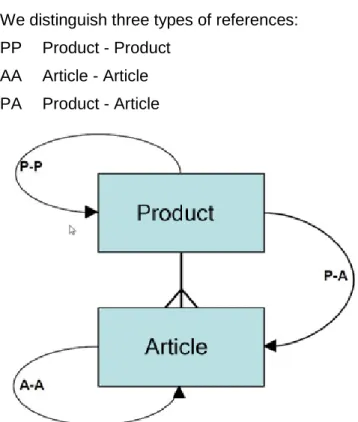
Page 5 van 9 We distinguish three types of references:
PP Product - Product AA Article - Article PA Product - Article
Page 6 van 9
3 File structure
The File attachment index is a text file according ASCII (ISO-8859-1 / Latin1) coding, in which the fields are separated by a [TAB]-code (ASCII character 9). In this format there is no mandatory field length, but all fields have to end with an enter (ASCI character 13 and 10).
3.1 Format definition
This chapter describes the format of the ASCII text files. Each file has the following definitions:
Veldnaam Fieldname The maximum length of the field Formaat Format The format of the field:
> A = Alphanumeric
> N = A round number (without preprocessing zero)
> D = Decimal number. D 6.4 means max 6 numbers in front of the decimal symbol and maximum 4 after it. The maximum value for this number is "999999.9999". The length of this number is 1, including the decimal symbol. It is not necessary to fill out this number with zero's.
Decimal symbol = "."
A separation stabbing at 1.000 is not allowed. V/O V/O V = Mandatory (verplicht) and O = Optional Toelichting Explanation Short explanation of the field.
3.2 File definition “Koppelingen.txt”
Veldnaam (Dutch) Fieldname Length Type V/O Description
IDType IDType 2 A V PP, PA or AA (ref. chapter 2) ID1 GLN Leverancier ID1 GLN Supplier 13 N V ID1
GTIN product/artikel GTIN product/article 14 N O ID1
Product-/artikelcode Product-/article number 20 A V ID1, if unknown specify GTIN Koppeltype Relation type 3 A V Rel. chapter 4
ID2 GLN Leverancier ID2 GLN Supplier 13 N V ID2 GTIN product/artikel GTIN product/article 14 N O ID2
Product-/artikelcode Product-/article number 20 A V ID2 if unknown specify GTIN Aantal ingesloten Count of included 16
(12,3) D O Default =1
Eenheid aantal ingesl. Unit of number included 3 A O List A (ref. chapter 5) GLN eigenaar koppeling GLN owner relation record 13 N V
Page 7 van 9 distributed in one uniform table.
Character 1 is the type of ID1 and character 2 is the type of ID2.
If ID1 is a reference to a product and ID2 is a reference to an article then the ID type we use is PA.
ID1 and ID2
ID1 and ID2 identify the products/articles through GLN and product- or article number. The join-type identifies if ID1 and ID2 should be read as products or as articles. In the format of the PALF the order is defined by time and from big to small. ID1 is older than ID 2; ID1 is bigger than ID2.
Multiple sources
Because of the possibility of multiple sources of a reference, in this model is chosen that every reference has an owner. All sides can offer a reference. When a manufacturer or importer, being the responsible party of this product, offers the reference, this one will be leading above other references.
Page 8 van 9
4 Reference types
In this document we distinguish the following reference types:
Code Code name PP PA AA ID1 > ID2 ID2 > ID1
PRE Precedes Predecessor Successor
COM Comparable Comparable and alternative CNO Comparable Norm product meets requirements norms CON Contains Contains part is part of BE2 Belongs to from the same series / part of FI2 Fits to fits on / closes it on to
PCH Parent Child is product of Is article with
4.1 Compare
Precedes
Precedes is a special compare in witch ID 1 and ID2 are supplied by the same supplier in which ID1 is marked as “End-of-life” (in Artlev.txt). For example product X (ID1) is
predecessor of product Y (ID2) from the same manufacturer. Product Y is probably changed in size and version.
Comparable
Two products with the same characteristics. Not necessarily from the same manufacturer.
Comparable Norm product
The characteristics of norm product P1 (ID1) are 100% applicable to product X (ID2).
4.2 Group
Contains
Some products contain components which are orderable as parts. For example a boiler and a burner.
Belongs to
Products that belong together based on their appearance.
Fits to
Products that fit on each other, like a bolt and nut.
4.3 Related
Parent - Child
Page 9 van 9 The list below is from ASCII PAB 2.03 standard.
List A (Content unit etc.)
Code Description CMT Centimeter GRM Gram KGM Kilogram LTR Liter MMT Millimeter MTK Square meter MTQ Cubic meter MTR Meter PCE Piece TNE Ton