Cloud Scale Load Balancing
•
Ananta: Cloud scale load balancing, Parveen Patel
et.al; SIGCOMM 2013
•
Duet: Cloud scale Load Balancing with hardware
and soJware, Rohan Gandhi, et.al; SIGCOMM
2014
Slides taken from SIGCOMM presentaPon
What’s happening?
•
Cloud Services
•
Azure (MicrosoJ), AWS (Amazon), Google Cloud
PlaWorm (Google)
•
MulP-‐tenant
•
Huge Compute Capacity
•
Needs to be shared with high utlizaPon
•
Spread requests over compute/storage resources
•
Load balancer in the front end
MicrosoJ
Windows Azure -‐ Some Stats
•
More than 50% of Fortune 500
companies using Azure
•
Nearly 1000 customers signing
up every day
•
Hundreds of thousands of
servers
•
We are doubling compute and
storage capacity every 6-‐9
months
•
Azure Storage is Massive – over
4 trillion objects stored
MicrosoJ
Scaling
•
VerPcal scaling (scale up) vs Horizontal scaling
(scale out)
•
VerPcal scaling
–
More resource/capacity to a node/switch/server
–
Increase power of resource, bigger
–
Reliability
•
Horizontal scaling
–
More independent elements/nodes to a system
–
Increase resources, more of the same
–
Distributed state
Load balancing
•
RotaPng DNS
•
Configure DNS to return different IP addresses
for the same name resoluPon
•
www.yahoo.com
-‐-‐-‐ x.y.z.1, x.y.z.2 ….
•
Advantages, Layer 3.. Scales
•
Disadvantages: DNS does not know the load or
the health of the servers
•
Cannot use heterogeneous load balancing policy
•
Most load balancers are switch based . Layer4-‐
Layer7
MicrosoJ
Layer 4 LB/switching
•
Switch is configured to have virtual IP address (VIP)
•
This is the IP address that the DNS retrurns for the
name
•
Switch configured based on policy to determine which
actual server the SYN is forwarded
•
Can be based on desPnaPon port# (80 for hlp, 21 for
SMTP, etc)
•
Acts as a desPnaPon-‐NAT
•
Return packets come to switch and the Source address
changed back to VIP
MicrosoJ
Layer 4 LB
10.1.2.3 10.1.2.4 10.1.2.5 10.1.2.6 VIP=141.1.2.6VIP VIP-‐P DIP DP
141.1.2.6 80 10.1.2.3 80
141.1.2.6 21 10.1.2.4 21
Layer 4 LB
•
Port aware
•
Switching decisions based on TCP SYN
•
DesPnaPon NAT
•
Return packets need to come back to the
switch/LB
•
Need to act as Source NAT as well
Direct path to sender
•
With a NAT box technique for rewriPng,
packets need to return to the switch
•
Beler to avoid going back to the LB on the
return path
•
Direct return to sender
•
Need IP-‐in-‐IP encapsulaPon
Layer 4 vs layer 7 load balancing
•
Layer 4 LB based on TCP header only
•
Layer 7 LB examines the content and then decides the server.
•
Based on hlp requests.
•
Layer 7 switches need to terminate TCP connecPons
•
LB needs to wait for hlp request before deciding on the binding
•
External Client terminates TCP connecPon at switch
•
AJer applicaPon level request, binding determined to applicaPon
server.
•
The client sPll need to see the same sequence numbers coming
from the applicaPon server
•
Need to imitate the same connecPon as the switch.
TCP Splicing
client
L7 switch
server
step1 step2 SYN(CSEQ) SYN(DSEQ) ACK(CSEQ +1) HTTPREQ(CSEQ+1) ACK(DSEQ+1) step3 step7 step8 step4 step5 step6 SYN(CSEQ) SYN(SSEQ) ACK(CSEQ+1) HTTPREQ(CSEQ+1) ACK(SSEQ +1) DATA(SSEQ+1) ACK(CSEQ+HTTPREQ+1) DATA(DSEQ+1) ACK(CSEQ+HTTPREQ+1) ACK(DSEQ + HTTPRES + 1) ACK(SSEQ+ HTTPRES+1) .Ananta in a nutshell
•
Is NOT hardware load balancer code running on
commodity hardware
•
Is distributed, scalable architecture for Layer-‐4
load balancing and NAT
•
Has been in producPon in Bing and Azure for
three years serving mulPple Tbps of traffic
•
Key benefits
–
Scale on demand, higher reliability, lower cost,
flexibility to innovate
How are load balancing and NAT used in
Azure?
Background: Inbound VIP
communicaPon
Terminology:
VIP – Virtual IP
DIP – Direct IP
Front-‐ end VM LB Front-‐ end VM Front-‐ end VM Internet
DIP = 10.0.1.1 DIP = 10.0.1.2 DIP = 10.0.1.3
LB load balances and
NATs VIP traffic to DIPs
Client à VIP
Client à DIP VIP = 1.2.3.4
MicrosoJ
Background: Outbound (SNAT) VIP
communicaPon
Front-‐ end VM L B Back-‐ end VM DIP = 10.0.1.1 DIP = 10.0.1.20 Front-‐ end VM LB Front-‐ end VM Front-‐ end VMDIP = 10.0.2.1 DIP = 10.0.2.2 DIP = 10.0.2.3
Service 1 Service 2
1.2.3.4 à 5.6.7.8
DIP à 5.6.7.8 VIP1 à DIP
VIP1 = 1.2.3.4 VIP2 = 5.6.7.8
MicrosoJ
VIP traffic in a data center
DIP Traffic 56% VIP Traffic 44% Total Traffic Intra-‐ DC 70% Inter-‐ DC 16% Intern et 14% VIP Traffic Inbou nd 50% Outbo und 50% VIP Traffic MicrosoJ
Why does our world need yet another
load balancer?
TradiPonal LB/NAT design does not meet
cloud requirements
MicrosoJ
Requirem
ent Details State-‐of-‐the-‐art
Scale
• Throughput: ~40 Tbps using 400 servers
• 100Gbps for a single VIP
• Configure 1000s of VIPs in seconds in the event of a disaster
• 20Gbps for $80,000 • Up to 20Gbps per VIP • One VIP/sec configuraPon rate Reliability • N+1 redundancy • Quick failover • 1+1 redundancy or slow failover Any service anywhere
• Servers and LB/NAT are placed across L2 boundaries for scalability and flexibility
• NAT and Direct Server Return (DSR) supported only in the same L2 Tenant
isolaPon
• An overloaded or abusive tenant cannot affect other tenants
• Excessive SNAT from one tenant causes complete outage VM Switch VMN Host Agent VM1
. . .
VM Switch VMN Host Agent VM1. . .
Controlle r Controlle rKey idea: decompose and distribute
funcPonality
Ananta Manage
r
VIP ConfiguraPon: VIP, ports, # DIPs
MulPple xer MulPplex er
. . .
MulPplexer VM Switch VMN Host Agent VM1. . .
. . .
SoJware router (Needs to scale to Internet bandwidth)Hosts
(Scales naturally with # of servers)
MicrosoJ
Ananta: data plane
2nd Tier: Provides connecVon-‐level (layer-‐4) load spreading, implemented in servers. 1st Tier: Provides packet-‐level (layer-‐3) load spreading, implemented in routers via ECMP.
3rd Tier: Provides
stateful NAT implemented in the virtual switch in every server. MulPple xer MulPplex er
. . .
MulPplexer MicrosoJ VM Switch VMN Host Agent VM1. . .
VM Switch VMN Host Agent VM1. . .
VM Switch VMN Host Agent VM1. . .
. . .
Inbound connecPons
Rout
er
Rout
er
MU
X
Host
MU
X
Rout
er
MU
X
…
Host Agent1
2
3
VM DIP4
5
6
7
8
Dest:VIP
Src:Clie
nt
Packet Headers Dest:VIP
Dest:DIP
Src:
M
ux
Src:
Clie
nt
MicrosoJ Dest:Client
Src:VIP
Packet Headers ClientOutbound (SNAT) connecPons
Packet Headers Dest: Server:80 Src: VIP:1025 MicrosoJ VIP:1025 à DIP2 Server Dest: Server:80 Src: DIP2:5555
Fastpath: forward traffic
Host
MUX
MUX
MUX
1
VM…
Host Agent 1 DIP1MUX
MUX
MUX
2
2 Host VM…
Host Agent DIP2 Data Packets DesPnaPon VIP1 VIP2 MicrosoJ SYN SOURCE=VIP1Fastpath: return traffic
Host
MUX
MUX
MUX
1
VM…
Host Agent 1 DIP1 4MUX
MUX
MUX
2
2 3 Host VM…
Host Agent DIP2 Data Packets DesPnaPon VIP1 VIP2 SYN SYN-‐ACK SOURCE=VIP2 DEST=VIP1Fastpath: redirect packets
HostMUX
MUX
MUX
1
VM…
Host Agent DIP1 6 7MUX
MUX
MUX
2
Host VM…
Host Agent DIP2 7 Redirect Packets DesPnaPon VIP1 VIP2 MicrosoJ ACK Data Packets 5Fastpath: low latency and high bandwidth for
intra-‐DC traffic
HostMUX
MUX
MUX
1
VM…
Host Agent DIP1MUX
MUX
MUX
2
8 Host VM…
Host Agent DIP2 Redirect Packets Data Packets DesPnaPon VIP1 VIP2 MicrosoJImpact of Fastpath on Mux and Host
CPU
10
55
13
2
0
10
20
30
40
50
60
Host
Mux
% CPU
No Fastpath
Fastpath
MicrosoJLessons learnt
•
Centralized controllers work
– There are significant challenges in doing per-‐flow processing, e.g., SNAT
– Provide overall higher reliability and easier to manage system
•
Co-‐locaPon of control plane and data plane provides faster local
recovery
– Fate sharing eliminates the need for a separate, highly-‐available management channel
•
Protocol semanPcs are violated on the Internet
– Bugs in external code forced us to change network MTU
•
Owning our own soJware has been a key enabler for:
– Faster turn-‐around on bugs, DoS detecPon, flexibility to design new features
– Beler monitoring and management
Duet: Cloud scale LB with hardware and SoJware
LB architecture
Hardware vs soJware LB
•
SoJware LB
•
Horizontal Scaling
•
Distributed deployment
•
High availability
•
Slow, latency penalty
•
Hardware
•
Fast, low latency
•
Costly
•
VerPcal scaling
•
Failover difficult
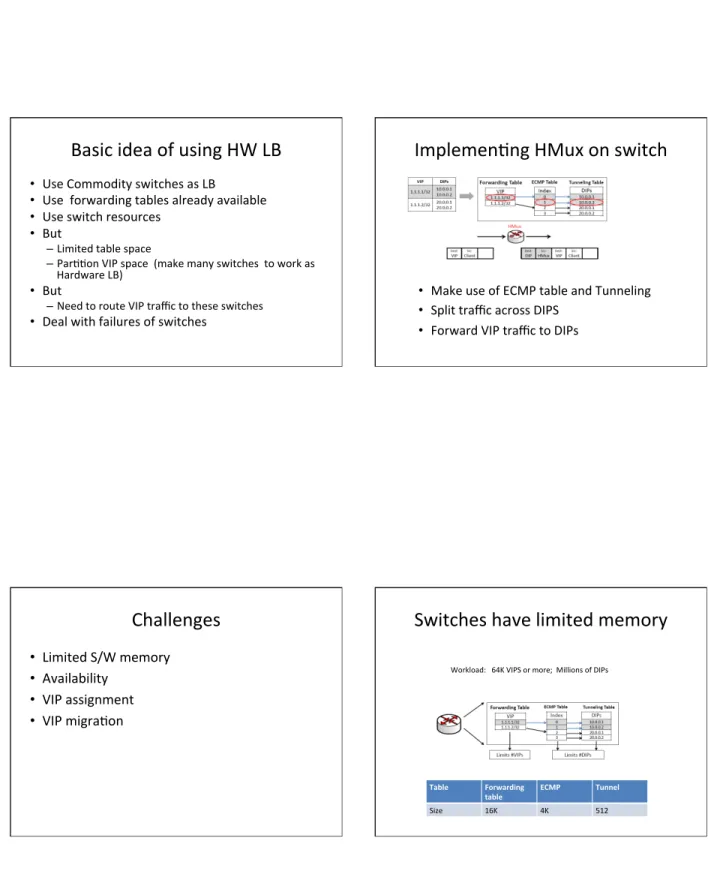
Basic idea of using HW LB
•
Use Commodity switches as LB
•
Use forwarding tables already available
•
Use switch resources
•
But
–
Limited table space
–
ParPPon VIP space (make many switches to work as
Hardware LB)
•
But
–
Need to route VIP traffic to these switches
•
Deal with failures of switches
ImplemenPng HMux on switch
•
Make use of ECMP table and Tunneling
•
Split traffic across DIPS
•
Forward VIP traffic to DIPs
Challenges
•
Limited S/W memory
•
Availability
•
VIP assignment
•
VIP migraPon
Switches have limited memory
Table Forwarding
table ECMP Tunnel
Size 16K 4K 512
ParPPon VIPs across HLBs
Availability?
Block of VIPs not accessible? Use SoJware backup
Use SoJware LB as a backup
SoJware LBs can handle enPre range of VIPs like Ananta