Gating Design Optimization for Improvement
in Yield of Casting
M. N. Jadhav
1, K. H. Inamdar
2P.G. Student, Department of Mechanical Engineering, Walchand College of Engineering, Sangli, Maharashtra, India
1Associate Professor, Department of Mechanical Engineering, Walchand College of Engineering, Sangli,
Maharashtra, India
2ABSTRACT:
Casting has many process variations depending upon the material, the type of pattern, mould and the
pouring technique like sand casting, investment casting, die casting, squeeze casting and lost foam casting. Sand
casting is the most widely used process which can be used to produce intricate parts in almost every metal that can be
melted. Casting defects analysis is process of finding the root cause of occurrence of defects in the rejection of casting
and taking necessary steps to reduce the defects and to improve the casting yield. The design of gating system in most
foundries is very much of an individual art based on the experience of the foundry man and the collective experience of
foundry men in developing the castings. In this paper the discussion about optimization of yield of casting is done by
modifying and optimizing the existing gating system. A gating system is essentially the plumbing network through
which molten metal is introduced to the mold cavity of the casting; the conduit network through which liquid metal
enters a mold and flows to fill the mold cavity, where the metal can then solidify to form the desired casting shape.
KEYWORDS:
Gating design, Existing gating, Modified gating, Yield improvement.
I. INTRODUCTION
The design of gating system in most foundries is very much of an individual art based on the experience of the foundry
man and the collective experience of foundry men in developing the castings. The development of the gating system in
this way has led to the adoption of a number of fairly well defined designs like bottom gates, side gates, multiple gates
etc.Foundries represent an important sector of the manufacturing industry and these foundry industries in developing
countries suffer from poor quality and productivity due to involvement of number of process parameters in casting
process. And also the more yield of casting is a favorable factor as it gives more profit.
Casting is a very versatile process capable of being used in mass production of items in very large shaped pieces, with
intricate designs and having properties unobtainable by any other methods. More than 60% of the automotive
components out of the total are manufactured by metal casting process. The major activities involved in making a
casting are moulding, melting, pouring, solidification, fettling, cleaning, inspection and elimination of defective
castings. Out of different casting methods, green sand casting is the commonly used method for producing automotive
components.
In casting processes, there are various parameters with different adjustment levels may influence the defects in casting. For each type of defect, several causes have been listed under differing categories such as design, moulding, pouring and melting related parameters. A gating system is essentially the plumbing network through which molten metal is introduced to the mold cavity of the casting; the conduit network through which liquid metal enters a mold and flows to fill the mold cavity, where the metal can then solidify to form the desired casting shape.
II.LITERATUREREVIEW
Choudhari et al. [1] In this study, the component suffered from shrinkage porosity defect leading to premature failure. It also was subjected to incomplete fill due to sudden variation in thickness. Hence, it was necessary to redesign and redevelop the component. Component geometry has been modified without affecting its functionality by providing sufficient draft and radius at the junction. An attempt has been made to carry out the entire methoding, simulation and optimization in Autocast software.
Sadekar et al. [2] yield is the ability of a foundry to manufacture acceptable casting in an effective manner. Improving yield offers many commercial as well as financial benefits to the foundry. Along with direct cost control, high yield is also associated with better process control, and therefore improved cost control. By using computer simulation, an optimum gating system can be designed to improve the acceptability of the casting. Hence work has been done in this regard to analyze the defects of a casting and thus improve its acceptability. As results rejection rate of the component was reduced from 10.60% to 1.52% and box yield was reduced form 75.37% to 67.82%
Kanthavel et al. [3] investigated chill performance on steel casting (steel ball valve). For investigation of chill performance, the experiments were performed using DoE and response surface method. The parameters were taken are chill distance, chill thickness, pouring temperature, and pouring time.Manikanda [4] studied optimization of riser design through genetic algorithm optimization technique. Input parameters were taken volume of casting and riser. Using GRA optimize tool, yield of sand casting product is improved.
Zhao et al. [5] proposed, in casting Hidden defects inside the casting occurring during the manufacturing and use processes can develop into fatigue or stress corrosion cracks, which may result in catastrophic failures of products. The hidden defects need to be diagnosed correctly; otherwise new defects may be introduced. Unfortunately, it is not an easy task, since internal discontinuities such as blowholes, porosity, shrinkage, and cracks in casting components are notoriously difficult to detect. For inspection a robust sparse-representation-based inspection system for the detection and classification of casting hidden defects in radiographs is presented. Four common types of casting defects including cracks, blowholes, shrinkage porosities and shrinkage cavities are considered.Jolly et al. [6] analyzed Numerical simulators based on FDM and FEM methods, provided powerful means of analyzing various phenomena occurring during the casting process.
Khadeand Sawant, [7] In this paper they analyzed and studied casting of brake disc. This work has been made to solve the problem of lower casting yield due to over designed gating system components. To overcome this problem they redesigned gating system. They made various 3D CAD models of that designs and designed gating systems for the casting and simulated using simulation program Autocast -X flow plus. After analyzing the simulation results, they get results which are not agreed, then they made changes in that design and 3D CAD model and simulated again, they repeated that procedure until the desired results are obtained so as it will give the sound quality casting with the higher casting yield, profit and productivity.
Magdum and Jadhav, [8] in this work they shows the development of the casting processes simulation techniques used in the AutoCAST simulation software. In the simulation technique they designed gating systemnumerically and by that dimensions theydrawn 3D model of the gating and cavity, that model is used for virtual casting in that process by that simulation technique trial and error method, the optimized gating system was finalized. After that they implementedfinalized designed gating system on the pattern for simulation process and taken the sample casting to validate the result of the simulation technique. So they overcome wastage caused due to trial and error by using this technique and optimization of quality implies lower production cost and higher yield.
III. GATING DESIGN OF GREEN SAND CASTINGS
A gating system is essentially the plumbing network through which molten metal is introduced to the mold cavity of the casting; the conduit network through which liquid metal enters a mold and flows to fill the mold cavity, where the metal can then solidify to form the desired casting shape.
The basic requirements of a gating system are as follows:
i. Flow should be smooth and uniform, with minimum turbulence to avoid entrapment of air, metal oxidation and mold
erosion.
iii. It should avoid mold and core erosion which implies that the velocity of metal flow should be fairly low.
iv. The gating system must facilitate removal of slag and inclusions in the gating system prior to the entry of molten metal to
the mold cavity.
It must give maximum casting yield possible.
a. Existing Gating System
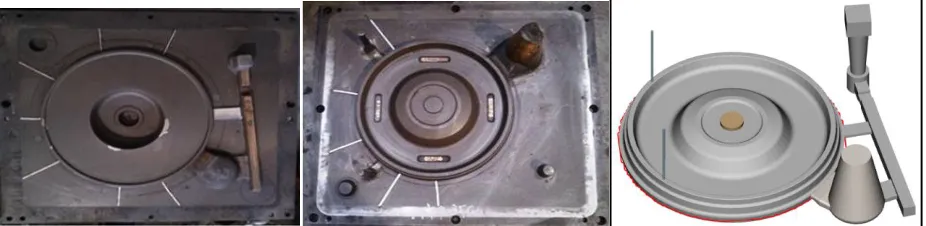
Existing gating system is as shown in following figure 1. Here sprue is connected to runner and runner is connected to casting with two ingates one ingate is connected through feeder for compensation of shrinkage. This design is having two vents on outer part for removal of gases and table 1 shows the process details for existing gating system.
.
Fig. 1: Pattern and 3D model of existing gating system.
Table 1: Existing Process Details.
No
Title
Details
1
Mould material
Green sand
2
Height of casting
70mm
3
Tapping temperature (Tp)
1460-1470
0C
4
Pouring Temperature
1360-1420
0C
5
Pouring time
15-20 sec
6
Density of material
7200 kg/m3
7
Total weight of casting in mould box
43.55 kg
8
Number of cavities in mould box
1 No.
9
Size of box
700 mm X 600mm, Cope 230mm, Drag 170mm
10
Total dimensions of mould box
700 mm X 600mm X 400mm
11
Shape of mould box
Rectangle
12
Type gating system
Parting line gating system
13
Existing Yield of casting =
Total
weight
of
good
casting
Total
weight
of
metal
poured
Yield =
. ∗.
=
76.58%
b. Modified Gating System
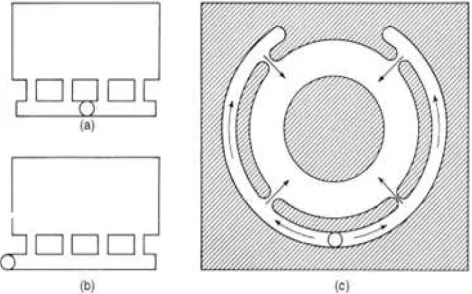
Typical horizontal multi-gating systems are shown in fig. 2. These systems find use for extended castings of plate form.
The metal continues to flow along a straight path unless an obstruction creates a back pressure which initiates flow into
other elements of the system.
Fig. 2: Horizontal multiple ingates; (a), (b) parallel finger ingates,(c) Circumferentially placed ingates
With reference to above theory, Inmodified gating system the feeder have been removed and instead of that chill is
used to increase the yield of the casting. The function of the chill is to help for directional solidification. Figure 3 shows
the chill used inside the core. And two ingates are replaced with four ingates.
Fig. 3: (a) Casting with chill used inside the core and connected with gating system, (b) Chill used inside the core.
The use of chill inside the core has reduced the shrinkage defects and addition of vent at centre has also minimized the
blowhole defects.The use of chill helps in improvement for directional solidification.
Modified yield of casting =
. ∗Table 2: Comparison between Existing and Modified Gating system
Gating
Gating Ratio
Casting Weight
Bunch Weight
Yield of Casting
Existing
1 : 1.3 : 1.1
43.55
56.87
76.58%
Modified
1 :1.1 : 1.2
43.55
52.04
83.71%
In above table 2, comparison between existing and modified gating system shown.After modification in the gating
system, the defects were removed and also yield improvement is 7.13 % with the modified gating of MMPL casting.
And also with the modification of the gating system the turbulence of metal flowing through the cavity of gating is
reduced and smooth and continuous flow in filling the complete cavity.
IV. CONCLUSIONS
1.
The gating design optimization improves the yield of the casting and it also helps in reducing the defects.
2.
Yield of existing gating system is 76.58% and after modification of gating system, yield obtained is 83.71%. This
indicates that, there is total yield improvement of 7.13%.
3.
A good gating design provides
smooth and uniform metal flow, with minimum turbulence to avoid entrapment of
air, metal oxidation and mold erosion.
REFERENCES
[1] C. M. Choudhari, B. E. Narkhede and S. K. Mahajan, “Casting Design and Simulation of Cover Plate using AutoCAST-X Software for Defect
Minimization with Experimental Validation”, ICMPC, 6, pp. 786 – 797, 2014.
[2] D. Sadekar, G.R. Bharath and S. Kumar, “Yield Improvement of Castings using Computer Aided Simulation – A Case Study”, International
Journal on Theoretical and Applied Research in Mechanical Engineering, 3, pp. 1-4, 2014.
[3] K. Kanthavel, K. Arunkumar and S.Vivek, “Investigation of chill performance in steelcasting process using Response Surface Methodology,”
Procedia Engineering,97, pp. 329 – 337, 2014.
[4] ManikandaPrasath K., “Optimal Riser Design in Sand Casting Process Using GeneticAlgorithm,” International Journal of Scientific &
Engineering Research, 5,pp. 371-374, 2014.
[5] Inyue Zhao, Zaixing He, Shuyou Zhang and Dong Liang, “A sparse representationbased robust inspection system for hidden defects
classification in castingcomponents,” Neurocomputing, 153, pp. 1-10, 2015.
[6] Jolly MR, L. HSH, Turan M and Campbell J, “Use of simulation tools in the practical development of a method for manufacture of cast iron
camshafts. In: Modeling of casting, welding and advanced solidification processes” (MCWASP IX) Aachen, Germany, pp. 311–318, 2000.
[7] Utkarsh S. Khade1 and Suresh M. Sawant, “Gating Design Modification Using 3D CAD Modeling and Casting Simulation for Improving the
Casting Yield,” ISSN 2250-3234, 4, pp. 813-820, 2014.
[8] Swaroop S. Magdum andBaliram R. Jadhav, “Design and Development of Casting by Simulation Technique for Yield Improvement in Foundry