Medium Access Control Protocol for Radio LANs
K. S. NatarajanChia Chi Huang David F. Bantz
IBM Thomas J. Watson Research Center P.O. Box 704, Yorktown Heights. NY 10598
Abstract
The medium access control protocol concerns the use of broadcast messages from a central controller to demarcate three intervals: the first two intervals in which transmission is scheduled by the controller, and the third in whicll a decentralized contention-based medium access control protocol is used. Tile medium access con-trol protocol is well-adapted, but not limited, to use with frequency-hopping methods of spread-spectrum radio transmissions.
1. Introduction
In indoor digital data radio systems, a key problpm is providing efficient access to the channel, as that channel is limited in capacity and shared by all its users. In this contribution we assume a network architecture where a finite number of Access Points are attached to a Distribution System. The Distrihution System enables:
• Communication between mobile statiol1s and applications/data residing in the enterprise computing environment. A typical structllre has mobile stations com-municating to an Access Point (a fixed station) acting as a bridge between the radio environment and tile Distribution System. The Access Point relays mes-sages to otller resources attaclled to tile Distriblltion System.
• Communication between mobile stations. If COllllTlllnication is between two mo-bile stations, tllis can occur utilizing the store-and-forward capability of one or more Access Points attaclled to a Distribution SystPIll. An approach to setting up ad-hoc networks between mobile stations would require implementation of Ac-cess Point functions in software in mobile station adapter cards and a metllod for designating one of tllem to perform Access Point functions.
Eacll Access Point has processing and storage capability to perform store-and-forward functions. The Distribution System can, in general, be an IEEE 802 network. Eacll mobile station can communicate with a set of Acr,oss Points. Witllin eacll Basic Service Area tile radio link is Ilalf-duplex that is sharAd between inbound (mobile
July 8, 1991
DOC.: IEEE
P802.11/91-74
In this contribution, the transmission technique assumed is spread spectrum, au-thorized by the US Federal Communications Commission in its regulations, part
15.247, for use in certain frequency bands without user license. Specifically, the form of spread-spectrum considered is frequency-hopping, bllt the medium access control protocol can also be used with discrete-sequence systems. In a frequency-hopping system, the carrier frequency of the transmitter changes at intervals of time, remain-ing constant between those instants. The period of constant frequency is called an
hop and it is only during these hops that messages rnay be exchanged. Because
these hops are of finite duration they impose a structure on the use of the radio channel: no transmission may cross a hop boundary. Hops impose a framing struc-ture on time.
Efficient radio channel usage is the basic requirement for a practical indoor radio data networks. The different types of traffic from various data terminals are usually bursty in nature and not predictable. Static channel allocation means such as frequency division or fixed time division are inefficient for many forms of computer-to-computer traffic, known to be bursty in nature. Furthermore, they are not well-suited for mobile communication systems with a dynamically changing population of mobile stations. Random access schemes (such as Aloha, Slotted Aloha, CSMA and its variants) are known for their short response time when channel load is light. With these schemes, the shared channel should not be heavily loaded to avoid potential stability problem. When channel load increases, random access schemes can introduce unacceptable delays and can become unstable if not suitably controlled.
Controlled access schemes, based on polling or reservation methods, achieve much better channel use efficiency when load is heavy. However, polling schemes may suffer from overhead unless care is taken to millillli7P the effective walk-time (i.e, time required to poll a mobile station) on the response time seen by the mobile stations. Controlled access schemes have the following desirable characteristics. They:
• allow the implementation of non-isochronolls and isochronous applications. • can ensure fairness of access to mobile stations. No mobile station is deprived
of communication because of capture effects.
A number of comprehensive survey articles [TOB82] [KlJR84] [KLE8S] as well as text books [HAY84] [BER87] [ROM90] describe multiple access protocols for use in dif-ferent communication environments.
2. Proposed Scheme
In order to reduce response time when traffic load is light and increase channel use efficiency when traffic load is intense, a hybrid of controlled access and random ac-cess scheme is desirable. The proposed medium acac-cess control scheme is based on a frame structure and can be used under FCC part 15 frequency hopping rules. The frame structure of the proposed scheme is as follows. The duration of a hop is sub-divided into three intervals, such that a different medium access control protocol is used in each interval. Centralized control is used in the first two intervals and de-centralized control in the third interval.
Frame structure
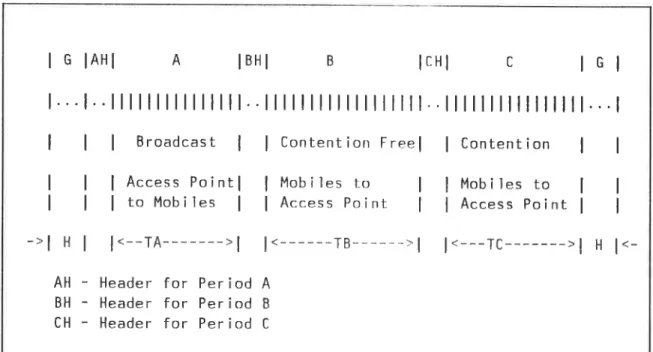
The medium access control protocol is now briefly described with respect to Fig. 1 below. In Fig. 1, the labelled intervals are:
• G - the interval during which the transmitter carrier frequency is changing, of duration H.
• Period A
-AH (Broadcast from Access Point to mobile stations) - the interval during which the Access Point broadcasts a special message to all the mobile stations that identifies the beginning of Period A and contains additional control information (see below).
A (Broadcast from Access Point to mobile stations) -the interval during which outbound traffic is transmitted. The Access Point broadcasts packets and mobile stations receive packets addressed to them.
• Period B
-BH (Broadcast from Access Point to mobile stations) - the interval during which the Access Point broadcasts a special message to all the mobile stations signifying the end of the Period A and the beginning of Period B. It also contains additional control information (see below).
B (Contention Free Transfer from Mobile stations to Access Point) -at the end of Period A, mobile stations take turn to transmit according to the slot allo-cation specified in BH.
July 8, 1991
DOC.: IEEE
P802.11/91-74
• Period C
-CH (Broadcast from Access Point to mobile stations) - the interval during which the Access Point broadcasts a special message to all the mobile stations, identifying the end of the Period B and the beginning of the Period C. The message also conveys the TC, length of the Period C.
C (Random Access from Mobile stations to Access Point) -the interval during which any station may contend for the channel and transmit a message without the consent of the Access Point. A Slotted-ALOHA protocol can be used in this interval. This interval is used for the following types of informa-tion:
Registration requests that enable mobile stations to identify themselves and request the services of the Access Point. This is necessary because the set of mobile stations accessing the wireless LAN can change
dy-namically with time. An Access Point can not assume a priori knowledge about the number or the identity of mobile stations desiring its services.
Request bandwidth for transmission in Contention Free mode (Period B). Both isochronous or non-isochronous services can be supported by transmitting the appropriate bandwidth reservation request to the Access Point. Allocations based on reservation requests are specified in the AH and BH headers of the next frame.
Transmission of bursty data (single packet messages).
Period A operation - Each mobile station waits for Header AH corresponding to
Pe-riod A. The header specifies the lengths of all three intprvals (TA, TB and TC) and the lengths of their corresponding headers (TAH, TBH and TCH). On correct reception of Header AH, each mobile station sets a timer for TA so that it knows when to receive Header BH and learn about the beginning of Period B. Header AH identifies the start of the information frame, carries an unique identification of the Access Point, speci-fies the frequency hopping pattern and carries other system control information. In Period A the Access Point controls the transmissions outbound to the mobile stations. The corresponding header (AH) control information for this interval is broadcasted by the Access Point and received by all mobile stations.
On correct reception of the above control information Header AH, each receiving mobile station can receive packets broadcasted by the Access Point that are ad-dressed to it. The remaining packets are discarded by the mobile station.
Period B operation - At the end of Period A, each mobile station waits for Header BH corresponding to Period B. It contains the lengths of Periods Band C (TB, TC) and the lengths of their corresponding headers (TBH, TCH). When received, each mobile station sets a timer for TB so that it knows when to receive Header CH and learn about the beginning of Period C, the contention interval. Header BH also specifies such control information as which mobile stations may transmit, the number of packets allocated to each of them and the sequence in which they can transmit in the current frame. The mobile stations transmit packets to the Access Point according to the allocation information received in BH. If a mobile station fails to receive BH cor-rectly, then it will not make use of any slots that may have been allocated to it in the current frame.
I
GIAH I
AIBHI
BICHI
CI
GI
I
...
I .. 111I " 11111 " " .. 11111I11111111 I " I
..
11111I " " " " II ... I
Broadcast
Contention Freel
Contention
Access POintl
Mobiles
to
Mob i les to
to Mob i
1es
I
Access Point
Access Point
->1 H
I<--TA---
>
I
I<---TB--
--
--
>
I I<---TC--->I H
1<-AH - Header for Period A
BH
-Header for Per i ad B
CH
-Header for Period C
Figure 1. Frame Structure of Medium Access Control Scheme
Period C operation - At the end of Period B, each mobile station waits for Header CH corresponding to Period C. The header contains TC, the length of the third interval. When received, each mobile station sets a timer for TC so that it knows when to schedule its next frequency change.
July 8, 1991
DOC.: IEEE
P802.11/91-7i
Hopping considerations - Broadcast reception of messages is not guaranteed, only
likely. Radio conditions may be such that a particular mobile station does not hear the broadcast message AH. If a mobile station does not hear Header AH, then it refrains from participation in the current frame by remaining quiet for the entire hop. Instead, it remembers the hop length of the last frame to set a timer so that it knows when to hop, and it will listen in the next frame for the AH message. If no AH message is heard for a number of consecutive frames the mobile station must assume that it has lost hop synchronization with the rest of the system, and enter a synchronization ac-quisition mode (to be discussed below).
Each frame period of length T
=
(TAH+TA+TBH+TB+TCH+TC) can also be a fre-quency hopping period for implementation under FCC part 15. A fixed length of T is recommended but is not necessary. Fixed length of T has following useful charac-teristics:• When several frequency hopping patterns are used in overlapped operation in an Extended Service Area (multiple Access Points pills a Distribution System) and each Access Point uses a fixed length T per hop, then interference separation may be achieved by appropriate choice of hopping sequences for the Access Points.
• If all radios in a system are hopping with the same pattern, a fixed length of T permits different Basic Service Areas to hop in synchronism but at different phases of the hopping pattern. This eliminates interference between Basic Ser-vice Areas.
A tradeoff needs to be made in selecting the length of T. A large T makes the system overhead smaller and a small T makes the system response time smaller.
By varying TA+TB, the Access Point can expand or contract the contention interval. If the system is very lightly loaded and most of the traffic is inbound to the Access Point, it is advantageous to mobile response time to lengthen TC. Conversely, if the system is heavily loaded and most of the traffic is outboll nd, TC shou Id be minimized.
TC should not be reduced to zero, however, as it is the only mechanism by which a newly activated mobile station can register itself to the Access Point.
Synchronization acquisition
The issue of how a newly activated mobile station acqllires synchronization with the Access Point with respect to hopping must be resolved. A method for sync acquisi-tion is the following. A mobile staacquisi-tion that needs to get in sync could monitor a single frequency for an AH message. Once received, the mobile station can now predict the
for the identification of its permanent owner: otherwise the mobile station may syn-chronize to the wrong Access Point. Alternatively, the mobile station may hear mUl-tiple AH messages and choose a Access Point by measuring signal strength and choosing the strongest. The mobile station can then register itself to the Access Point by transmitting a message to the Access Point in the contention interval. Note that the entire hop time is (TAH
+
TA+
TBH+
TB+
TCH+
TC).Handoff between Access Points in a Frequency Hopping System
A basic problem in providing transparent communication service for mobile stations in an Extended Service Area is handoff. A mobile station needs to know when, how, and to which Access Point to handoff. In order to achieve this goal, information has to be gathered at the mobile station about the current status of all the potential new Access Points around it such that it can make an appropriate handoff decision. In order to collect handoff information from surrounding Access Points, a mobile sta-tion must have knowledge of:
1. Who are the handoff candidates (i.e., which surrounding Access Points can serve the mobile station) ? How many of the candidates should be monitored?
2. For each handoff candidate Access Point,
• when can its handoff information be collected?
• which state of its frequency hopping pattern it will be in?
Furthermore, the Access Points involved in a handoff 8nd the mobile station must cooperate according to a well defined protocol for accornrlishing the handofffunction. We have considered different methods with varying degree of requirement on net-work synchronization among the Access Points. I n Ollf~ method, Access Points are tightly synchronized with each other. In another method, each Access Point can op-erate independently of other Access Points without any need for tight global syn-chronization. Details on key issues related to handoff will be described in a future contribution.
Implementation
A partial implementation of the protocol has been done in software. A software im-plementation is consistent with the performance requirements of slow frequency hopping, which by FCC regulations limits the duration of an hop to 400 milliseconds. Mobile stations need to have the capability of receiving broadcast messages. This can be done by adopting the convention used ill sOl11e data-link-level protocols, namely, an address of all ones, or any coml11only-agreed-to address, signifies a
July 8, 1991
DOC.: IEEE P802.11/91]'(
3. Summary
The proposed mediu m access control protocol uses broadcast messages to demarcate three intervals within an hop: two intervals during which the Access Point has control, and a third interval during which access is gained by contention. The timing of the broadcast messages controls whether the system appears
predomi-nantly contention-based or controlled by a central controller. As the load on the sys-tem increases the Access Point can switch to a controlled method of medium access, unconditionally stable. The protocol meshes well with the constraints of slow fre-quency hopping, although it can be used with any signalling technique (spread-spectru m or not).
The protocol has the following desirable characteristics: • short access time if the channel is lightly loaded
• good channel utilization if the channel is heavily loaded • unconditionally stable
• simple implementation
• matched well to typical traffic patterns, where most traffic is outbound from an Access Point attached to a Distribution System to mobile stations.
Acknowledgement - The authors thank Robert Cato of IBM Raleigh, NC for his
con-tribution during the initial stages of this work.
References
[T0882J F. A. Tobagi, "Multiaccess Link Contro\", Computer Architectures and
Pro-tocols, edited by Paul E. Green, Jr., PlenLls Press, NY, 1982, pp. 145-189.
[KUR84J J. F. Kurose, M. Schwartz and Y. Yemini, "Multiple-Access Protocols and
Time-Constrained Communication", ACM Computing Surveys, Vol. 16, No. 1, March 1984, pp. 43-70.
[KLESSJ L. Kleinrock, "Performance Evaluation of Distributed
Computer-Communication Systems", UC Los Angeles, Computer Science Department Technical Report CSD-880084, Oct. 88.
[BERB7] D. Bertsekas and R. Gallager, Data Networks, Prentice-Hall Inc., New Jersey, 1987.
[ROM90] R. Rom and M. Sidi, Multiple Access Protocols - Performance and Analysis, Springer-Verlag, 1990.
[CHE91] J. Cheah, Contribution IEEE P802.11/91-54, May 1991.
[RVP91] C. Rypinski, Contribution IEEE P802.11/91-19, March 1991.