IM Guide to Work Processes
Foreword
In the mid nineties Rijkswaterstaat (RWS - the Department of Public Works) began to introduce Incident Management (IM) on Dutch highways. In the past twenty years the quality of IM has improved tremendously, whereby cooperation in work processes is becoming increasingly multidisciplinary. The aim of the Guide to IM Work Processes This guide is a practical report that provides insight into the work processes/methods of the various emergency services involved in the IM process. It concerns the following aspects:
u familiarity with each other’s work
processes/methods
u harmonisation of the different work
processes/methods
u creating clarity in dealing with incidents
Target group
The Guide to IM work processes is intended for the emergency services (police, fire brigade and ambulance services) and highways authorities (Rijkswaterstaat, provincial and municipal).
The book can be used as a source of information by other parties such as:
u salvage companies
u emergency centres
u breakdown services
u transport sector
u insurers
From GRIP onwards IM is an aspect of crisis management. IM and its embedding within crisis management are described in chapters to 4. The work processes of all the respective emergency services and the highways authority (RWS) are specified in chapter 4 while chapter 5 explains how the IM work processes are translated within the IM process.
Chapter 6 describes the methods of communication among the various emergency services that aim to enable the processes to run smoothly. Chapter 7 concerns the UPP ‘Help in Incidents’. The IM work processes of the highways authorities are detailed in chapter 8. Chapter 9 reveals the scaling up process to the supervising officer (SO) and finally, in chapter 0, key contact information is provided.
4
N.B.: While the IM work processes of the highways authorities have been developed from the perspective of the role of RWS as highways authority, they are nonetheless very applica-ble for other highways authorities, certainly with regard to the ongoing development of the function of the highways inspector (HI) who will soon have to undertake tasks for both the main and auxiliary road networks.
Therefore, the job titles of the highways authority have been generalised for the purpose of this document. The detailed IM processes of the highways authorities (monodisciplinary) are incorporated in chapter 8. This IM work processes guide is multidisciplinary.
Amsterdam-Amstelland Brabant Zuid-Oost Brabant-Noord Drenthe Flevoland Fryslân Gelderland-Midden Gelderland-Zuid
Gooi en Vechtstreek Groningen Haaglanden Hollands Midden IJsselland Korps Landelijke Politiediensten Kennemerland Limburg-Noord Limburg-Zuid Midden en West Brabant Noord- en Oost-Gelderland Noord-Holland Noord Rotterdam-Rijnmond Twente Utrecht Zaanstreek-Waterland
Zeeland Zuid-Holland-Zuid vts Politie Nederland Politieacademie
Police academy of the Netherlands
Korps
Divisie of district
5
The practical execution per IM work process is realised only by highways authority (see chapter 8). The aim is also to detail the IM work processes of the emergency services in the future and incorporate them in this guide.
For more information about IM,
go to www.incidentmanagement.nl.
N.B.: Where ‘he’ is cited in the text, this refers to both ‘he’ and ‘she’.
6
Table of contents
Foreword
What is IM? 7
IM as a crisis management component 8
How does IM work?
4 The IM process
5 Forms of consultation and scaling up 5
6 Communication during the incident 6
7 The UPP ‘Help in incidents’ 9
8 Details of IM work processes 4
of the highways authority
8. Take safety measures 4
8. Traffic flow 8
8. Diversions 0
8.4 Salvage
8.5 Damage recovery/clearance 6
8.6 Inform the road user 8
9 Scaling up to highways authority SO 40
0 Main contact information 4
Appendices 45
7
1 What is IM?
DefinitionIM is the set of measures to clear the road for traffic as fast as possible following an incident on the road. It involves close cooperation with the emergency services and takes account of:
u safety u victim assistance u investigation u traffic flow u damage control/recovery Aim of IM
One as quickly as possible released road. Principle
Based on their own tasks and level of authorisation, each of the emergency services works to deal with an incident on the road as safely and efficiently as possible and to contain the consequences.
8
IM is closely connected with the Dutch disaster (crisis) management in which the emergency services like the police, fire brigade, regional medical team and the municipal authority have legal responsibility via crisis management processes.
GRIP
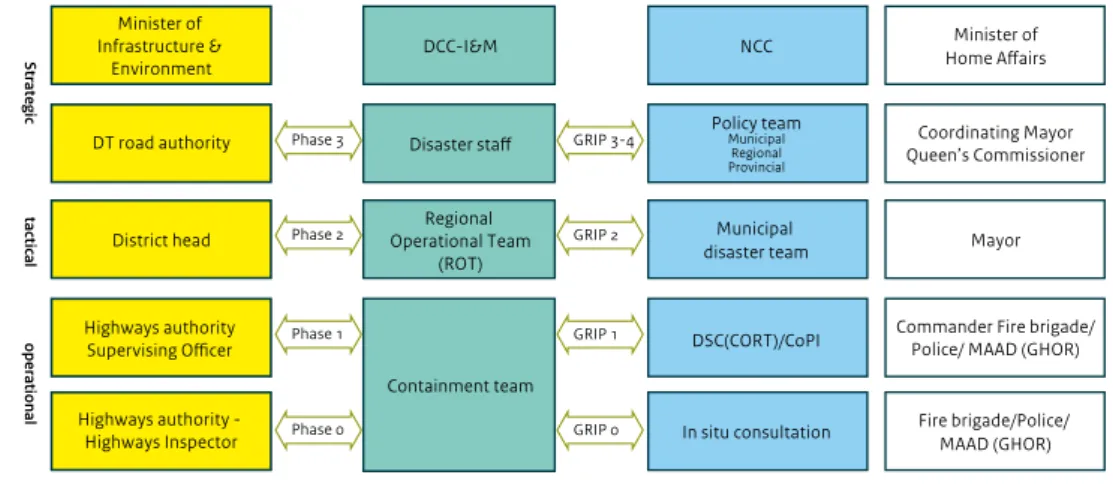
The Dutch acronym GRIP stands for ‘Coordinated Regional Incidentmanagement Procedure’. Crisis management distinguishes five scales. In road incidents IM has its own place within that system of scales.
Emergency services recognise GRIP phases 0 to 4 while the highways authority speaks in terms of coordination phases 0 to . The highways authority scales are at a variance with some of the components of the GRIP scaling, although the highways authori-ty’s phase corresponds with GRIP .
Incidentmanagement concerns up to GRIP after which it becomes crisis or disaster management. Highways authority
The tasks and work processes of the highways authority are not specified within the crisis manage-ment process but they do support the police to an important extent.
9
Crisis management processes Police: public order and traffic
u clearance and evacuation
u road closures and protection
u regulating traffic
u maintaining public order
u identifying victims
u supervision
u criminal investigation
Fire brigade: containing source and effect
u containing fire and emission of hazardous
substances
u rescue and technical assistance
u human and animal decontamination
u decontamination of vehicles and infrastructure
u observe and measure
u warning the public
u creating access and clearance
MAAD: Medical Assitance in Accidents and Disasters (in Dutch: GHOR)
u emergency medical assistance (EMA)
u psycho-social assistance in accidents and
disasters (PSAAD)
0
Municipality: public care
u information
u relief and care for homeless, evacuees and the
slightly injured
u arranging burials u registering victims
u provision of primary necessities of life
u registering and concluding damage
u environmental care
u post-disaster care
Safety regions
The fire brigade, MAAD (GHOR), police and munici-palities work closely together in a safety region for the effective preparation and contain of crises and disasters. There are 5 regions that organise the approach to major accidents, disasters and crises such as flooding, the outbreak of infectious diseases and terrorism.
The designations of crisis management processes may vary per safety region.
Minister of Infrastructure & Environment DCC-I&M NCC Minister of Home Affairs
DT road authority Disaster staff Policy teamMunicipal Regional Provincial
District head Operational TeamRegional (ROT)
Municipal
disaster team Mayor
Highways authority Supervising Officer Containment team DSC(CORT)/CoPI Coordinating Mayor Queen’s Commissioner
Commander Fire brigade/ Police/ MAAD (GHOR) Highways authority -
Highways Inspector Phase 0 GRIP 0 In situ consultation Fire brigade/Police/ MAAD (GHOR) Phase 1 GRIP 1 Phase 2 GRIP 2 Phase 3 GRIP 3-4 St ra te gic ta cti ca l op er at io na l
GRIP level Scope of the incident
GRIP 0/Routine Normal daily work of the operational services
GRIP Source containment
GRIP Source and effect containment
GRIP Threat to the wellbeing of (major groups of) the population
GRIP 4 Cross-municipal, possibly scarcity
3 How does IM work?
IM contextsIn this context IM relates to highways and roads that are designated IM roads and to which IM policy regulations apply. These roads may be state highways, provincial and municipal roads. IM concerns all events (like accidents, breakdowns, overturned loads, stranded vehicles) that can adversely affect the capacity of the road and thus hinder the flow of traffic.
IM regulations have been established whereby salvage companies are sent to the scene directly by the police emergency room/traffic centre to clear the road as fast as possible to enable traffic to flow:
u national passenger car regulation (LPR) u national truck regulation (LTR, in Dutch: LVR)
The importance of using IM has been shown in many studies, and some 97% of incidents on the Dutch road network come under the category of IM.
4 The IM process
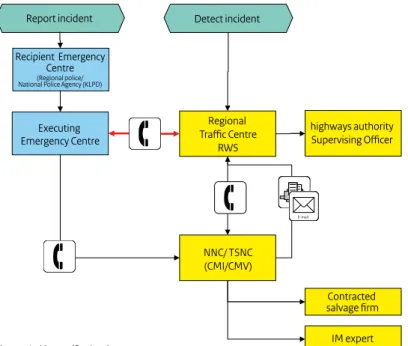
The IM process is the set of work processes from notification to clearing the road. Four phases are involved:
. detection and notification . getting to the scene . action
4. normalisation
Notification and getting to the scene phase For the phase of notification and getting to the scene there are specific IM work processes per discipline. In the notification phase each discipline has to keep to its own verification protocols and legal regulations in respect of driving to the incident and the use of optical and/or audio warning signals
Action phase
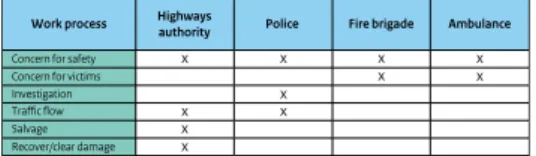
The IM work processes that apply winthin the action phase for the different disciplines are shown in the table below in order of priority.
Normalisation phase
The normalization phase emphasizes the resumption of safe traffic flow
Figure 2: IM work processes for the various emergency services
Work process Highwaysauthority Police Fire brigade Ambulance
Concern for victims Investigation Traffic flow Salvage Recover/clear damage x x x x x x x xx x x
4 Executing Emergency Centre Regional Traffic Centre RWS
Report incident Detect incident
NNC/ TSNC (CMI/CMV) Contracted salvage firm IM expert Fax Fax E-mail E-mail Fax Fax E-mail E-mail highways authority Supervising Officer Recipient Emergency Centre (Regional police/ National Police Agency (KLPD)
5
5 Forms of consultation and scaling up
At the incident site each emergency service deals withits own IM work processes in the right way. Some processes have precedence over others, like ‘victim assistance’ precedes ‘salvage’. This requires agreement and consultation.
Prioritisation of work processes own safety
traffic safety victim assistance
4 technical/criminal investigation 5 traffic flow
6 retention of load and vehicle
On-site coordination and consultation In smaller incidents there is regularly coordination and consultation at the scene between representa-tives of the emergency services and the highways authority.
Coordination (Command) at the Place of the Incident (CoPI)
In larger, more complex incidents – or if a small-scale incident develops into a large-scale incident – the scale becomes GRIP or higher.
6
Communication between the services A key component of the IM work processes is the interaction between one’s own organisation and the other emergency services at the scene of the incident. The following communication methods are used to streamline the interdisciplinary and multidisciplinary communication:
LSD
Effective consultation is based on three key words:
u Listen
u Summarise
u Discuss
CAD (in Dutch: BOB)
The CAD method is the internal priority-setting/ decision-making process that the IM professional should regularly undertake in each phase of dealing with the incident:
u Conceptualise
u Assess
u Decide
7
IRS-EM
Members of the CoPI are using a more advanced IRS-EM method for CAD:
u Information (collecting of): OSE (in Dutch: OSO)
• Object • Subject • Environment
u Risks (deducing, estimating of)
These together form: Conceptualise
u Scenarios (creating)
u Effects / conclusions serving prioritizing action
These together form: Assess
u Measures (devicing of)
This one formes: Decide
CAPS (in Dutch: BAAS)
When consulting with others the CAPS method makes conceptualisation and decision-making unambiguous through structured and efficient information exchange.
u Conceptualise
u Act
u Propose further action
u Summarise
Inform road users
DRIPs (Dynamic Route Information Panels) allow the highways authority to directly inform the road user of incidents in the form of pre-warnings and diversions. The Netherlands Traffic Management Centre (VCNL) supplies the traffic information via providers. In the event of major incidents, the press officer informs the police and the media.
8
7 The UPP ‘Help in incidents’
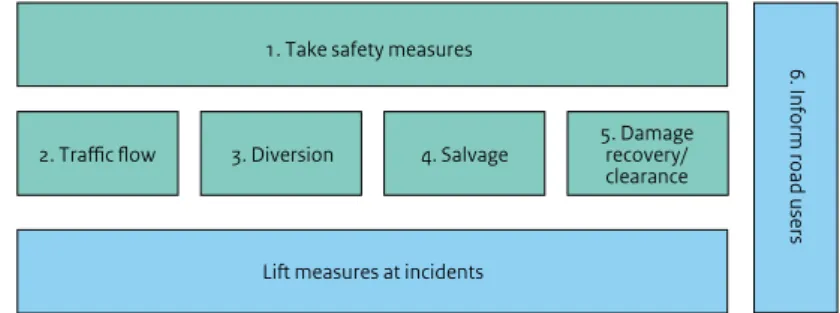
The UPP ‘Help in incidents’ is a highways authority process, the start of which is a more intensified incident notification via a police emergency room and/or regional traffic centre (RTC). The observation of an incident by an employee of one of the IM chain partners on the road may be cause to start the process.The UPP ‘Help in Incidents’ ends when all the measures taken at an incident have ceased and a normal situation is resumed. The process comprises the following IM work processes:
1. Take safety measures
Lift measures at incidents 2. Traffic flow 3. Diversion 4. Salvage
6. I nfo rm ro ad u se rs 5. Damage recovery/ clearance
9
Communication and cooperation
The uniform structure and execution of communica-tion and cooperacommunica-tion ensure efficient and optimal execution of the IM work processes. Seen from the perspective of the highways authority, this is communication and/or cooperation between:
u highways inspector (HI)
u supervising officer (highways authority SO)
u highways traffic supervisor (HTS)
u coordinating highways traffic supervisor (CHTS)
u emergency workers (and any SO emergency
workers)
u contract partners (like salvage companies,
contractors)
u breakdown services
u road users
Scaling up
Scaling up incidents is linked to operational rules of play (see chapter 0). The IM work processes stay the same even in an incident that is scaled up though how the IM work processes are classified may change.
Classifying IM work processes
The term ‘classification’ means the planning, consensus, organisation and execution of work.
0
In small-scale incidents
The uniform method to classify the IM work processes by the HI in small-scale incidents (phase 0) is given below:
1. Establish plan per work process
The HI establishes a plan for how each process will be executed
2. Agree plans with TS
The HI agrees these plans with the TS
3. Agree plans with TS
The HI agrees these plans with the IM chain partners
4. Agree plans with TS
After approval, the HI executes these plans and maintains regular contact with the TS on progress
In large-scale incidents
In scaling up from phase the highways authority SO orchestrates the supervision of the HI that has to classify the IM work processes, making the HI
responsible for establishing and executing one or more IM work processes. This makes a uniform method necessary for classifying IM work processes. This process is shown below:
1. Allocate IM work process
The highways authority SO allocates one or more IM work processes
2. Establish and agree plan per IM work process
The HI establishes – after agreement with the relevant IM chain partner(s) - a plan for how an allocated IM work process is executed through a checklist
3. Get plan approved by highways authority SO
The HI asks the highways authority SO where he can approve the plan
4. Execute plan
The HI executes the plan after gaining approval and maintains regular contact with the highways authority SO and with the TS on progress
5. Establish overall plan
The highways authority SO establishes an overall plan for all individual IM work processes on the basis of the HI plans that influence this overall plan
6. Incorporate overall plan in CoPI
The highways authority SO discusses his overall plan in the CoPI and makes a decision regarding the agreements that influence this overall plan
7. Modify overall plan
The highways authority SO modifies his overall plan in line with the agreements made in the CoPI
8. Feedback and modify plan per IM work process
The highways authority SO feeds back on the modifications to the HI and TS. The HI then adjusts the plan in the light of the IM work process he is assigned
4
8 Details of IM work processes of the highways authority
The following paragraphs outline the followingcomponents per IM work process:
u description of IM work process
u tasks and responsibilities u target group
u relationship with other IM work processes of the
highways authority, directives and protocols
8.1 Safety measures
Description
This IM work process begins with the notification of an incident or an HI’s own observation. The TS will verify the notification according to standard verification protocol, key to this being the safety of the HI (smoke, wind, hazardous substances, hostility, etc.) who must go to the scene. The HI will also consider these aspects too, of course.
5
The start of this IM work process is established during the verification into the notification of an incident or en route to the scene. If the notification appears to require scaling up, this is immediately enforced. Once at the scene, the HI acts according to the ‘Directive for Initial Safety Measures in Incidents for unilateral and bilateral collision danger’.
This directive is not yet translated into English. In 005, an English translation was released by the Dutch version of the ‘Directive Initial Safety Measures for Incidents on Motorways’ in 004. This directive developed in subsequent years into a new directive and differs in parts of the directive in 004. The flashing lights discipline is monitored and any subsequent measures initiated.
This IM work process is classified by the HI and agreed with the TS and the police.
This work process relates to the police processes and is the start of classifying the IM work processes: ‘traffic flow’, ‘diversion’, ‘salvage’, ‘damage recovery/ clearance’ and ‘inform road users’.
6
TS HI
Organise signalling (arrows, crosses, speed) Decide to scale up
Inform KLPD, Regional police, VCNL
Inform TS (cause, residual duration)
Adjust plan and actions according to changes Drive to scene of incident
Collate with police processes Call out highways authority SO
Incident observed
Verification of notifying agent Incident reported
Diversion Salvage Damage recovery/clearance Inform road users Traffic flow
6 1st safety measures + 4 rules by hazardous substances
(see GISMI)
7 Goal
The safest possible workplace at the scene of the incident, taking account of the following priorities:
u own safety
u safe workplace
u safety of those involved u traffic safety
Target group
u emergency services at the scene
u those involved in the incident and dealing with it,
like victims, emergency services
u other road users
Tasks include: Traffic supervisor (TS) u notification verification u regulating signaling u decision to scale up
u call up/inform highways authority SO
u inform police emergency centre, VCNL highways
inspector (HI)
Highways inspector (HI) u notification verification u go to scene of incident u take initial safety measures
u inform TS/SO
u if not first at scene, check with emergency
services already present
8 Relationship with other IM work processes of the highways
authority, directives and protocols:
u directive for initial safety measures at incidents u safeguard investigation
u directive 96A Measures, WIP
u disaster plans
u act upon incidents involving hazardous
substances (incl. subsequent damage)
u act upon incidents involving a (starting) fire
u undertake rescue
u trauma care: request collegial back-up
following shock
u IM related police work processes
8.2 Traffic flow
Description
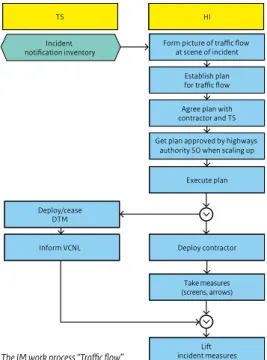
This IM work process starts following the notification of and/or registered notification of an incident. The TS places traffic measures on the matrix boards emanating from camera pictures or by request of the emergency services.
The work relates to the IM process ‘ take safety measures’ and ensures that the road user is advised concerning speed so as to optimise the traffic flow, for which the HI establishes a plan of action at the scene in agreement with the TS and the police, possibly detailing a number of current and future scenarios.
9
The IM work process ‘traffic flow’ ends when the traffic measures taken for the incident are lifted; when all DTM measures are no longer in operation and the equipment of the contractor(s) at the scene are cleared.
TS HI
Establish plan for traffic flow
Deploy/cease DTM
Get plan approved by highways authority SO when scaling up
Execute plan
Take measures (screens, arrows) Form picture of traffic flow
at scene of incident
Agree plan with contractor and TS
Inform VCNL Deploy contractor
Lift incident measures Incident
notification inventory
0 Goal
The traffic flow in the vicinity of the incident is safe and optimal, whereby own safety, the safety of the incident scene and those involved at incident are secured.
Target group u road users
u emergency services still en route to the incident
scene Tasks include: Traffic supervisor (TS)
u deploy DTM measures
u inform VCNL
Highways inspector (HI)
u inform road user at scene
u establish traffic flow plan
u agree plan with TS and police
u get approval of plan from highways authority SO
for scaling up
u deploy contractor
Relationship with other IM work processes of the highways authority, directives and protocols:
u traffic management at scene
8.3 Diversions
Description
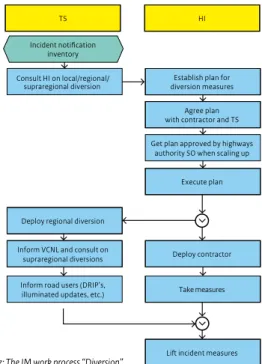
A registered notification of an incident may be the starting signal for the TS to organise a ‘diversion’ after safety measures have been taken.
If necessary, one or more major diversion routes may be implemented. The RTC has an internal scaling system to indicate who has authority for local, regional and supraregional diversions, whereby scenarios are used. In the event of scaling up local diversions come under the responsibility of the highways authority SO. Work in progress (WIP) may be suspended on the diversion route.
The IM work process ends when the traffic measures taken for the incident are lifted; when all DTM measures are no longer in operation and any equipment of the contractor(s) at the scene are cleared.
TS HI
Establish plan for diversion measures
Deploy regional diversion
Execute plan
Take measures Consult HI on local/regional/
supraregional diversion
Agree plan with contractor and TS
Deploy contractor
Lift incident measures Incident notification
inventory
Get plan approved by highways authority SO when scaling up
Inform VCNL and consult on supraregional diversions
Inform road users (DRIP’s, illuminated updates, etc.)
Goal
Traffic distribution via other overflow routes to relieve/avert the incident area and safeguard traffic flow. Target group u road users Tasks include: Traffic supervisor (TS) u consult on local/regional/supraregional diversions u implement diversions
u inform VCNL & consult on supraregional
diversions
u inform road user
Highways inspector (HI)
u establish plan for diversion measures
u agree plan with TS and police
u approval of plan from highways authority SO
when scaling up
u deploy contractor
Relationship with other IM work processes of the highways authority, directives and protocols:
u protocol for diversions
(local, regional and supraregional)
u diversion scenarios
8.4 Salvage
Description
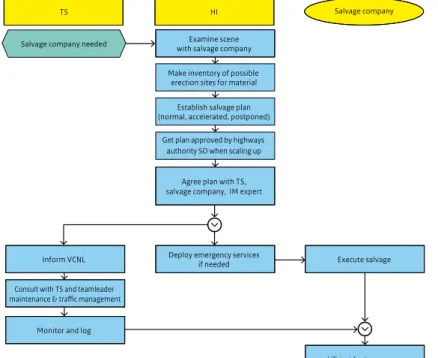
The start of this IM work process is a notification received at the National Notification Centre Incidents (NNCI) or Truck Salvage Notofication Centre (TSNC), whereby the TS knows that a salvage vehicle is en route. This may run parallel to the process ‘take safety measures’. If the TS is cognisant of the fact that a truck is involved in the incident, the TS will notify TSNC, which will send an IM expert to the scene to advise where appropriate on salvage options. A check must establish which salvage company goes to the scene of the incident, and the HI will examine the vehicle to be salvaged together with the salvage company, establish a plan along with the salvage method.
Upon scaling up, the HI consults with the highways authority SO about the most suitable method and time of salvage, depending on the situation. Three salvage choices exist:
. normal
. accelerated - with any additional damage to the vehicle/cargo/road
4
TS HI Salvage company
Make inventory of possible erection sites for material
Examine scene with salvage company
Get plan approved by highways authority SO when scaling up
Establish salvage plan (normal, accelerated, postponed)
Inform VCNL
Monitor and log
Deploy emergency services
if needed Execute salvage
Lift incident measures Salvage company needed
Agree plan with TS, salvage company, IM expert
Consult with TS and teamleader maintenance & traffic management
5 Goal
The traffic flow in the incident area is optimised by the salvage option and the time it occurs adjusted to the traffic intensity.
Target group
u road users
Tasks include: Traffic supervisor (TS)
u inform VCNL
u inform NNCI and/or TSNC
u monitor and log
Highways inspector (HI)
u examine vehicle to be salvaged with salvage
company
u register possible erection sites for material u establish plan for salvage (normal, accelerated,
postponed)
u approval of plan from highways authority SO
when scaling up
u agree plan with TS, salvage company, IM expert
Relationship with other IM work processes of the highways authority, directives and protocols:
u accelerated and postponed truck salvage process
u protocol for additional lanes during rush-hours u disasters – contact contractor
6
8.5 Damage recovery / clearance
Description
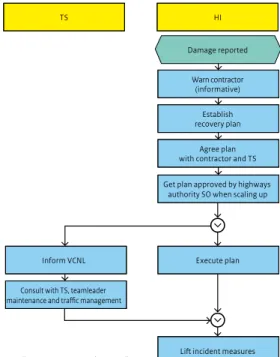
The start of this IM work process is a notification received by the TS of damage to the road surface, crash barrier, etc. The contractor can be informed in advance that he may be called upon. The requisite material and personnel must be promptly called in and be available, and the time and recovery/clearance method decided, taking account of minimum traffic disruption. The IM work process ends when the recovery and clearance of the scene of the incident have been executed according to the terms and conditions of the contract.
TS HI
Warn contractor (informative)
Agree plan with contractor and TS Get plan approved by highways
authority SO when scaling up Establish recovery plan
Inform VCNL Consult with TS, teamleader maintenance and traffic management
Execute plan
Lift incident measures Damage reported
7 Goal
The quality and safety of the road, road furniture and/ or structures is optimally safeguarded for the purpose of traffic safety. Target group u road users Tasks include: Traffic supervisor (TS) u inform VCNL
u consult HI of highways authority SO (when
scaling up)
Highways inspector (HI)
u warn contractor (informative)
u establish plan for recovery u agree plan with TS and contractor
u approval of plan from highways authority SO
when scaling up
Relationship with other IM work processes of the highways authority, directives and protocols:
8
8.6 Inform the road user
Description
The start of this IM work process is a notification received by the TS. If the road on which the incident occurs also has cameras and traffic signalling, these will be activated in one of two ways:
u automatically, according to data from detection
loops in the road (based on speed and/or traffic intensity)
u manually, based on camera pictures or upon
request by the emergency services going to or at the scene
The IM work process can be supported in all events by the HI at the scene using the DRIP on his service vehicle.
If a diversion is implemented, the road user can be informed in two ways:
u DRIP’s above the road. There is national
agreement on the texts to be used.
u VCNL provides the traffic information and a
forecast of the duration of the hindrance via providers.
The IM work process ends when the traffic measures are lifted.
N.B.: In cooperation with the Driving Test
Organisation (DTO) and driving schools the road user will be informed about IM in the coming years, with attention focusing on the required driving behaviour of road users in traffic jams, alongside incidents and what to do in breakdown situations.
9 Goal
Road users adjust driving behaviour to the situation (traffic jam/incident) as learned
u to recognise a situation
u to recognise the highways authority as in charge
of traffic safety and management Target group u road users Tasks include: Traffic supervisor (TS) • deploy DTM measures • inform VCNL
Highways inspector (HI)
• inform road user at incident area
• establish a plan for communication to road user • agree plan with TS and emergency service
representatives
• approval of plan from highways authority SO when scaling up
40
9 Scaling up to Highways authority SO
Scaling up may be an informative or operationalprocess. Informative
The highways authority SO is informed by the TS. Operational
The highways authority SO takes over responsibility for dealing with the incident. This may be remotely (by phone, for instance) depending on the decision of the highways authority SO called up. If the HI or TS requests the presence of the SO at the scene, the SO always goes to the scene.
Scaling up process
Scaling up ensues based on the first notification or subsequent information that complies with the criteria for scaling up.
4
Disaster organisation
Within the disaster organisation of the highways authority there are four distinct scales (see figure chapter ) that result in four coordination phases (0 to ) in scaling up containment.
Within the disaster organisation of the highways authority the HI has an operational function level; phase 0, or small-scale incidents. The HI is the representative of the highways authority in on-site coordination and consultation and wears the green bib.
In the case of large-scale incidents, to phase , the highways authority SO will come to the scene. The HI is still part of the on-site coordination and consulta-tion and/or CoPI until the SO arrives, after which the SO takes his place in the on-site coordination and consultation.
4
Scaling up criteria for highways authority The following criteria apply to scaling up to phase (GRIP ) within the disaster organisation of the highways authority:
u Incidents where the emergency services scale up to
GRIP
u Incidents with a significant impact on traffic flow o lengthy traffic jams
o full lane closure
o diversions
o incidents just prior to rush-hour
o complex incidents
u incidents involving trucks with hazardous
substances or livestock
u incidents involving fatalities or serious injuries u incidents involving own personnel /contacts
u incidents involving significant damage to the
property of the highways authority
u incidents involving (overturned) truck(s) with
salvage options
u cross-district incidents
u incidents that are politically sensitive and attract the
media
u all other incidents not described under the criteria
above but which, in the opinion of the TS, can be considered as serious and time-consuming
u all incidents not described under the criteria above
4
10 Main contact details
Programmabureau Incidentmanagement (PB-IM) Telephone number – (00) 80700 / (00) 807450 E-mail - [email protected]Internet site - www.incidentmanagement.nl Verkeerscentrum Nederland (VCNL) Telephone number – (00) 80700 Emergency number - 495 Police
Police required? Then call
Inspectie Verkeer & Waterstaat (IVW) - Central office in The Hague
Telephone number – (070) 456 6 66 Truck salvage notification Centre Requests for truck salvage are via police emergency centres Telephone number:
44
COORDINATING
Verkeerscentrum Nederland (VCNL) Telephone number – (00) 80700 REGIONAL TRAFFIC CENTRES:
Noord- en Oost-Nederland - Wolfheze Telephone number - (06) 48 4 Emergency number - 8447 Utrecht
Telephone number – (00) 80 66 00 Emergency number - 46
Noord-West Nederland – Velsen-Zuid Telephone number - (055) 565 700 Emergency number - 545
Zuid-West Nederland - Rhoon Telephone number - (00) 50 00 Emergency number - 868 Zuid-Nederland - Geldrop Telephone number - (040) 80 95 50 Emergency number – 409
45
11 Appendices
CAD Conceptualise, Assess, Decide
CAPS Conceptualise, Act, Propose, Summarise
CoPI Coordination (Command) at the Place of
the Incident
CTS Coordinating Traffic Supervisor
DPSMI Directive for Primary Safety Measures for
Incidents with unilateral and bilateral collision hazard
DPW Department of Public Works (RWS)
DRIP Dynamic Route Information Panels
DSC Disaster Site Command (in Dutch: CORT)
DTM Dynamic Traffic Measures
DTO Driving Test Organisation
EMA Emergency Medical Assistance
GRIP Coordinated Regional Incident
contain-ment Procedure
HI Highways Inspector
IM Incident Management
I&M Ministry of Infrastructure and
the Environment
IPO Interprovincial Council
IRS-EM Information, Risks, Scenarios -
Effects, Measures (IRS-EM method for CAD)
LPR National Passenger Car Regulations
LSD Listen, Summarise and Discuss
MAAD Medical Assistance in Accidents and
Disasters (in Dutch: GHOR)
MCT Maintenance, Control and Traffic
MMT Mobile Medical Team
MT Management Team
46
NNCI National Notification Centre Incidents (in
Dutch: CMI)
NPC National Police Agency (in Dutch: KLPD)
NTR National Truck Regulations (in Dutch: LVR)
PB-IM Program Bureau Incident Management
PPH Preventive Public Healthcare
(in Dutch: POG)
PSAAD Psycho-Social Assistance in Accidents and
Disasters (in Dutch: PSHOR)
ROT Regional Operational Team
RTC Regional Traffic Centre (in Dutch: RVC)
RWS Rijkswaterstaat (Department of Public
Works)
SO Supervising Officer
TI Transport Inspectorate
TS Traffic Supervisor
TSNC Truck Salvage Notification Centre
(in Dutch: CMV)
UPP Uniform Primary Processes
VCNL Verkeerscentrum Nederland (The
Netherlands Traffic Management Centre)
47
12 Colophon
The coordinator and owner of this IM work processes guide is the Programme Bureau for Incidentmanagement of Verkeerscentrum Nederland. April 0 Rijkswaterstaat Verkeerscentrum Nederland Programmabureau Incidentmanagement Papendorpseweg 0 58 BJ UTRECHT T. (00) 80 7 00 F. (00) 80 7 7 www.incidentmanagement.nl
This is a publication of
Rijkswaterstaat
For more information go to www.rijkswaterstaat.nl or phone 0800 - 800
(Mon till Sun 06.00 - .0, free of charge) April 0