THE STUDY OF MECHANICAL PROPERTIES OF PINEAPPLE LEAF FIBRE REINFORCED TAPIOCA BASED BIOPLASTIC RESIN COMPOSITE
D. Mathivanan 1, H. Norfazilah1, J.P. Siregar 1, M.R.M. Rejab 1, D. Bachtiar1, C. Tezara2
1
Faculty of Mechanical Engineering, Universiti Malaysia Pahang, 26600 Pekan, Pahang, Malaysia, *Email: [email protected]
2
Department of Mechanical Engineering, Faculty of Science, Technology, Engineering and Mathematics, INTI International University, 71800 Nilai,
Negeri Sembilan, Malaysia
ABSTRACT
Natural fibre reinforced composite has brought the material engineering to a high new level of research. Natural fibres are compatible with matrices like polypropylene and can be used as reinforcement material to reduce the composition of plastic in a material. Natural fibres such as kenaf, pineapple leaf, and coir already found its importance in reducing the dependence of petroleum based products. However the biodegradability of the product at the end of the intended lifespan is still questionable. This has led many researches to look for a suitable replacement for synthetic fibres and achieve better adhesion between fibre and matrix. In this study, fiber and matrix which are hydrophilic in nature was used and the mixture was extruded and hot compressed to acquire better mechanical properties. The specimens were fabricated and tested according to ASTM D638. The 30% composition illustrates the best average modulus value among other composition and from this result it can be concluded that the increase of PALF fibre in TBR composite increases the modulus strength of the composite.
Keywords: Pineapple leaf fibre; mechanical properties; tapioca bioplastic composite.
INTRODUCTION
The depletion of petroleum, landfill issues and degradability of product has urged variety of studies to be carried out worldwide to find a suitable solution for the problem stated[1]. New materials have been tested and studied to replace the current synthetic fibres which are made from petroleum and difficult to be degraded naturally by enzyme or bacteria[2]. Natural fibres which are found abundantly and a renewable resource has caught the attention of researches all over the world[3]. There are three types of natural fibres which are plant fibre, animal fibre and mineral fibres which are already being studied[4]. Plant fibres which are mostly from agricultural waste can be found in most of the countries in the world[5]. Every year, tropical countries like Thailand, Malaysia, and Indonesia records tonnes of waste from agricultural crops[6].
Natural plant fibres’ usage in mass industries such as automotives, construction, sports and medicine has already seen rapid increase due to its good properties such as high tensile strength, acoustic insulate, light weight, low cost, less health risk and non abrasiveness towards equipment[7]. Plant fibres has good mechanical properties which almost equivalent with glass fibres. These properties are results of high cellulose
2
content in plant fibre which has high number of hydroxyl group bonded in intramolecular pattern among macrocellulose[8].
In past studies done by researchers on PALF with synthetic fibres such as polypropylene and polyvinyl acid has shown drastic improvement in terms of strength[9], however these composite are found hard to be decomposed naturally by microorganisms. Moreover the adhesion between PALF and synthetic matrices are low due to the difference in polarity between fibre and matrix which makes the bonding to be weak[10]. In this study we will use tapioca based bioplastic resin as matrix because of the chemical similarity between starch in tapioca flour and cellulose in PALF where both are hydrophilic in nature[11].
We will use extrusion[12] followed by hot compression moulding[13] method to fabricate the specimen as this techniques are used widely and shown better results than most of the fabrication methods. Fabrication technique plays an important role in enhancing the properties of the composite as the temperature and the method used determines the properties of the final product.
In this study we will use pineapple leaf fibre (PALF) as reinforcement material to reinforce tapioca based bioplastic resin (TBR). Pineapple leaf is one of the main agricultural wastes in Malaysia as this country is one of the major export countries of this fruit which enables PALF to be found abundantly and easily accessible for the project. The main objective of this research was to study the mechanical properties of PALF reinforced TBR composite.
METHODOLOGY
In this research, we will study the adhesion and the best compatibility between PALF and TBR through several tests by manipulating the composition of the composite according to Table 1. The temperature for extrusion and hot compress process were set to 160oc at maximum to avoid PALF fibre from damaging due to excess heat. The mould was prepared according to ASTM D638 specimen size to achieve the best result. The parameters such as span length and crosshead speed for the testing also was set constant as stated in ASTM D638. Altogether 28 experimental test run was conducted and 5 best results from each composition will be taken for average value calculation. Experimental Procedure
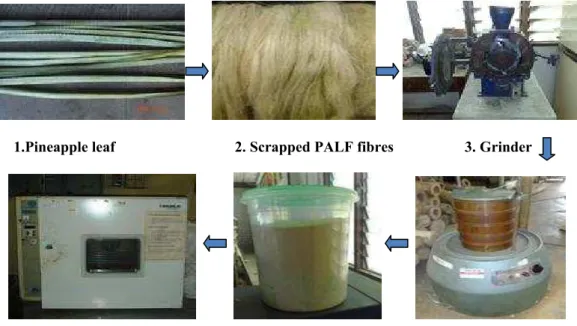
PALF is made through scrapping the pineapple leaf with a sauce plate. The fibres are then cut into small sizes and grind. The grinded fibres were then sieved to get the highest amount of fibre length available. Then the fibres are placed in oven for 24 hours before the experiment. The composites were made through mixing the PALF and TBR according to the composition in Table 1. The mixture was first extruded into pellet using extrusion, followed by pelletizer. The extrusion temperature for all zone were set at 160oc. The pellets were then placed in the mould and hot pressed at 160oc for 5 minute at 8 Mpa, and then cold pressed at room temperature for 5 minute at 8 Mpa. The composites were then cut into ASTM D638 specimen size using a hand saw. The specimens were tested for tensile strength using INSTRON machine according to ASTM D638 parameters. The top five results were taken from the INSTRON machine for analysis and average value calculation.
3
1.Pineapple leaf 2. Scrapped PALF fibres 3. Grinder
6. Vacuum Oven 5. Sieved PALF fibre 4. Sieve Shaker
Figure 1-6 Preparation of materials
7. Extruder 8. Hot Compression Moulding 9. PALF/TBR Composites
Figure 7-9 Preparation of Composites
Table 1. PALF and TBR mixture by weight fraction.
TBR/PALF Mixture PALF TBR Pure TBR plate 0% 100% 10% PALF reinforced TBR composite plate 10% 90% 20% PALF reinforced TBR composite plate 20% 80% 30% PALF reinforced TBR composite plate 30% 70%
4
RESULTS AND DISCUSSION
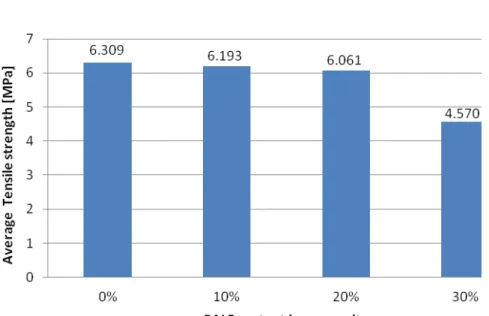
Figure 10. Average Tensile strength of PALF/TBR Composite
5
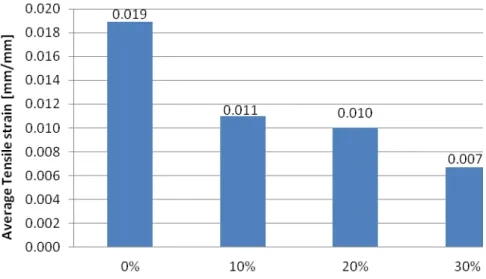
Figure 12. Average Tensile strength of PALF/TBR Composite
Figure 10 and 11 shows that the average modulus and average tensile strength obtained from the experiment. It can be observed that the average modulus increases as the fibre content increases in the composition and the highest were 1.145GPa at 30% PALF content. This is due to the availability to transfer stress through fibre which enables the composite to hold the load longer and better as the fibre loading increases. However the average tensile strength presents decrease as the fibre content and the highest average tensile strength were 6.3088MPa at 0% PALF content, this is caused by the increase of fibre in the composites causes’ fibre agglomeration or fibre overlapping which causes weak bond between TBR and PALF. Another reason for this result is the fabrication method where the composites were cut into specimens using hand saw which also weakens the bond between matrix and fibre. Furthermore, in Figure 12 it was noted that the graph showed decrease as the fibre loading increased. This is because the change in characteristic of the composite in term of ductility and brittleness where the composite becomes more brittle as the fibre composition increases in the composite making the specimens easier to break.
CONCLUSIONS
From this research, it can be concluded that the effort to reinforce tapioca based bioplastic resin with PALF has shown positive result where the average modulus of the composite show an improvement at 30% PALF/TBR composite which is higher value than the pure tapioca based bioplastic resin although the average tensile strength of 10% PALF/TBR composite shown a slight decrease than the pure TBR. The best compatibility and adhesion between PALF and TBR were at 30% because of the increase in PALF fibre. All the objective of the studies has been achieved in this experiment.
6
ACKNOWLEDGEMENTS
The authors wish to thank the Ministry of Higher Education, Malaysia, for funding the research through the Fundamental Research Grant Scheme (FRGS) grant number 140120. The authors also would like to be obliged to Universiti Malaysia Pahang for providing laboratory facilities.
REFERENCES
[1] Kengkhetkit, N. and T. Amornsakchai, A new approach to “Greening” plastic composites using pineapple leaf waste for performance and cost effectiveness. Materials & Design, 2014. 55(0): p. 292-299.
[2] Leao, A.L., et al., Agro-Based Biocomposites for Industrial Applications. Molecular Crystals and Liquid Crystals, 2010. 522(1): p. 18/[318]-27/[327].
[3] Davindrabrabu, M., et al. Effect of Fibre Loading on the Flexural Properties of Natural
Fibre Reinforced Polymer Composites. in Applied Mechanics and Materials. 2015.
695(0): p.85-88.
[4] Satyanarayana, K.G., G.G.C. Arizaga, and F. Wypych, Biodegradable composites based
on lignocellulosic fibers—An overview. Progress in Polymer Science, 2009. 34(9): p.
982-1021.
[5] Arib, R.M.N., et al., Mechanical properties of pineapple leaf fibre reinforced
polypropylene composites. Materials & Design, 2006. 27(5): p. 391-396.
[6] Nayan, N.H.M., W.A.W.A. Rahman, and R.A. Majid, The effect of mercerization process on the structural and morphological properties of Pineapple Leaf Fiber (PALF) pulp. Malaysian Journal of Fundamental and Applied Sciences, 2013. 10(1).
[7] Vinod B and D.S.L. J, Effect of Fiber length on the Tensile Properties of PALF Reinforced
Bisphenol Composites. International Journal of Engineering, Business and Enterprise
Applications (IJEBEA), 2013. 5(2): p. 158-162.
[8] Kabir, M.M., et al., Chemical treatments on plant-based natural fibre reinforced
polymer composites: An overview. Composites Part B: Engineering, 2012. 43(7): p.
2883-2892.
[9] Leao, A.L., et al., Pineapple Leaf Fibers for Composites and Cellulose. Molecular Crystals and Liquid Crystals, 2010. 522(1): p. 36/[336]-41/[341].
[10] Mishra, S., et al., A Review on Pineapple Leaf Fibers, Sisal Fibers and Their
Biocomposites. Macromolecular Materials and Engineering, 2004. 289(11): p. 955-974.
[11] Ozemoya, P.O., E.S.A. AJISEGIRI, and P.A. IDAH, Production of Adhesives from Cassava
Starch. Leonardo Electronic Journal of Practices and Technologies, 2007(10): p. 93-98.
[12] Gunning, M.A., et al., Effect of Compatibilizer Content on the Mechanical Properties of
Bioplastic Composites via Hot Melt Extrusion. Polymer-Plastics Technology and
Engineering, 2014. 53(12): p. 1223-1235.
[13] Rett, H.T., Thermal and microscopic analysis of biodegradable laminates madefrom
cassava flour, sorbitol and poly (butylene adipate-coterephthalate) PBAT. Acta