A STUDY ON THE EFFECT OF PHYSICAL, MECHANICAL AND, MORPHOLOGICAL PROPERTIES OF PINEAPPLE LEAF FIBER REINFORCE
CORNSTARCH BIODEGRADABLE PLASTIC COMPOSITE
NUR AMANINA SYAZWANI BINTI ASERI
This report is submitted
in fulfillment of the requirement for the degree of Bachelor of Mechanical Engineering with Honours
Faculty of Mechanical Engineering
UNIVERSITI TEKNIKAL MALAYSIA MELAKA
DECLARATION
I declare that this thesis entitled “The Effect Of Pineapple Leaf Fiber Reinforce Cornstarch Biodegradable Plastic Composite To The Physical, Mechanical, And Morphological Properties” is the result of my own research except as cited in the references. The thesis has not been accepted for any degree and is not concurrently submitted in candidature of any other degree.
APPROVAL
I hereby declare that I have read this dissertation/report and in my opinion this
dissertation/report is sufficient in terms of scope and quality as a partial fulfillment of
Bachelor of Mechanical Engineering.
i
ABSTRACT
ii
ABSTRAK
iii
ACKNOWLEDGEMENT
First of all, I would like to express my most gratitude to ALLAH S.W.T for given me the oppurtunity to finish this research without any problems. Without HIS permission, I would never be able to complete this research.
I would like to express my acknowledgement to Dr. Nadlene Binti Razali for all the help and guidance that she has given to me in completing this research. As my supervisor, she plays an important role in my research. Also not to forget, my gratitude to Encik Nazri and Encik Rizal for assisting me in performing the experiment and testing for this research. Without their supervision and guidance, I would never complete the experiment and testing in time.
A special gratitude goes to the Faculty of Mechanical and University Teknikal Malaysia Melaka (UTeM) for giving me all the facility required for me to undergo my research testing. Without the provided facility, I can never be able to finish my research successfully.
iv
TABLE OF CONTENTS
DECLARATION
i
APPROVAL
ii
ABSTRACT
i
ABSTRAK
ii
ACKNOWLEDGEMENT
iii
TABLE OF CONTENTS
iv
LIST OF TABLES
vi
LIST OF FIGURES
vii
LIST OF APPENDICES
ix
LIST OF ABBREVIATIONS
x
LIST OF SYMBOL
xi
Chapter 1
1
INTRODUCTION 1
1.0 Overview 1
1.1 Problem Statement 3
1.2 Research Objectives 4
1.3 Scope of Study 5
Chapter 2
6
LITERATURE REVIEW 6
2.0 Introduction 6
2.1 Natural Fibre 6
2.2 Pineapple Leaf Fibre (PALF) 11
2.2.1 Extraction Method of PALF 12
2.2.2 Pineapple Leaf Fibre Composite 13
2.3 Alkaline Treatment 16
2.3 Corn Starch 20
Chapter 3
22
3.0 METHODOLOGY 22
3.1 Overview of Methodology 22
3.2 Composite Preparation 24
3.2.1 PALF Preparation 24
3.2.1.1 Alkali Treatment 24
3.2.1.2 PALF Fabrication 27
3.2.2 Matrix Preparation 28
3.2.3 Composites Preparation 29
v
3.3.1 Characteristic of Physical Properties 31
3.3.1.1 Density 31
3.3.1.2 Moisture Content 32
3.3.1.3 Water Absorption 33
3.3.2 Mechanical Testing 34
3.3.2.1 Tensile Test 34
3.3.2.2 Flexural Test 35
3.3.3 Morphological 36
3.3.3.1 SEM 36
Chapter 4
37
4.0 RESULT AND DISCUSSION 37
4.1 Physical Properties 37
4.1.1 Density 37
4.1.2 Moisture Content and Water Absorption 38
4.2 Mechanical Testing 42
4.2.1 Tensile Test 42
4.2.2 Flexural Testing 44
4.3 Morphological 46
4.3.1 Scanning Electron Microscopic (SEM) 46
Chapter 5
49
5.0 CONCLUSION AND RECOMMENDATION 49
REFERENCES
51
vi
LIST OF TABLES
TABLE TITLE PAGE
2.1 The Equilibrium Moisture Content of Natural Fibre 9
2.2 Comparison of Thermoplastic and Thermoset Matrix 14
2.3 The Alkali(NAOH) Treatment Natural Fibre 18
2.4 Alkali Treated Fibre Reinforced PolymerComposites 20
vii
LIST OF FIGURES
Figure Title Page
2.1 Natural fibre main classes 8
2.2 PALF machine 12
2.3 Extraction process of PALF 13
2.4 Work reported on mechanical characteristics of thermoset hybrid
composites 15
2.5 Work reported on mechanical characteristics of thermoplastics hybrid
composites 16
2.6 Structure of (i) untreated and (ii) alkalized fibre(Kabir et al., 2012) 19
3.1 Overall research process 23
3.2 Gantt chart 24
3.3 PALF soaked in NAOH solution 25
3.4 Composite Preparation Flowchart 26
3.5 Smoothen PALF 27
3.6 Cutting process of treated PALF 27
viii
3.8 Sample Preparation into mould 30
3.9 Sample being pressed by hot press machine 31
3.10 Electronic Densimeter 33
3.11 Oven used in moisture testing 34
3.12 Sample of Water Absorption 35
3.13 Instron Universal Testing Machine, Model 5980 Series 36
3.14 Sample Position 36
3.15 (a) Position of sample for flexural test, (b) Sample after being bend 37
3.16 (a) Scanning Electron Microscope , (b) Sample Placement,(c) Sample
Coating Machine 38
4.1 Result of the effect of fibre loading towards the composite density 40
4.2 Moisture content of PALF reinforced cornstarch composite to its fibre
loading 41
4.3 Water absorption of the PALF reinforced cornstarch composite to the
fibre loading 42
4.4 Tensile strength of PALF reinforced cornstarch composite to the fibre
loading 44
4.5 Flexural Strength to the fibre loading 45
4.6 Figure 4.6: (a) 10 wt% fibre loading sample, (b) 30 wt% fibre loading
ix
LIST OF APPENDICES
Appendix Title Page
A ASTM D 3039 56
B ASTM D 7264 57
x
LIST OF ABBREVIATIONS
Abbreviations
PALF Pineapple Leaf Fibre
PFRR Polymer From Renewable Resources
PLA Polyactic acid
PHB Polyhydroxy Butyrate
SEM Scanning Electron Microscopy
CFRP Carbon Fibre Reinforced Polymer
NFRP Natural Fibre Reinforced Polymer
GFRP Glass Fibre Reinforced Polymer
TPS Thermoplastic Starch
RH Relative Humidity
xi
LIST OF SYMBOL
Symbol
NAOH Sodium Hydroxide
OH Hydroxyl
NA Sodium
Water Density
m Mass
1
CHAPTER 1
INTRODUCTION
1.0 Overview
Lately, the world has been facing so many problems regarding to environmental issues. Some of the issues arise are such as the harmful industrial material that can affected people health, the disposal of the unbiodegradable material such as plastic and the global warming cause by the greenhouse effect. In order to overcome these arising problem, researchers from all over the world are considering in producing environment-friendly material or also known as green material. One of the solution that recently highlighted by the researchers is that replacing the synthetic fibre composites with the natural fibre composites. This is due to the reason that natural fibre has many advantages compared to the synthetic fibre. The advantages of the natural fibre are (Pickering, Afendy and Le, 2016) low in density and high specific strength and stiffness, renewable resource, can be produced at lower cost than synthetic fibre, low hazard manufacturing processes, low emission of toxic fumes when dealing with heat and during incineration at end of life, and less abrasive damage to processing equipment compared with that for synthetic fibre composites. There are many bio-composites products that are being commercialized from a fibre based plant such as kenaf, jute, roselle, sugar palm fibre and banana pseudo stems.
2
Malaysia due to the facts that it is one of the most important tropical fruits in Malaysia. This is due to the fact that in Malaysia alone, over 130 distinct species of pineapple are cultivated. Currently, the main focus of this country pineapple industry are the fruits and related foodstuffs while the pineapple leaves are treated as agricultural wastes where it either being let composted or burned by farmers. This lead to the wasting of a very potential source of good natural fibres.
Researchers found that the PALF are vary in their properties according to the plant types, geographical regions, plant age, and weather conditions. Non-treated and treated PALF of various lengths and fibre loadings have been used to reinforce matrices such as polypropylene, polyethylene, polycarbonate and polyester (Mohamed et al., 2009).
Polymers from renewable resources have attracted the attentions of researcher because of two major reasons that is firstly environmental concerns, and secondly the realization about the finite of petroleum resources. Polymers from renewable resources (PFRR) can be classified into three groups where the first group is natural polymers, such as starch, protein and cellulose synthetic polymers, while the second group is from the natural monomers, such as polylactic acid (PLA) and lastly the polymers from microbial fermentation, such as polyhydroxy butyrate (PHB). Many properties of PFRR can also be improved through blending and composite formation like numerous other petroleum-based polymers. In order to prevent premature degradation, it is important to control the environment in which the polymers are used. For instance, the water solubility of majority of natural polymers raises their degradability and the speed of degradation, but this moisture sensitivity will limit their application.
3
natural resource. One of the most promising polymers in this matter is PLA, since it is made from agricultural products and readily biodegradable (Yu, Dean and Li, 2006).
This study discusses the PALF’s mechanical, chemical, thermal, and physical characteristic comparing it with the other established bast fibres like kenaf and roselle. In this research, the PALF was treated using alkali treatment in hopeful to produce a PALF composites that have better physical, mechanical, morphological and thermal properties. The mechanical properties and reaction of the PALF and natural polymer or in this content corn-starch will be observed and valued in this study and hopefully to produce a fully functioning composite that are 100% consist of natural material.
1.1 Problem Statement
Natural fibres are being the main focus of research as it is more environmental friendly if compared to the existing glass and carbon fibres. Other than that, natural fibre has a lot of unexplored potential and advantages which attracted researcher all around the world to conduct the studies. Although natural fibre contains many advantages and potentials, it also has its own shortcomings. Results from previous studies show that natural fibre has a lower strength compared to the synthetic fibre like glass and carbon fibre. To overcome this problem, natural fibre need to be re-strengthen before it can be used as a composite.
The pineapple leaf fibre (PALF) can be abundantly found in Malaysia as it is one of the biggest sector in Malaysian agriculture sector. Generally, the leaves of the pineapple plant are let to composed or burnt as that only the fruits are being used. It is a waste as the leaves can be treated as one of the main resources of natural fibres for natural composites.
4 1.2 Research Objectives
For this research, there are two objective that are:
1. To investigate the effect of PALF fibre loading to the cornstarch reinforcement in terms of physical and mechanical properties.
5 1.3Scope of Study
The aim of this study is to evaluate the effect of fibre loading on the pineapple leaf fibre (PALF) reinforced corn starch polymer in terms of its morphological, mechanical and thermal properties. In this research, the PALF is treated with alkaline treatment and blended with corn starch and glycerol mixture to form the composite sample. The research’s methodology is experimental investigation where it is divide into two phases.
The first phase of this research is to investigate the fibre loading of PALF toward physical and mechanical properties of the composites. The composites were prepared into four fibres loading which are, 5%, 10%, 15%, 20%, 25%, 30%, 40%, 50%, 60% and 70%. The composites are being fabricated by laying up the PALF and corn starch with glycerol mixture into the mould and then will be inserted into the hot press machine. The testing involved in the phase are density test, moisture test, water absorption test, tensile testing, and flexural test.
The second phase involve the analysis of the morphological properties of the PALF reinforced corn starch polymer. The testing that being done is Scanning Electron Microscopy (SEM).
6
CHAPTER 2
LITERATURE REVIEW
2.0 Introduction
For the last two decade, researchers and scientist have been attracted to the study about polymer from renewable resources (PFRR) due to environmental concern and finite petroleum resources realization. These problems have made bio composite considerable important and becoming a very wide range of properties of engineering materials. The main advantages of natural polymer are that it has a good potential in management of waste, biodegradability and in lower ash production during the incineration.(Yu, Dean and Li, 2006)
These renewable resources of polymer come in three types that are polymers from natural resources, (starch, protein, cellulose), synthetic based polymer that consist of natural monomer (polylactic acid, PLA), and microbial fermentation based polymer such as polyhydroxy butyrate,( PHB).(Avérous, 2004)
2.1 Natural Fibre
7
overcome these problem(Lau et al., 2018). Some of the material that is being considered is the bio composite which are consist fully of natural material. The development in the rising of the bio based composites are impressive is view from a technical point which can be reflected through their rapid growth in the industrial market.(Faruk et al., 2012) These shows that natural composites have a very high potential to be the perfect substitute of advanced composites.
Bio composites compositions majorly consist of natural fibres. Natural fibres can be classified into two types(Lau et al., 2018) . The first type is the animal based, that are silk from cocoon, chicken’s feather, wool and silk from spider. These types of fibre are commonly apply in biomedical applications such as implants as it is required to be either biodegradable and biocompatible to avoid harm to human body. The second type is the plant based. Jute, hemp, sisal, kenaf, coir, flax, bamboo and banana are example of this type. The plant type nature fibre is usually mixed with polymers to form natural fibre reinforced polymer (NFRP) composites. It can be categorized as renewable sources and can be extracted from the nature without damaging the environment. Can be the substitute of glass fibre as the composites NFRP’s mechanical properties are equivalent to glass fibre reinforced polymer (GFRP)
For the plant based natural fibres sources, depending on the utilization, the fibres are divided into primary and secondary where the primary class are those plant which grown for their fibre. Example of primary plant are sisal, jute, kenaf and hemp. While the secondary type of plant is where the fibre is produce as a by-product. Example of secondary plant are pineapple, oil palm and coir.
8
Figure 2.1: Natural Fibre Main Classes (Lau et al., 2018)
9
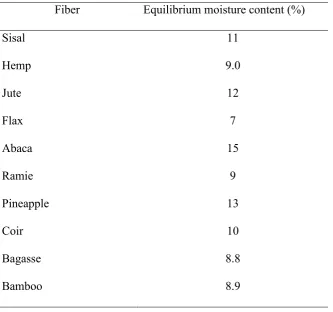
[image:23.595.142.476.357.669.2]Natural fibre structure includes a functional group known as hydroxyl group which contribute to the hydrophilic characteristic in natural fibre. Due to the present hydroxyl group, a weak interfacial bonding appeared between hydrophilic natural fibre and hydrophobic polymer matrices during the manufacturing process of NFRP. Not only that, the hydrophilic properties in natural fibre influences the natural fibre’s mechanical properties especially for all the cellulose-fibre as the moisture content of fibres is dependent on the non-crystalline content and the fibre void content. Table 2.1 shows the equilibrium moisture content of some natural fibres:
Table 2.1:The Equilibrium Moisture Content Of Natural Fibres
Fiber Equilibrium moisture content (%)
Sisal 11
Hemp 9.0
Jute 12
Flax 7
Abaca 15
Ramie 9
Pineapple 13
Coir 10
Bagasse 8.8
Bamboo 8.9
10
Natural fibre attracts the attention in many applications due to its satisfactory properties and greater benefit of nature fibre compared to synthetic fibre in terms of its low weight, require less cost, decrease damages to the equipment, good mechanical properties such as tensile strength and flexural strength, surface finish improvement of moulded parts composites, renewables sources, being abundant, flexibility processing, biodegradable and minimum health hazard.
However, like every other material, natural fibre also has its own downcast. Natural fibre structure comprises of cellulose, hemicellulose, lignin, pectin and waxy substance, allowing the absorption of moisture from the surrounding that has resulted to weak bindings between fibres and polymer.