Take Practice Test:
On a separate sheet of paper
write down numbers 1-34.
1.
2.
3. through 34.
Indicate which ones you gotcorrect with + or - . Use the grade breakdown to check your score.
A 32-34 96-102
B 29-31 87-93
C 24-28 72-84
D 20-23 60-69
F 0-19 0-57
Grade # Correct Points Earned
This is the Benchmark Grade Breakdown
Standard 9D&9E
Electrochemical
Impulse &
1. (9d) Identify the cell
below
A.Cell Body B. Axon
2. (9d) What is the function
of the cerebrum?
A. controls conscious and voluntary activities of the body.
B.
controls heart rate. C. controls blood pressure.D. controls breathing.
Controls thought and conscious movements
Controls muscle coordination and homeostasis.
Medulla Oblongata
Controls involuntary body movements like heart beat, breathing, digestion etc.
Thalamus
Receives messages from sense organs and causes appropriate response.
Hypothalamus
Controls and analyzes hunger,thirst, fatigue, anger & body temperature.
3. (9d)What is the function
of the central nervous
system?
A. To relay messages
B. To process information
C. To analyze information
D. all of the above
4. (9e) Neurons are
categorized by the
A.direction in which they carry impulse.
B. amount of metabolic activity takes place.
C. number of impulses or dendrites that branch out.
5. (9d) What is the function of
the neurotransmitters?
A. to transmit nerve impulses
through the dendrites.
B. to stimulate the production of
epinephrine.
C. to transmit nerve impulses
across synapses.
6. (9e) Sensory receptors
that are sensitive to
chemicals are found in the
A. Skin,body core & hypothalamus.
B. Skin, skeletal muscles & ears
C. Eyes.
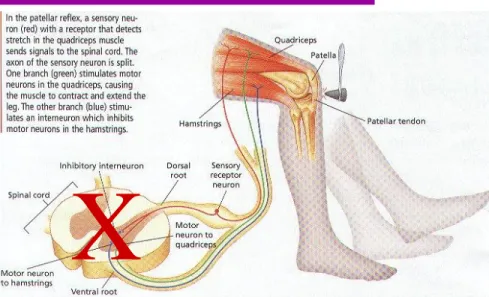
7. (9e) In the reflex arc or
action illustrated in the
diagram below. What does X
represent?
A. Sensory Neuron
B. Motor Neuron
C. Interneuron
D.Parasympathetic Nervous System
8. 9d Which of the following
best describes the direction
and sequence of movement
of a traveling nerve impulse?
A. axon,cell body,dendrites,synapse
B. dendrites,cell body,axon,synapse
C. dendrites,axon,cell body,synapse
9. (9e) “C” represents which
type of nerve?
C. Interneuron D.All of the above
A. Sensory Neuron B. Motor Neuron
C
A
Standard 9B & 9C
Endocrine Feedback
System
10. 9B Which system
coordinates the body’s
response to changes in its
internal and external
environment?
A. Endocrine System
B. Nervous System
C. Lymphatic System
11. (9c) Which gland fails to
produce enough of its hormone
in the disease diabetes
mellitus?
A. adrenal
B. hypothalamus
C. pancreas
D. parathyroid
12. 9C Feedback inhibition
means that an increase in a
substances will
A. Stop production of another substance
B. Increase the production of another substances
C. Increase production of that substance
D. Decrease production of that substance
13. 9C Which process
enables the body to
maintain a stable body
temp?
A. The parasympathetic nervous system
B. The sumpathetic nervous system
C. Feedback inhibition
14. 9B The ability to move
your right hand is controlled
by the
A. Left hemisphere of the cerebrum
B. Right hemisphere of the cerebrum
C. Both the left and right
hemisphere of the cerebrum
D. Neither hemisphere of the cerebrum
15.9C Which system in a human
is responsible for producing
hormones from glands, to
regulate metabolism, growth,
and sexual development?
A. Circulatory
B. Digestive
C. Endocrine
Standard 9A
Nutrients &
16.
(9a) The ( ) is not
necessary for removing urea
from the body.
• Circulatory system
• liver
• heart
17.
(9a) Which of the following is the correct order of nutrient (food) flow from the mouth to the cells?A.Mouth, esophagus, small intestine, stomach, cells & bloodstream.
B.Mouth, trachea, esophagus, stomach, large intestine, small intestine & colon. C.Mouth, stomach, large intestine,
bloodstream & cells.
D.Mouth, esophagus, stomach, small intestine, bloodstream & cells.
18.
(9a) Carbon dioxide is
Not removed from the the
body through which of the
following?
Nose & Mouth Trachea
Bronchus Bronchioles
Alveoli
The Order of Air Flow in Lungs
Larynx Pharynx
• Circulatory system
• Lungs
• Excretory System
• kidney
Standard 10A & 10D
Viruses & Bacteria
19. (10a) ____ is an enzyme
found on the skin, in the saliva
and in tears that kills bacteria
by breaking down their cell
wall.
A.Antigens
B.Amylase
C.Lysozymes
D.Lysosomes
20. (10a) Which of the following is not a way that the skin acts as a
nonspecific defense against disease?
A.Production of sweat
B.Forms an outer layer
C.Production of antibodies
D.Production of lysozymes
21.
(10a) The body’s first
line of defense against
disease is ____?
A.Killer T Cells
B.Antibodies
C.The skin
D.Interferon
E.Roving macrophages
22.
(10d) Unlike lytic
viruses, lysogenic viruses do
NOT
A.Injected their genetic material into the host cell.
B.Enter the lytic cycle.
C.Lyse the host cell right away. D.Infect host cells.
23. (10d) Antibiotics are
used to treat infectious
diseases caused by
A.fungi
B.viruses
C.bacteria
24. (10d) Interferon is a
natural chemical used
primarily to fight ___
infections.
A.fungal
B.viral
C.bacterial
25. (10d) The cell
structure below is a
A.Plant Cell
B.Virus
C.Animal Cell
D.Bacteriophage
E.Bacterial Cell
Standard 10B & 10C
The Lines of Defense
26
.
(10c) A vaccine
contains _____
A.Antibodies
B.Dying or weak viruses
C.antibiotics
27. (10b) Which of the
following is the function of
antibodies in the immune
response?
A.Antibodies produce
antibiotics.
B.Antibodies attach to antigens
and attract phagocytes which
engulf & destroy the antigen.
C.Antibodies produce
28. (10c) An infectious
disease is one caused
by
A.Heredity
B.Materials in the
environment
C.Pathogens
D.Hemophilia
E
29. (10c) A person who has
received a vaccine against
polio
A.Is able to produce antibodies against polio.
B.Has polio antibodies in the blood. C.Has antipolio killer T cells in
blood.
D.Is more susceptible to the polio virus than someone who has not had the vaccine.
Standard 10E & 10F
HIV & The Immune
Response
30. (10f) Cells that are
directly responsible for the
production of antibodies are
A.Red Blood Cells
B.Phagocytes
C.T-cells
D.B-cells
31. (10e) HIV weakens
the immune system by
killing
A.Antibodies
B.B Cells
C.Helper T Cells
D.Killer T Cells
Humoral Immunity Step 6: Macrophage Helper T cell assists the activated B cell to develop into an antibody-producing plasma cell. Copy32. (10e) HIV spreads
through the body by
A. Replicating inside the cells of the immune system.
B.Preventing the body from
producing antibodies against HIV. C.Causing the body to have asthma
attacks.
D.Strengthening the immune system.
33. (10e) Zidovudine (AZT) is a
drug that stops an enzyme that HIV needs to multiply. What effect
would you expect AZT to have on the number of T cells in an HIV-infected person’s blood and
immune system?
A.AZT should increase T cells. B.AZT should decrease T cells. C.AZT has no effect on T cells
34. (10e) White blood cells that
bind to infected cells and
secrete chemicals that disrupt
the cell membranes of these
cells are termed
A. Helper T-cells B. Killer T-cells C. Macrophages D. plasma CellsBody Systems Practice Test 1. D 11. C 21. C 31. C 2. A 12. D 22. C 32. A 3. D 13. C 23. C 33. A 4. A 14. A 24. B 34. B 5. C 15. C 25. E 6. D 16. B 26. B 7. C 17. D 27. B 8. B 18. D 28. C 9. A 19. C 29. A 10. D 20. C 30. D