Civil Engineering Journal
Vol. 5, No. 12, December, 2019An Evaluation of Barriers obstructing the Applicability of
Public Private Partnership (PPP) in Infrastructure Development
Sedqi Esmaeel Rezouki
a, Jinan Kata'a Hassan
a* a Department of Civil Engineering, College of Engineering, University of Baghdad, Baghdad, Iraq.Received 10 August 2019; Accepted 25 October 2019
Abstract
Shortage in funds after the declining in oil prices since 2014, made Iraq government encourage private sector engagement in financing infrastructure projects through PPP. However, private sector reluctance was notable. Therefore, this research is conducted to assess if Iraq is a supportive environment for PPP projects development. 25 risk factors of PPP projects have been listed and organized within a questionnaire that was conducted with a participation of 98 respondents from public, private institutions and academics. Means comparison was used to rank and identify respondent agreement on assessing the level of importance of these risk factors, also nonparametric tests were used. Findings indicated that all respondents groups have agreed on ranking corruption on the top of barriers that government should deal with to ensure the success of PPP projects. Afterward scarcity of private funds came in the first place followed by insufficient public administration processes and then by the lack of legal framework followed by the delays in acquisition of land and while the lack of sovereign guarantee came at the fifth place. The perceptions of survey groups’ respondents concerning the importance of risk factors differ , where both public and academics respondents have serious concerns regarding the private sector capacity to carry out the task and the availability of private funds. On the other hand the private sector concerns the availability of government incentives to support for infrastructure PPP projects. Overall findings indicated that government must work on building a solid enabling environment before the initiation of PPP approach in Iraq.
Keywords: PPP; Enabling Environment; Barriers; Risk Factors; Iraq.
1.
Introduction
PPP defined as long-term contractual agreement between a public agency and a partner or consortium of companies from private sector to carry out the design, implementation, financing, operating and management of the infrastructure. In the partnership the responsibility of financing, constructing, asset management and maintenance, and service provision will be on the private partner; in return the private partner will obtain payments from the government and/or from user fees [1]. As PPP agreements depend on private funding it will be an efficient tool for delivering infrastructure and filling the gap between required capital cost and government limited financial resources in addition to cost-effectiveness [2]. A proper risk sharing assumes to transfer risk to the party that best able to control. Accordingly government should not transfer risks that private sector will not be able to control and mange [1]. PPP have been used worldwide in industrialized, industrializing, and developing countries. The purpose of PPPs adoption varies greatly from country to another, in industrialized countries like UK and Germany; PPP adopted in public service provision. Meanwhile industrializing countries, with tremendous needs for basic infrastructure like China and India, PPPs used to sustain rapid economic growth it’s usually seen in power, water or road sectors [3]. In developing countries PPP adopted to overcome
* Corresponding author: [email protected] http://dx.doi.org/10.28991/cej-2019-03091439
© 2019 by the authors. Licensee C.E.J, Tehran, Iran. This article is an open access article distributed under the terms and conditions of the Creative Commons Attribution (CC-BY) license (http://creativecommons.org/licenses/by/4.0/).
the shortage in the governments’ financial resources or to fulfill conditions imposed by International Organizations to provide loans [4-7]. In the case of Iraq as developing country, Government of Iraq (GOI) faced a severe shortage in funding due the decline in oil prices in 2014, which made GOI suspend near 2700 under-construction infrastructure projects funded under the government capital budget projects [8]. As a solution to prevent destruction of the projects that had reached high percent of completion and to fulfill the shortage in basic services by new project too, the PPP appear to be as appealing solution. Accordingly, government encouraged governmental institutions to engage private sector in financing infrastructure projects that have been suspended due the financial crisis through public- private sector partnership to be another financing option. However, private entities’ involvement in filling that gap was unpromising. Therefore, this study aims to explore major barriers and risk factors to PPP projects in Iraq using quantitative methods. The paper consists of the following sections; section 2 discuss advantages & criticisms of the PPP, section 3 discuss the required conditions for successful application of section 4 review PPP experience and major barriers and risk factors impacting PPPs Projects in Middle East and North Africa (MENA) to take advantage of their experience and the similarities in conditions with Iraq as developing countries, section 5 discuss challenges and risks associated with PPP's contracts in Iraq, section 6 provides details about the applied research approach, section 7 highlighted Results discussions, and finally, section 8 summarizes overall conclusions of this paper
2.
Advantages and Criticisms of the PPP
PPPs as tool for infrastructure projects development and provision coupled with many advantages, which chiefly resulted from PPP major three features: private fund, creativity and proper risk sharing [9]. Figure 1 shows PPP contracts main feature and advantages.
Figure 1. Main feature and advantages of PPP contracts [10] On the other hand, critics on using PPPs for infrastructure provision are mainly about:
Weakness and poor ability of public entities to manage the implementation of PPP projects, high costs of bidding poor ability in contracts design and bids formulation in addition to the need to hiring services’ advisory [11-13]. The complex nature of these contracts makes it difficult to structure PPP projects and predict its contingencies
[14].
Improper contracts’ design may fail to deal flexibly to make the needed adjustments to boost public authority requirements in the provided services. Moreover, if risks weren’t sufficiently allocated private partners this may lead to costly consequences on public authority [12].
Added future expenditures resulted fiscal obligations which impose constraint on governments [9, 11]. Long term contracts may lead to opportunistic behaviour and underinvestment [1].
As private entities may not be able to borrow money with a low rate of interest as the public agencies leading to higher project capital costs [14]
Investor’s transparency about returns could be questioned, in addition to liabilities imposed by PPP projects on users and taxpayers [12].
3.
Conditions for Successful PPPs
Although PPP considered being a promising approach for infrastructure development and the provision of services in the different countries around the world, PPP could be inadvisable for some government and for some projects. Accordingly, lessons learned from international best practices have identified conditions that should be fulfilled to increases the possibility of a successful PPP implementation [10, 15]. Alternatively, government can achieve value for money through traditional procurement by applying a sound procuring and oversighting procedures and strategies [16].
• On-time, on-budget construction • Improved value for money • Improved customer service • More innovation
• Improved care of public assets • Government focus on outcomes • Risk sharing
• Incentives from combining tasks • Private financing
• Private sector specialization • Competition
• Performance-based contracts
Advantages of PPP contract Features of PPP that drive advantages
3.1.Committed Political Leadership
The transition in infrastructure's procurement from traditional public procurement to PPP is an approach adopted by political leadership and be obligated to by the top of governmental hierarchical. If PPP be committed at that level, the mobilization of resources needed for PPP success will be guaranteed. Building mutual trust between the different partners and stakeholders by establishing enabling environment that provide guaranties and safeguard equally for all partners and investors will also lay on the political leadership [17-19].
3.2.Project is Suited to PPP Model
Project that best suits the PPP model should have a number of the following features: 1) adequate number private companies a proper qualification to ensure competitive bidding; 2) Innovation possibilities; 3) project is self-financed ; 4) provide loop of feedback starting from price setting to a provision of service; 5) possibility of tasks bundling; 6) Possibility of proper risk transfer to private partner; 7) the need to obtain private sector specialization that public sector is lacking to; 8) Project outputs' specifications can be well defined and measured; 9) Large strategic projects to obtain a possibility of spreading out the capital cost of along the contract term; 10) An adequate preparation time to ensure the contract will be negotiated properly [20-22].
3.3.Institutional Structures and Legal/Regulatory Framework
There are fundamental principles for PPP implementation at the program level which include: 1) The availability of PPP institutional legal framework and Policy; 2) Developing competent PPP units where, the establishment of competent PPP units to deal with PPPs projects represents a substantial element in overcoming institutions’ poor qualification and capabilities’; 3) Perception of PPP objectives; 4) Performance and method specifications [23, 24]; 5) Initiating a systematic assessment and revision of current legislation and regulations and the need for development of new ones; and the establishment of a standardized approval's processes and a sound interagency coordination to avoid and eliminate any institutional and/or regulatory barriers to PPP implementation [15], this may implemented on both levels local and national.
3.4.The Proper Risks Sharing
Allocating anticipated risks to the party that best able to manage and control it is the only way to achieve value for money. Furthermore, the lack of transferring enough risk to the private partner, will lead to the lack of motivations to achieve PPP expected objectives [25]. A proper risk sharing represent a major attribute of well-developed public entities managerial and technical abilities [15].
3.5.Law Authority and the Independence of Judiciary System
One of the most attractive factors for investors to undertake PPP projects is the Law authority and the independence of judiciary system in protecting contractual and ownership rights [17]. Another important factor is the clear and timely manner disputes' resolution procedures. Where government must set into place such procedures to ensure a good disputes resolution are available wherever disagreements arise throughout the agreement term [26].
3.6.Public Sector Ability
Government should work on three aspects to ensure a proper implementation of: 1) Consensus building between the different stakeholders including society to ensure acceptance of PPP projects; 2) Sustain an efficient PPP contract management throughout PPP project lifecycle; 3) highly qualified staff legally, financially, and technically apart from political impact to ensure that PPP optimum features risks sharing, value for money, and PPP project monitoring is achieved [20]. Building a well-qualified public entities technically and managerially is a major step in overcoming institutional constraints that may hamper the implantation of PPP projects [15].
4.
PPP in Middle East and North Africa (MENA)
In developing countries there are four major themes should be taken into consideration to achieve a successful implementation of PPP projects and gain its favorable benefits; 1) macroeconomic indicators impacts, 2) political situation's influences, 3) organizational structures circumstances, and 4) factors associated to PPP project. It’s important to understand that the elements of these themes are interrelated and all should be dealt with and improved [27] Figure 2, summarize these factors.
Figure 2. Factors influencing PPP project success and anticipated benefits [27]
MENA countries as other developing countries have unfavorable business environment with high level of potential risks resulted in investors' reluctance, in addition to the political and security turmoil which have made the situation even worse. This section will focus on six countries in the region which have passed through similar conditions to Iraq and have earlier experience with PPP and passed through conditions similar to the conditions that Iraq has passed through like; Egypt, Tunisia and Morocco, or have a well-developed experience with PPP projects implementation like Turkey, Dubai and Jordan who have recognized the importance of engaging private sectors in the development of infrastructure and started to found the required enabling environment for this participation by establishing the needed legal/regulatory framework to support the success PPP program implementation. The Main findings include:
4.1.PPP Legal and Policy Frameworks in MENA 4.1.1. Turkey
Despite the fragmented legal and institutional structure and improper interagency coordinating and management, Turkey succeeded in developing public entities’ capacities to undertake PPP projects implementation. This can be clearly seen in a good number of PPP projects conducted in the different sectors since the 90s. PPP unit have been established in the Ministry of development (MoD) in 2007. The unit made a significant contribution in the Tenth Development Plan [28]. Table 1 summarizes the number of projects and their value in the six focus countries plus Iraq [29].
Table 1. PPP in Infrastructure throughout 1990 - H1 2017 in US$ billion [29]
Country Jordan Morocco Tunisia Egypt Turkey Dubai* Iraq
Total Investment in US$ billion 13.348 32.848 7.052 26.776 168.616 9.351 11.444
Projects reaching financial closure 40 22 9 30 213 8 13
Sector with largest investment share water &
Sewerage Ports water & Sewerage water & Sewerage Roads Social & Health Ports
Infrastructure Sectors Reported ICT &
Sewerage Natural gas Natural gas
ICT &
Sewerage ICT & Porst All ICT
Type of PPI with largest share in investment Mgt. & lease contracts Greenfield project Greenfield project Mgt. & lease contracts Mgt. & lease contracts NA Greenfiel d project Cancelled Projects 1 0 0 0 1 0 0
% Cancelled Projects of total investment 11% 0 0 0 9% 0% 0
* Dubai data between 2013-2018, source: www.infrapppworld.com
4.1.2. Jordan
Has a good track and has enacted new PPP law no. 31 of 2014 anticipated to bring greater clarity to the legal framework [29, 30]. Political/Institutional indicators Level of corruption Internal conflict Democratic accountability Investment profile Bureaucracy quality Project Factors Type of PPP
Private participation level Contract
Award method Proposal mode
Sector multilateral support Government support through
revenue or capital subsidy, or guarantee
Sponsors (foreign or domestic) Funding (government, private,
foreign, and MDB) Macroeconomic Conditions Growth Exchange rates Trade Fiscal balance Debt level Climate Country/Sovereign risks PPP Project Outcome
4.1.3. Morocco
Has engaged private sector in developing infrastructure by concession. In 2011 the central PPP unit has been established [17]. Moreover, PPP new Law No. 86-12 on PPP contracts enacted on December 24, 2014 followed by Decree no 2-15-45 on May 13th, 2015 providing regulation for PPP law [30].
4.1.4. Tunisia
Has also fragmented legal and institutional structure in implementing PPP projects [17]. In November 27th, 2015 Law No. 49-2015 on PPPs enacted, and PPP unit formulated [30].
4.1.5. Egypt
Has a specific PPP law no. 67 enacted in 2010 [30]. Also a competent and efficient central PPP unit has been established. Despite that, concession contract is still in use according to sectorial statutes [17].
4.1.6. Dubai
Has enacted PPP law no. 22 of 2015, which consider a mature approach to attracting long-term investment to the Emirate [31]. There is no centralized PPP authority according to Dubai’s PPP act. In fact, Dubai’s PPP act gives government entities entering into a PPP arrangement the flexibility to manage the financial, economic and social feasibility of a project, as well as the distribution of risk between the parties [32].
4.2.Major Barriers and Risk Factors Impacting PPPs Projects in MENA 4.2.1. Egypt, Jordan, Tunisia and Morocco
The examination of the enabling environment in these countries throughout 2005 to 2015, it can be concluded that the highest level of potential risks lay within institutional and legal aspects (which include; 1) Lack of Legal framework, 2) Interagency coordination, 3)Poor public decision-making process, 4) Project scoping (incl. contract design & risk allocation), 5) Bidding process, 6) Government Capacity, and 7) The capacity of the private sector) where the highest frequencies of barriers have been indicated. It forms with operational barriers (which include; 1) Land acquisition, 2) Choice of location, 3) Construction risks, and 4) Social & Environmental risks) the larger percent of risks that hindering the PPP progress as presented in Figure 1. The interesting finding, risks related to political considerations (which include; 1) Government stability/ security conditions, 2) Corruption/ lack of transparency, 3) Public understanding & opposition, and 4) Change of law & Breach of contract) indicated low percent than other risks ranged from (10-25) % to Morocco and Tunisia respectively. Meanwhile financial consideration (which include; 1) lack of private funding, 2) Transfer of funds, 3) lack of sovereign guarantee, 4) Inflation rate, 5) Changes in interest rate, 6) Changes in currency exchange rates, and 7) Tax regulation) came after ranged from (10-24) % to Tunisia and Egypt respectively. From Figure 3 it can be noticed that Egypt and Tunisia have higher percent compared to the other countries indicating the impact of political turmoil started in 2011[17].
Figure 3. Risk factors to PPP in Egypt, Jordan, Morocco, and Tunisia [17]
This could be explained by risks related to political considerations is uncontrolled, changing them will take long time to achieve political stability on the other hand statutory and organizational risks can be under government control and
24% 16% 10% 25% 24% 21% 19% 10% 38% 48% 40% 45% 18% 16% 31% 20% 0% 10% 20% 30% 40% 50% 60%
Egypt Jordan Morocco Tunisia
can be improved quicker than political risks. Accordingly if government urging to succeed in undertaking PPP approach it must adopt a scheduled reforming program that support PPP implementation in the different stages of PPP projects development.
4.2.2. Dubai
Knight (2016) identifies two challenges Dubai needs to deal with in implementing PPP program. Firstly, specify certain sectors to apply PPP, this will enable investors to reduce the cost of bids preparation if they fail in one project they are almost prepared to redirect their efforts to another one within the same sector. Secondly, to overcome oil prices fluctuation that may have high effect on the available liquidity of public authorities. Government should ensure a proper risks sharing and sufficient pricing to attract to foreign funders in filling that gap [33]. Despite Dubai PPP Law is considered an overwhelmingly positive step forward in facilitating PPP projects in the Emirate [32] in more deep examination, the top ten critical success factors to PPP projects in UAE are: 1) Public and private partners commitment, 2) Proper risk sharing, 3) Ability and qualification of public sector entities, 4) Transparency of the processes, 5) Competent private partner, 6) Competitive bidding procedures, 7) Committed political leadership, 8) sound feasibility studies, 9) Proper administration, and 10) Supporting legal/Regulatory Framework [34].
4.2.3. Turkey
Turkey as a developing country in order to succeed in PPP should establish a solid ground to support PPP program initiation and implementation that would include; 1) PPP institutional structure and enabling legal/regulatory framework; 2) Overcoming The struggle of powers within public authorities to ensure effective coordination; 3) Careful study for financial amplifications of suggested PPP to minimize financial consequences to State budgetary; 4) Huge need for infrastructure development may led to aggressive use of PPPs with no consideration for value for money which should be considered; 5) Adequate capacity building program should be provided to governmental entities to implement PPP contracts successfully [28].
In a deeper exploration, studies illustrated that proper institutional structures and legal/regulatory framework, precise selection of project that is suited to PPP model, and sound and comprehensive feasibility studies indicated a higher impact on PPP successful implementation. On the other hand proper consultancy to client, projects uncomplicated structural organization, and social perception and understanding seem to have lower impact [35]. In more generic and brief interpretation there are five areas need to work on to support PPP implementation; 1) PPP project financing, proper management, operational influences, competitive procuring processes, and supportive institutional structure [35].
5.
Challenges and Risks of PPP's Contracts in Iraq
The enabling environment refers to the relevant policies, laws, regulations and institutions which allow and support the development of infrastructure projects, as well as overall government support, capacity and commitment for PPPs in the country [36]. The absence of any of these elements can lead certain themes to emerge hindering PPP progress. Iraq, through the past 15 years the existing PPP projects were procured based on different laws including act No. 22 enacted in 1997 for public firms, the act of firms No. 21 enacted in 1997, Investment act No. 13 of 2006. Where there is no designated PPP law enacted to be the legal base for PPP projects agreement in Iraq which represent a real barrier in PPP progress. In regard to other challenges, Wali (2015) had addressed a generic perception of the most important potential challenges and risks that would face the PPP implementation in Iraq. She suggested government should consider three aspects; firstly, improving government poor experience in PPP. Secondly, fulfilling stakeholder expectations and thirdly, adopting a phased, pragmatic approach [37].
In addition to these aspects the researcher identifies another two serious barriers. The first one is improving business and investment environment. The Transparency International organization ranks Iraq 166th out of 176 countries in its Corruption Perception Index [38]. Iraq also has a poor business climate and stood on place 168 out of 189 in the World Bank’s Doing Business Index 2018 (a drop of 22 place over 2014), with low scores in all the indicators [39]. Table 2 shows the World Bank ranking of doing business for some countries in the region. If Iraq is to build a stronger, more resilient economy, it must improve its business and investment environment, its capacity to attract private investment will be critical in that respect.
Table 2. Ease of doing business ranking in the region (WB/doing business, 2018)
Economy UAE Turkey Morocco Tunisia Jordan Egypt Iraq
Rank global (2018) 21 60 69 88 103 128 168
Scores (2018) 78.73 69.14 67.91 63.58 60.58 56.22 44.87
Rank global (2014) 25 51 68 56 116 113 146
The second one is the interagency coordination PPP contracts are so the complex nature of PPP arrangements required efficient and closely working relationships between competent public authorities in on hand and private partners on the other hand.
6.
Research Approach
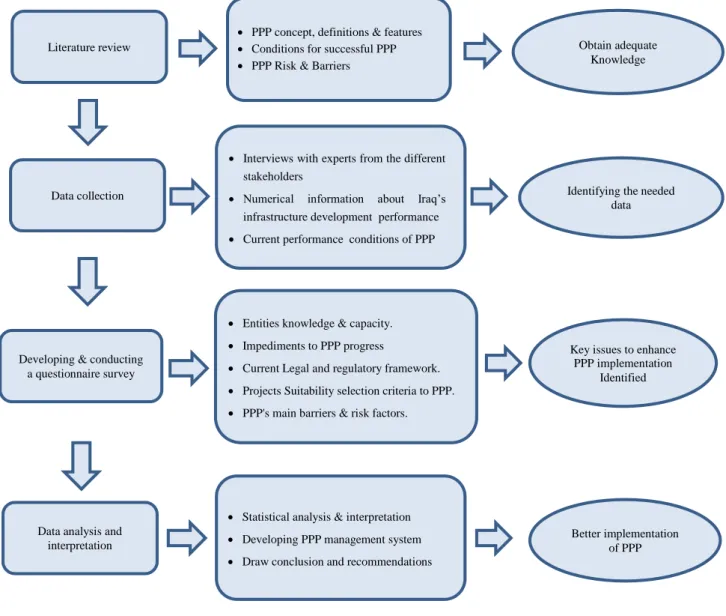
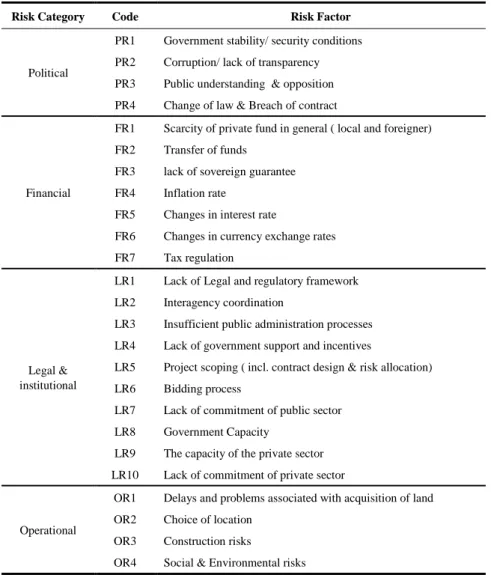
The applied research methodology is presented in Figure 4. Using of the same concept applied in Al-juboori (2015), Li et al. (2005) and Babatunde et al. (2016) [40-42] studies, the study implemented based on a quantitative analysis. A well-structured questionnaire (presented in Appendix I), and based on a quantitative analysis used to identify the standpoints of respondents on the theme of the research presented in this paper. The questionnaire divided into five parts. This paper is targeted to present the two parts of the questionnaire. Part 1 presents respondents’ general data. Part 2 ( represent the fourth part of the questionnaire ) aims to identify respondent agreement on assessing the level of importance of risk factors related to PPP enabling environment that considered as key barriers may face the development of PPP projects in Iraq which is the target of this paper. Through the literature review of this research, 25 risk factors of PPP projects have been listed under four main groups, political situation concerns, financing, statutory and organizational, and functional risks as shown in Table 3, where their importance will be rated by the survey respondents on Likert six points scale where 1=least important”, 6= very important” with an option of 0= don’t know/ inapplicable.
Literature review
PPP concept, definitions & features Conditions for successful PPP PPP Risk & Barriers
Obtain adequate Knowledge
Data collection
Interviews with experts from the different stakeholders
Numerical information about Iraq’s infrastructure development performance Current performance conditions of PPP
Identifying the needed data
Developing & conducting a questionnaire survey
Entities knowledge & capacity. Impediments to PPP progress
Current Legal and regulatory framework. Projects Suitability selection criteria to PPP. PPP's main barriers & risk factors.
Key issues to enhance PPP implementation
Identified
Data analysis and interpretation
Statistical analysis & interpretation Developing PPP management system Draw conclusion and recommendations
Better implementation of PPP
Table 3. Risk factors related to PPP enabling environment in Iraq
Risk Category Code Risk Factor
Political
PR1 Government stability/ security conditions PR2 Corruption/ lack of transparency PR3 Public understanding & opposition PR4 Change of law & Breach of contract
Financial
FR1 Scarcity of private fund in general ( local and foreigner) FR2 Transfer of funds
FR3 lack of sovereign guarantee FR4 Inflation rate
FR5 Changes in interest rate
FR6 Changes in currency exchange rates FR7 Tax regulation
Legal & institutional
LR1 Lack of Legal and regulatory framework LR2 Interagency coordination
LR3 Insufficient public administration processes LR4 Lack of government support and incentives
LR5 Project scoping ( incl. contract design & risk allocation) LR6 Bidding process
LR7 Lack of commitment of public sector LR8 Government Capacity
LR9 The capacity of the private sector LR10 Lack of commitment of private sector
Operational
OR1 Delays and problems associated with acquisition of land OR2 Choice of location
OR3 Construction risks
OR4 Social & Environmental risks
6.1.Questionnaire Distribution and Data Collection
150 questionnaires survey are distributed using separate questionnaire hard copies as well as an online questionnaire using google drive forms and distributed to public sector organizations work in the infrastructure projects development, private sector companies, private banks and academics. 116 questionnaires were returned which form (77%) of the total distribution. On the other hand 98 questionnaires are answered where 18 of the returned questionnaires deemed ineligible due to improper survey's respondent, blanked answers, ineligible, and multiple answers. The percent of questionnaire returned and valid (84%) is considered adequate for the purpose of analysis and reporting based [43].
6.2. Data Analysis
The 98 returned valid questionnaires were analyzed using Statistical Package of Social Science (SPSS) version 25. Respondents' general information was analyzed using descriptive analysis. As the Normality test have been checked and data set is not following a normal distribution, the Kendall’s Coefficient of Concordance is used to test the internal agreement between the respondents within the same group; and Kruskal Wallis test is conducted to test the agreement among respondents of the survey groups. The data is analysed in three-stages,
1) Identifying risk importance depending on the values of their means with ordinal organization from the highest to the lowest.
2) Kendall's 𝒲� concordance coefficient test will be used to examine inner agreements within the same group. 3) Determining the differences between any two groups’ participants’ ratings on any individual risk factor, through
7.
Results and Discussions
7.1.Respondents General Information and Rate of Response
Table 4 shows the general information of the respondents. Public sector respondents form 56% of survey respondents, while private sector form 27% and academics form 17%. In regard the general work experience, respondents who have general work experience not less than 21 years form 50% of the whole respondent followed by those with general work experience of 16-20 years by 29.6% then those with general work experience of 11-15 years by 14.3% and those who have general work experience of 6-10 years by 5.3%. While those with general work experience of 5 years or less were only 1%. Findings show that those who have at least 21 years of general working experience form majority of public, private sectors and academics respondents by 43.6%, 57.7%, and 58.8% respectively. Indicating that the target respondents have an adequate experience that to provide a balanced view and reliability for the research survey. In relation to the years of experience in PPP projects implementation, finding shows that 53% of respondents from the public sector are lacking the experience in PPP projects, forming the highest percent within the three groups of respondents, followed by academics respondents with 41.2%. Meanwhile the percentage of respondents from the private sector who have no previous experience is 30.8%. Furthermore, the lowest percentage is 10.9% of public sector’s respondents, who have over 6 years’ of experience. As the implementation of PPP projects is not conducted widely and limited to a few number projects in Iraq [29], it is expected to find that more than one-half (53%) of respondents from the public sector have no previous experience in PPP.
Table 4. General information of respondents
Respondents profile Percentage of respondents in the survey sample
1 Sector of work Overall Public Private Academics
100% 56.2% 26.5% 17.3%
2 Years of Experience in work Overall Public Private Academics
5 Years or less 1% 3.8%
6-10 Years 5% 9.1%
11-15 Years 14.3% 18.2% 11.5% 5.9%
16-20 Years 29.6% 29.1% 26.9% 35.3%
Over 21 year 50% 43.6% 57.7% 58.8%
3 Years of experience in PPP projects
implementation Overall Public Private Academics
Non 44.9% 52.7% 30.8% 41.2%
1-2 years or less 13.3% 14.5% 11.5% 11.8%
3-5 years 21.4% 21.8% 23.1% 17.6%
Over 6 years 20.4% 10.9% 34.6% 29.4%
7.2.Result on to Risk Factors Importance Ranking
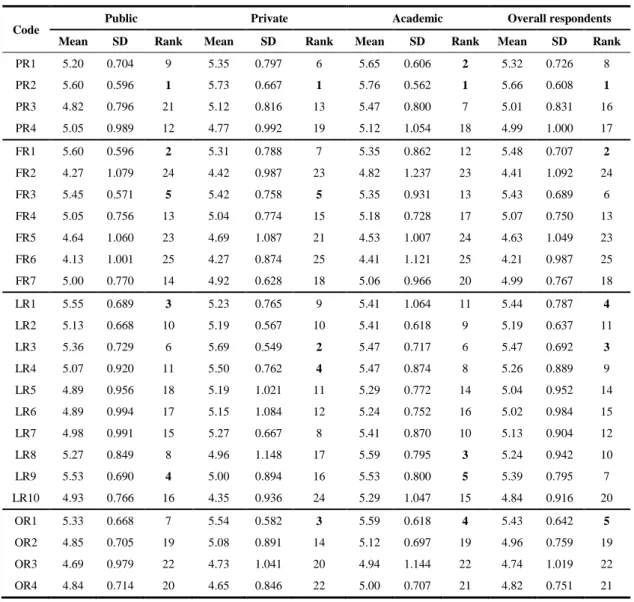
Mean (M) and standard deviation (SD) values obtained using SPSS illustrated in Table 5 in addition to risk factors ranking as viewed by the sample respondents in the three groups. It can be concluded from Table 5 that the scores are close to the mean since SD of all rated factors is relatively small. It can also be noted that the M scores values of all factors ranged between 4.13-5.76 which means all the tested factors considered important based the ratings of all participants since it vary from important to highly important to ensure a successful implementation to PPP adoption.
It can be seen from Table 5, that the means values for the factors as rated by the respondents from public sector are ranged from 4.13 to 5.60, which indicate a relatively small variance in the responses by (1.47). The means values of private sector and academics respondents are from 4.27 to 5.73 and 4.41 to 5.76 respectively. Means values differences are also small by (1.46) and (1.62) respectively. The small differences in means shown in the survey groups indicate that survey respondents have rated these factors much more consistently.
Table 5. Relative importance of risk factors for PPP projects in Iraq rated by the survey respondents
7.2.1. Risk Factors' Importance Ranking from the Perspective of Overall Respondents
From the perspective of all respondents, findings from Table 5 indicate that the main risks challenges to PPP in Iraq as it have been agreed on by all respondents is “Corruption” the following top five most important barriers and risk factors (in descending order) that may prohibit the implementation of PPP projects in Iraq are:
Scarcity of private fund in general (local and foreigner); Insufficient public administration processes;
Lack of Legal framework;
Delays and problems associated with acquisition of land.
“Corruption/lack of transparency in public administrative” is ranked on the top of risks factors and barriers that government should deal with to ensure the success of PPP projects. It is not surprising that overall respondents have ranked corruption as on the top of risks factors hampering PPP in Iraq’s business environment, as Iraq stood on the order 167th out of 176 countries in its Corruption Perception Index [38]. Corruption represents the main barrier not for PPP implementation only but in the country development process and stability.
The second one is “private funding’s Scarcity”. Financial scarcity may lead to termination of the project and losing the invested funds. Act of Investment no. 13 enacted in 2006 and its amendments, provide incentives to risks related to political and market demand risks to attract private investors as well as government liabilities or repayment obligations, in addition to provision of exemption related to certain taxes, which justify the relative low rating of “Taxing system” FR7 and “Exchange rates fluctuation” FR6, this doesn’t mean these factors are satisfying investors expectation as the taxing system and legislations is too old and need to be modernized by considering Tax as an economic tool employed properly in encouraging foreign and local investors and the private sector in general in compliance with provision of
Code Public Private Academic Overall respondents
Mean SD Rank Mean SD Rank Mean SD Rank Mean SD Rank
PR1 5.20 0.704 9 5.35 0.797 6 5.65 0.606 2 5.32 0.726 8 PR2 5.60 0.596 1 5.73 0.667 1 5.76 0.562 1 5.66 0.608 1 PR3 4.82 0.796 21 5.12 0.816 13 5.47 0.800 7 5.01 0.831 16 PR4 5.05 0.989 12 4.77 0.992 19 5.12 1.054 18 4.99 1.000 17 FR1 5.60 0.596 2 5.31 0.788 7 5.35 0.862 12 5.48 0.707 2 FR2 4.27 1.079 24 4.42 0.987 23 4.82 1.237 23 4.41 1.092 24 FR3 5.45 0.571 5 5.42 0.758 5 5.35 0.931 13 5.43 0.689 6 FR4 5.05 0.756 13 5.04 0.774 15 5.18 0.728 17 5.07 0.750 13 FR5 4.64 1.060 23 4.69 1.087 21 4.53 1.007 24 4.63 1.049 23 FR6 4.13 1.001 25 4.27 0.874 25 4.41 1.121 25 4.21 0.987 25 FR7 5.00 0.770 14 4.92 0.628 18 5.06 0.966 20 4.99 0.767 18 LR1 5.55 0.689 3 5.23 0.765 9 5.41 1.064 11 5.44 0.787 4 LR2 5.13 0.668 10 5.19 0.567 10 5.41 0.618 9 5.19 0.637 11 LR3 5.36 0.729 6 5.69 0.549 2 5.47 0.717 6 5.47 0.692 3 LR4 5.07 0.920 11 5.50 0.762 4 5.47 0.874 8 5.26 0.889 9 LR5 4.89 0.956 18 5.19 1.021 11 5.29 0.772 14 5.04 0.952 14 LR6 4.89 0.994 17 5.15 1.084 12 5.24 0.752 16 5.02 0.984 15 LR7 4.98 0.991 15 5.27 0.667 8 5.41 0.870 10 5.13 0.904 12 LR8 5.27 0.849 8 4.96 1.148 17 5.59 0.795 3 5.24 0.942 10 LR9 5.53 0.690 4 5.00 0.894 16 5.53 0.800 5 5.39 0.795 7 LR10 4.93 0.766 16 4.35 0.936 24 5.29 1.047 15 4.84 0.916 20 OR1 5.33 0.668 7 5.54 0.582 3 5.59 0.618 4 5.43 0.642 5 OR2 4.85 0.705 19 5.08 0.891 14 5.12 0.697 19 4.96 0.759 19 OR3 4.69 0.979 22 4.73 1.041 20 4.94 1.144 22 4.74 1.019 22 OR4 4.84 0.714 20 4.65 0.846 22 5.00 0.707 21 4.82 0.751 21
article 25 and 26 of the Iraqi constitution regarding the reformation of Iraqi economic and encouragement of investments in the different sectors.
The third risk factor of PPP projects, as respondents generally recognized, is "insufficient public administration processes". In general, inefficient management will lead to increased costs, in addition to undefined and lack of transparence processes will raise the level of uncertainty for investors and eventually increase the cost or loss the interest in the project.
For example in Iraq if you want to start a project it need to pass by 11 steps in average and a total time period of 77 days, costing about 117% of income per capita. Meanwhile UAE the process will pass by 6 step with total time to complete is only 13 day, costs 6% of income per [39].
Fourth barrier is the “Lack of Legal and regulatory framework” as there is no designated PPP law enacted to be the legal base for this type of contracting methods. The government tried to provide a legal cover for that purpose within the provisions of article (16), (15) and (14) of the State Budget Law of 2015, 2016, and 2017 respectively also the Council of Ministers’ decision No. 96 of 2016 and the PPP guidelines and project selection criteria issued by the MoP. Unfortunately provisions of PPP article have been removed from the State Budget Law of 2018 and 2019 due to political oppositions leaving the PPP without legal cover.
The fifth one is “Delays and problems associated with acquisition of land” which represent a significant barrier to PPP projects in developing countries, in particular problems related to squatters in addition to unsolved land ownership disputes for PPP project purposes [27] where any delay even if in a small part project area can lead to a delay in the whole timetable and scheduling as well as project feasibility [44].
7.2.2. Risk Factors' Importance Depending on Participants' Point of View in Each Group of the Survey
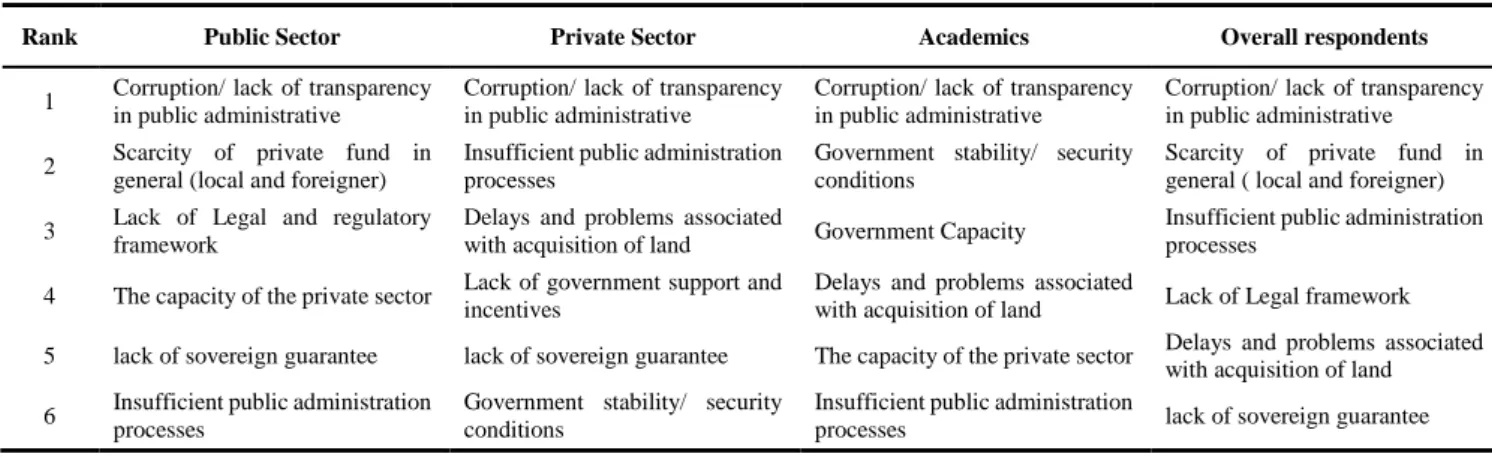
From Table 6, generally the three groups have agreed that Corruption stood in the top of the risk factors in Iraq. Afterward public sector respondents have ranked “Scarcity of private fund” at the second order. Meanwhile private sector and academics respondents ranked this barrier lower at seventh and twelfth order respectively. From perspective of public sector this can be explain due to private sector reluctance from submitting to PPP infrastructure projects despite the actions that government have taken to encourage private sector entities to finance the implementation of under-construction infrastructure projects by issuing the Council of Ministers’ decision No. 340 of 2015, which authorize the governmental institutions to negotiate with the contractors for the completion of the projects by them or through a second financier to complete the remaining works of the projects that have high percent of completion with an interest rate not exceeding 10%. On the other hand the lower ranking of this factor by respondents from both private sector and academics can be explained by their believe that private fund is available but the problem is the lack of confidence in the Government's commitment to fulfill its obligations under PPP contracts as oil represents the main resource of the government budget which always is affected by the fluctuation in the oil markets, the government ability to fulfill these obligations will be questioned since government has no future vision of Iraqi cash status, to set timetables for payments. Furthermore, the respondents from both private sector and academics have ranked “Insufficient public administration processes” and “Government stability/ security conditions” respectively at the second place. From the private sector perspective the current institutional procedures and process is not fulfilling their expectations as long as the routine and the complex procedures are still exist which is economically consuming for time and money. Meanwhile the academics ranking of government stability/ security conditions explained by their realization for the role stable political will in supporting PPP approach and attracting foreign investors as the security conditions have been improved.
Table 6. Top five risk factors from the perspective of each group of the survey sample
Rank Public Sector Private Sector Academics Overall respondents
1 Corruption/ lack of transparency in public administrative
Corruption/ lack of transparency in public administrative
Corruption/ lack of transparency in public administrative
Corruption/ lack of transparency in public administrative
2 Scarcity of private fund in general (local and foreigner)
Insufficient public administration processes
Government stability/ security conditions
Scarcity of private fund in general ( local and foreigner)
3 Lack of Legal and regulatory framework
Delays and problems associated
with acquisition of land Government Capacity
Insufficient public administration processes
4 The capacity of the private sector Lack of government support and incentives
Delays and problems associated
with acquisition of land Lack of Legal framework 5 lack of sovereign guarantee lack of sovereign guarantee The capacity of the private sector Delays and problems associated
with acquisition of land 6 Insufficient public administration
processes
Government stability/ security conditions
Insufficient public administration
The third barrier as ranked by public sector’s respondents is “Lack of Legal and regulatory framework” where, a well-developed PPP regulation that consistent with the Iraqi’s laws and regulations is needed to eliminates any crosses in related laws and can facilitate and clarify any ambiguities regarding the types of PPP contracts, contract forms and the requirements of each type. The need of such regulation is highly increased when there is a limited experience with PPP as in the case of Iraq especially within public entities that will be responsible about the whole process management. As they perceive that the legal cover to PPP projects in the provided by government within State Budget Law of 2015, 2016, and 2017 through the provisions of articles 16, 15 and 14 respectively. And the issued guidelines and regulation for PPP projects implementation by the Ministry of Planning (MoP) was not enough to support and clarify any ambiguities related to this new type of contracts in regard to infrastructure projects. this lack became more outstanding when Parliament for political reasons disapproved the inclusion of PPP article in the State Budget Law of 2018 and 2019 which have obstruct the use of PPP.
On the other hand the lower ranking of this factor by respondents from both private sector and academics at the ninth and eleventh place respectively can be explained based on the perception that after 2003, government worked on developing an enabling business environment by changing the legal and regulatory frame to bring in foreign investors and encourage local investors as well. By 2005, the Ministry of Industry adopted a promising program under firms act No. 22, by selecting 36 state owned factories and firms with a share of 51% of a project total ownership and a share of the production too, encouraging by that private investors to engage in management and operation partnership. In 2006, the government had legislated investment act no. 13 which has been amended twice in 2010 and 2015 to give more clarification to major principles of investments, and providing better assurances. Under the 2nd amendment investors are allowable to own lands. Accordingly, undertaking project under Build Operate Transfer (BOT), Build Own Operate Transfer (BOOT) arrangements became available options. Moreover, as leasing for long period (limited to 50 years) is allowable under this act, PPP arrangements such as Building Leasing Operating Transferring (BLOT) and Building Transferring Operating (BTO) became applicable too (investment law 2nd amendment No.50 of 2015).
Meanwhile, the third place as ranked by the respondents from both private sector and academics is “Delays and problems associated with acquisition of land” and “Government Capacity” respectively. Reflecting private sectors concerns regarding the secure access of land and assets which represent a prominent concern and obstructing investors’ participation construction industry Iraq. On the other hand the academics ranking for government capacity as public organizations have a big role throughout the different stages PPP projects’ lifecycle accordingly PPP units must be established and supported with the adequate capacity building programs to handle the management of PPP development and implementation to overcome any institutional weakness before the initiation of PPP program.
The fourth barrier as ranked by the respondents from public sector is “The capacity of the private sector” and at the fifth place by the academics respondents indicating realistic fears of both public sector and academic respondents from the consequences if the private partner fails in fulfilling his obligations. Meanwhile respondents of private sector placed it lower at sixteenth place, ranking instead of at the fourth place the “Lack of government support and incentives” as they believe that PPP infrastructure projects are not feasible if implemented as an investment opportunity unless being supported financially by government. Meanwhile academic respondent have ranked delays and problems associated with acquisition of land on the fourth place agreeing with private sector on its important impact on hampering PPP projects implementation in particular and any construction project in general.
The fifth barrier as ranked by respondents from both the public and private sector is “Lack of sovereign guarantee” reflecting their understanding for the importance of providing sovereign guarantee, such as bond with long maturity term that suit PPP project will provide significant governmental backed risk. And private entities and investors will be encouraged to benefit of these backing guarantee. Meanwhile academics respondents have ranked this barrier lower at the thirteenth place reflecting their concerns regarding the exposer of the government to payment risk on sovereign and/ or sub-sovereign borrowers/guarantors.
In general it can be concluded, that public respondents ranking is reflecting their deep understanding for what should work and focus on to build enabling environment for the development of PPP projects. Participants from private entities reflect their concerns about factors under the control of government that have high impact on sustainability of cash flow for PPP projects. Meanwhile academic tend to have more balanced vision that can see things form the different sides resulted in impartial ranking.
Furthermore, as we have mentioned before since the research used Likert scale from 1 to 6, accordingly a value that’s above 3.5 indicate that the barrier is important. Findings show that all barriers are above a mean of 3.5 they are all important to deal with in order to improve the applicability of PPP in Iraq.
7.2.3. Testing Inner Agreement within Each Group
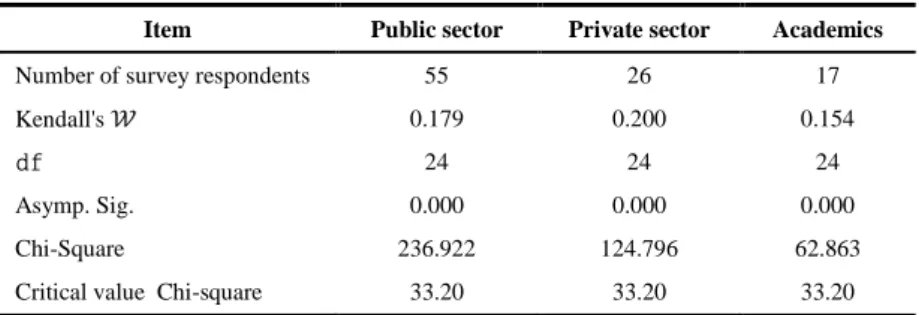
Kendall’s 𝒲 concordance coefficient will be used for this purpose. The suppositions are; zero supposition, where Ηo∶𝒲=0, alternative supposition, Ηo∶𝒲≠0. As tested number of attributes is greater than seven, the value of Chi-square
would be considered instead 𝒲 value. It can be seen from Table 7 that the Chi-square critical value for each one of the three groups is 33.20 at degrees of freedom (𝚍𝚏) = 24. As the calculated Chi-square values for the three groups of the survey, obtained by the outputs of SPSS are all larger than Chi-square critical value as shown in Table 7, indicating an agreement between the respondents within the same group on these rankings’ of risks.
Table 7. Kendall’s 𝒲 test results on risk ranking of PPP projects
Item Public sector Private sector Academics
Number of survey respondents 55 26 17
Kendall's 𝒲 0.179 0.200 0.154
𝚍𝚏 24 24 24
Asymp. Sig. 0.000 0.000 0.000
Chi-Square 236.922 124.796 62.863
Critical value Chi-square 33.20 33.20 33.20
7.2.4. Testing Inner Agreement within the Sample groups
For this purpose Kruskal Wallis test will be used. Where the supposition are: Zero supposition, Ηo∶𝙼𝗀1=𝙼𝗀2= 𝙼𝗀3
Alternative supposition, Η𝑎∶ as minimum, one difference amongst the tested groups’ medians will be found. Whereas
𝙼𝗀1, 𝙼𝗀2, 𝙼𝗀3 are the median values for public sector (Group 1) private sector (Group 2), and the academics (Group 3) respectively, Table 8 presents obtained outputs from SPSS.
It can be concluded from Table 8 that there are differences in participants’ rating within groups of the sample on PR3 (Public understanding & opposition), LR9 (The capacity of the private sector) and LR10 (Lack of commitment of private sector) which came from the different their understandings and work interest of the participants. This means that the rest 22 factors are rated almost at the same way by all sample groups, with a level of confidence equal to 95%
Table 8. Kruskal Wallis test for risk factors among survey groups
Risk factors Chi-Square (H value) Asymp. Sig. (p-value) Significant Risk factors Chi-Square (H value) Asymp. Sig. (p-value) Significant PR1 5.662 0.059 No LR3 4.200 0.122 No PR2 2.736 0.255 No LR4 5.932 0.052 No PR3 9.545 0.008 Yes LR5 3.493 0.174 No PR4 2.732 0.255 No LR6 2.453 0.293 No FR1 2.936 0.230 No LR7 3.369 0.185 No FR2 3.338 0.188 No LR8 4.540 0.103 No FR3 0.045 0.978 No LR9 8.230 0.016 Yes FR4 0.397 0.820 No LR10 13.877 0.001 Yes FR5 0.256 0.880 No OR1 3.191 0.203 No FR6 1.528 0.466 No OR2 2.342 0.310 No FR7 0.930 0.628 No OR3 1.305 0.521 No LR1 3.903 0.142 No OR4 3.470 0.176 No LR2 2.582 0.275 No
As Kruskal Wallis test refer to the existence of the difference without specifying in which group, Mann–Whitney– Wilcoxon will be used to identify that using below suppositions:
Zero supposition, Ηo∶𝜇𝗀1=𝜇𝗀2 Alternative supposition, Η𝑎∶𝜇𝗀1≠𝜇𝗀2
Where 𝜇𝗀1 and 𝜇𝗀2 are the Mean values of score for G1/ public and G2/ Private and G3/ Academics, zero supposition assumes equal mean between paired groups. If 𝘗-value is not larger or equal to 0.05, zero supposition not accepted, as the two groups under the study focus indicates a significant difference.
Where the level of confidence (α) will be equal to 0.05 and will be modified and divided over 3 to get rid of I error. Thus, the 3 test will be significant at level equal to 0.0167.
Based on the results of Mann-Whitney test presented in Table 9, It can be seen that, G1 and G2 differs significantly on LR9 with (0.007) and LR10 with (0.008) on the other hand G1 and G3 differs significantly on PR3 with 0.003 in addition to G2 and G3 which also differs significantly on LR10 with 0.001. With end of this test no further tests is required both tests (Mann–Whitney & Kruskal Wallis) conformed each other.
Table 9. Mann- Whitney U-test for risk factors between paired groups
Risk Factor
Group 1 and 2 Group 1 and 3 Group 2 and 3
Mann-Whitney U Wilcoxon W Z Asymp. Sig. (2-tailed) Mann-Whitney U Wilcoxon W Z Asymp. Sig. (2-tailed) Mann-Whitney U Wilcoxon W Z Asymp. Sig. (2-tailed) PR1 623.50 2163.50 -1.002 0.316 302.50 1842.50 -2.391 0.017 177.500 528.50 -1.240 0.215 PR2 609.00 2149.00 -1.344 0.179 393.50 1933.50 -1.218 0.223 218.00 569.00 -0.110 0.912 PR3 572.00 2112.00 -1.538 0.124 255.00 1795.00 -2.981 0.003 163.00 514.00 -1.560 0.119 PR4 579.00 930.00 -1.479 0.139 441.50 1981.50 -0.378 0.706 170.00 521.00 -1.332 0.183 FR1 576.50 927.50 -1.616 0.106 400.50 553.50 -1.042 0.298 210.00 561.00 -0.300 0.764 FR2 655.50 2195.50 -0.628 0.530 340.00 1880.00 -1.753 0.080 170.50 521.50 -1.303 0.192 FR3 698.50 2238.50 -0.187 0.851 458.00 1998.00 -0.142 0.887 219.00 372.00 -0.056 0.955 FR4 707.00 1058.00 -0.087 0.931 427.00 1967.00 -0.577 0.564 199.50 550.50 -0.574 0.566 FR5 695.00 2235.00 -0.210 0.834 439.00 592.00 -0.392 0.695 202.00 355.00 -0.489 0.625 FR6 660.00 2200.00 -0.584 0.559 384.50 1924.50 -1.145 0.252 190.00 541.00 -0.809 0.418 FR7 645.00 996.00 -0.816 0.414 438.50 1978.50 -0.425 0.671 192.00 543.00 -0.779 0.436 LR1 547.00 898.00 -1.925 0.054 460.00 613.00 -0.118 0.906 174.00 525.00 -1.282 0.200 LR2 684.00 2224.00 -0.355 0.722 362.50 1902.50 -1.544 0.123 177.00 528.00 -1.253 0.210 LR3 536.00 2076.00 -2.057 0.040 428.00 1968.00 -0.582 0.561 186.00 339.00 -1.057 0.291 LR4 526.00 2066.00 -2.064 0.039 344.50 1884.50 -1.749 0.080 220.50 373.50 -0.015 0.988 LR5 577.50 2117.50 -1.466 0.143 359.00 1899.00 -1.518 0.129 219.50 570.50 -0.041 0.968 LR6 591.50 2131.50 -1.316 0.188 384.00 1924.00 -1.170 0.242 216.50 369.50 -0.121 0.904 LR7 620.50 2160.50 -1.015 0.310 349.00 1889.00 -1.670 0.095 183.00 534.00 -1.039 0.299 LR8 622.00 973.00 -1.014 0.311 355.50 1895.50 -1.649 0.099 148.00 499.00 -1.992 0.046 LR9 475.50 826.50 -2.687 0.007 457.50 1997.50 -0.156 0.876 142.50 493.50 -2.102 0.036 LR10 467.50 818.50 -2.663 0.008 317.00 1857.00 -2.123 0.034 94.50 445.50 -3.282 0.001 OR1 597.00 2137.00 -1.329 0.184 366.50 1906.50 -1.486 0.137 208.00 559.00 -0.376 0.707 OR2 610.00 2150.00 -1.134 0.257 374.50 1914.50 -1.344 0.179 218.00 569.00 -0.079 0.937 OR3 698.00 2238.00 -0.181 0.856 385.00 1925.00 -1.158 0.247 189.50 540.50 -0.819 0.413 OR4 602.50 953.50 -1.225 0.220 391.50 1931.50 -1.109 0.267 155.50 506.50 -1.736 0.082
8.
Conclusions
1) The main risk challenge to PPP in Iraq as it has been agreed on by all respondents is “Corruption” that government should stop or minimize to the lowest level to improve the government performance in general and in PPP in particular. The following top five risks factors are:
Lack of private funding in general
Insufficient public administration processes Lack of Legal and regulatory framework
Delays and problems associated with acquisition of land Lack of sovereign guarantee
2) The perceptions of survey groups respondents concerning the importance of risk factors differ based on their point of view, where both public and academics respondents have serious concerns regarding the private sector
capacity to carry out the task. On the other hand the private sector concerns the availability of government incentives to support for this type of infrastructure.
3) Improving the capacity of the public sector and other stakeholders by intense and specialized capacity building programs is a priority. Contracting with specialized agencies to support the public organizations with the required expertise and provide in-job training to run the process is a favored option in this initial stage.
4) Legislating PPP law as soon as possible to cover this type of contract, in addition to the establishment PPP units, the development of a comprehensive regulatory framework combined with specific and clear selection criteria of the best private partner.
5) Reforming and standardizing approvals procedures wherever possible, delegate the authorities wherever necessary, and improve the interagency coordination is extremely important to save time and support the application of PPP approach.
6) Risk factors and barriers identified in the enabling environment of Iraq necessitate government commitment and intervention to provide the different types of support including issuing long term bonds to encourage the participation of the private banks and private sector and find a solution to the delay and the problems of land acquisition to attract experienced, well reputation and eligible international firms to ensure good performance and empower the local private sector firms through side by side work enrollment. And in the top of all that minimizing corruption and increasing transparency.
9.
Acknowledgments
This study is conducted with a great help, cooperation and support of the Ministry of Construction and Housing and Public Municipalities, Ministry of Planning, and the National Investment Commission.
10.
Conflicts of Interest
The authors declare no conflict of interest.
11.
References
[1] Araujo, Sonia, and Douglas Sutherland. “Public-Private Partnerships and Investment in Infrastructure.” SSRN Electronic Journal (September 2010). doi:10.2139/ssrn.1685344.
[2] Saussier, Stéphane. “Public–private Partnerships.” Journal of Economic Behavior & Organization 89 (May 2013): 143–144. doi:10.1016/j.jebo.2012.05.001.
[3] Alfen, Hans Wilhelm, Satyanarayana N. Kalidindi, Stephen Ogunlana, ShouQing Wang, Martinus P. Abednego, Andrea Frank-Jungbecker, Yu-Chien Amber Jan et al. “Public-private partnership in infrastructure development: case studies from Asia and Europe.” Weimar: Verlag der Bauhaus-Universität, 2009.
[4] Cheung, Esther, Albert P.C. Chan, and Stephen Kajewski. “Enhancing Value for Money in Public Private Partnership Projects.” Journal of Financial Management of Property and Construction 14, no. 1 (April 17, 2009): 7–20. doi:10.1108/13664380910942617.
[5] Thomas, A. V., Satyanarayana N. Kalidindi, and L. S. Ganesh. “Modelling and Assessment of Critical Risks in BOT Road Projects.” Construction Management and Economics 24, no. 4 (April 2006): 407–424. doi:10.1080/01446190500435275. [6] Jamali, Dima. “Success and Failure Mechanisms of Public Private Partnerships (PPPs) in Developing Countries.” International
Journal of Public Sector Management 17, no. 5 (August 2004): 414–430. doi:10.1108/09513550410546598.
[7] Appuhami, Ranjith, Sujatha Perera, and Hector Perera. “Coercive Policy Diffusion in a Developing Country: The Case of Public-Private Partnerships in Sri Lanka.” Journal of Contemporary Asia 41, no. 3 (June 29, 2011): 431–451. doi:10.1080/00472336.2011.582713.
[8] Ministry of Planning, Baghdad, Iraq Budget execution report, (2017).
[9] World Bank. “Public-Private Partnerships: Reference Guide” Washington DC (2012).
[10] Lammam, Charles, Hugh MacIntyre, and Joseph Berechman. "Using public-private partnerships to improve transportation infrastructure in Canada." Fraser Institute Studies in Economic Prosperity (May 2013).
[11] Harris, S. “Public private partnerships: Delivering better infrastructure services” Working Paper no. 41. (2004). Washington, D.C.: Inter-American Development Bank.
[12]HM Treasury. ”A new approach to public private partnerships” London (2012). Available online: https://www.gov.uk/government/uploads/system/uploads/attachment_data/file/205112/pf2_infrastructure_new_approach_to_p ublic_private_parnerships_051212.pdf.
[13] Kwak, Young Hoon, YingYi Chih, and C. William Ibbs. “Towards a Comprehensive Understanding of Public Private Partnerships for Infrastructure Development.” California Management Review 51, no. 2 (January 2009): 51–78. doi:10.2307/41166480.
[14] Katz, D. “Financing infrastructure projects: Public Private Partnerships (PPPs)” Policy Perspectives Paper no. 06/02 (2006). [15] Biygautane, Mhamed, Cristina Neesham, and Khalid Othman Al-Yahya. “Institutional Entrepreneurship and Infrastructure
Public-Private Partnership (PPP): Unpacking the Role of Social Actors in Implementing PPP Projects.” International Journal of Project Management 37, no. 1 (January 2019): 192–219. doi:10.1016/j.ijproman.2018.12.005.
[16] Hussain, Sherena, and Matti Siemiatycki. “Rethinking the Role of Private Capital in Infrastructure PPPs: The Experience of Ontario, Canada.” Public Management Review 20, no. 8 (March 21, 2018): 1122–1144. doi:10.1080/14719037.2018.1428412. [17] Organization for Economic Co-operation and Development (OECD). “Public-Private Partnerships in the Middle East and North
Africa, a Handbook for Policy Makers.” (2015). Available online: https://www.oecd.org/mena/competitiveness/PPP%20 Handbook _EN_with_covers.pdf.
[18] Biygautane, Mhamed. “Infrastructure Public–Private Partnerships in Kuwait, Saudi Arabia, and Qatar.” Public Works Management & Policy 22, no. 2 (October 13, 2016): 85–118. doi:10.1177/1087724x16671719.
[19] Ojelabi, RA, OI Fagbenle, AO Afolabi, PF Tunji-Olayeni, and LM Amusan. “Appraising the Barriers to Public-Private Partnership as a Tool for Sustainable Development of Infrastructures in a Developing Economy.” IOP Conference Series: Earth and Environmental Science 146 (May 2018): 012016. doi:10.1088/1755-1315/146/1/012016.
[20] Murphy, Timothy J. “The Case for Public-Private Partnerships in Infrastructure.” Canadian Public Administration/Administration Publique Du Canada 51, no. 1 (March 2008): 99–126. doi:10.1111/j.1754-7121.2008.00006.x. [21] Ross, Thomas. “Three Bad Reasons to Do a Public-Private Partnership—and One Very Good One”. Business in Vancouver
(November 18, 2008).
[22] Eggers, William D., and Tom Startup. ”Closing the Infrastructure Gap: The Role of Public-Private Partnerships” 2006. Deloitte Research Study.
[23] Abdel Aziz, Ahmed M. "Successful delivery of public-private partnerships for infrastructure development." Journal of construction engineering and management 133, no. 12 (2007): 918-931. doi:10.1061/(ASCE)0733-9364(2007)133:12(918). [24] Quelin, Bertrand V., Sandro Cabral, Sergio Lazzarini, and Ilze Kivleniece. “The Private Scope in Public–Private Collaborations:
An Institutional and Capability-Based Perspective.” Organization Science 30, no. 4 (July 2019): 831–846. doi:10.1287/orsc.2018.1251.
[25] Scribner, Marc. "The Limitations of Public-Private Partnerships Recent Lessons from the Surface Transportation and Real Estate Sectors." Issue Analysis, Competitive Enterprise Institute (2011).
[26] Organization for Economic Co-operation and Development [OECD] Recommendation of the Council on Principles for Public Governance of Public Private Partnerships. (2012).
[27] Lee, Minsoo, Xuehui Han, Pilipinas Quising, and Mai Lin Villaruel. “Hazard Analysis on Public–Private Partnership Projects in Developing Asia.” SSRN Electronic Journal (2018). doi:10.2139/ssrn.3339075.
[28] Emek, Uğur. “Turkish Experience with Public Private Partnerships in Infrastructure: Opportunities and Challenges.” Utilities Policy 37 (December 2015): 120–129. doi:10.1016/j.jup.2015.06.005.
[29] Private Participation in Infrastructure (PPI) database- World Bank Group. Available online: https://ppi.worldbank.org/en/ppi. (accessed on February 2018).
[30] Public-Private Partnerships Laws/Concession Laws - World Bank Group. Available online: https://ppp.worldbank.org/public-private-partnership/legislation-regulation/laws/ppp-and-concession-laws. (accessed on February 2018).
[31] PwC and Dubai Investment Development Agency. “Adopting the Public Private Partnerships model and its role in attracting Foreign Direct Investment”. (January 2016): Available online: www.pwc.com/m1/en/publications/documents/adopting-ppp-and-its-role-in-attracting-fdi-dubai.pdf.
[32] Rocca, Mark. “Public Private Partnerships, United Arab Emirates” (2017): Available online: https://gettingthedealthrough.com/area/71/jurisdiction/33/public-private-partnerships-united-arab-emirates/.
[33] Knight, Stephen. “Dubai Embraces PPP Again” (2016). Available online: https://www.jdsupra.com/legalnews/dubai-embraces-ppp-again-13626/.
[34] Almarri, Khalid, and Bassam Abu-Hijleh. “Critical Success Factors for Public Private Partnerships in the UAE Construction Industry- A Comparative Analysis between the UAE and the UK.” Journal of Engineering, Project, and Production Management 7, no. 1 (January 31, 2017): 21–32. doi:10.32738/jeppm.201701.0004.
[35] Ozorhon,B. Durna E. and Caglayan S. “Critical Success Factors For Public Private Partnership Projects In Developing Countries: Case Of Turkey” International Research Conference 2017: Shaping Tomorrow’s Built Environment Conference Proceedings 11-12 September 2017. Available online: http://usir.salford.ac.uk/id/eprint/44058.
[36] Yong, HK. “Public–Private Partnerships Policy and Practice A Reference Guide, Commonwealth Secretariat” (September 2010): Available online: https://books.thecommonwealth.org/public–private-partnerships-policy-and-practice-paperback.
[37] Wali, Meervat R. “Optimal Selection of Investment Contracts for Infrastructure Projects in Iraq” PhD thesis, Baghdad University (2015).
[38] Transparency International organization. “Corruption Perceptions index”. Available online: https://www.transparency.org/cpi2018. (accessed on March 2018).
[39] World Bank. “Ranking & Ease of Doing Business Score 2018”. Available online: http://www.doingbusiness.org/en/rankings. (accessed on February 2018).
[40] Al-juboori, Omar. “Conditions for Applying Public Private Partnership (PPP) in Iraq Infrastructure Projects Successfully” Ph.D. thesis, University of Munich (2015).
[41] Li, Bing, A. Akintoye, P.J. Edwards, and C. Hardcastle. “Perceptions of Positive and Negative Factors Influencing the Attractiveness of PPP/PFI Procurement for Construction Projects in the UK.” Engineering, Construction and Architectural Management 12, no. 2 (April 2005): 125–148. doi:10.1108/09699980510584485.
[42] Babatunde, Solomon Olusola, Srinath Perera, Lei Zhou, and Chika Udeaja. “Stakeholder Perceptions on Critical Success Factors for Public-Private Partnership Projects in Nigeria.” Built Environment Project and Asset Management 6, no. 1 (February 2016): 74–91. doi:10.1108/bepam-11-2014-0061.
[43] Miller, D. “Handbook of Research Design and Social Measurement” California: SAGE Publications Ltd, (1991).
[44] B.Weber, H.W. Alfen. “Infrastructure as an Asset Class: Investment Strategies, Project Finance and PPP” Wiley publications, (2010).
Appendix I
A Survey on Public-Private Partnership as an Alternative to Financing Suspended Infrastructure Projects in Iraq
To the Respondent Dear Madam / Sir,
This questionnaire survey is prepared to be a part of a master thesis entitled “Public-Private Partnership as an Alternative to Financing Suspended Infrastructure Projects in Iraq”, submitted to the college of engineering of university of Baghdad in partial fulfilment of the requirements for the degree of Master of Science in civil engineering / project management. The purpose of this study is to assess whether the use of PPP as governmental approach in filling the financing gap is a viable solution for Financing Suspended Infrastructure Projects due to the financial crisis of 2014 and the inability of government to provide all of the required funds for infrastructure development in Iraq.
PPP can be defined as “an agreement between a government and a private firm under which the private firm delivers an asset, a service, or both, in return for payments contingent to some extent on the long-term quality or other characteristics of outputs delivered”. PPPs in facilities development involve private companies in the design, financing, construction, ownership and operation of a public sector utility for long term contract (20-30) year. PPPs are known worldwide with various other alternative names such as Private Participations in Infrastructure (PPI), Private-Sector Participation (PSP), P3, Privately Financed Projects (PFP), and Private Finance Initiatives (PFI).
The survey contains 13 questions, and we estimate it will take an average of 25 minutes to be completed. Your completion of this survey is voluntary and questions are individual, subjective assessments. Your participation in this survey renders me a highly appreciated assistance. Please be sure that your personal data are going to be top confidential. I welcome your comments or questions relating to this survey, you can contact me at the bellow mentioned addresses.
Notice: It is important to note that there are definitely no “right” or “wrong” answers; the only “correct” answers are what you honestly think and feel.
Thank you in advance for your help, we do appreciate your time. Jinan k. Hassan
MSc. Student
College of engineering University of Baghdad
![Figure 1. Main feature and advantages of PPP contracts [10]](https://thumb-us.123doks.com/thumbv2/123dok_us/251711.2525575/2.892.128.736.491.682/figure-main-feature-advantages-ppp-contracts.webp)
![Table 1. PPP in Infrastructure throughout 1990 - H1 2017 in US$ billion [29]](https://thumb-us.123doks.com/thumbv2/123dok_us/251711.2525575/4.892.60.830.788.998/table-ppp-infrastructure-h-billion.webp)
![Figure 3. Risk factors to PPP in Egypt, Jordan, Morocco, and Tunisia [17]](https://thumb-us.123doks.com/thumbv2/123dok_us/251711.2525575/5.892.178.717.761.1087/figure-risk-factors-ppp-egypt-jordan-morocco-tunisia.webp)