University of Massachusetts Amherst
ScholarWorks@UMass Amherst
Masters Theses 1911 - February 20142013
Relationships among Source Credibility of
Electronic Word of Mouth, Perceived Risk, and
Consumer Behavior on Consumer Generated
Media
Mei-hsin Wu
University of Massachusetts Amherst
Follow this and additional works at:https://scholarworks.umass.edu/theses
This thesis is brought to you for free and open access by ScholarWorks@UMass Amherst. It has been accepted for inclusion in Masters Theses 1911 -February 2014 by an authorized administrator of ScholarWorks@UMass Amherst. For more information, please contact
Wu, Mei-hsin, "Relationships among Source Credibility of Electronic Word of Mouth, Perceived Risk, and Consumer Behavior on Consumer Generated Media" (2013).Masters Theses 1911 - February 2014. 984.
RELATIONSHIPS AMONG SOURCE CREDIBILITY OF ELECTRONIC WORD OF MOUTH, PERCEIVED RISK, AND CONSUMER BEHAVIOR ON
CONSUMER GENERATED MEDIA
A Thesis Presented
by
Mei-Hsin Wu
Submitted to the Graduate School of the
University of Massachusetts Amherst in partial fulfillment
of the requirements for the degree of
MASTER OF SCIENCE
February 2013
© Copyright by Mei-Hsin Wu 2013
RELATIONSHIPS AMONG SOURCE CREDIBILITY OF ELECTRONIC WORD OF MOUTH, PERCEIVED RISK, AND CONSUMER BEHAVIOR ON
CONSUMER GENERATED MEDIA
A Thesis Presented by
Mei-Hsin Wu
Approved as to style and content by:
Miyoung Jeong, Chair
Linda Lowry, Member
Thomas Kida, Member
Haemoon Oh, Department Head
iv
ACKNOWLEDGEMENTS
I would like to express my gratitude to those who helping me to complete this thesis.
First, I am so grateful to have Professor Miyoung Jeong to be my thesis advisor and guide
me through the research progress. I would also like to thank my committee members,
Professor Linda Lowry and Professor Thomas Kida, for their invaluable suggestions and
comments on my thesis. I sincerely appreciate the respondents’ participation to my
survey. Finally, I want to thank my friends and family, especially my parents. Their
v
ABSTRACT
RELATIONSHIPS AMONG SOURCE CREDIBILITY OF ELECTRONIC WORD OF MOUTH, PERCEIVED RISK, AND CONSUMER BEHAVIOR ON CONSUMER
GENERATED MEDIA
FEBRUARY 2013
MEI-HSIN WU
B.B.A., SOOCHOW UNIVERSITY
M.S., UNIVERSITY OF MASSACHUSETTS AMHERST Directed by: Professor Miyoung Jeong
As technology advances, the influence of electronic word-of-mouth (eWOM)
surpasses the influence of traditional face-to-face WOM communication on consumers’
decision making. Since the hospitality and tourism products and services contain more
interpersonal interaction that needs to be experienced by consumers, the influence of
eWOM in the hospitality industry is more significant than in other industries.
The main purpose of this study is to examine the relationships among source
credibility of eWOM, customers’ perceived risk, and their behavior intentions to use
consumer generated media. The result provides evidence about the influence of eWOM
on overall perceived risk and how consumers use eWOM to manage and reduce the
vi
significance of eWOM influence and connects the gap in the previous literatures between
source credibility of eWOM and perceived risk research. Practically, hoteliers can set
their marketing strategies precisely aimed to consumers’ needs and are able to build good
reputations through those online travel forums or hotel review sites.
vii TABLE OF CONTENTS Page ACKNOWLEDGEMENTS………. iv ABSTRACT……….. v LIST OF TABLES……… x LIST OF FIGURES……….. xi CHAPTER 1. INTRODUCTION ………1 1.1. Research Background ………1 1.2. Problem Statement ……….2 1.3. Research Questions ………5
1.4. Significance of the Study ………..….6
1.5. Definitions of Terms ………..6
2. LITERATURE REVIEW ………...8
2.1. Introduction ……….8
2.2. Word of Mouth (WOM) Communication ………...8
2.2.1. Electronic Word of Mouth (eWOM) ………..10
viii 2.3. Source Credibility………...13 2.3.1. Expertness ………...14 2.3.2. Trustworthiness ………...16 2.3.3. Objectivity ………...17 2.3.4. Homophily ………..19 2.4. Perceived Risk ………...21
2.4.1. The Relationship between Perceived Risk and WOM………24
2.5. Trust ………...24
2.6. Consumer Behavior Intention ………26
3. RESEARCH DESIGN AND METHODOLOGY ……….29
3.1. Research Design………..29
3.2. Sampling Procedure……….……...29
3.3. Instrument / Questionnaire Design…………..………...……30
3.4. Data Collection………...…31
4. RESULTS………..………...…...32
4.1. Descriptive Analysis………..………...……32
4.1.1. Demographic Profile ………..……….33
ix
4.2. Factor Analysis………..………...….………36
4.3. Hypotheses Test………..………...….……..41
4.3.1. Relationship between Source Credibility and Perceived Risk………….41
4.3.2. Relationship among Source Credibility, Perceived Risk, and Trust……43
4.3.3. Relationship among Source Credibility, Perceived Risk, Trust, and Purchase Intention………44
4.3.4. Relationship among Source Credibility, Perceived Risk, Trust, Purchase Intention, and eWOM Involvement……….45
5. CONCLUSION………..49
5.1. Discussion………...49
5.2. Implications……….50
5.3. Limitations………..52
5.4. Recommendations for Future Research………..52
APPENDICES A. QUESTIONNAIRE (ENGLISH VERSION)………..54
B. QUESTIONNAIRE (CHINESE VERSION)……….. …...63
C. PERMISSION OF POSTING SURVEY LINK IN BACKPACKERS…...71
x
LIST OF TABLES
Table Page
1. Demographic Profile of Respondents………...33
2. Respondents’ Information Search and Travel Pattern………...35
3. KMO and Bartlett's Test of Sphericity………..37
4. Results of Factor Analysis of Source Credibility………..38
5. Results of Factor Analysis of Perceived Risk and Trust………39
6. Results of Factor Analysis of Consumer Behavior Intention………40
7. Correlations Matrix………42
8. Regression of Source Credibility and Perceived Risk………...43
9. Regression of Source Credibility, Perceived Risk, and Trust………...44
10. Regression of Source Credibility, Perceived Risk, Trust, and Purchase Intention….45 11. Regression of Source Credibility, Perceived Risk, Trust, Purchase Intention, and eWOM Involvement………..46
xi
LIST OF FIGURES
Figure Page
1. A Conceptual Model of Word-of-Mouth……….12
1
CHAPTER 1
INTRODUCTION
1.1. Research Background
As the social media become an indispensable part of people’s daily lives, the speed
of information transfer increases and the power of electronic word-of-mouth (eWOM)
grows more rapidly. A positive recommendation or compliment in an online discussion
forum may bring a lot of business for an organization in a short time, but a negative
complaint in a personal blog also can quickly cause other consumers’ mistrust of the
product or service, and result in a huge loss to a firm. Since the hospitality and tourism
products and services contain more interpersonal interaction that needs to be experienced
by consumers, the influence of eWOM in the hospitality industry is more significant than
in other industries (Litvin, Goldsmith, & Pan, 2008).
Nowadays, when travelers search for their lodging and travel information for their
upcoming trips, they tend to rely more on sources from the Internet than before.
According to the research conducted by the U.S. Travel Association, the number of
American adults who use the Internet to plan travel was over 105 million in 2008,
2
searching travel information online is that it is easier and faster to get updated
information. The information seeker can reach abundant travel information online
without the restriction of time and place. Moreover, the voluntary opinions and reviews
from experienced travelers’ points of view are much more persuasive to those information
searchers (Jeong & Jeon, 2008).
However, when consumers obtain plenty of information and a variety of opinions on
their future travel online, their overall perceived risk toward the products or services
might be changed. Thus, the criteria consumers use to judge the factuality of information
and to make their final decision is important for industry practitioners to know to meet
their needs in this competitive and dynamic Internet environment.
1.2. Problem Statement
The main purpose of the study is to examine the relationships among source
credibility of eWOM, customers’ perceived risk, and their behavior intentions to use
consumer generated media (CGM). Since Bauer (1960) first launched the concept of
perceived risk, many studies have adopted it to examine its relationships with customer
behavior (e.g. Cox &Rich, 1964; Mitchell, 1992; Mitra, Reiss, & Capella, 1999; Ross,
3
consumers’ decision making processes and influence their behavior.
In order to reduce the risk associated with a purchase decision, information search is
a common strategy consumers use (O'Connor, 2008; Smith, Menon, & Sivakumar, 2007).
Among the five information sources, Andreasen (1986) proposed that personal
independent source has been viewed as a credible and trustworthy one. Particularly, the
influence of word-of-mouth (WOM) on consumer behavior attracts scholars’ attention.
Mitchell and Greatorex (1993) found that asking advice from family and friends is a
useful way to reduce perceived risk in most service purchases. Studies (i.e., Arndt, 1967a;
Lutz & Reilly, 1974) also proposed that WOM was the most important source of
information in reducing risk, and the degree of initial perceived risk and the importance
of personal source information had a positive relationship with a purchase decision.
As technology advances, consumers are able to easily obtain information about
products and services through eWOM before they purchase. The influence of eWOM
such as blogs, forums, and consumer review sites surpasses the influence of traditional
face-to-face WOM communication on consumers’ decision making (Cheng & Zhou,
2010). Although research in eWOM is still in its initial stages, the power of eWOM
transmission and its influence on consumer behavior makes this subject a spotlight in the
4
eWOM research focuses on its impact on communication and consumers’ behaviors
(Cheung & Thadani, 2010). Only a few studies have been conducted to evaluate the
causal relationship between perceived risk and eWOM transmission. For example, Huang,
Chou, and Lan (2007) examined the influence of inherent perceived risk of service,
negative eWOM transmission, and message types on consumer behavior in their study.
However, since the overall perceived risk is a critical determinant in consumer decision
making processes, disclosing the variation of overall perceived risk affected by the source
credibility of eWOM would be principal in eWOM research.
This study plans to make contributions in both academic and practical perspectives.
Academically, it bridges the theoretical gap by clarifying the relationship among source
credibility of eWOM and overall perceived risk. Practically, both independent travelers
and hotel managers will be benefited knowing what cues consumers use to assign trust
and what criteria consumers view most important when choosing a hotel for their future
stay. The independent travelers can better be informed about the service qualities of
certain hotels from other experienced consumers, make the best decision matching their
needs and expectations, and reduce the possibility of being disappointed when they
actually go. The hotel managers can have a better understanding of consumers’ decision
5
decisions, the hotel managers can form precise marketing strategies aiming their potential
customers and adjusting their operation to fulfill consumers’ expectations.
1.3. Research Questions
In this study, the following research questions have been developed to achieve its
objectives:
1. What are the characteristics of the independent travelers who use eWOM as their
main information source?
Personal factors such as age, gender, and education affect consumers’ online
information search and travel patterns. People who use eWOM as their information
source may share the same characteristics. Moreover, the effect of eWOM may also be
influenced by the receiver’s prior knowledge and experience (Cheng & Zhou, 2010).
2. What factors influence the level of consumers’ perceived risk to eWOM?
The source credibility of eWOM may affect consumers’ perceived risk. Identifying
what criteria independent travelers use to judge the source credibility of eWOM will be
helpful in solving the puzzle of factors that influence the consumers’ perceived risk.
3. How does consumers’ perceived risk and trust influence their behavioral intentions?
6
have toward the information they obtained. Trust enhances consumers’ willingness to
purchase and influence their degree of involvement to eWOM communication.
1.4. Significance of the Study
The result of this study could provide evidence about the influence of eWOM on
overall perceived risk and how consumers use eWOM to manage and reduce the potential
risks when making their lodging decisions. From the academic viewpoint, it not only
confirms the significance of eWOM influence, but also connects the gap in the previous
literature between source credibility of eWOM and overall perceived risk research.
Practically, by knowing what criteria those independent travelers use to judge the
factuality of eWOM information, hoteliers are able to set their marketing strategies
precisely aimed to consumers’ needs and build good reputations through those online
travel forums or hotel review sites.
1.5. Definitions of Terms
Electronic Word of Mouth (eWOM) Communication
eWOM is the Web-based interpersonal communication between strangers to deliver
7
(Cheng & Zhou, 2010; Litvin et al., 2008). eWOM transfers via E-mail, blogs, forums,
chat room, instant messages, newsgroups, electronic bulletin boards, social network sites,
and review sites (Cheng & Zhou, 2010; Hennig-Thurau, Gwinner, Walsh, & Gremler,
2004).
Perceived Risk
Perceived risk is how consumers feel about the possibility of uncertainty and the
unpleasant consequence toward a purchase (Cunningham, 1967a). The overall perceived
risk of the current research measured is the unavoidable risk with a product choice
consumers perceive after risk reduction processes.
Independent Travelers
Independent travelers are individuals who arrange their travel itinerary by
themselves. Instead of relying on the package offered by the travel retailer, they search
information from the travel guidebooks or the Internet to book their own transportation
8
CHAPTER 2
LITERATURE REVIEW
2.1. Introduction
In this chapter, key theoretical constructs in the previous studies such as
word-of-mouth (WOM), source credibility, perceived risk, trust, and consumer behavior
are reviewed. The first section will define the nature of WOM, electronic word-of-mouth
(eWOM) communication, and the influence of WOM on consumer decision-making. The
second section will present the existing studies on source credibility and the four
dimensions developed to measure the source credibility in this study. The following
section will describe the flow of research in perceived risk, its relationship with WOM,
and the importance of perceived risk in consumer decision-making. And, finally, the role
of trust in consumer decision-making will be addressed along with its influence on
consumers’ behavior intentions.
2.2. Word of Mouth (WOM) Communication
WOM, the interpersonal communication between consumers to deliver the
9
al., 2008), has been recognized as a powerful determinant that has a greater influence
than personal sale or commercials on consumers’ purchase decision (Katz & Lazarsfeld,
1955). As the hospitality and tourism product consumption involves more customer
participation and the service quality is affected by the interaction between service
providers and consumers, it is difficult to anticipate the purchase outcome precisely
before experience. However, consumers are able to roughly imagine the performance of a
service provider from WOM information and set their expectation to the service quality
before actual consumption. The information exchange between experienced and
inexperienced customers decreases the degree of uncertainty that a new buyer perceived.
Previous research shows that a negative WOM spreads faster and wider than a
positive WOM. Swanson and Hsu (2009) confirm that most consumers would discuss
their travel and tourism consumption experience with others and the unsatisfactory
service encounter distributes wider in their social network. Although companies are glad
to take advantage from positive WOM to advertise their products or services, they also
take the risk of being threatened by the negative WOM. Thus, a way to manage the
influence of WOM and prevent the reputation of product and company from decreasing is
10
2.2.1 Electronic Word of Mouth (eWOM)
As technology advances, the format of WOM transfers from the face-to-face
communication to the Web-based platforms such as blogs, forums, and review sites
between strangers (Cheng & Zhou, 2010). Although the eWOM differs from WOM in the
way it transmits, the power of influence to consumers does not decrease. The importance
of the influence of eWOM on consumers’ decision-making process has been proved in
various studies (Litvin et al., 2008; Xiang & Gretzel, 2010). With the help of new
technology, consumers are able to actively participate in and spread out WOM promptly.
For example, consumers can simultaneously share their experience about the performance
of a restaurant service by the Smartphone Apps while they are enjoying their meal.
In general, independent travelers hope to have more control over their trip. They may
use eWOM information as their first information resource when they start to plan their
trip or search for the eWOM information when they need a third party opinion to verify
the factuality of information they get from other sources (such as advertisements)
(Gretzel, Hyan-Yoo, & Purifoy, 2007; O'Connor, 2008).
2.2.2 Effect of WOM on Consumer Decision Making Process
11
in and make an effort to understand consumer behavior for a long time (Bettman, Luce, &
Payne, 1998; Zeleny, 1982). Many factors such as individuals’ personality, personal
experience, convincing advertisements, persuasive salespersons, information accessibility,
and even the third party opinion may have direct, indirect, or interactive influence to a
consumer’s final purchase choice (Bettman et al., 1998; Sirakaya & Woodsideb, 2005). In
the marketing literature, the five stages model of consumer decision process is the most
well-known and has been applied to the consumer behavior studies to illustrate consumer
behavior (Sirakaya & Woodsideb, 2005). The process of problem recognition,
information search, alterative evaluation, purchase decision, and post-purchase evaluation
illustrates most consumers’ purchase behaviors.
WOM plays a critical role in the decision making process. It is involved in both
pre-purchase and post-purchase stages and affects consumer behaviors. First, before the
decision making and purchasing stage, (in the information search and alterative
evaluation stages) consumers intend to seek for information to maximize the value of
their money. Second, the satisfied or unhappy experiences motivate consumers to share
their opinions with others (the post-purchase evaluation). Figure 1 shows Litvin,
12
Figure 1 A conceptual model of word-of-mouth (Litvin et al., 2008)
In general, independent travelers search for their lodging information online rather
than booking their hotel through a travel retailer in order to find an accommodation that Motivations for Contribution Source of WOM Mediating Variables Originator Word-of-Mouth Listener Mediating Variables Outcomes of WOM
13
has the best value to them. The difference between purpose and needs results in the
different degree of their risk perception and influences their purchase decision.
Backpackers are looking for the most economic place to save money and some
independent travelers may want to stay in a traditional accommodation to experience a
unique culture. Through an online traveling forum or review site, they can collect
information provided by other experienced travelers and find an accommodation that
meets to their demands and expectations. As a result, the consumer-generated content
(CGC) becomes one important information source for travel planning, especially for
travelers’ accommodation decisions (Gretzel & Yoo, 2008).
2.3. Source Credibility
Source credibility refers to the information receivers’ perceived trust toward the
source of information (Ohanian, 1990). Existing literature identifies source expertise and
source trustworthiness as two major determinants to measure the credibility of
information (e.g., Applbaum & Anatol, 1972; Wiener. & Mowen, 1986; Whitehead, 1968).
In addition to the dimension of expertise and trustworthiness, views differ from
researchers about other dimensions of source credibility in the influence on consumers’
14
measured from four dimensions in the present study: expertness, trustworthiness,
objectivity, and homophily.
2.3.1 Expertness
Expertness indicates the extent of skillfulness, authoritativeness, competence, and
qualification a person has about the specific knowledge (Applbaum & Anatol, 1972;
Whitehead, 1968). Information from an expert source is more persuasive and has positive
influences on receivers’ attitude change (Ohanuan, 1990). Three indicators are used to
evaluate the extent of expertness of the review in the current research: website reputation,
reviewers, and information.
A website is the platform of eWOM distribution. Information from a professional
forum or a reliable review site is more credible and may change reviewers’ perceived risk.
According to Park and Lee (2009), the reputation of a website influences the information
credibility consumers perceived. For example, TripAdvisor.com is a well-established
review site that has 50 million unique individuals visiting each month and over 60 million
reviews and opinions posting on its site (www.tripadvisor.com). Consumers perceive
TripAdvisor.com as a specialized travel website. Thus, the travel information from
15
Since the hospitality and tourism products are more experience-oriented, the
information seekers do not expect to obtain information from an expert who has
professional or specialized knowledge about the hotel industry. Thus, a recommendation
from a former consumer who has actual experience is more persuasive than a comment
from an industry expert. The difference in details (such as photo numbers or description
detail) the reviewer offer might be a cue for information receivers to determine whether
the information providers are knowledgeable and experienced. For example, when
consumers want to know if a hotel meets their demand, the opinion from a former hotel
guest actually staying in the same hotel is more helpful.
To evaluate the degree of experience for a reviewer, the contribution and the
duration are two indicators. Contribution refers to how many reviews a reviewer wrote
and the duration reflects how long a reviewer involves in sharing and exchanging
information. Both of them can show reviewers’ experience of hotel choice. One way to
judge the expertness of eWOM information is from the reader’s point of view. If the
reader thinks a review is helpful, it means the content targets to his/her concerns.
Based on the previous studies, the following hypothesis has been developed:
H1: The higher the expertness of eWOM is, the lower degree of the perceived risk
16
2.3.2 Trustworthiness
Trustworthiness of the eWOM is another factor which may affect the information
receivers’ perceived risk. Yoo and Gretzel (2009) confirm the existence of a relationship
between structure of content and trustworthiness. The reveal of information providers’
personal identifying information (PII) has positive influence on receivers’ trust (Xie,
Miao, Kuo, & Lee, 2011). Also, the information providers’ active participation in the
online forum may result in the information receivers’ trust. How much time the providers
devoted to the online discussions, how fast they respond to information seekers’ inquiries,
and how frequent they share information might be the standards the information seekers
use to judge the degree of information providers’ participation.
Distinguishing between truthful and deceptive reviews in the online environment is a
main concern to travelers while choosing their lodging place. The influence and
importance of customer-generated opinion increases the interest in exploring the
dissimilarity of a truthful and deceptive message. Burgoon, Blair, Qin, and Nunamaker
(2003) and Zhou and Sung (2008) suggest that a deceptive message is different from a
truthful message in the aspect of quantity, non-immediacy, lexical complexity, and
17
the participants and then do the content analysis to compare the differences between
truthful and deceptive reviews.
It is a common notion that people prefer to spend their time and energy to do things
they have passion for or they can get a benefit from doing it. Most reviews are
contributed by volunteers. Thus, the quantity of content may reflect a reviewer’s opinion.
Because the review is based on the reviewer’s personal experience, self-reference such as
the use of first person pronouns is unavoidable but the lexical complexity of word usage
may not be necessary. In addition, the consistency between reviews from different
reviewers is a strong support to the factuality of the information. Thus, the following
hypothesis is formulated:
H2: The higher the trustworthiness of eWOM is, the lower degree of the perceived
risk consumer has.
2.3.3 Objectivity
People often assign their trust to information sources according to the objectivity of
the content. It is an important cue to judge the fairness of a statement because subjective
opinions may cause bias and affect the judgment. Concrete and impartial descriptions in a
18
own judgment. While describing the complimentary breakfast a hotel offers, naming what
kind of food it has is more clear and objective than just saying “it is adequate”.
Information receivers’ perceived risk changes along with the information objectivity
they perceived, not only by the direction of opinions (positive or negative), but also by
the sentiment of words. For example, they may recognize certain products or services as
high risk according to the expression of the content. An emotional complaint and a
neutral comment cause different results to their perceived risk. If the content of eWOM is
describing a unique circumstance, there may be different judgment than toward a normal
situation.
Personal emotion influences the objectivity of judging the performance of service.
When people are in a hurry, normally they are less patient. For the hotel guests who rush
to catch the flight, waiting for one minute to check out may feel like forever. They may
complain about how inefficient the front desk clerk is in the hotel reviews. In addition,
the difference of reviewers’ role affects the reader’s perception. For example, although
the editor of a review site is professional and experienced traveler, the review he/she
wrote may cause doubt to readers whether it implies some commercial purpose.
If a review is written from objective perspective, it is more trustable and reduces the
19
reveals.
H3: The higher the objectivity of eWOM is, the lower degree of perceived risk
consumers have.
2.3.4 Homophily
People incline to bond themselves with others who are similar to them (McPherson,
Smith-Lovin, & Cook, 2001). In the sociology research, homophily is viewed as an
important factor which influences the human communication. The perceived homophily
reduces the uncertainty, enhances good feeling, and reinforces safety of the interpersonal
relationship (Prisbell & Andersen, 1980). The homophily influences information
receivers’ judgment to the information they receive. For example, the information
receiver may trust the eWOM information from information providers who have similar
backgrounds or interests with them.
Lazarsfeld and Merton (1954) distinguish the similarity between sources and
receivers into status homophily and value homophily. The status homophily refers to the
external similarity among individuals such as the age, the gender, or the social class. The
value homophily emphasizes from the internal perspective such as the similar belief,
20
In traditional WOM, the receiver knows the credibility of an information provider
since they have an existent social tie to each other. The strength of ties between sender
and receiver is a basis to judge the degree of source credibility. Brown and Reingen (1987)
find that the level of tie strength has different influence on the receiver’s decision making
because a strong tie to the referral source is more creditable.
Unlike offline WOM communication, eWOM message transfers between strangers
who have non-existent tie. The nature of anonymous in eWOM communication increases
the difficulty of judging the credibility of source and the authenticity of the information
(Cheng & Zhou, 2010). Steffes and Burgee’s study (2009) reveals that in the online
environment, the source credibility is not correlated positively with the intensity of social
relationship. However, information gathering from non-existent tie but homophily source
in an online forum is viewed as a credible source. In the receivers’ decision-making
process, the homophily source is more influential than a referral source that the
communicator has a strong or weak tie to.
When people search information online, the degree of homophily between
themselves and the sources affects their perceived risk and their behavior intentions.
Steffes and Burgee (2009) argue that information from a source that is similar in age,
21
influential in consumers’ decision-making process, regardless of the intensity of social
relationship between individuals.
Even though lacking of social ties between information providers and receivers in
the online environment, the presence of communicators’ personal identifying information
(PII) increases the credibility of online review (Xie et al., 2011). The presence of
communicator’s personal identifying information also reveals the degree of individuals’
homophily, and thus reduces the risk information the receiver perceived. Therefore, the
following hypothesis has been derived:
H4: The homophily between information providers and information receivers
negatively correlates to the perceived risk.
2.4. Perceived Risk
Perceived risk is defined as how consumers feel about the possibility of uncertainty
and the unpleasant consequence toward a purchase in consumer research (Cunningham,
1967a). As risk aversion is one of the human instincts, perceived risk plays a critical role
and influences every stage of the consumer decision making process (Mitchell, 1992). In
general, people hope to manage and reduce the possibility of unpleasant consequences
22
most consumers will seek information about the product and service from different
sources to help them to minimize the risk and make a decision (Dowling & Staelin, 1994).
Thus, the information accessibility influences the relationship between the source
credibility and perceived risk. If the information receivers can easily get information
about the product or service from media or they are familiar with particular brand, it
helps to reduce the perceived risk they have.
Bauer (1960) considers consumer behavior as risk taking and the perceived risk is
subjective judgment which varies from person to person. Cox (1967) argues that the
amount at stake and the feeling of subjective certainty are two major factors determined
by the amount of perceived risk. Cunningham (1967a) also proposes that uncertainty and
consequences are two components of perceived risk and five possible losses involved:
financial loss, physical loss, time loss, performance loss, and psycho social loss. Bettman
(1973) divides risk into two parts: inherent risk and handled risk. The inherent risk is the
original risk consumers perceived toward a product itself. It exists along with its product
class. The difference of price, function, and the importance to a buyer of a product results
in different inherent risk consumers perceived. For example, the inherent risk along with
a wedding dress purchase is higher than that of a pajama purchase because of the
23
purchase is higher than that of a clothes purchase because of the difference of the amount
of spending and the influence duration of that purchase. Whereas, the handled risk is the
unavoidable risk with a product choice after risk reduction processes. It may be low when
consumers are confident with their purchase through a brand choice or an information
search. The overall perceived risk of the current research measured is the same as the
handled risk Bettman (1973) proposes.
Compared with a product purchase, a service purchase contains more uncertainty
due to its four characteristics: intangibility, heterogeneity, perishability, and inseperability.
Affected by these innate characteristics of service, consumers perceive higher risk in a
service purchase than in a product purchase (Mitchell & Greatorex, 1993). For example,
consumers normally behave in a more cautious manner to a hotel room purchase decision
because the duration of the product is comparatively much shorter than other
merchandise, but the cost is relatively high.
As the population of Internet usage increases, the online platform becomes an
efficient channel for businesses to advertise and distribute their merchandise. Recent
research in perceived risk focuses on its influence on online shopping (e.g., Cases, 2002;
Crespo, Rodrı´guez del Bosque, & Garcı´a de los Salmones Sa´nchez, 2009; Kim, Kim,
24
(financial risk, performance risk, psychological risk, social risk, physical risk, and time
risk) in perceived risk recognized by most studies (Jacoby & Kaplan, 1972; Roselius,
1971; Stone & Gronhaug, 1993), the security risk emerges and becomes one critical
concern to consumers along with their purchases of online shopping (Kim et al., 2005).
2.4.1 The Relationship between Perceived Risk and WOM
Seeking WOM information is one normal strategy to reduce risk (Arndt, 1967b;
Roselius, 1971). Previous research (Arndt, 1967b) reveals that the degree of perceived
risk affects consumers’ WOM information seeking behavior and purchase decision.
Cunningham (1967b) argues that high risk perceivers are more likely to involve in WOM
and the discussion may change their initial inclination of cautious or risky behavior.
Particularly, consumers pay more attention to unfavorable comments while they
perceived higher risk (Arndt, 1967b).
2.5. Trust
The relationship between perceived risk and trust is inconsistent in the literature
(Lim, 2003). Some researchers suggest that trust is the antecedent of perceived risk and
25
2009; Kim, Ferrin, & Rao, 2008). However, Kim and Prabhakar (2000) propose that the
balance of initial trust in electronic channel and perceived risk determines consumers’
trust behavior. In this study, trust is defined as the trusting behavior which is a
consumer’s confidence to accept the uncertain consequence to the purchase.
Consumers act differently according to the degree of trust they have toward the
eWOM information. The overall perceived risk influence consumers’ trusting behavior. If
consumers perceive a higher degree of risk, they may participate in the discussion or ask
more questions to verify the factuality of the eWOM information. If the lower risk is
perceived, the possibility of their willingness to purchase the product or service is higher.
While the information seekers are looking for lodging, there are two factors directly
affecting the degree of their trust. One is the degree of information detail. Another is the
degree of the information providers’ participation. In the process of online information
searching, security is one of the concerns for travelers (Morosan & Jeong, 2008). A travel
blog which has photos of accommodation facilities and detailed descriptions of the
interactions between the workers and customers can help the information seekers to draw
a whole picture of how comfortable the accommodation is and what kind of service it
offers.
26
same eWOM content, too. The experienced independent travelers may quickly scan the
online review and distinguish between deceptive and truthful information subconsciously.
In contrast, inexperienced independent travelers may spend more time examining those
contents and using information from other sources to verify the factuality of eWOM
information. On a travel forum, if the information providers are experienced travelers
who share their lodging experiences more often, actively join the discussion about
lodging places, and answer other people’s questions, the information they provide and the
opinions they give are viewed as more valuable for the information seekers.
Since the overall perceived risk is the combination of consumers’ judgment to a
purchase decision and their willingness to accept the consequence, it may predict the
consumers’ trust behavior. Thus, the following hypothesis has been developed.
H5: The lower degree of perceived risk the consumer has, the higher consumers’
trust is.
2.6. Consumer Behavior Intention
As the information seekers believe the information they get from the eWOM is
reliable, their expectations of getting at least the same service in the lodging place
27
the possibility of buying the product or service also increases. In other words, customers’
expectations and their willingness to purchase have a positive relation. For example, if
the information providers compliment a certain hotel, the information seekers will expect
they can get the same service the hotel offered the information providers, and increase
their willingness to stay in the same hotel. In contrast, if the information seekers receive
negative information, the chance of getting dissatisfactory service is high, so their
willingness of purchasing the product or service decreases.
When the information seekers’ willingness to purchase is high, the possibility of
actually making a purchase will increase. While the information seekers experience the
service by themselves, they may subconsciously compare the differences between the
information they get from eWOM and their own perception. When the information
seekers build a stronger relationship with the information providers (for example, both of
them have similar experiences in the same accommodation), their willingness to share
their experiences increases. Eventually, these information seekers contribute their
experiences and become the information providers who offer useful information to later
information seekers.
H6: The higher consumers’ trust is, the higher purchase intention is.
28
H8: The higher consumers’ purchase intention is, the higher eWOM involvement is.
The conceptual model of the present study is summarized as follows.
Figure 2. The conceptual model of the present study Source Credibility of eWOM Consumer Behavior Intension H8 H7 H2 H4 H6 H5 H1 Perceived Risk Trust Purchase Intention eWOM Involvement Expertness Homophily Objectivity H3 Trustworthiness
29
CHAPTER 3
RESEARCH DESIGN AND METHODOLOGY
3.1. Research Design
The present study intends to identify the relationships among source credibility of
eWOM, perceived risk, and consumers’ behavior intentions. In order to make a general
overview of consumer behavior, conducting a survey with potential travelers is an
efficient way to gain representative information about how consumers’ behaviors are
influenced by the eWOM.
3.2. Sampling Procedure
As this study focuses on potential travelers’ online information searching behavior,
the sample of this study was those who have or are going to have experienced to search
for information online. As a result, the online travel forum site is a good setting for the
study since users and visitors are qualified for this purpose. Backpacker.com
(http://www.backpackers.com.tw/forum/) was contacted to obtain the permission to post
the questionnaire link on its website to recruit potential respondents. Backpackers.com is
30
travelers to seek, transfer, and discuss travel information and share experiences. This
website has almost 600,000 members who can be potential participants in this study.
3.3. Instrument / Questionnaire Design
Qualtrics, Web-based survey software, was used to gather the online survey data.
The questionnaire was divided into three parts and the closed format questions that have
already predetermined responses were used in the questionnaire.The first section was the
socio-demographic questions that aim to know the basic information of these respondents,
such as their gender, age, and education. The second section of the questionnaire focused
on understanding the attendants’ traveling preferences and information searching patterns.
The example questions were what the main purpose of their trip is, what kind of
information they are interested in, and where they gain the information. The third section
of questions was used to measure the relationships among the variances in research
questions 2 and 3. Those questions were presented by a 5-point Likert scale, 1 being from
strongly disagree to 5 being strongly agree. The main measurements included the
expertness, trustworthiness, objectivity, and homophily of source credibility, information
receivers’ overall perceived risk to the eWOM information, their trust to purchase, their
31
3.4. Data Collection
An online self-administered survey was developed on Qualtrics. Before actually
collecting data from the target participants, a pilot test was conducted with thirty potential
independent travelers to evaluate the clarity of the questionnaire in the wording, order,
and layout. Then, the questionnaire link was posted on Backpackers.com to collect data.
The formal survey was conducted from August 20, 2012 to September 30, 2012 to collect
data.
The online survey has pros and cons. Benefits of the online survey are time-saving,
cost-reduction, and target-accessibility, while potential disadvantages are low response
rates and sampling issue (Wright, 2005). However, considering the purpose of the current
research is to investigate the influence of eWOM to consumers’ behavior intentions, the
online survey is appropriate to aim the specific group. In order to increase the response
rate, one 2 GB Apple iPod shuffle was offered as an incentive for the respondents. Every
32
CHAPTER 4
RESULTS
This chapter demonstrates the result of this study. The data was analyzed by using
SPSS 18.0 to test the hypotheses of the relationships among source credibility of eWOM,
perceived risk, and consumers’ behavior intention. First, the descriptive analyses were
conducted to identify respondents’ demographic profile as well as their information
search behavior and travel pattern in general. Second, exploratory factor analysis and
reliability tests were conducted to confirm the factor structure of the measurement items
and ensure reliability of each construct. Third, the relationships among variables were
examined by multiple regression analysis.
4.1. Descriptive Analysis
An online survey was conducted from August 20, 2012 to September 30, 2012 in
collaboration with backpackers (www.backpackers.com.tw) to collect data. The total of
378 participants responded to the online questionnaire. Out of the 378 responses, 117
responses have been eliminated for the further analysis: 49 incomplete responses and 68
unqualified due to no intention to plan or book their own travel. Thus, 261 valid
33
4.1.1. Demographic Profile
Table 1 shows the result of the respondents’ demographic profile. Out of the 261 respondents, 33% are male. Eighty-six percent of respondents were between 18 to 35 years old, which shows the majority of the participants were young. Regarding the education, 47.9% of the respondents had bachelor's degrees and 41.8% had Master's degrees. In terms of nationality, the majority of respondents were from Taiwan, which accounts for 88.5 % of total respondents.
Table 1. Demographic Profile of Respondents (n=261)
Demographic Variable Frequency (n) Percent (%)
Gender Male 86 33.0 Female 175 67.0 Age 18 – 25 38 14.6 26 – 35 187 71.6 36 – 45 14 5.4 46 – 55 5 1.9 56 – 65 12 4.6 Older than 65 5 1.9
Highest Education High school or less 6 2.3
Associate degree 7 2.7 Bachelor's degree 125 47.9 Master's degree 109 41.8 Ph. D. degree 14 5.4 Nationality Taiwan 231 88.5 China 8 3.1 Hong Kong 1 0.4 USA 17 6.5 Turkey 1 0.4 India 1 0.4 Canada 1 0.4 New Zealand 1 0.4
34
4.1.2. Respondents’ Information Search and Travel Pattern
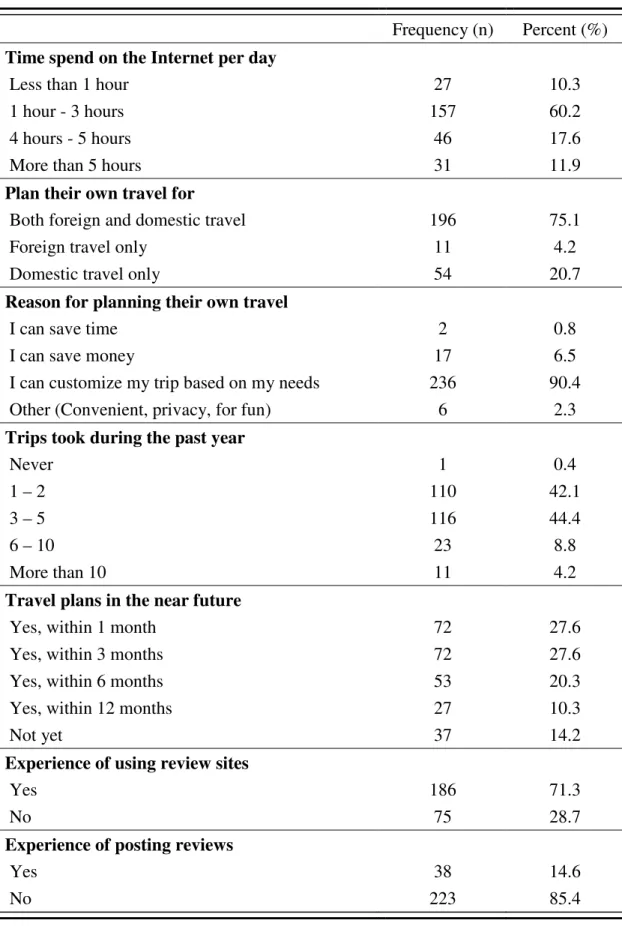
Tables 2 shows respondents’ information search and travel pattern. About sixty
percent of respondents reported that they spent at least one to three hours on the Internet
daily for leisure-related purposes. Seventy-five percent of respondents planned to book
for both national and international travel. The main reason for them to plan and book
their own travel is to customize their trip based on their needs. Ninety-nine percent of
respondents traveled at least once in the past year and eighty-five percent of respondents
plan to travel within one year. Seventy-one percent of respondents have experienced
using hotel review sites or travel forums to obtain information for planning their trip.
However, only fourteen percent of respondents have posted their own experience on hotel
35
Table 2. Respondents’ Information Search and Travel Pattern (n=261)
Frequency (n) Percent (%)
Time spend on the Internet per day
Less than 1 hour 27 10.3
1 hour - 3 hours 157 60.2
4 hours - 5 hours 46 17.6
More than 5 hours 31 11.9
Plan their own travel for
Both foreign and domestic travel 196 75.1
Foreign travel only 11 4.2
Domestic travel only 54 20.7
Reason for planning their own travel
I can save time 2 0.8
I can save money 17 6.5
I can customize my trip based on my needs 236 90.4
Other (Convenient, privacy, for fun) 6 2.3
Trips took during the past year
Never 1 0.4
1 – 2 110 42.1
3 – 5 116 44.4
6 – 10 23 8.8
More than 10 11 4.2
Travel plans in the near future
Yes, within 1 month 72 27.6
Yes, within 3 months 72 27.6
Yes, within 6 months 53 20.3
Yes, within 12 months 27 10.3
Not yet 37 14.2
Experience of using review sites
Yes 186 71.3
No 75 28.7
Experience of posting reviews
Yes 38 14.6
36
Hotel review sites (20.2%), word-of-mouth (18.8%), travel forums (18.4%),
personal travel blogs (17.4%), and hotel websites (14.6%) are the major sources where
respondents get hotel information to plan their trips. The main purposes of browsing hotel
review sites or travel forums are to get useful information (31.3%), to obtain updated
information (21.1%), and for convenience (17.7%). The key factors respondents consider
when choosing a hotel are price (29.0%), location (28.9%), and service quality (17.7%).
4.2. Factor Analysis
This study adopted items from the different studies (Applbaum & Anatol, 1972;
Ohanian, 1990; Steffes & Burgee, 2008; Whitehead, 1968) and modified questions to fit
the identity of eWOM to measure the source credibility. Principal component analysis
with varimax rotation method was employed to confirm the factor structure and ensure
the valid measurement of the variables.
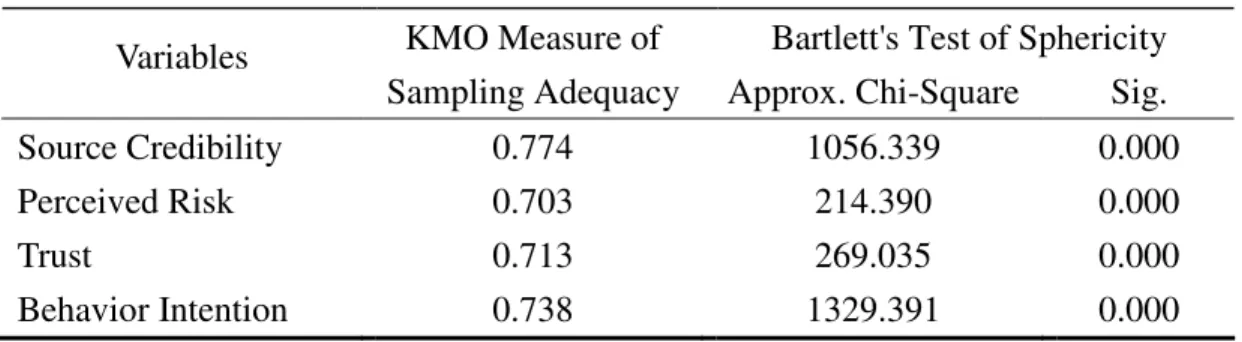
The Kaiser-Meyer-Olkin (KMO) Measure of Sampling Adequacy and Bartlett's Test
of Sphericity were conducted to confirm if the factor analysis is appropriate to the
measurement. As shown in Table 3, the KMO of source credibility, perceived risk, trust,
and consumer behavior intention are more than 0.7 and the Bartlett's Test of them are all
37
Table 3. KMO and Bartlett's Test of Sphericity
Bartlett's Test of Sphericity Variables KMO Measure of
Sampling Adequacy Approx. Chi-Square Sig.
Source Credibility 0.774 1056.339 0.000
Perceived Risk 0.703 214.390 0.000
Trust 0.713 269.035 0.000
Behavior Intention 0.738 1329.391 0.000
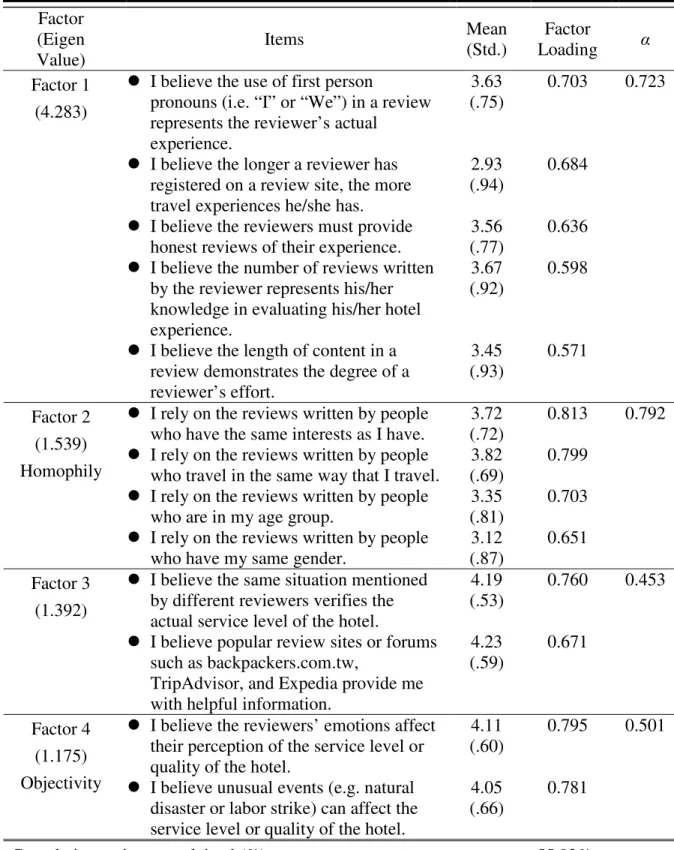
As shown in Table 4, four factors were extracted from 15 items of source credibility.
Q22 and Q29 were discarded from later analyses because their factor loadings are lower
than 0.5 (Hair, Black, Babin, Anderson, & Tatham, 1992). The result of factor analysis
shows that items in expertness and trustworthiness were re-categorized into Factors 1 and
3. Factors 2 and 4 are consisted with the literature that Factor 2 is defined as homophily
and Factor 4 was defined as objectivity. According to the result of factor analysis,
thirteen items were used to measure source credibility. The Cronbach's alpha of source
credibility is 0.788.
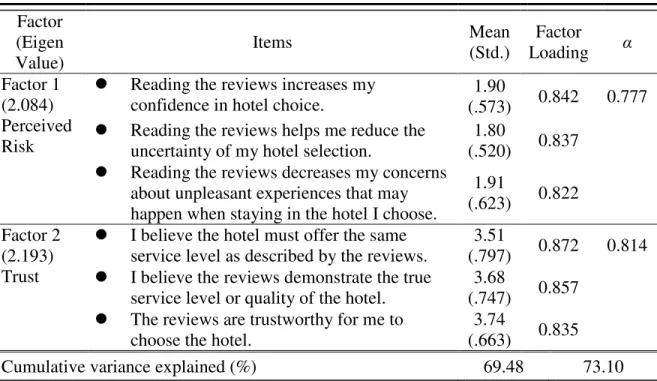
Table 5 demonstrated the result of factor analysis of perceived risk and trust. One
factor has been extracted from three items of perceived risk and one factor extracted from
three items of trust. As a result, six factors are used for the regression analysis. The
Cronbach's alpha of perceived risk and trust are 0.777 and 0.814, which are within the
38
Table 4. Results of Factor Analysis of Source Credibility Factor (Eigen Value) Items Mean (Std.) Factor Loading α I believe the use of first person
pronouns (i.e. “I” or “We”) in a review represents the reviewer’s actual
experience.
3.63 (.75)
0.703 0.723
I believe the longer a reviewer has registered on a review site, the more travel experiences he/she has.
2.93 (.94)
0.684
I believe the reviewers must provide honest reviews of their experience.
3.56 (.77)
0.636 I believe the number of reviews written
by the reviewer represents his/her knowledge in evaluating his/her hotel experience. 3.67 (.92) 0.598 Factor 1 (4.283)
I believe the length of content in a review demonstrates the degree of a reviewer’s effort.
3.45 (.93)
0.571
I rely on the reviews written by people who have the same interests as I have.
3.72 (.72)
0.813 0.792 I rely on the reviews written by people
who travel in the same way that I travel.
3.82 (.69)
0.799 I rely on the reviews written by people
who are in my age group.
3.35 (.81) 0.703 Factor 2 (1.539) Homophily
I rely on the reviews written by people who have my same gender.
3.12 (.87)
0.651 I believe the same situation mentioned
by different reviewers verifies the actual service level of the hotel.
4.19 (.53)
0.760 0.453 Factor 3
(1.392)
I believe popular review sites or forums such as backpackers.com.tw,
TripAdvisor, and Expedia provide me with helpful information.
4.23 (.59)
0.671
I believe the reviewers’ emotions affect their perception of the service level or quality of the hotel.
4.11 (.60)
0.795 0.501 Factor 4
(1.175)
Objectivity I believe unusual events (e.g. natural disaster or labor strike) can affect the service level or quality of the hotel.
4.05 (.66)
0.781
39
Table 5. Results of Factor Analysis of Perceived Risk and Trust Factor (Eigen Value) Items Mean (Std.) Factor Loading α Reading the reviews increases my
confidence in hotel choice.
1.90
(.573) 0.842 0.777 Reading the reviews helps me reduce the
uncertainty of my hotel selection.
1.80 (.520) 0.837 Factor 1 (2.084) Perceived Risk
Reading the reviews decreases my concerns about unpleasant experiences that may happen when staying in the hotel I choose.
1.91
(.623) 0.822 I believe the hotel must offer the same
service level as described by the reviews.
3.51
(.797) 0.872 0.814 I believe the reviews demonstrate the true
service level or quality of the hotel.
3.68
(.747) 0.857 Factor 2
(2.193) Trust
The reviews are trustworthy for me to choose the hotel.
3.74
(.663) 0.835
Cumulative variance explained (%) 69.48 73.10
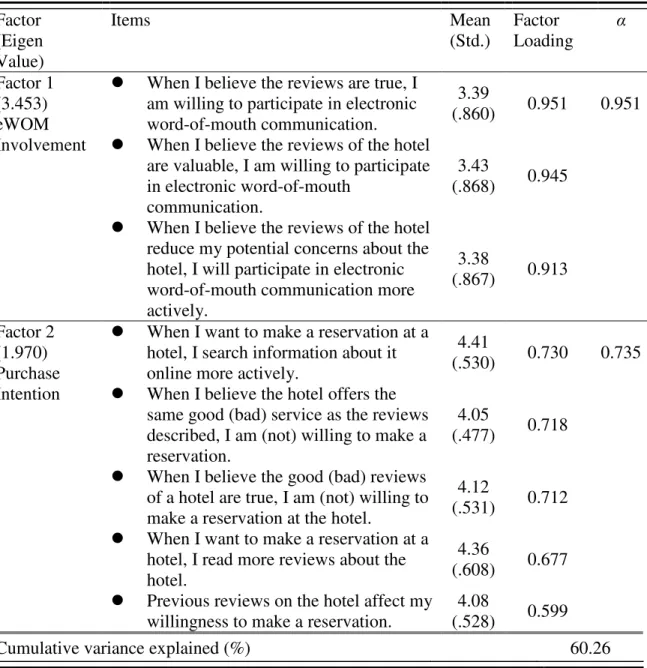
The result of factor analysis of consumer behavior intention was summarized in the
Table 6. Two factors of consumer behavior intention were extracted from nine
measurement items. Factor 1 is named as eWOM Involvement and Factor 2 is purchase
intention. One item was removed from further analysis due to low factor loading score
(Hair et al., 1992). Eight items were used to measure consumer behavior intention. The
40
Table 6. Results of Factor Analysis of Consumer Behavior Intention Factor (Eigen Value) Items Mean (Std.) Factor Loading α
When I believe the reviews are true, I am willing to participate in electronic word-of-mouth communication.
3.39
(.860) 0.951 0.951 When I believe the reviews of the hotel
are valuable, I am willing to participate in electronic word-of-mouth communication. 3.43 (.868) 0.945 Factor 1 (3.453) eWOM Involvement
When I believe the reviews of the hotel reduce my potential concerns about the hotel, I will participate in electronic word-of-mouth communication more actively.
3.38
(.867) 0.913
When I want to make a reservation at a hotel, I search information about it online more actively.
4.41
(.530) 0.730 0.735 When I believe the hotel offers the
same good (bad) service as the reviews described, I am (not) willing to make a reservation.
4.05
(.477) 0.718 When I believe the good (bad) reviews
of a hotel are true, I am (not) willing to make a reservation at the hotel.
4.12
(.531) 0.712 When I want to make a reservation at a
hotel, I read more reviews about the hotel. 4.36 (.608) 0.677 Factor 2 (1.970) Purchase Intention
Previous reviews on the hotel affect my willingness to make a reservation.
4.08
(.528) 0.599
Cumulative variance explained (%) 60.26
The eigenvalues of all factors are greater than one and the variances for source
credibility, perceived risk, trust, and behavior intentions are 55.93%, 69.48%, 73.10%,
41
4.3. Hypotheses Test
Multiple regression analysis was employed in this study to explore the relationship
among source credibility, perceived risk, trust, and behavior intention. The sum of items
in each dimension was calculated to a single variable to perform the regression analysis.
The correlation coefficient between variables was showed in Table 7.
4.3.1. Relationship between Source Credibility and Perceived Risk
The regression analysis of the relationship between source credibility and perceived
risk is presented in Table 8. The overall multiple regression model was significant
(F=18.448, p<0.05). 22.4% of perceived risk can be explained by the source credibility.
Expertness, trustworthiness, and objectivity are significant at the p=0.000, p=0.018, and
p=0.004 level and are negatively related with perceived risk. However, homophily was
42 Table 7. Correlations Matrix
Sum of EX Sum of TR Sum of OB Sum of HO Sum of PR Sum of Trust Sum of PI Sum of eWOM Pearson Correlation 1 .538** .127* .410** -.399** .530** .338** .376** Sig. (2-tailed) .000 .040 .000 .000 .000 .000 .000 Sum of EX N 261 261 261 261 261 261 261 261 Pearson Correlation .538** 1 .139* .380** -.355** .455** .292** .249** Sig. (2-tailed) .000 .024 .000 .000 .000 .000 .000 Sum of TR N 261 261 261 261 261 261 261 261 Pearson Correlation .127* .139* 1 .170** -.235** .127* .128* .124* Sig. (2-tailed) .040 .024 .006 .000 .040 .038 .045 Sum of OB N 261 261 261 261 261 261 261 261 Pearson Correlation .410** .380** .170** 1 -.290** .493** .085 .251** Sig. (2-tailed) .000 .000 .006 .000 .000 .173 .000 Sum of HO N 261 261 261 261 261 261 261 261 Pearson Correlation -.399** -.355** -.235** -.290** 1 -.458** -.496** -.272** Sig. (2-tailed) .000 .000 .000 .000 .000 .000 .000 Sum of PR N 261 261 261 261 261 261 261 261 Pearson Correlation .530** .455** .127* .493** -.458** 1 .271** .307** Sig. (2-tailed) .000 .000 .040 .000 .000 .000 .000 Sum of Trust N 261 261 261 261 261 261 261 261 Pearson Correlation .338** .292** .128* .085 -.496** .271** 1 .239** Sig. (2-tailed) .000 .000 .038 .173 .000 .000 .000 Sum of PI N 261 261 261 261 261 261 261 261 Pearson Correlation .376** .249** .124* .251** -.272** .307** .239** 1 Sig. (2-tailed) .000 .000 .045 .000 .000 .000 .000 Sum of eWOM N 261 261 261 261 261 261 261 261
43
Table 8. Regression of Source Credibility and Perceived Risk Coefficients Independent Variable Unstandardized Standardized t Value Hypothesis Test Source Credibility Expertness -.193 -.252 -3.722*** H1 Support Trustworthiness -.114 -.159 -2.377** H2 Support Objectivity -.228 -.164 -2.925*** H3 Support Homophily -.058 -.098 -1.573 H4 Reject R2(Adjusted R2)=.224 (.212) *p<.10. **p<.05. ***p<.01.
4.3.2. Relationship among Source Credibility, Perceived Risk, and Trust
Table 9 presented the regression analysis of the relationship among source
credibility, perceived risk, and trust. The overall multiple regression model was
significant (F=39.398, p<0.05). 43.6% of trust can be explained by the source credibility
and perceived risk. Perceived risk (β=-.235, t=-4.407, p<0.05) is very significant at the
p=0.000 level and negatively related with trust. Expertness (β=.255, t=4.290, p<0.05),
trustworthiness (β=.134, t=2.325, p<0.05), and homophily (β=.274, t=5.135, p<0.05) are
significant and positively related with trust, but objectivity (β=-.026, t=-.524, p>0.05) did
44
Table 9. Regression of Source Credibility, Perceived Risk, and Trust Coefficients Independent Variable Unstandardized Standardized t Value Hypothesis Test Source Credibility Expertness .257 .255 4.290*** Trustworthiness .127 .134 2.325** Objectivity -.047 -.026 -.524 Homophily .213 .274 5.135***
Perceived Risk -.311 -.235 -4.407*** H5 Support
R2(Adjusted R2)=.436 (.425) *p<.10. **p<.05. ***p<.01.
4.3.3. Relationship among Source Credibility, Perceived Risk, Trust, and Purchase Intention
Table 10 presented the regression analysis of the relationship among source
credibility, perceived risk, trust, and purchase intention. The overall multiple regression
model was significant (F=17.418, p<0.05). 29.2% of purchase intention can be explained
by the source credibility, perceived risk, and trust. Perceived risk (β=-.428, t=-6.878,
p<0.05) is very significant at the p=0.000 level and negatively related with purchase
intention. Expertness (β=.167, t=2.424, p<0.05) and homophily (β=-.157, t=-2.498,
p<0.05) are significant, but trustworthiness (β=.100, t=1.525, p>0.05), objectivity
(β=.017, t=.316, p>0.05), and trust (β=.017, t=.237, p>0.05) did not appear to be
45
Table 10. Regression of Source Credibility, Perceived Risk, Trust, and Purchase Intention Coefficients Independent Variable Unstandardized Standardized t Value Hypothesis Test Source Credibility Expertness .167 .167 2.424** Trustworthiness .094 .100 1.525 Objectivity .031 .017 .316 Homophily -.121 -.157 -2.498** Perceived Risk -.559 -.428 -6.878*** Trust .016 .017 .237 H6 Reject R2(Adjusted R2)=.292 (.275) *p<.10. **p<.05. ***p<.01.
4.3.4. Relationship among Source Credibility, Perceived Risk, Trust, Purchase Intention, and eWOM Involvement
Table 11 presented the regression analysis of the relationship among source
credibility, perceived risk, trust, purchase intention, and eWOM involvement. The overall
multiple regression model was significant (F=7.879, p<0.05). 17.9% of eWOM
involvement can be explained by the source credibility, perceived risk, trust, and purchase
intention. Expertness (β=.239, t=3.165, p<0.05) is significant, but other variables were
46
Table 11. Regression of Source Credibility, Perceived Risk, Trust, Purchase Intention, and eWOM Involvement
Coefficients Independent Variable Unstandardized Standardized t Value Hypothesis Test Source Credibility Expertness .316 .239 3.165*** Trustworthiness -.003 -.003 -.037 Objectivity .106 .044 .745 Homophily .081 .079 1.157 Perceived Risk -.102 -.059 -.805 Trust .111 .085 1.115 H7 Reject
Purchase Intention .125 .095 1.399 H8 Reject
R2(Adjusted R2)=.179 (.156) *p<.10. **p<.05. ***p<.01.
According to the result of hypothesis tested, the outcome was summarized in Table 12.
The result supports the hypothesis that consumers’ perceived risk is negatively affected
by the source credibility of eWOM. In the four dimensions of source credibility this study
tested, expertness, trustworthiness, and objectivity are confirmed to be significant to
predict consumers’ perceived risk. However, the result differs from previous studies
viewing expertness and trustworthiness as two separate dimension of source credibility;
one finding from the factor analysis is that the dimensions of expertness and
trustworthiness of source credibility in eWOM are crossing borders. It could be explained
by the characteristic of anonymous of information senders in the eWOM communication.