UNDG
A Joint Project of
The United Nations Development Programme, World Bank, United Nations Development Group
Practical Guide to Multilateral
Needs Assessments
The Practical Guide is the result of a positive collaboration between the United Nations Development Group, the Bureau of Crisis Prevention and Recovery of the United Nations Development Programme, and the Conflict Prevention and Reconstruction (CPR) Unit of the World Bank. The German Agency for Technical Cooperation (GTZ) was contracted to prepare the guide with support from the German Ministry for Economic Cooperation and Development. The guide includes a discussion of the context in which post-conflict needs assessments take place, its links with the post-conflict recovery phase, and a broad typology of post-conflict settings that influence the approach to the needs assessment. The guide reviews some key conceptual issues, including the need to embed the process within a longer-term vision on reconstruction, linkages to other processes, the selection of priority sectors, approaches to costing needs, integration of cross-cutting issues such as gender and environment, and the need to focus on institutional capacity building. The guide includes recommendations on managing the needs assessment process, from the preparatory phase to the lessons-learned phase. It also presents indicative estimates of the costs involved in mounting needs assessments missions. Throughout the guide, the emphasis is on practical approaches and recommendations, with a
focus on sequenced steps, phases and responsibilities.
We would like to acknowledge the excellent work of GTZ consultants Uwe Kievelitz, Thomas Schaef, Manuela Leonhardt, Herwig Hahn, and Sonja Vorwerk in the research and drafting of this report. We would also like to thank the staff of the UNDG, UNDP, the World Bank, BMZ and many other institutions in Geneva, Washington D.C., New York, Afghanistan, Timor Leste, Sri Lanka, Liberia and Iraq for sharing their time and experience.
* This Guide has also been published by the World Bank, Social Development Papers: Conflict
Prevention and Reconstruction, Paper No. 15, August 2004.
Table of Contents
AcronymsGlossary
1. Introduction to the Guide ... 1
1.1 Purpose of the Practical Guide... 1
1.2 Target Audiences ... 2
1.3 Content and Structure ... 2
1.4 How to Use the Guide... 3
2. The Post-Conflict Situation: The Context of Response ... 3
2.1 The PCNA and the International Donor Conference ... 3
2.2 The PCNA within the Continuum from Humanitarian to Development Assessments... 4
2.3 The PCNA in the Context of Post-Conflict Recovery ... 5
2.4 Typology of Post-Conflict Situations ... 6
3. Conceptual Elements of Needs Assessments ... 9
3.1 Introduction... 9
3.2 Vision for the Recovery Process as the Basis of the PCNA ... 9
3.3 Relating the PCNA to the Conflict ... 10
3.4 PCNA Linkages to the CAP and Development Planning ... 11
3.5 Cooperation and Participation in the PCNA... 12
3.6 Selecting Priority Sectors for Post-Conflict Recovery ... 12
3.7 Needs and their Assessment ... 13
3.8 Recovery Planning and Costing... 14
3.9 Integrating Key Cross-Cutting Issues ... 15
3.10 Paying Attention to Institutional Capacity Building... 16
4. Managing the PCNA Process ... 16
4.1 Preparatory Phase ... 16
4.2 Field Phase... 27
4.3 Consolidation and Reporting Phase ... 34
4.4 Stock-Taking and Lessons Learned Phase... 36
5. Operational Issues ... 36
5.1 Capacity Requirements for Conducting the PCNA ... 36
5.2 Financial Requirements for the PCNA ... 37
Annex 1: Supporting Material………..39
References... 41
Figures Figure 1: Status of PCNA in Relation to Other Multilateral Assessments………...5
Figure 2: Analytical Model of the Deficit Analysis……….14
Figure 3: The Conflict-Sensitive Framework of a PCNA ………..…….17
Figure 4: The Structure of PCNA Mission……….….26
Boxes Box 1: Definition: The Post-Conflict Needs Assessment………..………1
Acronyms
ADB Asian Development Bank
BMZ Bundesministerium für wirtschaftliche Zusammenarbeit und Entwicklung (German Federal Ministry for Economic Cooperation and Development)
CAF Country Assistance Framework
CAP Consolidated Appeal Process
CAS Country Assistance Strategy
CCA Common Country Assessment
CDA Conflict-related Development Assistance CHAP Common Humanitarian Action Plan DAC Development Assistance Committee
DDR Disarmament, Demobilization and Reintegration
EC European Commission
ECHA UN Executive Committee on Humanitarian Affairs (ECHA) ECLAC European Commission for Latin America and the Caribbean
EU European Union
GTZ Gesellschaft für Technische Zusammenarbeit (German technical cooperation)
HDI Human Development Index
IDP Internally Displaced Persons
IMF International Monetary Funds
MDG Millennium Development Goals
OCHA UN Office for the Coordination Humanitarian Affairs OSCE Organization for Security and Co-operation in Europe PCNA Post-Conflict Needs Assessment
PRSP Poverty Reduction Strategy Paper
RBPF Results-based Planning Framework
TOR Terms of Reference
TSS Transition Support Strategy
UN United Nations
UNCT United Nations Country Team
UNDAC United Nations Disaster Assistance Coordination UNDAF United Nations Development Assistance Framework UNDG(O) United Nations Development Group (Office)
UNDP United Nations Development Program
UNDP-BCPR UNDP–Bureau for Crisis Prevention and Recovery USAID US Agency for International Development
Glossary
Clusters Clusters are thematic groups composed of selected sectors or topics, depending on the specific country setting. For example, the cluster Institutions and Capacity Building of the Sudan needs assessment comprised the topics decentralization, capacity building, public administration and expenditure management. A cluster is coordinated by a cluster manager. The sectors or topics of a cluster are managed by sector specialists.
Conflict “A relationship between two or more interdependent parties in which at least one of the parties perceives the relationship to be negative or detects and pursues opposing interests and needs.” (Ropers 1999, quoted in GTZ 2001) In the context of this guide, conflict mainly refers to situations of macro-political violence between two or more warring parties.
Conflict sensitivity
Ability to understand the interaction between humanitarian, development and other interventions and the (conflict) context, and to act upon this understanding to avoid negative impacts and maximize positive contributions (FEWER 2004).
Do No Harm Approach seeking to avoid unintended negative impacts of development and other interventions on conflict (Anderson 1999).
Human security Freedom from pervasive threats to people’s rights, safety or lives. Embraces the twin objectives of “freedom from fear” (referring to the threat of violence, crime and war) and “freedom from want” (referring to economic, health, environmental and other threats to people’s well being) (UN 1994).
Needs The term “needs” is used to describe the need for humanitarian or development interventions to bridge the gap between identified deficits and the envisioned future (short-term post recovery) situation of a sector or country.
Needs assessment Needs assessments were first introduced by humanitarian agencies, involving the definition of basic needs, the identification of deficits in the fulfillment of these needs (based on standards, and considering vulnerability, risks and capacities), and the assessment of required external assistance to close these deficits. Needs
assessments for recovery and developmental purposes take a broader view of needs, including institutional, policy and infrastructure issues.
Peace building “Peace-building aims to build and enable durable peace and sustainable
development in post-conflict situations.” Immediately after conflict, peace-building focuses on economic recovery, the removal of small arms from the community, the rebuilding of governance institutions, the launching of reconciliation processes, the releasing of land for agricultural purposes, and the rebuilding of social capital (UNDP 2001).
Recovery ”The recovery approach focuses on how best to restore the capacity of the government and communities to rebuild and recover from crisis and to prevent relapses. In so doing, recovery seeks not only to catalyze sustainable development activities but also to build upon earlier humanitarian programs to ensure that their inputs become assets for development.” (UNDP 2001) The recovery period generally covers the first decade after the end of conflict.
Recovery needs Those priority investments in human, material and social development which a society needs to overcome the roots and consequences of violent conflict and achieve political stability, security, justice and social equity.
Results-based planning framework
The Results-Based Planning Framework (RBPF) or Results Matrix is a planning and management tool that provides a framework for designing the strategy and implementation plans around specific and measurable outcomes. At the post-conflict needs assessment planning stage, use of the framework forces questioning of the strategy and increased selectivity. During implementation the framework is used for management purposes—to help assess if implementation is on track and if not why not. The framework also facilitates the link to post-recovery development planning.
Stakeholders In general terms, the term stakeholders refers to all those groups which share a common interest in a certain issue or intervention, or which are affected by it in a similar way. Stakeholders in a post-conflict needs assessment involve the parties (formerly) engaged in conflict as well as other groups likely to be involved in or affected by recovery activities.
Transition
(post-conflict) “The period in a crisis when partnerships with the international community are most crucial in supporting or underpinning still fragile cease-fires or peace processes by helping to create conditions for political stability, security, justice and social equity.” (based on UNDG/ECHA definition 2004) The transition period generally lasts about two years after the end of conflict.
PRACTICAL GUIDE TO MULTILATERAL NEEDS ASSESSMENTS IN
POST-CONFLICT SITUATIONS
1. INTRODUCTION TO THE GUIDE 1.1 Purpose of the Practical Guide
Introduction to the Post-Conflict Needs Assessment (PCNA)
Over the last decade, donors have attributed increasing importance to providing timely and substantive support to post-conflict recovery and peace building. A large part of this assistance is mobilized via international reconstruction conferences, at which donors make pledges based on an overall assessment of post-conflict recovery needs. Thus, the post-conflict needs assessment (PCNA) has recently become a key entry point for conceptualizing, negotiating and financing post-conflict recovery strategies.
Generally, PCNAs are jointly carried out by the UN and the World Bank, sometimes in conjunction with other key donor agencies. This guide aims to support current efforts among these agencies to further enhance their engagement in the PCNA by learning from available experience. It draws strongly on material from recent needs assessments in Timor-Leste, Afghanistan, Sri Lanka, Iraq and Liberia.
Box 1: Definition: The Post-Conflict Needs Assessment
A complex analytical process led by the national authorities and supported by the international community and carried out by multilateral agencies on their behalf, with the closest possible collaboration of national stakeholders and civil society. The needs assessment aims to overcome consequences of conflict or war, prevent renewed outbreak and shape the short-term and potentially mid-term recovery priorities as well as articulate their financial implications on the basis of an overall long-term vision or goal.
This guide treats the PCNA both as a methodology and a process:
• As a methodology, the PCNA involves the technical assessment of recovery needs and development of a post-conflict transition strategy.
• As a process of consultation, negotiation and analysis, the PCNA provides a platform for national and international actors to agree on joint priorities, define their commitments and prepare their activities. In this sense, the PCNA is both a technical and a political exercise. It is therefore important to bear in mind that the PCNA is part of an ongoing peace process. It has the potential to facilitate this process by providing spaces for dialogue on common priorities and mobilizing resources to address key problems. There is also the risk, however, that the PCNA will obstruct a peace process by alienating key stakeholders or focussing negotiations on the material gains from recovery assistance.
Rationale and Value Added of a PCNA
Considering the substantial investment in time and resources by the international community in PCNAs, it is worthwhile articulating the rationale for such a substantial endeavor. After the end of a prolonged violent conflict, there is a need: (i) for a review and stock-taking regarding the recovery needs to get the country back on track toward sustainable development; and (ii) to secure financial support for this process, as the country torn by conflict will usually not be able to finance this from its own resources. In addition, in most cases the international community has an inherent interest in supporting the stabilization of countries emerging from conflict. Therefore, while the dimension and extent of PCNAs are subject to differing approaches, there is a clear rationale for obtaining a comprehensive assessment of a post-conflict country’s needs before considering funding possibilities.
In terms of value added, the following results and impacts can be expected from a PCNA of the type proposed in this guide:
• Provides donors, national authorities, and non-governmental organizations (NGOs) and other stakeholders, with a comprehensive and fairly objective estimate of needs;
• High international visibility resulting in more substantial financial pledges for recovery and reconstruction;
• International consensus on recovery priorities leading to less program overlap and more coherence between donors;
• Early focus on the roots of the conflict and measures to help overcome them in the context of recovery and reconstruction;
• Increased political momentum and support for the peace process;
• Increased legitimacy of the national authorities (conflict parties); and
• Establishment of a conceptual basis for an Interim Poverty Reduction Strategy Paper (I-PRSP), as well as World Bank and UN country strategies (Country Assistance Strategy—CAS; and UN Development Framework—UNDAF, respectively).
Objectives of Post-Conflict Recovery
In order to create the enabling conditions for sustainable and peaceful development, post-conflict recovery assistance is generally oriented toward the following goals:
• Political stability;
• Security and respect for human rights;
• Reduction of social exclusion and social healing;
• Access to services; and
• Adequate standard of living.
Purpose of the Practical Guide
PCNAs are complex multi-stakeholder processes, which routinely take place under extreme time constraints. This guide aims to help make PCNAs more effective by systematizing the analysis and suggesting more efficient processes. In particular, it contributes to:
• the definition of common minimum standards regarding quality, reliability and inclusiveness of the assessment;
• a fast-track professional response by the international community when recovery planning becomes feasible; and
• lowering the costs of PCNAs by promoting systematization and standardization.
1.2 Target Audiences
The practical guide has been prepared for:
• Multilateral agency headquarters and in-country staff with responsibility for steering, coordinating and contributing to the PCNA;
• The PCNA management team responsible for managing data collection, analysis and preparing the final report;
• Cluster/sector managers and technical mission staff responsible for sectoral assessments; and
• National authorities, conflict parties, civil society and other stakeholders contributing to the PCNA.
1.3 Content and Structure
These guidelines are presented in four chapters, including an extensive Annex with practical reference and support (available on line). The first chapter introduces the purpose and the target audience of the practical guide. It provides the user of the guide with an introduction of essential definitions and objectives of PCNAs and post-conflict recovery. The second chapter provides background information
and guidance for: (i) assessing the post-conflict situation of the respective country in which the PCNA will take place, and (ii) initiating the PCNA according to minimum requirements. The third chapter provides key conceptual elements which are essential for all PCNA mission members. They are conducive to reaching a successful outcome, including the best possible analysis, recovery scenario and cost estimates under existing conditions. The fourth and last chapter describes a systematic, step-by-step approach for managing the complex PCNA process.
1.4 How to Use the Guide
The practical guide is designed for different target audiences according to their tasks within the PCNA process. Thus, the guide is not designed to be read from cover to cover. However, no chapter is independent of the others. Chapters one to three should be read by all staff of the PCNA. In order to avoid repetition, cross-referencing between chapters and sections has been used to guide the reader to all the relevant information. Chapter four refers to the management process in detail and step by step, although the order of the steps can vary. Annex 1 provides an overview of the persons in charge according to the steps presented in Chapter four.
In general, the following audiences should read the respective sections of the practical guide as follows: All staff should be familiar with
the ‘basics’…
…in Chapters 1 to 3. When there is a political
decision to conduct a PCNA…
…decision-makers in headquarters and in-country staff responsible for steering, coordinating and contributing to the PCNA should read Chapters 2 and 3 in order to set time frames and structure the PCNA process.
When the PCNA management team has to prepare the PCNA mission…
…they and the PCNA coordinator should refer to Chapter 4.1
Cluster/Sector managers and technical mission staff with responsibility for sectoral assessments…
…should refer to Chapter 4.2
National authorities, conflict parties, civil society, other stakeholders …
…should refer to Chapters 2 and 3
After the donor conference has taken place…
…the PCNA coordinator and the secretariat should refer to Chapter 4.4. The units responsible for
designing and monitoring future PCNA…
…should read Chapter 5.
2. THE POST-CONFLICT SITUATION: THE CONTEXT OF RESPONSE 2.1 The PCNA and the International Donor Conference
In a globalizing world, violent conflicts are no longer local phenomena, but impact on the security and well-being of people in many other parts of the world. Donor countries are increasingly challenged by civil wars and regional conflicts, and develop new responses, which may include both military (e.g., UN peace keeping forces, North Atlantic Treaty Organization interventions) and/or development components. Development assistance to countries in transition from violent conflict to peace generally aim to:
• support the implementation of a peace agreement;
• provide the population with an early peace dividend;
• address the developmental causes of conflict; and
International donor conferences have become the major mechanism for mobilizing and coordinating international recovery assistance to post-conflict countries. They are built around the PCNA document generally prepared by the UN and World Bank, against which individual donors make their pledges. This contributes to enhancing the coherence of donor assistance as well as the transparency of their contributions. In contrast to the Consolidated Appeal Process (CAP), sectors in the PCNA are not associated with particular agencies, so that donors are free to choose the implementation mechanisms they find most suitable.
A PCNA is therefore best understood as a technical document representing the objective needs of the country, requiring the greatest possible accuracy. The PCNA does not include individual program proposals.
At the same time, the PCNA is a political process among national and international actors attempting to elaborate a development perspective for future peace and stability. The PCNA therefore needs to present a compelling vision of the country’s future development and set out a road map for post-conflict recovery. For this, it must be tailored to the specific local and national context, especially to:
• Reflect the political processes which underpin the post-conflict transition;
• Reflect an in-depth understanding of national realities; and
• Importantly, ensure that the results of the assessment are owned—and presented—by national (transitional) authorities.
2.2 The PCNA within the Continuum from Humanitarian to Development Assessments
The PCNA generally takes place in the early transition phase from violent conflict to peace. Its is usually preceded by humanitarian assessments, which may have taken place during the conflict, and is followed by longer-term oriented development assessments (e.g., CCA; Poverty Reduction Strategy Paper, PRSP). Figure 1 illustrates the status of the PCNA in relation to other multilateral assessment processes. In individual cases, however, assessments and planning processes may take place at different moments in time.
During open conflict, humanitarian needs assessments such as the UN “flash appeals” and the CAP constitute the primary response of the international community. At the same time, the UN and the World Bank may engage in a Watching Brief” process to monitor the situation and identify opportunities for re-engagement. In this period, an active UN and World Bank engagement in dialogue and capacity building can increase the readiness of national actors and development agencies to later engage in and contribute to a high-quality PCNA process.
As the country moves out of conflict, humanitarian assessments often remain important, but more long-term planning becomes possible. At this stage, PCNAs are organized to support the immediate post-conflict recovery process. When some degree of stability has been achieved, development-oriented national planning processes such as the PRSP and the CCA/UN Development Assistance Framework (CCA/UNDAF) can be initiated. However, a PCNA should also be used by UN Country Teams in place of a CCA if they feel ready to prepare a UN Development Assistance Framework soon after the PCNA has been completed. Throughout, needs assessment and planning should be supported by an analysis of the conflict and the peace process based on tools such as the Conflict-related Development Analysis, CDA (UN) or the Conflict Assessment Framework, CAF (World Bank).
In comparison to developmental assessments, the PCNA focuses on a relatively short time horizon of 12-24 months, but is usually guided by a medium (12-24-60 months) to long-term (5-10 years) perspective. Different from humanitarian assessments with similarly short timeframes, the PCNA is development-oriented and focuses on creating the enabling conditions for long-term peace and development. Humanitarian, post-conflict and development assessments should be accompanied by an ongoing conflict analysis.
Figure 1: Status of PCNA in Relation to Other Multilateral Assessments
Post-conflict periods are characterized by the simultaneous presence of humanitarian and recovery needs. Addressing these needs requires different approaches, levels of resources and also actors. In practice, the PCNA is often preceded by a humanitarian Consolidated Appeal Process (CAP), whereby overlaps in remit and activities are inevitable. While the CAP is an appeal launched by agencies who themselves will act as principal implementers, the PCNA provides an overview of financial requirements and proposed disbursement, financial management and accounting mechanisms. Where a CAP and a PCNA closely follow each other, it is necessary to include and indicate the nature and costs of humanitarian needs defined in the CAP in the PCNA. This may also include the indication of all financial needs in the national budget and the definition of procedures for channeling the funding. This enhances transparency for donors and national stakeholders.
2.3 The PCNA in the Context of Post-Conflict Recovery
Post-conflict recovery planning can benefit from contextualizing recovery assistance within a broader timeframe, which can help to: (i) sequence recovery priorities in accordance with the country’s evolving needs, and (ii) time external assistance in line with the country’s management and implementation capacities.
Successful post-conflict countries pass through a number of stages on the road to peaceful and sustainable development. This is not necessarily a linear process, and countries may suffer reversals. Nevertheless, experience and research (e.g., Collier et al. 2003) generally distinguishes three major phases:
CHAP/CAP CAF CAF Humanitarian emergency Open conflict Open
conflict Post-conflict/fragile peace DevelopmentDevelopment Post-conflict/ fragile peace
UN
WB
Conflict Analysis Conflict Analysis PCNA PCNA CCA / UNDAF CCA / UNDAF TSS / CAS TSS / CAS PRSP PRSPCDA: Conflic t-related De velopm ent Anal ysis
CCA/UND AF Com mon Country Assessment and Developm ent Assistance Framework CAF Con flict Anal ysis Framework
TSS/C AS: Transitional Support Stra teg y/Countr y Assistance Strateg y PRS/C AS: Po ver ty Reduc tion Stra teg y /Countr y Ass istance Strateg y CAP: Consolidated Appeal Process
PCN A Post-Conflic t Needs Ass essment
Watching Brief Watching
Brief CASCAS
“Watching Brief ” “Watching Brief ” CHAP/CAP CAF CAF Humanitarian emergency Open conflict Open
conflict Post-conflict/fragile peace DevelopmentDevelopment Post-conflict/ fragile peace
UN
WB
Conflict Analysis Conflict Analysis PCNA PCNA CCA / UNDAF CCA / UNDAF TSS / CAS TSS / CAS PRSP PRSPCDA: Conflic t-related De velopm ent Anal ysis
CCA/UND AF Com mon Country Assessment and Developm ent Assistance Framework CAF Con flict Anal ysis Framework
TSS/C AS: Transitional Support Stra teg y/Countr y Assistance Strateg y PRS/C AS: Po ver ty Reduc tion Stra teg y /Countr y Ass istance Strateg y CAP: Consolidated Appeal Process
PCN A Post-Conflic t Needs Ass essment
Watching Brief
Watching
Brief CASCAS
“Watching Brief ”
“Watching Brief ”
Phase Time horizon Absorptive capacity Economic growth Stabilization/
Transition
12 months Low Low
Transformation/ Institution building
12-36 months Rising Low
Consolidation 36-120 months High High
Within this sequence, the PCNA approximately covers the first two phases of post-conflict recovery. In both phases, the capacity of national institutions to make effective use of external assistance is still low and economic growth slow. These phases, however, are critical to lay the foundations for a spur in reform and growth, which usually takes place between the fourth and seventh year and then tapers off toward the end of the first decade after conflict. Therefore, it is important to maintain the momentum of external assistance beyond the immediate post-conflict period.
Each phase of the recovery process requires its own priority setting. The following table provides some indicative priorities, which should be considered when preparing for a PCNA. Among these, the assessment should particularly focus on those factors presenting risks to the peace process.
Phase Indicative recovery priorities Stabilization/ Transition (12 months) Security Political framework Macro-economic framework
Support to national capacities
Consolidation of a small civil service
Restoration of essential infrastructure
Restoration of essential services
Meeting humanitarian needs
Return of refugees/IDPs
Dialogue and trust building between former conflict parties Transformation
Institution building (12-36 months)
Political reform
Economic reform
Judicial reform/rule of law
Institutional capacity building
Security sector reform
Disarmament, demobilization and reintegration
Restoration of important infrastructure
Restoration of productive capacities
Extension of essential services
Social safety nets
Food security
Continued return of refugees/IDPs
Reconciliation process/social healing Consolidation
(36-120 months)
Continuation and deepening of reform processes
Institutional capacity building
Extension of infrastructure and services
Reconciliation/social healing
Inclusive policies
2.4 Typology of Post-Conflict Situations
The PCNA should reflect an in-depth knowledge of the country situation and be carried out with a maximum of national leadership and involvement. Early post-conflict situations, however, sometimes present special challenges that make it difficult to achieve the levels of local participation, ownership and data quality that have become good practice in development cooperation. The main bottleneck in this regard is the capacity of national institutions to engage in the needs assessment. Furthermore, the level of national capacities and, often related, the degree of (in)security in the country have implications for
recovery planning. From this operational perspective, it makes sense to distinguish between two types of post-conflict situations.
These distinctions should not be regarded as absolute, but rather as the two ends of a continuum. Countries are usually found between these two extremes and in the course of time may move in either direction. Decisions on the content, process and planning horizon of a PCNA therefore have to be taken on an individual basis and may need to be adjusted during the course of the assessment. The aim is to achieve the largest possible degree of national ownership.
¾ Type A: Strong National Capacities
In this case, a well-established government and/or conflict parties have committed themselves to peace and to ensuring relative stability and security in the country. This is frequently the case where the conflict took place in parts of the country only (e.g., Sri Lanka, Sudan). There is often a formal truce, while official peace negotiations are under way. In some cases, the conflict parties establish joint mechanisms to steer the needs assessment.
In this case, national authorities have the capacity to fully engage in the PCNA. Together with a relatively stable security situation, this allows for a complex and participatory approach including extensive in-country data collection and consultation processes. As national contributions and ownership are likely to be high, planning can be oriented beyond the short-term (0-18 months) to include medium-term (18-36 months) recovery and development needs.
Particular care is required in managing relations with and between the (former) conflict parties. As mutual trust is likely to be low, a balanced approach and transparency are key to the success of the assessment. On the other hand, (former) conflict parties sometimes join forces in rejecting attempts by the international community to address root causes of conflict or institutional and security issues in the context of the PCNA. This may be partly because these sensitive issues are still under negotiation in the peace talks, or partly because the parties are not yet ready to surrender influence and power to the new transitional structures.
¾ Type B: Weak National Capacities
In the opposite case, internal turmoil or external occupation have ousted the previous government, while an internationally recognized new government is still being formed (e.g., Iraq, Timor-Leste). Otherwise, the entire state apparatus may have eroded over the years leaving little capacity to build on. This situation is typical after a protracted conflict including multiple conflict parties and regional fragmentation (e.g., Afghanistan). In these countries, peace is usually fragile and violence ongoing at the local level or in certain regions.
Even where a transition government is in place, it usually lacks capacity to make substantial contributions to the needs assessment. In-country movement and stakeholder consultations have to be reduced to a minimum due to lack of security and access.1 In this situation, it may be more realistic to conduct a preliminary PCNA with a short-term focus (up to 18 months), which will be repeated after about 18-24 months under leadership of the new transitional government and with stronger civil society involvement. Such a “light” PCNA would involve a smaller team and concentrate on key areas required for stabilizing the country. Proposals should be robust enough to be feasible under difficult security conditions and conflict scenarios. In contrast to the humanitarian CAP, however, a light PCNA also focuses on developmental approaches including a conflict analysis. Inevitably, quality standards for a preliminary PCNA may be lower.
Where national counterpart capacities are weak, international agencies may find it easier to promote discussions and inclusion of sensitive areas such as security sector reform, institutional reform, and
1
These are not absolute distinctions. In some PCNAs, even a weak transitional government has shown a great deal of involvement and achieved an impressive amount of stakeholder consultation.
reconciliation, as well as measures addressing the root causes of conflict. While this certainly enhances the comprehensiveness of the assessment, the political will and institutional capacity in the country to implement these measures have to be critically evaluated.
The following table illustrates the key features of type A and B post-conflict situations. Again, it is important to regard these as the two end points of a continuum.
Characteristics
Type A
Strong national capacities and relative stability
Type B
Weak national capacities and high instability
Conflict type Conflict in regions of the country
Sub-regional war
Protracted conflict
Complex political emergency
External occupation
Government In place
Internationally recognized
Policy and implementing capacity
Failing state
Non-existent or nascent
Internationally not recognized Other conflict parties One major opposition group Multiple warring factions
International occupying forces Conflict resolution Truce existing and observed by the
conflict parties
Increasing stability
Unstable truce
Low-intensity or regional violence
High instability International
peacekeeping
UN, OSCE or regional peacekeeping forces may be installed
Occupying forces or NATO peacekeepers may be present
Examples Sri Lanka Afghanistan
Liberia
The consequences of type A/B post-conflict situations for the process and substance of the PCNA can be summarized as follows. They should be considered when preparing a PCNA according to the steps suggested in Chapter 4.
Consequences for
PCNA Type A Type B
Role of national
authorities/conflict parties
Provide political guidance to the PCNA
Present results of PCNA at the donor conference
Contribute to the PCNA
Present results of PCNA at the donor conference where appropriate
PCNA mission Complete national counterpart
structure
Nationals participate in PCNA mission on an individual basis Time horizon
(sequencing)
Stabilization and transformation phase (0-36 months)
Extended stabilization phase (18 months)
Follow-up assessment after 18-24 months
Priorities/cluster selection Include political and economic reform agenda, justice, reconciliation
Focus on security, stability and restoration of livelihoods
Mobility Mission may move within the country Insecurity limits mobility of PCNA
mission Stakeholder involvement Data collection includes field work
Sectoral validation workshops in the capital and regions
Broad-based consolidation workshop
Secondary data collection
Consultations in capital only or with diaspora
in capital
Data quality Potentially high Low
Capacity building Joint PCNA steering mechanism by
conflict parties may contribute to common governance structures
PCNA process may contribute to emergence/consolidation of national planning structures
Implementing mechanisms
National structures coordinate and/or carry out large part of recovery programs, supported by technical assistance
Quick-impact programs by international agencies, capacity building and technical assistance for national structures to prepare for stronger involvement
Minimum Requirements for Initiating a PCNA
A PCNA requires certain minimum conditions to fulfill its objectives of addressing the developmental causes of conflict and providing an incentive for the parties to the peace process. Multilateral agencies should define such minimum conditions for engagement and clearly communicate them to international donors and the parties to the conflict. Although individual decisions have to depend on an in-depth assessment of local dynamics, the following benchmarks indicating the possibility of a PCNA are suggested (based on work by UNDG/ECHA 2004):
• A peace agreement has been signed or the peace process is very advanced;
• National authorities agree to embark on a PCNA process;
• Major donors accept the need for, and are willing to support recovery programs for the country;
• The situation is politically stable enough and conducive for the return and reintegration of refugees and internally displaced populations (based on UNHCR/OCHA recommendations); and
• The political and administrative system in place has a minimum capacity or is being supported to build its capacity to work in partnership with the UN system on recovery planning, coordination and program implementation.
Disbursement of recovery funds may be made dependent on a peace accord and initial steps towards its implementation.
3. CONCEPTUAL ELEMENTS OF NEEDS ASSESSMENTS 3.1 Introduction
A PCNA as developed in this guide rests on a number of key conceptual elements. They are conducive to a successful outcome, including the best possible analysis, recovery scenario and cost estimates under the circumstances—as well as keeping all actors involved as co-owners of the process. The conceptual elements are at the core of a PCNA and should direct the efforts of all involved staff, from the senior management at UNDG and the World Bank up to each sector or cross-sector specialist in the mission team. In addition, it is important to share and refine these basic assumptions with national counterparts and stakeholders involved in the PCNA.
3.2 Vision for the Recovery Process as the Basis of the PCNA
As the PCNA is the first step in the long process of recovery from violent conflict to peace, stability and socio-economic development, even a short-phased assessment should be guided by a vision of the respective country’s future and by longer-term development objectives. It is essential to develop and share this vision with all key stakeholders to the peace process. The long-term recovery vision of the country should be nurtured by three major considerations:
• The priorities and strategies of the parties to the peace process as laid out in the ceasefire agreement or peace accord. Where possible, the perspectives of stakeholders without formal representation at the peace process should also be included.
• A general concern with security, equality, justice, and development as well as with building institutions for peaceful conflict management.
• The long-term objectives and commitments of the international community, such as the Millennium Development Goals (MDGs), the conventions on human rights, and other international standards. They may be complemented by the measurement of progress through the Human Development Index (HDI).
Ö Chapter 4.1: Step 7
3.3 Relating the PCNA to the Conflict
The PCNA should contribute to preventing the recurrence of violent conflict in fragile post-conflict transition situations. This requires a high sensitivity to conflict both in the PCNA process as well as in the identification of recovery needs and their relation to the causes of violent conflict. For this, both the PCNA process and content need be based on conflict analysis.
The PCNA as a Peace-Building Tool
Donors initiate PCNAs in order to provide political and material support to an emerging peace process. In this sense, the PCNA is part of the peace process. Yet there are also considerable risks involved. The prospect of substantial international assistance coming into the country may increase the stakes in the peace negotiations and make it more difficult for the parties to reach sustainable agreements. Tensions are also likely where post-conflict planning may require difficult decisions on future economic and social issues, which are still under negotiation by the conflict parties. In addition, the international attention to the conflict parties may sideline legitimate concerns of the wider population which may not feel represented by either party.
From a “do no harm” perspective, this situation requires a high degree of conflict-sensitivity in the PCNA process. Impartiality, inclusiveness and transparency are key requirements for a successful needs assessment process as well as a timing and pace appropriate to the peace process. Under these conditions, a PCNA can provide a framework to foster awareness and dialogue between the conflict parties regarding the long-term challenges awaiting the country. In the best case, agreements on more technical issues in the context of the needs assessment can pave the way for more substantive political agreements.
Involving Conflict Parties
The PCNA process should be inclusive and aim for maximum national ownership. It must not further antagonize conflict parties, but involve them in a constructive dialogue on the future priorities for their country. Moreover, the PCNA needs to give a voice to those stakeholder groups which do not feel represented by the conflict parties and lack the political and/or military power to assert their interests. This requires a careful preparation of the PCNA process which can benefit from a good understanding of the various stakeholders to the peace process, their interests, capacities and relations.
Ö Chapter 4.1: Step 6
Targeting Violent Conflict
One of the key challenges of post-conflict recovery consists in recognizing and transforming the structures which contributed to violent conflict. Otherwise, recovery assistance risks rebuilding a society that already contains the seeds of future violence. Conflict is still present in a post-conflict situation, only the way of dealing with it has changed. Therefore, an analysis of the conflict and peace process is an essential tool for any PCNA since it examines the factors stabilizing and destabilizing the current situation, and identifies the key actors and their positions. Conflict analysis and/or conflict-sensitive tools
are integrated into the PCNA in each phase: preparation, field work and consolidation. This allows targeting post-conflict recovery programming toward the key factors determining peace and stability in the country.
Ö Chapter 4.1: Steps 6, 13 and 18
Selecting Priority Sectors for Post-Conflict Recovery
The PCNA should focus on those sectors which contain direct conflict risks, as well as those which are critical to peace building and stabilisation. This particularly includes sectors that can deliver a quick peace dividend to the population and help create legitimate national institutions. Conflict analysis can help identify these sectors, orient sectoral assessments towards those issues most relevant to the peace process, and set conflict-sensitive sectoral targets. When assessing national implementing capacities, conflict analysis can help understand the conflict-related roles of key institutions and thus inform decisions on possible partnerships.
The priorities derived from a conflict analysis may need to be balanced with the exigencies of promoting effective governance structures and economic development, whereby peace and stability objectives should remain the primary concern. As initial decisions on sectors and issues of emphasis are necessarily taken on the basis of limited knowledge, refining, deepening and also modifying priorities needs to be regarded as an ongoing process throughout the PCNA.
Ö Chapter 4.1: Step 8 Box 2: Why Conflict Analysis?
Conflict analysis provides essential information for rendering the process and substance of PCNA conflict-sensitive. This takes place at the following entry points:
Designing the PCNA process: From the very beginning, conflict analysis needs to inform decisions on the PCNA process, particularly national stakeholders to involve and the process of involving them. Furthermore, conflict analysis provides information on conflict actors, conflict issues, and possibly regional dimensions of conflict, which should be considered when selecting national mission members, preparing data gathering, identifying interview partners as well as preparing stakeholder consultations and validation workshops.
Visioning and objective setting: Conflict analysis helps to flesh out a positive vision for the country’s future and set recovery objectives, which reflect the country’s realities and take account of peace and security issues.
Selection of priority sectors and cross-cutting issues: Conflict analysis helps in selecting those issues and sectors with the greatest potential for promoting peace and stability, or alternatively, identifying those that may become a threat to the peace process and therefore need to be addressed.
Sectoral needs assessments: Within individual sectors, conflict analysis can help focus needs assessments on critical peace issues and factor in security and peace building costs (e.g., costs of providing security to major installations, capacity building costs for the conflict-free management of infrastructure investments in addition to reconstruction costs only). In addition, conflict analysis can help understand the role of different institutions within the conflict and peace process.
3.4 PCNA Linkages to the CAP and Development Planning
During the transition from open conflict to post-conflict development, countries usually go through a series of needs assessment and planning processes. As outlined in section 2.2, these can range from watching brief, humanitarian CAP and PCNA on the one hand, to mainstream development planning in the context of a PRSP and the preparation of Country Assistance Strategies (CCA/UNDAF; CAS/Transitional Support Strategy—TSS) on the other. While each of these assessments has its own specific focus and institutional arrangements, they should build on each other as far as possible. While saving time and resources on the side of the multilateral agencies, this also reduces the burden these complex processes place on the national authorities. In addition, it helps to minimize consultation fatigue among stakeholder and civil society representatives.
The UNDG regards the PCNA as a special type of CCA, and encourages their staff to use it instead of doing a CCA for a period of 12-18 months after the PCNA. In the preparatory phase of a PCNA, provisions should be made to build institutional and substantive linkages between these assessments, including: data sharing, streamlining data collection and consultations, ensuring staff continuity between the assessment missions, and building joint co-ordination mechanisms. The PCNA should integrate the estimated costs of humanitarian assistance within the results-based planning framework and the national budget.
3.5 Cooperation and Participation in the PCNA
Participation and co-ordination efforts should focus on:
• Bringing together a broad range of expertise to produce a PCNA document of high technical quality;
• Creating ownership of and commitment to the results of the PCNA among all stakeholders; and
• Integrating most development actors into a strong recovery framework, enabling smooth cooperation in the follow-up to the PCNA.
Securing National Ownership
The PCNA process produces a document of national importance that will influence government policy over the next couple of years. The needs assessment should therefore be owned by national stakeholders as far as possible. National ownership will also increase the likelihood of integrating the PCNA’s main goals into national policy making and the implementation of respective programs. Building ownership, however, requires enabling conditions in terms of time, capacity (skills, resources) and the political will to consult. In a type B post-conflict situation, where national capacities are weak, additional support needs to be provided to enable national stakeholders to fully participate in the PCNA process.
National stakeholders include the incumbent government and (other) parties to the conflict. In some cases, difficult decisions may be required as to how far internationally ostracized groups should be involved in the assessment. Neither the government nor the conflict parties, however, are likely to represent the full range of interests in society. An effort should therefore be made to consult members of a wide selection of groups, possibly including people outside elite circles.
Integrating the UN System
The various UN agencies, regional development banks, the World Bank and the International Monetary Fund (IMF) can contribute a broad range of expertise to PCNAs and will be key actors in reconstruction and recovery. However, they require intensive coordination. At headquarters level, the UNDG Technical Working Group is increasingly assuming this role. In-country agencies participating in the process can be usefully co-coordinated via the UN country team (UNCT).
In order to enhance the impartiality and credibility of the exercise, the needs assessment team should be composed of experts chosen on the basis of their individual capabilities, and not their institutional affiliation.
Involving Bilateral Donors and Civil Society
Bilateral donors and civil society organizations can bring additional country expertise and perspectives to the needs assessment. Early involvement and buy-in by donors increases the likelihood of funding for the PCNA and enhances the coherence of the overall international response. Both donors and civil society need clear structures in order to contribute to a PCNA, however. Participation within the clear mechanisms of a PCNA and at workshops can help secure the co-ownership of the process and the results by donors and civil society.
3.6 Selecting Priority Sectors for Post-Conflict Recovery
Given the limitations of national implementing capacities and international funds, a PCNA should not aim to be comprehensive. Instead, it should focus on those areas that will help stabilize the country and
promote the successful transition from violent conflict to peace. This requires a complex understanding of the factors that drove the conflict and of the risks that the peace process entails based on an analysis of the specific post-conflict situation (see Section 3.3).
Typical destabilizing factors during a ceasefire or peace process include: idle and poorly controlled armed groups; uncontrolled arms circulation; widespread unemployment; large numbers of IDPs or refugees; destroyed infrastructure and production facilities; a rise in criminal and interpersonal violence; weak political institutions; competition between political/social groups over the control of incoming aid flows; a strong illicit economy; dysfunctional health and education services; and mistrust and desire for revenge. In addition to addressing the immediately destabilizing consequences of conflict, a speedy transition from conflict to peace needs to be promoted. The longer violent conflict lasted, the greater the extent to which it will have transformed a country’s political system, economy and society. This kind of system may become self-perpetuating, as the high number of former conflict countries relapsing into violence demonstrates. PCNAs must therefore develop strategies for addressing these conflict factors.
Conflict is also likely to resume where the root causes of the conflict remain unchanged. These may include unequal access to land, education and services, the discrimination of certain religious, ethnic or regional groups, competition over natural resources or resentment caused by bad governance. To sustain the peace process, conflict parties need to be confident early on that their grievances will be addressed. The PCNA should identify key grievances that could re-ignite conflict and propose actions that the national authorities and international community can undertake to mitigate them.
The following sectors and issues merit special consideration in a PCNA to stabilize post-conflict countries and create the conditions for peaceful development:
• Political reforms to return the country to democratic rule (e.g., plans for local/national elections, strengthening parliament, and establishing an independent judiciary);
• Transitional justice and reconciliation programs (e.g., plans for a truth and reconciliation commission, community justice programs, war crimes tribunal, and measures to resolve land disputes);
• Security sector reform (e.g., integrating rebels in the national army, establishing civilian police, ensuring accountability of security forces, and arms collection and control);
• Promotion of productive activity and re-establishment of a legitimate market economy (e.g., opening up regions cut off by conflict, helping to establish markets, export promotion, agricultural extension schemes, vocational training, and de-mining of roads);
• Reconstruction of basic infrastructure and restoration of basic services including food security;
• Promotion of national dialogue, peace building and reconciliation (e.g., establishment of reconciliation commissions mandated to manage this process, civic education programs, and establishing an independent human rights commission);
• In case of large numbers of Internally Displaced Persons (IDPs)/refugees, voluntary repatriation and reintegration, provisions and emergency services to camps, and resettlement plans; and .
• Supporting the re-establishment of the civil service at the national and local levels. Ö Chapter 4.1: Steps 6 and 8
3.7 Needs and their Assessment
A key step in the PCNA process involves the primarily technical assessment of the needs for assistance of a particular sector. The overriding issue is to clarify what role the sector plays in the peace process and how it may contribute to achieving stability and peace-building objectives (relevance assessment) as they have been defined in the vision for the recovery phase. Wherever available, internationally accepted objectives and standards (such as the Millennium Development Declaration) should provide the long term
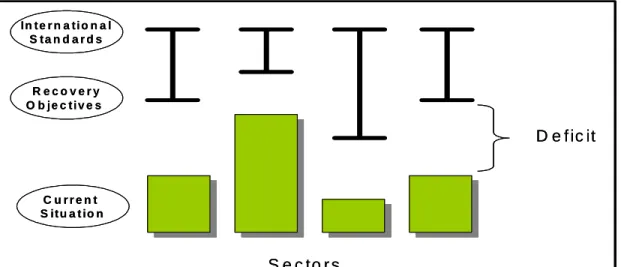
vision for a sector of the country. The concrete (conflict-sensitive) objectives to be reached within the timeframe of the PCNA (2 years) will have to be adjusted to each country’s specific post-conflict setting. Using these adjusted country specific objectives for the recovery phase, the deficits of a sector can be determined by comparing the actual situation against these realistic short term expectations. The gaps between the current situation and the adjusted objectives mark the deficits to be overcome within the time horizon of the PCNA. The identified deficits can be expressed as needs and subsequently priority areas of action can be described. Figure 2 represents the analytical model underlying the assessment.
Figure 2: Analytical Model of the Deficit Analysis
D e f ic it S e c to r s In t e r n a t i o n a l S t a n d a r d s R e c o v e r y O b je c t i v e s C u r r e n t S it u a t io n D e f ic it S e c to r s In t e r n a t i o n a l S t a n d a r d s R e c o v e r y O b je c t i v e s C u r r e n t S it u a t io n
3.8 Recovery Planning and Costing
Results-Based Planning Framework (RBPF)
To be meaningful for a country in a post-conflict situation a needs assessment has to result in a coherent planning document outlining goals, outcomes and necessary interventions. In addition, it needs to indicate key planning assumptions and risks. This is achieved by using a results-based approach for the planning exercise.
A “Guidance Note on Planning and Costing”, describing how to establish a results-based planning framework is provided in Chapter 4.2 Steps 15 and 16.
Ö Chapter 4.2: Steps 15 and 16
The basis for planning is derived from the analysis of needs. Through the analysis, a clear picture of the development gaps for each sector has been provided, describing the deficits between the current situation and the envisioned state. Here, it is important to select and define targets against which the deficits are measured in a conflict-sensitive manner. Among others, they should include the peace building priorities identified by conflict analysis. These deficits which determine the current needs and priority areas/issues of actions are now expressed as objectives, distinguishing between development goals, target outcomes and necessary interventions.
It is always important to keep in mind the conflict context. When, for example, water is identified as a main conflict issue, the planned intervention should not be restricted to the physical rehabilitation of an irrigation scheme only, but should also address management issues, aiming to ensure equitable and transparent distribution of water in order to reduce the potential for future conflicts.
Estimating Resource Requirements
The objective of the costing exercise is to estimate the needed financial resources to implement the planning for the priority areas and thus to inform and guide the commitments and pledges at the donor conferences. The approach used is based on the sectoral analysis—as already used to estimate costs for sector-wide approaches in education or health. Each sector must generate basic information on demographics (to assess the client population and estimate trends); on the delivery system (e.g., items in a basic health care package, number of villages visited by mobile health teams, and length of schooling cycles); and on cost parameters (supply-side costs such as teacher wage, teacher-student ratio, fixed and variable costs for mobile health teams, unit costs for delivery of basic health care package). This information can then be used to compute outputs and assess the overall public cost of reaching them. The “soft” (or non-physical) sectors in reconstruction, such as macro economy, security, governance etc., which have different characteristics, may build the needs assessment on a program analysis. The costs are assessed by calculating the amount necessary to implement identified interventions and programs, which are needed to achieve agreed targets. Close coordination with the IMF and the public budgeting process is critical in order to get an overview of expected government revenues, and its participation in recurrent expenditures and capital investments.
The “Guidance Note on Planning and Costing” in Annex 30 provides details on how to consistently estimate recovery costs across sectors .
Linking up with National Planning Processes
Recovery planning in the context of the PCNA needs to feed into subsequent national planning processes as much as possible. Where a transitional national government is in place, a high level of national participation in PCNA planning can build the foundations for taking up PCNA results in subsequent national policy-making, planning and budgeting processes. Methodologically, a results-based transition framework on the basis of a Log Frame approach can enhance the compatibility between planning processes and instruments. In this way, a government recovery program based on the main results of the PCNA could become the core of an Interim PRSP. More conceptual work is required in this area, however.
3.9 Integrating Key Cross-Cutting Issues
Cross-cutting issues affect all or a substantial number of sectors important for post-conflict recovery and should therefore be considered in every cluster/sector analysis. Typical cross-cutting issues are:
Gender: violent conflict and civil strive predominantly affect the civilian population, the majority of whom are women and children. On the one hand, women and children suffer from violent conflict in particular ways (e.g., female headed households, gender-based violence, child soldiers, and trauma) and have specific needs in post-conflict recovery. On the other hand, women and children can contribute their unique skills and capacities to the peace process.
Environment: armed conflict usually causes significant damage to the natural environment (e.g., land mines and unexploded ordnance, scorched earth tactics, and decay of resource management systems). Control of territory and natural resources are among key issues leading to violent conflict.
Human rights: the denial of the human rights to individuals and groups frequently leads to conflict. A rights analysis can help deepening the understanding of conflict and the challenges to the peace process. International human rights legislation can additionally provide a useful framework for guiding recovery objectives, particularly in those more political areas not covered by MDGs or other internationally agreed benchmarks(e.g., international rights-based accords).
Security: while sometimes treated as a sector (as in the Preliminary Needs Assessment for Afghanistan), security has many dimensions that impact the political, social and economic spheres of post-conflict countries, which suggest it should be treated as a cross-cutting theme. This would include issues such as the governance aspects of stabilizing or controlling the security sector,
economic impacts of insecurity and violence, and the social consequences of violence and community action (e.g., community policing, demining).
Ö Chapter 4.1 and 4.2: Steps 8 and 13
3.10 Paying Attention to Institutional Capacity Building
PCNAs face the dilemma of initiating the flow of unprecedented levels of external assistance into post-conflict countries, whose institutional capacities have decayed over long periods. Most post-post-conflict countries face severe institutional capacity constraints (e.g., in terms of human resources, managerial skills, monitoring and evaluation systems) that limit their ability to rapidly implement needed interventions. Such constraints are often described as limited ‘absorptive capacity.’ It is important to note that insufficient absorptive capacity is distinct from poor governance since even well governed countries may not have the ability to immediately make productive use of increased resources.
To be able to address these shortcomings, an analysis of national implementing capacities and an assessment of capacity building needs should be mainstreamed across all sectors of the needs assessment. To avoid providing capacity building assistance to specific factions only, particularly those supporting conflict, institutions and their staff should be assessed for their political orientation and role in the conflict.
Although critical absorptive capacity constraints can only be addressed and resolved through a long-term approach to institutional strengthening, efforts should be initiated during the recovery phase to build capacity. Concretely, countries must be encouraged to and assisted in developing mid- to long-term plans for scaling up human resources; improving the management skills of administrative staff; and strengthening mechanisms of financial control and reporting. Specific attention should be given to capacities that can promote non-violent conflict resolution.
Institutional capacity assessment should also pay attention to the risks of a brain drain of qualified, but underpaid public servants toward international agencies and NGOs establishing themselves in the country. Possible distortions to national salary scales by international agencies and NGOs and the subsequent loss of high-level personnel need to be considered when preparing strategies for strengthening national institutional capacities.
Step 8 contains a brief checklist for conflict-sensitive institutional assessment. Ö Chapter 4.1: Step 8
4. MANAGING THE PCNA PROCESS
Chapter 4 summarizes the main steps, which have become good practice in a PCNA. In addition, it offers a range of tools, such as sample job descriptions, terms of reference (ToRs), workshop and report outlines and costing tools, which support the implementation of the respective steps. The Chapter contains a relatively brief description of the main elements of PCNAs, while the respective tools are included in the Annexes to the guide (listed in Annex 1). Annex 1 includes an overview of the steps and respective tools listed in Chapter 4.
4.1 Preparatory Phase
The preparatory phase of a PCNA begins with the initial talks between donors, the UNCT and national authorities or parties to the conflict on the possibility of holding an international donor conference and ends with the arrival of the PCNA mission in the country. In this period, the multilateral agencies (World Bank Country Teams; UNDGO; and UNDP Bureau for Crisis Prevention and Recovery, BCPR) play a lead role in facilitating the political process between national authorities and donors, establishing consultation and coordination mechanisms between donors, the UN system and civil society at
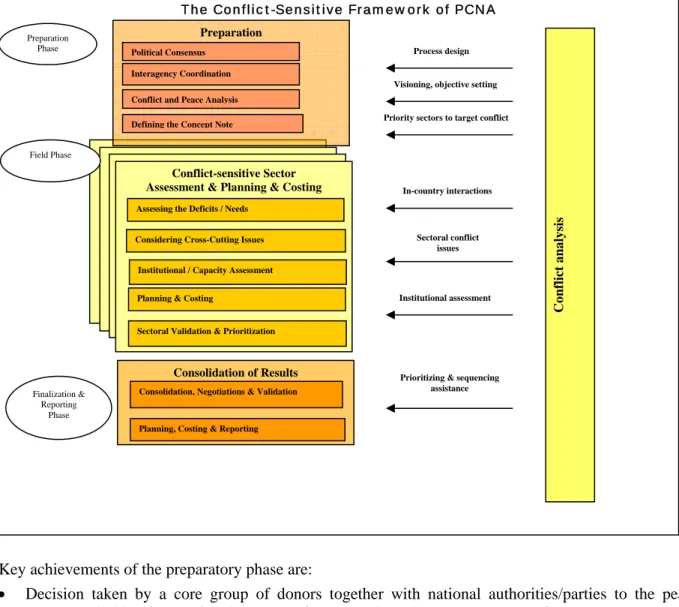
headquarters level and in the field, and setting up the PCNA mission. Figure 3 illustrates the methodology and process of the PCNA structured in four phases:
Figure 3: The Conflict-Sensitive Framework of a PCNA
Key achievements of the preparatory phase are:
• Decision taken by a core group of donors together with national authorities/parties to the peace process to hold an international donor conference and conduct a preparatory PCNA;
• Structures established for steering and coordinating the PCNA at headquarters and country level (core coordination group, donor liaison group, UN technical working group, interagency coordination group, joint steering committee by the conflict parties);
• Consensus on purpose and scope of PCNA, agreement on vision for post-conflict recovery, selection of priority sectors and cross-cutting issues informed by conflict analysis; and
• Operational structures established for carrying out in-country work on the PCNA (PCNA Secretariat, establishment of PCNA mission, concept note, terms of reference).
In this sense, the preparatory phase can be structured into three sets of activities, which in practice may take place in parallel:
1. Establishment of decision-making, consultation and co-ordination mechanisms for the PCNA (steps 1-4): There is so far no standardized process for initiating a PCNA (step 1). After the decision for an
The Conflict-Sensitive Framework of PCNA
Finalization & Reporting
Phase
Consolidation of Results
Planning, Costing & Reporting Consolidation, Negotiations & Validation
Conflict-sensitive Sector Assessment & Planning & Costing
Assessing the Deficits / Needs
Planning & Costing
Sectoral Validation & Prioritization
Field Phase
Considering Cross-Cutting Issues Institutional / Capacity Assessment
Preparation Phase
Preparation
Political Consensus
Conflict and Peace Analysis Interagency Coordination
Defining the Concept Note
Conflict analysis
Process design Visioning, objective setting Priority sectors to target conflict
In-country interactions
Sectoral conflict issues
Institutional assessment
Prioritizing & sequencing assistance