Towards Increasing the Financial Performance: An Application
of CAMEL Model in Banking Sector in the Context of Sri Lanka
Ahamed Lebbe Abdul Rauf
Senior Lecturer,Department of Accountancy and Finance,South Eastern University of Sri Lanka
Abstract
The main objective of this study was to evaluate comparative ability of financial performance of banks in Sri Lanka. For this purpose, a sample of banks consisting both private and public banks are selected. Data were gathered for ten years commencing from 2005. For evaluating the financial performance and comparison well known CAMEL model was used. All the CAMEL model parameters (capital adequacy, assets quality, management quality, earning quality, liquidity) were used as independent variables and as the indicators of financial performance return on equity (ROE) and return on assets (ROA) were considered as dependent variable. Descriptive, correlation and regression analysis were employed to test the hypotheses. The study found that private banks are best in all parameters of CAMEL and financial performance. However, performances of public banks were less compared to the private banks. From the findings it can be revealed that capital adequacy, assets quality and earning quality were significantly correlated with financial performance, and management efficiency and liquidity were not significantly correlated with financial performance of the banks. Implications of findings and directions for future research also discussed.
Keywords: CAMEL model,capital, assets, efficiency, quality, liquidity.
Introduction
The banking sector plays an important role in Sri Lankan economy as in other countries in the world. A considerable growth and improvement can be observed recent past in terms of number of banks, number of instruments on offer, range of services provided. There are twenty five licensed commercial banks operating in the country regulated by the Central Bank of Sri Lanka. Ten of these banks are formed locally and the rest are foreign banks operating as branch entities. Two of the local commercial banks are state-owned. The Sri Lankan government and the central bank of Sri Lanka too have introduced several reforms to improve the efficiency and stability of the financial sector.
As other sector, banking sector too has to face the present dynamic changes taken place in the environment to achieve competitive advantages. The banking sector has adopted new technologies to a considerable level to improve its efficiency and performance in order to achieve their long term goals. Ability to compete is determined by its financial performance efficiently and effectively. As such appraising financial performance is very crucial for all organizations. This is especially important for financial institutions like banks, because it helps to identify the major strengths and weaknesses of the business. Financial analysis also assists to predict the future performance of the banks. The information obtain from financial analysis shows the financial position of the organization, that will be interested by various internal and external stakeholders such as managers, employees, customers, financial institutions, and government.
Review of literature
Various authors have assessed the financial strength and weaknesses of financial institutions using various models. Among the models CAMEL model is popular. CAMEL is the model which measures the financial performance of banks in terms of five features, Capital adequacy, Assets quality, Management, Earning quality, and Liquidity. It is used frequently by researchers. As such a number of evidences are found from the literature.
Gupta and Verma (2008) examined the competitive analysis of financial performance of private sector banks in India. They found that management of non-performing assets and risks emanating from adverse events are the key to the higher profitability of Indian bank and concluded that transparency and good governance would work as principal guiding force for Indian Banks. Snagmi and Nazir (2010) also analyzed financial performance of major two banks using CAMEL model and highlighted that the position of banks under study sound and satisfactory in terms of their capital adequacy, asset quality, management efficiency and liquidity were concerned. In another study by Mohiuddin (2014) among a sample of commercial banks in Bangladesh using CAMEL parameters found that the bank under study was best at their financial performance during the period of study.
Further, another recent study by Suba and Jogi (2015), evaluating and comparing the performance of two private sector banks HDFC and ICICI in India, found that while there was no significance level of difference between the two selected banks in terms of certain indicators, significance difference was observed between two selected banks in terms indicator of capital adequacy ratio. Another study (Azizi & Sarkani , 2014) conducted in the context of Mellat Bank in Iran reveal that there is a positive significant relationship between the indices of liquidity, quality of management and earnings with financial performance. However, no relationship was seen
between capital adequacy and assets quality with bank financial performance.
Keovongvichith (2012) also analyzed the financial performance of the banking sector using CAMEL framework to identify the strength and weaknesses of the banks. Ibrahim (2014) analyzed on comparative performance of two banks in United Arab Emirates. The findings showed that both banks performed reasonably well during the period studied. Liquidity levels were lower for the commercial bank of Dubai, while the national bank of Abu Dhabi benefitted by having an overall higher degree of profitability. Trivedi (2013) used CAMAL model analysis for urban co-operative bank in Surat city. It was found out that the capital adequacy, assets quality, management efficiency, and earning capacity of SPCB was at acceptable level. However, the overall state of liquidity was not satisfactory.
Taani (2013) studied the impact of capital structure on performance of Jordanian banks. The results shown that bank performance which is measured by net profit, return on capital employed and net interest margin is significantly and positively associated with total debt; while total debt is found to be insignificant in determining return on equity in the banking industry of Jordan. Andries, Vasile and Ursu (2012) examined on Determinants of bank performance in CEE Countries. The results of study showed that promote stability and efficiency by enhancing their efforts to continue the reform of the financial services regulatory and supervisory framework.
More recently, Jha and Hui (2014) investigated and compared the financial performance of commercial banks in Nepal using CAMEL Model. The results shown that public sector banks are significantly less efficient than private banks, domestic private banks are equally efficient to foreign-owned (joint venture) Banks. Goel and Rekhi (2012) conducted a comparative study on the performance of selected public sector and private sector banks in India. Analysis revealed that new banks are more efficient than that of old ones and the public sector banks were not as profitable as private sector.
In a similar study by Gupta (2014) using a sample of Indian public sector banks using CAMEL approach for five years of period found that there is a significant difference in performance of all the public sector banks. Reddy and Prasad (2011) have applied the CAMEL approach to Rural Regional banks in India attempting to discuss the financial performance of selected regional rural banks during post reorganization period to distinguish between two classes of these banks. Lohia (2011) examined the performance of Indian banking industry and found that private banks perform better than public banks overall based on the CAMEL Framework. Kumar et al. (2012) has analyzed soundness of Indian banks and found that private banks are growing at a faster pace than public sector banks and will head towards convergence faster than the private sector banks.
Balaputhiran and Nimalathashan (2013) did a comparative study between private and state banking sector in Sri Lanka. The results revealed that all variables of corporate governance are positively correlated with ROE in state banks as well as, in private banks except BD and BMF other variables have strong negative relation with ROE, which is significant at five percent level of significance. Jeevarajasingam (2014) has studied on Liquidity and Profitability of Private Banks in Sri Lanka showed that liquidity ratio has strong positive correlation with return on assets. Thayapran and Pratheepan (2014) studied the total factor productivity growth of commercial banks in Sri Lanka. The overall results concluded that comparatively selected private banks are more efficient than state banks in the study period in Sri Lanka.
Matkar (2011) studied the financial performance of MSC bank in India using CAMEL model. He suggested that for the survival of the banks they should adopt quality risk management and maintain profit motives to enhance the profitability and higher performance of the banks. Chakraborty, Salam and Rubbanyn (2015) studied the financial Performance of Islamic Bank in Bangladesh for a period of five years and suggested for making sustainable profitability these banks should minimizes the risk.
Although CAMEL model has been used to measure financial performance by various countries, as far the recent published literature, none of such study seems to be carried out in the Sri Lankan context. Application of CAMEL model in measuring financial performance of Sri Lankan banking sector is very useful. Therefore, the main focus of this study is to evaluate comparative ability of financial performance using CAMEL model for the selected banks from government and private banks.
Methodology of the Study
Selected two government and two private banks are subjected to study. Since this study assess the sensitive issue of banking sector, actual names of the banks are not used and thereby, selected government banks are named as AB and CD, selected private banks are named as EF and GH.
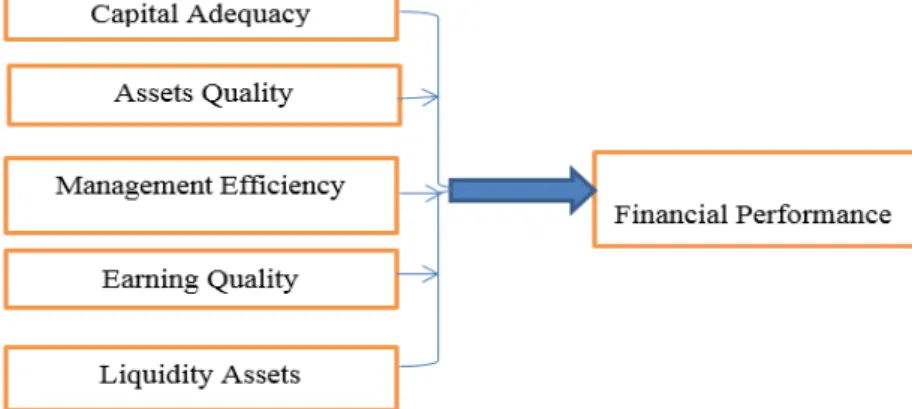
For the purpose of the present study, the research instrument used is the CAMEL Model which is the recent innovation in the area of financial performance evaluation of banks. The components of CAMEL model Capital adequacy, Asset quality, Management efficiency, Earning quality and Liquidity are considered as independent variables and the financial performance is considered as the dependent variable. As such financial performance, financial condition, operating soundness and regulatory compliance of the banking institution can also be evaluated.
financial performance of banks eg. Kumar at el. (2012). As such following conceptual framework is developed.
Figure 1: Conceptual Framework
For the purpose of convenient presentation variables are abbreviated (see Table 1) Table 1: Variables, Measures and their Abbreviations
Abbreviations Names of the Variables Measure
ROA Return on Assets Return / Assets
ROE Return on Equity Return / Equity
CAR Capital Adequacy Equity Capital / Total Assets
AQR Assets Quality Net NPA / Net Advances
MER Management Efficiency Total Advances / Total Deposits
EQR Earning Quality Net Profit / Total Assets Ratio
LR Liquidity Liquid Assets / Total Assets
Secondary data were collected from Annual report of individual Banks and Annual report of Central bank of Sri Lanka for the sample period from 2005 to 2014.
Presentation and Analyzing
CAMEL model has been used to evaluate the variables and competitive financial performance of selected banks. Here the financial performances are indicated by ROA and ROE. Descriptive analysis, mean, standard deviation, correlation and multiple regressions are used to analyze. Banks are ranked based on the mean value of gathered data using group ranking and composite ranking method. CAMEL model analysis is carried out from five perspectives.
Capital Adequacy
It is important for a bank to maintain depositors’ confidence and preventing the bank from going bankrupt. Capital adequacy refers to overall financial condition of banks and also the ability of management to meet the need of additional capital. The computation of capital adequacy ratio is done by taking ratio of equity capital and loan loss provisions minus non-performing loans to total assets.
Table 1: Results of the Descriptive and regression analysis of Capital Adequacy Ratio Names of Bank Mean value of the
ratio
Standard deviation
Sig .value R Squares
Rank ROA ROE ROA ROE
Capital Adequacy Ratio (CAR) .008 .001 .985 .997
CAR
AB 12.8800 1.53174 3
CD 10.9400 4.54855 4
EF 13.6700 1.72553 1
GH 13.4540 2.03483 2
The higher CAR ratio indicates the investor protection ability of the bank from bankruptcy. When comparing with other banks EF bank highly successful in CAR with a mean value of 13.67 and GH bank become second in rank. AB bank and CD bank obtain third and fourth ranks respectively. As per the results of the regression analysis, CAR shows a significant ROA and ROE and R squares indicate 98.5% and 99.7% impact on dependent variable.
Asset Quality
Asset quality determines the healthiness of financial institutions against loss of value in the assets as asset impairment risks the solvency of the financial institutions. The weakening value of assets has a spillover effect, as losses are eventually written-off against capital, which eventually expose the earning capacity of the institution.
Table 2: Results of the Descriptive and regression analysis of Asset Quality Ratio Names of Bank Mean value of the ratio Standard deviation
Sig .value R squares
Rank
ROA ROE ROA ROE
Assets Quality Ratio (AQR) .007 .006 .987 .988
AQR
AB 2.4000 1.17379 1
CD 5.7200 2.42432 4
EF 3.8000 1.13529 3
GH 2.9000 .56765 2
According to the Table 2, as AB bank had lower value of Non-performance to total assets ratio, AB bank is at the top position with assets quality ratios and ROA and ROE are at significantly shown. Based on R squares it indicates 98.75% and 98.8% impact on the variation of ROA and ROE respectively. Therefore, it can be concluded that as assets quality significantly correlated with financial performance of the banks.
Management Efficiency.
Management efficiency is another important element of the CAMEL Model. The ratio in this segment involves subjective analysis to measure the efficiency and effectiveness of management. The management of bank takes crucial decisions depending on its risk perception.
Table 3: Results of the Descriptive and regression analysis of Management Efficiency Ratio Names of Bank Mean value of the ratio Standard deviation
Sig .value R squares Rank
ROA ROE ROA ROE
Management Efficiency Ratio (MER) .641 .129 .124 .120
MER
AB 59.0000 8.51143 4
CD 65.8000 13.58758 3
EF 71.3000 16.97089 1
GH 68.7000 6.88073 2
According to the above Table 3, the bank EF is in the top position with highest mean value of management efficiency ratios with the mean value of 71.3 with total advances (TA) to total deposit (TD) ratio, all the banks have lower level of management efficiency ratios. According to the results, 0.641 and.129 of significant values of ROA and ROE respectively, shows the impact on the variation of financial performance is 12.4% and 12% respectively. Therefore Management efficiency is not significantly correlated with financial performance.
Earning Quality
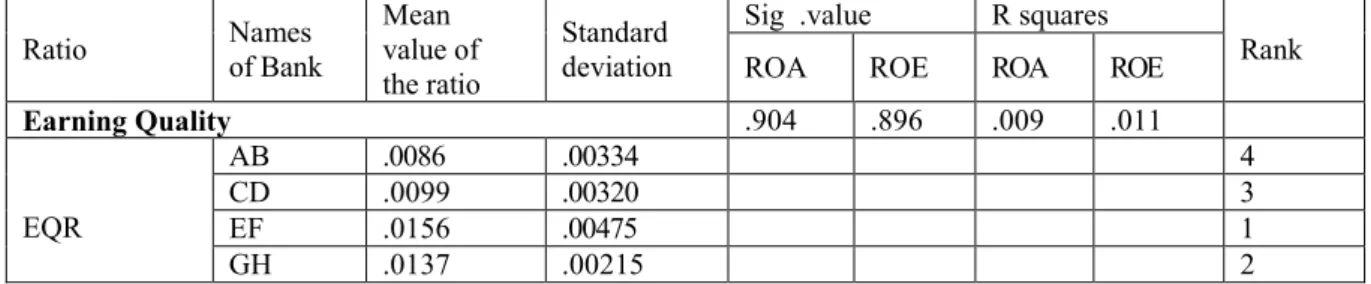
The quality of earnings is a very important criterion that determines the ability of a bank to earn consistently. It basically determines the profitability of bank and explains its sustainability and growth in earnings in future. Table 4: Results of the Descriptive and regression analysis of Earning Quality
Ratio Names of Bank Mean value of the ratio Standard deviation
Sig .value R squares
Rank
ROA ROE ROA ROE
Earning Quality .904 .896 .009 .011 EQR AB .0086 .00334 4 CD .0099 .00320 3 EF .0156 .00475 1 GH .0137 .00215 2
GH bank and EF bank are at the top position of the earning quality of selected banks. AB bank and CD bank shows lower level of earning quality than other banks. According to the findings net profit to total assets ratio not significantly correlated with financial performance and it shows 0.09% and 0.011% of R squares values with ROA and ROE respectively.
Liquidity
Risk of liquidity is curse to the image of bank. Bank has to take a proper care to hedge the liquidity risk; at the same time ensuring good percentage of funds are invested in high return generating securities, so that it is in a position to generate profit with provision liquidity to the depositors.
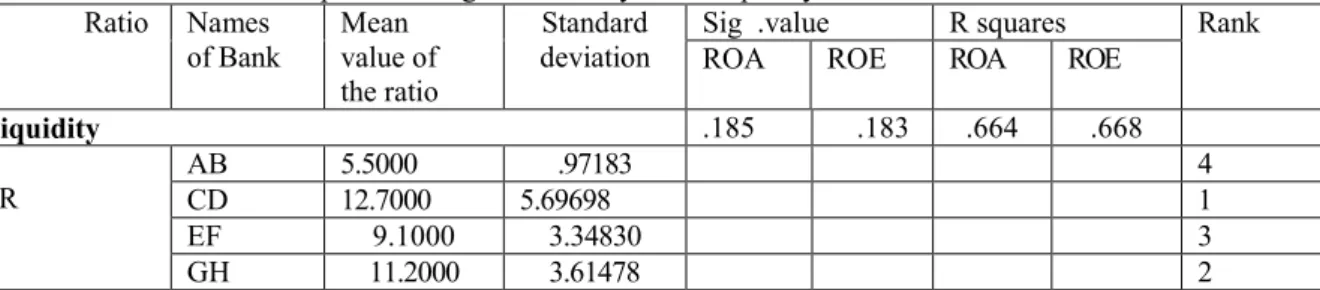
Table 5: Results of the Descriptive and regression analysis of Liquidity Ratio Names of Bank Mean value of the ratio Standard deviation
Sig .value R squares Rank
ROA ROE ROA ROE
Liquidity .185 .183 .664 .668 LR AB 5.5000 .97183 4 CD 12.7000 5.69698 1 EF 9.1000 3.34830 3 GH 11.2000 3.61478 2
According to the results presented in Table 5, Liquid assets make higher impact on ROA and ROA which measure the financial performance. Liquid assets total assets ratio shows 66.4% and 66.8% impact on ROA and ROE respectively, and CD bank is at the top position of liquidity than other banks. GH bank is placed second rank from the banks in its liquidity. EF bank and AB bank shows third and fourth positions. Significant value with financial performance and liquid assets ratios not significantly correlated with ROA and ROE.
Composite Ranking
In order to evaluate the overall performance of the banks under study, composite ranking (Gupta &Verma, 2008) system is applied. It is computed, by averaging the all the ranks. Thus, (Capital Adequacy + Asset Quality + Management efficiency + Earning quality + Liquidity) /no of indicators (5). On the basis of composite average, these banks have been ranked. The bank which has the lowest composite average is ranked as the best bank.
Table 6: Overall Financial Performance of the Banks
NAME CAR AQR MER EQR LR Composite
Average Rank
AB 3 1 4 4 4 3.2 4
CD 4 4 3 3 1 3 3
EF 1 3 1 1 3 1.8 1
GH 2 2 2 2 2 2 2
In order to assess the overall performance of banks the composite rating has been calculated using the group ranking of the selected banks in Sri Lanka for the period of 2005-2014 and results are presented in the above Table. On the basis of CAMEL model analysis, EF bank is ranked as first position with lowest composite average of 1.8, followed by GH bank and next rank is the CD bank.
Further analysis reveals that EF bank has the best capital adequacy ability and efficiency management process than other banks; however, it has lower liquidity and assets quality than other banks. But overall financial performance of EF bank is satisfactory. In the meantime, GH bank is able to maintain all the factors in satisfactory level. Therefore it is ranked second place in terms of its overall financial performance compared to other banks. Similarly, although CD bank is at the top position in liquidity, other factors are lower than other banks. While AB bank has lower liquidity, other factors also lower than other banks.
Conclusions and Findings
This study was mainly based on the evaluation of comparative ability of financial performance of banks in Sri Lanka. The comparative financial performance is analyzed using CAMEL model and finally ranked the banks based on the descriptive, correlation and regression analysis. All the information was collected for the period of ten years (2005-2014) from the annual reports of two public sector banks (AB bank and CD bank) and two private sector banks (EF bank and GH bank).
Overall performances of banks were obtained through composite rating using the group ranking of the banks in Sri Lanka. As a result, EF bank is ranked as first position followed by GH bank and next rank is the CD bank. While AB bank has lower liquidity, other factors also lower than other banks. Based on this analysis it can be revealed that the capital adequacy and assets quality are the factors which make higher influence for the financial performance of banks under the study period.
Recommendations
According to this findings capital adequacy ratio had significant relationship with financial performance, therefore, CD Bank should take action to increase the capital adequacy ratio. Similarly, EF bank should take an action to decrease assets to net advances ratio. As CD Bank also represented higher asset quality ratio, it should consider taking an action for decreasing this ratio. As results reveal that management efficiency had positive relationship with financial performance, and this is lower in public banks, public banks should improve efficiency management system. Public sector banks should follow the way which increases the earning quality and should take decision to decrease the operating expenses specially loan losses and provisions, other over heads for favorable profitability
of the bank. Public bank has to take decision to decrease current liabilities and increase the current assets and liquidity assets as possible, as they had not satisfactory position for holding the favorable short tern financial position.
In the present economic environment banking sector is one of the most competitive sectors. When commonly consider all the banks are in a competitive position. Here CD bank and GH bank has higher liquidity ratios than banks. It indicates Bank ability to pay customer obligation more than other banks. Therefore customer should consider interest rate, credibility, good will, and other facilities & benefits before selecting best bank for their investment and other banking activities.
This study topic will be a good area for future researchers because the result may change in future according to the future expected data. Findings of this study may be helpful for the banks and policy makers in improving financial and banking sector in Sri Lanka. Although there are many banks in Sri Lankan banking industry, this study considered only four commercial banks. This is one of the most important limitations of this study. Therefore, future study should consider more banks for more realistic findings.
References
Andires.A.M , Cocris.V and Ursu .S.G (2012) Determinants of Bank Performance in CEE countries, REBS Review of Economics and Business Studies, 5(2), 165-177.
Azizi.M and Sarkani.Y.A (2014) Review financial performance of MELLAT Bank According to CAMEL Model, A journal of multidisciplinary research, 3(1), 32-42.
Baalaputhiran.S and Nimalathasan.B (2013) Corporate Governance and Banking Performance: A comparative study between private and state banking sector in Sri Lanka, European Journal of Business and Management, 5(20), 92-100.
Chakraborty.J, Salam.F and Rabbany.G (2015) financial analysis of Islamic bank in Bangladesh, International journal of Economics Finance and Management, 3(2), 99-106.
Goel.C and Rekhi.C.B (2013) A Comparative Study on the Performance of selected public sector and private sector banks in India, Journal of business Management and Social Science Research, 2(7),46-56.
Guptha. R.CA (2014) An Analysis of Indian public sector Banks using CAMEL Approach, IOSR Journal of Business and Management, 16(1), IV, 94-102.
Guptha. S and Verma .R (2008) Comparative analysis of Financial Performance of private sector banks in India: Application of CAMEL model, Journal of Global Economy, 4(2), 160-184.
Ibrahim. M (2014) Comparative Performance of Tow Banks in United Arab Emirates, Research Journal of Accounting and Finance, 5(21), 24-30.
Jeevarajasingam .N (2014) A study on Liquidity and profitability of Private Banks in Sri Lanka, Research Journal of Finance and accounting, 5(21),165-174.
Jha.S and Hui.X (2014) A Comparison of Financial Performance of Commercial Banks: A case study of Nepal, African Journal of Business Management, 6 (25),7601-7611.
Keovengvichitn. P (2012) An Analysis of the Recent Financial Performance of the Lotion Banking Sector during 2005-2011,International Journal of Economics and Finance, 4(4),148-162.
Kumar, at.el. (2012) Analyzing Soundness in Indian Banking: A CAMEL Approach, Research Journal of Management Sciences, 1(3), 9-14.
Lohia.S (2011) Performance of Indian Banking Industry over the ten Years. CMC Student Scholarship, Claremont Colleges, Scholarship @ Claremontpp, 1-55.
Mohiuddin .G (2014) Use of CAMEL model: A study of Financial Performance selected Commercial Banks in Bangladesh, Universal Journal of Accounting and Finance.2(5), 151-160.
Nimalathasan .B (2009) Determinants of Key Performance of (KPIS) of Private sector banks in Sri Lanka. An Application of Explortory Facter analysis. The Annals of The "Ştefan cel Mare" University of Suceava. Fascicle of The Faculty of Economics and Public Administration, 9(2), 9-17.
Reddy.M and Prasad .K.V.N (2011) Evaluating Performance of Regional Rural Banks:An Application of CAMEL model, Journal of Arts Science and Commerce, vol 2, 61-67.
Snagmi M.U.D and Nazir.T (2010) Analysing Financial Performance of Commercial Banks in India: Application of CAMELmodel, Pak.J.commer Soc.sci.vol, 4 (1), 40-55.
Suba .N.R and Jogi .P.K (2010) Evaluation Performance of Private sector banks HDFC and ICICI: An Application of CAMEL model with Capital and Earning Parameters, International multidisciplinary Research Journal , 2(1), 1-5.
Taani. K (2012) Capital Structure effects on Banking Performance: A case study of Jordan, International Journal of Economics, Finance and Management Science, 1(5), 227-233.
Trivedi .K.R.C (2013) A CAMEL model Analysis scheduled Urban Co -operative Bank in Surat City: A case study of Surat People's Co-operative Bank, IOSR Journal of Business and Management. 48-54.