Program
Comprehension
During
Software
Maintenance
and Evolution
Armeliese von MayrhauserA. Marie Vans
Colorado State University
Code cognition
models
examine
how programmers
understand
program
code. The
authors
survey the current
knowledge
in this area by
comparing
six program
comprehension
models.
P
rogram understanding is a major factor in providing effective
software maintenance and enabling successful evolution of com-
puter systems. For years, researchers have tried to understand
how programmers comprehend programs during software maintenance
and evolution. Five types of tasks are commonly associated with software
maintenance and evolution: adaptive, perfective, and corrective main-
tenance; reuse; and code leverage. Each task type typically involves cer-
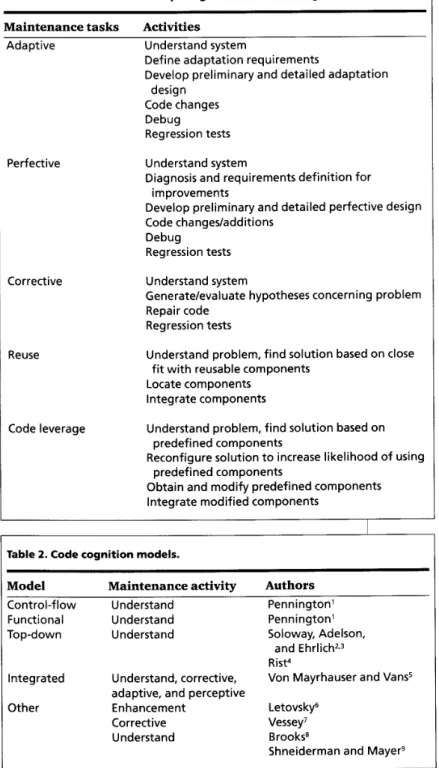
tain activities (see Table 1). Some activities, such as understanding the
system or problem, are common to several tasks. To analyze the cognitive
processes behind these tasks, researchers have developed several mod-
els (see Table 2).
In this article, we describe common elements of six cognition models
and compare them based on their scope and experimental support. All
models use existing knowledge to build new knowledge about the men-
tal model of the software that is under consideration. Many of these mod-
els are based on exploratory experiments, and some of those models have
been validated. Programmers employ various strategies and use cues in
code or documentation as guidance. However, their level of expertise
greatly influences how efficiently they understand the code.
Because of limited knowledge about specialized cognition needs for
some maintenance tasks, the code cognition models do not represent every
single task listed in Table 1. Most models assume that the objective is to
understand all of the code rather than a particular purpose, such as debug-
ging. While these general models can foster a complete understanding of
a piece of code, they may not always apply to specialized tasks that more
efficiently employ strategies geared toward partial understanding.
We identify open questions, particularly considering maintenance and
evolution of large-scale code. These questions relate to scalability of exist-
ing experimental results with small programs, validity and credibility of
results based on experimental procedure, and challenges of data
availability.
COMMON ELEMENTS OF COGNITION MODELS
The program comprehension process uses existing knowledge to acquire
new knowledge that ultimately meets the goals of a code cognition task.
This process references both existing and newly acquired knowledge to build
a mental model of the software that is under consideration. Understanding
depends on strategies. While these cognition strategies vary, they all for-
mulate hypotheses and then resolve, revise, or abandon them.
Knowledge
Programmers possess two types of knowledge: general knowledge that
is independent of the specific software application they are trying to under-
stand and software-specific knowledge s that represents their level of understand- ing of the software application. During the understanding process, they acquire more software-specific knowledge but may also need more general knowledge-for example, how a round-robin algorithm works. Existing knowledge concerns the programming languages and computing environment, programming principles, domain-specific architecture choices, algo- rithms, and possible solution approaches. If the programmer has worked with the code before, existing knowledge includes any (partial) mental model of the software. New knowledge primarily concerns the software product. It is acquired through- out the code understanding process. This knowledge relates to functionality, soft- ware architecture, the way algorithms and objects are implemented, control, dataflow, and so on. It obviously spans many abstraction levels from “this is an operating system” to “variable q is incre- mented in this loop.” The understanding process matches existing knowledge with software knowledge until the program- mers believe they understand the code. The set of matches is the mental model; it can be complete or incomplete.
r
Mental model
The mental model is an internal, work- ing representation of the software under consideration. It contains static entities such as text structures, chunks, plans, hypotheses, beacons, and rules of dis- course. Top-level plans refine into more detailed plans or chunks. Each chunk, in turn, represents a higher level abstraction of other chunks or text structures. A chunks construction combines several dynamic behaviors, including strategies, actions, episodes, and processes.
Model Maintenance activity Control-flow
Functional Top-down Static elements of the mental
model
Text-structure knowledge includes the program text and its structure. Text-struc- ture knowledge for understanding grows through experience and is stored in long- term memory. Pennington’ uses text-struc- ture knowledge to explain control-flow knowledge for program understanding. Structured programming units form text structure and organize knowledge.
Integrated Other
rable 1. Tasks and activities requiring code understanding.
Maintenance tasks Adaptive
Activities
Understand system
Define adaptation requirements
Develop preliminary and detailed adaptation design
Code changes Debug
Regression tests
Perfective Understand system
Diagnosis and requirements definition for improvements
Develop preliminary and detailed perfective design Code changes/additions
Debug
Regression tests
Corrective Understand system
Generate/evaluate hypotheses concerning problem Repair code
Regression tests
Reuse Understand problem, find solution based on close fit with reusable components
Locate components Integrate components
Code leverage Understand problem, find solution based on predefined components
Reconfigure solution to increase likelihood of using predefined components
Obtain and modify predefined components Integrate modified components
Table 2. Code cognition models.
Authors Understand
Understand Understand
Understand, corrective, adaptive, and perceptive Enhancement Corrective Understand Pennington’ Pennington’ Soloway, Adelson, and Ehrlich2f3 RisV
Van Mayrhauser and Vans5 Letovsky6
Vessey’ Brooks8
Shneiderman and Mayer9
tionships. For example, a Begin statement starts a block Examples of text-structure knowledge units include con- of code, while a subsequent If statement indicates a con- trol primes-iteration (loop constructs), sequences, and ditional control structure with a particular purpose. Their conditional constructs (for example, If-Then-Else); vari- relationship is such that the If is part of the block initiated able definitions; module calling hierarchies; and module by the Begin.
parameter definitions. The program text’s microstructure Chunks are knowledge structures containing various contains the actual program statements and their rela- levels of text-structure abstractions. Text-structure chunks
are called macrostructures, which are identified by a label
and correspond to the program text’s control-flow orga-
nization.’ For example, the microstructure for a sort
includes all its statements, while the macrostructure is an
abstraction of the block of code and includes only the label
sort. Lower level chunks can form higher level chunks.
Higher level chunks comprise several labels and the con-
trol-flow relationships between them.
Plans are knowledge elements for developing and vali-
dating expectations, interpretations, and inferences; they
capture the comprehender’s attention during the program
understanding task. These plans also include causal
knowledge about the information flow and relationships
between parts of program. Plans are schemas (frames)
with two parts: slot types (templates) and slot fillers. Slot
types describe generic objects, while slot fillers are cus-
tomized to fit a particular feature. Data structures such as
lists or trees are examples of slot types, and specific pro-
gram fragments are examples of slot fillers. These struc-
tures are linked by either aKind-ofor an Is-a relationship.
Programmingplans
can be high-, low-, or intermediate-
level programming concepts. For example, searching, sort-
ing, and summing algorithms as well as data-structure
knowledge such as linked-lists and trees are intermediate-
level concepts. Iteration and conditional code segments
are low-level concepts. Programming plan knowledge
includes roles for data objects, operations, tests, other
plans, and constraints on what can fill the roles.
Domain plans
incorporate all knowledge about the prob-
lem area except for code and low-level algorithms. Domain
plans apply to objects in the real world. For instance, plans
to develop a software tool for designing automobiles
would include schemas related to the function and appear-
ance of a generic car. An appropriate plan would also
include slots for problem domain objects such as steering
wheels, engines, doors, and tires. Domain plans are crucial
for understanding program functionality. Control-flow
plans alone are not enough to understand aspects such as
causal relationships among variables and functions.
Domain plans also address the environment surrounding
the software application, the domain-specific architec-
ture, and solution alternatives.
Letovsl@ refers to
hypothesesas conjectures and defines
them as results of comprehension activities (actions) that
can take seconds or minutes to occur. Letovsky has iden-
tified three major types of hypotheses:
l why
conjectures hypothesize the purpose of a function
or design choice;
l how
conjectures hypothesize the method for accom-
plishing a program goal; and
l what
conjectures hypothesize classification-for exam-
ple, a variable or function.
Degrees of certainty associated with a conjecture vary
from uncertain guesses to almost certain conclusions.
Brook9 theorizes that hypotheses are the only drivers
of cognition. Understanding is complete when the men-
tal model contains a complete hierarchy of hypotheses. At
the top is the primary hypothesis: a high-level description
of the program function, which is necessarily global and
nonspecific. Subsidiary hypotheses support the primary
hypothesis. Hypotheses can fail for three reasons: code to
verify a hypothesis can’t be found; confusion exists
because one piece of code satisfies different hypotheses; or
code can’t be explained.
Hypotheses drive the direction of further investigation.
Generating hypotheses about code and investigating
whether they hold or must be rejected is an important facet
of code understanding.
Dynamic elements of the mental model
A strategy guides the sequence of actions while follow-
ing a plan to reach a particular goal. For example, if the
goal is to understand a block of code, the strategy might be
to systematically read and understand each line of code
while building a mental representation at higher and
higher abstraction levels. An opportunistic strategy stud-
ies code in a more haphazard fashion.
Strategies also differ in how they match programming
plans to code. Shallow reasoning2a3
does so without in-
depth analysis. Many experts do this when they recognize
familiar plans. Deep reasoning2a3
looks for causal rela-
tionships among procedures or objects and performs
detailed analyses.
Strategies guide two understanding mechanisms that
produce information: chunking and cross-referencing.
Chunkingcreates new, higher level abstraction structures
from chunks of lower level structures. As structures are
recognized, labels replace the detail of the lower level
chunks. In this way, lower level structures can be chunked
into larger structures at a higher abstraction level. For
example, a code segment may represent a linked-list def-
inition as pointers and data. In an operating system defi-
nition, this may be abstracted as a ready queue. The code
segment that takes a job from the ready queue, puts it into
the running state, monitors elapsed time, and removes the
job after expiration of the time quantum may be abstracted
as a round-robin scheduler. The code for the queue, timer,
and scheduling are microstructures. Continued abstrac-
tion of the round-robin scheduler, dead-lock resolution,
interprocess communication, process creation/deletion,
and process synchronization eventually leads to the higher
level structure definition, “process management of the
operating system.”
Cross-referencing
relates different abstraction levels, such
as a control-flow view and a functional view, by mapping
program parts to functional descriptions. For instance, rec-
ognizing that a code segment manages processes and
determining its purpose says something about functional-
ity. Hence, cross-referencing
is essential to building a men-
tal representation across abstraction levels.
Code cognition formulates hypotheses, checks whether
they are true or false, and revises them where necessary.
Hypotheses, like plans and schemas, exist at all levels of
abstraction. The key is to keep the number of open
hypotheses manageable while increasing understanding.
Facilitating knowledge acquisition
Beacons,
cues that index into knowledge, can be text or
a component of other knowledge. For example, a swap
statement inside a loop or a procedure can be a beacon for
a sorting function; so can the procedure name Sort.
Beacons are useful for gaining a high-level understanding.8
Rules of&scour-se are conventions in pro- gramming such as coding standards, algo- rithm implementations, expected use of data structures, and so on. Rules of dis- course set programmer expectations. Programming plans are retrieved from long-term memory via these expectations. Soloway, Adelson, and EhrlichL show that expert programmers perform significantly better on plan-like code (code fragments that match expert programming plans) than on nonplan-like code. In practice, this means that unconventional algorithms and programming styles are much harder to understand, even for experts.
Expert characteristics
A programmer’s level of expertise in a given domain greatly affects program understanding. Experts tend to show the following characteristics:
Dacumntation
goal in specification layer is accomplished and by which parts of the implementation layer)
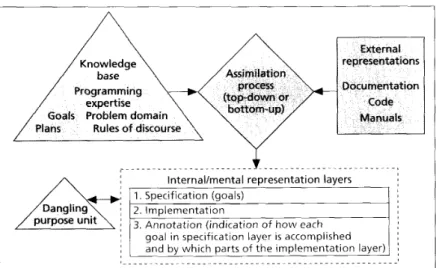
Figure 1. Letovsky comprehension model.
l They organize knowledge structures by functional char-
acteristics of the domain in which they are experts. For instance, novices might understand a particular pro- gram organized according to the program syntax. But experts might organize program knowledge in terms of algorithms rather than the syntax used to implement the program.“’
l Experts have developed efficiently organized special-
ized schemas,“’ often abstracted from previously designed software systems.
l Specialized schemas contr-ibute to efficient pr-oblem
decomposition and comprehension.‘” Top-down corn- prehension becomes feasible for problems that match specialized schemas.
l Experts approach problem comprehension with flexi-
bility.’ They discard questionable hypotheses and assumptions much more quickly than novices do, and they tend to generate a breadth-first view of the pro- gram. As more information becomes available, they refine their hypotheses.
COGNITION MODELS
Common elements of program cognition models occur in various theories. We discuss the most important ones below.
Letovsky model
Letovsky’s high-level comprehension model (see Figure 1) has three main components: a knowledge base, a mem tal model (internal representation), and an assimilation process.” The knowledge base contains programming expertise, problem-domain knowledge, rules of discourse, plans, and goals.
The mental model has three layers: a specification, an implementation, and an annotation layer. The specifica- tion layer-the program’s highest abstraction level- completely characterizes the program goals. The implementation layer contains the lowest level abstrac- tion. with data structures and functions as entities. The
annotation layer links each goal in the specification layer to its realization in the implementation layer. However, these links can be incomplete. The dangling-purpose unit models such unresolved links.
The assimilation process occurs either top-down or bot- tom-up. It is opportunistic in that the programmers pro- ceed in the way they think yields the highest return in knowledge gain. To contribute to one of the three layers constl ucted in the mental representation, the under- standlng process matches code, documents. and so on with elements from the knowledge base.
Shneiderman and Mayer model
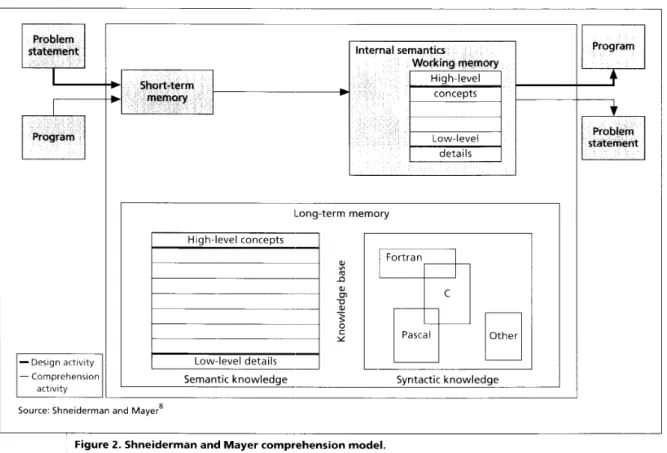
Shneiderman and Mayer’s comprehension model (see Figure 2)” recodes the program in short-term memory into an internal semantic representation via a chunking process. These internal semantics contain different levels of program abstraction. At the top are high-level concepts
such as program goals, The lowest levels contain details
such as the algorithms used to achieve program goals. Long-term memory, a knowledge base with semantic and syntactic knowledge, assists during internal seman- tics construction. Syntactic knowledge is programming language dependent, while semantic knowledge concerns general programming knowledge independent ofany spe- cific programming language, Like working memory, semantic knowledge in long-term memory is layered and incorporates high-level concepts and low-level details. Program understanding is directional: It starts with the progl-am code and continues until the problem statement is reconstructed.
Brooks model
Brooks” sees program comprehension as the recon- struction of the domain knowledge used by the initial developer. Understanding involves recreating the map- pings flrom the problem domain into the programming domain, through several intermediate domains.
The problem (application) domain concerns real-world problems-for example, maintaining appropriate inven- tory levels. The objects are inventories, physical entities
Problem statement I Program Internal semantics Working memory Program + + Problem statement ILong-term memory High-level concepts Low-level details n Other
-Comprehension Semantic knowledge Syntactic knowledge
Source: Shneiderman and Mayer8
Figure 2. Shneiderman and Mayer comprehension model.
domain schemas External representation in problem domain External representation Program code User manuals Maintenance manuals
Internal representation/mental model Hypothesis and subgoals I..________..._.__~~~---.--~~.~...---~-~~~~~~~....~....~~~~~---~~~~..
“,; . _.... .~~.~~...~i...~....~.
Internal representation
j Current mental representation of program : _ _~ ~~ f (plandschemas)
Figure 4. Soloway, Adelson, and Ehrlich comprehension model.
that have properties such as s ize, cost, and quantity. Once the physical objects are characterized, intermediate knowledge domains are required. Inventory cost might include not only the actual cost but also overhead such as storage. Accounting knowledge recognizes the appropri- ate overhead calculations. Knowledge of program syntax helps implementation. This example uses at least four dif- ferent knowledge domains to reach the programming domain: inventories, accounting, mathematics, and pro- gramming languages.
Knowledge within each domain includes details about domain objects, the operations allowed on them, and the order in which those operations are allowed. Interdomain knowledge describes the relationships between objects in different but c losely related domains, such as the rela- tionship between the general operating system domain and the Unix operating system domain.
The mental model is built through a top-down process that successively refines hypotheses and auxiliary hypotheses. Hypotheses are iteratively refined, passing through several knowledge domains until they can be matched to specific code in the program or a related document.
Figure 3 illustrates the Brooks model. Knowledge, shown as triangles, can be used directly for hypothesis gen- eration in the mental model or matched (mapped) from one domain to another. A cognitive process verifies that internal representations reflect knowledge contained in external representations such as code, design documents, or requirements specifications. Beacons are the main vehi- c le for this verification, which is also hypothesis driven. Once a hypothesis is generated the external (internal) rep- resentations can be searched to support the hypothesis. Top-down model: Soloway, Adelson, and Ehrlich
Top-down understanding (see Figure 4)2 .i typically applies when the code or type of code is familiar. The code
can then be decomposed into the typical elements of that system type. Theoretically, new code could be understood entirely in a top-down manner if the programmer had already mastered code that performed the same task and was structured in exactly the same way.
This model uses three types of plans: strategic, tactical, and implementation. Strategic plans describe a global strat- egy used in a program or algorithm and specify language- independent actions. Tactical plans are local strategies for solving a problem; these plans contain language-indepen- dent specifications of algorithms. Implementation plans are language dependent and are used to implement tacti- cal plans; they contain actual code fragments.
A mental model is constructed top-down. It contains a hierarchy of goals and plans. Rules of discourse and bea- cons help decompose goals into plans and plans into lower level plans. Typically, shallow reasoning builds the con- nections between the hierarchical components.
Figure 4 shows the model’s three major components. The triangles represent knowledge (programming plans or rules of discourse). For example, a subset of the rules of discourse might include the following:
l variables updated same way as initialized,
9 no dead code,
l a test for a condition means that the condition must be
potentially true,
l don’t do double duty with code in a nonobvious way,
and
l an If is used when a statement body is guaranteed to
execute only once; a W hile is used when the statement may need to be executed repeatedly.
The diamond represents the understanding process. The rectangles illustrate internal or external program rep- resentations. (External representations include docu- ments such as requirements or design documents; code; user, reference, or maintenance manuals; and other mis-
r...__---._,
model :
r---_--,
model : j (final mental
~ Figure 3. rennmgton comprehension model.
cellaneous related documents. Internal representations include plans and schemas.) The understanding process matches external representations to programming plans using rules of discourse to select plans, by setting expec- tations. Once a match is complete, the internal represen- tation is updated to reflect the newly acquired knowledge. These updated mental representations are subsequently stored as new plans.
Comprehension begins with a high-level goal and then generates detailed subgoals necessary to achieve the higher level goals. Program documentation and code invoke implementation, strategic, or tactical plans, depending on the current mental representation’s focus. Pennington model: bottom-up comprehension
Comprehension develops two different mental repre- sentations: a program model and a situation model. The program model is usually developed before the situation model.
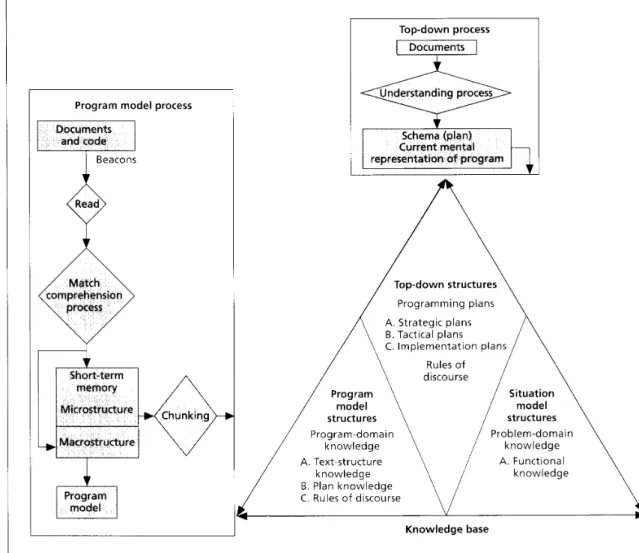
PROGRAM MODEL. Pennington’ II found that when code is completely new to programmers, the first mental rep- resentation they build is a control-flow program abstrac- tion called the program model. This representation, built from the bottom up via beacons, identifies elementary blocks of code control primes in the program.
Pennington uses text structure and programming plan knowledge to explain program model development. The
program model is created via the chunking of microstruc- tures into macrostructures and via cross-referencing. Programming plan knowledge, consisting of program- ming concepts, exploits existing knowledge during the understanding task and infers new plans for storage in long-term memory.
Least recently used (LRU) page replacement for mem- ory management is an example of plan knowledge from the operating systems domain. Data structure knowledge may contain the implementation of a first-in, first-out (FIFO) queue.
SITUATION MODEL. This model also is built from the bottom up, as the program model creates a dataflow/fimc- tional abstraction. The model requires knowledge of real- world domains, such as generic operating system structure and functionality for the operating system domain. The situation model is complete once the program goal is reached.
Domain plan knowledge is used to mentally represent the code in terms of real-world objects, organized as a functional hierarchy. For example, the situation model describes the actual code “pcboards = pcboards - sold” as “reducing the inventory by the number of PC boards sold.” Lower order plan knowledge can be chunked into higher order plan knowledge.
A situation model is built by cross-referencing and chunking. The matching process takes information from
rable 3. Model evaluation criteria.
Soloway,
Model Abstraction Shneiderman Adelson, Integrated
criterion level Letovsky and Mayer Brooks and Ehrlich Pennington model
Static: Low Knowledge Syntactic Programming Implementation Text- Program
Knowledge base knowledge domain plans structure model
structures knowledge structures
Intermediate Knowledge Semantic
base knowledge Intermediate domain Tactical plans Plan knowledge Situation structures
High Knowledge Semantic Problem Strategic Top-down
base knowledge domain plans structures
Static: Low Implementation Working Hypotheses Plans/schemas Program Program
Mental layer memory: and subgoals model model
representations Low-level
concepts
Intermediate Hypotheses PlansJschemas Situation Situation
and subgoals model model
High Specification Working Hypotheses Plans/schemas Top-down
layer memory: and subgoals model
High-level concepts
Dynamic: Direction Top-down or Top-down or Top-down Top-down Bottom-up Top-down or
Processes bottom-up bottom-up bottom-up
Experimentation Type Small-scale Small-scale Self- Small-scale Small-scale Large-scale
code code observation code code code
experiments experiments experiments experiments experiments experiments
I
the program model and builds hypothesized higher order plans. These new plans are stored in long-term memory and chunked to create additional higher order plans.
Figure 5 graphically represents Pennington’s model. The right half illustrates program model building, while the left half describes situation model construction. Text- structure knowledge (control primes; program structure; syntax; programming conventions; and control sequence knowledge such as sequences, iterations, or conditions) and external representations (code, design documents, and so on) are inputs to the comprehension process. Beacons can invoke a particular schema (for example, a swap operation causes the programmer to recall sorting functions). Code statements and their interrelationships form the microstructure. Microstructures are chunked into macrostructures (chunked lines of text organized by con- trol primes). These chunks are stored in long-term mem- ory and used to build even larger chunks.
6),5 has four major components: the top-down, situation, and program models and the knowledge base. The first three reflect comprehension processes. The fourth is needed to successfully build the other three. Each com- ponent is involved in the internal representation of the program (or short-term memory) and a strategy to build this internal representation. The knowledge base furnishes the process with information related to the comprehen- sion task and stores any new and inferred knowledge. For large systems, a combination of approaches to under- standing becomes necessary. Therefore, the integrated model combines the top-down understanding of Soloway, Adelson, and Ehrlich3 with the bottom-up understanding of Pennington.’ Nevertheless, experiments show that programmers switch between all three comprehension models.5
The program model can change after situation model construction begins. A cross-reference map allows direct mapping from procedural, statement-level representa- tions to a functional, abstract program view. Higher order plans can cause a programmer to reconsider the program model and alter or enhance it as necessary. The program- mer may directly modify the text base or use these plans as input to the program model comprehension process.
Any of the three submodels may become active at any time during the comprehension process. For example, dur- ing program model construction, a programmer might recognize a beacon indicating a common task such as sort- ing. This leads to the hypothesis that the code sorts some- thing, causing a jump to the top-down model. The programmer then generates subgoals and searches the code for clues to support these subgoals. If the program- mer finds a section of unrecognized code during this search, he may return to program model building. Structures built by any one model component are acces- sible by the other two, but each model component has its own preferred knowledge types.
Integrated Metamodel
The integrated code comprehension model (see Figure
1
Program model process
Microstructure
Macrostructure
0
Chunking
Figure 6. Integrated Metamodel.
EVALUATION AND ANALYSIS
Top-down process Documents Top-down structures Programming plans A. Strategic plans A. Functional C. Rules of discourse Model scope
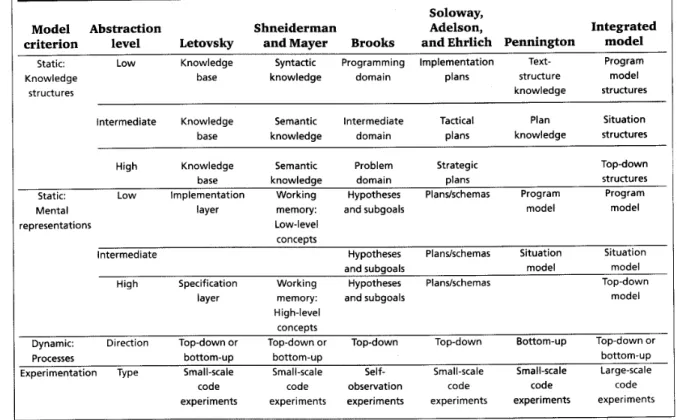
Model evaluation uses the following criteria: First. does the model incorporate static structures that represent per- sistent knowledge and the system’s current mental repre- sentation? Second, does it represent dynamic processes that build the mental representation using knowledge? Third, to which extent was each model validated by experiments? For each model, Table 3 (on the previous page) lists the criteria, the abstraction level for each static property, the direction of dynamic model building, and the experiment type used in validation. Blankcells indicate that the model does not include the associated attribute. For example, Letovsky’s model does not have a representation for an intermediate mental representation of the system. Evaluation
All six models accommodate a mental representation of the code, a body of knowledge (knowledge base) stored in long-term memory, and a process for combining the knowl-
Knowledge base
edge in long-term memorywith new external information (such as code) into a mental representation. Each differs in the amount of detail for these three main components.
Letovsky’s model is the highest level cognition model, emphasizing the mental representation’s form. No details explain how the knowledge assimilation process works or how knowledge is incorporated into the mental representa- tion The knowledge types coincide with Soloway, Adelson, and Ehrlich’s model. Shneiderman and Mayer’s model is more detailed, since it organizes knowledge in a hierarchy and separates semantic and syntactic knowledge. Like the Letovsky model, this model focuses on the mental represen- tation’s form but lacks details on knowledge construction.
Brooks’ model differs from the other models in that all changes to the current mental representation stem from hypothesis, The mental model is constructed in one direc- tion only, from the problem domain to the program domain. However, we have observed that program under- standing is not unidirectional.i Nevertheless, both the Brooks model and the Soloway, Adelson, and Ehrlich model construct the mental representation top-down,
Situation model process
(1
Beacons 4 Read9
m
Bunkingel
Situation model From top-down modelfrom the highest abstraction level through finer levels of detail. The Brooks mode1 leaves the knowledge structures undefined. Although hypotheses are important cognition drivers, mental representations can be updated by other means-for example, a strategy-driven method (using a cross-referencing, systematic, or opportunistic strategy).
Pennington’s model is more detailed and includes spe- cific descriptions of the cognition processes and knowl- edge. It accounts for the types, forms, and composition of knowledge to construct most of the mental representa- tion. It also contains mechanisms for abstraction. The major drawback is its lack of higher level knowledge struc- tures such as design or application-domain knowledge.
Soloway, Adelson, and Ehrlich’s model emphasizes the highest level abstractions in the mental model. One aspect that distinguishes this model is its top-down development of the mental model with its assumption that the knowl- edge it uses has been previously acquired. By itself, this model does not account for situations when code is novel and the programmer has no experience to use as a back- plane in which to plug new code.
Each model represents important aspects of code com- prehension, and many characteristics are shared among different models. For example, Brooks, Letovsky, and Shneiderman and Mayer all focus on hierarchical layers in the mental representations. Brooks and Soloway, Adelson, and Ehrlich use a form of top-down program comprehension, while Pennington uses a bottom-up approach to code understanding. And Letovsky and Shneiderman and Mayer use both top-down and bottom- up comprehension. All five models use a matching process between what is already known (knowledge structures) and the artifact under study. No one model accounts for all behavior as programmers understand unfamiliar code. The Integrated Metamodel responds to the cognition needs for large software systems. It combines relevant por- tions of the other models and adds behaviors not found in them-for example, when a programmer switches between top-down and bottom-up code comprehension. Analysis
Cognition models and the theories behind them must be grounded in experiments that either collected the infor- mation supporting those theories or validated it.
Several types of program comprehension experiments have been conducted. The appropriate type depends on the purpose of the study and the amount of existing research. Objectives range from theory building to vali- dation of detailed portions of a theory. Studies to build a theory are typically observational. Behaviors are observed as they occur in the real world. Once a theory is built from observations, correlational studies can be designed. These studies determine enough about the behavior in question to explore relationships among variables. At the other end of the spectrum, hypothesis-testing experiments investi- gate cause and effect between variables. Hypothesis test- ing consists of carefully controlled experiments whose purpose is to validate an existing theory. Correlational 1 studies indicate possible relationships between variables.
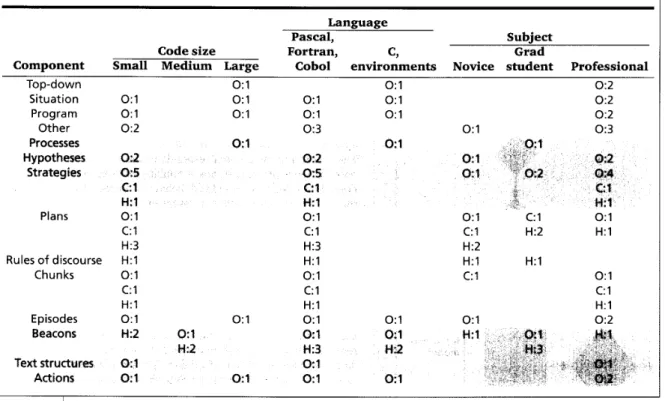
Let us now analyze what aspects of code cognition have been covered by existing experiments and how much we really know about how programmers understand code. Table 4 organizes code cognition experiments in terms of models, common cognition elements, code size, pro- gramming language, and subjects. For code size, “small” refers to programs of less than 900 lines of code (LOC); “medium” refers to between 900 and 40,000 LOC; while “large” refers to more than 40,000 LOC. Languages such ~ as Cobol, Fortran, Basic, and Pascal are distinguished from state-of-the-art development environments such as C/Unix with tools like Make or Lint. Subjects are catego- rized as novices, grad students, or professional program- mers. Each cell in the table represents the number and types of experiments that investigated the row component ’ with the column attribute. Experiments are classified as observational (0), correlational (C), or hypothesis-test- ing (H). For more details on these experiments, see von Mayrhauser and Vans?
Many experiments validate or verify portions of the models presented here. For example, several experiments have addressed the use of plans and strategies. Results seem to support the top-down theory of program corn- prehension. On the other hand, only observational exper-
rable 4. Number and type of experiments-observational (0). correlational (C), or hypothesis-testing (H)-that investigated each component with a given code cognition attribute.
Language
Pascal, Subject
Code size Fortran, c, Grad
Component Small Medium Large Cobol environments Novice student Professional
Top-down 0:l 0:l 0:2
Situation 0:l 0:l 0:l 0:l 0:2
Program 0:l 0:l 0:l 0:l 0:2
Other 0:2 0:3 0:l 0:3
Processes 0:l 0:l -0:l
Hypotheses 02 0:2 o:, y&&: 02
Strategies 05 0:s 0:l
y‘o:;!
; 0:4 C:l Cl .g c;:r H:l H:l -A p &I' Plans 0:l 0:l 0:l C:l 0:l C:l C:l C:l H:2 H:l H:3 H:3 H:2 Rules of discourse H:l H:l H:l H:l Chunks 0:l 0:l C:l 0:l C:l C:l C:l H:l H:l H:l Episodes 0:l 0:l 0:l 0:l 0:l 0:2 Beacons H:2 0:l 01 0:l H:l H:2 H:3 Hz2 :Text structures 0:l o:l
Actions 0:l 0:t 0:l 03
I
iments have examined the use of text structures during bottom-up processing. Correlational and hypothesis- testing experiments are needed to lend credence to the situation models and program models of program comprehension.
Table 4 clearly reveals the unexplored areas of code com- prehension. Only one experiment investigating cognition elements used large-scale code. Just two experiments used medium-sized code. A C/Unix environment, probably the most commonly used state-of-the art environment today, appeared in only three experiments. As far as purpose, most studies investigated strategies, beacons, or plans. Few studies addressed processes, rules of discourse, actions, program comprehension episodes, or entire cognition models. In addition, most were observational experi- ments-which is appropriate, since the development of program-comprehension models is still in the theory-build- ing phase. In light of this information, program cognition must concentrate on three issues: scalability of experi- ments, static or dynamic behavior, and theory building.
SCALABILITY OF EXPERIMENTS. We mUSt investigate whether the many well designed experiments that use small-scale code can scale up for production code. For example, Pennington’s study of mental representations of code’ used 200.LOC programs. These studies can answer questions about understanding small program segments or very small programs. However, they do not address the interactions of isolated components of understanding or whether these results can play an important role in under- standing large programs.
STATICORDYTUMICBEHAVIOR. Currentresultsmainly focus on the static properties of programming skills. For example, experiments identified persistent knowledge areas, such as searching or sorting algorithms, but did not investigate knowledge use or application.
THEORY BUILDING. Many experiments are designed to measure specific conditions (for example, whether or not programmers use plans) but the experimental hypothe- ses (for example, that programmers use plans when understanding code they have never seen before) are not always based on a well-defined program-comprehension theory. Theories regarding large-scale program compre- hension for specialized maintenance tasks are in their infancy.
PROGFMMUNDERSTANDINGISAKEYFACTOR insoftwaremain- tenance and evolution. We have summarized the major ele- ments of cognition, how they are represented in several different program models, and the importance of experi- mentation in developing and validating model theories. Several conclusions can be drawn from this survey:
l While a lot of important work exists, most of it centers
around general understanding and small-scale code.
l Existing results from related areas need further investi-
gation. For example, Pennington’s model borrows from work in understanding technical reports. Perception and problem solving are also strongly related to pro- gram comprehension.
l S o m e results g e n e r a l i z e o r a p p e a r a s c o m p o n e n t s of
t l a r g e r results. F o r e x a m p l e , e l e m e n t s of P e n n i n g t o n ’s a n d S o l o w a y , A d e l s o n , a n d E h r l i c h ’s m o d e l s a p p e a r in the Integrated M e t a m o d e l .
l Data availability is a challenge. F i n d i n g expert software
e n g i n e e r s that w o r k o n p r o d u c t i o n c o d e is difficult u n l e s s the c o m p a n i e s that m a i n t a i n l a r g e - s c a l e c o d e e n c o u r a g e their m a i n t e n a n c e e n g i n e e r s to participate in p r o g r a m c o m p r e h e n s i o n experiments. Existing e x p e r - i m e n t s i n a d e q u a t e l y a d d r e s s these w o r k situations.
l T h e literature fails to p r o v i d e a clear picture of c o m -
p r e h e n s i o n p r o c e s s e s b a s e d o n specialized m a i n t e n a n c e tasks s u c h a s adaptive o r perfective m a i n t e n a n c e . M o d e l s of the g e n e r a l u n d e r s t a n d i n g p r o c e s s p l a y a n important part in d e v e l o p i n g a c o m p l e t e u n d e r s t a n d - i n g of a p i e c e of code. H o w e v e r , they m a y not a l w a y s b e representative for n a r r o w tasks s u c h a s r e u s e o r e n h a n c e m e n t s that m i g h t m o r e efficiently e m p l o y strategies g e a r e d towards partial understanding. A better g r a s p of h o w p r o g r a m m e r s u n d e r s t a n d c o d e a n d what is m o s t efficient a n d effective c a n s p a w n v a r i o u s i m p r o v e m e n t s , s u c h a s better tools, better m a i n t e n a n c e g u i d e l i n e s a n d processes, a n d d o c u m e n t a t i o n that s u p -
ports the cognitive process. I
R e f e r e n c e s ~ -
1. N . P e n n i n g t o n , “S tim u l u s S tructures a n d M e n t a l R e p r e s e n -
tations in E x p e r t C o m p r e h e n s i o n of C o m p u t e r P r o g r a m s , ” Cognitive P s y c h o l o g y , V o l . 1 9 , 1 9 8 7 , pp. 2 9 5 - 3 4 1 .
2. E. S o l o w a y a n d K . Ehrlich, “E m p i r i c a l S tudies of P r o g r a m - m i n g K n o w l e d g e , “IE E E T r a n s . S o f h v a r e E n g . , V o l . S E - l o , No. 5, Sept. 1 9 8 4 , pp. 5 9 5 - 6 0 9 .
3. E. S o l o w a y , B. A d e l s o n , a n d K. Ehrlich, “K n o w l e d g e a n d Processes in the C o m p r e h e n s i o n of C o m p u t e r P r o g r a m s , ” i n T h e N a t u r e ofExpertise, M. Chi, R. Glaser, a n d M. Farr, eds., A. L a w r e n c e E r l b a u m Associates, Hillsdale, N.J., 1 9 8 8 , pp. 1 2 9 - 1 5 2 .
4. R.S. Rist, “P l a n s i n P r o g r a m m i n g : Definition, Demonstration, a n d D e v e l o p m e n t , ” Proc. First W o r k s h o p
B e h a v i o r : A M o d e l a n d E x p e r i m e n t a l Results,” Int’l J. C o m - puter a n d Information S c i e n c e s , V o l . 8, No. 3, 1 9 7 9 , pp. 2 1 9 - 2 3 8 .
10. R. G u i n d o n , “K n o w l e d g e E x p l o i t e d by Experts d u r i n g Soft- w a r e Systems Design,“Int’2J. M a n - M a c h i n e S tudies, V o l . 33,
1 9 9 0 , pp. 2 7 9 - 1 8 2 .
11. N. P e n n i n g t o n , “C o m p r e h e n s i o n Strategies in P r o g r a m m i n g , ” Proc. S e c o n d W o r k s h o p E m p i r i c a l S tudies of P r o g r a m m e r s , A b l e x P u b l i s h i n g , N o r w o o d , N.J., 1 9 8 7 , pp. 1 0 0 - 1 1 2 . 12. A. v o n M a y r h a u s e r a n d A.M. V a n s , “P r o g r a m U n d e r s t a n d i n g :
A Survey,” Tech. R e p o r t C S - 9 4 . 1 2 0 , C o l o r a d o State Univer- sity Fort Collins, Col., 1 9 9 4 .
A n n e l i e s e v o n M a y r h a u s e r is a professor of c o m p u t e r s c i e n c e at C o l o r a d o S tate University. S h e is Q I ! S O the director of the C o l o r a d o A d v a n c e d Software Institute, a n o r g a n i z a - tion of thestate of C o l o r a d o f o r t e c h n o l o g y transfer research. H e r r e s e a r c h interests focus o n software e n g i n e e r i n g , p a r - ticularly testing a n d m a i n t e n a n c e . V o n M a y r h a u s e r r e c e i v e d a Dipl. Inf d e g r e e f r o m the University of K a r k r u h e a n d a n A M d e g r e e a n d P h D f i o m D u k e University, all in c o m p u t e r science. S h e is the author of a software e n g i n e e r i n g text a n d o v e r 8 0 j o u r n a l s a n d c o n f e r e n c e publications. S h e is the IE E E C o m p u t e r Society’s vicepresidentforpublications. A . M a r i e V a n s is a P h D c a n d i d a t e at C o l o r a d o S tate U n i - versity. A s asoftware r e s e a r c h e n g i n e e r f o r Hewlett-Packard, s h e d e v e l o p e d specifications a n d tests for c o m p u t e r h a r d - ware. H e r r e s e a r c h interests in c l u d e e m p i r i c a l studies ofpro- g r a m m e r s a n d d e s i g n of e x p e r i m e n t s for software e n g i n e e r i n g . V a n s r e c e i v e d a n M S d e g r e e f r o m C o l o r a d o S tate University a n d a B S d e g r e e f r o m C a l $ o r n i a S tate University at S a c r a m e n t o , both in c o m p u t e r science. S h e is a m e m b e r of U p s i l o n P i Epsilon.
R e a d e r s ca n contact the authors at t h e D e p a r t m e n t of C o m - puter S c i e n c e , C o l o r a d o S tate Universig, Fort Collins, C O 80.523; e - m a i l {avm, v a n s } @ cs.colostate.edu.
E m p i r i c a l S t u d i e s o f P r o g r a m m e r s , A b l e x P u b - lishing, N o r w o o d , N.J., 1 9 8 6 , pp. 2 8 - 4 7 . 5. A. v o n M a y r h a u s e r a n d A.M. V a n s , “C o m -
p r e h e n s i o n Processes D u r i n g L a r g e - S c a l e M a i n t e n a n c e , “Proc. 16thlnt’l Conf. Software E n g i n e e r i n g , I E E E C S Press, L o s Alamitos, Calif., O r d e r No. 5 8 5 5 , 1 9 9 4 , pp. 3 9 - 4 8 . 6. S. Letovsky, “Cognitive Processes i n P r o -
g r a m C o m p r e h e n s i o n , “Proc. First W o r k s h o p E m p i r i c a l S t u d i e s of P r o g r a m m e r s , A b l e x P u b l i s h i n g , N o r - w o o d , N.J., 1 9 8 6 , pp. 5 8 - 7 9 . 7. I. Vessey, “Expertise i n D e b u g g i n g C o m - p u t e r p r o g r a m s : AProcessAnalysis,“lntlJ. M a n - M a c h i n e Studies, V o l . 23, 1 9 8 5 , pp. 4 5 9 - 4 9 4 . 8. R. Brooks, “T o w a r d s a T h e o r y of the C o m - p r e h e n s i o n of C o m p u t e r P r o g r a m s , “Int’lJ. M a n - M a c h i n e Studies, V o l . 18, 1 9 8 3 , pp. 5 4 3 - 5 5 4 . 9. B. S h n e i d e r m a n a n d R. Mayer, “Syntac- tic/Semantic Interactions i n P r o g r a m m e r N a m e ( P l e a s e Print) P L E A S E N O T I F Y U S 4 W E E K S IN A D V A N C E ~ N e w A d d r e s s
City State/Country Zip
M A I L T O : I E E E Service C e n t e r
4 4 5 H o e s L a n e
Piscataway, N J 0 8 8 5 4