Open Courseware Initiative in Turkey
Ali Yazıcı(1 Ali Ekrem Özkul(2) Kürşat Çağıltay(3)
[email protected] [email protected] [email protected]
(1) TOBB University of Economics & Technology, Ankara, Turkey (2) Anadolu University, Eskişehir, Turkey
(3) Middle East Technical University, Ankara, Turkey
Abstract
Developments in educational course technology created many opportunities for the educators to prepare and present course material efficiently and effectively over the net using affordable digital equipment and computers. OCW is the natural outcome of these efforts and is mainly based on the concept of “sharing” the online material locally and globally. In developing countries with acceptable Internet access, it would be feasible to implement OCW project in native tongue to minimize the negative effects of digital divide. In this article, first, OCW basics are reviewed and components and levels of online course material are introduced. Worldwide OCW efforts and OCW Consortium formed by the 45 Turkish Universities and the activities of the consortium are discussed next. Finally, future of OCW and suggestions for expanding OCW in Turkey is given.
Keywords. Open Courseware, Open Educational Resources, EduCommons, Creative Commons
Introduction
Open Courseware (OCW) or more generally Open Educational Resources (OER) is an initiative to provide educational course material at undergraduate and graduate levels online, free and openly available to humanity. This initiative is mainly attributed to Massachusetts Institute of Technology (MIT) where the project was given a start and aimed at providing all over 1800 MIT courses online by the end of 2007. In addition to MIT OCW, several other universities from the USA and all over the world joined to open courseware movement.
A common definition of OER is “digitized material offered freely and openly for educators, students and self-learners to use and reuse for teaching, learning and research” [1]. The same document suggests that OER refers to accumulated digital assets that can be adjusted and which provide benefits without restricting the possibilities for others to enjoy them.
Although the OER projects are new, the concept of “sharing” knowledge in higher education [2], and open courseware [3] and establishing consortiums to achieve OER [4] have already been encountered in the literature. However, implementation of OCW in the lines of MIT approach is recent.
Benefits of OER
Some of the benefits and primary purposes of OER are outlined below [1], [5]:
• OER promotes cooperation, sharing and learning among instructors
• OER provides a free advertising platform for educational institutions
• OER creates a competitive atmosphere among the instructors and content developers. Hence, quality of OER can be improved
• OER expands access to learning materials freely for everyone
• OER can be an efficient way of promoting lifelong learning
• Sharing knowledge for free is in line with academic traditions and a good approach to be supported
• Governments may reduce the overall cost of higher education by supporting OER projects and hence gain publicity
Barriers
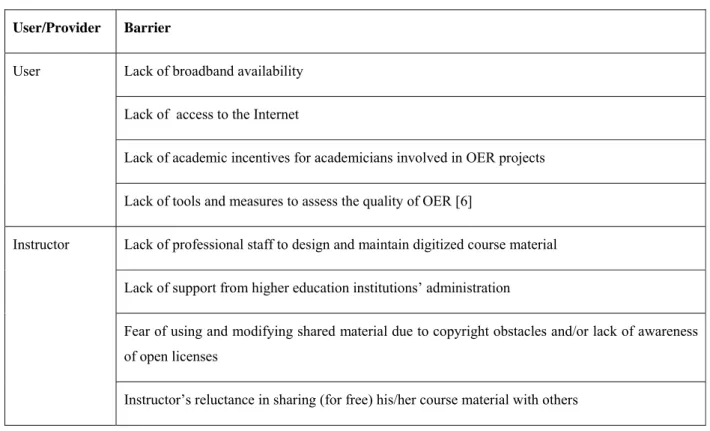
As mentioned above sharing OER for free creates many opportunities for individuals, institutions (mainly universities), and even for governments. However, there are certain technical and non-technical barriers to be resolved especially in developing countries as outlined below:
Table 1. Barriers to OER User/Provider Barrier
Lack of broadband availability Lack of access to the Internet
Lack of academic incentives for academicians involved in OER projects User
Lack of tools and measures to assess the quality of OER [6]
Lack of professional staff to design and maintain digitized course material Lack of support from higher education institutions’ administration
Fear of using and modifying shared material due to copyright obstacles and/or lack of awareness of open licenses
Instructor
Lack of academic incentives for academicians involved in OER projects
Limited participation by the instructors because of organizational caution, cultural barriers, and tenure standards that give little weight to pedagogical innovation [6]
Agency problem: Who is the owner of OEG? Decision makers who bear the cost or instructors who develop the course material? [6]
Levels of eLearning and OER
Today, online education is organized and managed in the context of eLearning and Learning Management Systems (LMS) respectively. A 5-level iterative model is given in [7] involving staff, teaching support and addresses the requirements in developing online material. Although, OER approach is entirely different, this model can be useful in classifying and quantifying the OER content. Briefly, the 5-level iterative model consists of the following levels: Level 1: Administration (course guides, staff contact, timetable, assessment criteria, and list of resources)
Level 2: Document and distribution (Lecture notes and PowerPoint slides, assignments, sample exams, and announcements)
Level 3: Enhanced face-to-face (navigable course structure, topic based material, forums, graphics, and quizzes) Level 4: Fully online (flexible delivery, choice of learning activities, online assessment, and moderated forums and off campus contexts)
Level 5: Enhanced online (media rich resources, flexible teaching/learning, off campus contexts, and suitable for other markets)
Accordingly, OCW/OER can be classified as online material at level 3 enriched with some multimedia material.
OCW/OER Worldwide
The idea of sharing valuable course material online, freely to others became widespread. First free course materials were made available by the installation of first Web sites but they were individual attempts. By the end of 20th century, several more organized free courseware initiatives have been initiated. As stated before, MIT’s project is considered as the first highly structured and organized one. According to the OECD report [1], more than 3000 free courseware is available in various academic fields.
As a result, in addition to MIT OCW, other universities from the USA and all over the world have established OCW sites with course materials in a variety of academic disciples. Among these, one can list Utah State University OCW, University of Notre Dame OCW, and John Hopkins Bloomberg School of Public Health OCW. Open University UK, as a university completely dedicated to distance teaching is also one of the members of the OCW consortium. The OpenCourseWare Consortium includes more than 100 higher education institutions and organizations from about 20 countries. It is funded by Hewlett foundation. In order to participate the consortium, desired institutions are required
to commit to publish at least 10 courses under the institution’s name in an opencourseware format. The following is the list of member countries:
Australia Austria Canada China
Colombia France Iran Japan
Korea Mexico Netherlands Saudi Arabia
South Africa Spain & Portugal Taiwan Thailand
United Kingdom United States Venezuela Vietnam
Another similar organization is the Open Educational Resources (OER) Commons. It was created by the Institute for the Study of Knowledge Management in Education and also funded by Hewlett Foundation. The OER Commons presents course materials from Pre-K level to graduate school level (http://www.oercommons.org/).
In Europe an open courseware project called “Science, Education and Learning in Freedom (SELF)” was initiated as a part of the European Union (EU). It is an international project aiming to provide a platform for the collaborative sharing and creation of free educational and training materials on “Free Software” and “Open Standards” (http://selfproject.eu/). Moreover, two Dutch companies have started an open course materials project. It works under a Learning Management System and can be accessed at http://open-of-course.org/courses/.
OpenOCW (http://openocw.org/) is another project where anyone can contribute courses on any topic in one of the 18 departments so far by creating a free account on the system. OpenCourseWare Finder (http://ocwfinder.com) is a useful site providing a keyword search for locating OCW material easily.
Finally, Multimedia Educational Resources for Learning and Online Teaching – MERLOT is also a very widely known free and open resources repository (http://www.merlot.org/Home.po). It was developed by California State University Center for Distributed Learning (CS)-CDL at www.cdl.edu). At the moment it has more than 14,000 resources.
OER Initiative in Turkey
The use of advanced technologies to improve the efficiency and effectiveness of higher education has always become an issue within higher education institutions. Although a lot of progress has been achieved worldwide to benefit from new technologies, as acknowledged in the strategic plan of the Turkish Higher Education Council [8], this development did not impinge on the Turkish higher education system sufficiently. The strategy report points out the ongoing dominance of traditional educational practices. Lecture notes created from limited resources and the teaching through lecturing and note taking is prevalent among the higher education institutions. However the faculty attempting to use the advanced technologies usually can not fully exploit the benefits of these technologies. The report draws attention to the initiatives such as MIT-OCW to support the higher education teaching and learning activities.
Despite the severe shortage of text books and educational materials, a substantial awareness has not been observed in the Turkish HE milieu towards the OCW initiative as a potential to alleviate this need. Ozkul [9] discussed the issue of eLearning in engineering education where he describes the MIT courseware as a supporting resource for both the learners and the instructors and gives examples to the ICT technologies employed in creating the courses. In 2004; Berk , Chairman of Free Scientists and Scholars of Turkey (FSAST), in the website called “Biliminsanı Platformu” (http://www.bilimadami.org/TR/) emphasizes the need for course materials in Turkish higher education institutions. In the same web page, he announces the initiative in collaboration with MIT to translate some of the courses into Turkish giving priority to the field of biology. The web site also includes some partially completed courses.
The major attempt to introduce OER into Turkish higher education system is accomplished by the Turkish Academy of Sciences (TUBA). In the letter sent by the president of TUBA in late 2006 to the rectors of the universities, the educational potential of the OER is pointed out and representatives from the universities are invited to a meeting to further discuss the issue. In early 2007 the Academy assembled two successive meetings with the representatives from the universities as the Turkish Open Courseware General Assembly.
As a major outcome of these meetings, a national OCW Consortium (http://uadmk.ulakbim.gov.tr/) was formed with members from all Turkish academic institutions, Higher Education Council (YÖK) and Turkish Academic Network and Information Center (ULAKBIM) under the Scientific and Technological Research Council of Turkey (TÜBİTAK). The elected members of the executive committee are working towards the nationwide implementation of the project. Currently, in addition to TUBA and TÜBİTAK, 45 universities have signed MOU’s with the consortium to contribute and develop OER in the native tongue.
Elected board of governors is in charge of managing the activities of the consortium. The OCW project will be implemented according to the following plan:
1. Universities will set up their infrastructures to house OER.
(a) EduCommons software will be installed and used for the purpose.
(b) Educational Technology centers will set up the rules and regulations of the OER to manage and maintain the system.
2. Universities will encourage academicians to prepare and upload OER material to their servers.
3. Universities with limited resources will upload their courses directly to EduCommons server located at the Turkish Academic Network and Information Center (ULAKBIM)
4. The consortium will take all the majors to introduce and spread out the OER to the use of academicians and students all over the country.
Future of OER
It is interesting to note that those institutions that form the worldwide OCW consortium are from the two extreme ends of the higher education provision. At one end Open University UK, a mega university that offers higher education to masses and at the other, MIT and other elites, meet for the provision of their content and expertise to the
public. This is confirmed by Atkins et al [10] who describe OER as “an initiative that has nurtured a culture of sharing, not only within individuals, but also within major institutions of higher education”. They characterize the next phase as “to nurture a culture of learning in which both intellectual capital (content) and human capital (talent) spiral upward, together” and assert that “the conditions now exist for a Open Participatory Learning Infrastructure (OPLI) which consolidates the understanding, technology and incentive from multiple threads of activity”. Taking all these developments into consideration it can be asserted that the ultimate phase in the OER movement will be a learning ecosystem, a concept from biology which has started to be used in social sciences to understand the complex relationships among the individuals and organizations. Hence the static nature of today’s OCW will convert into dynamic relationship between learners and institutions and this OPLI will evolve into a learning ecosystem. In Turkey the OER initiative has the potential to contribute significantly to the higher education system in various aspects. First and foremost is that the OER is expected to help in alleviating the problem of inadequate teaching and learning resources in the higher education system. It will enrich the learning resources available to students and self learners. For the instructors the OER will provide an opportunity to benchmark their courses with the peers and improve their own teaching. For institutions the OER will be the source of information for the accreditation of the programs and/or courses offered by other institutions. One important expansion may be the use of the OER for the transition to e-learning. Systematic integration of the various components of a course within a learning management system (LMS) a will produce a standalone distance learning course or a learning package.
There are several issues to be resolved before OER gets credit from the academic world. One of them is the copyright issues and legal rights of the course providers. Creative Commons Legal Code is a public license used by many course developers in the OER world. Under Creative Commons License, the course provider grants the users with privileges such as copy modify and publish material under certain conditions. It is one of the tasks of the consortium to promote a similar licensing scheme in Turkey in accordance with the laws and regulations. Another issue is the assessment of the OER. A kind of OER classification might be necessary based on the feedback from the users and the statistical data collected during the usage of the material.
The most important challenge of the Turkish OER project is to convince faculty members to open their courses for the public. Necessary support mechanisms and strategies have to be developed to increase their participation. These issues will be presented and pros and cons will be discussed.
References
1. OECD Report, “Giving Knowledge for Free: The emergence of Open Educational Resources”, Centre for Educational Research and Innovation, OECD 2007
2. Baldi S, Heier H, Mehler-Bicher A, “Open courseware and open source software - Learning from experience?”, COMMUNICATIONS OF THE ACM 46 (9): 105-107 SEP 2003
3. Malloy TE, Jensen GC, Regan A, and Reddick M, “Open courseware and shared knowledge in higher education”, BEHAVIOR RESEARCH METHODS INSTRUMENTS & COMPUTERS 34 (2): 200-203 MAY 2002
4. Harding RD, Lay SW, Quinney DA, “A consortium approach to courseware design in mathematics”, COMPUTERS & EDUCATION 26 (1-3): 171-178 APR 1996
5. Mallony, T.E., Jensen, G.C., and Regan, A., “Open Courseware and Shared knowledge in Higher Education”, Behaviour Research Methods, Instruments, & Computers 34(2): 200-203, 2002
6. Bissell, A. and Boyle, J., ”Towards a Global Learning Commons: ccLearn”, Educational Technology 47(6): 5-9 November-December 2007
7. Craats, C. van der, McGovern, J., and Pannan, L., “A Five-Level Approach to the Large-Scale Development and Delivery of Online Programs”, Proceedings of ASCILITE 2002
8. Higher Education Council of Turkey (T.C. Yükseköğretim Kurulu), “Turkey’s Higher Education Strategy (in Turkish)”, http://www.yok.gov.tr/duyuru/yok_strateji_kitabi.pdf, Last accessed date: January 11, 2008
9. Ozkul A.E., “e-Learning and Distance Engineering Education (in Turkish).”, Elektrik Muhendisligi (Journal of Electrical Engineering), V.41, No.419, 18-27, 2003 ,
http://www.emo.org.tr/yayinlar/dergi_goster.php?kodu=327&dergi=1, Last accessed date: January 19, 2008 10. Atkins D.E., Brown S.E. , Hammond A.L., A Review of the Open Educational Resources (OER) Movement:
Achievement, Challenges, and New Opportunities, Report to The William and Flora Hewlett Foundation, February 2007, http://www.oerderves.org/wp-content/uploads/2007/03/a-review-of-the-open-educational-resources-oer-movement_final.pdf , Last accessed date: January 19, 2008