Association for Information Systems
AIS Electronic Library (AISeL)
PACIS 2015 Proceedings
Pacific Asia Conference on Information Systems
(PACIS)
2015
Judging Online Peer-To-Peer Lending Behavior:
An Integration of Dual System Framework and
Two-Factor Theory
Xi Lin
Xiamen University, [email protected]
Shun Cai
Xiamen University, [email protected]
Di Xu
Xiamen University, [email protected]
Xin Fu
Xiamen University, [email protected]
Follow this and additional works at:
http://aisel.aisnet.org/pacis2015
This material is brought to you by the Pacific Asia Conference on Information Systems (PACIS) at AIS Electronic Library (AISeL). It has been accepted for inclusion in PACIS 2015 Proceedings by an authorized administrator of AIS Electronic Library (AISeL). For more information, please [email protected].
Recommended Citation
Lin, Xi; Cai, Shun; Xu, Di; and Fu, Xin, "Judging Online Peer-To-Peer Lending Behavior: An Integration of Dual System Framework and Two-Factor Theory" (2015).PACIS 2015 Proceedings. 138.
JUDGING ONLINE PEER-TO-PEER LENDING BEHAVIOR: AN
INTEGRATION OF DUAL SYSTEM FRAMEWORK AND
TWO-FACTOR THEORY
Xi Lin, School of Management, Xiamen University, Fujian, China, [email protected]
Shun Cai, School of Management, Xiamen University, Fujian, China, [email protected]
Di Xu, School of Management, Xiamen University, Fujian, China, [email protected]
Xin Fu, School of Management, Xiamen University, Fujian, China, [email protected]
Abstract
The past decade has witnessed a growing number of business models that facilitate economic exchanges between individuals with limited institutional mediation. One of the important innovative business models is online peer-to-peer (P2P) lending, which has received widely attention from government, industry, investors, and researchers. Based on dual system framework and two-factor theory, this research proposes a research model to investigate the role of various signals from the P2P platform in affecting lender’s investment decisions. With data collected from PPDAI, a popular Chinese P2P lending site, we test the proposed model with logistic regression and hierarchical linear model. The results reveal that most of the factors perform significantly in lenders’ decision making. We also find the specific information of an auction itself is more important than borrower’s characteristics to a large degree. Finally, the research emphasizes that bid number performs well in moderating most of the relationships between variables.
1
INTRODUCTION
The past decade has witnessed a growing number of business models that facilitate economic exchanges between individuals with limited institutional mediation. One of the important innovative business models in digital finance is online P2P lending, which have received widely attention from government, industry, investors, and researchers (Gonzalez & Loureiro 2014; Greiner & Wang 2010; Herzenstein, Dholakia, et al. 2011; Herzenstein, Sonenshein, et al. 2011; Lin et al. 2013; Yum et al. 2012). P2P lending site is a new and innovative platform of financial transactions that bypasses conventional intermediaries by directly connecting borrowers and lenders (Yum et al. 2012). The first P2P lending platform Zopa was launched in 2005. Nowadays, P2P lending is dramatically gaining its popularity worldwide, such as Zopa in the UK, Prosper in the US, and PPDAI in China. This boom is powered by technology advance and rapidly changes customer behavior. The rise of P2P lending will bring new competition to the industry and propel the financial sector into a new era by integrating finance with the internet.
Founded in 2007, PPDAI is the first online P2P lending platform in China. Like Prosper.com, PPDAI serves as an information dissemination platform with no offline business. It is the typical representative of pure intermediary and online service provider. To date, there are more than 600 thousand registrants in this P2P lending site. The loan loss provision has reached more than 10 million RMB by the end of last month. The business mode for PPDAI makes the operation cost much lower than offline companies, so it can give more profit to lenders and borrowers for attracting more customers. The revenue of PPDAI mainly comes from service fee and compensate but with no guarantee for lender’s capital and bad debts expense risk.
Although P2P lending markets enjoy rapid development in recent years, this business model is not developing without problem. One of the most important problems is information asymmetry (Lin et al. 2013; Yum et al. 2012). One of the ways to solve this problem may be taking advantage of a portfolio that consists of a large number of microloans with diverse risk levels, but with an inherent risk of default on loans made via the online medium to strangers without collateral (Yum et al. 2012).
For a P2P marketplace to flourish, it is important to examine how lenders make their decisions (Greiner & Wang 2010; Lin et al. 2013). In particular, if diverse information is presented on the P2P lending platform as signals, how will those signals process and interpret by different lenders? To answer this question, we propose a research framework to categorize different signals sent by the platform and investigates their roles in affecting lenders’ decisions. Building upon dual system framework and two-factor theory, we investigate how lenders process different information and test the relationship between different information signals and lender’s choices. Past literature has applied dual system framework to human decision making (Dhar & Gorlin 2013; Djulbegovic et al. 2012; Gerrard et al. 2008). When lender makes decision whether to invest in a loan requested, they may be influenced by the intuition or deliberate thinking. On the other hand, when people seek out information for selections and make investment decisions, motivation and hygiene factors lead to different results.
2
LITERATURE REVIEW
Online P2P lending has gained widely attention over the past few years. Some of the researches have concentrated on variables that influence funding success and interest rates of loan request (Greiner & Wang 2010; Herzenstein, Sonenshein, et al. 2011; Lin et al. 2013; Yum et al. 2012). Yum et al. (2012) explored the influence of role of the voting results and transaction history on loan funding success on P2P lending behavior. The results showed that borrowers tried to maintain a good reputation, and direct communication with lenders may adjust incorrect inference from hard data when their creditworthiness was questioned. Similarly, Greiner and Wang (2010) explored how trust-building mechanisms behave in P2P lending marketplaces. The research employed likelihood of funding and reduced interest rate to represent trust behaviors which revealed the importance of economic status, social capital and listing quality that influence trust behavior.
Besides, there are many researches emphasizing social networks and personal characteristics. Lin et al. (2013) believed online friendships of borrowers acting as signals of credit quality. Research concentrated on analyzing friendships and discovered that friendships increased the probability of successful funding, lowered interest rates on funded loans, and were associated with lower ex post default rates. Herzenstein, Sonenshein, et al. (2011) examined how identity claims constructed in narratives by borrowers influenced lender’s decisions about unsecured personal loans. Especially, they used loan funding, percentage reduction in final interest rate and loan performance as dependent indicators to discuss the issues and found that unverifiable information affected lending decisions above and beyond the influence of objective, verifiable information.
Past literature has employed various theories and frameworks to demonstrate the underlying phenomena. Lee and Lee (2012) empirically investigated lender’s behavior and found strong evidence of herding behavior and its diminishing marginal effect as bidding advances. Based on Elaboration Likelihood Model (ELM), Greiner and Wang (2010) introduced trust-building mechanisms behaving in P2P lending marketplaces and found the importance of the central route (economic status) as the major driver for bidding behavior and of peripheral cues (social capital and listing quality) as trust-building mechanisms that influence trust behavior. Considering information asymmetry, researches also introduced signal theory to explain P2P lending behavior. Collier and Hampshire (2010) drew on theory from the principle-agent perspective to empirically examine the signals that enhance community reputation.
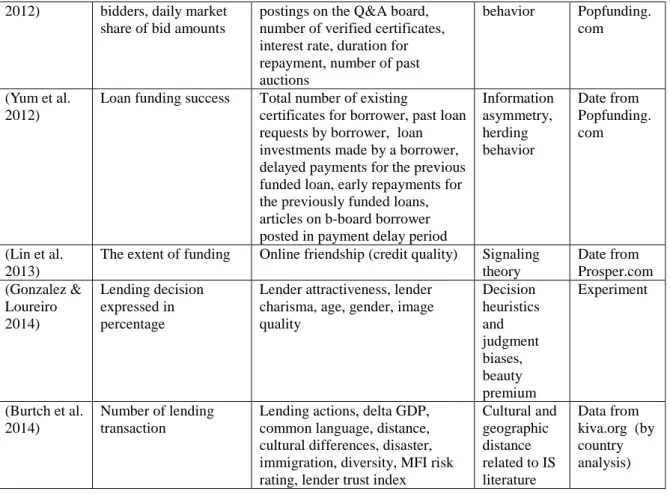
Under these circumstances, current research explores the determinants of P2P lending behavior. And unlike previous literature, one of the most interesting things about this study is to systematically analyze the underlying phenomena of P2P lending marketplaces. We bring two-factor theory and dual system framework as the analysis framework in order to demonstrate lenders’ choice which has little emerged. Besides, we use bid number as moderator to exploring the herding behavior about lender’s choice. Also, a brief summary on P2P research is presented as Table 1.
References Dependent variables Main independent variables Supporting theory Method/data (Greiner & Wang 2010) Trusting behaviors (likelihood of funding, reduced interest rates)
Economic status (central route) social capital, listing quality (peripheral cues) ELM (elaboration likelihood model) Data from Prosper.com (Herzenstein , Sonenshein, et al. 2011) Loan funding, percentage reduction in final interest rate, loan performance
Borrower’s identities (trustworthy, successful,
hardworking, economic hardship, moral, religious) Identity claims Data from Prosper.com (Galak et al. 2011)
Loan value, time until loan filled
Borrower group size, unfilled loan size, loan term, field partner risk rating, borrower gender, borrower country characteristics, death rate, power distance, individualism, masculinity Prosocial lending Data from Kiva (Herzenstein , Dholakia, et al. 2011)
Relative time elapsed, number of bids
Starting interest rate, requested loan amount, percent funded, debt-to-income ratio, homeownership, credit grade
Herding behavior Date from Prosper.com (Sonenshein et al. 2011)
Loan funding Credit grade, amount requested, maximum interest rate,
explanation, denial, acknowledgment, unusual explanation Social account Data from Prosper.com, laboratory experiment (Duarte et al. 2012) Likelihood of a loan being funded Trustworthiness, attractiveness, financial resources, credit profile information, listing and auction characteristics
Beauty premium
Data from Prosper.com
2012) bidders, daily market share of bid amounts
postings on the Q&A board, number of verified certificates, interest rate, duration for repayment, number of past auctions
behavior Popfunding. com
(Yum et al. 2012)
Loan funding success Total number of existing
certificates for borrower, past loan requests by borrower, loan investments made by a borrower, delayed payments for the previous funded loan, early repayments for the previously funded loans, articles on b-board borrower posted in payment delay period
Information asymmetry, herding behavior Date from Popfunding. com (Lin et al. 2013)
The extent of funding Online friendship (credit quality) Signaling theory Date from Prosper.com (Gonzalez & Loureiro 2014) Lending decision expressed in percentage
Lender attractiveness, lender charisma, age, gender, image quality Decision heuristics and judgment biases, beauty premium Experiment (Burtch et al. 2014) Number of lending transaction
Lending actions, delta GDP, common language, distance, cultural differences, disaster, immigration, diversity, MFI risk rating, lender trust index
Cultural and geographic distance related to IS literature Data from kiva.org (by country analysis)
Table 1. Summary on P2P lending research
3
THEORETICAL BACKGROUND
3.1 Dual System Framework
Consumer choice can be influenced by the context. When people make decision they will evaluate whether the tradeoffs under consideration to be favorable or unfavorable to the options (Simonson & Tversky 1992). If the attributes of options are equally confident to the consumer, or the benefit of options is difficult to explore, more effort and attention may be paid to the information processing. These kinds of attribute-by-attribute evaluation and justification processing make a choice deliberately and consciously.
Previous researches have emphasized human non-conscious behavior (Aarts et al. 2008; Chartrand & Fitzsimons 2011). This gave the theoretical explanation for consumer’s unconscious behavior. Sometimes consumer will choose a preference option outside awareness according to their intuitive feeling-a non-conscious, automatic information processing (Dhar & Gorlin 2013). Normally speaking, intuition and non-consciousness can be very powerful when one option dominates the other. When the whole attributes of option act much better than the other, consumer will spontaneously make the choice without deeply deliberate thinking. But the situation we often face is the benefit of attributes to be difficult evaluating so that we can’t choose one option just due to intuition. In fact, Epstein (1994) has discovered people understanding reality in two fundamentally different ways, one variously labeled as intuitive, automatic, natural, nonverbal, narrative, and experiential, and the other analytical, deliberative, verbal, and rational. A great breadth and depth of literature has extended the two ways to human decision making and proposed dual processing framework in human behavior decision (Dhar & Gorlin 2013; Djulbegovic et al. 2012; Gerrard et al. 2008).
Stanovich and West (2000) coined System 1 and System 2 to represent two information processes. System 1 means human process information with automatic, largely unconscious, fast and interactional tendencies. While System 2 reveals a controlled, slow and analytic information
processing. The distinction between System 1 and System 2 will always produce different response. Researches has found System 1 usually operates through the working of associative memory (Dhar & Gorlin 2013; Evans & Stanovich 2013). When we make a choice, sometimes we do not mean intentionally controlling our judgments to realize the objectives but spontaneously do the processing. All the behavior generated is automatic, unintentional, and fast. When System 1 performs better, System 2 may enhance the same outcomes, just like checking function. When consumer cannot apply system 1 spontaneously, judgments would mainly rely on human reasoning and analysis.
Dhar and Gorlin (2013) believed most traditional choice heuristics are System 2 heuristics that result from conscious and deliberate processing. In order to simplify the decision by concentrating on some subset of attributes they proposed a novel dual system framework for explaining consumer preference construction in choice which could be descried as intuitive and deliberate framework. Intuitive processing can reflect consumer purchase processing which is interpreted as non-conscious, automatic tendencies. While deliberate processing demonstrates when consumer makes a certain choice the benefits and cost are difficult to evaluate so it need to be deeply analyzing and effortful processing. Consider, for example, the choice between options can be judged only by two attributes. Then if x dominates y both on the quality and price, consumer will choose x intuitively. But the situation is always complex and need deliberate thinking. If x has better quality and y has better price, then consumer will apply tradeoffs to their final choice. The decision will depend on the weights of two variables on the choice. To simplify the problem, the consequence can be judged by whether consumer is willing to pay more for better quality or not.
In summary, when a consumer will consider the options based on their relative evaluations. That is, different context and task may generate various consequences.
3.2 Two-factor Theory
Two-factor theory originated from the research of Herzberg et al. in 1959. The theory revealed that most of the intrinsic aspects of the job, called motivators (e.g., achievement, recognition), accounting for good critical incidents. While extrinsic factors, called hygiene factors (e.g., company policy and administration), mainly connecting with bad critical incidents.
Based on the fundamental inferring and propositions, documentation of the theory accompanied with conflicting researches (House & Wigdor 1967; King 1970; Soliman 1970). Hence, the theory was criticized on several grounds which could be summarized by House and Wigdor (1967). First of all, it was defined as methodologically bound. The argument focused on the storytelling critical-incident method without other methods to test the theory. Second, the contention addressed on that it was faulty research. Critics purported there were procedural deficiencies including the utilization of Herzberg's categorization procedure to measure job dimensions, the satisfiers and “hygiene factors”. And third, it was different with previous proofs concerning with satisfaction and motivation. One of the most interesting things is those studies which used the Herzberg technique or a modified form of it supported the motivation-hygiene theory, whereas most of the studies which used a method different from that of Herzberg's did not substantiate the motivation-hygiene theory (French et al. 1973; Soliman 1970).
Schwab and Heneman (1970) found that recognition and achievement were the most frequently mentioned favorable sequence factors. And considerable effort was taken to ensure that the storytelling methodology was replicated faithfully. While Soliman (1970) proposed that correlation of responses provided no support for the motivation-hygiene theory. The results partially supported the hypothesis of theory and revealed that organization environment was an important mediator in analyzing the motivation of human working.
One of the important findings is summarized that it is possible to replicate Herzberg's original results by controlling crucial aspects in the experimental process (French et al. 1973). Moreover, the theory and its applications remain influential in the area of organizational psychology (Furnham et al. 1999). In specific, two-factor theory has been applied to numerous research contexts, e.g., education, tourism and IT industry (DeShields Jr et al. 2005; Henry Gaziel 1986; Lundberg et al. 2009; Park & Ryoo
2013). In the current research environment, we employ two-factor theory to describe the lenders’ behavior in the P2P lending marketplace which littele appeared before. The two-factor theory proposes to demonstrate industrial motivation, thus it attempts to explore the attitudinal determinants of employee behavior. The theory emphasizes the motivators are typically intrinsic factors which are part of job content and are largely administered by the employee (DeShields Jr et al. 2005), while hygiene factors are extrinsic factors. The most critical thing to understand this theory is distinguishing the difference of satisfaction and dissatisfaction. Briefly, the opposite of satisfaction is no satisfaction, but not dissatisfaction. In the meantime, the opposite of dissatisfaction is no dissatisfaction, but not satisfaction. As mentioned above, motivation factors tend to be more often for good critical incidents, while hygiene factors are more often connected with bad critical incidents. Once the intrinsic, positive emotion dominates others, it is possible to enhance continuous working efficiency which may perform as satisfaction. On the other hand, although the extrinsic factors can improve working efficiency, it significantly behaves when they are absence, which may contribute to dissatisfaction. Hence, in the P2P lending context, motivators refer to information about relevant and potential revenue, whereas hygiene factors are defined as information about credit quality which may connect with foreseeable and potential risks.
With above analysis, if we cross-combine dual system framework and two-factor theory to explore human motivation under two typical information processes, then four dimensions of heuristic processing can be demonstrated: motivation with deliberate processing, motivation with intuitive processing, hygiene with deliberate processing and hygiene with intuitive processing. In order to simplify, we also called those dimensions as quadrant 1, 2, 3 and 4. These four information motivation and processes consist of our research framework.
4
RESEARCH MODEL AND HYPOTHESIS
The aim of this article is to analyze lenders’ decision-making in online peer-to-peer lending marketplaces. In order to obtain observable data, we use the auction as the unit of analysis. Since the status of auctions (success or failure) can reflect the real opinion of every participating lender, using the auction as the unit of analysis is quite appropriate. And the heterogeneous characteristics of each lender are also eliminated by using this unit of analysis (Yum et al. 2012).
As mentioned above, dual system framework can describe human choice heuristics (Dhar & Gorlin 2013; Djulbegovic et al. 2012; Gerrard et al. 2008; Stanovich & West 2000), while two-factor theory demonstrates intrinsic and extrinsic factors of things (DeShields Jr et al. 2005; Henry Gaziel 1986; Park & Ryoo 2013). When we cross-combine these two theories, the framework established can distinguish intrinsic and extrinsic factors with different human choice heuristic processing which is consistent with our research topic. Considering peer-to-peer lending environment, motivation factors are related to revenue which contributes to lenders’ profit. While we defined hygiene factors as information about credit quality which connected with foreseeable and potential risk. Without them may lead to bad critical results. So, all the factors which are effective contribution in this dimension should be positive to the success of bid funding. That is to say, the coefficients of significant factors in quadrant 3 and 4 should be positive ones. On the other hand, people make lending choice mainly by two heuristic ways. One is non-conscious, automatic processing; the other is to be deeply analyzing and effortful processing. The former don’t need too much thinking, we will certainly get the suitable solution. But the latter do need some deliberate analyzing and thinking. As a lender, when they make decision whether to bid on a certain auction, they are more interesting in bid itself rather than borrowers who submit the loan request. So it do spend them much more time in deliberate thinking and analyzing the bid. Hence, we categorize information about auction itself into deliberate processing, while others about borrowers are defined as intuitive processing.
According to the framework we established, we divide borrow amount, PPDAI interest rate and loan duration into quadrant 1. Secondly, we consider vouch status, credit grade, whether draw back borrowed money and whether join in “advanced plan” as variables in quadrant 3 because those factors are the information about auction itself, without which may lead to potential risk. Finally, number of friends and certifications are information of borrowers which should be categorized into intuitive
processing dimension. In specific, friendships can increase the probability of successful funding (Lin et al. 2013). Hence, lenders are convinced that friendships can make a successful auction which may bring revenue. While lack of certifications may bring them much more risk in making lending choice. So we divide these two factors into quadrant 2 and 4. Based on above discussions, a research framework is proposed as Table 2.
Deliberate processing Intuitive processing Motivation factors Borrow amount (BrwAmt)
PPDAI interest rate (PPDaiIR) Loan duration (LoanDuration)
Number of friends (NumFrid)
Hygiene factors Vouch status (Vouch) Credit grade (CreditGrade)
Whether draw back borrowed money (IsDrwBck)
Whether join in “advanced plan” (IsAdvPln)
Number of certifications (NumOfCer)
Table 2. Research framework in P2P lending
With the above research framework, we can explore online peer-to-peer lending behavior systematically by heuristic analysis. For every auction, we divide detailed information into different dimensions. Besides, we include some control variables to exclude interference effect. An interesting thing is that we use bid number as moderator to test lenders’ herding behavior. Hence, a research model is posited as Figure 1.
Figure 1. Research model
When lenders consider whether to invest an auction, it is important for them to distinguish the details of bids and the borrowers’ credit characteristics. Borrow amount, interest rate and loan duration are detailed features of an auction. When lenders consider whether to choose a bid, they will pay much attention to consider a few questions, such as how much borrowers want, how time they will pay back and how about their revenue. According to Lee and Lee (2012), the starting interest rate and payback period influenced loan funding success. Prior researches have indicated higher interest rates, and lower requested amount are more likely to receive bids (Greiner & Wang 2010; Herzenstein, Dholakia, et al. 2011). Also, no matter how high the interest rate, the attractiveness of an investment is diminished with a long payback period (Lee & Lee 2012). Therefore, we propose:
Hypothesis 1 An auction with more borrow amount is less likely successful.
BrwAmt StmtList PPDaiIR LoanDuration Vouch IsDrwBck IsAdvPln NumFrid NumOfCer CreditGrade
Gender Age IsMarry
Control variables
BidNum
Hypothesis 2 An auction with more interest rate is more likely successful. Hypothesis 3 An auction with a shorter payback period is more likely successful.
Lee and Lee (2012) emphasized that an auction with more verified certification attracts more bids. In our research, more certifications, which refer to whether borrowers are verified by photo, mobile phone number, diploma or video, can enhance the persuasion that those bids are more reliable and credible for investing. Similarly, if the auction is guaranteed by some creditable people or the official institution, lenders will be more confident in investing the bid which explains as vouch status in our research. Also, when lender takes investment plan into account, the credit grade of an auction is quite important. Past literature has demonstrated that the higher the credit grade, the more possible auctions being funded (Greiner & Wang 2010; Herzenstein, Dholakia, et al. 2011). So, we posit:
Hypothesis 4 An auction with more number of certifications is more likely successful. Hypothesis 5 An auction with vouch is more likely successful.
Hypothesis 6 An auction with higher credit grade is more likely successful.
Lin et al. (2013) proposed that friendships increased the probability of successful funding. Online number of friends in P2P lending behaves as signals of credit. More friends may reflect higher degree of centrality of a borrower in a social network. It delivers a strong signal that borrower is honest, friendly and trustworthy to some degree. So, we hypothesize:
Hypothesis 7 The friendship of an auction is positive to successful funding.
Based on the specific peer-to-peer lending platform-PPDAI which is famous and typical in China, we employ some more specific information. An auction can be labeled as whether to make borrow amount into cash, or whether to participate in advanced plan which may enjoy some excellent functions in the official platform. Those two factors may give guarantee or privilege to borrowers, such as displaying in the homepage of official platform, so that making different use experience for lenders. We suppose:
Hypothesis 8 An auction with “draw back” plan is more likely successful. Hypothesis 9 An auction with “advanced” plan is more likely successful.
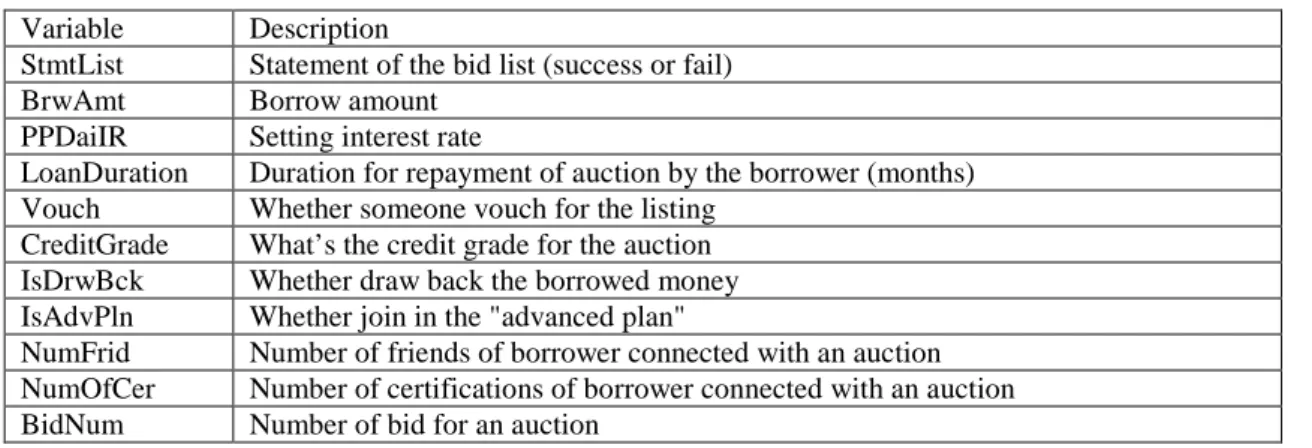
In order to observe successful auction clearly, we regard status of bid list as dependent variable. An interesting thing is that we employ bid number to explore lenders’ herding behavior. More bids on a certain auction may contribute to herding behavior, which has been confirmed by past literature (Herzenstein, Dholakia, et al. 2011; Lee & Lee 2012). Unlike previous researches, we use bid number as a moderator to discuss the relationships between factors and successful auctions, which is an interesting and attractive research question. Key variables are summarized as Table 3.
Variable Description
StmtList Statement of the bid list (success or fail) BrwAmt Borrow amount
PPDaiIR Setting interest rate
LoanDuration Duration for repayment of auction by the borrower (months) Vouch Whether someone vouch for the listing
CreditGrade What’s the credit grade for the auction IsDrwBck Whether draw back the borrowed money IsAdvPln Whether join in the "advanced plan"
NumFrid Number of friends of borrower connected with an auction NumOfCer Number of certifications of borrower connected with an auction BidNum Number of bid for an auction
5
DATA ANALYSIS AND RESULTS
The objective of our research is to analyze online P2P lending behavior. Based on the data collected from PPDAI, we launch an empirically exploration. Since dependent variable is binary factor, we use SPSS 21 to apply logistic and hierarchical linear regression analysis.
In this research, we collected data of PPDAI from January, 2011 to June, 2011. In order to obtain effective data, we selected all of loan requests information which was relevant to our study. The descriptive statistics of key variables is shown as Table 4.
During this period, 7793 unique auctions were used as a big and creditable research sample. Among those data, there were 3091 successful auctions. Hence, exploring successful auctions are quite confident and reliable.
Variable BrwAm t PPDa iIR Loan Durat ion Vouc h Credi tGrad e IsDr wBck IsAdv Pln Num Frid Num OfCe r BidN um N 7793 7793 7793 7793 7793 7793 7793 7793 7793 7793 Mean 5891.66 17.85 6.31 .06 2.50 .09 .22 22.43 3.70 19.59 Median 3300.00 20.00 6.00 .00 2.00 .00 .00 7.00 4.00 16.00 S.D. 8417.96 4.27 3.42 .24 .87 .29 .42 47.59 1.04 21.09 Min. 3000 0 1 0 1 0 0 0 2 0 Max. 200000 25 12 1 6 1 1 559 5 323
Table 4. Descriptive statistics of key variables
We use hierarchical linear analysis to discuss P2P lending behavior. In this research, we contain 3 control variables (Gender, Age, IsMarry) to eliminate any other interference factors. In model 1, we only include control factors to examine the control effect. In model 2, we add independent variables to test the fit of model and independent effect. In model 3, moderator is employed to verify the fit of whole model. For the last model, we include interaction effect of moderator and independent variables to examine the moderating effect.
Table 5 represents the results of statistics analysis when statement of bid list acts as dependent variable. Since the dependent variable is binary factor, we use logistic regression analysis to explain the relationships. In model 1, all of the control variables are significant. It means those control factors behave well to represent other interference effect. Model 2 reveals that independent variables perform well in describing the statement of bid list. In Model 3, we introduce moderator into regression equation and find good fit of model.
In model 4, most of the effect of independent variables and moderator are significant except borrow amount and “IsDrwBck”. For lenders, they provide capital support just to make sure that borrowers can return back no matter whether they change the status of funding. So, hypothesis 1 and hypothesis 8 was rejected. Secondly, if we observe the coefficients of borrow amount, interest rate and loan duration, we will find all of the factors in motivation with deliberate processing have negative effect to the success of bid, although the effect of borrow amount is not so significant. That is to say, hypothesis 3 is supported while hypothesis 2 send reverse signal. We may be curious about the result of hypothesis 2, which may be different from Lee and Lee (2012).Why does this interesting thing happen? In actually, higher interest rate is good for lenders but harmful to borrowers. The higher interest rate borrowers set, lenders will be more likely and happier to provide their money, but it may be not the same for borrowers. We explore the raw data in detail, and find there are 1157 auctions returned back by borrowers which accounts for 24.6% failed listings. Borrowers may feel stressful for higher interest rate after they put bids on website so that they draw back the bid lists. Besides, in this research we suppose all the lenders are rational and reasonable to some degree. The extremely high interest rate may send a reverse and uncertain signal to lenders so that they don’t support bid lists. And we collected date from PPDAI which reveals that Chinese lenders’ behavior may be different and unique from other country. Those reasons may explain the negative effect of interest rate. Thirdly, we investigate the coefficients of vouch, credit grade and IsAdvPln, and notice that all of these factors
about the hygiene facets with deliberate processing are quite positive and signification to the successful actions. These conditions support hypothesis 5, 6, and 9. Finally, for the last two variables, the coefficients of number of verified certifications and online friends are also positively significant which support hypothesis 4 and 7, which is consistent with some past literature (Lee & Lee 2012; Lin et al. 2013). MODEL 1 Nagelkerke R2=0.069 MODEL 2 Nagelkerke R2=0.530 MODEL 3 Nagelkerke R2=0.561 MODEL 4 Nagelkerke R2=0.573 Variabl es B Sig. Variab les B Sig Variab
les B Sig Variables B Sig Gender 0.221 0.002 Gender 0.406 0.000 Gender 0.381 0.000 Gender 0.364 0.000 Age 0.414 0.000 Age 0.120 0.017 Age 0.127 0.013 Age 0.126 0.015 IsMarr y 0.496 0.000 IsMarr y 0.240 0.001 IsMarr y 0.259 0.000 IsMarry 0.259 0.000 Consta nt -1.559 0.000 BrwA mt 0.114 0.005 BrwA mt -0.133 0.002 BrwAmt -0.088 0.081 PPDaiI R -0.519 0.000 PPDaiI R -0.449 0.000 PPDaiIR -0.404 0.000 LoanD uration -0.186 0.000 LoanD uration -0.163 0.000 LoanDurat ion -0.149 0.000 Vouch 1.282 0.000 Vouch 1.604 0.000 Vouch 1.412 0.000 Credit Grade 1.474 0.000 Credit Grade 1.325 0.000 CreditGrad e 1.355 0.000 IsDrw Bck -0.511 0.000 IsDrw Bck -0.254 0.035 IsDrwBck -0.176 0.168 IsAdv Pln 0.387 0.000 IsAdv Pln 0.300 0.000 IsAdvPln 0.300 0.000 NumFr id 0.343 0.000 NumFr id 0.342 0.000 NumFrid 0.352 0.000 NumO fCer 0.431 0.000 NumO fCer 0.355 0.000 NumOfCer 0.304 0.000 Consta nt -4.951 0.000 BidNu m 0.780 0.000 BidNum 1.863 0.000 Consta nt -4.629 0.000 BrwAmt_ BidNum -0.006 0.703 PPDaiIR_ BidNum -0.246 0.000 LoanDurat ion_BidNu m 0.151 0.001 Vouch_Bi dNum -1.158 0.000 CreditGrad e_BidNum -0.313 0.000 IsDrwBck _BidNum 0.210 0.267 IsAdvPln_ BidNum -0.226 0.012 NumOfCer _BidNum -0.215 0.002
NumFrid_ BidNum -0.059 0.277 Constant -4.647 0.000
Table 5. Status of bid list as dependent variable
Comparing with model 3 and model 4, we find “Nagelkerke R square” increase that reveals there is moderating effect existing. Moreover, we find bid number behaves well in most relationships except the borrow amount, “IsDrwBck” and number of friends. The more bids on an auction, the stronger herding behavior. Number of bids send a signal that how many people are confident in an auction. Table 6 concludes the related result. When more people bid on current auction, other lenders’ influence becomes much more important. At this time, the influence of higher interest rate resulting in lower success rate eliminates. More people’s bids behavior seems a visible assurance. It will weaken the original guarantee condition, such as vouch status, credit grade and number of certifications. Besides, more bids on an auction will promote the relationship of shorter duration contributing to successful auction. That is to say, although there is strong herding behavior, people are still concerns about loan duration.
Borrow amount (BrwAmt)
- PPDAI interest rate (PPDaiIR) *** + Loan duration (LoanDuration)***
Number of friends (NumFrid)
- Vouch status (Vouch) *** - Credit grade (CreditGrade) ***
Whether draw back borrowed money (IsDrwBck)
- Whether join in “advanced plan” (IsAdvPln) ***
- Number of certifications (NumOfCer) ***
Note: *** means significant moderating effect; “+” represents positive moderating effect, “-” represents negative moderating effect
Table 6. Moderating effect between StmtList and independent variables
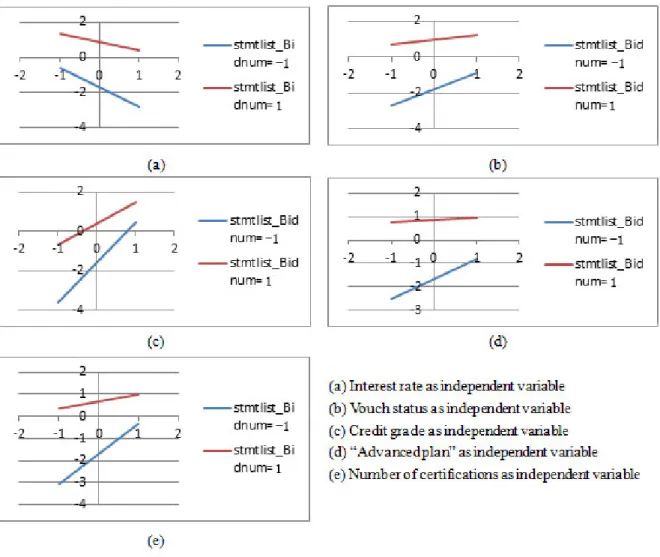
In order to understand moderating effect more explicitly, we introduce Figure 2 to analyze the moderating effecting between independent variables and dependent variable. First of all, we make all the independent variables and moderator be standardized to simplify the calculation process. As a sample evaluation, we will investigate when bid number changes (average ± standard deviation), what will happen on those variables. In specific, the variables BrwAmt, IsDrwBck and NumFrid are removed from the analysis since those factors are insignificant on dependent variable. Secondly, we establish logistic regression analysis on every significant variable. However, we found the fit of model for loan duration can’t reach the standard so we exclude the analysis of this one.
Figure 2 (a) represents the relationship of interest rate and status of bid list when bid number reach different level. We can find that large interest rate results in less possibility of biding on auction. When more people bid on auction, the influence of higher interest rate resulting in lower success rate eliminates. Figure 2 (b)-(e) shows positive relationship between independent variables and dependent variable which is consitent with above discussion. Figure 2 (b) to (e) reveals when more people bid on an auction, the affect of vouch status, credit grade, advanced plan and number of certifications on “StmtList” weakens. When more people bid on auction, the efficacy of original promise (i.e., vouch, credit grade, number of certifications) recedes. The influence of advanced plan also acts in a similar way. Although we introduce same level of bid number to test moderating effect, different variables shows different sensitivity. Especially, we notice the dependent variable is a binary factor, so we just use Figure 2 to describe the tendency of dependent variable when independent variables change.
Figure 2. Moderating effect between independent variables and StmtList
6
DISCUSSIONS AND CONCLUSIONS
In conclusion, this research concentrates on lenders’ behavior of peer-to-peer lending marketplaces. This is very important for analyzing lender’s decision making process, during which we can summarize some useful implications from the empirical research results.
Generalizing the statistics analysis, we can find most of hypotheses are supported except hypothesis 1, 8, while hypothesis 2 behaves significantly negative. We can find all the factors in hygiene dimension are positive no matter they are significant or not. In actual, we categorize information about risk into quadrant 3 and 4. All those factors will not directly increase lender’s benefit, but it deliver guarantee and confident to lenders for attracting more bids. So borrowers should introduce more credit guarantee for bids and borrowers themselves to make lenders believe the bids are safe enough.
There are also some contributions in this research. The first contribution of this article is to establish a systematical framework to analyze every auction information, with which we extent our research to a new field. If we look into the data analysis explicitly, we will find most of the coefficients of significant deliberate processing factors are bigger than intuitive processing factors. That is to say, for lenders’ decision making, the former variables are more influential than latter ones. Actually, when lenders get enough information to make choice, they will rely on deliberate thinking instead of just making intuitive judgment. The specific information of an auction is more important than borrower’s characteristics to a large degree. It sends a signal to borrowers that setting good and appropriate conditions of an auction is much more important than obtaining other credit certifications. Secondly, we also find the hygiene variables behave strong positive effect which is consistent with above discussion. Just as mentioned above, we labelled information about credit quality which connected
with risk as hygiene factors. With those factors lenders will be more confident in making decisions. It represents the credit of auctions and borrowers. Therefore, hygiene variables send positive signals to lenders. Finally, we employ bid number as moderator to explore influence in P2P lending behavior which hardly emerged. Most of the moderating effect is significant. With more people bid on auction, potential lenders will obtain a creditable signal to be more likely lending their money. So, most of the moderating effect eliminates the relationship between independent variables and dependent variable. It reveals that if borrowers get enough bids, potential lenders will participate in the auction more positive since they may ignore some essential conditions.
We can also find some limitations in the current research. First of all, we collect date from PPDAI which may perform unique characteristics. Hence, the generalizability may be limited. Secondly, we capture some typical features in PPDAI which may be not enough. Including more specific information about auctions in the following study is quite significant. Finally, in order to get observable data, we set P2P platform as controllable variable. In the future research, exploring loan behavior of different platforms may give us new inspiration.
References
Aarts, H., Custers, R., & Marien, H. (2008). Preparing and motivating behavior outside of awareness. Science, 319(5870), 1639-1639.
Burtch, G., Ghose, A., & Wattal, S. (2014). Cultural Differences and Geography as Determinants of Online Prosocial Lending. MIS Quarterly, 38(3), 773-794.
Chartrand, T. L., & Fitzsimons, G. J. (2011). Nonconscious consumer psychology. Journal of Consumer Psychology, 21(1), 1-3.
Collier, B. C., & Hampshire, R. (2010). Sending mixed signals: Multilevel reputation effects in peer-to-peer lending markets. Paper presented at the Proceedings of the 2010 ACM Conference on Computer Supported Cooperative Work, Savannah, Georgia, USA.
DeShields Jr, O. W., Kara, A., & Kaynak, E. (2005). Determinants of business student satisfaction and retention in higher education: Applying Herzberg's two-factor theory. International journal of educational management, 19(2), 128-139.
Dhar, R., & Gorlin, M. (2013). A dual-system framework to understand preference construction processes in choice. Journal of Consumer Psychology, 23(4), 528-542.
Djulbegovic, B., Hozo, I., Beckstead, J., Tsalatsanis, A., & Pauker, S. G. (2012). Dual processing model of medical decision-making. BMC medical informatics and decision making, 12(1), 94. Duarte, J., Siegel, S., & Young, L. (2012). Trust and Credit: The Role of Appearance in Peer-to-peer
Lending. The Review of Financial Studies, 25(8), 2455-2483.
Epstein, S. (1994). Integration of the cognitive and the psychodynamic unconscious. American Psychologist, 49(8), 709.
Evans, J. S. B., & Stanovich, K. E. (2013). Dual-process theories of higher cognition advancing the debate. Perspectives on Psychological Science, 8(3), 223-241.
French, E. B., Metersky, M. L., Thaler, D. S., & Trexler, J. T. (1973). Herzberg's two factor theory: Consistency versus method dependency. Personnel psychology, 26(3), 369-375.
Furnham, A., Forde, L., & Ferrari, K. (1999). Personality and work motivation. Personality and individual differences, 26(6), 1035-1043.
Galak, J., Small, D., & Stephen, A. T. (2011). Microfinance Decision Making: A FieldStudy of Prosocial Lending. Journal of Marketing Research, 48(SPI).
Gerrard, M., Gibbons, F. X., Houlihan, A. E., Stock, M. L., & Pomery, E. A. (2008). A dual-process approach to health risk decision making: The prototype willingness model. Developmental Review, 28(1), 29-61.
Gonzalez, L., & Loureiro, Y. K. (2014). When can a photo increase credit? The impact of lender and borrower profiles on online peer-to-peer loans. Journal of Behavioral and Experimental Finance, 2(0), 44-58.
Greiner, M. E., & Wang, H. (2010). Building consumer-to-consumer trust in e-finance marketplaces: an empirical analysis. International Journal of Electronic Commerce, 15(2), 105.
educational setting. The Journal of Psychology, 120(6), 613-626.
Herzenstein, M., Dholakia, U. M., & Andrews, R. L. (2011). Strategic herding hehavior in peer-to-peer loan auctions. Journal of Interactive Marketing, 25(1), 27-36.
Herzenstein, M., Sonenshein, S., & Dholakia, U. M. (2011). Tell me a good story and I may lend you money: The role of narratives in peer-to-peer lending decisions. Journal of Marketing Research (JMR), 48, S138-S149.
House, R. J., & Wigdor, L. A. (1967). Herzberg's dual‐factor theory of job satisfaction and motivation: A review of the evidence and a criticism. Personnel psychology, 20(4), 369-390. King, N. (1970). Clarification and evaluation of the two-factor theory of job satisfaction.
Psychological Bulletin, 74(1), 18.
Lee, E., & Lee, B. (2012). Herding behavior in online P2P lending: An empirical investigation. Electronic Commerce Research and Applications, 11(5), 495-503.
Lin, M., Prabhala, N. R., & Viswanathan, S. (2013). Judging borrowers by the company they keep: Friendship networks and information asymmetry in online peer-to-peer lending. Management Science, 59(1), 17-35.
Lundberg, C., Gudmundson, A., & Andersson, T. D. (2009). Herzberg's two-factor theory of work motivation tested empirically on seasonal workers in hospitality and tourism. Tourism Management, 30(6), 890-899.
Park, S. C., & Ryoo, S. Y. (2013). An empirical investigation of end-users’ switching toward cloud computing: A two factor theory perspective. Computers in Human Behavior, 29(1), 160-170. Schwab, D. P., & Heneman, H. G. (1970). Aggregate and individual predictability of the two-factor
theory of job satisfaction. Personnel psychology, 23(1), 55-66.
Simonson, I., & Tversky, A. (1992). Choice in context: Tradeoff contrast and extremeness aversion. Journal of marketing research.
Soliman, H. M. (1970). Motivation-hygiene theory of job attitudes: An empirical investigation and an attempt to reconcile both the one-and the two-factor theories of job attitudes. Journal of Applied Psychology, 54(5), 452.
Sonenshein, S., Herzenstein, M., & Dholakia, U. M. (2011). How accounts shape lending decisions through fostering perceived trustworthiness. Organizational behavior and human decision processes, 115(1), 69-84.
Stanovich, K. E., & West, R. F. (2000). Individual differences in reasoning: Implications for the rationality debate? Behavioral and Brain Sciences, 23(5), 645-665; discussion 665-726.
Yum, H., Lee, B., & Chae, M. (2012). From the wisdom of crowds to my own judgment in microfinance through online peer-to-peer lending platforms. Electronic Commerce Research & Applications, 11(5), 469-483.