Chapter 5 Case Study Fieldwork
Introduction
This chapter reports the research findings relating to how the e-commerce (EC) systems of the large multinational company collaborating in this case study are organised, how they impact (and are anticipated to impact) upon its business operations, and upon the supply chain. In particular it will focus upon the introduction of the electronic mall (an Internet-based system) and upon the issue of intermediation within this context. Also considered are the factors affecting customer adoption of the mall: the main inhibitors and drivers of this process. This is followed by a discussion of the role of the manufacturer in providing support and encouraging adoption of EC.
The qualitative approach generates descriptive data relating to perceptions, attitudes, beliefs, and behavioural characteristics of respondents and their associates. Within an organisational setting, I interviewed managers about their opinions and perspectives on issues relating to their own role in the organisation, and to the company’s relationship with its business partners. The objective of the qualitative analysis presented in this chapter is to interpret these fieldwork data and pick out evident key themes or patterns.
It was found that respondents anticipated that EC would greatly affect communications and transactions taking place between the supplier, its intermediaries, and its customers, and also the activities or functions that each partner is expected to carry out. They anticipated benefits in terms of time and cost savings for their own organisation, and in terms of the provision of information to their customers. However, they also articulated potential problems that suggest that some partners might be reluctant to adopt EC.
The chapter is organised as follows: the next section presents a background on the company, section two considers e-commerce policy, section three describes the operational methodology for the study, section four presents the findings, and section five draws some conclusions from these findings.
5.1 Background on the Company
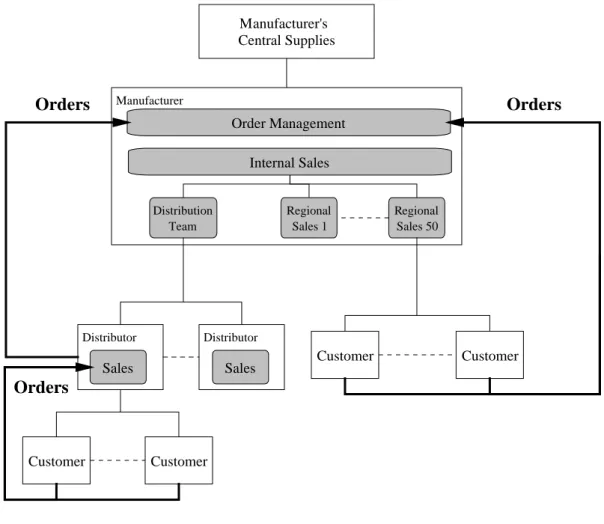
The company make a large range of products to equip factories with Industrial Automation equipment. It is part of a large multinational, based in the UK and with some manufacturing facilities in the UK, but having a European stocking policy where all stock is held centrally and shipped from there all over Europe. The market is exclusively business-to-business, where their end customers are other manufacturing companies. As shown in Figure 5-1, the company has a large number of independent distributing companies (distributors) who hold inventory in the UK, covering every region of the UK with their local branches and servicing the many smaller customers. The distributors also stock the products of other manufacturers. The company also has thousands of direct customers who are supplied directly from the central European store. Mostly these are larger companies. The company has a differential pricing strategy, which is governed by market price conditions and business volumes.
Manufacturer Manufacturer's Central Supplies Order Management Internal Sales Distribution Team VIA DISTRIBUTION DIRECT CUSTOMERS Regional Sales 1 Regional Sales 50 Distributor Customer Sales Customer Customer Customer Orders Orders Orders Distributor Sales
Figure 5-1: Market structure. Heavy lines show the flow of orders and normal lines show the market relationships (representing all other kinds of information flow).
Customer Services (CS) consists of the two separate departments of Internal Sales and the Order Management, although it also works closely with small teams from the areas of finance and from e-commerce. The Internal Sales department consists of a team of people responsible for assisting the distributors, plus a team of people working with the regional sales engineers. Regional sales engineers are each responsible for managing a number of direct customer accounts. The Order Management department is the area where customer orders are processed and issues arising from the delivery process are resolved. There is frequent contact between the department and the regional engineers.
The traditional role of the distributor, is to service customers by providing local stock and local engineers for a quick delivery and service, and specialised knowledge in different product areas. The benefits they give to the manufacturer include the ability to accept credit card payments, breaking bulk and cost effectively supplying the smaller customers, willingness take the financial risk of dealing with those customers, and having a local sales force which acts as a multiplier of their products (thus reaching customers that otherwise they would not).
There are two main business objectives that are of concern to the research project. One of the company objectives is to increase the volume of sales through distributors. The company believes that there are too many direct customer accounts, some of which, from the manufacturer’s point of view, are not economical to take on as direct accounts. The referrals policy aims to transfer these small or medium-size direct customers through to deal instead with distributors. In addition, the manufacturer must persuade the distributors to increase their business volumes correspondingly.
Secondly, there is an e-commerce initiative. The company is currently undergoing an ‘e-business transition’ process, which involves business process reengineering in order to better take advantage of the new opportunities presented by e-business. This includes improving internal business processes to increase efficiency, and extending e-commerce systems to suppliers and customers to improve trading relationships and gain strategic benefits.
As the initiator of the technological change, it is essential that the manufacturer set up processes to effectively manage the customer and distributor adoption of EC. It appears that this is in fact what they are already doing: carrying out customer readiness surveys, publicising and putting forward EC to their distributors, and having a dedicated e-business team.
Electronic Data Interchange (EDI) is one well-established e-commerce technology that the company has been using with its partners (some distributors and some large customers) for a number of years. The focus now is on providing e-commerce to the rest of the partners through use of Internet-based EDI. The advantages of the Internet EDI compared to traditional EDI are that it is cheaper to adopt, more widely used and compatible with other companies’ systems, and more flexible with regards to the kinds of information that may be shared.
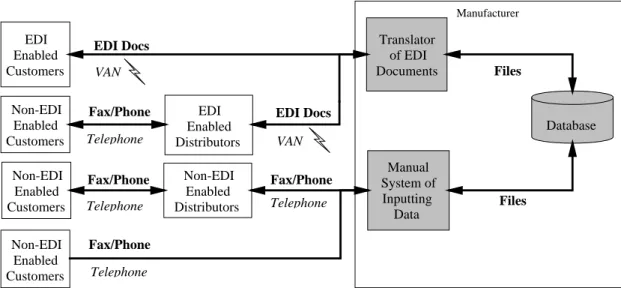
EDI Enabled Customers Manufacturer Translator of EDI Documents Manual System of Inputting Data Database Files Files VAN EDI Docs Non-EDI Enabled Customers Non-EDI Enabled Customers EDI Enabled Distributors Non-EDI Enabled Distributors Non-EDI Enabled Customers Fax/Phone Fax/Phone Fax/Phone VAN Fax/Phone Telephone Telephone Telephone EDI Docs Telephone
Figure 5-2: Current information infrastructure. Type of document is shown in a bold font; transmission media is shown in italics.
Figure 5-2 shows the current information infrastructure. Customers on the left are divided into those with EDI facilities and those without. EDI documents are traditionally transmitted directly over a Value-Added Network (VAN), by a number of the larger customers. The EDI documents are then translated into formats suitable for supplier’s internal applications, such as the SAP database system. Non-EDI enabled customers may phone up the supplier and send in their orders by fax. These orders will go either via the distributor’s systems (if the customer has an account with a distributor) or directly to the manufacturer (if the customer has a direct account). Distributors that have EDI systems in place will receive their orders manually, input them into the EDI system, and send them on electronically to the manufacturer. In the
current situation, the manufacturer must maintain in parallel a manual system for receiving and inputting the order data into the SAP system.
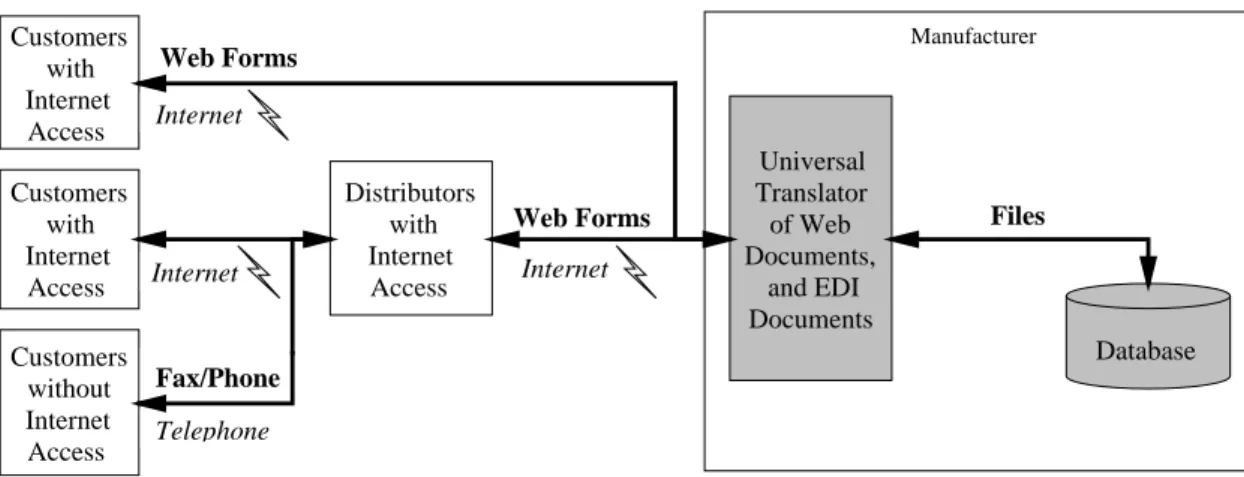
Customers with Internet Access Manufacturer Universal Translator of Web Documents, and EDI Documents Customers with Internet Access Database Files Web Forms Internet Web Forms Customers without Internet Access Distributors with Internet Access Internet Internet Fax/Phone Telephone
Figure 5-3: Proposed information infrastructure. Type of document is shown in a bold font; transmission media is shown in italics.
Figure 5-3 shows an Internet-based system that can be seen as a replacement for all current manual based systems. It consists of a universal translator system that is capable of handling electronic documents of various types, and converting them into a format that suits the company’s systems. The universal translator will convert Internet-based documents such as web-forms, as well as traditional EDI documents. It will be able to generate web pages, will support e-mail messages, and technical data sheet and software downloads.
Customers and distributors that do not currently have EDI will be encouraged to adopt Internet-based EDI. One key component of this strategy is the Electronic Mall, which is designed for, and promoted to, the direct customers. Distributors will also be encouraged to use Internet-based EDI, to link their business systems with both the manufacturer and with their own customers and transfer documents in a variety of formats.
Internet-based EDI is thought by the manufacturer to be a very promising solution for those customers and distributors that have not already adopted traditional EDI because it will allow them to leverage their investments in EDI and achieve widespread use
amongst smaller trading partners. Internet-based EDI lowers these barriers to adoption because distributors can use the public Internet rather than expensive VANs to connect, they can use inexpensive web form translation software rather than traditional EDI standards, and because it is now becoming common-knowledge how to use this technology. The goal of 100% compatibility with EDI may now be achievable, through a combination of traditional EDI for large volume, security-critical document exchange with the larger partners, and small-scale exchange of documents using Internet-based EDI. The estimated benefits of this to the initiator are very high in terms of strategic impact and operational impact.
5.3 Data Collection Methodology
Summarising what was said earlier in section 4.2, the company was contacted through existing links with the university, and a ‘stakeholder’ group was established to oversee the research and provide assistance. The broad objectives, which were agreed between the stakeholders and the researcher, were to address issues within Customer Services relating to the management and development of IOS and e-commerce systems (in particular the electronic mall) and the impact of this technological change upon the supply chain. These questions are detailed further in the case study research design (sect. 4.2.4) and in chapter six.
The interviews were carried out over a total of three days in October and November 2001. They took place with members of the Customer Services department: the Order Management team, Internal Sales, product managers, and finance and e-commerce. In other words we interviewed employees in a variety of positions at the company. Interviews took place with 9 employees in total. The decision as to which employees to interview was taken by the stakeholders: they suggested people who might be worthwhile to speak to, and advised upon the interview questions.
The interviews conducted lasted between 45 minutes and 100 minutes. They were semi-structured but were conducted in accord with a list of interview topics and questions drawn from the literature, and from our preliminary discussions. The
interviews were exploratory in nature, aimed at clarifying issues related to e-commerce and concerning the employees at the company, and their understandings and perceptions of those issues. The methodology used was that described by Yin (1994): having some topics of discussion in mind rather than a fixed list of interview questions, thus allowing a flexible approach to interviewing.
Topics of discussion included: the effect of e-commerce (both traditional and Internet forms) on distributors; the referrals policy; customer adoption of e-commerce; the impact upon the company’s reputation amongst customers; and efficiency gains due to EC. Data were collected using a tape recorder and transcripts were made. The data were thus qualitative in nature, and the ATLAS.ti (2002) software package appropriate for handling such data was used for organising and undertaking a detailed analysis. The remainder of this chapter presents our findings, the emerging patterns that are evident from this qualitative analysis of the fieldwork. Where the interview respondents are quoted, we identify each by a unique code, PX, where X is a number assigned to the individual between one and nine.
5.4 Emergent Themes from the Case Study Fieldwork
A number of themes have emerged from the interview data. It is clear that distributors and customers have a certain amount of reluctance to participate in either the EC programme or the referrals programme, for a variety of reasons. Conflicts of interest do exist, and many different processes of persuasion, negotiation and social influence are taking place. In general, respondents held the view that customers are not so easily influenced by the manufacturer’s point of view, and that the ideology that ‘the customer is always right’ will more often prevail in those negotiations.
“We have got a distributor, a large customer… they demand that their suppliers receive their orders electronically and invoice them electronically. As a customer, they can demand that of us if we are the supplier, but we can't demand that our customers use the electronic means to order from us.” (P6)
“You can go to a distributor and explain your rationale, but they might turn round and say ‘You don't own me…I've got my own company and sales guys and this is what I am going to do.’” (P2)
However, this statement may not necessarily articulate the whole truth about the power relation between manufacturer and distributor. There are conflicting accounts where respondents have suggested that distributors are sometimes seen as partners that can be coerced or pressurised into accepting a change:
“I think they do realise that we are in the fortunate position that we can insist that the distributors place their orders electronically. I am talking specifically about distributors where we have more of a partnership and can perhaps dictate or we are in a much better bargaining position. They are selling the product on for us.” (P8)
The ability of the manufacturer to dictate terms or to have more influence over the distributor is obviously greatest in the case where they are their only supplier or their largest supplier, and where switching suppliers is difficult or expensive to carry out. For customers it is normally not so difficult to switch manufacturer, and this is perhaps why the ‘customer is always right’ attitude prevails.
There are a lot of interactions between the company and it’s customers and distributors, involving the sales engineers going to the premises of the customer and meeting face-to-face. Also the e-business team get involved at some stage. These occasions allow plenty of opportunities for social influence processes to take place.
“[The company] … seems to be very supportive of its customers. They are very good at going in and assisting at setting up, and giving any training that is required and explaining what the advantages are of going on the electronic systems.” (P5)
“We have got quite a good relationship with our distributors, and a dedicated distribution team. It is basically their job to go out and make sure that all the benefits are understood.” (P1)
5.4.1 Drivers and Inhibitors of Electronic Commerce Adoption
Other empirical studies (summarised in Riggins (1999)) have suggested that large suppliers or buyers, as initiators of inter-organisational systems (IOSs), have the most to gain from the network, but that they also carry large risks. Trading partners might not adopt the system (adoption risk), or if they do choose to adopt, satisfactory implementation may not be carried out within the trading partners’ own internal systems, and so the full benefits may not be realised (implementation risk). This adoption risk might be down to the lack of ‘technological readiness’ of the partners. As our respondent explained, some distributors don’t have the required in-house knowledge and expertise to use the new systems:
“I do find that the amount of IT support in many of these quite substantial companies I would of thought represents quite a risk. But until they are able to actually carry out the developments then they will find it difficult to participate.” (P6)
In terms of the organisation of the partners as well, some don’t think that they need to have electronic commerce facilities and are therefore reluctant to change.
“Taking an extreme case, one company still has a cardex system and one PC which is connected to the Internet. If people want to use it they have to go outside, cross the road and go into another building then they are obviously not that interested in e-commerce.” (P1)
In addition to the lack of organisational and technological preparedness, another inhibitor among the partners is the lack of knowledge about e-commerce and misperceptions about its nature. In the discussions they are having, the manufacturer has identified the most promising selling points of the technology, and is trying to put them to the partners:
“It has got some unique selling points in that it is instantaneous, it doesn't need any human contact so there are no telephone queues and it is useable when you want it. It has got unique features. You can track your order, to see where it is up to, before you
have ordered you can see what the availability of products are. You can see what prices are there, prices are updated smoothly and quickly.” (P1)
“Lets say a customer wants data sheets on particular products we can send them electronically now. The Internet has helped a lot in that respect, because they can get their own information, they don't have to ring up and then wait for a catalogue to come through the post.” (P7)
“Of course, we are only operational from 8.30 until 5 I think so if they [distributors] want to know if a product is available at 7.30 in the morning, they can do that. They can also track their own orders. If a customer calls them at 8 o'clock in the morning, because many of them are open from 7, then they can go onto the mall and track their own order.” (P6)
At the same time as stressing the good points about the technology, the manufacturer is trying to play down the disadvantages. The main disadvantage is that there are potential difficulties in integrating the e-commerce technology with the internal systems of customers. If the customer is using manual systems or other systems that do not interface with the e-commerce system of the supplier, then it means that the onus is on the customer to do extra work in keeping different systems all up-to-date:
“To me any e-commerce solution that passes work back and makes somebody do any more than they previously did under a manual basis or other system, is a retrospective step and is one which is going to be difficult to sell to your customer.”
(P1)
This aspect is likely to be perceived by the customer as a negative of e-commerce.
“E-commerce is seen as if you are just pushing the workload back. Someone, somewhere has got to do some work to get the information on the system. What we are saying to them is ‘Well, we used to do it with this, now you do it and save us time, and pass it through to us electronically’”. (P1)
“If they place orders on the mall, can they then track people who they sold those products to and order those various reports which would fit within their own business systems, or are we asking them to do something in addition and asking them to duplicate? If I was a distributor, I would want it to fit in with my system as well.” (P4)
Other technological disadvantages are that there is a perceived security risk of doing business over the Internet, and that for some of the partners it would be expensive (or it is perceived to be expensive) to set up and maintain the new system.
These perceived inhibitors of e-commerce might well be compounded by a distributor’s concern about the risk of being disintermediated. Theoretically, the electronic mall represents an alternative kind of distribution channel from which customers could order directly from the manufacturer, or through an electronic third-party intermediary.
“I think there is a certain amount of concern and worry within the distributors at the moment because at a very basic level they see something like the electronic mall as replacing them.” (P1)
This idea could make the distributor very wary of participation in electronic commerce and give him a negative attitude towards it. Distributors might find it difficult to support such an initiative, if they believe that it threatens their own role.
On the other hand, distributors might see it as an opportunity rather than a threat. One type of knowledge that would appear to influence the adoption decision is the idea that EC could become an industry-wide standard. If all a company’s customers and suppliers are using it, then it obviously becomes a more valuable proposition, both in terms of operational and strategic value. In general, traditional EDI did not achieve this widespread acceptance (because of reasons already mentioned) but it is believed that the Internet has the potential to reach a large proportion of industry. The following responses revealed that there might well be a growing perception of the ubiquity of EC that could be decisive for customer and distributor acceptance:
“I don't think at the moment it is a massive benefit to them but they know that everything is moving towards e-commerce and the mall. So it means that they are staying on par with us and moving forward with us.” (P3)
“In their day-to-day working life, e-mail, the Internet has made them realise. It just takes one of them to realise that they are not on there and someone else is and you can bet your life, no matter how small or large, that they get someone in there, because they realise that they are going to get left behind.” (P8)6
To summarise, we have uncovered a number of different attitudes towards e-commerce that drive or inhibit adoption. We have identified the three main inhibitors: lack of technological and organisational preparedness; uncertainty about whether the benefits of e-commerce outweigh the costs; and, for distributors, concern that they will be disintermediated. The drivers are all the information benefits already mentioned: greater data accuracy, more efficient processing, 24-hour availability of the system, automated order tracking, price and availability information, the ability to download technical information and datasheets, and also the expectation that EC will achieve widespread acceptance.
5.4.2 Incentives Offered by the Initiator and the Mandate-of-Adoption Policy
One important manufacturer strategy for persuading trading partners to adopt is to offer subsidies. This is the level of support with EC they may receive from the manufacturer in terms of funding for equipment, technical assistance with setting up and training in use of the system. In addition to the technical support, the manufacturer is also willing to offer a financial incentive to those distributors that are prepared to go along with their initiative:
“We are starting to incentivise them by giving them an extra percent [of discount] if they can trade with us electronically.” (P8)
6
Note that this observation appears to support a counter argument to the one previously discussed. Here we have the threat of disintermediation acting as a driver for adoption rather than as an inhibitor!
“Maybe it's a case of [us] having to invest in those distributors and give them the tools they need to be able to trade with us electronically and get on board with the email, conferencing training things that we are going to do.” (P8)
“It may be a case of getting somebody to get in his car and go round and see everybody and promote it and say ‘this is how to do it’ and get people in there and help customers set it up because they haven't always got the resources to put time into setting it up at their end.” (P7)
Another strategy that has been known to be used by the initiator of an IOS is the mandate-of-adoption policy. This forces the partners to agree to adopt if they want to carry on the business relationship with the initiator. The consequences of this policy are that it might fail if enough of the trading partners are not in a position, technologically in terms of their compatibility with the new system, or financially in terms of the cost/benefit analysis (particularly for the smaller firms), to comply. The mandate may or may not include some financial incentives. An outcome of 100% adoption of the IOS is a very favourable one for the manufacturer because then they would not need to maintain manual systems for sales and order processing in parallel with e-commerce ones.
“I think that we are making it clear that two years down the line, that we would expect to receive, certainly from our distributors, orders electronically.” (P8)
“Certainly a number of our distributors are very enthusiastic and prefer to use that [the electronic mall] rather than other means. Its different strokes for different folks, some like it and some don't. They are our customers and you can't force them to do that.” (P6)
There seemed to be a difference of opinion as to whether or not the manufacturer would go down the path of mandate-of-adoption. It is probably something that they are still in the process of deciding. What is certain is that they want to replace many of the old and inefficient manual processes, and that e-commerce will become the preferred way of doing business with their distributors. The company expects more
and more distributors to start using their e-commerce systems, whilst offering substantial support subsidies and financial incentives to enable and encourage them to do so. At some point in the future, they may be in a position to mandate the adoption.
Although they do have less influence over customers than distributors, one possible option would be to refer those customers that do not wish to adopt to deal via one of the distributors. Since distributors service very many small customers, it is likely that they will continue to use manual systems with their customers.
5.4.3 The Role of the Distributor and the Likely Impact of E-commerce
Despite the concerns of distributors and their reluctance to adopt, there is no doubt that e-commerce the will have a big impact on the nature of their role. Not only do they offer discounts on the list price to their customers, but they also play an important role in providing a local service. There are two aspects to this service. The first is the ability to provide fast replacement parts from their stock, and the second is the local availability of technical support. Both of these aspects provide great benefits over the direct service. However, our respondents raised questions concerning distributors technological competence, indicating that the level of service is very variable amongst different distributors:
“Some of our distributors are much better than others: some are more technically competent. They employ the right people with the right backgrounds and training. At this moment in time I have some reservations about the ability of some of our distributors to serve our customers in the way we would like.” (P4)
The provision of local service and expertise is the main reason why distributors will still have a role in the supply chain, after the transition to Internet e-commerce. The manufacturer cannot supply directly to those customers ordering through the electronic mall, because it is not economical for them to do so. In fact, as we have seen, the company wants, through referrals, to increase the volume of sales through distributors.
“We have a policy within control systems of referring customers through local distributors. We prefer the customers to buy from the distributor. There are too many customers out there to be able to deal directly.” (P7)
“I believe our decision was that we ought to maintain our distributors and develop them as part of [our] business because they do add value. I think they are happy with that now.” (P4)
However, the company admits that they probably have too many distributors, and that they do expect more added-value from its distributors, rather than functioning as ‘box-shifters’ that merely hold inventory.
“What we are saying to the distributors is "You are fighting over small pieces of business, and what you need to do is make sure you can differentiate yourself and bring something extra that perhaps some other distributors can't.”” (P8)
The manufacturer expects distributors to offer value-added service not only in terms of having e-commerce facilities themselves, but also by linking their systems with those of their end customers. Distributors can also add value in the eyes of the manufacturer by establishing a more proactive sales force (selling a complete basket of the company’s products as well as services), by bringing technical expertise in specialist areas, or by developing better stock management systems (using e-commerce technology):
“They are providing technical information that maybe we are not experts in, they are providing added value, such as stock management. Which is something that the mall could never give you in a million years.” (P1)
As discussed in the section above, there was a mixed reaction to whether or not there was ultimately a role for non-EC distributors. However, if distributors decide not implement EC systems or offer any other kind of value-adding service, then they may start to lose business to their competitors and run the risk of being shut out of the supply chain:
“A quote I have heard in the past that's been said to our distributors is ‘if you are no more intelligent than the click of a button, then why do we need you?’” (P1)
“I think what you might see is the number of franchise distributors reducing, the ones that are smaller or not prepared to be anything more than a box shifter.” (P1)
Although this issue is not an immediate worry for distributors – Internet-based e-commerce has not made any significant impact yet, and the company is in the process of referring many of its direct accounts through the distributors – the evidence suggests that the company in the long-term expects its distributors to stay up-to-date with these value-adding systems:
“There will always be box-shifters because we do need them and we do want to sell more and more through distribution but I think we are going to have to specialise in areas at some point.” (P1)
“I think that eventually, and maybe it will be as soon as twelve months time, we might start saying to the distributors ‘we are not going to accept your order, unless it is electronic’, so it won't be a case of having to channel the fax orders, the telephone orders. It won't be an issue. I think the issue will be: trade with us electronically or your days are numbered.” (P8)
The company will refer business preferentially to those distributors that meet these expectations:
“It is quite important in encouraging our distributors that we provide referred business.” (P6)
Our respondents anticipated that a combination of factors including: incentives offered, increasing competition and the threat of disintermediation, would be strong enough to motivate many distributors to re-evaluate their role and offer more value-adding services. There is quite a clear and candid message emerging from this study: if the distributors are not, in the eyes of the manufacturer, seen to be developing their
systems to accommodate e-commerce facilities or to be bringing consultancy expertise in some technologically specialised area, then they are at risk of losing their place in the supply chain.
We can identify two trends facing distributors in the near future: the trend towards more business through distribution (by means of increasing the business volumes of each distributor, rather than increasing the total number of distributors) and the trend towards reduced margins for the distributors. In the first case, growth of sales will depend upon the willingness of distributors to invest in holding more stock (which represents a risk), and on the willingness of customers to go through distribution, which may involve changing their status from that of a direct customer to being serviced by a distributor. It will depend also on the market conditions: our respondents assert that there is a market shift taking place in customer demand towards their products, but that the overall size of the market is steady.
Distributors’ margins are expected to go down, and there are two reasons for this: the situation of a referred account is different to that of an account brought by the distributor because the former is one into which the manufacturer has put all the effort. The manufacturer may have built up a relationship with that customer over a number of years, and would therefore feel that they deserve a larger share of the profits from that business.
Indeed, with technological developments such as the mall, the manufacturer may in future play a larger role in the transaction. If the customer’s initial point of contact was via the mall, this channel could provide a great deal of technical information, orders could be placed and tracked, and payment could accepted in future on the mall. The account need only be transferred to the distributor for delivery and after-sales service.
The second reason for reduced margins is that there is increasing competition in the market for industrial automation products in general, and amongst distributors in particular and a distributor can only win new business by competing with other distributors.
5.4.4 The Impact of E-commerce on Efficiency Gains and Productivity
This section mainly discusses the effect on productivity for the manufacturer, but since this also implies changes for the distributors and customers, these will also be mentioned at the end of the section. The use of EDI (primarily by distributors, but by a few customers as well) has resulted in productivity gains in several areas. It has reduced the workload for the manufacturer in at least three ways. Firstly, with EDI the data are entered into the system at the distributor end, and are then automatically checked when they reach the supplier and can be processed immediately.
“The kind of orders we get can be between 100-200 line items on an order. You can imagine how long it would take us in CS to sit and input 200 line items. That is how we used to work. But then, EDI came along, so now the majority of distribution input the data for us and electronically send it to us. To me, EDI is fabulous because it has freed up so much of our time.” (P3)
“It is certainly true to say that if a normal order comes in, it will take us 8-10 minutes to process, whereas an EDI order takes us two minutes to process. We get a clear efficiency gain there, absolutely clear, and that is just in time of ordering.” (P1)
This has reduced the amount of manpower required to process orders: as a result of the introduction of EDI, the same number of staff have been able to process a much larger volume of orders.
Secondly, EDI document formats reduce the likelihood of errors appearing in orders, which normally require a lot of time and effort to rectify:
“It saves time for people like me because I end up having to phone up [the supplier] and argue about who is paying the cost, they have got this product they don't want back and we don't want it because the wrong one has been delivered. The benefits of going to EDI, you can't count them. It's fantastic.” (P1)
Finally, the production of electronic invoices has reduced the amount of paperwork required. Manually raising an invoice, printing and sending it in an envelope, and then filing a copy of every document is a very time-consuming process.
“The invoices are electronic so that has saved on resources because of the volumes of invoices that are handled for the distributors. What normally happens is they are printed off somewhere here and there is a lady who sits and folds them up and puts them in envelopes. So her job has probably halved with all the electronic invoices. (P5)
The expected efficiency gains from the electronic mall include all of those mentioned above. It is aimed at improving productivity in communication processes with the remaining majority of direct customers, specifically those that have not already adopted EDI. It should greatly reduce the number of telephone price and delivery enquiries, and telephone order status enquiries because this information will be available through the mall. It will reduce the product data input on the part of the manufacturer (they only have to input it once, and then it is on the whole system) and it should reduce the workload in producing quotation documents. There should also be fewer queries over wrong part numbers, because the system will not allow customers to enter the wrong numbers.
“I do know that that the mall system is going to have availability for distribution and allow them to track orders themselves. When the distributors do have that information on their systems, then that will free up our time because they can check it themselves.” (P3)
There are other anticipated benefits from the mall, process improvements that also benefit the customers: faster order processing times, fewer mistakes in orders, automatic converting of quotations into orders, the availability of up-to-date price information, improved product information, and discount and special deal information. These are therefore good selling points for the technology:
“It has got some unique selling points in that it is instantaneous, it doesn't need any human contact so there are no telephone queues and it is useable when you want it. It
has got unique features. You can track your order, to see where it is up to, before you have ordered you can see what the availability of products are, and these would all take phone calls usually.” (P1)
“If we are going to try and make the system useful, and convert quotes into orders if the customer wants to do that, rather than go through the step of processing all the line items again it would be nice if the customer could pick the quotation number up and say, press a button, and it convert into an order without having to tap all of the lines in.” (P5)
“[Since the introduction of EDI systems]…queries tend rather to be about discounts for customers, special deals, negotiated information passed through from the field, than whether the list price is right or wrong. There is a place for the mall, or whatever the e-commerce strategy is, to overcome that.” (P4)
The respondents also identified certain types of enquiries that cannot be resolved with the mall for various reasons: enquiries for very old products, urgent requirements, and automation of whole factories. It is expected these types of enquiries will still need to be dealt with by telephone or face-to-face communications. However, if the voluminous amounts of day-to-day enquires can be handled automatically this will already represent a great step in increasing the productivity of the company.
Internet-based e-commerce for the majority of customers will result in great efficiency gains, mostly occurring in the Order Management department. It is expected to provide benefits similar to those experienced when EDI was first introduced to the larger customers. If it does receive widespread acceptance, and if the unique features of the system do turn out to be useful, then we might find the electronic mall providing efficiency gains on a scale many, many times greater than before.
Conclusion
Although Internet-based e-commerce has, in this case study, yet to make much of an impact on customer buying behaviour, manufacturer internal operational processes, and on the role of distributors, it is clear that it is seen by the manufacturer as providing a number of benefits in the near future. Managers see it as an opportunity for the company to improve in key areas of providing information to customers, and are concerned that their traditional distributors should carry through these improvements to the smaller customers. If they are not seen to be doing this, then there might not be a role for them in the future.
Large-scale disintermediation is thought to be unlikely, firstly because the manufacturer is not able to carry out the function of servicing customers locally, and secondly because there are barriers to entry discouraging new intermediaries: distributors generally require high technological expertise to be able to sell these types of products. However, we anticipate more competition between distributors and as a result, some of them may not survive as trading partners of the company.
The efficiency gains with the introduction of Internet-based EC are anticipated to be very substantial from the manufacturer’s point of view. However, it is clear that it is also going to be largely down to the manufacturer to describe the possibilities of EC to the customers, and to make it an attractive proposition for them to adopt. If the efficiency gains made by the manufacturer were passed on to the users of the electronic mall by way of discounts, then this would provide one important incentive.
There are also process improvements and efficiency gains of which the customer can take advantage, and which are themselves good selling points for the technology. The more widespread the adoption amongst customers, the larger the potential gains. Although it is difficult to predict the likely extent of these efficiency gains, it is clear that there is massive potential to automate processes in customer services, and that savings could be many times greater even than those experienced when EDI was introduced.
The case study findings will be used, along with the quantitative data that has been supplied, to construct an agent-based model that is focused on the specific issues that concern the company. A participatory stakeholder approach to the modelling will be used, where there is frequent contact with the industrial stakeholders for the purposes of evaluating the model. The objectives of the simulation modelling are to find out whether the technique can be used to inform the stakeholders and to address the research questions set out in the following chapter.
The case study findings, along with conclusions obtained from the simulation modelling, will then be compared with the empirical studies and theoretical work reviewed in the literature section. Here the current research will be placed in the context of previous work which aims to identify the patterns relating to the impact on intermediaries of changes in information and communication technology. In the penultimate chapter, there will be a discussion about whether or not the findings support what was previously known or hypothesised about intermediated markets, and what the current work contributes in terms of new knowledge or theory.