저작자표시-비영리-변경금지 2.0 대한민국 이용자는 아래의 조건을 따르는 경우에 한하여 자유롭게 l 이 저작물을 복제, 배포, 전송, 전시, 공연 및 방송할 수 있습니다. 다음과 같은 조건을 따라야 합니다: l 귀하는, 이 저작물의 재이용이나 배포의 경우, 이 저작물에 적용된 이용허락조건 을 명확하게 나타내어야 합니다. l 저작권자로부터 별도의 허가를 받으면 이러한 조건들은 적용되지 않습니다. 저작권법에 따른 이용자의 권리는 위의 내용에 의하여 영향을 받지 않습니다. 이것은 이용허락규약(Legal Code)을 이해하기 쉽게 요약한 것입니다. Disclaimer 저작자표시. 귀하는 원저작자를 표시하여야 합니다. 비영리. 귀하는 이 저작물을 영리 목적으로 이용할 수 없습니다. 변경금지. 귀하는 이 저작물을 개작, 변형 또는 가공할 수 없습니다.
Doctoral Thesis
Leveraging Emerging Hardware to Improve the
Performance of Data Analytics Frameworks
Moohyeon Nam
Department of Electrical and Computer Engineering
Computer Science and Engineering
Graduate School of UNIST
Leveraging Emerging Hardware to Improve the
Performance of Data Analytics Frameworks
Moohyeon Nam
Department of Electrical and Computer Engineering
Computer Science and Engineering
Abstract
The data analytics frameworks have evolved along with the growing amount of data. There have been numerous efforts to improve the performance of the data analytics frameworks in-cluding MapReduce frameworks and NoSQL and NewSQL databases. These frameworks have various target workloads and their own characteristics; however, there is common ground as a data analytics framework. Emerging hardware such as graphics processing units and persistent memory is expected to open up new opportunities for such commonality. The goal of this dis-sertation is to leverage emerging hardware to improve the performance of the data analytics frameworks.
First, we design and implement EclipseMR, a novel MapReduce framework that efficiently leverages an extensive amount of memory space distributed among the machines in a cluster. EclipseMR consists of a decentralized DHT-based file system layer and an in-memory cache layer. The in-memory cache layer is designed to store both local and remote data while balancing the load between the servers with proposed Locality-Aware Fair (LAF) job scheduler. The design of EclipseMR is easily extensible with emerging hardware; it can adopt persistent memory as a primary storage layer or cache layer, or it can adopt GPU to improve the performance of map and reduce functions. Our evaluation shows that EclipseMR outperforms Hadoop and Spark for various applications.
Second, we proposeB3-treeandCache-Conscious Extendible Hashing(CCEH) for the persis-tent memory. The fundamental challenge to design a data structure for the persispersis-tent memory is to guarantee consistent transition with 8-bytes of fine-grained atomic write with minimum cost.
B3-tree is a fully persistent hybrid indexing structure of binary tree and B+-tree that benefits from the strength of both in-memory index and block-based index, and CCEH is a variant of extendible hashing that introduces an intermediate layer between directory and buckets to fully benefit from a cache-sized bucket while minimizing the size of the directory. Both of the data structures show better performance than the corresponding state-of-the-art techniques.
Third, we develop a data parallel tree traversal algorithm, Parallel Scan and Backtrack
(PSB), for k-nearest neighbor search problem on the GPU. Several studies have been proposed to improve the performance of the query by leveraging GPU as an accelerator; however, most of the works focus on the brute-force algorithms. In this work, we overcome the challenges of traversing multi-dimensional hierarchical indexing structure on the GPU such as tiny shared memory and runtime stack, irregular memory access pattern, and warp divergence problem. Our evaluation shows that our data parallel PSB algorithm outperforms both the brute-force algorithm and the traditional branch and bound algorithm.
Contents
I Introduction . . . 1
1.1 Thesis and Contributions . . . 3
1.2 Thesis Organization . . . 5
II Background and Related Work . . . 6
2.1 EclipseMR: Distributed and Parallel Task Processing with Consistent Hash-ing . . . 6
2.2 B3-tree: Byte-Addressable Binary B-Tree for Persistent Memory . . . 7
2.3 Write-Optimized Dynamic Hashing for Persistent Memory . . . 8
2.4 Parallel Tree Traversal for Nearest Neighbor Query on the GPU . . . 11
III EclipseMR: Distributed and Parallel Task Processing with Consistent Hashing . . 15
3.1 EclipseMR . . . 15
3.2 Distributed In-Memory Cache . . . 17
3.3 Evaluation . . . 19
IV Index Structures for the Persistent Memory . . . 24
4.1 B3-Tree: Byte-addressable Binary B-tree . . . . 24
4.2 Failure-AtomicB3-Tree Node Update . . . 25
4.3 Evaluation . . . 34
4.4 Cacheline-Conscious Extendible Hashing . . . 42
V Parallel Tree Traversal for Nearest Neighbor Query on the GPU . . . 56
5.1 Parallel Scan and Backtrack for kNN Query . . . 56
5.2 Bottom-up Construction of SS-tree . . . 58
5.3 Experiments . . . 61
VI Conclusion . . . 69
References . . . 70
List of Figures
1 Extendible Hash Table Structure . . . 9
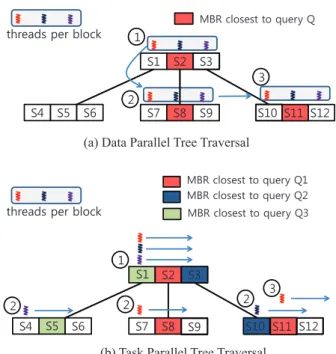
2 Data parallel tree traversal algorithms access a single tree node at a time and each thread determines whether each branch can be pruned out or not. But in task parallel tree traversal algorithms, each thread accesses different tree nodes and it causes significant warp divergence. . . 13
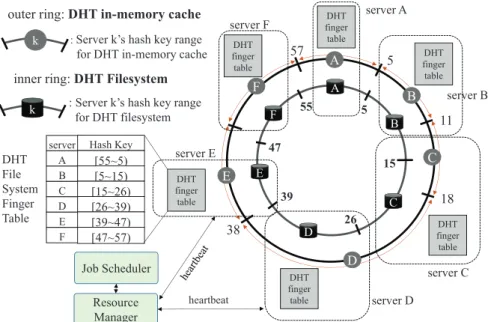
3 Double-layered Chord ring in EclipseMR. The outer layer is the distributed in-memory cache layer and the inner layer is the distributed file system layer. . . 16
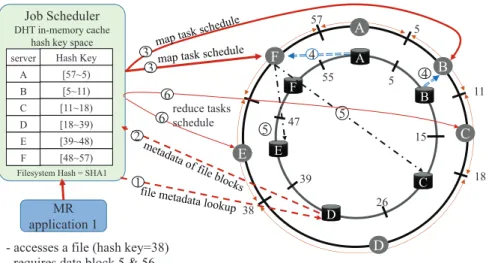
4 MapReduce Job Scheduling in EclipseMR . . . 18
5 IO throughput with varying the number of data nodes . . . 20
6 Performance comparison against Hadoop and Spark . . . 21
7 Execution Time of Iterative Jobs . . . 22
8 Page Structure ofB3-tree . . . 24
9 Insertion intoB3-tree Page . . . 27
10 Failure-Atomic Page Split in B3-tree . . . 29
11 Failure-Atomic Redistribution . . . 31
12 Insertion Performance with Varying Page Sizes . . . 35
13 Search Performance: Balanced Trees vs Skewed Trees . . . 35
14 Deletion Performance with Varying Page Sizes . . . 36
15 Throughput Comparison with Varying Number of Indexed Data . . . 37
16 Insertion Performance Comparison (Latency) . . . 38
17 Search Performance with Varying Read Latency . . . 39
18 Insertion(a) and Search(b) Throughputs with Varying Number of Threads . . . . 39
19 Performance Comparison with 4 Threads(l) and 16 Threads(r) Using Mixed Work-load . . . 39
20 Cacheline-Conscious Extendible Hashing . . . 42
21 Failure-Atomic Segment Split Example . . . 43
22 MSB segment index makes adjacent directory entries be modified together when a segment splits . . . 46
23 Buddy Tree Traversal for Recovery . . . 47
24 Throughput with Varying Segment/Bucket Size . . . 50
26 Performance of concurrent execution: latency CDF and insertion/search through-put . . . 54 27 Massively Parallel Scanning and Backtracking: In the root node A, the pruning
distance is initially infinite. In step 1, we search a leaf node which is closest to the query point and update the pruning distance while computing the MAXDIST of child nodes. In the second tree traversal 2, regardless of whether B or C is closer to the query point, we fetch the leftmost child nodeB from global memory if both B and C are within pruning distance. In node B, we check which child nodes are within the pruning distance. In the example, suppose D and E are within the pruning distance. Then 3 we fetch the left child node D. Suppose
H is not within the pruning distance. Then node H will be pruned out, and 4
we visit node I and kNN points will be updated. After processing node I, 5
we fetch its sibling nodes J and K. If node K does not update kNN points or pruning distance, 6 we fetchK’s parent nodeE from global memory and prune out child nodes (L in the example) which are farther than the pruning distance. IfM’s MINDIST is smaller than the pruning distance, 7we fetchM and 8keep scanning its sibling nodes. If node N does not update kNN points, 9 we move to its parent node F, which does not have any child nodes within the pruning distance. Thus 10we move one level up to nodeC. If nodeC does not have any child nodes within the pruning distance, we will move to the root node and finish the search. Otherwise, as in the example, we visit the leftmost leaf node Gas it is within the pruning distance. We keep this traversal and visitG,R, and S. . . 57 28 Bottom-up Constructed SS-trees vs Top-down Constructed SR-tree (Parent Link
Tree Traversal) . . . 61 29 Distribution of Datasets Projected to the First Two Dimensions (N: number of
clusters, σ: standard deviation . . . 62 30 Query Processing Performance with Varying Input Distribution (100 clusters) . . 63 31 Query Processing Performance with Varying Number of Fan-outs . . . 64 32 Performance with Varying Dimensions (Synthetic Datasets (100 clusters) . . . . 65 33 Query Processing Performance with Varying k . . . 65 34 Query Processing Performance with Real Datasets (NOAA) . . . 66
I
Introduction
The amount of data is continuously growing at this moment and demanding data analytics frameworks to be more efficient and scalable to handle such an enormous amount of data. There have been many studies on how to process the increasing data size, including MapReduce frameworks and NoSQL and NewSQL databases. The conventional data analytics heavily relies on the database systems that model the data into tables and their relations with others so that it can provide the structured query language (SQL) interface to manipulate the records and schema of the tables with atomicity, consistency, isolation, and durability. However, as the substantial portion of the generated data is unstructured and difficult to be molded into tabular form, the MapReduce programming model becomes very popular as it provides a new abstraction for programmers to handle the data in an easy and scalable way without the messy details that complicate the problem. In the MapReduce programming model, programmers can define their own custom map and reduce functions to process data in a scalable and flexible fashion. NoSQL databases are based on this MapReduce programming model to provide simplicity of design, simpler horizontal scaling, and finer control over availability with relaxed consistency model.
However, there are still needs for strong transactional properties and consistency require-ments that the conventional database systems used to provide. NewSQL databases are modern relational databases that satisfy both the ACID guarantees of transactional database systems and the scalability of the NoSQL databases. These systems have different requirements to fulfill and their own unique workloads, but the frameworks have a common ground as data analytics frameworks. In this dissertation, we investigate how to leverage emerging hardware to improve the performance of the data analytics frameworks.
The frameworks have been built on the assumption of block-addressable storage devices, such as HDD or SSD for decades, which are slow, coarse-grained, but persistent. Despite the drawbacks of the devices, it is necessary to rely on the devices to ensure the durability of the data. Fast, byte-addressable DRAM has been used as a buffer to mitigate such deficiencies, but there is always a trade-off depending on which data is stored on which device due to the limited capacity of expensive memory space and volatile nature of the device. However, as byte-addressable persistent memory such as 3D Xpoint, phase-change memory, and STT-MRAM emerges, now the main memory is not only a volatile buffer but also persistent primary storage itself. The persistent memory is expected to provide low-latency as DRAM, but it persists data in the unit of bytes with large storage capacity.
As this byte-addressable persistent memory breaks the barrier separating volatile and non-volatile storage, it is necessary to design new data structures for this new hierarchy of memory. The persistent memory requires the data on the CPU cache to be written back to the memory to ensure the safety of the data, but unfortunately, the unit of atomic write from the cache to the memory is only 8-byte. Furthermore, as the order of the write instructions is not guaranteed, it is difficult to provide the consistency of the data structures. These challenges should be
dealt with the fine-grained memory management scheme with memory fence and cacheline flush instructions which barriers the memory write to keep the order between the memory operations and triggers the flush of cacheline containing the modified data, respectively.
There have been many studies to leverage the byte-addressability, durability, and high per-formance of persistent memory by re-designing block-based data structures such as B+-trees. B+-tree variants have been widely adopted in the past decades as they are designed to provide failure-atomicity, consistency, durability, and concurrency by being updated in block-granularity. These properties were not the primary concerns of the various byte-addressable in-memory data structures such as Radix-tree, Skip-list, and T-tree, since they were designed for the volatile main memory. These data structures are not cache-conscious as old processors have tiny CPU cache, but as CPU cache size has increased, in-memory B-tree variants that are conscious of cache locality and arrange sorted keys in hierarchical blocks have been developed [1, 2, 3]. The legacy in-memory indexes are outperformed by these variants of B-tree as they benefit from various features of modern processors such as large CPU caches, instruction-level parallelism, and memory-level parallelism, which means that block-based data structures are efficient as not only disk-based index, but also in-memory index.
However, B-tree variants are not always the correct solutions due to the growing size of the tree. There are latency-critical applications that can benefit from the byte-addressable persistent memory. The increasing level of the tree structure results in increased latency, which is unacceptable for such applications. Hash-based index structures have static flat structures that guarantee constant lookup time, which is appropriate for such latency-critical applications. Only a few of studies have attempted to adapt hash-based data structures to persistent memory. One of the main challenges in a hash-based structure for the persistent memory is in achieving efficient
dynamic rehashing under the fine-grained failure-atomicity constraint. Dynamic rehashing is inevitable as predicting the capacity of a hash table is not always possible that the table might suffer from hash collisions, overflows, and under-utilization. However, rehashing is not desirable as it degrades total system throughput as the table is not accessible during the rehashing process, which significantly increases the tail latency of queries. Furthermore, rehashing requires a large number of writes to persistent memory, and the writes are expected to induce higher latency and energy consumption in persistent memory.
On the other hand, as the modern processor manufacturers focus on integrating more and more cores inside a single chip to increase the performance of a processor, the multi-core pro-cessors have become commodity hardware nowadays, and even the graphics processing units (GPUs) are widely adopted as SIMD (Single Instruction Multiple Data) accelerators to enhance the performance of the computations. It is inevitable to take into account the multiple levels of parallelism to design a data structure; however, it is a difficult task to efficiently exploit multi-ple cores with limited bandwidth and capacity of the memory hierarchy. Problems become even worse if we want to traverse tree-based indexes on the GPUs. One of the challenges in traversing a hierarchical index on the GPU is the tiny shared memory and runtime stack on the GPU. It
is necessary to store a tree node that is big enough to efficiently exploit the SIMD units of the GPU; however, the size of such tree node is too huge for the runtime stack to store multiple nodes to traverse the tree structure. The irregular memory access pattern of the tree traversal hinders exploiting parallelism since GPUs are designed for deterministic memory accesses. Traversing the hierarchical structure requires lots of branch operations that can cause the warp divergence problem that can decrease both the SIMD efficiency and the GPU utilization. To alleviate such problems, we have to take advantage of spatial locality and avoid cache invalidation by exploiting the byte-addressability and fine-grained memory management.
1.1 Thesis and Contributions
In this dissertation, I will show that the data structures for the new emerging hardware should exploit fine-granularity to improve the performance of the data analytics frameworks while sus-taining the consistency and increasing the concurrency. To support this goal, I develop and evaluate a set of data structures and techniques to fully leverage the emerging hardware for the data analytics frameworks. The key contributions are summarized as follows:
• EclipseMR: Distributed and Parallel Task Processing with Consistent Hashing
We design and implementEclipseMR, a MapReduce framework that can efficiently utilize large distributed memory space in a cluster and benefit from emerging hardware with the following set of techniques. EclipseMR has two layers of consistent hash rings, which are a decentralized DHT-based file system and an in-memory key-value store with consistent hashing. The in-memory key-value store is designed to cache local data and remote data so that it can balance the load between the servers in a cluster. In order to efficiently leverage huge memory space distributed across the cluster with a higher cache hit ratio, we propose a locality-aware fair (LAF) job scheduler that acts as the load balancer for the cache. The LAF job scheduler predicts the availability of reusable data and assigns tasks to the servers with such data while balancing data locality and load balance. Our evaluation shows that EclispeMR is faster than Hadoop and Spark by a large margin for various applications.
• B3-tree: Byte-Addressable Binary Block Tree for Persistent Memory
The primary challenge in designing a B+-tree for fast, byte-addressable persistent memory is transforming a consistent state of the structure into another consistent state with 8-bytes of atomic write. Previous studies employ the append-only updates with additional metadata to manage the order of the keys or the selective persistence with hybrid memory hierarchy of DRAM and PM.
We design and implement theB3-tree, a fully persistent hybrid indexing structure of binary tree and B+-tree that benefits from the failure-atomicity and byte-addressability of an in-memory index and the durability, cacheilne consciousness, and balanced tree height of a
block-based index. We also develop a logging-less failure-atomic split and merge algorithms for theB3-tree that significantly reduce the number of cacheline flush instructions caused by the logging or journaling. B3-tree consistently outperforms wB+-tree, one of the
state-of-the-art B+-tree variant, by a large margin and shows comparable performance with partially persistent FPtree.
• Write-Optimized Dynamic Hashing for Persistent Memory
In the past few years, many studies have been proposed to leverage the byte-addressability, durability, and low latency of persistent memory, including, numerous variants of B+-tree indexes due to the fine-grained I/O for persistent memory. However, only a few have paid their attention to the hash-based index structures, which have multiple advantages including constant lookup time and higher memory utilization. The primary challenge of a hash-based index structure in persistent memory is to achieve efficient dynamic rehashing under fine-grained failure-atomicity constraint.
In this work, we adapt the extendible hashing for byte-addressable persistent memory by using cacheline-sized buckets and introducing an intermediate layer of segments to the extendible hashing. The three-level structure of thisCache-Conscious Extendible Hashing
(CCEH) guarantees to find a record with only two cacheline accesses. We also develop a failure-atomic rehashing and recovery algorithm for CCEH without using explicit logging. We evaluate the performance with the state-of-the-art hashing techniques for the persistent memory, and our CCEH successfully reduces the maximum query latency by over two-thirds compared to the state-of-the-art hashing techniques.
• Parallel Tree Traversal for Nearest Neighbor Query on the GPU
The nearest neighbor search is a fundamental problem that finds the closest point to a given query point in multi-dimensional space, and it is used in wide application domains such as computer graphics, information retrieval, and scientific data processing. Recent advances of GPGPU (General-Purpose computing on Graphics Processing Units) comput-ing, several studies have been proposed to accelerate the k-nearest neighbor search using GPUs, but most of the works focus on enhancing the exhaustive search for the exact k-nearest neighbors as it is known that the multi-dimensional hierarchical indexing trees are not suitable for the GPUs due to the tiny shared memory and runtime stack, irregular memory access pattern of tree traversal, and warp divergence problem.
In this work, we develop a data parallel tree traversal algorithm,Parallel Scan and Back-track (PSB), for k-Nearest Neighbor query processing on the GPU. The PSB algorithm avoids the warp divergence problems while traversing the multi-dimensional tree-structured index to enhance SIMD efficiency. The sibling leaf nodes are linearly scanned to take ad-vantage of accessing contiguous memory blocks and reducing unnecessary backtracking to the parent nodes. We also develop the parallel bottom-up construction algorithm for the
fast SS-tree construction by parallelizing Ritter’s minimum enclosing circle algorithm [4]. Our evaluation shows that the PSB algorithm outperforms not only the exhaustive brute-force search but also traditional branch and bound algorithms by a large margin.
1.2 Thesis Organization
The rest of this dissertation is organized as follows. In section II, we present the background and related work. In section III, we present a novel MapReduce framework EclipseMR that can benefit from the following emerging hardware. In section IV, we present index structures for the persistent memory that overcomes the challenge of failure-atomicity. In section V, we present the multi-dimensional indexing structure, SS-tree and its traversal algorithm for the GPU, called parallel scan and backtrack algorithm. In section VI, we conclude this dissertation.
II
Background and Related Work
2.1 EclipseMR: Distributed and Parallel Task Processing with Consistent
Hashing
As the demand for large-scale data analysis frameworks grew in the high performance com-puting community in the late ’90s, several distributed and parallel data analysis frameworks such as Active Data Repository [5], which supports the MapReduce programming paradigm and DataCutter [6], which supports generic DAG workflows, were developed for large scale scientific datasets. A few years later, industry had a growing demand for large-scale data processing appli-cations and Google developed Google File System [7] and the MapReduce framework [8]. Since then, there has been a great amount of effort to extend and improve distributed job processing frameworks for various data-intensive applications. [9, 10, 11, 12, 13]
Spark [14, 13] shares the same goal as our framework in that it reuses a working set of data across multiple parallel operations. Resilient Distributed Datasets (RDDs) in Spark are read-only in-memory data objects that can be reused for subsequent MapReduce tasks. Spark addresses the conflict between job scheduling fairness with data locality by delaying a job for a small amount of time if the job can not launch a local task [15]. Our EclipseMR job scheduling is different from Spark in that EclispeMR employs consistent hashing to determine where to store and access the cached data objects. Based on the consistent hashing, EclipseMR strikes a balance between load balancing and data locality. Dache is another MapReduce framework where a central cache manager uses its best efforts to reuse the cached results of previous jobs [16]. Compared to Dache, EclipseMR is more scalable as it does not have a central directory to keep the list of cached data objects that can change dynamically at a very fast pace.
Main Memory MapReduce (M3R)proposed by Shinnar et al. [12] is a MapReduce framework that performs in-memory shuffle by simply storing the intermediate results of map tasks in main memory instead of the block device storage. They show in-memory shuffle significantly improves a certain type of applications. however, M3R can not be used if workloads are large and do not fit in main memory or applications require resilience because the in-memory framework is not fault tolerant. Moreover, it is questionable if MapReduce is the right programming paradigm for their target application - sparse matrix vector multiplication. Rahman et al. [17] proposed
HOMR - a hybrid approach to achieve the maximum possible overlapping across map, shuffle, and reduce phases. Our work is similar to that in the sense that EclispeMR aggressively overlap three phases by proactive shuffling. The in-memory caching layer of EclipseMR is similar to
Tachyon, which is the cache layer that sits on top of HDFS and acts as a distributed cache for Spark. The difference between Tachyon and EclipseMR in-memory caching is that EclipseMR caching evenly distributes popular cached objects via LAF algorithm.
partial results of the computations from previous runs. Tiwari et al. [18] proposed theMapReuse
delta engine as an in-memory MapReduce framework that detects input data similarity, reuses available cached intermediate results and computes only for the new portion of input data. They show the reuse of intermediate results significantly improves job execution time. ReStore[19] is another framework that stores intermediate results generated by map tasks in HDFS so that they can be reused by subsequent jobs. Their works are similar to ours but the conventional fair job scheduling policies they use do not guarantee balancing the workloads if requested intermediate results are available only on a small number of overloaded servers.
TheMRShareframework proposed by Nykiel et al. [20] merges a batch of MapReduce queries into a single query so that it takes the benefits of sharing input and output data across multiple queries. The multiple query optimization problem has been extensively studied in the past, and it has been proven to be an NP problem. Nevertheless, extensive research has been conducted to minimize query processing time through data and computation reuse using heuristics or proba-bilistic efforts [19, 21, 10, 22]. These multiple query optimization studies are complementary to our work.
2.2 B3-tree: Byte-Addressable Binary B-Tree for Persistent Memory
As byte-addressable persistent memory is now on the horizon, numerous studies have been conducted to exploit new opportunities of its beneficial features in various domains including file systems and database management systems [23, 24, 25, 26, 27, 28, 29, 30, 31, 32, 33, 34, 35, 36, 37, 38].
Systems on byte-addressable persistent memory has to safeguard against failures with fine-grained write atomicity. That is, in persistent memory, the granularity of failure-atomic writes is expected to be 8-bytes, or a cache line if we use hardware transactional memory [39, 33]. In persistent memory, Such a small write granularity makes it difficult to guarantee consistency of various data structures including B+-trees because not all 8-byte writes can transform a consistent index into another consistent index. Moreover, independent store instructions can be arbitrarily reordered in modern processors. Therefore, a large number of expensiveclflushand
mfenceinstructions are required to guarantee the consistency of data structures [35].
To resolve this problem, Venkataraman et al. [35] proposed to use multi-versioning scheme so that we can roll back to previous consistent states. Version-based recovery methods, though, have a limitation in that it requires an expensive garbage collection.
Alternatively, Yang et al. [37] proposed NV-Tree that updates B-tree pages in append-only
manner instead of making a large portion of data structures dirty so that it can reduce the number of calls to clflushand mfence. While the append-only update mitigates the overhead of write transactions, read transactions suffer from finding a key in unsorted arrays. The append-only update scheme has been adopted by other persistent B-tree variants developed later, i.e., wB+-tree [40] and FP-tree [41]. wB+-tree proposed to use additional metadata to manage
the ordering of keys in order to resolve the problem of unsorted keys. However, the additional metadata in wB+-tree requires additional cache line flushes, which is sub-optimal. We note that wB+-tree still relies on expensive logging methods for tree rebalancing operations because it stores both internal and leaf tree pages in persistent memory.
FPTree, proposed by Oukid et al., is similar to NV-Tree in that it also stores leaf pages in persistent memory while keeping internal tree pages in DRAM [41]. Different from NV-Tree, FPTree exploits hardware transactional memory to efficiently handle concurrency of internal tree page accesses and it reduces the cache miss ratio via fingerprinting, which is one-byte hash value for keys stored in leaf page. Both NV-Tree and FPTree employselective persistencewhere they store internal pages in volatile DRAM but leaf pages in persistent memory. Therefore, the internal pages in NV-Tree and FP-Tree may be lost upon system failure. Although the internal pages can be reconstructed from scratch using the leaf pages in persistent memory, the entire reconstruction process can hinder the instant use of the index.
Every 8-byte store instruction used in the FAST and FAIR algorithms transforms a B+-tree into another consistent state or a transient inconsistent state that read operations can tolerate. By making read operations tolerate transient inconsistency, FAST and FAIR B-tree avoids ex-pensive copy-on-write and logging. However, a large number of shift operations employed in FAST and FAIR B-tree make the performance degrade as we increase the tree node size and aggravate wearing issues of persistent memory.
2.3 Write-Optimized Dynamic Hashing for Persistent Memory
The focus of this subsection is on dynamic hashing, that is, hashing that allows the structure to grow and shrink according to need. While various methods have been proposed [42, 43, 44], our discussion concentrates on extendible hashing as this has been adopted in numerous real systems [45, 46, 47, 48, 49] and as our study extends it for PM.
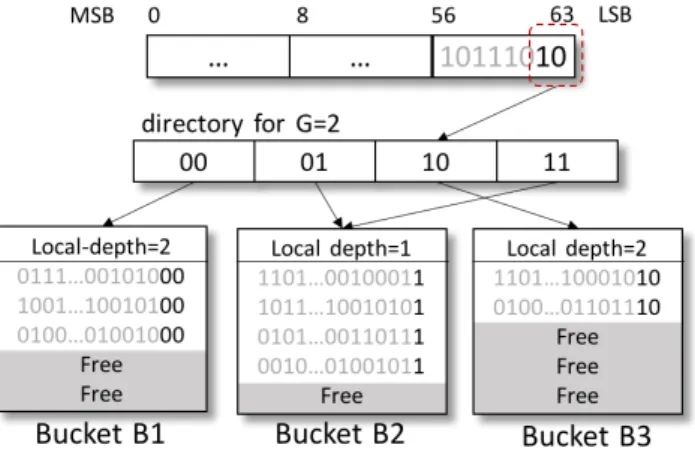
Extendible Hashing: Extendible hashing was developed for time-sensitive applications that need to be less affected by full-table rehashing [50]. In extendible hashing, re-hashing is an incremental operation, i.e., rehashing takes place per bucket as hash collisions make a bucket overflow. Since extendible hashing allocates a bucket as needed, pointers to dynamically allocated buckets need to be managed in a hierarchical manner as in B-trees in such a way that the split history can be kept track of. This is necessary in order to identify the correct bucket for a given hash key.
Figure 1 shows the legacy design of extendible hashing. In extendible hashing, a hash bucket is pointed to by an entry of adirectory. The directory, which is simply abucket address table, is indexed by either the leading (most significant) or the trailing (least significant) bits of the key. In the example shown in Figure 1, we assume the trailing bits are used as in common practice and each bucket can store a maximum of five key-value records. The global depth G stores the number of bits used to determine a directory entry. Hence, it determines the maximum
Figure 1: Extendible Hash Table Structure
extendible hashing doubles the size of the directory by incrementing G. From the example, G
is 2, so we use the low end 2 bits of the key to designate the directory entry in the directory of size 4 (22). Eventually, when the buckets fill up and split, needing more directory entries,Gcan be incremented to 3, resulting in a directory of size 8.
While every directory entry points to a bucket, a single bucket may be pointed to by multiple directory entries. Thus, each bucket is associated with a local depth (L), which indicates the length of the common hash key in the bucket. If a hash bucket is pointed bykdirectory entries, the local depth of the bucket isL=G−log2k. For example in Figure 1, B2 is being pointed to
by 2 directory entries. For this bucket, as the global depth (G) is 2 and the bucket is pointed to by two directory entries, the local depth of the bucket (L) is 1.
When a hash bucket overflows, extendible hashing compares its local depth against the global depth. If the local depth is smaller, this means that there are multiple directory entries pointing to the bucket, as for bucket B2 in Figure 1. Thus, if B2 overflows, it can be split without increasing the size of the directory by dividing the directory entries to point to two split buckets. Thus,Gwill remain the same, but theLs for the two resulting buckets will both be incremented to 2. In the case where the bucket whose local depth is equal to the global depth overflows, i.e., B1 or B3 in Figure 1, the directory needs to be doubled. In so doing, both the global depth and the local depth of the two buckets that result from splitting the overflowing bucket also need to be incremented. Note, however, that in so doing, overhead is small as rehashing of the keys or moving of data only occur for keys within the bucket. With the larger global and local depths, the only change is that now, one more bit of the hash key is used to address the new buckets.
The main advantage of extendible hashing compared to other hashing schemes is that the rehashing overhead is independent of the index size. Also, unlike other static hash tables, no extra buckets need to be reserved for future growth that results in extendible hashing having higher space utilization than other hashing schemes [51]. The disadvantage of extendible hashing is that each hash table reference requires an extra access to the directory. Other static hashing schemes do not have this extra level of indirection, at the cost of full-table rehashing. However,
it is known that the directory access incurs only minor performance overhead [52, 51].
PM-based Hashing: Recently a few hashing schemes, such as Level Hashing [53], Path Hashing [54], and PCM-friendly hash table (PFHT) [55] have been proposed for persistent memory as the legacy in-memory hashing schemes fail to work on persistent memory due to the lack of consistency guarantees. Furthermore, persistent memory is expected to have limited endurance and asymmetric read-write latencies. We now review these previous studies.
PFHT is a variant of bucketized cuckoo hashing designed to reduce write accesses to PCM as it allows only one cuckoo displacement to avoid cascading writes. The insertion performance of cuckoo hashing is known to be about 20∼ 30% slower than the simplest linear probing [56]. Furthermore, in cuckoo hashing, if the load factor is above 50%, the expected insertion time is no longer constant. To improve the insertion performance of cuckoo hashing, PFHT uses a stash to defer full-table rehashing and improve the load factor. However, the stash is not a cache friendly structure as it linearly searches a long overflow chain when failing to find a key in a bucket. As a result, PFHT fails to guarantee the constant lookup cost, i.e., its lookup cost is notO(1)but O(S) where S is the stash size.
Path hashing is similar to PFHT in that it uses a stash although the stash is organized as an inverted binary tree structure. With the binary tree structure, path hashing reduces the lookup cost. However, its lookup time is still not constant but in log scale, i.e.,O(logB), when B is the number of buckets.
Level hashing consists of two level hash tables. The top level and bottom level hash tables take turns playing the role of the stash. When the bottom level overflows, the records stored in the bottom level are rehashed to a4×times larger hash table and the new hash table becomes the new top level, while the previous top level hash table becomes the new bottom level stash. Unlike path hashing and PFHT, level hashing guarantees constant lookup time.
While, level hashing is an improvement over previous work, our analysis shows that the rehashing overhead is no smaller than legacy static hashing schemes contrary to the authors’ claim that it is reduced by 1/3. As, at least one of the two hash tables is always almost full in level hashing, the bottom level hash table often fails to accommodate a collided record resulting in another rehash. The end result is that level hashing is simply performing a full-table rehash in two separate steps.
Consider the following scenario. Say, we have a top level hash table that holds 100 records and a bottom level stash holds 50 records. Hence, we can insert 150 records without rehashing if a hash collision does not occur. When the next 151th insertion incurs a hash collision in the bottom level, the 50 records in the bottom level stash will be rehashed to a new top level hash table of size 200 such that we have 150 free slots. After the rehash, subsequent 150 insertions will make the top level hash table overflow. However, since the bottom level hash table does not have free space either, the 100 records in the bottom level hash table have to be rehashed. To expand a hash table size to hold 600 records, level hashing rehashes total 150 records, that is, 50 records for the first rehashing and another 100 records for the second rehashing.
On the other hand, suppose the same workload is processed by a legacy hash table that can store 150 records as the initial level hash table does. Since 151th insertion requires more space in the hash table, we increase the hash table size by four times instead of two as the level hashing does for the bottom level stash. Since the table now has 600 free spaces, we do not need to perform rehashing until the 601th insertion. Up to this point, we performed rehashing only once and only 150 records have been rehashed.
Interestingly, the numbers of rehashed records are no different. We note that the rehashing overhead is determined by the hash table size, not by the number of levels. As we will show in Section 4.4.7, the overhead of rehashing in level hashing is no smaller than other legacy static hashing schemes.
2.4 Parallel Tree Traversal for Nearest Neighbor Query on the GPU
2.4.1 Stackless Tree Traversal
In computer graphics, a very large number of rays are concurrently traced by leveraging many GPU cores. In order for classic recursive tree traversal algorithms to traverse bounding volume hierarchies, the size of the run-time stack space must be as large as the maximum stack depth times the number of rays. However, the size of shared memory in modern GPUs is very small (less than 64KB). Therefore, the computer graphics community has proposed various stackless tree traversal algorithms such askd-restart[57],skip pointer[58], rope tree [59], and short stack [60]. The Kd-restart algorithm proposed by Foley et al. [57] divides a query line into multiple small line segments while navigating a kd-tree. Thereby, it reduces the size of each bounding box of a line segment. Then, it repeatedly searches the kd-tree with the small bounding box from its root node again. This restart strategy eliminates backtracking and the need for a large run-time stack.
The rope tree [59] and the parent link [61] algorithms eliminate the need for a run-time stack by using auxiliary links. In rope tree, each node storesropes- pointers to neighboring tree nodes in each dimension, thus a rope can be followed if a query line segment intersects a face of the bounding box. Unfortunately kd-restart and rope tree algorithms cannot be directly employed for kNN query processing because the kNN query is not a line segment. kNN query processing irregularly traverses an indexing tree and prunes out sub-trees based on the distance between a query point and the bounding volumes of sub-trees.
Theparent link[61] algorithm is a more generic stackless tree traversal algorithm that can be employed for kNN query processing. In the parent link algorithm, each tree node has a pointer to its parent node (parent link) [61]. Instead of relying on the run-time stack, the parent link algorithm allows backtracking to a parent node by following the parent link pointer. A drawback of the parent link tree algorithm is that the same tree node has to be fetched from slow global memory multiple times when it backtracks.
right sibling node or a right sibling of its parent node. Unlike parent link, skip pointer does not allow backtracking to parent nodes. Instead, skip pointer visits right sibling nodes of the same parent. Only if it visits the rightmost sibling node of the current parent node, it backtracks to a higher level of the tree and visits the sibling of its parent node. The skip pointer algorithm is guaranteed to not visit previously accessed tree nodes, and it avoids fetching the same tree node multiple times from global memory. However, this is also a drawback of skip pointer algorithm because visiting all sibling nodes requires too many accesses to unnecessary tree nodes, especially for kNN query processing.
Another solution to the tiny run-time stack problem is to use a fixed size of small shared memory as a short stack [60]. If the short stack is not deep enough for a tree traversal, the short stack deletes a tree node from the bottom of the stack and pushes a new tree node on the top. While traversing a tree with a short stack, we may find a parent node has been evicted from the short stack. If the deleted parent node has to be visited for backtracking, the short stack algorithm restarts the tree traversal from the root node again, as in kd-restart. Although the short stack algorithm increases the chance of reusing previously visited tree nodes, it often restarts the tree traversal, which adds the overhead of fetching tree nodes from global memory. The overhead of global memory access is known to offset the benefits of reusing tree nodes available in the short stack [62]. Moreover, the size of a single SS-tree node becomes larger than 32 Kbytes when the dimension is higher than 32. Considering the tiny shared memory size of the GPU, the short stack algorithm cannot be used for high dimensional SS-trees.
2.4.2 Data Parallelism vs Task Parallelism
The stackless tree traversal algorithms described in section 2.4.1,kd-restart[57],skip pointer[58], rope tree [59], and short stack [60] focus on distributing a large number of line intersection queries across a set of GPU processing units. Such task parallelismis known to improve query processing throughput, but it does not improve the query response time of individual queries.
Data parallelismcontrasts to task parallelism in the sense that a large number of GPU processing units perform the same task on different parts of an index.
Figure 2 illustrates how a data parallel algorithm and a task parallel algorithm traverse a tree structure in different ways. In data parallel tree traversal algorithms, a set of threads in a GPU block concurrently access the same tree node and cooperate to determine which child node to fetch and visit. But in a task parallel tree traversal algorithm, each thread processes a different query and follows a different search path. Therefore each GPU processing unit accesses different parts of global memory and the number of accessed tree nodes varies across GPU processing units.
In task parallelism, the query response times are determined by the slowest thread in the block because a block of threads has to wait until all the other threads in the same block finish. Moreover, task parallelism makes each thread execute a different instruction. But, a warp is the minimum thread scheduling unit in CUDA architecture. All threads in a warp must execute the
6 6 6 6 6 6 6 6 6 6 6 WKUHDGVSHUEORFN 0%5FORVHVWWRTXHU\4 6 6 6 6 6 6 6 WKUHDGVSHUEORFN 0%5FORVHVWWRTXHU\4 0%5FORVHVWWRTXHU\4 0%5FORVHVWWRTXHU\4 6 6 6 6 6
(a) Data Parallel Tree Traversal
(b) Task Parallel Tree Traversal
6
Figure 2: Data parallel tree traversal algorithms access a single tree node at a time and each thread determines whether each branch can be pruned out or not. But in task parallel tree traversal algorithms, each thread accesses different tree nodes and it causes significant warp divergence.
same instruction. If a thread in a warp needs to execute different instructions from the other threads, it needs to wait for multiple cycles until other threads finish. As more threads diverge,
SIMD efficiencydecreases and the utilization of GPU processing units decreases. This problem is calledwarp divergence.
In order to avoid such warp divergence and improve individual query response time, we develop a data parallel tree traversal algorithm and efficiently utilize a large number of GPU processing units.
2.4.3 SS-Tree
SS-tree [63] is a balanced n-ary multi-dimensional tree structure designed for nearest neighbor query processing. SS-tree employs bounding spheres instead of bounding rectangles for the shapes of tree nodes. Employing bounding spheres is not only beneficial for reducing the size of a tree node but it can also eliminate a number of conditional branches that are required by the classic branch-and-boundsearch algorithm [64].
SS-tree has been shown to outperform R-tree and K-D-B-tree for high dimensional datasets in many prior studies [63, 65]. Although bounding sphere volumes of SS-tree are often much larger than bounding rectangle volumes of R-trees especially in low dimensions, it is known that the number of visited tree nodes is often much smaller than that of R-trees in high dimensions [65]. Moreover, SS-trees can prune out child nodes with fewer computations than other indexing
structures. That is, rectangular bounding boxes in variants of R-tree or K-D-B-tree require the calculation of distances to each facet of a bounding shape. As the dimension increases, the number of facets also increases and the computation overhead to calculate the high-dimensional distances increases exponentially. Instead, SS-tree just computes the distance between a query and a centroid and adds or subtracts the radius of the bounding sphere, which significantly reduces the computation time.
The incremental kNN search algorithm [66] that uses a priority queueis known to perform faster than the branch-and-bound algorithm. However on the GPU, a block of threads share the priority queue, which necessitates protecting the priority queue using a lock. The lock will serialize a large number of threads, which results in high warp divergence and significant performance degradation.
III
EclipseMR: Distributed and Parallel Task Processing with
Consistent Hashing
As the more space is available in the main memory, developers have started to adopt in-memory caching. Hadoop, which is one of the most popular MapReduce frameworks, also introduces in-memory caching in HDFS to cache local input data. However, the input data caching alone does not significantly improve the job execution time, especially for compute-intensive applications. In the database systems field, a considerable amount of studies has been conducted to show semantic caching successfully reduces query response time and improves system throughput by exploiting sub-expression commonality across multiple queries. If multiple MapReduce jobs have some common sub-computations, caching not only the input data but also the intermediate results for the sub-computations can greatly speed up subsequent tasks.
3.1 EclipseMR
EclipseMR consists of a job scheduler, a resource manager, and double-layered consistent hash ring structures - a DHT file system and a distributed in-memory key-value store as shown in Figure 3. The job scheduler is responsible for assigning incoming queries, including MapReduce tasks, to back-end worker servers, and the resource manager is responsible for server join, leave, failure recovery, and file upload. The distributed in-memory cache and the DHT file system are completely decentralized components leveraging consistent hash rings. EclipseMR requires the job scheduler and resource manager to act as coordinators, but any worker server can take on the responsibility regardless. Hence, the job scheduler and the resource manager are selected by a distributed election algorithm.
3.1.1 DHT File System
As in HDFS, DHT file system in EclipseMR partitions an input data file into fixed-sized blocks, but the partitioned data blocks are distributed across the servers according to their hash keys. Since the location of the partitioned blocks can be determined by hash functions, the DHT file system does not need a centralized directory service that manages the location of each block. Instead, we store metadata about a file including file name, owner, file size, and partitioning information in a decentralized manner. For example, if a user uploads a file, we generate a hash key using the file name, and store the metadata about the file in the server (file metadata owner) whose hash key range includes the file’s hash key. At the same time, the partitioned file blocks are distributed across servers based on their hash keys.
Later, when an application wants to access a file, it obtains the hash key of the file using its file name, and accesses the file metadata owner in order to check the access permission, file size, hash keys of the partitioned blocks, etc. Once the applications reads the file metadata, it multicasts the block read requests to remote servers. Suppose the hash key ranges of the
A A B C D E F B C D E F 5 5 11 15 18 26 38 39 47 57 55
outer ring: DHT in-memory cache
inner ring: DHT Filesystem
:Server k’s hash key range for DHT in-memory cache
k
: Server k’s hash key range for DHT filesystem k server A B C D E F Hash Key [55~5) [5~15) [15~26) [26~39) [39~47) [47~57) DHT finger table DHT finger table DHT finger table DHT finger table DHT finger table DHT finger table server E server F server A server B server C server D Job Scheduler Resource Manager heartbeat DHT File System Finger Table
Figure 3: Double-layered Chord ring in EclipseMR. The outer layer is the distributed in-memory cache layer and the inner layer is the distributed file system layer.
DHT file system are as shown in Figure 3. If a file’s hash key is in the range of [5,15), its file metadata will be stored in serverB. To resolve the input data block skew problem, we distribute the partitioned file blocks across the ring using their hash keys.
We make DHT file system fault tolerant by replicating the file metadata as well as file blocks in predecessors and successors. When a worker server fails, either a predecessor or a successor will take over the faulty server and utilize the replicated blocks and metadata. Hence, unless a server fails along with its predecessor and successor at the same time, the DHT file system can tolerate system failures. If a resource manager or a scheduler fails, the rest of the worker servers execute an election algorithm to choose a new resource manager and a scheduler.
In the DHT file system, each server manages its own routing table, called finger table, containing m peer servers’ information. m can be determined by system administrators but it should be chosen so that 2m −1 > S, where S is the number of servers in the hash ring. Unless a cluster has more than thousands of servers, as in large scale peer-to-peer file sharing systems, we set m to the total number of servers to enable the one hop DHT routing [67]. Whenmis smaller, file IO requests can be redirected and the IO performance can be degraded. Because most distributed query processing systems are more stationary than dynamic peer-to-peer file sharing systems and the number of servers is usually less than a couple thousand, storing complete routing information for entire servers in a DHT routing table does not hurt the scalability of the system but improves data access performance [67].
Since the local DHT routing table is very small, the table lookup places minimal overhead on each server. When a server receives a file block access request from a remote server, it checks if the hash key of the file block is within its own hash key range. If so, it looks up its local
disks and serves the data access request. Otherwise, i.e., if zero hop routing is not enabled, it routes the request to another server that owns the hash key as in the classic DHT routing algorithm [68].
The DHT routing table is stationary so that it updates neighbor information including successor and predecessor only when a participating server joins, leaves, or fails. Each server exchanges heartbeat messages with direct neighbors to detect server failures, and the resource manager and job scheduler are notified when a server failure is detected. If a server fails, the resource manager reconstructs the lost file blocks in atake-overserver using the replicated data blocks.
3.2 Distributed In-Memory Cache
In data-intensive computing, it is common for same applications to submit jobs that share the same input data. For example, database queries often access the same tables. There exist several prior works [69, 70] that report more than 30% of MapReduce jobs are repeatedly submitted in a production environment. Over the past decades, there have been a large number of works that exploit sub-expression commonality across multiple queries and incremental computation [19, 21, 20, 10, 22, 18]. The incremental computation significantly increases the chances of data reuse, reduces the job response time, and improves the system throughput.
On top of the DHT file system, EclipseMR deploys a distributed in-memory cache layer to exploit the incremental computation. The distributed in-memory cache consists of two partitions - iCacheand oCache.
iCache is where input data blocks are implicitly cached. The latest HDFS also implemented in-memory caching, but HDFS in-memory caching stores only local input data blocks. Since data skew problem occurs not only in a record level but also in an input block level, HDFS in-memory caching does not mitigate the skew problem of input blocks. To resolve this problem, we letiCacheallow input data blocks to be cached in peer servers according to their hash keys.
oCacheis where intermediate results of map tasks and outputs of iterative jobs are explicitly cached by user applications. EclipseMR tags the cached data with their metadata (application ID, user-assigned ID for cached data). oCache helps avoid redundant computations by sharing the intermediate results among multiple jobs. oCacheis similar to RDDS in Spark, but interme-diate results or outputs for iterative jobs in EclipseMR are cached according to their hash keys, so it evenly distributes frequently accessed cached data objects across the entire distributed memories. The cached intermediate results and outputs of iterative jobs are also persistently stored in the DHT file system according to their hash keys so that long running jobs can survive faults and restart from the point of failure.
The hash key ranges of in-memory caches are determined by a job scheduler based on work-load pattern so that popular hash key ranges can use more distributed memories. However, the hash key ranges of DHT file system are statically determined by consistent hashing and do not change unless servers join or fail. Therefore, the hash key ranges of the distributed in-memory
Job Scheduler DHT in-memory cache
hash key space
Filesystem Hash = SHA1
A A B C D E F B C D E F 5 5 11 15 18 26 38 39 47 57 55 MR application 1 1 2 3 4 4 5 5 3 6 reduce tasks schedule 6
- accesses a file (hash key=38) - requires data block 5 & 56
server A B C D E F Hash Key [57~5) [5~11) [11~18) [18~39) [39~48) [48~57) 4 5
remote file I/O if cache miss occurs push intermediate results
Figure 4: MapReduce Job Scheduling in EclipseMR
cache layer can be misaligned with the hash key ranges of the DHT file system.
3.2.1 MapReduce Processing
Figure 4 illustrates how EclipseMR processes a MapReduce job on a double layered ring struc-ture. Suppose a job is submitted to the job scheduler. The job scheduler runs a hash function with the input file name to find out which server is the file metadata owner. Suppose server D
is the file metadata owner in the example ( 1). Then, serverDchecks the file access permission and replies how the file is partitioned (step 2) and what are their hash keys.
If the input file is partitioned into two blocks and their hash keys are 6 and 56, the two blocks are stored in server A and B’s local disks, respectively. Given the hash keys of the two blocks, the job scheduler searches the hash key ranges of the distributed in-memory caches, and assigns a map task to each of serverB and serverF (step 3). Note that a map task is scheduled in server F instead of A even though an input file block 56 is stored in server A’s local disk. This is because each worker server’s hash key range in the job scheduler’s hash key table are misaligned with the hash key ranges of the DHT file system.
If server F has the input file block in its iCache, it reuses it. Otherwise, serverF reads the input file block from the DHT file system, i.e., looks up its DHT routing table to find out the file block 56 exists in remote serverA’s local disk. After reading the block from A’s local disks, serverF stores the block in itsiCache (step 4), and runs map tasks.
While map tasks are running, EclipseMR forwards the intermediate results generated by the map tasks to other servers according to the hash keys of the intermediate results so that they are persistently stored in the DHT file system (step 5). EclipseMR stores the intermediate results in persistent file systems as in Hadoop so that it can restart failed tasks and reuse the
intermediate results of the previous failed tasks. Although we store the intermediate results on disk, they can be cached inoCache for future reuse. Note that we store the intermediate results on the reducer side, not on the mapper side. The stored intermediate results are invalidated by time-to-live (TTL) which can be set by applications, and they are not replicated by default.
While map tasks are generating intermediate results, they notify the scheduler with their hash keys. With the given hash keys, the scheduler schedules reduce tasks where the intermediate results are stored. Reduce tasks read these intermediate results from oCache or the DHT file system using the hash keys (step 6).
If a user application specifies it can reuse intermediate results and they are available inoCache
or the DHT file system, the map tasks skip computation and reducer tasks can immediately reuse the cached data. If intermediate results are not available, the map tasks searchiCachefor input data blocks to reuse. If input data blocks are not available either, they read input data blocks from the DHT file system. There exist certain applications such ask-means that can not reuse intermediate results between map tasks and reduce tasks, but they need the results of reduce tasks from each iteration. For such applications, the EclipseMR allows applications to store the iteration outputs in oCache or the DHT file system instead of intermediate results.
3.2.2 Proactive Shuffling
Hadoop stores the intermediate results in the local disks of the server where the map tasks run. The shuffle phase in Hadoop sorts, splits, and sends the intermediate results to reducers. It is known that the shuffle phase of MapReduce is network intensive and the shuffle phase can constitute a bottleneck. Hadoop tries to pipeline map, shuffle, and reduce phases by starting reduce tasks as soon as intermediate result files are available, but Hadoop pipelining is far from satisfactory, and there have been several previous works that try to aggressively overlap the shuffle phase with the map phase and decouple from the reduce phase [71, 72, 9, 73, 74].
Unlike Hadoop or Spark, EclipseMR determines where to run reduce tasks based on the hash keys of the intermediate results. Therefore, the shuffle phase in EclipseMR does not have to wait until map tasks finish. Instead, EclipseMR lets each mapper pipeline the intermediate results to the DHT file system in a decentralized fashion while they are being generated. Based on the hash keys of the intermediate results, each map task stores the intermediate results in a memory buffer for each hash key range. When the size of this buffer reaches a certain threshold specified by the application, EclipseMR spills the buffered results to the DHT file system so that they can be accessed by reducers.
3.3 Evaluation
In this section, we first evaluate the performance of EclipseMR by quantifying the impact of each feature we presented. We then compare the performance of EclipseMR against Hadoop 2.5 and Spark 1.2.0. We have implemented the core modules of EclipseMR prototype in about
0 200 400 600 800 1000 6 14 22 30 38 Throughput (MB/sec) # of Nodes DHT file system HDFS
(a) AVG IO Throughput (Bytes/Map Task Exec. Time) 0 200 400 600 800 1000 6 14 22 30 38 Throughput (MB/sec) # of Nodes DHT file system HDFS
(b) AVG IO Throughput (Bytes/Job Exec. Time)
Figure 5: IO throughput with varying the number of data nodes
17,000 lines of C++ code. The source code that we used for the experiments is available at http://github.com/DICL/EclipseMR.
We run the experiments on a 40-nodes (640 vCPUs) Linux cluster that runs CentOS 5.5. Each node has dual Intel Xeon Quad-core E5506 processors, 20 GBytes DDR3 ECC memory, and a 5400rpm 256GB HDD for OS and a single 7200rpm 2TB HDD for HDFS and the DHT file system. 20 nodes are connected via a 1G Ethernet switch, the other 20 nodes are connected via another 1G Ethernet switch, and another 1G Ethernet switch forms the two level network hierarchy. We set both the number of map task slots and the number of reduce task slots to 8 (total 640 slots).
We use HiBench [75] to generate 250 GB text input datasets for the word count,inverted index, grep, and sort applications, 15 GB graph input datasets for page rank, and 250 GB
kmeansdatasets. In [76, 77], they report the median input sizes for the majority of data analytics jobs in Microsoft and Yahoo datacenters are under 14 GBytes. Hence, we also evaluate the performance of EclipseMR with small 15 GB text input datasets that we collect from Wikipedia and 15 GB k-means datasets that we synthetically generate with varying distributions.
3.3.1 IO Throughput
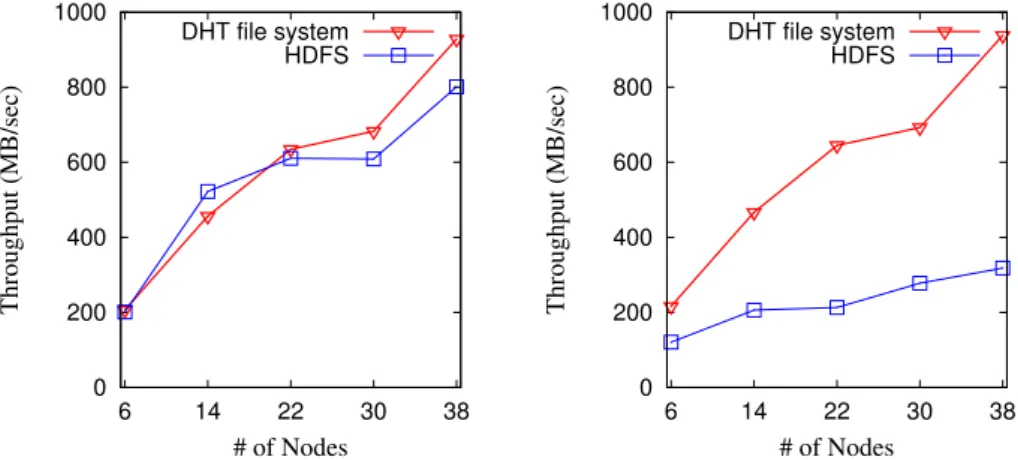
In the experiments shown in Figure 5(a), we measure the read throughput (total bytes/map task execution time) of the DHT file system and HDFS using HDFS DFSIO benchmark while varying the number of servers. As can be seen in Figure 5(a), HDFS and DHT file system show similar IO throughput. Note that this metric does not include the overhead of NameNode directory lookup and job scheduling, but it measures the read latency of local disks. In Figure 5(b), we measure the read throughput in a different way, i.e., total bytes/job execution time. While the DHT file system has negligible overhead in decentralized directory lookup and job scheduling, Hadoop suffers from various overheads including NameNode lookup, container initialization, and
0 0.2 0.4 0.6 0.8 1
InvertedIndexWordCountSort K-Means LogisticRegressionPageRank
Normalized Time
858s 3756s 678s 8051s 2392s 3332s
EclipseMR Spark Hadoop
Figure 6: Performance comparison against Hadoop and Spark
job scheduling.
In order to evaluate the scalability of the DHT routing table and HDFS name node, we submitted multiple concurrent DFSIO jobs in an experiment that we do not show due to the page limit, and we observed that the IO throughput of HDFS degrades at a much faster rate than the DHT file system.
3.3.2 Comparison with Hadoop and Spark
Finally we compare the performance of EclipseMR against Hadoop and Spark. Since all three frameworks provide different leversfor tuning, we performed Hadoop and Spark tunings to our best efforts according to various performance tuning guides available on the web.
However, it is hard to quantify which design of EclipseMR contributes to the performance differences because EclipseMR does not share any component with Hadoop software stack. More-over, Hadoop and Spark are full featured frameworks that provide various generic functionalities that are usually followed by significant overhead. For an example, Hadoop tasks run in Yarn containers and each Yarn container spends more than 7 seconds for initialization and authenti-cation [78]. This overhead becomes significant because the container initialization and authen-tication repeats for every task. I.e., Hadoop spends 7 seconds for every 128 MB block [79]. Compared to Hadoop and Spark, EclipseMR is a lightweight prototype framework that does not provide any other functionalities than what we present in this paper.
We use the default fair scheduling in Hadoop, and the delay scheduling in Spark. Again we submit a single application that accesses 250 GB datasets (or 15 GB datasets forpage rank) at a time after emptying the OS buffer cache and distributed in-memory caches for non-iterative MapReduce applications. For page rank,kmeans, and logistic regressionapplications, we enable distributed in-memory caches and set the size of the cache to 1 GB per server.
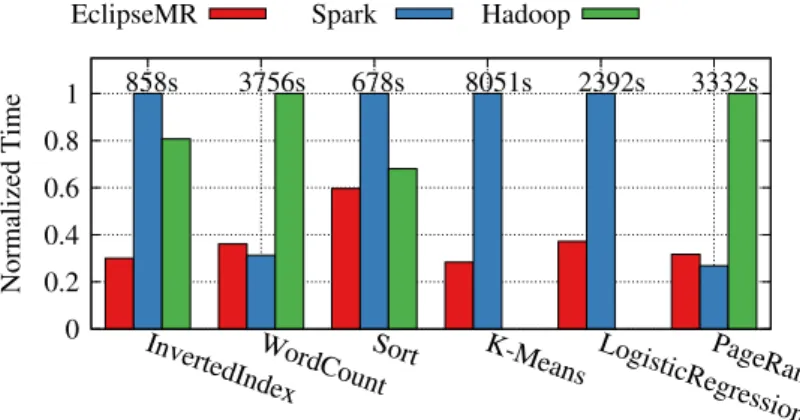
Figure 6 shows the normalized execution time to the slowest result. For the non-iterative MapReduce applications, Spark often shows slightly worse performance than Hadoop, which we believe is because Spark is specifically tailored for iterative jobs such as page rank, kmeans, and logistic regression, not for non-iterative ETL jobs such asinverted index. For
non-iterative jobs, all three frameworks do not benefit from caching. Therefore, the performance differences are mainly caused by scheduling decisions.
The performance of sort in Figure 6 shows how efficiently each framework performs the shuffle phase. Spark is known to perform worse than Hadoop for sort, and our experiments also confirm it. Spark claims it has improved sortsince version 1.1, but our experiments with version 1.6 show that Spark is still outperformed by Hadoop and EclipseMR.
For iterative applications, we set the number of iterations to 5 for thekmeansapplication, 2 for thepage rankapplication, and 10 for thelogistic regressionapplication. Since Hadoop is an order of magnitude slower than the other two frameworks, we omit the performance of Hadoop kmeansandlogistic regression.
For kmeans, EclipseMR is about 3.5x faster than Spark, and for logistic regression, EclipseMR is about 2.5x faster than Spark. Note that our faster C++ implementations ofkmeans
and logistic regression contributed to the performance improvement, but there are other performance factors that are not out of scope of this this research, i.e., Java heap management, container overhead, and some engineering issues that make Spark tasks unstable also need to be investigated.
For page rankapplication, Spark is about 15% faster than EclipseMR. This is because the size of the input file in page rank is small and our cluster has a large enough number of slots to run all the mappers concurrently. So, there’s no load balancing issues. Moreover,page rank
generates a very large output for each iteration; the size of iteration outputs in page rank is often similar to that of input data. While Spark does not store the intermediate outputs in file systems, EclipseMR writes the large iteration outputs to the persistent DHT file systems to provide fault tolerance. Therefore, if the size of intermediate results is large, the performance gap between EclipseMR and Spark decreases and EclipseMR is outperformed by Spark.
3.3.3 Iterative Applications
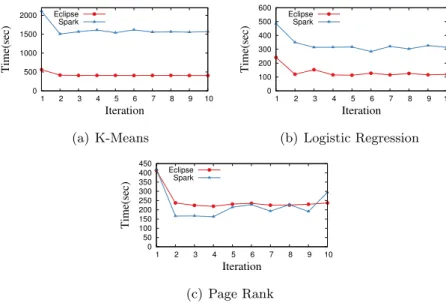
In the experiments shown in Figure 7 we further analyze the performance of EclipseMR and Spark for iterative applications -k-means, logistic regression, and page rank. Spark runs the first iteration of the iterative applications much slower than subsequent iterations because it constructs RDDs that can be used by subsequent iterations. For subsequent iterations ofkmeans
and logistic regression, EclipseMR runs 3x faster than Spark because it does not wait to be scheduled on the servers that has the iteration outputs in their caches, but it immediately starts running in a remote server and accesses remote cached data.
Similar to kmeans and logistic regression, page rank also runs subsequent iterations faster than the first iteration by taking advantage of input data caching. Unlike kmeans, EclipseMR is outperformed by Spark for subsequentpage rankiterations mainly because EclipseMR writes large iteration outputs to the DHT file system. However, even if EclipseMR writes to slow disks, EclipseMR is at most 30% slower than Spark. With a small 30% IO overhead, EclipseMR can restart from the iteration if system crashes.
0 500 1000 1500 2000 1 2 3 4 5 6 7 8 9 10 Time(sec) Iteration Eclipse Spark (a) K-Means 0 100 200 300 400 500 600 1 2 3 4 5 6 7 8 9 10 Time(sec) Iteration Eclipse Spark (b) Logistic Regression 0 50 100 150 200 250 300 350 400 450 1 2 3 4 5 6 7 8 9 10 Time(sec) Iteration Eclipse Spark (c) Page Rank
Figure 7: Execution Time of Iterative Jobs
Note that Spark runspage rank slower than EclipseMR in the last iteration because Spark writes its final outputs to disk storage. The last iterations ofkmeansandlogistic regression
are not slower than the previous iterations because the outputs of these applications are not as large as page rank.
IV
Index Structures for the Persistent Memory
The fundamental challenge in designing a data structure for the persistent memory is to guarantee the failure-atomicity during the transition between one consistent state to the other. It is necessary to rely on the fine-grained memory management scheme with memory fence instruction and cache-line flush instruction. However, it is desirable to minimize the number of these expensive instructions as they hinder the optimization of out-of-order execution and cause cache invalidation.
4.1 B3-Tree: Byte-addressable Binary B-tree
Figure 8: Page Structure of B3-tree
4.1.1 Node Structure of B3-tree
B3-tree is a hybrid index that combines the positive properties of binary search tree (byte-addressability) and balanced hierarchical B-tree (cache locality). B3-tree is a self-balancing binary tree index but its rebalancing operation is similar to that of B-trees rather than the rotations of AVL-tree or red-black tree. B3-tree groups a set of nearby BST nodes and stores them in a singleB3-tree node. To distinguish internal BST nodes from external B3-tree nodes, we refer to external B3-tree node as B3-tree page and internal binary nodes as BST nodes
hereafter.
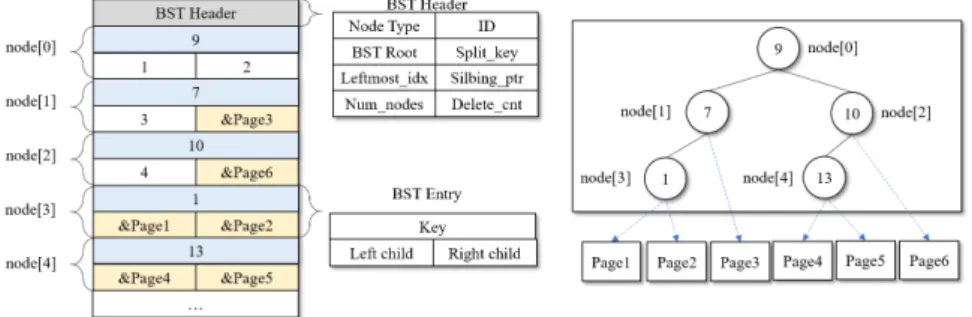
Figure 8 illustrates the structure of B3-tree page. As in B-tree variants, B3-tree is an n-ary
tree, i.e., each tree page has multiple pointers to child pages and the ordering of child pages are managed by a BST. As shown in Figure 8, eachB3-tree page consists of a header and an array of keys and child pointers.
The header stores three fields; i) the root offset stores the offset of the root BST node, ii) thepage type field indicates whether the current page is a leaf B3-tree page or an internalB3 -tree page, iii) and the sibling pointer points to its external sibling B3-tree page, which we will describe in Section 4.2.2.1.