Sovereign Debt and Structural Reforms
Andreas Müllery Kjetil Storeslettenz Fabrizio ZilibottixMay 30, 2019
Abstract
We construct a dynamic theory of sovereign debt and structural reforms with limited enforcement and moral hazard. A sovereign country in recession would like to smooth consumption. It can also undertake costly reforms to speed up recovery. The sovereign can renege on contracts by su¤ering a stochastic cost. The Constrained Optimum Allocation (COA) prescribes non-monotonic dynamics for consumption and e¤ort and imperfect risk sharing. The COA is decentralized by a competitive equilibrium with markets for renegotiable GDP-linked one-period debt. The equilibrium features debt overhang: reform e¤ort decreases in a high debt range. We also consider environments with less complete markets.
JEL Codes: E62, F33, F34, F53, H12, H63
Keywords: Debt Overhang, Default, Dynamic Principal-Agent Model, European Debt Cri-sis, Markov Equilibrium, Moral hazard, Renegotiation, Risk premia, Sovereign Debt, Structural Reforms.
We would like to thank the editor, three referees, Arpad Abraham, Manuel Amador, George-Marios Angeletos, Cristina Arellano, Adrien Auclert, Marco Bassetto, Tobias Broer, Fernando Broner, Alessandro Dovis, Jonathan Eaton, John Geneakoplos, Marina Halac, Patrick Kehoe, Enrique Mendoza, Juan-Pablo Nicolini, Ugo Panizza, Victor Rios-Rull, Ctirad Slavik, Aleh Tsyvinski, Harald Uhlig, Jaume Ventura, Christopher Winter, Tim Worrall, and seminar participants at Annual Meeting of the Swiss Society of Economics and Statistics, Barcelona GSE Summer Forum, Brown University, CEMFI, Columbia University, CERGE-EI, CREi, ECB conference: Public debt, …scal policy and EMU deepening, EIEF Political Economy Workshop, ESSIM 2016, European University Institute, Goethe University Frankfurt, Graduate In-stitute of Geneva, Humboldt University, Istanbul School of Central Banking, LMU Munich, NORMAC, Oxford, Royal Holloway, Swiss National Bank, Università Cà Foscari, Universitat Autonoma Barcelona, University College London, Uni-versity of Cambridge, UniUni-versity of Essex, UniUni-versity of Konstanz, UniUni-versity of Mannheim, UniUni-versity of Oslo, UniUni-versity of Oxford, University of Pennsylvania, University of Padua, University of Toronto, and Yale University. We acknowledge support from the European Research Council (ERC Advanced Grant IPCDP-324085).
yUniversity of Essex, Department of Economics, [email protected]. zUniversity of Oslo, Department of Economics, [email protected]. xYale University, Department of Economics, [email protected].
In this paper, we propose a normative and positive dynamic theory of sovereign debt in an environ-ment characterized by informational frictions. The theory rests on two building blocks. First, sovereign debt is subject to limited enforcement, and countries can renege on their obligations subject to real costs as in, e.g., Aguiar and Gopinath (2006), Arellano (2008) and Yue (2010). Second, countries can undertakestructural policy reforms to speed up recovery from an existing recession.1 The reform e¤ort is assumed to be unobservable and subject to moral hazard.
The theory is motivated by the recent debt crisis in Europe, where sovereign debt and economic reforms emerged as salient and intertwined policy issues. Greece, for instance, saw its debt-GDP ratio soar from 103% in 2007 to 172% in 2011 (despite a 53% haircut in 2011) and the risk premium on its government debt boom during the same period. While creditors and international organizations pushed the Greek government to introduce structural reforms that would help the economy recover and meet its international …nancial obligations, such reforms were forcefully resisted internally.2 Opposers maintained that the reforms would imply major sacri…ce for domestic residents while a large share of the bene…ts would accrue to foreign lenders. Meanwhile, international organizations stepped in to provide …nancial assistance and access to new loans, asking in exchange …scal restraint and a commitment to economic reforms. Our theory rationalizes these dynamics.
The model economy is a dynamic endowment economy subject to income shocks following a two-state Markov process. The economy (henceforth, the sovereign) starts in a recession with a stochastic duration. Costly structural reforms increase the probability that the recession ends. Consumers’ preferences induce a desire for consumption and e¤ort smoothing. We …rst characterize the solution of two planning problems: the …rst best and the constrained optimum allocation (COA) subject to limited enforcement and moral hazard. In the …rst best, the planner provides the sovereign country with full insurance by transferring resources to it during recession and reversing the transfers once the recession ends. The sovereign exerts the e¢ cient level of costly e¤ort as long as the recession lasts.
The …rst best is not implementable in the presence of informational frictions for two reasons. First, the sovereign has access to a stochastic outside option whose realization is publicly observable. This creates scope for opportunistic deviations involving cashing in transfers for some time, and then unilaterally quit (i.e., default on) the contract as soon as the realization of the outside option is su¢ ciently favorable. Second, the sovereign has an incentive to shirk and rely on the transfers rather than exerting the required reform e¤ort to increase output.
The COA is characterized by means of a promised utility approach in the vein of Spear and Sri-vastava (1987), Thomas and Worrall (1988 and 1990), and Kocherlakota (1996). The optimal contract is subject to an incentive compatibility constraint (IC) that pins down the e¤ort choice and a partic-ipation constraint (PC) that captures the limited enforcement. The COA has the following features: throughout recession, within spells of a slack PC (i.e., when the realized cost of default is high), the planner front-loads the sovereign’s consumption and decreases it over time in order to provide dy-namic incentives for reform e¤ort (as in Hopenhayn and Nicolini 1997). In this case, the solution is dictated by the IC and is history-dependent: consumption and promised utility fall over time, while e¤ort follows non-monotone dynamics. Whenever the PC binds (i.e., the sovereign faces an attractive
1
Examples of such reforms include labor and product market deregulation, and the establishment of …scal capacity that allows the government to raise tax revenue e¢ ciently (see, e.g., Ilzkovitz and Dierx 2011). While bene…cial in the long run, these reforms entail short-run costs for citizens at large, governments or special-interest groups (see, e.g., Blanchard and Giavazzi 2003).
2Italy is another example. The incumbent Italian government –which advocated economic reforms and …scal stability
– was defeated in the elections of March 2018. Since a new populist government which strenuosly opposes structural reforms took o¢ ce, the Italy-Germany 10-year bond spread has increased from 1.3% to 3.2% between March and October 2018.
outside option), the planner increases discretely consumption and promised utility in order to prevent the sovereign from leaving the contract.
Next, we study the decentralization of the COA. We show that the COA can be implemented by a market equilibrium where the sovereign issues two one-period securities paying returns contingent on the aggregate state (GDP-linked bonds). The bonds, which are defaultable and renegotiable, are sold to pro…t-maximizing international creditors who hold well-diversi…ed portfolios. When the sovereign faces a low realization of the default cost, she could, in principle, default, pay a cost, and restart afresh with zero debt. However, costly default can be averted by renegotiation: when a credible default threat is present, a syndicate of creditors o¤ers a take-it-or-leave-it debt haircut. As in Bulow and Rogo¤ (1989), there is no outright default in equilibrium, but recurrent stochastic debt renegotiations.3 In order for this market arrangement to attain constrained e¢ ciency, the creditors must, ex-post, have all the bargaining power. We show that a Markov-perfect market equilibrium with these characteristics attains the same allocation as a social planner who can in‡ict the same punishment in case of a deviation as can the market in case of outright default (i.e., imposing the same stochastic default cost and letting the agent resume in the market equilibrium with zero debt).
In our model, two one-period securities are su¢ cient to decentralize the COA. This result hinges on two features. First, the process of renegotiation (following a particular protocol) e¤ectively turns the two assets into a continuum of state-contingent securities. Second, the equilibrium debt dynamics and its endogenously evolving price provide e¢ cient dynamic incentives for the sovereign to exert the second-best reform e¤ort. We prove that our environment yields the same allocation as a full set of Arrow-Debreu securities with endogenous borrowing constraints in the spirit of Alvarez and Jermann (2000). Our decentralization is parsimonious and simple, in the sense that it requires only two assets and no need to solve for a set of endogenous borrowing constraints.
In the market equilibrium, debt accumulates and consumption falls over time as long as the recession lingers and debt is not renegotiated. Interestingly, the reform e¤ort is a non-monotone function of debt. This result stems from the interaction between limited enforcement and moral hazard. Under full enforcement, e¤ort would increase monotonically over the recession as debt accumulates. Absent moral hazard, e¤ort would be constant when the PC is slack and decrease every time debt is renegotiated. When both informational constraints are present, e¤ort increases with debt at low levels. However, for su¢ ciently high debt levels the relationship is ‡ipped: there, issuing more debt deters reforms because, when the probability of renegotiation is high, most of the gains from an economic recovery would accrue to foreign lenders. In this region, the reform e¤ort falls over time as debt further accumulates. Thisdebt
overhang curtails consumption smoothing: when sovereign debt is high, investors expect low reform
e¤ort, are pessimistic about the economic outlook, and request even higher risk premia. Interestingly, in our theory this form of debt overhang is constrained e¢ cient under the postulated informational constraints.
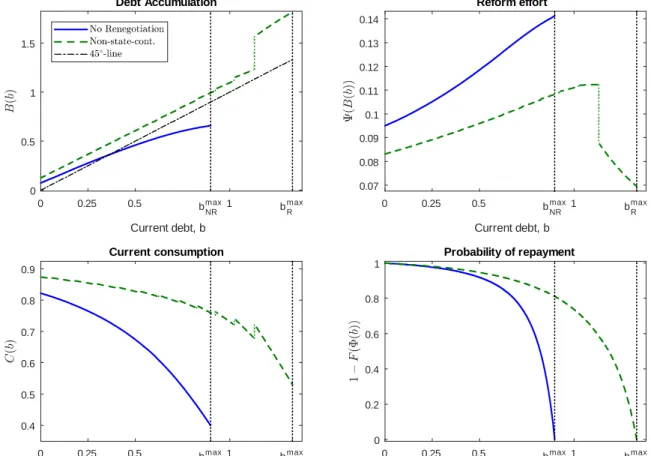
We also study environments with more incomplete markets. In particular, we consider an economy where the sovereign can issue only one asset – a non-contingent bond. This economy fails to attain the COA: the sovereign attains less consumption smoothing and provides an ine¢ cient e¤ort level.4 This extension is interesting because in reality markets for GDP-linked bonds are often missing. In this (arguably realistic) one-asset environment, there is scope for policy intervention. In particular,
3Empirically, unordered defaults are indeed rare events. Tomz and Wright (2007) and Sturzenegger and Zettelmeyer
(2008) documents a substantial heterogeneity in the terms at which debt is renegotiated, which is consistent with our assumption of a stochastic outside option (see also Panizzaet al. 2009 and Reinhart and Trebesch 2016).
4
We also study a case where renegotiation is ruled out as in Eaton and Gersovitz (1981). This further curtails consumption smoothing and welfare.
an international institution such as the IMF can improve welfare by means of an assistance program. During the recession, the optimal program entails a persistent budget support through extending loans on favorable terms. When the recession ends, the sovereign is settled with a (large) debt on market terms.
Our analysis is related to a large international and public …nance literature. In a seminal con-tribution, Atkeson (1991) studies the optimal contract in an environment in which an in…nitely-lived sovereign borrower faces a sequence of two-period lived lenders subject to repeated moral hazard. The focus of our paper di¤ers from Atkeson’s in two regards. First, we emphasize the non-monotone e¤ort dynamics and the role of periodic renegotiations along the equilibrium path. Second, we provide a novel decentralization result through renegotiable bonds.
A number of recent papers deal with the dynamics of sovereign debt under a variety of informa-tional and contractual frictions. Dovis (2019) studies the e¢ cient risk-sharing arrangement between international lenders and a sovereign borrower with limited commitment and private information about domestic productivity. In his model the COA can be implemented as a market equilibrium with non-contingent defaultable bonds of short and long maturity. He does not consider the interaction between structural reforms and limited commitment. Aguiaret al. (2017) study a model à la Eaton and Gerso-vitz (1981) with limited commitment assuming, as we do, that the borrower has a stochastic default cost. Their research is complementary to ours insofar as it focuses on debt maturity in rollover crises, from which we abstract. Jeanne (2009) also studies a rollover crisis in an economy where the govern-ment takes a policy action that a¤ects the return to foreign investors (e.g., the enforcegovern-ment of creditor’s right) but this can be reversed within a time horizon that is shorter than that at which investors must commit their resources.
Our work is also related to the literature on debt overhang initiated by Krugman (1988). He constructs a static model with exogenous debt showing that a large debt can deter the borrower from undertaking productive investments. In this regime, it may be optimal for the creditor to forgive debt. This is never optimal in our model. Several papers consider distortions associated with high indebtedness in the presence of informational imperfections. Aguiar and Amador (2014) show that high debt increases the volatility of consumption by reducing risk sharing. Aguiar et al. (2009) consider the e¤ect of debt on investment volatility. When an economy is indebted, productivity shocks gives rise to larger dispersion in investment rates. Aguiar and Amador (2011) consider a politico-economic model where capital income can be expropriated ex-post and the government can default on external debt. A country with a large sovereign debt position has a greater temptation to default, and therefore investments are low. Conesa and Kehoe (2017) construct a theory where governments of highly indebted countries may choose to gamble for redemption.
Our research is related also to the literature on endogenous incomplete markets due to limited enforcement or limited commitment. This includes Alvarez and Jermann (2000) and Kehoe and Perri (2002). Our result that e¢ ciency can be attained by a sequence of one-period debt contract is related to Fudenberget al. (1990) who provide conditions under which commitment problems in repeated moral hazard setups can be resolved by a sequence of one-period contracts. Our theory also builds on the insight of Grossman and Van Huyck (1988) that renegotiation can be used to complete markets. Our focus on a unique Markov equilibrium is related to Auclert and Rognlie (2016) who study the properties of an Eaton-Gersovitz economy. The analysis of constrained e¢ ciency by means of promise-keeping constraints is related to the literature on competitive risk sharing contracts with limited commitment, including, among others, Thomas and Worrall (1988), Marcet and Marimon (1992), Phelan (1995), Kocherlakota (1996), and Krueger and Uhlig (2006).
as Aguiar and Gopinath (2006), Arellano (2008), and Chatterjee and Eyigungor (2012).5 Abraham et al. (2018) study an Arellano (2008) economy, extended to allow shocks to government expenditures, and compare quantitative outcomes of the market allocation to the optimal design of a Financial Stability Fund. Broneret al. (2010) study the incentives to default when parts of the government debt is held by domestic residents. Songet al. (2012) and Mülleret al. (2016a) study the politico-economic determinants of debt in open economies where governments are committed to honor their debt.
The rest of the paper is organized as follows. Section 1 describes the model environment. Section 2 solves for the …rst best and the COA under limited enforcement and moral hazard. Section 3 provides the main decentralization result. Section 4 considers one-asset economies and discusses policy interventions to restore e¢ ciency. Section 5 concludes. Appendix A contains the proofs of the main lemmas and propositions. Online Appendix B contains additional technical material referred to in the text.
1
The model environment
The model economy is a small open endowment economy populated by an in…nitely-lived representative agent. A benevolent sovereign makes decisions on behalf of the representative agent. The stochastic endowment follows a two-state Markov switching process, with realizationswandw, where0< w < w. We label the two endowment states recession and normal time, respectively. An economy starting in recession remains in the recession with endogenous probability 1 p and switches to normal time with probabilityp. Normal time is assumed to be an absorbing state. This assumption aids tractability and enables us to obtain sharp analytical results. During recession, the sovereign can implement a costly reform policy to increase p. In our notation,p denotes both thereform e¤ ort and the probability that the recession ends. The sovereign can smooth consumption by contracting with a …nancial intermediary that has access to an international market o¤ering a gross return R.
The sovereign’s preferences are given byE0P t u(ct) tIfdefault intg X(pt) , where = 1=R.
The function u is twice continuously di¤erentiable and satis…es limc!0u(c) = 1, u0(c) > 0, and
u00(c)<0. I 2 f0;1g is an indicator switching on when the economy is in a default state and is an associated utility loss. In the planning allocation, the cost accrues when the sovereign opts out of the contract o¤ered by the planner. In the market allocation, it accrues when sovereign unilaterally reneges on a debt contract with international lenders.6 In recession, follows an i.i.d. process drawn from the p.d.f. f( ) with an associated c.d.f. F( ): We assume that F( ) is continuously di¤erentiable everywhere, and denote its support by @ [ min; max] R+, where min < max < 1. The assumption that shocks are independent is for simplicity. In order to focus on debt dynamics in recessions we assume that there is full enforcement in normal time (i.e., in normal time is arbitrarily large) – see (Müller et al. 2016b) for a generalization in which the distribution of is the same in normal time and in recession.
The function X(p) represents the reform cost, assumed to be increasing and convex in the proba-bility of exiting recession, p2[p; p] [0;1]. X is assumed to be twice continuously di¤erentiable, with the following properties: X p = 0; X0 p = 0; X0(p)>08p > p; X00(p)>0, andlimp!pX0(p) =1.
5
Other papers studying restructuring of sovereign debt include Asonuma and Trebesch (2016), Bolton and Jeanne (2007), Hatchondoet al. (2014), Mendoza and Yue (2012), and Yue (2010).
6The cost is exogenous and publicly observed, and captures in a reduced form a variety of shocks including both
taste shocks (e.g., the sentiments of the public opinion about defaulting on foreign debt) and institutional shocks (e.g., the election of a new prime minister, a new central bank governor taking o¢ ce, the attitude of foreign governments, etc.). Alternatively, could be given a politico-economic interpretation, as re‡ecting special interests of lobbies.
The time line of events is as follows: at the beginning of each period, the endowment state is observed; then, is realized and publicly observed; …nally, e¤ort is exerted.
2
Planning allocation
We …rst characterize the constrained e¢ cient allocation as the solution to a (dual) benevolent social planner problem which maximizes the principal’s (i.e., creditors’) discounted value of expected future pro…ts subject to a sequence of incentive and limited enforcement constraints. The problem can be written recursively using the agent’s (i.e., sovereign’s) continuation utility as the state variable and letting the planner maximize pro…ts subject to a promise-keeping constraint.7
Let denote the promised utility, i.e., the expected utility the sovereign is promised in the beginning of the period, before the realized is observed. is the key state variable of the problem. We denote by ! and ! the promised continuation utilities conditional on the realization and on the economy staying in recession or switching to normal time, respectively. We denote byP( )the expected present value of pro…ts accruing to the planner conditional on delivering the promised utility in the most cost-e¤ective way. The optimal value P( )satis…es the following functional equation:
P( ) = max fc ;p ;! ;! g 2@ Z @ w c + p P(! ) + (1 p )P(! ) dF( ); (1)
where the maximization is subject to a promise-keeping constraint (PK)
Z
@
[u(c ) X(p ) + (p ! + (1 p )! )]dF( ) = ; (2)
the planner’s pro…t function in normal time, P(! ) = max
c2[0;~c]w c+ P
1[! u(c)] ; (3)
and the boundary conditions c 2[0;~c],p 2[p; p], ; ! 2[!;!~], and ! 2[!;!~], where~c;!;~ !~ and ! are generous bounds that will never bind in equilibrium.
We introduce two informational frictions. The …rst is limited enforcement captured by a set of PCs: the sovereign can quit the contract when the realization of makes such action attractive ex-post. The second is moral hazard captured by an IC: the reform e¤ort is chosen by the sovereign and is not observed by the planner.
Under limited enforcement, the planner must provide a utility that exceeds the sovereign’s outside option if she quits the contract, , where is the shock discussed above and is the sovereign’s value of not being in the contract. Thus, the allocation is subject to the following set of PCs:
u(c ) X(p ) + [p ! + (1 p )! ] ; 2 @; (4) and to a lower bound on initial and future promised utility, i.e., E[ ]and
! ; (5)
7We formulate the planning problem as a one-sided commitment program. The problem would be identical under
two-sided lack of commitment under some mild restrictions on the state space. In particular, one should impose an upper bound on the sovereign’s initial promised utility to ensure that the principal does not …nd it optimal to ever exit the contract. We return to this point below.
where is the expected utility that the sovereign could attain by quitting the contract in the next period after the realization of . Thus, it is not feasible for the planner to promise a utility ! < : In addition, we assume that is su¢ ciently low to ensure that it is never e¢ cient to terminate the program (even under the realization = min).8 In the …rst part of the paper we simply treat as an exogenous parameter. Later we endogenize .
When the planning problem is subject to moral hazard, the allocation is also subject to the following IC, re‡ecting the assumption that the sovereign chooses e¤ort after the planner has set the future promised utilities:
p = arg max
p2[p;p] X(p) + [p! + (1 p)! ]: (6)
2.1 First best
We start by characterizing the …rst-best allocation given by the program (1)–(3). The proof, which follows standard methods, can be found in Appendix B.
Proposition 1 Given a promised utility ; the …rst best allocation satis…es the following properties.
The sequences for consumption and promised utilities are constant at the level cF B( ); !F B = ;
and !F B = +X pF B( ) = 1 1 pF B( ) ; implying full consumption insurance, cF B( ) =
cF B !F B . Moreover, e¤ ort pF B( ) is constant over time throughout recession. cF B( ) and pF B( )
are strictly increasing and strictly decreasing functions, respectively, satisfying:
1 (1 pF B( ))
0 B
@ (w w)
| {z }
output increase if recovery
u0 cF B( ) + X pF B( )
| {z }
saved e¤ ort cost if recovery
1 C A = X0 pF B( )(7) u cF B( ) 1 X pF B( ) 1 (1 pF B( )) = : (8)
The solution to the functional equation (3) in normal time is given by
P(! ) = w c
F B(! )
1 ; c
F B(! ) =u 1((1 )! ): (9)
The …rst-best allocation yields full insurance: the sovereign enjoys a constant consumption irrespec-tive of the endowment state and exerts a constant reform e¤ort during recession. Moreover, consump-tioncF B is strictly increasing in while e¤ortpF B is strictly decreasing in : a higher promised utility is associated with higher consumption and lower e¤ort. P is strictly decreasing and strictly concave.
2.2 Constrained Optimum Allocation (COA)
Next, we characterize the COA. The planning problem (1)-(3) is subject to the PC (4), the lower bound on ! (5), and the IC (6). Note that the planning problem is evaluated after the uncertainty about the endowment state has been resolved, but before the realization of . For didactic reasons, we …rst study a problem with only limited enforcement. Then, we generalize the analysis to the case in which
8Note that the constraint (5) is implied by next period’s PK (2) and the set of PCs (4). It is convenient to specify
it as a separate constraint since this allows us to attach a Lagrange multiplier to (5) instead of (2). The condition on must guarantee that w c min+ p minP(! min) + (1 p min)P(! min) 0. Otherwise, both parties would gain from terminating the contract. This condition will always hold true when we endogenize .
there is also moral hazard. We start by establishing a property of the COA that holds true in both environments.9
Lemma 1 Assume that the pro…t function P is strictly concave. De…ne the sovereign’s discounted
utility conditional on the promised utility and the realization as ( ) u(c ( )) X(p ( )) +
[p ( )! ( ) + (1 p ( ))! ( )]: Then, the COA features a unique threshold function ~( ) such
that the PC binds if < ~( )and is slack if ~( ). Moreover,
( ) = if <~( );
~( ) if ~( ):
The lemma formalizes the intuitive properties that (i) if the planner provides the agent with higher expected utility than her reservation utility in a state a, then it is optimal for her to do so for all > a; moreover, promised utility is equalized across all such states; (ii) if the planner provides the agent an expected utility equal to the reservation utility in a state b, then it is optimal for her to also do so for all < b. Thus, ( )is linearly decreasing in for <~( ), and constant thereafter.
2.2.1 Limited Enforcement without Moral Hazard
In this environment, there is no IC and the planner can control the e¤ort level directly. We prove in Appendix B that the planner’s pro…t function P( ) is strictly decreasing, strictly concave and di¤erentiable for all interior , i.e., > . Moreover, the …rst-order conditions (FOCs) of the program are necessary and su¢ cient. The proof follows the strategy in Thomas and Worrall (1990).
Combining the FOCs with respect to c ; ! ;and ! with the envelope condition (see the proof of Proposition 2 in Appendix B) yields:10
1 u0(c(! )) 1 u0(c ) = 0 (10) u0(c ) = 1 P0(! ); 8! > : (11) Combining these with the FOC with respect top yields
X0(p ) = (! ! ) +u0(c ) P(! ) P(! ) : (12) Equation (10) establishes that the planner provides the sovereign with full insurance against the endowment shock, i.e., she setsc(! ) =c and equates the marginal pro…t loss associated with promised utilities in the two states. Equation (12) establishes that e¤ort is set at the constrained e¢ cient level: The marginal cost of e¤ort equals the sum of the marginal bene…ts accruing to the sovereign and to the planner, respectively. Proposition 2 provides a formal characterization of the COA.11
9
Proving thatP in equation (9) is strictly concave is straightforward. The strict concavity of P is more di¢ cult to establish analytically. We prove below thatP is strictly concave in the case without moral hazard, while in the case with moral hazard we will guess and verify it numerically.
1 0Note that since there is full enforcement during normal time, c(! )andP(! )are as in the …rst best (cf. equation
9). Thus, P0(! ) = 1=u0(c(! )):Also, equations (10)-(11) imply that the marginal cost of providing promised utility is equalized across the two endowment states, i.e., P0(! ) =P0(! ):
1 1The proof is in Appendix B. The proof of Proposition 3 below encompasses the proof of Proposition 2 as a special
Proposition 2 The COA is characterized as follows. The threshold function ~( ) is decreasing and implicitly de…ned by the condition
= "Z ~( ) min dF( ) + ~( )h1 F(~( ))i # : (13) Moreover:
1. If < ~( ), the PC is binding, and the allocation (c ; p ; ! ; ! ) is determined by (10), (11),
(12), and by (4) holding with equality. Moreover, ! = 0 > .
2. If ~( ), the PC is slack, and the allocation(c ; p ; ! ; ! )is given by! = 0 = ; c =c( );
! =!( ); andp =p( ), where the functions c( ); !( ) and p( )are determined by
u(c( )) X(p( )) + [p( )!( ) + (1 p( )) ] = ~( ); (14)
(10), and (12), respectively. The solution is history-dependent. The reform e¤ ort is strictly decreasing and consumption and future promised utility are strictly increasing in .
The COA under limited enforcement has standard back-loading properties. Whenever the PC is slack, consumption, e¤ort and promised utility remain constant over time. Consumption remains constant even when the recession ends. Thus, the COA yields full consumption insurance across all states in which the PC is slack. Whenever the PC binds, the planner increases the sovereign’s consumption and promised utilities while reducing her e¤ort in order to meet her PC. In this case,
0 > .12
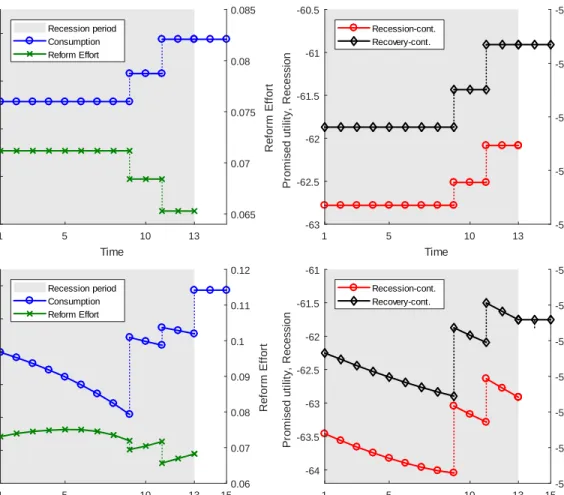
The upper panels of Figure 1 describe the dynamics of consumption and e¤ort (left panel), and promised utilities (right panel) under a particular sequence of realizations of .13 In this numerical example, the recessions last for 13 periods. Thereafter, the economy attains full insurance. Consump-tion is back-loaded and e¤ort is front-loaded. In periods 9 and 11, the PC binds and the planner must increase consumption and promised utility, and reduce e¤ort. Consumption and e¤ort remain constant when the PC is slack. Note also that consumption remains constant when the recession ends.
2.2.2 Limited Enforcement with Moral Hazard
Next, we consider the more interesting case in which the planner cannot observe e¤ort and is subject to both a PC and an IC. The COA features an important qualitative di¤erence from the case without moral hazard: within each spell in which the PC is slack, the planner front-loads consumption and promised utility to incentivize the sovereign to provide e¤ort. Therefore, moral hazard prevents full insurance even across the states of nature in which the PC is slack.
Let us start the analysis from the IC (6). The FOC yields X0(p ) = (! ! ), or equivalently
p = (! ! ) (15)
where (x) (X0) 1( x): The properties of X imply that p is increasing in the promised utility gap ! ! . Equation (15) is the analogue of (12). E¤ort is distorted because the sovereign does not internalize the bene…ts accruing to the planner.
1 2Although we have assumed that the planner controls e¤ort directly, the same allocation would obtain if the planner
did not control e¤ort ex ante but could observe it ex post and punish deviations. Details are available in the working paper version (Mülleret al. 2016b).
1 3
1 5 10 13 15 Time 0.4 0.5 0.6 0.7 0.8 0.9 1 Con s umpti on 0.06 0.07 0.08 0.09 0.1 0.11 0.12 R e fo rm E ffo rt Recession period Consumption Reform Effort 1 5 10 13 15 Time -64 -63.5 -63 -62.5 -62 -61.5 -61 Pr om ised ut il it y, R ecession -54 -53.5 -53 -52.5 -52 -51.5 -51 Pr om ised ut il it y, R ecover y Recession-cont. Recovery-cont. 1 5 10 13 Time 0.9 0.91 0.92 0.93 0.94 Con s umpti on 0.065 0.07 0.075 0.08 0.085 R e fo rm E ffo rt Recession period Consumption Reform Effort 1 5 10 13 Time -63 -62.5 -62 -61.5 -61 -60.5 Pr om ised ut il it y, R ecession -56 -55.5 -55 -54.5 -54 Pr om ised ut il it y, R ecover y Recession-cont. Recovery-cont.
Figure 1: Simulation of consumption, e¤ort, and promised utilities for a particular sequence of ’s. In this particular simulation the recession ends in period 13. The top panels show the planner allocation without moral hazard, the bottom panels with moral hazard.
The FOCs with respect to ! and ! together with the envelope condition yield (see proof of Proposition 3 in Appendix A):
1 u0(c(! )) 1 u0(c ) = 0(! ! ) (! ! ) P(! ) P(! ) (16) 1 u0(c ) = P0(! ) + 0(! ! ) 1 (! ! ) P(! ) P(! ) ; 8! > (17) 0 = [! ]; (18)
where 0 is the Lagrange multiplier on the constraint ! . This constraint binds in a range of low ’s where the impossibility of promising a utility below curbs the planner’s ability to provide dynamic incentives.14 Equation (17) is then replaced by the conditions ! = and >0.
The FOC (16) is the analogue of (10). With moral hazard, the planner does no longer provide the sovereign with full insurance against the realization of the endowment shock: by promising a higher
1 4
consumption if the economy recovers, she provides incentives for e¤ort provision. Note that the e¤ort wedge is proportional to the elasticity 0= :
The FOC (17) is the analogue of (11). There, the marginal utility of consumption simply equaled the pro…t loss associated with an increase in promised utility. Here, the planner …nds it optimal to open a wedge that is proportional to the elasticity of e¤ort: she front-loads consumption in order to make the sovereign more eager to leave a recession.
We can now proceed to a full characterization of the COA with moral hazard. As is common for problems with both limited enforcement and moral hazard, it is di¢ cult to prove that the program is globally concave and to establish analytically the curvature of the pro…t function. We therefore assume that P( )is strictly concave in , and verify this property numerically.15
Proposition 3 Assume that P is strictly concave. The COA with unobservable e¤ ort is characterized
as follows: (i) p = (! ! ) as in equation (15); (ii) the threshold function ~( ) is decreasing and
implicitly de…ned by equation (13). Moreover:
1. If < ~( ); the PC is binding and the allocation (c ; ! ; ! ; ) is determined by (16), (17),
(18), and by (4) holding with equality.
2. If ~( );the PC is slack and the allocation (c ; ! ; ! ; ) is determined by (16), (17), (18),
and
u(c ) X(p ) + [p ! + (1 p )! ] = ~( ): (19)
The solution is history-dependent, i.e., c =c( ); ! =!( );and ! =!( ). Promised utility
falls over time, i.e., ! =!( ) = 0 with = 0 when is su¢ ciently large. The function
c( ) is strictly increasing. The e¤ ort function p( ) = (!( ) !( )) is strictly increasing in
a range of low . In this range e¤ ort declines over time when the PC is slack.
3. P( )is strictly decreasing, and di¤ erentiable for all > . In particular,P0( ) = 1=u0(c( ))<
0: Moreover, P(! )> P(! ) for all and :
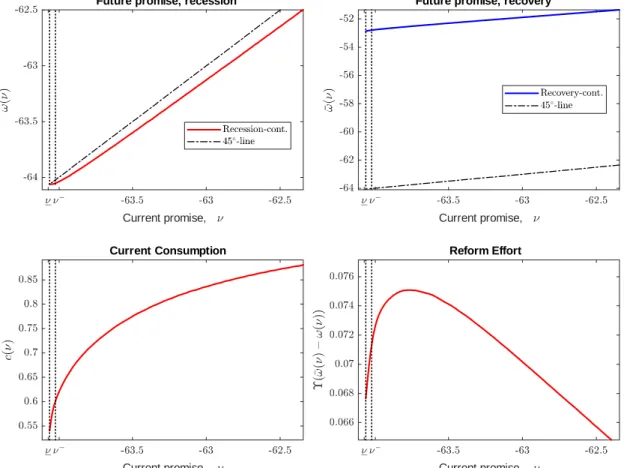
Figure 2 illustrates the results of Proposition 3 based on a numerical example. All panels show policy functions for an economy in recession, conditional on a slack PC. Promised utilities ! ( )and ! ( )and consumptionc( )are weakly increasing in . The upper left panel shows the law of motion of when the recession lingers and the PC remains slack. The fact that! ( )is below the 45-degree line implies that promised utility falls over time and converges to the lower bound .16 In the range
[ ; ]the planner is constrained by the inability to abase promised utility below . The two left panels imply that, if the recession lingers and the PC is slack, consumption declines over time. Instead, the dynamics of e¤ort are non-monotone.
We now discuss some additional analytical properties of the COA. We start with consumption dynamics. Combining (17) with the envelope conditionP0(! ) = 1=u0(c(! ))for! > and denoting
0 =! and 0 =! ;yields: 1 u0(c ) 1 u0(c( 0)) = 0( 0 0) 1 ( 0 0) P 0 P 0 : (20) 1 5
We prove that under the assumption thatP is strictly concave,P( )must be di¤erentiable for all interior and that the FOCs are necessary (see Lemma 3.2 in Appendix B). Although we cannot establish in general that they are also su¢ cient, this turns out to be the case in all parametric examples we considered.
1 6Note that, as falls, the probability that the PC binds increases. At the PC binds almost surely in the next period,
Current promise, Future promise, recession
Current promise, Future promise, recovery
Current promise, Current Consumption
Current promise, Reform Effort
Figure 2: Policy functions for state-contingent promised utility, consumption, and e¤ort conditional on the maximum cost realization max.
We label equation (20) a Conditional Euler Equation (CEE). The CEE describes the optimal consump-tion dynamics for states where the PC does not bind next period and > . The right-hand side of (20) is positive. Thus, consumption decreases over time as long as the economy remains in recession and the PC is slack, echoing the optimal consumption dynamics in Hopenhayn and Nicolini (1997).17
Combining the CEE (20) with the Euler equation describing the consumption dynamics upon recovery (16), yields a conditional version of the so-called Inverse Euler Equation (CIEE):
1 u0(c ) = 1 0 0 1 u0(c( 0))+ 0 0 1 u0(c( 0)): (21) The CIEE equates the inverse marginal utility in the current period with next period’s expected inverse marginal utility conditional on the PC being slack and > . The key di¤erence relative to the standard inverse Euler equation in the dynamic contract literature (cf. Rogerson 1985) is that our CIEE holds true only in states where the PC is slack. If there were no enforcement problems, then our
1 7The right-hand side of (20) is positive since 0>0andP( 0)> P( 0) (see the proof of Proposition 3 in Appendix
A). This implies that the marginal utility of consumption must be rising over time as falls. This property di¤ers from some other papers in the repeated moral hazard literature (e.g., Phelan and Townsend (1991)) where the pro…t function can be non-monotone in promised utility. In our model, the planner would never be better o¤ by delivering more than the promised utility (as long as is in the feasible set );since she can reduce current consumption without a¤ecting the e¤ort choice.
CIEE would boil down to a standard inverse Euler equation.
Next, we turn to the e¤ort dynamics. In analogy with consumption, one might expect that, when the PC is slack, the planner would back-load e¤ort to incentivize its provision. However, this conjecture is incorrect. E¤ort is in fact decreasing in promised utility when is high, inducing back-loading of e¤ort.18 However, when is su¢ ciently low, e¤ort is increasing in promised utility (cf. Proposition 3 and its proof), implying that, as falls, e¤ort decreases over time. In this range, the planner front-loads e¤ort even within spells when the PC is slack. The reason is that the planner cannot reduce inde…nitely the promised utility. When , the constraint ! becomes binding, and the planner sets ! = , inducing p ( ) = (! ( ) ). Since both both and ! are increasing functions (the planner can decrease ! without bound since there is perfect enforcement in normal time), p must be increasing in :Hence, e¤ort declines over time if the recession lingers and the PC remains slack for su¢ ciently long.19
The lower panels of Figure 1 illustrate simulated dynamics of consumption, promised utilities, and e¤ort in the case of moral hazard under the same sequence of realizations of as in the upper panels. Consumption and promised utilities fall over time when the PC is slack, while e¤ort falls or rises over time depending on : When becomes su¢ ciently low (i.e., in periods 7, 8, and 9), the reform e¤ort starts falling. Note that consumption increases when the recession ends, implying that the endowment risk is not fully insured.
In conclusion, the combination of limited enforcement and moral hazard delivers e¤ort dynamics qualitatively di¤erent from models with only one friction. In our model e¤ort is hump-shaped over time, even when the PC remains slack. In contrast, e¤ort is monotone increasing in many pure moral hazard models and weakly decreasing in pure limited enforcement models. The dynamics of consumption echo the typical properties of models with dynamic moral hazard as long as the PC is slack, namely the planner curtails consumption in order to extract higher e¤ort over time. However, the planner periodically increases consumption and promised utility whenever the PC is binding. This averts the immiseration that would arise in a world of perfect enforcement.
2.3 Primal Formulation
We have characterized the COA by solving a dual planning problem, i.e., maximizing pro…ts subject to a promised-utility constraint. We can alternatively solve aprimal problem where the planner maximizes discounted utility subject to a promised-expected-pro…t constraint. We characterize the primal program because it is directly comparable with the market equilibrium studied below.
Let pl( ) and pl( ) denote the sovereign’s discounted utility before and after the realization of ;respectively:We can write the primal problem as:
pl( ) = Z @ pl ( )dF( ) (22) = Z @ max fc ;p ; 0; 0g 2@ h u(c ) X(p ) + p pl 0 + (1 p ) pl 0 i dF( );
1 8Lemma 3.1 in Appendix B shows that e¤ort is decreasing in promised utility when is large. This result is subject
to a su¢ cient condition, namely that limp!pX00(p) >0. However, numerical analysis suggests that this is true more
generally.
1 9
where pl( ) =u(w (1 ) )=(1 ), subject to the promised-pro…t constraint = Z @ b dF ( ); (23) having de…ned b =w c + h p 0 + (1 p ) 0 i
as the planner’s discounted pro…t after the real-ization of . The problem is subject to a set of PCs and ICs
u(c ) X(p ) + hp pl 0 + (1 p ) pl 0 i ; 2 @; (24)
p = arg max
p2[p;p] X(p) +
h
p pl 0 + (1 p) pl 0 i; (25) and to the boundary conditionsc 2[0;~c], 0 2[ ;~], and ; 0 2[ ; max], where = (~c w)=(1 R 1)
and ~ = w=(1 R 1) are generous bounds that will never bind in equilibrium and max satis…es pl(
max) = E[ ].
While the program (22) may in general admit multiple …xed points for pl, we can characterize the unique …xed point associated with the COA by exploiting duality properties. First, for the primal and the dual to be equivalent, = P( ) and = pl( ): Thus, pl = P 1. Since P is strictly decreasing and strictly concave, so must be pl. Second, the two solutions must feature the same threshold function, i.e., pl( ) = ~(P 1( )).
A complete characterization of the primal COA is deferred to Proposition 4 in Appendix A. Here, we highlight the properties that will be key for the decentralization results. First, the value function of the primal COA satis…es:
pl( ) =h1 F( pl( ))i pl( ) +Z pl( )
min
( )dF( ); (26)
where 2 [ ; P( E[ ])] and pl( ) ~(P 1( )): As in the dual, the agent perceives the utility if the PC binds and ~( ) if the PC is slack, where =P 1( ). Second, e¤ort must be the
same as in the dual, implying thatp= pl( 0; 0) = ( pl( 0) pl( 0)). Third, letb ( )denote that optimal choice of b in the COA. In Proposition 4, we prove that the COA features20
b ( ) = ( bpl( ) = Wpl 1 pl( ) if pl( ) ^ bpl( ) = Wpl 1( ) if < pl( ) ; (27) where Wpl(x) max 02[ ;~]; 02[ ;P( E[ ])]u w x+ h pl( 0; 0) 0+ 1 pl( 0; 0) 0i (28) X( pl( 0; 0)) + pl( 0; 0) pl( 0) + (1 pl( 0; 0)) pl( 0)
is the agent’s discounted utility. In particular, Wpl(b ( )) denotes the continuation utility after the realization of ; conditional on the optimal choice of b ( ) given by (27). If the PC is slack, the principal sets b = bpl( ) independently of . In this case, consumption and continuation utility
2 0Note that the optimal choice of consumption and future promised utility are also identical across the primal and the
are also independent of , and in particular Wpl bpl( ) = pl( ). If, instead, the PC binds, then the principal sets b = ^bpl( ); which ensures that the agent’s PC holds with equality. In this case, the agent’s continuation utility is Wpl ^bpl( ) = : Note that = 1 F( pl( )) bpl( ) +R pl( )
min
^
bpl( )dF( ). Namely, the promised expected pro…t equals the expected "transfer" she receives from the agent. Note also that inverting this expression allows us to de…ne bpl( )recursively;
bpl( ) =
R pl( ) min b
pl pl 1( ) dF( )
1 F( pl( )) : (29)
It is easy to show that (29) de…nes a unique function bpl( ) and that this function is increasing. The primal COA admits the following interpretation. In the initial period, before the state is realized, the risk-neutral principal is endowed with a claim b=bpl( )on the sovereign whose expected
repayment is .21 After is realized, the principal receives the face value of “debt”b in all states in which the PC is slack. If the PC binds, she takes a haircut, i.e., she receives a lower payment
^
bpl( ) < b. The planner then adjusts optimally the issuance of new claims. The case without moral
hazard is especially intuitive. If the PC is slack, the planner keeps the debt constant at its initial level (b=b0). If the PC binds, she reduces the future obligation so as to keep the sovereign in the contract. Under moral hazard, b (and, hence, the promised pro…t) change over time even when the PC is slack in order to provide the optimal dynamic incentives for e¤ort provision. This interpretation is useful to understand the market decentralization to which we now turn.
3
Decentralization
In this section, we show that the COA can be decentralized by a market allocation where the sovereign issues one-period defaultable bonds, held by risk-neutral international creditors. In the market economy, the planner is replaced by a syndicate of international investors (the creditors) who can borrow and lend at the gross interest rate R.
We assume that the sovereign can issue two one-period securities. The …rst is a non-contingent bond, like in Eaton and Gersovitz (1981), which returns one unit of good in all states. However, di¤erent from Eaton and Gersovitz (1981), the bond is defaultable and renegotiable according to the protocol discussed below. The second security is a state-contingent bond that yields a return only in the normal state, i.e., a GDP-linked bond. The GDP-linked bond is not subject to any risk of renegotiation, because there is no default in the normal state. In this environment, markets are incomplete for two reasons. First, there exists no market for securities o¤ering a return contingent on the e¤ort level. Second, there is no market to insure explicitly against the realization of .
The market structure with a non-contingent bond and a GDP-linked bond is equivalent to one in which there exist two state-contingent securities, which we labelrecession-contingent debtand
recovery-contingent debt,with pricesQ b; b andQ b; b .22 We carry out our discussion with this latter notation
because it is more standard and convenient. At the beginning of each recession period, the sovereign observes the realization of the default cost and decides whether to honor the recession-contingent debt that reaches maturity or to announce the intention to default. This announcement triggers a
2 1Note that, since bpl( ) is a continuous and monotone increasing function, we can write the inverse function = pl
bpl and de…ne the problem for an initial level ofbpl instead of an initial promised pro…t.
2 2Denote by bn and bs the non-contingent and state-contingent security, respectively. Then, bn =band bs =b b.
renegotiation process. Since debt is honored in normal times, no arbitrage implies that Q=pR 1. If the country could commit to repay its debt also in recession, the bond price would beQ= (1 p)R 1. However, due to the risk of renegotiation, recession-contingent debt sells at a discount,Q (1 p)R 1.
We now describe the renegotiation protocol. If the sovereign announces default, the syndicate of creditors can o¤er a take-it-or-leave-it haircut that we assume to be binding for all creditors.23 By accepting this o¤er, the sovereign averts the default cost. In equilibrium, a haircut is o¤ered only if the default threat is credible, i.e., if the realization of is su¢ ciently low to make the sovereign prefer default to full repayment.24 Note that the creditors have, ex-post, all the bargaining power, and their o¤er makes the sovereign indi¤erent between an outright default and the proposed haircut.
The timing of a debt crisis can be summarized as follows: The sovereign enters the period with the pledged debt b, observes the realization , and then decides whether to threaten default on all its debt. If the threat is credible, the creditors o¤er a haircut^b b. Next, the sovereign decides whether to accept or decline this o¤er. Finally, the sovereign issues new debt subject to the period budget constraint c=Q b0; b0 b0+Q b0; b0 b0+w ^b.
To facilitate comparison with the COA we start by setting the post-default outside option exoge-nously equal to . Thus, in the out-of-equilibrium event that the sovereign declines the o¤ered haircut, the default cost is triggered, debt is canceled, and realized utility is . We will later endogenize
by assuming that the sovereign can subsequently resume access to …nancial markets.
3.1 Market Equilibrium
We focus on market equilibria where agents condition their strategies on pay-o¤ relevant state variables, ruling out reputational mechanisms. We view this assumption as realistic in the context of sovereign debt since it is generally di¢ cult for creditors to commit to punishment strategies, especially when new lenders can enter and make separate deals with the sovereign. In our environment, the pay-o¤ relevant state variables are b,w, and . For technical reasons, we impose that debt is bounded,b2[b;~b]where
~
b = w= 1 R 1 is the natural borrowing constraint in normal time and b > 1 is such that for
b=b it is not optimal to default. In equilibrium, these bounds never bind.
The natural equilibrium concept is that of Markov-perfect equilibrium. For didactical reasons, we …rst de…ne a market equilibrium under the assumption that, in case of outright default, the game ends and the sovereign receives the exogenous utility . Strictly speaking, this is not a Markov-perfect equilibrium, as di¤erent strategies apply on and o¤ the equilibrium path. We will later endogenize by setting it equal to the value of the reversion to the market equilibrium without debt. In that case, we will refer to the equilibrium as a Markov-perfect equilibrium.
De…nition 1 A market equilibrium is a set of value functions fV; Wg, a threshold renegotiation
function , a set of equilibrium debt price functions fQ; Qg, and a set of optimal decision rules
fB; B; B; C; g such that, given an outside option and conditional on the state vector (b; ) 2 [b;~b] [ min; max], the sovereign maximizes utility, the creditors maximize pro…ts, and markets clear. More formally:
2 3
In our environment there would be no reason for a subset of creditors to deviate and seek a better deal. In Section 4 below, we show that ruling out renegotiation altogether reduces welfare, ex-ante. Therefore, our theory emphasizes the value of making haircut agreements binding for all creditors.
2 4By assumption, the sovereign has always the option to simply honor the debt contract. Thus, the
The value function V satis…es
V(b; ) = maxfW (b); g; (30)
where W (b) is the value function conditional on the debt levelb being honored,
W(b) = max
(b0;b0)2[b;~b]2
u Q b0; b0 b0+Q b0; b0 b0+w b +Z b0; b0 ; (31)
with continuation utility Z is de…ned as
Z b0; b0 = max
p2[p;p] X(p) + p b
0 + (1 p) b0 ; (32)
and the value of starting in recession with debt b and in normal time with debt b are (b) =
R
@V (b; )dF( ) and (b) =u w 1 R
1 b =(1 ), respectively.
The threshold renegotiation function satis…es
(b) = W(b): (33)
The recovery- and recession-contingent debt price functions satisfy the arbitrage conditions:
Q b0; b0 b0 = b0; b0 R 1 b0 (34) Q b0; b0 b0 = 1 b0; b0 R 1 b0 (35)
where (b0)is the expected repayment of the recession-contingent bonds conditional on next period
being a recession, (b) = (1 F( (b)))b+ Z (b) min ^ b( ) dF( ); (36)
and where ^b( ) = 1( ) is the new post-renegotiation debt after a realization .
The set of optimal decision rules comprises: 1. A take-it-or-leave-it debt renegotiation o¤ er:
B(b; ) = ^b( ) if (b);
b if > (b): (37)
2. An optimal debt accumulation and an associated consumption decision rule:
B(B(b; )); B(B(b; )) = arg max (b0;b0)2[b;~b]2 u Q b0; b0 b0+Q b0; b0 b0+w B(b; ) +Z b0; b0 ; (38) C(B(b; )) = Q B(B(b; )); B(B(b; )) B(B(b; )) + (39) Q B(B(b; )); B(B(b; )) B(B(b; )) +w B(b; ):
3. An optimal e¤ ort decision rule:
b0; b0 = arg max
p2[p;p] X(p) + p b
0 + (1 p) b0 : (40)
The equilibrium law of motion of debt is b0; b0 = B(B(b; )); B(B(b; )) :
The probability that the recession ends is p= b0; b0 .
Equation (30) implies that there is renegotiation if and only if < (b): Since,ex-post, creditors have all the bargaining power, the discounted utility accruing to the sovereign equals the value that she would get under outright default. Thus
V (b; ) =W(B(b; )) = W (b) if b ^b( );
if b >^b( ):
Consider, next, the equilibrium price functions. Since creditors are risk neutral, the expected rate of return on each security must equal the risk-free rate of return. Then, the arbitrage conditions (34) and (35) ensure market clearing in the security markets and pin down the equilibrium price of securities in recession. The function (b)de…ned in equation (36) yields the expected value of the outstanding debt b conditional on the endowment state being a recession but before the realization of . The obligation b is honored with probability 1 F( (b)), where (b) denotes the largest realization of such that the sovereign can credibly threaten to default. With probability F( (b)), debt is renegotiated to a level that depends on denoted by ^b( ): The haircut ^b( ) keeps the sovereign indi¤erent between accepting the creditors’o¤er and defaulting. This implies the following indi¤erence condition,
W(^b( )) = : (41)
Consider, …nally, the set of decision rules. Equations (38)-(39) yield the optimal consumption-saving decisions while equation (40) yields the optimal reform e¤ort. The e¤ort depends on b0 and b0, since it is chosen after the new securities are issued. Note also that since F( (b)) = 0for b0 ( ) 1( max), the bond price function (36) implies that debt exceeding this level will not raise any debt revenue. Thus, it is optimal to choose b0 ( ) 1(
max).
3.2 Decentralization Through Renegotiable One-Period Debt
We now establish a key result of the paper, namely, that there exists a unique market equilibrium with one-period renegotiable bonds satisfying De…nition 1 and that this equilibrium decentralizes the COA. We start by noting the analogy between in the primal program and the equilibrium function
(b) in Equation (36). Both de…ne the expected pro…t accruing to the principal or to the creditors. In particular, one can invert the equilibrium function and de…ne b( )like bpl( )in Equation (29) – up to replacing pl by the equilibrium function :The decentralization result will be stated under the condition that = (b) (or, identically, thatb=b( )), namely, the sovereign has the same initial obligation in the COA and in the market equilibrium.
For technical reasons, we impose the following additional constraint to (31):
b0 b0: (LSS)
This constraint allows us to prove formally (as a su¢ cient condition) that the program describing the market equilibrium is a contraction mapping. We label this constraint Limited Short Selling (LSS)
because it is equivalent to a limit on the ability of the sovereign to short sell the GDP-linked bond.25 The LSS constraint has an intuitive interpretation: debt issuance must be such that the expected debt repayment is larger if the economy recovers than if it remains in recession – a natural feature of the allocation given the sovereign’s desire to smooth consumption. The LSS constraint is never binding in equilibrium. Under this condition, we can prove that the market equilibrium is unique and decentralizes the COA.
Proposition 5 (A) The market equilibrium subject to the LSS constraint exists and is unique.
(B) This equilibrium decentralizes the COA of Proposition 4 conditional on the same outside option .
We sketch here the strategy of the proof of existence and uniqueness. The complete proof is in Appendix A. We establish that there exists a unique value function W and an associated equilibrium debt threshold function ^b satisfying the maximization in (31) and the market clearing conditions. In particular,^b and W must satisfy the indi¤erence condition (41) for all 2 @.
We proceed in two steps. First, we de…ne an arbitrary debt threshold function ( ). We replace the equilibrium debt repayment function (b) in (36) with the exogenous debt repayment function
(b) = R@minfb; ( 0)gdF( 0). Then, we show by way of a contraction mapping argument that for any (and associated ) there exists a unique value functionW (with associated debt price functions) consistent with the agents’ optimizing behavior and market clearing. Note that equation (41) is not necessarily satis…ed for an arbitrary , and in general, ( )6=W 1( ). Second, we prove that the mapping from, say, n( ) to an “updated”debt limit function n+1( ) W n1( ) is a contraction
mapping. Therefore, the iteration converges to a unique …xed point ^b( ) = limn!1 n( ) satisfying
equation (41), i.e., W^b ^b( ) = . This is the equilibrium value function, namely, W =W^b:The
two contraction mapping arguments together imply that the equilibrium functions^band W exist and are unique.26 This proof strategy may also be of independent interest as a general approach for proving uniqueness of equilibrium in in…nite-horizon sovereign-debt models.27
Once we have established the existence and uniqueness of the market equilibrium, we show that it decentralizes the COA (part (B) of Proposition 5). To this end, we show that the market equilibrium satis…es the conditions of the primal representation of the COA, in particular W =Wpl and = pl
for = (b) (see Proposition 4 in Appendix A). The strategy for establishing equivalence between the two programs is similar to Aguiar et al. (2017).
The decentralization hinges on the equilibrium price functionsQand Q. The key features are that (i) there exists two GDP-linked bonds; (ii) the recession-debt is renegotiable; (iii) renegotiation entails no cost; and (iv) the renegotiation protocol involves full ex-post bargaining power for the creditors. When selling one-period bonds at the prices Q and Q, the sovereign implicitly o¤ers creditors an expected future pro…t that takes into account the probability of renegotiation. This is equivalent to the pro…t promised by the social planner in the primal problem. There are two noteworthy features. First, although there is a continuum of states of nature, two securities are su¢ cient to decentralize the
2 5
To see this, recall that in the market structure with a non-state-contingent bond and a GDP-linked bond,b0n=b0and b0
s =b0 b. It follows that the LSS constraint (b0) b0 is equivalent to a limit on short-selling of the state-contingent
claim, namelybs (bn) bn. Note that the LSS constraint is weaker than a no-short-selling constraint (bs 0) because
(bn) bn 0.
2 6We show that the mapping maps arbitrary debt limits into debt limits that are bounded, countinuous, and
non-decreasing. The contraction mapping theorem guarantees that there is a unique debt limit and that this debt limit is also bounded, continuous, and non-decreasing.
2 7
COA. This is due to the state-contingency embedded in the renegotiable bonds. Second, the market equilibrium provides e¢ cient dynamic incentives.
Finally, we brie‡y return to the discussion about one- vs. two-sided lack of commitment in the planning problem of Section 2.2.1. In footnote 7 we argued that commitment on behalf of the principal is not an issue as long as is su¢ ciently low. In the market equilibrium, this amounts to assuming that b 0: In this case, recession debt will always remain positive along the equilibrium path. Since this claim has a non-negative value, the creditors would never unilaterally terminate existing contracts, nor would the principal have any commitment problem if she promised the corresponding utility in the planning program.
3.3 Endogenous Outside Option
Proposition 5 is stated conditional on an exogenous outside option . In this section, we endogenize . In a sovereign debt setting, it is natural to focus on an environement in which the sovereign can resume participation in …nancial markets after defaulting. For simplicity, we assume that access to new borrowing is immediate. This has a natural counterpart in the planning problem, namely, if the sovereign leaves the optimal contract, she reverts to the market equilibrium with zero debt after su¤ering the punishment .
With some abuse of notation, letW(b; )denote the value function conditional on honoring debtb in an economy with outside option . Similarly, letWpl(b; )denote the analogue concept in the primal planning allocation. Because W is monotone decreasing in , there exists a unique W satisfying the
…xed point W =W (0; W). Intuitively,W (b; W) is the market (Markov-perfect) equilibrium when
(out of equilibrium) outright default triggers the payment of the cost and the reversion to a market equilibrium with zero debt. The next proposition establishes that if the planner and the market can in‡ict is the same punishment, namely, and the reversion to a market equilibrium with zero debt, then the planner cannot improve upon the Markov-perfect equilibrium.
Proposition 6 Consider a planning allocation and a market equilibrium such that, if the sovereign
defaults, her continuation utility equals (in both cases) W ;where W is the solution to the …xed
point W =W(0; W). Then, W(b; W) =Wpl(b; W) and (b; W) = pl( (b) ; W). Namely, the
Markov-perfect market equilibrium decentralizes the COA conditional on the threat of reversion to a market equilibrium with zero debt.
Proposition 6 is established under the assumption that neither the planner nor the market can in‡ict more severe punishments than the reversion to the Markov-perfect equilibrium. One could sustain more e¢ cient subgame perfect equilibria if one could discipline behavior with threats that are subgame perfect but not necessary Markovian (e.g., some forms of temporary market exclusions). Interestingly, such allocations could still be decentralized by a market equilibrium with one-period renegotiable bonds, similar to the equilibrium in De…nition 1. Non-Markov equilibria require that the market can coordinate expectations on a sequence of default and e¤ort policies associated with a worse equilibrium. In reality, it may be di¢ cult to achieve such coordination when there exists a multiplicity of anonymous market institutions to which the sovereign can turn after default.
3.3.1 Debt Overhang and Debt Dynamics
The market equilibrium inherits the same properties as the COA. A binding PC in the planning problem corresponds to an episode of sovereign debt renegotiation in the equilibrium. Thus, as long
as the recession continues and debt is not renegotiated, consumption falls. When debt is renegotiated down, consumption increases discretely. The debt dynamics mirrors the dynamics of promised utility in the dual representation of the COA. A fall in promised utility corresponds to an increase of sovereign debt. In the COA of Section 2.2.2, decreases over time during a recession unless the PC binds and the promised utilities !( )and !( )are increasing functions (where, recall, 0=!( )if the recession continues and the PC is slack). Correspondingly, as long as debt is honored and the recession continues, both recession- and recovery-contingent debt are increasing over time.28
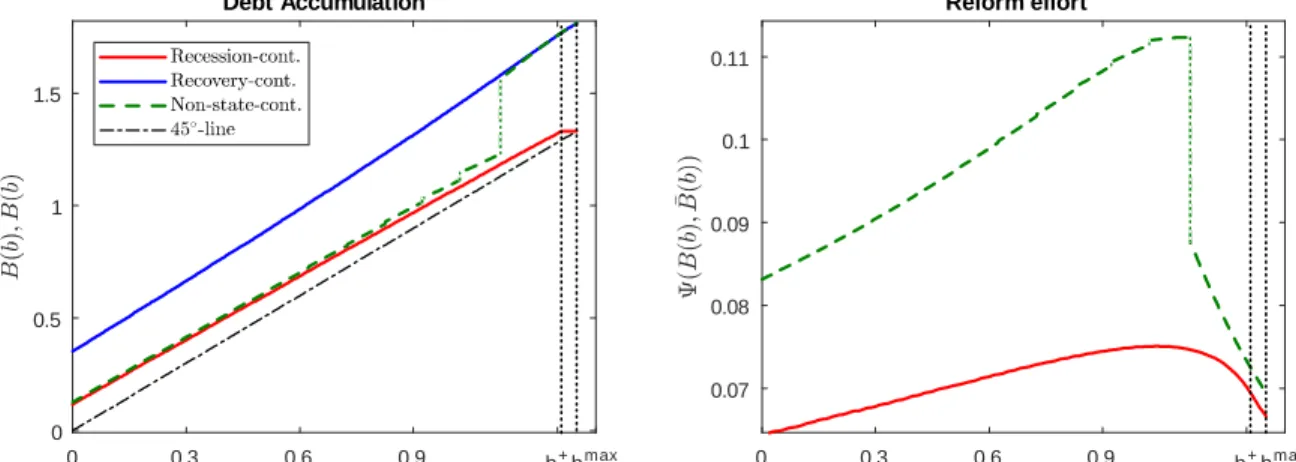
The left panel of Figure 3 shows the equilibrium policy function for recession- and recovery-contingent debt (solid lines) conditional on no renegotiation and on the recession lingering. Recession-contingent debt converges tobmax;which corresponds to the lower bound on promised utility discussed in Section 2.2.2 and displayed in Figure 2. At this level, debt is renegotiated with certainty if the re-cession continues, and issuing more debt would not increase the expected repayment in rere-cession. The …gure also shows the level of debtb+corresponding to in Figure 2. In the rangeb > b+the sovereign would like to issue recession-debt abovebmax but is constrained to issueb0=bmax. However, she is not subject to any constraints when issuing recovery-contingent debt, so b0 increases in bin this range.
The right panel of Figure 3 shows the equilibrium e¤ort as a function of b (solid line). This corresponds to the lower right panel in Figure 2: it is increasing at low debt levels and falling at high debt levels. Intuitively, when debt is low, a larger debt strengthens the desire for the sovereign to escape recession (this force is also present in the …rst best of Proposition 1 where e¤ort is decreasing in promised utility). However, as debt increases, the probability that debt is fully honored in recession falls. At very high debt levels, the lion’s share of the returns to the e¤ort investment accrues to creditors making moral hazard rampant. In this region, adebt overhangproblem arises, reminiscent of Krugman (1988). In our model debt overhang is not a symptom of markets being irrational. To the opposite, it is an equilibrium outcome: a long recession may lead the sovereign to rationally choose to issue debt in the overhang region and creditors to rationally buy it. Creditors are willing to buy recession-contingent debt from a highly indebted countries in the hope of obtaining favorable terms in the renegotiation process.
3.4 Alternative Decentralizations
An alternative decentralization of the COA follows Alvarez and Jermann (2000), henceforth AJ, who show that the COA of a dynamic principal-agent model with enforcement constraints can be attained through a full set of Arrow-Debreu securities subject to appropriate borrowing constraints. In our economy, this requires markets for a continuum of securities paying o¤ in recession – one asset for each 2 @ –plus one recovery-contingent bond. In this section, we show that the AJ decentralization attains the same allocation as our decentralization through two renegotiable securities.
The proof of Proposition 5 hints at this equivalence. There, the idea is to propose an exogenous repayment schedule conditional on ; denoted by ^b( ); and then to show that there exists a unique schedule that satis…es the equilibrium conditions. Such a repayment schedule can be interpreted as the set of borrowing constraints that are necessary for the AJ equilibrium to attain e¢ ciency. While AJ requires explicit trade in a large set of markets, our model achieves the same allocation with two defaultable assets without imposing any explicit borrowing constraint.
To illustrate the result, consider an economy without moral hazard, which is the environment in the original AJ model. Suppose that the sovereign can issue securitiesb0AJ; that are claims to output in the
2 8
In the absence of moral hazard (e.g., if e¤ort were contractible), consumption and both types of debt would remain constant over time unless there is renegotiation.