In this paper a novel frequency hopping algorithm is intro-duced, which is tailored for use in a Cordless Telephone System (CTS) that relies on total frequency hopping to use the same frequency band as a GSM system.The algorithm was designed with the goal of minimising the interference between different CTS-units and between the CTS and the overlay GSM network, taking into account standard GSM interleaving and coding procedures. It is part of the GSM-CTS implementation assumption for standardisation at ETSI. The proposed algorithm is described and simulation results are shown to prove its optimal characteristics.1
1 - Introduction
The introduction of cellular mobile communication systems has enabled a great degree of mobility in telecom-munication services, and among the different standards, GSM and GSM1800 are being employed in many countries all over the world. Nevertheless, a typical user spends a reasonable amount of time at fixed locations, such as at home or in the office, and it is then usual to use the conven-tional fixed line network, which provides lower charges and better quality. Furthermore, indoor environments often lack the adequate radio coverage for a successful connec-tion to a PLMN. It would be desirable to have a single terminal which is able to connect to both a PLMN and the fixed network. A dual-mode terminal, such as a GSM/DECT mobile terminal, provides this feature, but a simpler solution is to develop a GSM mobile terminal that can also be used as a cordless phone based on the GSM air interface. This would require just a slight modification in a GSM hand-held set, as well as a CTS-Fixed Part, which is connected to the fixed network[1]. In order to comply with regulations and to avoid hardware modifications, the same frequency band as in a GSM PLMN must be used. However, the location of the CTSs are defined by the users and cannot be controlled by the PLMN operator, which prevents their inclusion in the operator’s frequency plan-ning. This implies that a way to minimise the interference between the CTS units and the GSM overlay network has to be found.
One way to implement the CTSs without causing a signif-icant interference in the GSM network is to employ slow frequency hopping [2,3], preferably over a large number of frequencies, so that in each burst a different radio channel is affected, and eventual collisions can be resolved by inter-leaving and decoding. It is also envisaged to assign to each
user a different FH sequence, which can be used for authentication. Due to this fact, and to eliminate the possi-bility that a PLMN user and a CTS employ the same FH sequence, a new FH algorithm is required, even though frequency hopping is already standardised for GSM [4]. Additionally, the frequency hopping code developed for this application can also be employed for the fast deploy-ment of picocells, which are to be used for serving hotspots within an overlaying macrocell, without requiring frequency planning.
2 - Requirements for the FH Algorithms
Complying to the demands of a CTS, some characteristics are desired for the frequency hopping code. These are discussed in this section.
The code size L is the number of different codewords that can be generated by a particular algorithm. Since in the CTS proposal the FH sequence is also a part of the authen-tication process, a large number of different sequences must be available in order to prevent unauthorised mobiles from having access granted. Moreover, having in mind that the code and location of different CTSs cannot be planned, a large code size prevents two neighbour CTSs from sharing the same FH sequence. For those reasons, the code size should be as large as possible.
Long sequences are required due to their use for authenti-cation, since short sequences can be easily scanned and reconstructed by a defrauder. As a reference, we consider that a period at least as long as the one obtained with the standard GSM frequency hopping code (T = 84864) is desired.
The alphabet size N, i.e., the number of different frequen-cies, should be flexible, since the number of available frequencies may depend on regulatory issues and on agree-ments with different network operators. In a possible implementation the number of available frequencies for frequency hopping changes depending on the interference levels on each channel, what would also require a flexible alphabet size.
Usually, the most important figure of merit of FH codes is the distribution of the Hamming correlation [5], but for our application an analysis has to be made which takes into account the interference between codes with possibly different periods (e.g., between a CTS and the PLMN), in which case this concept no longer applies. A more adequate and similar figure of merit is the hit probability, i.e, the probability that two FH sequences share the same frequency in a given burst. If the transmitter hops over N
1. This work was supported by Alcatel
A Frequency Hopping Algorithm for Cordless Telephone Systems
André Noll Barreto, Jürgen Deißner and Gerhard Fettweis
Dresden University of Technology
Chair for Mobile Communication Systems, 01062 Dresden, Germany
<noll,deissner,fettweis>@ifn.et-tu-dresden.de
frequencies, it can be expected that the mean value of the hit probability will be equal to 1/N, considering every possible pair of sequences at every possible relative delay. However, this may not be the case for every pair of sequences, and some pairs may have a much larger hit probability. Our goal is to design FH codes with a low vari-ance in the hit probability distribution, and hence with few pairs of sequences showing a large hit probability. An optimal algorithm satisfies the following condition for every pair of sequences.
(1) Furthermore, if we consider the application of frequency hopping in GSM, we must also take interleaving and coding into account. If many hits occur within the inter-leaving depth, the decoder will probably not be able to correct the errors, and therefore a code in which the hits are more evenly distributed in time is preferred. We assume that up to 3 hits within an interleaving depth of 8 can be corrected [17].
It should be reminded that, in accordance to the proposed application, the appropriate code should have good hit probability characteristics in the following three different interference scenarios.
1. The hits between two sequences generated by different CTSs.
2. The hits between a sequence generated by a CTS and a PLMN user not using frequency hopping.
3. The hits between a sequence generated by a CTS and a PLMN user using frequency hopping.
The second and the third scenarios can be considered more important, since one major requirement is that the PLMN services should be barely disturbed by the introduction of the CTSs.
Besides satisfying all the above requirements, the frequency hopping algorithm should be easy to implement.
3 - The Frequency Hopping Algorithm
Many different frequency hopping codes have been suggested in the literature [5-16], but none of them satisfies all the above requirements. The codes presented in [6,8-13,15] have all a short period, at the same order of magni-tude as the alphabet size, whereas the codes introduced in [5,16] have rather small code sizes. The codes suggested by Kumar [7] and Vajda [14] can have a long period and a large code size, but have an inflexible alphabet size and are relatively difficult to implement. Moreover, as we can see in the next section, the Kumar code does not perform very well when the interference between the CTSs and the PLMN is investigated.
We have taken as a basis for our algorithm the Lempel-Greenberger code[5]. It is a code with optimal Hamming correlation properties and long period, but it has three
major drawbacks. It has an inflexible alphabet size, which must be the power of a prime number; a limited code size, equal to the alphabet size; and long runs of the same frequency tend to occur, which is unfavourable for the second interference scenario, besides not providing suffi-cient frequency diversity. In this section we first describe this code and then introduce novel improvements.
3.1 Lempel-Greenberger Frequency Hopping Algorithm
Let {sn} denote an m-sequence (i.e., a maximum length linear feedback shift register sequence), of period TLG= pJ- 1 over GF(p), where J is the number of shift-register elements, and let b(n) be a K-tuple of consecutive elements {sn, sn - 1, ... , sn - K - 1}. Now let v be any tuple over GF(p) and f(x) be a one-to-one mapping of a K-tuple over GF(p) into a set of pK different frequencies. Assuming that each sequence is defined by a different vector v, there are LLG= pKdifferent frequency sequences defined by
LG(n) = b(n)⊗v≡f({b0(n)⊕v0, b1(n)⊕v1...,bK-1(n)⊕
vK-1}) (2)
, where⊕ represents addition modulo p.
This code can be proven to be optimal in terms of its Hamming correlation properties [5], or equivalently, in terms of the hit probability distribution, as defined by equa-tion (1).
3.2 Modified Lempel-Greenberger Algorithm
In order to increase the number of possible sequences, we first introduce a small modification, by allowing the K-tuples b’(n) to be formed of any K different shift-register elements at any order. Now, apart from v, we assign to each different sequence a K-tuple a, describing which elements of the shift-register form the K-tuple b’(n), so that
(3) where 0≤ ai<J and ai≠ajfor i≠j.
As in equation (2), the sequence is formed by LG’(n) = b’(n)⊗v.
By this modification, different
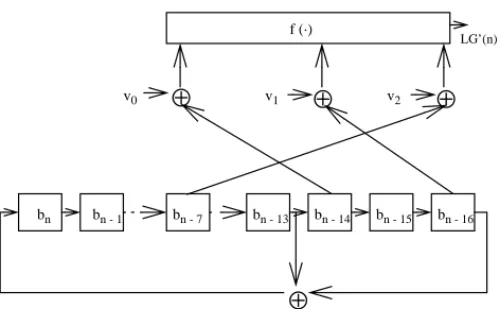
sequences can be generated, not counting delayed versions of the same sequence. The optimality in terms of the Hamming correlation can no longer be guaranteed, but its characteristics are nevertheless very good. The generation of the modified Lempel-Greenberger algorithm can be better visualised in Fig. 1, with p = 2, J = 17, K = 3 and a = {14,16,7}. Phit T N⁄ T ---≤ b' n( ) sn a 0 – ,sn–a1, ,… sn–aK–1 = LLG′ K! J–1 K–1 pK =
Fig. 1 - Implementation of a modified Lempel-Green-berger algorithm
3.3 Our algorithm (LG/NR)
In order to eliminate the problem of runs of same frequen-cies, the concatenation of a Lempel-Greenberger with a Reed-Solomon code was proposed in [16], but the difficul-ties with a small code size and inflexible alphabet size still remain. In our proposal, the modified Lempel-Greenberger code is block concatenated with an internal code, in whose codewords each frequency appears exactly once, and there are no restrictions on the alphabet size. Each internal code-word is constructed upon a base sequence of N non-repeating integer elements c = {c0, c1,...,cN -1}, 0≤ci<N and ci≠cjfor i≠j. Different internal code sequences can be generated by the modulo N addition over the base sequence, i.e., an internal code sequence cl is given by : cl = {c0 ⊕l, c1 ⊕l,..., cN - 1⊕l} (4) , where⊕ represents addition modulo N.
There are therefore N different internal code sequences for each base sequence.
We choose a modified Lempel-Greenberger code based on a binary shift-register, with K satisfying :
(5) In case the number of different internal sequences is smaller than the number of external code elements (i.e., 2K
>N), some internal sequences are generated by two different outer code elements, and hence would occur twice as often as the other sequences. In order to prevent that, we add the count of register shifts to the external code element before mapping into an internal sequence. An example of the generation of the concatenated sequence x(k) can be seen in Fig. 2, with c={3,2,0,5,4,1}, N = 6.
Different sequences are characterised by different sets of a, v and c, and hence the number of different sequences is Lour
code= LLG’(N - 1)!. For example, with J = 17 shift-register elements, N = 27 frequencies, and, according to (5), K = 5 there are Lour code≈ 2,4 ×1033different sequences, which is much more than for the codes found in the literature. The period of these sequences is Tour code= NTLG, which for
the above values is Tour code = 3538917.
Fig. 2 - Example of code concatenation
In the following sections this code will be referred as LG/NR, which stands for the concatenation of a Lempel-Greenberger with a non-repeating code.
4 - Simulation Results
As shown in the previous section, our algorithm has the appropriate characteristics in terms of period, code size and alphabet size. Since an analytical solution for the hit prob-ability characteristics was not feasible, simulations were performed, and the results are shown in this section. As a reference we have compared our code with different existing codes, namely: the Lempel-Greenberger code with extended code size, i.e, including the modification intro-duced in the previous section; the Kumar code; and a modi-fied version of the standard GSM code1.
In Fig. 3 and Fig. 4 the hit probability distribution of the different codes is displayed. For each code, 20000 different sequence pairs were correlated and for each pair the hit probability was obtained. The alphabet size is 32 for every code, except for the Kumar code, for which it is equal to 31 due to code constraints. The graphs show the corre-sponding histogram. It should be noticed that we want to minimise the occurrence of pairs of sequences with a high hit probability, and hence an ideal code would have a very concentrated hit probability distribution.In Fig. 3 we can see the results corresponding to the interference between two CTSs, i.e., the hit probability distribution between two sequences generated by the same algorithm. It can be seen that the modified GSM algorithm has the worst perform-ance, and the same behaviour can be observed in the standard GSM algorithm, which is probably due to some constraints imposed by synchronisation on the code design.
bn bn - 1 bn - 7 bn - 13 bn - 14 bn - 15 bn - 16 v2 v1 v0 f (·)
⊕
⊕
⊕
⊕
LG’(n) K = log2N1. This modification has to be introduced in order to achieve a larger code size, which is limited to 64 in the standard GSM code[4]. It consists in generating different sequences with different RNTABLES. The RNTABLE is a look-up table defined in the GSM standards , and it represents a one-to-one mapping of integers between 0 and 114 into 7 bits. In the GSM standards this table is constant and the same for every user. c3 c6=c0 c7=c1 c5 Generation of modified LG codeword LG’(n)
⊕
n l Mapping into an internal codeword c l x(k) 0 5 3 2 1 4 3 2 0 5 4 1 4 3 1 0 5 2 2 1 5 4 3 6 2 1 5 4 3 6 c5 3 6 7 5 5 0 1 2 3 4 3 5 5 2 1On the other hand, the modified Lempel-Greenberger has nearly optimal correlation properties, which means that the modifications did not alter to a great extent its properties. Both the Kumar and the LG/NR code have very good char-acteristics, similar to the ones expected from random sequences.
Fig. 3 - Hit Probability Histogram - Interference between two CTSs
Fig. 4 shows the results related to the interference between a CTS and a PLMN user without frequency hopping, i.e., it simply represents the probability of occurrence of any particular frequency. All codes, except the Kumar, have a good performance, but our code outperforms all the other. The results for the Kumar code indicate that some frequen-cies occur more often than the others. An analysis consid-ering a PLMN with frequency hopping shows similar results, since in GSM networks frequency hopping is usually made over a small set of frequencies.
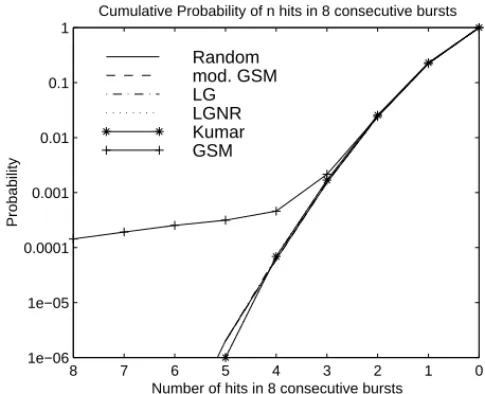
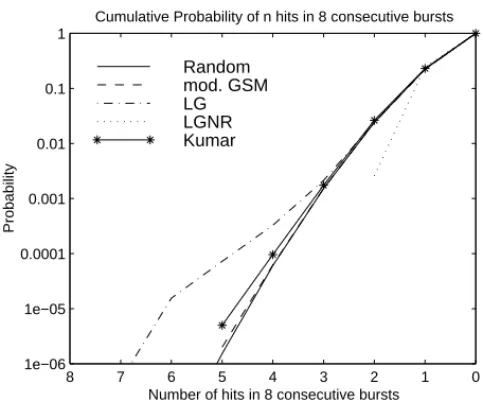
As already mentioned in section 2, the effect of inter-leaving and coding should also be investigated, and we have considered an appropriate measure to be the number of hits occurring within 8 consecutive bursts, which is the interleaving depth of a GSM traffic channel. Assuming that the decoder is able to recover the signal if at least 5 of these 8 bursts are received correctly [17], and that a hit can impair the correct reception of a burst, we shall consider the figure of merit to be the probability that more than 3 hits occur within any window of 8 consecutive bursts. The results can be seen in Fig. 5 and Fig. 6, where besides the above cited codes, the results for a random code have also been displayed.
Fig. 4 - Hit Probability Histogram - Interference between a CTS and a PLMN user with no Frequency Hopping In Fig. 5 the results obtained for two CTS sequences are shown. The standard GSM code was also simulated, and it has a much worse performance than the others, since due to the small code size, some sequences can be repeated. This justifies the need for a large code size and the introduction of a modified GSM code. All the other codes have perform-ances similar to that obtained by a random code.
Fig. 5 - Probability of at least n hits in 8 consecutive bursts - Interference between two CTSs
We see in Fig. 6 the simulation results for the interference between a CTS sequence and a user without frequency hopping. As we can see, the Lempel-Greenberger algo-a) mod. GSM x mod. GSM 0 0.02 0.04 0.06 0.08 0 0.5 1 1.5 2 2.5x 10
−3Hit Probability Distribution
Hit Probability Relative Occurrence 0 0.02 0.04 0.06 0.08 0 0.1 0.2 0.3 0.4 0.5 0.6 0.7 0.8 0.9 1
Hit Probability Distribution
Hit Probability Relative Occurrence b) mod. LG x mod. LG c) Kumar x Kumar 0 0.02 0.04 0.06 0.08 0 1 2 3 4 5 6 7x 10
−3Hit Probability Distribution
Hit Probability Relative Occurrence 0 0.02 0.04 0.06 0.08 0 1 2 3 4 5 6 7 8 9x 10
−3Hit Probability Distribution
Hit Probability Relative Occurrence d) LG/NR x LG/NR a) mod. GSM x no FH 0 0.02 0.04 0.06 0.08 0 0.002 0.004 0.006 0.008 0.01 0.012 0.014 0.016 0.018 0.02
Hit Probability Distribution
Hit Probability Relative Occurrence 0 0.02 0.04 0.06 0.08 0 1 2 3 4 5 6x 10
−3Hit Probability Distribution
Hit Probability Relative Occurrence a) LG x no FH 0.020 0.03 0.04 0.05 0.06 0.07 1 2 3 4 5 6 7 8x 10
−3Hit Probability Distribution
Hit Probability Relative O ccurrence 0 0.02 0.04 0.06 0.08 0 0.1 0.2 0.3 0.4 0.5 0.6 0.7
Hit Probability Distribution
Hit Probability Relative Occurrence c) Kumar x no FH d)LG/NR x no FH 8 7 6 5 4 3 2 1 0 1e−06 1e−05 0.0001 0.001 0.01 0.1 1
Cumulative Probability of n hits in 8 consecutive bursts
Number of hits in 8 consecutive bursts
Probability Random mod. GSM LG LGNR Kumar GSM
rithm performs rather badly by this criterion, since runs of the same frequency tend to happen. The Kumar code has a performance slightly worse than that obtained by a random code, what was expected from the results shown in Fig. 4. The modified GSM algorithm has good properties at this aspect, similar to the ones of a random code,but the LG/NR has by far the best results, since it was designed in a way that each frequency occurs no more than twice within the interleaving depth D(if D≤L + 1).
Fig. 6 - Probability of at least n hits in 8 consecutive bursts - Interference between a CTS and a PLMN user without
frequency hopping
Simulation studies considering the performance of the different algorithms in a mobile communications system have also been undertaken. Initial results show that a lower Frame Erasure Rate can be obtained using the LG/NR algo-rithm instead of the GSM algoalgo-rithm, and further informa-tion can be obtained from another study, yet to be published [18].
5 - Conclusion
We have developed a new frequency hopping code suited for application in a Cordless Telephone System. This code satisfies all the requirements for the use in a CTS, such as long period, large code size and flexible alphabet size. Moreover, simulation results show that it has an outstanding performance in terms of hit probability proper-ties, specially when considering the interference from a CTS with a PLMN user. These characteristics make it not just a good choice for employment in CTSs, but also for deploying PLMN picocells under existing macrocells, without requiring frequency planning.
6 - References
[1] Tdoc SMG1 509/97 : “Digital cellular telecommunica-tions system (Phase 2+); GSM Cordless Telephony System (CTS), Phase 1; Service Description” (GSM 02.XX), ETSI 1997
[2] Tdoc SMG2 WPB 121/97 :” Low interference GSM-Cordless telephony system description”, ETSI 1997 [3] M.I. Silventoinen, M. Kuusela and P.A. Ranta,
“Analy-sis of a New Channel access Method for Home Base Statiom”, ICUPC 96
[4] ETS 300 577 : European Digital Cellular telecommu-nications System (Phase 2); Radio Transmission and Reception (GSM 05.05), ETSI 1994
[5] A. Lempel and H. Greenberger, “Families of
sequences with optimal Hamming correlation proper-ties”, IEEE Trans. Inf. Theory, Jan. 1974, pp. 90-94 [6] F.M. Assis, “Hit probability between frequency
hop-ping sequences generated by Reed-Solomon and Her-mitian codes”, Electronics Letters, Jul. 1996, pp. 962-963
[7] P.V. Kumar, “Frequency-hopping code sequence designs having large linear span”, IEEE Trans. Inform. Theory, Jan 1988, pp 146-151
[8] H.D. Lüke, “Large families of polynomial phase sequences with low correlation”, European Trans. on Telecomm., May-June 1996, pp 235-238
[9] S.V. Marik, E.L. Titlebaum, “A class of frequency hop codes with nearly ideal characteristics for use in multi-ple access spread-spectrum communications and radar and sonar systems”, IEEE Trans. on Comm., Sep. 1992, pp. 1442-1447
[10]R.M. Mersereau, T.S. Seay, “Multiple access fre-quency hopping patterns with low ambiguity”, IEEE Trans. on Aerospace and Electronic Systems, July 1981, pp. 571-578
[11]A.A. Shaar, P.A.Davies, “Prime sequences : quasi-optimal sequences for OR channel code division multi-plexing”, Electronic Letters, 1981, pp. 880-890 [12]A.A. Shaar, P.A.Davies, “A survey of one-coincidence
sequence sets for frequency-hopped spread spectrum systems”, IEE Proc. - Part F : Commun., Radar and Signal Processing, Dec 1984, pp. 719-724
[13]E.L. Titlebaum, “Time frequency hop signals, Part I : Coding based upon the theory of linear congruencies”, IEEE Trans. Aerospace and Electronic Systems, July 1981, pp. 494-501
[14]I. Vajda, “Code sequences for frequency-hopping mul-tiple-access systems”, IEEE Trans. on Commun., Oct. 1995, pp. 2553-2554
[15]L.D. Wronski, R. Hossain and A.Albicki, “Extended hyperbolic congruential frequency hop code : Genera-tion and bounds for cross- and auto- ambiguity func-tion”, IEEE Trans. on Commun., March 1996, pp. 301-305
[16]N. Burger, “The design of frequency hopping patterns for multiple-access communications”, M.S. Thesis, University of Illinois at Urbana-Champaign, Jan. 1994 [17]M.Mouly and M.B. Pautet, “The GSM system for
mobile communications”, 1992
[18]J.Deissner, A.N. Barreto, U. Barth and G. Fettweis, “Interference analysis of a total frequency-hopping GSM Cordless Telephony System“, To be presented at PIMRC 98 8 7 6 5 4 3 2 1 0 1e−06 1e−05 0.0001 0.001 0.01 0.1 1
Cumulative Probability of n hits in 8 consecutive bursts
Number of hits in 8 consecutive bursts
Probability Random mod. GSM LG LGNR Kumar