The Marzano Framework
Design Question 2
Elements 6-13
Helping Students Interact with
New Knowledge
*This packet is best used in conjunction with Marzano Framework (Mat), Glossary, and the corresponding Design Question 2 vodcast presentation.
The Department of Safe Schools Single School Culture © for Academics The School District of Palm Beach County, Fl
! "#$$%&!'#()#&*$!
+&,%-,.&(!/%0*.&#!1,#&*$
Design Question 1: What will I do to establish and communicate learning goals, track student progress, and celebrate success? !"#$%&%'()*+,-").,-"'%'()/#-+0)-'&)12-+,0)3#)
4,-05",)36#0,)/#-+0 7"-28%'()135&,'3)!"#(",00 *,+,9"-3%'()135&,'3)1522,00
Design Question 6:What will I do to establish or maintain classroom rules and procedures? :03-9+%06%'()*+-00"##;)<#53%',0 ="(-'%>%'()!6?0%2-+).-?#53)#@)36,)*+-00"##;)@#") .,-"'%'( "#$$%&!'#()#&*$! 2334#$$.&(!5%&*#&*
Design Question 2:What will I do to help students effectively interact with the new knowledge? A&,'3%@?%'()*"%3%2-+)A'@#";-3%#' ="(-'%>%'()135&,'30)3#)A'3,"-23)B%36)C,B) D'#B+,&(, !",$%,B%'()C,B)*#'3,'3 *65'8%'()*#'3,'3)%'3#)EF%(,03%9+,)G%3,0E !"#2,00%'()#@)C,B)A'@#";-3%#' :+-9#"-3%'()#')C,B)A'@#";-3%#' <,2#"&%'()-'&)<,H",0,'3%'()D'#B+,&(, <,@+,23%'()#').,-"'%'(
Design Question 3:What will I do to help students practice and deepen their understanding of new knowledge? <,$%,B%'()*#'3,'3 ="(-'%>%'()135&,'30)3#)!"-23%2,)-'&)F,,H,') D'#B+,&(, I0%'()J#;,B#"8 :K-;%'%'()1%;%+-"%3%,0)-'&)F%@@,",'2,0 :K-;%'%'():""#"0)%')<,-0#'%'( !"-23%2%'()18%++0L)13"-3,(%,0L)-'&)!"#2,00,0 <,$%0%'()D'#B+,&(,
Design Question 4: What will I do to help students generate and test hypotheses about new knowledge? ="(-'%>%'()135&,'30)@#")*#('%3%$,+?)*#;H+,K) 7-080 :'(-(%'()135&,'30)%')*#('%3%$,+?)*#;H+,K) 7-080)A'$#+$%'()J?H#36,0%0)/,',"-3%'()-'&) 7,03%'( !"#$%&%'()<,0#5"2,0)-'&)/5%&-'2, "#$$%&!'#()#&*$! 1&67*#3!%&!*8#!'9%*
Design Question 5:What will I do to engage students? C#3%2%'()-'&)<,-23%'()B6,')135&,'30)-",)C#3) :'(-(,& I0%'()M2-&,;%2)/-;,0 4-'-(%'()<,0H#'0,)<-3,0 I0%'()!6?0%2-+)4#$,;,'3 4-%'3-%'%'()-).%$,+?)!-2, F,;#'03"-3%'()A'3,'0%3?)-'&):'3650%-0; I0%'()N"%,'&+?)*#'3"#$,"0? !"#$%&%'()=HH#"35'%3%,0)@#")135&,'30)3#)7-+8) -9#53)76,;0,+$,0 !",0,'3%'()I'505-+)#")A'3"%(5%'()A'@#";-3%#'
Design Question 7: What will I do to recognize and acknowledge adherence and lack of adherence to classroom rules and procedures? F,;#'03"-3%'()EO%36%3',00E MHH+?%'()*#'0,P5,'2,0 M28'#B+,&(%'()M&6,",'2,)3#)<5+,0)-'&)
!"#2,&5",0
Design Question 8:What will I do to establish and maintain effective relationships with students? I'&,"03-'&%'()135&,'30Q)A'3,",030)-'&)
G-28("#5'&0 I0%'()G,6-$%#"0)36-3)A'&%2-3,)M@@,23%#')@#")
135&,'30 F%0H+-?%'()=9R,23%$%3?)-'&)*#'3"#+
Design Question 9:What will I do to communicate high expectations for all students? F,;#'03"-3%'()S-+5,)-'&)<,0H,23)@#").#B) :KH,23-'2?)135&,'30 M08%'()T5,03%#'0)#@).#B):KH,23-'2?)135&,'30 !"#9%'()A'2#"",23)M'0B,"0)B%36).#B):KH,23-'2?) 135&,'30 :8#!!"#$"%&'()*+#,"-.&%'"%/'0++/)"12'3#&-&1&4!.3#&*.;.#$!*8#!<=!>#?!$*46*#(.#$!4#,#6-#3!@?!4#$#6478!;%4!#;;#7*.,#!*#678.&(!94#$#&*#3!.&!6!4%@0$*A!#6$?B*%B0&3#4$*6&3!)%3#-! %;!.&$*407*.%&!@6$#3!%&!*8#!24*!6&3!'7.#&7#!%;!:#678.&(C!!2--!56'7+8'9-#"-+:.+*!64#!%4(6&.D#3!.&*%!;'<+*.:%'=>+*-.&%*A!E8.78!64#!;04*8#4!%4(6&.D#3!.&*%!?'@+**&%'9+:A+%-*C!!!! !
The School District of Palm Beach County, FL Single School Culture © for Academics Department of Safe Schools
1
Percentile Gain for Specific Instructional Strategies*
Source: Mata-Analytic Synthesis of Studies Conducted ay Marzano Research Laboratory on Instructional Strategies (Haystead & Marzano, 2009).
This report synthesizes a series of quasi-‐experimental studies conducted as action research projects regarding the extent to which the utilization of selected instructional strategies enhances the learning of students. The data used for analysis can be found in Marzano Research Laboratory’s Meta-‐Analysis Database (see marzanoresearch.com).
12
Figure 11. Percentile Gain for Specific Instructional Strategies (Corrected)
Interpretation
There are a number of ways to interpret an effect size. One interpretation is the amount of overlap between the experimental and control groups. Consider again that an effect size of 1.00 can be interpreted as the average score in the experimental group being one standard deviation higher than the average score in the control group. Consulting a table of the normal curve (i.e., normal distribution) the associated percentile gain for an effect size of 1.00 is 34. This means that the score of the average student in the experimental group (50th percentile) exceeds the scores of 84 percent of the control group. Only 16 percent of the control group would be expected to have scores that exceed the score of the average student in the experimental group.
DQ2: Helping Students Interact with New
Knowledge
6. Identifying Critical Information
7. Organizing Students to Interact with New Knowledge 8. Previewing New Content
9. Chunking Content into “Digestible Bite” 10. Processing New Information
11. Elaborating on New Information
12. Recording and Representing New Knowledge 13. Reflecting on Learning
The School District of Palm Beach County, FL Single School Culture © for Academics Department of Safe Schools
2
6. Identifying Critical Information
Source: Marzano Protocol: Lesson Segment Addressing Content, DQ2.
Why Identify Critical Information?
!
A number of cognitive psychologists offer support for the
position that teachers must provide guidance as to the
important aspects of the new content
(Anderson
Greeno, Reder & Simon 2000).
!
Nuthall’s work suggests that
those learning experiences that
are
critical to
understanding new
content
should be
identified
and highlighted by teachers
.
! ! ! !""#$%&'!()!*+&,+-#! !
0DU]DQR3URWRFRO/HVVRQ6HJPHQWV$GGUHVVLQJ&RQWHQW
'4 ,GHQWLI\LQJ&ULWLFDO,QIRUPDWLRQ
The teacher identifies a lesson or part of a lesson as involving important information to which students should pay particular attention.
7HDFKHU(YLGHQFH
Teacher begins the lesson by explaining why upcoming content is important
Teacher tells students to get ready for some important information
Teacher cues the importance of upcoming information in some indirect fashion Tone of voice
Body position Level of excitement
6WXGHQW(YLGHQFH
When asked, students can describe the level of importance of the information addressed in class
When asked, students can explain why the content is important to pay attention to
Students visibly adjust their level of engagement 6FDOH/HYHOV(choose one)
Innovating Applying Developing Beginning Not Using Not Applicable
6FDOH
,QQRYDWLQJ $SSO\LQJ 'HYHORSLQJ %HJLQQLQJ 1RW8VLQJ
,GHQWLI\LQJ FULWLFDO LQIRUPDWLRQ Adapts and creates new strategies for unique student needs and situations. Signals to students which content is critical versus non-critical and monitors the extent to which students are attending to critical information. Signals to students which content is critical versus non-critical. Uses strategy incorrectly or with parts missing. Strategy was called for but not exhibited.
The School District of Palm Beach County, FL Single School Culture © for Academics Department of Safe Schools
3
7. Organizing Students to Interact with New Knowledge
• Students interacting in groups about the content • Allows students to experience content from
multiple perspectives
• Facilitates the learning of complex procedures and concepts
NOTE: Group size should be relatively small, pairs or triads work well when processing new content.
Myth or Truth
Directions: Mark each statement with an “M” if you believe it is a myth and a “T” if you believe it is a truth.
________1. We use only about 10% of our brain.
________ 2. As far as the brain is concerned, it’s all downhill after 40 (or 50 or 60 or 70). ________ 3. The human brain weighs about 3 pounds.
________ 4. Playing classical music to babies makes them smarter. ________ 5. The brain is made up of 75% water.
7. Organizing Students to Interact with New Knowledge
! Students interacting in groups about the content
! Allows students to experience content from multiple perspectives
! Facilitates the learning of complex procedures and concepts
NOTE: Group size should be relatively small, pairs or triads work well when processing new content. Handout Page 3 ! ! ! !""#$%&'!()!*+&,+-#! ! 2UJDQL]LQJ6WXGHQWVWR,QWHUDFWZLWK1HZ.QRZOHGJH
The teacher organizes students into small groups to facilitate the processing of new information. 7HDFKHU(YLGHQFH
Teacher has established routines for student grouping and student interaction in groups Teacher organizes students into ad hoc groups for the lesson
Diads Triads
Small groups up to about 5
6WXGHQW(YLGHQFH
Students move to groups in an orderly fashion
Students appear to understand expectations about appropriate behavior in groups Respect opinions of others
Add their perspective to discussions Ask and answer questions
6FDOH/HYHOV(choose one)
Innovating Applying Developing Beginning Not Using Not Applicable
6FDOH
,QQRYDWLQJ $SSO\LQJ 'HYHORSLQJ %HJLQQLQJ 1RW8VLQJ
2UJDQL]LQJ VWXGHQWVWR LQWHUDFWZLWK QHZNQRZOHGJH Adapts and creates new strategies for unique student needs and situations. Organizes students into small groups to facilitate the processing of new knowledge and monitors group processing. Organizes students into small groups to facilitate the processing of new knowledge. Uses strategy incorrectly or with parts missing. Strategy was called for but not exhibited.
The School District of Palm Beach County, FL Single School Culture © for Academics Department of Safe Schools
4
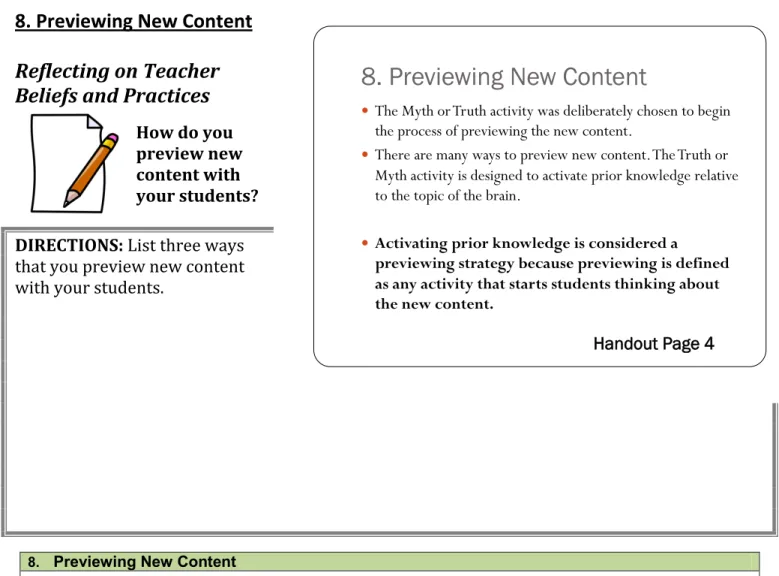
8. Previewing New Content
Reflecting on Teacher
Beliefs and Practices
How do you preview new content with your students?
DIRECTIONS: List three ways
that you preview new content with your students.
! ! ! !""#$%&'!()!*+&,+-#! ! 3UHYLHZLQJ1HZ&RQWHQW
The teacher engages students in activities that help them link what they already know to the new content about to be addressed and facilitates these linkages.
7HDFKHU(YLGHQFH
Teacher uses preview question before reading
Teacher uses K-W-L strategy or variation of it
Teacher asks or reminds students what they already know about the topic
Teacher provides an advanced organizer Outline
Graphic organizer
Teacher has students brainstorm
Teacher uses anticipation guide
Teacher uses motivational hook/launching activity Anecdotes
Short selection from video
Teacher uses word splash activity to connect vocabulary to upcoming content
6WXGHQW(YLGHQFH
When asked, students can explain linkages with prior knowledge
When asked, students make predictions about upcoming content
When asked, students can provide a purpose for what they are about to learn
Students actively engage in previewing activities
6FDOH/HYHOV(choose one)
Innovating Applying Developing Beginning Not Using Not Applicable
6FDOH
,QQRYDWLQJ $SSO\LQJ 'HYHORSLQJ %HJLQQLQJ 1RW8VLQJ
3UHYLHZLQJ
QHZFRQWHQW Adapts and creates new strategies for unique student needs and situations. Engages students in learning activities that require them to preview and link new knowledge to what has been addressed and monitors the extent to which students are making linkages.
Engages students in learning activities that require them to preview and link new knowledge to what has been addressed.
Uses strategy incorrectly or with parts missing.
Strategy was called for but not exhibited.
8. Previewing New Content
! The Myth or Truth activity was deliberately chosen to begin
the process of previewing the new content.
! There are many ways to preview new content. The Truth or
Myth activity is designed to activate prior knowledge relative to the topic of the brain.
! Activating prior knowledge is considered a
previewing strategy because previewing is defined as any activity that starts students thinking about the new content.
The School District of Palm Beach County, FL Single School Culture © for Academics Department of Safe Schools
5
9. Chunking Information into “Digestible Bites”
Why Do We Chunk?
The brain likes chunking because single bits of information are more difficult to remember. The brain learns well when the material is chunked.
DIRECTIONS:
Look at the section on Chunking on page 11.
Grouping information together in categories is another method of chunking.
Why Do We Chunk?
The brain likes chunking because single bits of information are more difficult to remember. The brain learns well when the material is chunked.
Handout Pages 5 and 11 Let’s look at the section of the article on Chunking on page 11.
Grouping information together in categories is another method of chunking. ! ! ! !""#$%&'!()!*+&,+-#! ! &KXQNLQJ&RQWHQWLQWR³'LJHVWLEOH%LWHV´
Based on student needs, the teacher breaks the content into small chunks (i.e. digestible bites) of information that can be easily processed by students.
7HDFKHU(YLGHQFH
Teacher stops at strategic points in a verbal presentation
While playing a video tape, the teacher turns the tape off at key junctures
While providing a demonstration, the teacher stops at strategic points
While students are reading information or stories orally as a class, the teacher stops at strategic points
6WXGHQW(YLGHQFH
When asked, students can explain why the teacher is stopping at various points
Students appear to know what is expected of them when the teacher stops at strategic points
6FDOH/HYHOV(choose one)
Innovating Applying Developing Beginning Not Using Not Applicable
6FDOH
,QQRYDWLQJ $SSO\LQJ 'HYHORSLQJ %HJLQQLQJ 1RW8VLQJ
&KXQNLQJ FRQWHQWLQWR GLJHVWLEOHELWHV Adapts and creates new strategies for unique student needs and situations. Breaks input experiences into small chunks based on student needs and monitors the extent to which chunks are appropriate. Breaks input experiences into small chunks based on student needs. Uses strategy incorrectly or with parts missing. Strategy was called for but not exhibited.
The School District of Palm Beach County, FL Single School Culture © for Academics Department of Safe Schools
6
10. Processing New Information
DIRECTIONS:
Read the Cocktail Party Effect on page 12. When you get to the Cocktail Party Experiment, some of the words are in bold type and some are not. As quickly as you can, read only the words in bold type.
Explain the Cocktail Party Effect to your partner.
10. Processing New Information
! Dr. Marzano suggests formal group processingstrategies: ! Jigsaw
! Reciprocal Teaching
! Concept Attainment
A more detailed explanation of these strategies can be found in the Art and Science of Teaching book on pages 46 and 47 and in
the Marzano glossary. Handout Page 6
! ! !
!""#$%&'!()!*+&,+-#! !
3URFHVVLQJ1HZ,QIRUPDWLRQ
During breaks in the presentation of content, the teacher engages students in actively processing new information.
7HDFKHU(YLGHQFH
Teacher has group members summarize new information
Teacher employs formal group processing strategies Jigsaw
Reciprocal Teaching Concept attainment
6WXGHQW(YLGHQFH
When asked, students can explain what they have just learned
Students volunteer predictions
Students voluntarily ask clarification questions
Groups are actively discussing the content
Group members ask each other and answer questions about the information Group members make predictions about what they expect next
6FDOH/HYHOV(choose one)
Innovating Applying Developing Beginning Not Using Not Applicable
6FDOH
,QQRYDWLQJ $SSO\LQJ 'HYHORSLQJ %HJLQQLQJ 1RW8VLQJ
3URFHVVLQJQHZ
LQIRUPDWLRQ Adapts and creates new strategies for unique student needs and situations. Engages students in summarizing, predicting, and questioning activities and monitor the extent to which the activities enhance VWXGHQWV¶ understanding. Engages students in summarizing, predicting, and questioning activities. Uses strategy incorrectly or with parts missing. Strategy was called for but not exhibited.
The School District of Palm Beach County, FL Single School Culture © for Academics Department of Safe Schools
7
11. Elaborating on New Information
Learning requires multiple
exposures and interactions
with knowledge.
For example, answer this question:
It is easier to drive a car while listening to the radio than it is to drive a car while reading a map.
Why is that true? ! ! ! !""#$%&'!()!*+&,+-#! ! (ODERUDWLQJRQ1HZ,QIRUPDWLRQ
The teacher asks questions or engages students in activities that require elaborative inferences that go beyond what was explicitly taught.
7HDFKHU(YLGHQFH
Teacher asks explicit questions that require students to make elaborative inferences about the content Teacher asks students to explain and defend their inferences
Teacher presents situations or problems that require inferences 6WXGHQW(YLGHQFH
Students volunteer answers to inferential questions
6WXGHQWVSURYLGHH[SODQDWLRQVDQG³SURRIV´IRULnferences
6FDOH/HYHOV(choose one)
Innovating Applying Developing Beginning Not Using Not Applicable 6FDOH
,QQRYDWLQJ $SSO\LQJ 'HYHORSLQJ %HJLQQLQJ 1RW8VLQJ
(ODERUDWLQJRQ
QHZLQIRUPDWLRQ Adapts and creates new strategies for unique student needs and situations. Engages students in answering inferential questions and monitors the extent to which students elaborate on what was explicitly taught. Engages students in answering inferential questions. Uses strategy incorrectly or with parts missing. Strategy was called for but not exhibited.
11. Elaborating on New Information
! Elaborations begin with simple inferential questions. When a
student provides an answer, the teacher asks: “Why do you believe this to be true?” or “Tell me why you think that this is so.”
Students need to be able to explain
and defend the inferences.
The School District of Palm Beach County, FL Single School Culture © for Academics Department of Safe Schools
8
12. Recording and Representing Knowledge
• Having Students Write Out Their Conclusions • Note-‐taking Strategies
o Informal Outline o Academic Notebooks
o Informal Outline, Web and Combination Notes
• Nonlinguistic Representations: o Graphic Organizers o Pictographs o Flow Charts o Timelines • Dramatic Enactments • Mnemonic Devices
o The Great Lakes: HOMES
o Huron o Ontario o Michigan o Erie o Superior
This strategy activates students’ prior
knowledge and experiences in relationship to the new content.
Previewing strategies include:
Making overt linkages – students identify connections between content they have studied and new content.
Previewing questions activate prior knowledge. Brief Teacher Summary – Teachers use oral and written summaries to help students anticipate key ideas and patterns.
Period Table of Elements
A group is a vertical column in the periodic table 18 groups
Some groups contain elements with very similar properties
Number of valence shell electrons determines group
A period is a horizontal row in the periodic table 7 periods
Some periods also show similar properties Total number of electron shells determines period
Elements are listed in order of increasing atomic number
Number of protons in atomic nucleus
Academic Notebook
Informal Outline
12. Recording Knowledge
! Having Students Write Out Their Conclusions
! Note-taking Strategies
! Informal Outline
! Academic Notebooks
! Informal Outline, Web and Combination Notes
The School District of Palm Beach County, FL Single School Culture © for Academics Department of Safe Schools
9
12. Recording and Representing Knowledge (Continued)
Informal Outline, Web and Combination Notes
! ! !
!""#$%&'!()!*+&,+-#! !
5HFRUGLQJDQG5HSUHVHQWLQJ.QRZOHGJH
The teacher engages students in activities that help them record their understanding of new content in linguistic ways and/or represent the content in nonlinguistic ways.
7HDFKHU(YLGHQFH
Teacher asks students to summarize the information they have learned
Teacher asks students to generate notes that identify critical information in the content Teacher asks students to create nonlinguistic representations for new content
Graphic organizers Pictures
Pictographs Flow charts
Teacher asks students to create mnemonics that organize the content 6WXGHQW(YLGHQFH
6WXGHQWV¶Vummaries and notes include critical content
6WXGHQWV¶Qonlinguistic representations include critical content
When asked, students can explain main points of the lesson
6FDOH/HYHOV(choose one)
Innovating Applying Developing Beginning Not Using Not Applicable 6FDOH
,QQRYDWLQJ $SSO\LQJ 'HYHORSLQJ %HJLQQLQJ 1RW8VLQJ
5HFRUGLQJDQG UHSUHVHQWLQJ NQRZOHGJH Adapts and creates new strategies for unique student needs and situations. Engages students in activities that help them record their understanding of new content in linguistic ways and/or in nonlinguistic ways and monitors the extent to which this enhances VWXGHQWV¶ understanding. Engages students in activities that help them record their understanding of new content in linguistic ways and/or in nonlinguistic ways. Uses strategy incorrectly or with parts missing. Strategy was called for but not exhibited.
The School District of Palm Beach County, FL Single School Culture © for Academics Department of Safe Schools
10
13. Reflecting on Learning
There are at least three reflection questions students might address (Cross, 1998; Ross, Hogaboam-‐Gray, & Rolheisser, 2002):
o What was I right about and wrong about?
o How confident am I about what I have learned?
o What did I do well during the
experience and what could I have done better?
Teacher Strategies:
o Reflective Questions and Journals o Exit Slips
High Probability vs. High Yield
“There are no high-yield instructional strategies; there are only high-probability strategies.
The simple presence or absence of an instructional strategy does not define effectiveness, but it is rather the teacher’s expertise in adapting that strategy to the classroom within the context of lesson segments that produces gains in student achievement.”
Marzano (2009)
The
Art
and
Science
of
Teaching
The strategy alone does not impact student achievement. It is using the strategy at the appropriate time and at the appropriate level.
The Science of teaching is knowing the strategies and the Art of teaching is knowing when to use them.
! ! !
!""#$%&'!()!*+&,+-#! !
5HIOHFWLQJRQ/HDUQLQJ
The teacher engages students in activities that help them reflect on their learning and the learning process. 7HDFKHU(YLGHQFH
Teacher asks students to state or record what they are clear about and what they are confused about
Teacher asks students to state or record how hard they tried
Teacher asks students to state or record what they might have done to enhance their learning
6WXGHQW(YLGHQFH
When asked, students can explain what they are clear about and what they are confused about
When asked, students can describe how hard they tried
When asked, students can explain what they could have done to enhance their learning
6FDOH/HYHOV(choose one)
Innovating Applying Developing Beginning Not Using Not Applicable 6FDOH
,QQRYDWLQJ $SSO\LQJ 'HYHORSLQJ %HJLQQLQJ 1RW8VLQJ
5HIOHFWLQJRQ
OHDUQLQJ Adapts and creates new strategies for unique student needs and situations. Engages students in reflecting on their own learning and the learning process and monitors the extent to which students self-assess their understanding and effort. Engages students in reflecting on their own learning and the learning process.
Uses strategy incorrectly or with parts missing.
Strategy was called for but not exhibited.
6WXGHQW,QWHUYLHZV
6WXGHQW4XHVWLRQV
Why is the information that you are learning today important?
How do you know what are the most important things to pay attention to? What are the main points of this lesson?
13. Reflecting on Learning There are at least three reflection questions students might address (Cross, 1998; Ross, Hogaboam-Gray, & Rolheisser, 2002): ! What was I right about and wrong about?
! How confident am I about what I have learned? ! What did I do well during the experience and what could I
have done better?
! Reflective Questions and Journals ! Exit Slips
What do you use for reflecting on learning?
The School District of Palm Beach County, FL Single School Culture © for Academics Department of Safe Schools
11
THE MORE WE UNDERSTAND THE BRAIN, THE BETTER
WE’LL BE ABLE TO DESIGN INSTRUCTION TO MATCH
HOW IT LEARNS BEST
BRAIN IMAGING AND LEARNING
The human brain is not the largest organ in the body. It weighs only about 3 pounds, less than the skin covering your body. Yet this marvelous structure is the source of all human behavior, simultaneously controlling a myriad of unbelievably complex functions. Within a span of time too short for humans to measure, it receives information and relays it to the appropriate locations for processing.
We’ve learned more about the brain and how it functions in the past two decades than in all of recorded history. We literally can look inside a brain and see what areas are most active while the person is engaged in various mental activities. We do this with the help of CAT Scans (Computed Tomography), PET Scans (Positron Emission Tomography), and MRIs (Magnetic Resonance Imaging).
We should not consider designing instruction to teach the human brain without taking into account the brain and how it functions. The more we understand the brain, the better we’ll be able to design instruction to match how it learns best. Will the day come when educators will have ready access to brain-‐imaging machines to assist them in diagnosing reading or attention problems? It may not be too outrageous to think so.
For example, PET scans of a reader show that much more frontal lobe activity occurs when the subject reads silently than when he or she is reading aloud to others. Activity in the frontal lobes often indicates higher-‐level thinking. On the other hand, the scan of the student reading aloud glows brightly in the motor area of the brain that governs speech, while showing little activity elsewhere. One way to interpret these scans is that there is more comprehension of what is being read when one reads silently. Do these scans prove that students should never read aloud? Of course they don’t. Armed with this information, however, teachers are able to make more informed decisions about how to balance silent and oral reading to obtain both diagnostic information on decoding problems and how to enhance comprehension of what is being read.
CHUNKING
Working memory is indeed limited. Still, before we become too discouraged with its space limitations, we need to realize that these limitations can be circumvented somewhat by the ability to “chunk” information. In discussing the number of items that one can hold in immediate memory, George Miller, a cognitive scientist, noted that the items did not have to be single bits but could be chunks of information. A chunk is defined as any meaningful unit of information. For example, take about 14 seconds to try memorizing the following sequence of 14 individual letters:
The School District of Palm Beach County, FL Single School Culture © for Academics Department of Safe Schools
12
This is difficult to do because 14 bits exceeds the capacity of your working memory.
Now the letters form five chucks that are easy to remember. We see IBM as a single unit, as is 911 or the phrase “a fat cat.” Social Security numbers would be much more difficult to
remember without the hyphens that group them into three memory-‐manageable chunks. Phone numbers are not remembered as a list of ten numbers but as two chunks of three numbers and one chunk of four. Grouping information together in classes or categories is another method of chunking.
If you wanted learners to understand why the brain organizes information into networks, you might ask them to think about looking for a book in a library where the volumes are arranged in a random fashion. Have them estimate how long it would take to find book. The same is true of the human brain where, if information were not stored in networks or categories, retrieval of information would take forever.
THE COCKTAIL PARTY EFFECT
How is it that in the noisy, confusing environment of a cocktail party, where many conversations are occurring, you are able to focus on a single conversation? The brain accomplishes this using selective auditory attention, often referred to as the “cocktail party effect.” This allows you to filter out the other, often louder conversations and pay attention to the one that is most relevant. What if you wanted to listen to two conversations simultaneously or wanted your students to pay attention to what you are saying and what they were reading at the same time?
Unfortunately, as nice as that would be, in most circumstances it’s not possible.
British psychologist E.C. Cherry first studied the cocktail party effect in the early 1950s. He analyzed the effect by providing competing speech inputs into each ear using headphones (dichotic listening). He sometimes asked subjects to repeat or “shadow” the train of thought coming into one ear while ignoring a similar input into the other ear. Under these conditions, the subjects could remember little of the unshadowed message (Cherry, 1953). Although the cocktail party effect refers to auditory processing, a similar effect can be observed in visual processing.
A COCKTAIL PARTY EXPERIMENT
In performing an experiment like this one on man attention car it house is boy
critically hat important shoe that candy the man material car that house is boy
being hat read shoe by candy the man subject car for house the boy relevant hat
task shoe be candy cohesive man and car grammatically house correct boy but hat without shoe either candy being man so car easy house that boy full hat
attention shoe is candy not man required care in house order boy to hat read shoe nor too difficult.
The School District of Palm Beach County, FL Single School Culture © for Academics Department of Safe Schools
13
Note that doing two things at the same time is different from processing two inputs at the same time. It is certainly possible to do two things at the same time if one of them is automatic. Motor neurons (with assistance from the cerebellum) may become so used to being activated in a particular sequence that they fire automatically with little or no conscious processing. When writing has become automatic, it is no longer necessary to consciously determine when to dot an “I” or cross a “t,” which allows you to pay attention to the content of your writing. Most of the time you are able to comprehend what you are reading because the decoding process is
automatic. First-‐grade students who are still sounding out most of the works in a sentence and for whom decoding is not automatic, however, will have a difficult time comprehending what they are reading.
WHY MNEMONICS WORK
Mnemonics are based on the principle that the brain is a pattern-‐seeking device, always looking for associations between the information it is receiving and what is already stored. Contrary to what many people believe, mnemonic strategies do not foster simple rote memory at the expense of comprehension and problem solving. In fact, available research evidence suggests that using mnemonic strategies to acquire factual information can often improve students’ ability to apply the information (Levin & Levin, 1990).
We require students to remember a considerable body of material that has little or no inherent meaning, such as letters of the alphabet or the items that make up a classification system. For these types of information, mnemonic strategies are extremely effective. They create links or associations that give the brain an organizational framework on which to hook new information.
For example, suppose the teacher wants her students to remember the names of the Great Lakes. The teacher can tell students to recall the word HOMES to remember Lake Huron, Ontario,
Michigan, Erie and Superior. She provides a framework that makes the information easier to learn and more likely to be readily recalled. In this case, the teacher provided the students with the mnemonic framework. Later, students generate their own frameworks for other pieces of knowledge, which are often more meaningful and therefore more powerful as a memory tool.
Research indicates that students’ performance on memory tasks is related to age. At about 5th grade, students begin to demonstrate a more efficient use of memory strategies (Moely et al., 1969). Researchers have also shown that higher-‐achieving students of all ages are more likely to be able to invent effective
learning strategies of their own. Learners can be taught to use effective strategies through demonstration and numerous opportunities to practice.
Source: