Procedia Computer Science 56 ( 2015 ) 580 – 585
1877-0509 © 2015 The Authors. Published by Elsevier B.V. This is an open access article under the CC BY-NC-ND license (http://creativecommons.org/licenses/by-nc-nd/4.0/).
Peer-review under responsibility of the Conference Program Chairs doi: 10.1016/j.procs.2015.07.257
ScienceDirect
The International Workshop on Networking Algorithms and Technologies for IoT
(NAT-IoT 2015)
AMCC: Ad-hoc based Mobile Cloud Computing Modeling
Mohammad AL-Rousan
a, Elham AL-Shara
a, Yaser Jararweh
a,∗aCollege of Computer and Information Technology, Jordan University of Science and technology , Irbid,22110, Jordan
Abstract
In this paper a new ad-hoc model for mobile based cloud computing is proposed based on the cloudlet approach. The model is using the Destination-Sequenced Distance-Vector (DSDV) for routing protocol and Random Way Point (RWP) for mobility mechanism. The model aim at reducing the end-to-end packet delay, better system scalability and mobility management. The model is flexible with various workload sizes that are offloaded to cloudlets and for different node’s speed. It also, exploit the mobile devices ability in utilizing its context awareness such as its locations. The model is predicted to achieve a lower hand-offdelay than using an enterprise cloud unless offloading small workload size.
c
2015 The Authors. Published by Elsevier B.V.
Peer-review under responsibility of the Conference Program Chairs.
Keywords: Mobile Cloud Computing; Cloudlet; Ad-Hoc; WiFi Connection
1. Introduction
Mobile devices such as, mobile phones, smart phones, laptops along with cloud computing resources come together in a new budding field of mobile cloud computing. Mobile cloud computing now a day became one of the most talked about technologies while cloud computing itself has vast importance in enterprises in terms of cost and computational promises it presents. The first difficulty for cloud computing is service availability as considered in1,2. So, the critical
point to make users that need to access the cloud services smoothly is mobility support. The proposal of this research is to study the behavior of a mobile cloud computing model in terms of performance to find out the benefits and drawbacks in order to achieve a most appropriate solution for the mobility problem. We propose a mobile cloud infrastructure as a service for mobile cloud applications consists of an enterprise cloud in addition to cloudlets that mobile nodes are connected to this cloudlet by (WiFi) in high bandwidth. In this paper we propose a new model for ad-hoc cloudlets network over using enterprise cloud to solve the mobility problem by utilizing the context aware technique (consumer’s mobile devices can sense and monitor their context such as location), in addition to measure the ability of the proposed model to react to the network topology change as ongoing to effectively transport data packets to their destination in terms of data transfer delay, system throughput and system overhead by Study the performance
∗Corresponding author. Tel.:+96227201000 ; fax:+962-2-720-1077. E-mail address:[email protected]
© 2015 The Authors. Published by Elsevier B.V. This is an open access article under the CC BY-NC-ND license (http://creativecommons.org/licenses/by-nc-nd/4.0/).
Mobile cloud computing was defined in many ways as presented in many literatures . In Fan defines that mobile cloud computing expands cloud computing with mobility through providing the ability of storing data and processing services on demand by using a cloud computing platform to the mobile devices users. Mobile cloud computing is still in its early stage. So, several problems might be faced when delivering cloud service in mobile environment. Mobile devices native characters resulting in that mobile devices can’t hold complicated applications. In addition, these devices can’t be always online4. Various literatures in this field are taken into account to get more
understanding, and realizing their ideas in order to create our own idea.6,7,8,9,4analyzed running an application for
mobile on a remote resource rich server, while the mobile device performs in the vein of a thin client connecting over to the distant (enterprise) server through 3G (e.g. Facebook’s location aware services, twitter for mobile).
1,10
suggested a new approach of mobile cloud computing by utilizing mobile devices to act as resources provider by building up a cloud environment in a peer-to-peer network way. Therefore, the shared resources of the various mobile devices locality will be utilized for offloading jobs to local mobile resources9. A cloudlet concept presented
by5,10,11,9,12,13show that the mobile device’s workload is offloaded to a nearby cloudlet. Each cloudlet is consisted of
a number of multi core computers that would be placed in common regions such as universities and airports so that mobile devices can benefit the low latency offered by connecting as a thin client to the cloudlet6.
Hong et. Al.in14Explored energy efficiency of mobile devices when transferring data securely over various
com-munication networks including high-speed 4G networks such as LTE and Wibro. We based on the Benchbee speed measurement of Galaxy S2 LTE14to get our parameters for calculating the time need to transmit a file either via WiFi
or via 3G.
Although number of researches in wireless networks10,9,12 have been done in location management, we want to
focus on managing and supporting mobility in mobile cloud computing systems. To achieve this, we need to have proper information about the mobile device to find out this device’s recent location if it’s moving away from or on the way to the range of the cloud. A possible technique could be the infrastructure based methods- that use technology such as Wi-Fi with GPS.
3. Mobile-Based Cloud Computing Modeling
Mobile cloud computing has not been separated from other areas such as application partitioning, peer-to-peer computing and context-aware computing. Since mobile cloud computing is still in its early stages, new mobile appli-cations can be enabled by mobile cloud framework when more resources can be available to the mobile device. The problem of supporting unbroken mobility along with ensuring connectivity to the cloud did not work out sufficiently.
3.1. Problem analysis
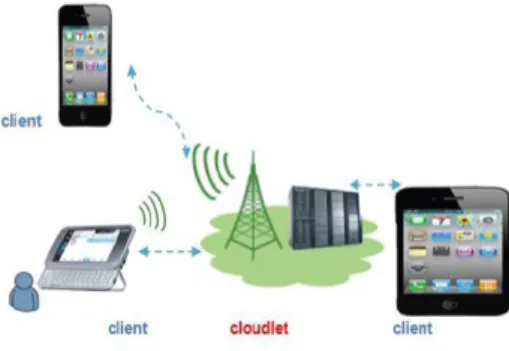
In the case of connecting to the cloudlet, as Figure 3.1 shows, the mobile device offloads its workload to a local cloudlet consisted of a number of multi core computers by means of association to the enterprise cloud servers10,11,9,15.
These cloudlets would be located in common areas, such as coffee shops, universities and airports. Mobile device performs in the vein of a thin client connecting over to the distant (enterprise) server through 3G6.
In traditional cloudlet approach, mobile users use the nearest cloudlet that covers limited area to achieve requested services such as, storing, processing and content delivery. Cloudlets as shown in Figure 3.1 act as temporary service servers since they update the nodes states at the end of the communication (when the job is done) to the enterprise cloud resulting in high latency. The cloudlet, which is presented to be obtainable for nearby mobile devices use, may benefit the mobile device users who need such a resource rich server within the range of server ’cloudlet’. This may
Fig. 1. Mobile device connect to a cloudlet.
Fig. 2. Traditional Cloudlet approach.
Fig. 3. Context information changes.
help users staying at a coffee shop, waiting at the airport, universities, or in any space within a specific range. But, what about mobile users who need to accomplish their work while on the move?
When we have a client with a cloudlet or enterprise cloud, then we talk about one possible movement which is the client movement since both cloudlet and the enterprise cloud are central stable servers. A key point is to monitor the context of current user’s location, when the cloudlet’s user going out of the range as shown in Figure 3.1, connection should be dynamically adapted for the contexts; to keep the job progress while any moves of cloud members.
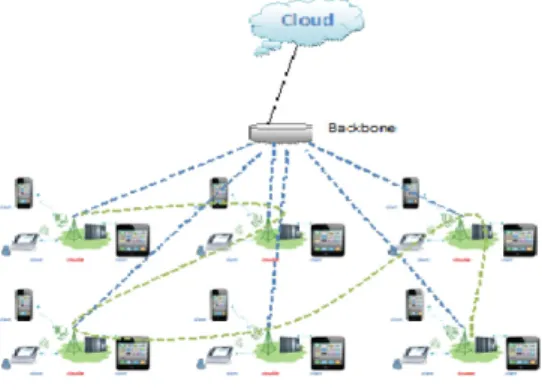
Fig. 4. Cloudlets network. 3.2. The Proposed Model Architecture
We propose a new model for ad-hoc network between cloudlets not between mobile nodes. Since cloudlets process data (jobs) on behalf of user’s mobile devices, cloudlets are having the same role; hence they are peer to each other, and each can establish a connection with any other cloudlet. Figure 3.1 shows the cloudlets network components which include the following:
• An enterprise cloud (3G connection).
• Cloudlets in nearby zones connecting to each other in high bandwidth wireless communication (e.g. WiMax).
• Set of mobile devices (laptops, smart phones, tablets) connecting to a cloudlet in high bandwidth wireless communication (WiFi).
• Repeaters between cloudlets.
In our framework there are number of deployed cloudlets associated with several mobile nodes. Each mobile node has a job to be processed by a nearby cloudlet. Each cloudlet presents a service(s) for any around mobile device. The cloudlet network consists of varied set of nodes with diverse tasks; that is because this network is comprised of many mobile nodes each is connected to the cloudlet in its area - with high bandwidth wireless functionality-via wireless links. All the nodes can be mobile except the cloudlets which are fixed. We use the Random Way Point mobility mechanism (RWP) for the movements of the mobile nodes, in addition to a modified version of the Destination-Sequenced Distance-Vector routing protocol (DSDV) for nodes routing. In the original DSDV protocol, each node in the network maintains a routing table, tags each route with a sequence number, and exchanges the routing information16. In our adapted DSDV protocol, the cloudlets swap the routing information about the mobiles whereas
the mobile nodes utilize the cloudlets as their service provider. In our proposed architecture, mobile nodes can send or receive data from either the nearby cloudlet or any accessible cloudlets in other zones. In addition to the ability to communicate with other mobile nodes in other zones also. So, the source nodes can be the cloudlets or any of the mobile devices as well as the aimed nodes. As in17, we can trim down the bandwidth to half by each one hop repeater.
So, using these repeaters in between cloudlets can be a possible solution to make every cloudlet reach the destination cloudlet by single hop. If the mobile device arrives to a zone with no cloudlet coverage then the client’s job should be delegated to the enterprise cloud server to keep the connection on. Then when the mobile device senses a nearby cloudlet the client’s job should be delegated to this cloudlet to achieve its benefits which represented by low latency in addition to protection; since the bandwidth cost in 3G networks is higher than WiFi.
3.3. Cloudlet’s additional components
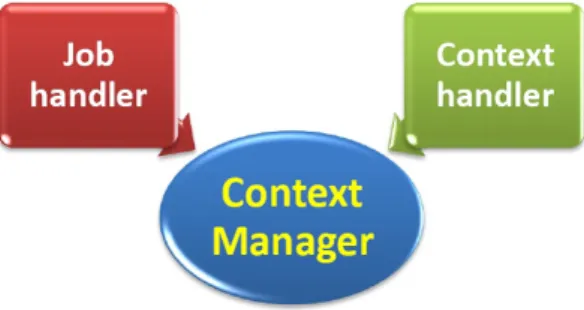
We assume that in each cloudlet server there are three major components: context handler, job handler, and context manager as in Figure 3.3. Since we focus on the mobility management issue in mobile cloud computing models, our
Fig. 5. Cloudlet server additional components.
model is based mainly on the context manager part with respect to other components benefits. Context manager is responsible for sensing and recording contextual information which is used to keep track on client nodes to register if new devices are joining in or if current devices are moving out of the cloudlet rang.
• Context handler
> Maintaining connections and communicating with the mobile devices.
> Monitoring potential nodes entering or leaving the coverage area.
• Job handler
> Partitions the application and data set required into separated subtasks.
> Returns the result of each subtask to the owner of the job or to the destination cloudlet.
• Context manager
> Keep track of context parameters such as, device context which includes the environmental and device settings, situational context relating to monitored data on user’s location.
> Responsible for the decision making procedure, where it responsible for suitable passing.
To make the decision, the server must analyze the user context in addition to the job at hand. This ability may come from the fact that mobile devices context enabled features allow us to determine further information from the computing device itself with no need for user input in addition to that user interaction methods with the application depend on user’s context such as location.11Due to the possible dynamic changes of our proposed network, resulting
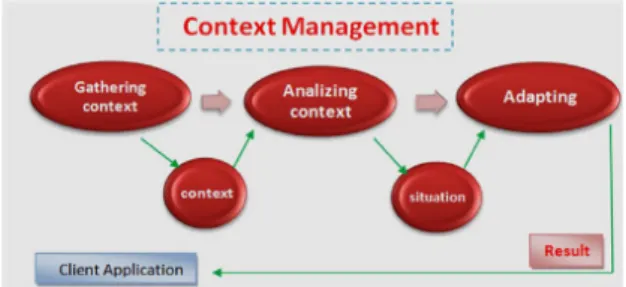
from the mobile nodes going in/out of range, it is critical for the network architecture to be self-organizing. Since consumers’ mobile devices can sense and monitor their context, the context information can be helpful. While a job is performing, members associated context can change then the situation needs to be adapted dynamically. The context information is gathered, and analyzed to determine the current situation of the consumer as shown in Figure 3.3. Then, a most appropriate decision is selected at the stage of adapting, and then the job will be offloaded to the selected server.
4. Conclusion
The AMCC model introduced in this paper presents a novel ad-hoc model for mobile based cloud computing that is using the low cost and easy to deploy cloudlet systems. The model exploit the capabilities of the Destination-Sequenced Distance-Vector (DSDV) for routing protocol and Random Way Point (RWP) for mobility mechanism. The model aim at reducing the end-to-end packet delay, better system scalability and mobility management. The initial predictions for the model showed that the variation of hand-offdelay as well as workload size gives significant impact on the end-to-end delay results.
Fig. 6. The context management process for gathering and analyzing the client context. 5. Acknowledgment
This work is partially supported by the USAID - PEER Science program, grant number PGA-2000003469.
References
1. Marinelli, E.E.. Hyrax: cloud computing on mobile devices using mapreduce. Tech. Rep.; DTIC Document; 2009.
2. Jararweh, Y., Jarrah, M., kharbutli, M., Alshara, Z., Alsaleh, M.N., Al-Ayyoub, M.. Cloudexp: A comprehensive cloud computing exper-imental framework.Simulation Modelling Practice and Theory2014;49(0):180 – 192. doi:http://dx.doi.org/10.1016/j.simpat.2014.09.003. 3. Communications, Z.. Zte corporation. a survey of mobile cloud computing. 2011.
4. Kovachev, D., Renzel, D., Klamma, R., Cao, Y.. Mobile community cloud computing: Emerges and evolves. In:Mobile Data Management (MDM), 2010 Eleventh International Conference on. 2010, p. 393–395. doi:10.1109/MDM.2010.78.
5. Satyanarayanan, M., Bahl, P., Caceres, R., Davies, N.. The case for vm-based cloudlets in mobile computing.Pervasive Computing, IEEE
2009;8(4):14–23. doi:10.1109/MPRV.2009.82.
6. Jararweh, Y., Tawalbeh, L., Ababneh, F., Dosari, F.. Resource efficient mobile computing using cloudlet infrastructure. In:Mobile Ad-hoc and Sensor Networks (MSN), 2013 IEEE Ninth International Conference on. 2013, p. 373–377. doi:10.1109/MSN.2013.75.
7. Quwaider, M., Jararweh, Y.. Cloudlet-based efficient data collection in wireless body area networks. Simulation Modelling Practice and Theory2015;50(0):57 – 71. URL:http://www.sciencedirect.com/science/article/pii/S1569190X14001099. doi:http://dx.doi.org/10.1016/j.simpat.2014.06.015; special Issue on Resource Management in Mobile Clouds.
8. Jararweh, Y., Tawalbeh, L., Ababneh, F., Khreishah, A., Dosari, F.. Scalable cloudlet-based mobile computing model. Procedia Computer Science2014;34(0):434 – 441. URL:http://www.sciencedirect.com/science/article/pii/S1877050914009065. doi:http://dx.doi.org/10.1016/j.procs.2014.07.051; the 9th International Conference on Future Networks and Communications (FNC’14)/The 11th International Conference on Mobile Systems and Pervasive Computing (MobiSPC’14)/Affiliated Workshops.
9. Bajad, R.A., Srivastava, M., Sinha, A.. Survey on mobile cloud computing. International Journal of Engineering Sciences&Emerging Technologies2012;1(2):8–19.
10. Fernando, N., Loke, S.W., Rahayu, W.. Mobile cloud computing: A survey. Future Generation Com-puter Systems 2013;29(1):84 – 106. URL: http://www.sciencedirect.com/science/article/pii/S0167739X12001318. doi:http://dx.doi.org/10.1016/j.future.2012.05.023; including Special section: AIRCC-NetCoM 2009 and Special section: Clouds and Service-Oriented Architectures.
11. Guan, L., Ke, X., Song, M., Song, J.. A survey of research on mobile cloud computing. Computer and Information Science, ACIS International Conference on2011;0:387–392. doi:http://doi.ieeecomputersociety.org/10.1109/ICIS.2011.67.
12. Altamimi, M., Naik, K.. The concept of a mobile cloud computing to reduce energy cost of smartphones and ict systems. In: Kranzlmller, D., Toja, A., editors. Information and Communication on Technology for the Fight against Global Warming; vol. 6868 of Lecture Notes in Computer Science. Springer Berlin Heidelberg. ISBN 978-3-642-23446-0; 2011, p. 79–86. URL: http://dx.doi.org/10.1007/978-3-642-23447-7 8. doi:10.1007/978-3-642-23447-7 8.
13. Quwaider, M., Jararweh, Y.. Cloudlet-based for big data collection in body area networks. In:Internet Technology and Secured Transactions (ICITST), 2013 8th International Conference for. 2013, p. 137–141. doi:10.1109/ICITST.2013.6750178.
14. Hong, J.A., Seo, S., Kim, N., Lee, B.D.. A study of secure data transmissions in mobile cloud computing from the energy consumption side. In:Information Networking (ICOIN), 2013 International Conference on. 2013, p. 250–255. doi:10.1109/ICOIN.2013.6496385. 15. Rindos, A., Vouk, M., Jararweh, Y.. The virtual computing lab (vcl): an open source cloud computing solution designed specifically for
education and research.International Journal of Service Science, Management, Engineering, and Technology (IJSSMET)2014;5(2):51–63. 16. Broch, J., Maltz, D.A., Johnson, D.B., Hu, Y.C., Jetcheva, J.. A performance comparison of multi-hop wireless ad hoc network
routing protocols. In:Proceedings of the 4th Annual ACM/IEEE International Conference on Mobile Computing and Networking; Mobi-Com ’98. New York, NY, USA: ACM. ISBN 1-58113-035-X; 1998, p. 85–97. URL:http://doi.acm.org/10.1145/288235.288256. doi:10.1145/288235.288256.