Ames Laboratory Accepted Manuscripts Ames Laboratory
8-15-2018
Structures and magnetic properties of iron silicide
from adaptive genetic algorithm and first-principles
calculations
Zejin Yang
Iowa State University and Ames Laboratory Shunqing Wu
Iowa State University and Ames Laboratory Xin Zhao
Iowa State University and Ames Laboratory Manh Cuong Nguyen
Iowa State University and Ames Laboratory Shu Yu
Iowa State University and Ames Laboratory
See next page for additional authors
Follow this and additional works at:https://lib.dr.iastate.edu/ameslab_manuscripts
Part of theEngineering Physics Commons, and theStructural Materials Commons
This Article is brought to you for free and open access by the Ames Laboratory at Iowa State University Digital Repository. It has been accepted for inclusion in Ames Laboratory Accepted Manuscripts by an authorized administrator of Iowa State University Digital Repository. For more information, please [email protected].
Recommended Citation
Yang, Zejin; Wu, Shunqing; Zhao, Xin; Nguyen, Manh Cuong; Yu, Shu; Wen, Tongqi; Tang, Ling; Li, Fuxiang; Ho, Kai-Ming; and Wang, Cai-Zhuang, "Structures and magnetic properties of iron silicide from adaptive genetic algorithm and first-principles calculations" (2018).Ames Laboratory Accepted Manuscripts. 403.
Structures and magnetic properties of iron silicide from adaptive genetic
algorithm and first-principles calculations
Abstract
We performed a systematic search for low-energy structures of binary iron silicide over a wide range of compositions using the crystal structure prediction method based on adaptive genetic algorithm. 36 structures with formation energies within 50 meV/atom (11 of them are within 20 meV) above the convex hull formed by experimentally known stable structures are predicted. Magnetic properties of these low-energy structures are investigated. Some of these structures can be promising candidates for rare-earth-free
permanent magnet.
Disciplines
Engineering Physics | Materials Science and Engineering | Structural Materials
Authors
Structures and magnetic properties of iron silicide from adaptive
genetic algorithm and first-principles calculations
Zejin Yanga,b, Shunqing Wub,c, Xin Zhaob, Manh Cuong Nguyenb, Shu Yub,c, Tongqi
Wenb,d, Ling Tanga,b, Fuxiang Lib,e, Kai-Ming Hob and Cai-Zhuang Wangb*
a) School of Science, Zhejiang University of Technology, Hangzhou, 310023, China b) Ames Laboratory, US DOE and Department of Physics and Astronomy, Iowa State University, Ames, Iowa 50011, USA.
c) Collaborative Innovation Center for Optoelectronic Semiconductors and Efficient Devices, Department of Physics, Xiamen University, Xiamen 361005, China
d) MOE Key Laboratory of Materials Physics and Chemistry under Extraordinary Conditions, School of Natural and Applied Sciences, Northwestern Polytechnical University, Xi’an 710072, China
e)Department of Physics, Beijing Key Laboratory of Opto-electronic Functional Materials & Micro-nano Devices, Renmin University of China, Beijing 100872 China
Abstract
We performed a systematic search for low-energy structures of binary iron
silicide over a wide range of compositions using the crystal structure prediction
method based on adaptive genetic algorithm. 36 structures with formation energies
within 50 meV/atom (11 of them are within 20 meV) above the convex hull formed
by experimentally known stable structures are predicted. Magnetic properties of these
low-energy structures are investigated. Some of these structures can be promising
candidates for rare-earth-free permanent magnet.
1. Introduction
Permanent magnets (PM) are one of the essential functional materials and have
been playing more and more important roles in modern technologies and energy
applications[1]. Currently, most high-performance PM materials such as Nd2Fe14B
and SmCo5 contain rare-earth (RE) elements. Due to the limited recourse and supply
of the RE, it is desirable to search for replacement materials for PM without using RE.
One class of the promising materials under intensive investigation is Fe-based
compounds owing to the high magnetic moment, good ferromagnetic stability, low
price and abundant of Fe. However, magnetocrystalline anisotropy energy (MAE) is a
major concern for Fe-based compounds as pure Fe forms body-centered cubic (BCC)
structure which does not exhibit any magnetic anisotropy.
Recently, several Fe-based RE-free compounds such as Fe-Co-X (X being B, C
or N)[2-7], Fe(Co)Pt[8], and Fe2P[9] have been studied intensively as potential
permanent magnet materials. These studies have demonstrated that the MAE of Fe
can be improved substantially by allowing with other non-magnetic elements. More
effort is desirable in searching for new low-energy structures of Fe-Si compounds and
characterize the magnetic properties of these structures for possible RE-free
permanent magnet applications.
In this paper, we systematically explore the low-energy structures of Fe-Si
compounds over a wide range of composition, especially focus on Fe-rich compounds.
In addition to reproducing the experimentally synthesized structures, a number of
structures with energies less than 20 meV/atom (11) and 50 meV/atom (25) with
respect to the convex hull formed by experimentally know stable structures are
obtained. Some of these structures have reasonably large MAE and would be potential
2. Computational Methods
Low-energy structures of binary iron silicide at various compositions were
searched by crystal structure prediction code using adaptive genetic algorithm
(AGA).[10] In the AGA approach, auxiliary classical potentials are used to accelerate
the structural search process. The parameters of the auxiliary classical potentials are
adaptively adjusted by fitting to first-principles calculation results after the GA search
is converged with a given interatomic potential. In each iteration of potential refitting,
typically only about 20 candidate structures with lower energies from the GA search
by previous auxiliary classical potential are extracted for first-principles calculations
to obtain the energies and forces in order to update the classical potential parameters
for next iteration of GA search. Therefore, the computer time used for the
first-principles calculations is minimal. Such combined potential iteration and GA
search can fully satisfy the desired calculation speed and accuracy simultaneously in
the structure search using genetic and related algorithms.
In the present study, crystal unit cells contain up to 8 formula units (f.u.) are used
in the AGA search. The size of the structure pool in the AGA search is 128 and the
search with a given interatomic potential is satisfied to be converged if the lowest
energy 128 structures remain unchanged in 500 consecutive GA generations. Then 16
lowest-energy structures at the end of each GA search with a given set of classical
potential parameters are selected for first-principle calculations to update the potential
parameters for next iteration of GA search, and so on. The interatomic potentials
searches[11]. The potential fitting is done by the force-matching method with
stochastic simulated annealing algorithm adopted in the potfit code[12,13].
The first-principles calculations are carried out using the projector-augmented
wave method[14] with a plane wave basis set, as implemented in the VASP[15,16]
code. The spin-polarized generalized gradient approximation and the
Perdew-Burke-Ernzerhof[17] functional are used to model the exchange-correlation
energy. Energy cutoff for the plan-wave basis is 350 eV. The self-consistent
convergence criterion for the energy is 1.0×10⁻⁷ eV. K-point sampling[18] of
2π×0.013 Å−1 in the Brillouin-zone is used and the force on each atom is converged to
less than 0.01 eV/Å during the atomic relaxation. After the crystal structure search
and optimization, low-energy structures are selected for magnetic property (including
MAE) calculations. Spin-orbit coupling is included in the MAE calculation and the
symmetry operation is switched off (ISYM =-1) during the MAE calculations.
3. Results and discussion
3.1 Low-energy structures
The formation energies of the low-energy structures of binary FexSiy compounds
with different compositions at zero pressure and temperature obtained from our AGA
search and first-principles total energy calculations are shown in Fig. 1. The convex
hull is constructed using the diamond Si and BCC Fe crystal structures as well as
several experimentally determined structures of binary Fe-Si compounds, i.e., (FeSi2,
FeSi, and Fe3Si). The formation energies are all negative suggesting that these
crystals. However, all the formation energies of the structures from the AGA search
are above the convex hull indicating that these structures would be metastable
[image:7.595.92.504.172.364.2]structures.
Figure 1. The formation energies of FexSiy obtained from our AGA search. The
formation energy is calculated as [E(FexSiy)-xE(Fe)-yE(Si)]/(x+y), E means energy.
The convex hull is constructed using the energies of the diamond Si , BCC Fe as well
as experimentally determined structures of FeSi2, FeSi, and Fe3Si. The black squares
are the results from the AGA structures and the red open circles are from the
experimentally observed structures. The lowest-energy structures at FeSi2, FeSi, and
Fe3Si are also reproduced by our AGA search.
Recently, materials synthesis under far-from-equilibrium conditions has become
an important approach for materials design and discovery. Various
far-from-equilibrium synthesis methods have been developed and used to obtain
metastable structures which could possess desirable properties and functionalities. In
the literature, many metastable structures with formation energy 100 meV/atom or
under non-equilibrium synthesis conditions. In binary iron silicide system, 7
compounds have been experimentally synthesized so far, including three metastable
phases, i.e., FeSi2 (P4/mmm), Fe5Si3 (P63/mcm), Fe11Si5 (Pm3m), with energy about
60, 30, and 10 meV/atom respectively with respective to the corresponding
ground-state structures. Our calculations show that Fe5Si3 (P63/mcm) exists a large
easy plane magnetic anisotropy with a MAE value of 2.21 MJ/m3 (E100=E010<E001),
whereas Fe2Si (P3m1) shows a relatively smaller MAE, with a value of 0.51 MJ/m3
(E100=E010<E001). Other experimentally observed iron silicides, including FeSi2 (Cmce,
P4/mmm), FeSi (P213), Fe3Si (Fm3m), Fe11Si5 (Pm3m), have zero MAE.
Figure 2 The formation energies of the FexSiy structures with the formation energy
less than 50 meV/atom above the convex hull obtained from our AGA search.
Since the structures with formation energy as high as 60 meV/atom above the
convex hull have been observed experimentally, some of the low-energy metastable
[image:8.595.117.483.391.611.2]2, we show all the metastable structures with the formation energy less than 50
meV/atom above the convex hull obtained from our AGA search. Among these 36
low-energy metastable structures, 11 of them have formation energies less than 20
meV/atom above the convex hull. There is a high chance that some of these 36
low-energy metastable structures can be made by experiment through the
non-equilibrium synthesis techniques. In the following sections, our discussion on the
magnetic properties of FexSiy compounds will base only on these 36 low-energy
structures.
3.2 Magnetic properties
We have calculated the magnetic properties and MAE for the 36 lowest-energy
(less than 50 meV above the convex hull) metastable structures. The results are listed
in Table 1.
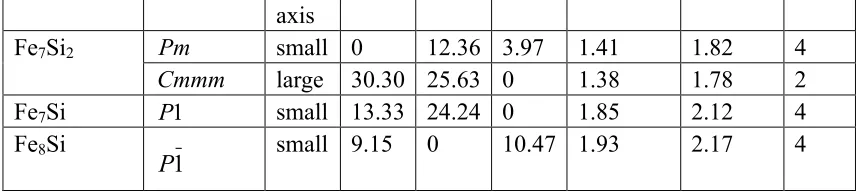
Table 1. Structural and magnetic properties of the 11 low-energy structure (within 20
meV/atom from the convex hull) of FexSiy. The magnetic moments are in the unit of µB. The MAE (µeV/atom) are calculated along three directions as indicated. n.f.u. means the number of formula units used in the AGA search to obtain the structures.
composition Symmetry MAE 100 010 001 Mag. Momenet per atom Mag. Moment per Fe n.f.u. FeSi m m
P 3 none 0 0 0 0 0 4
Fe3Si2_A C2/m small 0 3.7 0.5 4
Fe2Si Cmcm small 13.69 5.78 0 0.70 1.05 4
nmm /
P4 none 0 0 0 0.71 1.07 4
C2/m small 0 4.03 1.53 0.69 1.04 4
P2/m small 0 3.50 0.18 0.67 1.01 4
axis
Fe7Si2 Pm small 0 12.36 3.97 1.41 1.82 4
mmm
C large 30.30 25.63 0 1.38 1.78 2 Fe7Si P1 small 13.33 24.24 0 1.85 2.12 4
Fe8Si
1
P small 9.15 0 10.47 1.93 2.17 4
Table 2 Structural and magnetic properties of the 25 structures of FexSiy with the
energies between 20 to 50 meV/atom above the convex hull. Same definitions are used as those in Table 1.
Comp ositio n
Symmetry MAE 100 010 001 Mag. Mome nt per atom Mag. Mom ent per Fe nf.u. FeSi 2 6m
P small 0 14.75 26.75 0.37 0.75 4
C2/m none 0 0 0 0 0 4
Fe5Si4 P2/m small 11.58 18.17 0 0.25 0.45 4
Fe4Si3 I4/mmm large 49.61 0 41.17 0.37 0.65 4
Fe3Si2 P4/m easy
axis
20.44 0 20.44 0.42 0.71 4
P21/m nearly
perfect
27.13 27.42 0 0.47 0.79 4
Fe3Si2
_B
C2/m large 58.70 47.21 0 0.58 0.98 4
Fe7Si3 P21/m small 0 24.29 11.93 0.95 1.36 4
m
P small 0 32.78 1.42 0.88 1.26 4
1
P small 12.47 32.13 0 0.88 1.26 4
Fe3Si Fmmm small 0.88 0.09 0 1.276 1.70 4
mcm
C small 25.94 6.02 0 1.20 1.60 4
C2/m small 0 12.37 4.23 1.44 1.93 4
C2 nearly
perfect
10.33 9.98 0 1.06 1.41 8
Fe4Si C2/m small 0 11.35 21.32 1.94 2.43 4
Fe5Si P1 small 1.10 17.86 0 1.76 2.11 4 P21/m small 62.64 12.59 0 1.76 2.11 4 C2/m small 11.88 0 49.37 1.74 2.09 4
Fe6Si Cmmm easy
axis
[image:10.595.83.513.73.169.2]9 1
P small 16.00 10.11 0 1.79 2.09 4
mm
I4 easy
axis
6.04 6.04 0 1.64 1.91 4
1
P small 14.47 0 21.44 1.83 2.14 4
m
P small 23.28 0 11.55 1.77 2.07 4
Fe7Si
1
P small 8.80 12.18 0 1.88 2.15 4
Fe8Si P1 small 0 4.28 2.68 1.90 2.14 4
According to the values of MAE along different crystalline directions, we
classify these structures into three groups. Group I refers to those structures with
uniaxial anisotropy, i.e., only one direction has lower energy and energies along other
directions are the same and higher than that of the easy axis. Group II includes those
structures have large energy difference along the different directions but the energies
along the two higher energy directions are not the same. We refer such situation as
triaxial anisotropy and the MAE is the energy difference between the two
lower-energy directions. Group III are those structures with very small or even zero
MAE. The structures of the group I and II are shown in Fig. 3 and 4 respectively.
(a)Fe2Si_ P4/mmm 3.39 (b)Fe3Si2_ P4/m 20.4
(c) Fe3Si2_ P21/m 27.13 (d)Fe3Si_C2 ~10.0
Figure 3 Structures with uniaxial magnetic anisotropy, digital in the picture means
MAE with unit of µeV, Si Fe.
Figure 4 Structures with triaxial magnetic anisotropy, digital in the picture means
MAE with unit of µeV, Si Fe.
3.2.1 Structures with relatively large MAE
The Fe3Si2 (P4/m) is a tetragonal crystalwith structural parameters a=b=6.47 Å,
c=2.71 Å, α=β=γ=90°, and with two formula units per primitive cell, as is shown in
Fig. 3 (b). The Fe6Si (Cmmm) shown in Fig. 3 (c) has lattice parameters a=b=5.58 Å,
c=10.14 Å, α=β=97.91°, γ=90.0°, and with two formula units per primitive cell. Both
structures have energies larger than 20 meV/atom with respect to the convex hull.
These two structures exhibit uniaxial magnetic anisotropy with MAE of 0.31 and 0.39
MJ/m3, respectively. The average atomic magnetic moment in unit cell of the Fe3Si2 is
0.4281 µB although two Fe atoms in the unit cell have very large moment of 2.758 µB.
By contrast, Fe6Si structure has more evenly distributed moment of 1.57 µB per atom
and 1.83 µB per Fe atom in the unit cell.
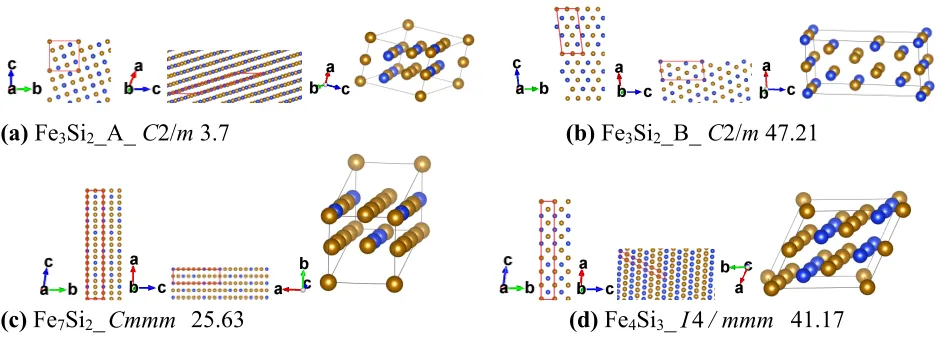
(a) Fe3Si2_A_ C2/m 3.7 (b) Fe3Si2_B_ C2/m 47.21
[image:12.595.60.528.171.340.2]
Four other structures (Fe2Si_P4/mmm, Fe3Si2_ P21/m, Fe6Si_I4mm, and
Fe3Si_C2) are also shown in Fig. 3. Although the Fe2Si_P4/mmm exhibit uniaxial
anisotropy, its MAE is very small, 3.39 µeV/atom. The average magnetic moment is
0.7 per atom and 1.05 µB per Fe atom. Nevertheless, the formation energy of the
Fe2Si_ P4/mmm structure is very close to the convex hull, (only about 19 meV/atom
above the convex hull) although it is not the lowest-energy one at the composition
obtained from our AGA search (see Table 1). Fe3Si2_P21/m has moderate MAE of
about 27 µeV/atom (0.41 MJ/m3) probably due to its large distortion from the BCC
lattice. However, the magnetic moment of this structure is relatively small (0.47 per
atom and 0.97 µB per Fe) due to relatively high concentration of Si. The MAE of
Fe6Si_I4mm structure is very small (see Table 2) and could be ignored due because
the lattice is still nearly BCC. However, the average magnetic moment is high, 1.64
per atom or 1.91 µB per Fe atom due to its Fe-rich composition. Finally, the Fe3Si_C2
has MAE of about 10.0 µeV/atom (0.15MJ/m3) and average magnetic moment of 1.06
per atom or 1.41 µB per Fe atom. More details of the structural properties along with
other low-energy structures can also be found in the supporting materials.
In Fig. 3,Fe3Si2 (P4/m) shows perfect MAE along a and c axes (20.4 µeV/atom)
with same projections along a and b axes. Fe6Si (Cmmm) has perfect MAE along a
and b axes, with identical values of 27.14 µeV/atom, in comparison with that of lower
energy direction c axis, consisting with the fact of same projections along a and b
axes, namely, the unit cell has a C2V mirror symmetry with respect to the plane formed
µeV along 100 and 010 axes relative to that of 001 axis. The energy difference
between the Fe2Si_P4/mmm with the stable state is below 20 meV/atom. Only this
phase is within the energy range of 0~20 meV/atom among all the studied 36
structures, other structures with perfect or nearly perfect easy-axis are within 20~50
meV/atom from their individual stable states. Its atomic distribution features are same
along a and b axes, agreeing with the fact of the identical energies along a and b axes.
Fe3Si2_ P21/m shows nearly perfect easy axis, with respective values of 27.13 and
27.42 µeV along 100 and 010 axes relative to that of 001 direction. Probably the
distorted BCC building block is the origin of the imperfect MAE of the crystal.
Fe6Si_I4mm shows nearly perfect easy axis but with nearly zero value, 6.0471 µeV
along 100 and 6.0367 µeV along 010 axes relative to that of 001 axis. The unit cell
shows C2v planar symmetry with respect to the plane formed by c axis, namely,
projections towards a and b are same, the nearly identical MAE could be reflected by
their totally symmetric geometric positions in regardless of the elemental species.
Fe3Si_C2 shows a slightly large difference between 100 and 010 axes, with respective
values of 10.33 and 9.98 µeV relative to that of 001 axis, similar with the case of
Fe6Si_I4mm.
We also found that some structures with relatively large MAE but the anisotropy
is not uniaxial. Among the selected structures with energies below 20 or within 20-50
meV/atom to their respective stable states, only three structures belong to these
categories. These structures are Fe3Si2_B_C2/m, Fe7Si2_Cmmm, and Fe4Si3_I4/mmm,
Fe3Si2_B_C2/m). The structural parameters of the Fe3Si2_B_ C2/m are parameters
4.78 (a=b) Å, 10.05 (c) Å, 94.83°
(α=β), 109.59°
(γ), respectively, and this structure
has large MAE along 100 and 010 axes relative to 001 axis, with values of 58.7 and
47.21 µeV/atom, respectively. Fe7Si2_Cmmm structure with structural parameters of
3.94 (a=b) Å, 12.94 (c) Å, 98.76°
(α), 90.0°
(β=γ), respectively shows MAE 30.3 and
25.63 µeV/atom along 100 and 010 axes, respectively. Fe4Si3_ I4/mmm is a structure
with lattice parameters 6.14 (a=c) Å, 10.75 (b) Å, 73.38°
(α), 53.13°
(β), 93.28°
(γ)
and shows MAE of 49.61 and 41.17 µeV/atom along 100 and 001 axes, respectively.
Their magnetic moments oth these structures can be found in Table 2.
We note that 25 structures with formation energy within 50 meV/atom above the
convex hull exhibit uniaxial magnetic anisotropy but the MAE are small. These
structures would be good candidates for soft ferromagnetic materials. These structures
include P6m2, C2/m, P21/c of FeSi, P2/m of Fe5Si4, I4/mmm of Fe4Si3, P21/m of
Fe3Si2, P2/m, P21/m, Pm, P1 of Fe7Si3, Fmmm, Cmcm, C2/m, C2 of Fe3Si, C2/m
of Fe4Si, P1, P21/m, C2/m of Fe5Si, Cmmm, P1, I4mm, P1, Pm of Fe6Si,
1
P of Fe7Si, P1 of Fe8Si, respectively. Detailed structural and magnetic properties
of these structures are shown in Tables 1 and 2and supporting information.
3.3.2 Effect of Si on the magnetic moment of Fe atoms
Analysis based on the results obtained from our calculations show that alloying
with Si has profound effects on the magnetic moments of Fe atoms. In general, the
overall magnetic moments of the FexSiy compounds are smaller than that of the BCC
However, some individual Fe atoms can have magnetic moment higher than their
values in BCC crystal. We find that the magnetic moment of individual Fe atom is
strongly dependent on its chemical as well as structural environments. In general, the
magnetic moment of the central Fe atom increases as the percentage of Fe atom in its
first neighbor shell increases, as shown in Fig. 5. Some Fe atoms can even achieve the
moment of 2.5-3.0 µB. A close inspection of Fig. 5 shows that although the magnetic
Figure 5 Magnetic moment of the central Fe atom in the FexSiy compounds as the
function of the percentage of Fe atom in its first neighbor shell.
moment of the central Fe atom increases with the number of Fe atoms in its first shell,
the variation of the magnetic moment at given Fe coordination numbers can be quite
[image:16.595.116.453.271.532.2]from about 0.5 to 1.5 µB. These results suggest that the magnetic moment of the
central atom can also be dependent on the way how the Fe (or Si) atoms are
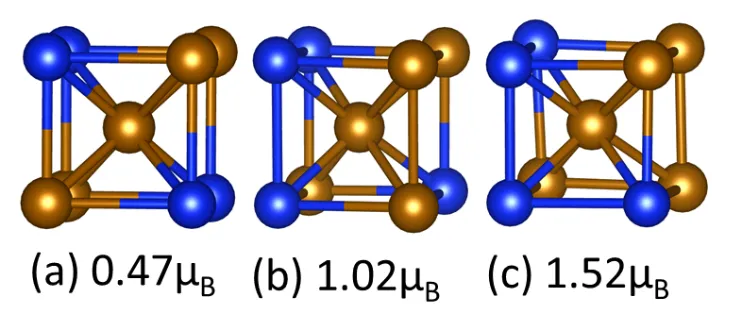
distributed in the first shell. As an illustration, we show in Fig. 6 that different
chemical arrangement around the central Fe atom can give very different magnetic
moment from about 0.5 to 1.5 µB although the ratios of the Fe atoms in the first shell
are the same in the three cases. It seems that more asymmetric distribution of the Fe
(or Si) atoms will give higher magnetic moment to the central Fe atom.
[image:17.595.90.461.291.446.2]
Figure 6 Dependence of the magnetic moment of the central Fe atom on the chemical
destruction of the first shell atoms. Note that the ratio of Fe:Si in the first shell is the
same for three structures, Si Fe.
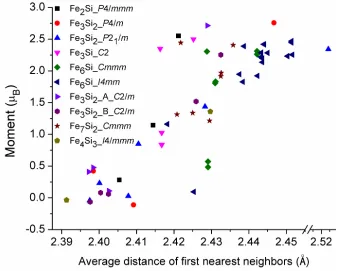
The magnetic moment of the Fe atom is also dependent on the distance from its first
neighbor atoms, as shown in Fig. 7. The longer the average distance, the higher the
Figure 7 Magnetic moment of the central Fe atom in the FexSiy compounds as the
function of the average bond lengths between the central atom and its first neighbor shell atoms.
It should be noted that even for a given crystal structure, the magnetic moment
on each Fe atom can be very different because the chemical environment can be
different for each individual Fe atoms in the same crystal structure. An example is
[image:18.595.130.468.76.347.2]Figure 8 Structure and moment (µB) of typical phases Fe6Si_Cmmm
The lattice of the Fe3Si2_P4/m structure shown in Fig. 8 is BCC. There three
types of Fe atoms (colored red, green, and purple respectively) in this structure
according to the distribution of Si atoms (blue) around them. The red Fe atoms are all
surround by Si atom in its first shell, therefore they have very small magnetic moment
of -0.12 µB (even the direction of the moment is different from the other two types).
The green Fe atoms have more Si atoms than Fe atoms in their first neighbor shell and
their magnetic moment is also small (0.12 µB). By contrast, because there are no Si
atoms in their first neighbor shell, the purple Fe atoms exhibit very large magnetic
moment of 2.76 µB, which is even larger than that of Fe in BCC pure-Fe crystal.
4. Conclusion
Using the adaptive genetic algorithm and first principles calculations, we
systematically explored the magnetic properties of the low-energy FexSiy compounds
over a wide range of chemical compositions. 36 new structures with energies less than
20 meV/atom (11) and 50 meV/atom (25) with respect to the convex hull formed by
experimentally know stable structures are determined. The deeply discussed structures
of the 36 predicted metastable structures have body-centered cubic (BCC) building
blocks with some degree of distortion from the BCC lattice. The presence of Si in the
FexSiy compounds break the chemical symmetry of the BCC lattice and lead to some
moderate magnetic anisotropy in some of the binary compounds. We also show that
chemical and structural environment of the central Fe atoms. The information
obtained from such a systematic study will be very useful for guiding experiment in
design and synthesis of Fe-Si-based materials for magnetic applications.
Acknowledgements
This work was supported by the National Science Foundation, Division of
Materials Research under Award DMREF: SusChEM 1436386. The development of
adaptive genetic algorithm method was supported by the US Department of Energy,
Basic Energy Sciences, Division of Materials Science and Engineering, under
Contract No. DE-AC02-07CH11358, including a grant of computer time at the
National Energy Research Scientific Computing Center in Berkeley, CA. Zejin Yang
acknowledges the financial support from China Scholarship Council (File No.
201508330131) and the hospitality of Ames lab and Iowa State University. Zejin
Yang acknowledges the Natural Science Foundation of Zhejiang Province, China
(Grant No: LY18E010007).
[1] R. McCallum; L. H. Lewis; R. Skomski; M. Kramer; I. Anderson: Practical aspects of modern and future permanent magnets. Annual Review of Materials Research 44, (2014), 451-477.
[2] J. Liao; Z. Feng; J. Qiu; Y. Tong: High-frequency permeability of sputtered Fe–Co–B-based soft magnetic thin films. Phys. Sta.. Sol. (a) 205, (2008), 2943-2947.
[3] N. X. Sun; S. X. Wang; T. J. Silva; A. B. Kos: High-frequency behavior and damping of Fe-Co-N-based high-saturation soft magnetic films. IEEE Trans. Magn. 38, (2002), 146-150.
[4] N. X. Sun; S. X. Wang: Soft magnetism of Fe–Co–N thin films with a Permalloy underlayer. J. Appl. Phys. 92, (2002), 1477-1482.
[5] A. E. Gendy; M. Bertino; D. Clifford; M. .Qian; S. N. Khanna; E. E. Carpenter:
Experimental evidence for the formation of CoFe2C phase with colossal magnetocrystalline-anisotropy.
[6] X. Zhao; L. Ke; C. Z. Wang; K. M. Ho: Metastable cobalt nitride structures with high magnetic anisotropy for rare-earth free magnets. Phys. Chem. Chem. Phys. 18, (2016), 31680-31690.
[7] X. Zhao; C. Z. Wang; Y. Yao; K. M. Ho: Large magnetic anisotropy predicted for
rare-earth-free Fe16-xCoxN2 alloys. Phys. Rev. B 94, (2016), 224424-224428.
[8] R. A. Ristau; K. Barmak; L. H. Lewis; K. R. Coffey; J. K. Howard: On the relationship of
high coercivity and L10 ordered phase in CoPt and FePt thin films. J. Appl. Phys. 86, (1999),
4527-4533.
[9] M. Costa; O. Granas; A. Bergman; P. Venezuela; P. Nordblad: Large magnetic anisotropy of
Fe2P investigated via ab initio density functional theory calculations. Phys. Rev. B 86, (2012), 085125.
[10] S. Q. Wu; M. Ji; C. Z. Wang; M. C. Nguyen; X. Zhao; K. M. Ho: An adaptive genetic algorithm for crystal structure prediction. J. Phys. Condens. Matt. 26, (2014), 035402-035407.
[11] M. S. Daw; M. I. Baskes: Embedded-atom method: Derivation and application to impurities, surfaces, and other defects in metals. Phys. Rev. B 29, (1984), 6443-6453.
[12] P. Brommer; F. Gahler: Effective potentials for quasicrystals from ab-initio data. Philos. Mag. 86, (2006), 753-758.
[13] P. Brommer; F. Gahler: Potfit: effective potentials from ab initio data. Modell. Simul. Mater. Sci. Eng. 15, (2007), 295-304.
[14] G. Kresse; D. Joubert: From ultrasoft pseudopotentials to the projector augmented-wave method. Phys. Rev. B 59, (1999), 1758-1775.
[15] G. Kresse; J. Furthmüller: Efficient iterative schemes for ab initio total-energy calculations using a plane-wave basis set. Phys. Rev. B 54, (1996), 11169-11186.
[16] G. Kresse; J. Furthmüller: Efficiency of ab-initio total energy calculations for metals and semiconductors using a plane-wave basis set. Comput. Mater. Sci. 6, (1996), 15-50.
[17] J. P. Perdew; K. Burke; M. Ernzerhof: Generalized gradient approximation made simple. Phys. Rev. Lett. 77, (1996), 3865-3868.