Relations Between Words
Thesis submitted in accordance with the requirements of the University of Liverpool for the degree of Doctor in Philosophy in
Faculty of Science and Engineering
School of Electrical Engineering, Electronics and Computer Science Department of Computer Science
by
Huda Hakami
Thank God for his grace to accomplish my PhD thesis. I would like to thank everyone who stood beside me and made it easier for me to complete the PhD study.
First and foremost, my great thank and praise goes to my supervisor Prof. Danushka Bollegala who support me in various aspects and truly provided unlimited supervision for my research. I learnt from him a lot about scientific research methodologies. Honestly, I consider my self lucky for getting this chance to study under his supervision.
I also wish to thank my second supervisor Prof. Yannis Goulermas and the IPAP members, Prof. Frans Coenen and Dr. Vitaliy Kurlin, for their feedback throughout different stages of my research. I would like to thank the members in the Natural Language Processing research group at Computer Science Department (NLP@Liv) lead by my supervisor Prof. Danushka as I have learnt a lot from their input. I was also a member in the Data Mining and Machine Learning (DMML) research group lead by my supervisor, thanks to all the group members. Thanks to my friends and colleagues for their continuous support.
I cannot forget thanking my family, my parents, sisters and brothers who continuously support me to achieve my goal. Especial thanks to my loved husband, Saeed. I appreciate everything you always do to make me strong and smile. Thank you, Saeed, for being engaged, listening to me and sharing ideas. I would never become who I am today if you weren't there throughout my study journey in Liverpool motivating me with your kindness and generosity. My little angels, Mohammad and Faisal, who have always been a source of happiness for me.
This thesis would not have been possible without the funding for my study at the University of Liverpool. My thanks also go to the Saudi Arabia Ministry of Education, Taif University in particular, who gave me the scholarship to study the PhD at the University of Liverpool. I extend my thanks to the department of computer science at the University of Liverpool, which provided me with the necessary capabilities to complete the research properly. Finally, I want to say that I spent the most beautiful years of my life while studying in Liverpool.
Reasoning about relations between words or entities plays an important role in human cognition. It is thus essential for a computational system which processes human languages to be able to understand the semantics of relations to simulate human intelligence. Automatic relation learning provides valuable information for many natural language processing tasks including ontology creation, question answering and machine translation, to name a few. This need brings us to the topic of this thesis where the main goal is to explore multiple resources and methodologies to effectively represent relations between words.
How to effectively represent semantic relations between words remains a problem that is underexplored. A line of research makes use of relational patterns, which are the linguistic contexts in which two words co-occur in a corpus to infer a relation between them (e.g., X
leads to Y). This approach suffers from data sparseness because not every related word-pair co-occurs even in a large corpus. In contrast, prior work on learning word embeddings have found that certain relations between words could be captured by applying linear arithmetic operators on the corresponding pre-trained word embeddings. Specifically, it has been shown that the vector offset (expressed as PairDiff) from one word to the other in a pair encodes the relation that holds between them, if any. Such a compositional method addresses the data sparseness by inferring a relation from constituent words in a word-pair and obviates the need of relational patterns.
This thesis investigates the best way to compose word embeddings to represent relational instances. A systematic comparison is carried out for unsupervised operators, which in general reveals the superiority of the PairDiff operator on multiple word embedding models and benchmark datasets. Despite the empirical success, no theoretical analysis has been conducted so far explaining why and under what conditions PairDiff is optimal. To this end, a theoretical analysis is conducted for the generalised bilinear operators that can be used to measure the relational distance between two word-pairs. The main conclusion is that, under certain assumptions, the bilinear operator can be simplified to a linear form, where the widely used PairDiff operator is a special case.
Multiple recent works raised concerns about existing unsupervised operators for inferring relations from pre-trained word embeddings. Thus, the question of whether it is possible to learn better parametrised relational compositional operators is addressed in this thesis. A supervised relation representation operator is proposed using a non-linear neural network that performs relation prediction. The evaluation on two benchmark datasets reveals that the penultimate layer of the trained neural network-based relational predictor acts as a good representation for the relations between words. Because we believe that both relational patterns and word embeddings provide complementary information to learn relations, a self-supervised context-guided relation embedding method that is trained on the two sources of information has been proposed. Experimentally, incorporating relational
contexts shows improvement in the performance of a compositional operator for representing unseen word-pairs.
Besides unstructured text corpora, knowledge graphs provide another source for relational facts in the form of nodes (i.e., entities) connected by edges (i.e., relations). Knowledge graphs are employed widely in natural language processing applications such as question answering and dialogue systems. Embedding entities and relations in a graph have shown impressive results for inferring previously unseen relations between entities. This thesis contributes to developing a theoretical model to infer a relationship between the connections in the graph and the embeddings of entities and relations. Learning graph embeddings that satisfy the proven theorem demonstrates efficient performance compared to existing heuristically derived graph embedding methods. As graph embedding methods generate representations for only existing relation types, a relation composition task is proposed in the thesis to tackle this limitation.
Acknowledgements i
Abstract iii
Contents vii
List of Figures x
List of Tables xii
Abbreviations xiii
Glossary xv
1 Introduction 1
1.1 Context of the Study . . . 1
1.2 Research Aim and Motivations . . . 3
1.3 Research Question and Issues . . . 7
1.4 Contributions . . . 7
1.5 Publications . . . 9
1.6 Thesis Outline . . . 10
1.7 Summary . . . 11
2 Background and Related Work 13 2.1 Introduction . . . 13
2.2 Semantic Spaces in NLP . . . 13
2.3 Why Do We Care About Relations in NLP? . . . 14
2.3.1 Relations Between Words . . . 15
2.3.2 Applications of Relation Learning . . . 16
2.4 Pattern-Based Approach for Relations . . . 17
2.4.1 Relational Patterns . . . 18
2.4.2 Latent Relational Analysis . . . 19
2.4.3 Other Pattern-Based Methods . . . 20
2.4.4 Limitations of Pattern-Based Semantic Spaces . . . 21
2.5 Relational Reasoning with Word Embeddings . . . 22
2.5.1 Word Embedding Models . . . 22
2.5.2 Relations as PairDiffs: A Compositional Approach . . . 26 v
2.5.3 Theories of Word Embedding Geometrics for Word Analogies . . . . 29
2.5.4 Criticisms of PairDiff Method . . . 31
2.5.5 Learning Relational Tasks via Word Embeddings . . . 32
2.6 Complementarity of Pattern-based and Compositional Approaches for Relations 33 2.7 Multi-Relational Knowledge Representations . . . 34
2.7.1 Knowledge Graphs . . . 35
2.7.2 Knowledge Graph Embeddings . . . 36
2.7.3 Limitations of Existing KGE Models . . . 38
2.8 Summary . . . 38
3 Deriving Relational Features from Word Representations 41 3.1 Introduction . . . 41
3.2 Training Word Embeddings . . . 42
3.3 Relational Similarity: Datasets and Tasks . . . 44
3.3.1 Multiple-Choice Analogy Questions: SAT . . . 44
3.3.2 Ranking Word-Pairs: SemEval-2012 Task 2 . . . 45
3.3.3 Analogy Completion: Google and MSR Analogies . . . 45
3.3.4 Relation Classification: DiffVec . . . 46
3.3.5 Bigger Analogy Test Set . . . 48
3.4 Unsupervised Compositional Approaches for Relations . . . 48
3.4.1 Unsupervised Compositional Operators . . . 50
3.4.2 Experiments and Results . . . 52
3.4.3 Breakdown of the Performance by Relation Types . . . 55
3.4.4 Effects of the Word Embeddings Dimensionality on Relations . . . . 58
3.4.5 Evaluating Relations Directionality Under PairDiff . . . 61
3.4.6 Knowledge Graph Completion . . . 63
3.5 Representative Space for Relational Similarity . . . 65
3.5.1 Relational Similarity in Feature Space . . . 66
3.5.2 Learning the Relational Feature Space . . . 67
3.5.3 Experiments and Results . . . 70
3.6 Summary . . . 73
4 Mathematical Analysis of Bilinear Relation Representations 75 4.1 Introduction . . . 75
4.2 Bilinear Relational Operators . . . 76
4.3 Learning Settings and Assumptions . . . 77
4.4 Theorem and Proof . . . 79
4.5 Analysis of the Regularised`2 loss . . . 82
4.6 Experiments and Results . . . 84
4.6.1 Cross-dimensional Correlations . . . 84
4.6.2 Learning Relation Representations . . . 89
4.6.3 Generalisation of Performance on Analogical Tasks . . . 90
4.7 Discussion . . . 92
4.8 Summary . . . 93
5 Learning Compositional Operators for Relation Representations 95
5.1 Introduction . . . 95
5.2 Learning Supervised Relation Compositional Operators . . . 96
5.2.1 Multiclass Neural Network Penultimate Layer . . . 97
5.2.2 Training Setup . . . 99
5.2.3 Evaluating Out-of-Domain Relations . . . 100
5.2.4 Evaluating In-Domain Relations . . . 107
5.2.5 Measuring the Degree of Relational Similarity . . . 107
5.3 Generalising Co-occurrences Between Word-Pairs and Patterns to Unseen Pairs109 5.3.1 Context-guided Self-Supervised Relation Embeddings . . . 110
5.3.2 Experimental Setup . . . 114
5.3.3 Measuring the Degrees of Prototypicality . . . 116
5.4 Summary . . . 118
6 Relations in Knowledge Graphs 119 6.1 Introduction . . . 119
6.2 A Latent Variable Model Approach to KGEs: RelWalk . . . 120
6.2.1 Relational Walk . . . 121
6.2.2 Learning KG Embeddings . . . 131
6.2.3 Empirical Evaluation of RelWalk Embeddings . . . 133
6.2.4 Validity of Key Assumptions . . . 136
6.2.5 Compression of Relation Embeddings . . . 138
6.3 Learning to Compose Relational Embeddings in Knowledge Graphs . . . 140
6.3.1 Relation Composition . . . 141
6.3.2 Experimental Settings and Datasets . . . 144
6.3.3 Experimental Results . . . 145
6.4 Summary . . . 147
7 Conclusion 149 7.1 Summary of Thesis . . . 149
7.2 Main Contributions and Findings . . . 151
7.3 Future Work . . . 154
References 157
1.1 The frequency of related word-pairs in Wikipedia corpus. . . 4 1.2 Example of linguistic regularities in word embeddings. The figure is taken
from Mikolov et al. (2013c). . . 5 1.3 An illustration of diverse sources that are consider in this thesis for learning
relation representations. . . 6 2.1 Example of analogical reasoning for completing rule bases. Taken from
Schock-aert and Prade (2014). . . 17 2.2 An illustration of LRA method for word-pair representations. This Figure is
inspired by Figure 1 in Liu et al. (2017). . . 19 2.3 Illustrative visualisation of word-pair vectors. Here axes work with andis a
large are the relational patterns. Three targeted word-pairs are plotted along with their statistical vectors that indicate co-occurrence frequencies between pairs and patterns. . . 20 2.4 Tow-dimensional visualisation for selected word-pairs of pre-trained SG (a)
and GloVe embeddings (b and c). These figures are taken from the original papers. . . 28 3.1 The average sparsity of relation embeddings for different operators using
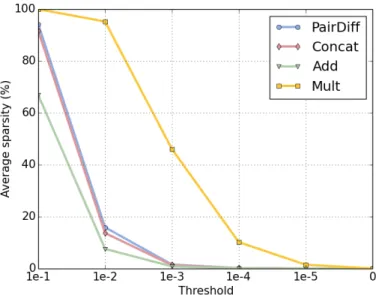
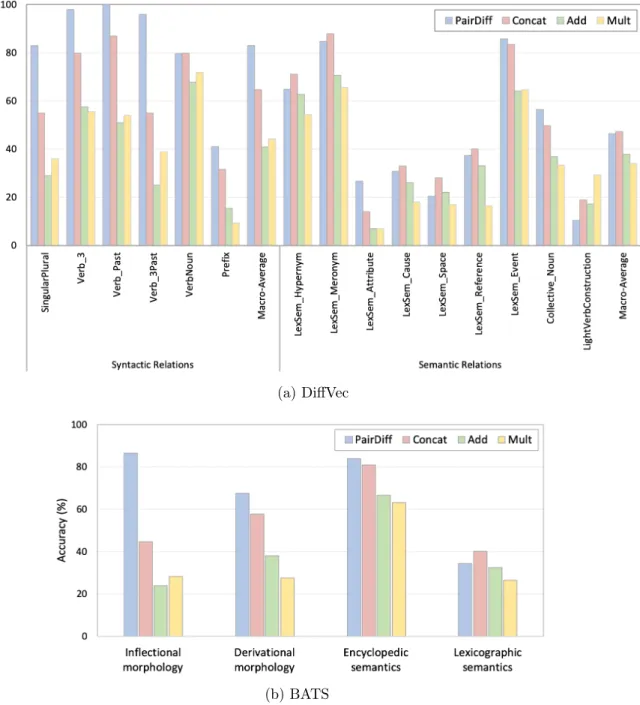
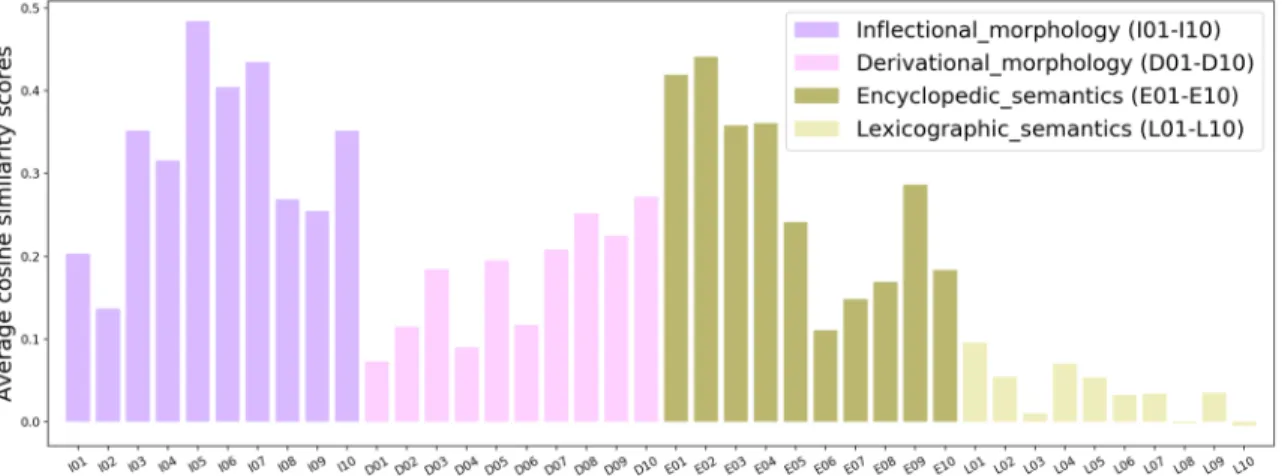
CBOW embeddings with 300 dimensions for some selected word-pairs. . . . 54 3.2 Accuracy on different types of relations for DiffVec (a) and BATS (b) datasets. 56 3.3 Average pair-wise cosine similarity scores for each relation type in BATS
using 300-dimensional CBOW embeddings. . . 57 3.4 Probability density estimation for `2 norms of PairDiff vectors in inflectional
morphology vs lexicographic semantic relations in BATS dataset. . . 58 3.5 Influence of the dimensionality of the CBOW word embeddings for
composi-tional relation representations. . . 60 3.6 Average `2 norm of relational vectors generated using PairDiff and Mult
operators. . . 61 3.7 The accuracy of SVM classifier for evaluating the directionality of relation
embeddings using PairDiff. . . 62 3.8 Cumulative evaluation of feature weighting methods. . . 73 4.1 Cross-dimensional correlations for six word embedding models. . . 87
4.2 Heatmap of the Pearson correlation scores between (a) SG embedding dimen-sions and (b) SG embedding squared dimendimen-sions among related word pairs (a, b). . . 88 4.3 The learnt model parameters for different word embeddings of 50 dimensions. 90 4.4 The training loss and test performance on the SAT and SemEval benchmark
datasets for relational embeddings. . . 91 5.1 Architecture of the proposedMnnPL, a feed forward neural network that is
used to model the supervised relational operatorf. . . 98
5.2 Effect of lexical overlaps in measuring word-pairs relational similarity. . . . 107 5.3 An illustration of the proposedCGRE for relation representations. . . 111 6.1 Heatmap visualisation of the orthogonality in different relation embeddings
from the WN18RR. . . 138 6.2 Results for the approximated relation embeddings for link prediction on
WN18RR and FB15K-237. . . 139 6.3 An illustration of the proposed relational compositional model using RelWalk
relation embeddings. . . 143
2.1 Score functions proposed in selected prior work on KGEs. Entity embeddings h,t ∈ Rd are vectors in all models, except in ComplEx where h,t ∈
Cd.
Here, `1/2 denotes either `1 or `2 norm of a vector. In ComplEx, ¯t is the
element-wise complex conjugate. . . 36
3.1 An example question from the SAT dataset. In this question, the common relation between the stem (ostrich, bird) and the correct answer (lion,cat) is is-a-large. . . 45
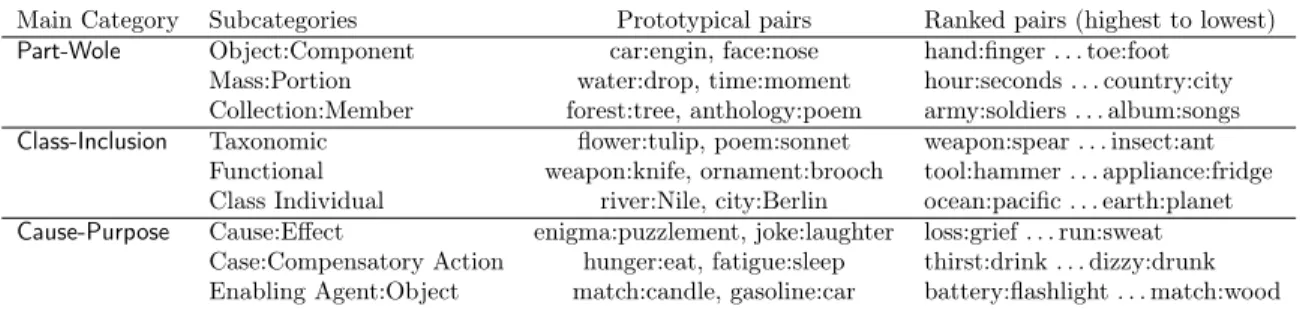
3.2 Taxonomy of selected semantic relations in SemEval-2012 Task 2 with ranked word-pairs . . . 46
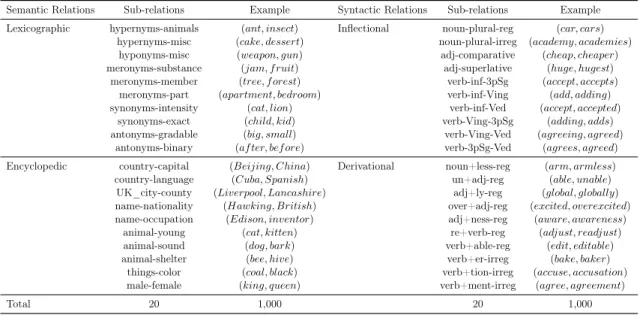
3.3 Types of relations and the number of instances for each relation type in DiffVec. 47 3.4 Relation types in BATS dataset. . . 48
3.5 Accuracy (%) of the compositional operators for measuring relational similar-ity in the benchmark datasets. MaxDiff scores are reported for SemEval-2012 Task 2. . . 53
3.6 Results of the compositional operators for KG completion task. . . 64
3.7 Statistic of the dataset used to discover relational feature space. . . 71
3.8 Accuracy per relation type for the top 1000 ranked features. . . 72
4.1 Means and standard deviations (mean±sd) for Pearson correlation scores between dimensions in word embeddings for related word-pairs. . . 88
5.1 The two nearest and the two farthest word-pairs for some stem word-pairs together with their similarity scores according to (5.6). . . 102
5.2 Average accuracy and MAP of 1-NN relation classification for different relation representation methods on DiffVec and BATS datasets. Results are shown for CBOW, SG, GloVe and LSA word embeddings (50 dimensional embeddings). 103 5.3 Break down of the performance for the four major relation types in the BATS dataset per method using GloVe embeddings. . . 104
5.4 Results for the out-of-domain evaluation using pre-trained 300-dimensional GloVe and CBOW. . . 105
5.5 1NN classification accuracy for relations in different target relation sets in out-of-domain evaluation using pre-trained GloVe and CBOW. Best performance for each relation type in each embedding model is shown in bold. . . 106
5.6 1-NN relation classification results for in-domain setting. . . 108
5.7 Results of measuring relational similarity scores (Pearson’s correlations). . . 109 xi
5.8 Examples for extracted patterns along with their weights for related word-pairs from the DiffVec training data and Wikipedia corpus. . . 114 5.9 Average MaxDiff accuracy and Spearman correlation for the 69 test relations
in SemEval 2012 Task 2. Best results are in bold. . . 116 5.10 Average MaxDiff (top) and Spearman correlation (bottom) for each major
relation in the test set of SemEval 2012-task2. The values between parentheses indicate the performance of a method combined with PairDiff. Best results for each relation are in bold. . . 117 6.1 Statistics of the KGs used in this study. . . 135 6.2 Results of Link prediction. Results marked with[?]are taken from (Dettmers
et al., 2018), [•]from (Nguyen et al., 2016), [/] from and (Cai and Wang, 2018). All other results for the baselines are taken from their original papers. 135 6.3 Results of Triple classification. Best results are in bold. . . 136 6.4 Empirical analysis of the concentration of the partitioning functions and
the orthogonality of the relation embeddings, and their Pearson correlation coefficients against H@10 for the relations in WN18RR dataset. . . 137 6.5 Examples of compositional constraintsrA∧rB→rC along with Jacard scores,
taken from Takahashi et al. (2018) dataset. . . 145 6.6 Performance of relation composition ranking task. . . 146 6.7 Triple classification accuracy for the different relational compositional operators.147
The abbreviations used throughout this thesis are listed below. BATS Bigger Analogy Test Set
CBOW Continuous Bag-of-Word embeddings CGRE Context-Guided Relation Embeddings GloVe Global Vector predictions
HSC Hierarchical Sparse Coding
KG Knowledge Graph
KGE Knowledge Graph Embedding
KL Kullback–Leibler divergence LDA Latent Dirichlet Allocation LRA Latent Relational Analysis LSA Latent Semantic Analysis
LSTM Long Short Term Memory
MnnPL Multi-class neural network Penultimate Layer NLP Natural Language Processing
NLRA Neural Latent Relational Analysis NMF Nonnegative Matrix Factorisation PMI Point-wise Mutual Information
PPMI Positive Point-wise Mutual Information
POS Parts-Of-Speech
PPMI Positive Point-wise Mutual Information RelWalk Relational Walk
SAT Scholastic Aptitude Test
SG Skip-Gram
SGD Stochastic Gradient Descent SVD Singular Value Decomposition SVM Support Vector Machine TransE Translating Embedding
VSM Vector Space Model
Semantic relations. Associations that exist between the meanings of words (Hypernym,
Meronym, capital-of, CEO, etc.).
Syntactic relations. In the context of the study in this thesis, syntactic relations refer to associations between different morphological forms of words (e.g., betweenapply
and applied or between aware and unaware). Syntactic relations are also called morphological relations.
Word analogies. A way of expressing a relationship between words and is formally written asa:b::c:d(read a is tob asc is tod).
Analogy questions. Test questions that require reasoning about relations. One form of analogy question is where you are given a word-pair and you are asked to choose another word-pair with the same relationship. Another form is filling a missing word given two word-pairs (i.e.,a:b::c:?).
Analogous word-pairs. A relation in the pair (a, b) is analogous to that in(c, d). Non-analogous word-pairs. A relation in the pair (a, b) is different from that in (c, d).
Relational similarity. Is a similarity between two pairs of words obtained by comparing a relation that holds between the two words in a first pair with that of a second pair. PairDiff. A method of generating a vector offset of a pair of words (a, b)by subtracting
pre-trained word embedding vectors (b−a), which in turn can be used to predict relations between words.
Word embeddings (or representations). Real-valued low dimensional vectors that capture semantic and syntactic properties of the words in a vocabulary.
Knowledge graph embeddings. Representations of entities and relations in a given graph, which enable predicting missing links in the graph.
Relational patterns. Linguistic contexts that connect two related entities in a text corpus.
Pattern-based approach. A popular approach for representing relations between words relying on the patterns extracted from linguistic contexts in which the pairs of words co-occur in a text corpus, e.g., “X increase the risk of Y”.
Compositional approach. Refers to methods for representing relations between two words that apply a compositional operator on their semantic representations rather than depending on relational patterns.
Unsupervised compositional operators. Following the literature, when a composi-tional operator does not have learnable parameters, we call it unsupervised.
Relational walk. A theoretical model that derives a relationship between the connections between entities and relations in a knowledge graph and the corresponding entity and relation embeddings. The relational walk is a generative model that performs a random walk over the KG parametrised by hidden knowledge vectors.
Relation compositions in knowledge graphs. The task of predicting representations for novel relation types by composing pre-trained relation embeddings for the relations that exist in a knowledge graph.
1
Introduction
1.1
Context of the Study
“Every word in a sentence is not isolated as it is in the dictionary. The mind perceives connections between a word and its neighbours. The totality of these connections forms the scaffold of the sentence.”
- Tesniére, 1959 In natural languages, i.e., English, Arabic, Chinese, relations are the connections between concepts that are expressed by words1. As stated by cognitive scientists, understanding
words by their relationships is essential to the expression of continuous thoughts for human intelligence (Tesnière, 1959). In aptitude tests provided by government institutions to enter universities in some countries such as the United States2 and Saudi Arabia3, students are
asked to detect word analogies of the form a : b :: c : d (read as a is to b as c is to d)
to measure their ability to recognise relations. One has to identify and then compare the relationship between the two words in each pair (a, b) and(c, d) to answer these type of questions. For example, (lion,cat) is relationally similar (i.e., analogous) to (ostrich,bird) because a lion is a large cat as an ostrich is a large bird.
Nowadays, in the digitalised world, it is required for a computational system that processes human languages to be equipped to learn semantics not only for the words but also for relations between them to intelligently perform useful tasks just as humans do. Such tasks that benefit from using relational information within Natural Language Processing (NLP) include analogical reasoning (Turney and Littman, 2005; Li et al., 2018), 1Throughout this thesis, words may refer to unigrams (e.g., food andanimal) as well as multi-word
expressions including named entities such as person or location names (e.g.,United States). The terms word and entity are used interchangeably in this thesis.
2
https://collegereadiness.collegeboard.org/sat
3
https://qiyas.sa/en/Exams/Education/GeneralAbilities/Pages/default.aspx
relation extraction (Mintz et al., 2009; Su et al., 2018), relational search (Cafarella et al., 2006; Duc et al., 2010, 2011), machine translation (Nakov, 2008; Zhang et al., 2018), text categorisation (Espinosa-Anke and Schockaert, 2018; Camacho-Collados et al., 2019), textual entailment (Vu and Shwartz, 2018; Joshi et al., 2019), word-sense disambiguation (Federici et al., 1997; Agirre et al., 2014) and knowledge graphs completion (Nguyen, 2017), among others.
In relational search, given a query “a is tob asc to ?” the goal is to retrieve entities that have a semantic relationship with c similar to that betweena andb. For example, given the relational search query “Bill Gates is to Microsoft asSteve Jobs is to ?”, a relational search engine is expected to return the result Apple Inc. because of the CEOrelation that holds
between the first and the second entity pairs. One might also want to ask a search engine to list all entities that are in a relation with another entity. For instance, a query “what can be produced from a cork tree”, needs a relational search to retrieve entities that are in the
produced-from relation withcork tree. Recognising textual entailment offers another kind
of application. Given a premise P, “a man ate an apple”, and a hypothesis H, “a man ate a fruit”, a model that can infer the existence of the is-arelation betweenfruit and apple
would correctly predict that H entails P.
Modelling the meaning of relations and relational reasoning are well-defined problems in the field of NLP and machine learning. Resources that are adopted for such tasks can be categorised into either: (a) text-based, and (b) knowledge graphs-based. Text corpora play a critical role in NLP research. In the context of learning relations, linguistic contexts of entities in a corpus work in one way or another as clues to infer relations between entities. For example, the sentence from Wikipedia that says “Parisis the capital and most populous
city of France, with . . .” shows the capital-of relation. On the other hand, real-world facts
such asParis is the capital city ofFrance is asserted in structured knowledge graphs such as Freebase, wherein Paris andFrance are represented by two nodes and the relationcapital-of
is the label for the edge that connects the two entities.
In NLP systems, linguistic components such as words, relations, phrases, etc. have to be represented in a way so as to make it possible for a computer to understand the underlying semantics. To address this need, Vector Space Models (VSMs) of semantics have been applied successfully as testified in the voluminous NLP related literature. The underlying concept of the VSMs is that a linguistic item is mapped to a vector of multiple dimensions corresponding to features that collectively derive the meaning of the represented item. These features are extracted and learnt from various resources such as the above-mentioned ones, text corpora and knowledge graphs. In theory, VSMs require semantically similar items to be nearby in space. The VSMs initially show their potential applications in document retrieval, where a search engine retrieves relevant documents to a given query according to the similarities (e.g., cosine of angles) between the query vector and the document
vectors in a space (Manning et al., 2008). Documents and queries are represented in a multi-dimensional space where each term in the vocabulary is a dimension. In the context of word representations, in which VSMs have achieved breakthrough performance, the dimensions in a space basically indicate the co-occurrence statistics from a text corpus (discussed in details in Section 2.5.1).
Semantic spaces have been successfully extended to encode relations, word-pairs and to represent Knowledge Graphs (KGs) as well (Turney and Pantel, 2010; Bordes et al., 2013). Word-pairs are represented in vector space such that pairs of words that belong to the same relation are closer than word-pairs from different relation types. Text-based resources have been employed in different themes to obtain representations for word-pairs in space. One methodology heavily depends on particular contexts in which related words appear in a text corpus (Turney, 2005; Espinosa-Anke and Schockaert, 2018). In contrast, from 2013 onwards, word representations that are generated from text corpora using deep learning methods have shown promising performance in capturing relational features of word-pairs. This thesis investigates such a property in the VSMs of semantics for words towards relations. In the context of KGs, entities and relations are also represented in a semantic space such that entities that participate in similar relations are embedded closely to each other, while at the same time relations that hold between similar entities are embedded closely to each other in the relational embedding space. This thesis also studies representations of relations in KGs.
Having introduced the importance and resources of relational learning, the work presented in this thesis is directed at several research issues within the context of representing relations between words. The rest of this chapter is organised as follows. Section 1.2 introduces the research aim and motivations. In Section 1.3 the research issues that are considered for this thesis are listed. The contributions of this thesis are explained in Section 1.4. Published work and the thesis outline are presented respectively in Section 1.5 and Section 1.6.
1.2
Research Aim and Motivations
How to accurately represent semantic relations between words or entities remains a problem that is underexplored within the NLP community. As elaborated earlier, a text corpus represents an important and abundantly available source of information for building NLP systems. Traditionally, automatic learning of word pair representations from a text corpus has relied on distributional relation analysis, which states that the relation between two words in a pair is evidenced by the contexts that co-occur with the pair (Turney and Littman, 2005; Turney, 2006; Bollegala et al., 2008). Such contextual information is expressed in the form of lexico-syntactic patterns, for instance, “X is a Y” and “Y such as X” patterns indicate that X is a hyponym of Y (Snow et al., 2005). This approach for representing
Figure 1.1: The frequency of related word-pairs in Wikipedia corpus.
relations is called, in this thesis,pattern-based because of the need for lexical patterns that connect pairs of words to infer relations between words.
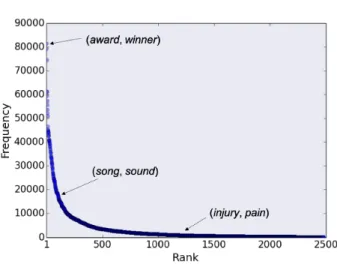
Despite the good performance of the pattern-based approach in previous research (Tur-ney, 2005; Jameel et al., 2018), it suffers from data sparseness which in turn limits the generalisation capabilities of this methodology. Specifically, two words have to co-occur in a contextual window, or else no relation can be represented for unseen word-pairs. Even in a large text corpus, not every related pair co-occurs within a specified window. Also, in any text collection, the number of sentences in which the two related words appear might be quite small or might not be relevant for characterising the considered relations, which drastically affects the quality of the relation representation. For example, Figure 1.1 shows the co-occurrence frequency and rank of related word-pairs4 in the Wikipedia corpus. The
graph illustrates that even in a large corpus as in the case of Wikipedia, the distribution of co-occurrences of related word-pairs has a long tail. Moreover,321 word-pairs from the set of related words do not co-occur within any sentence.
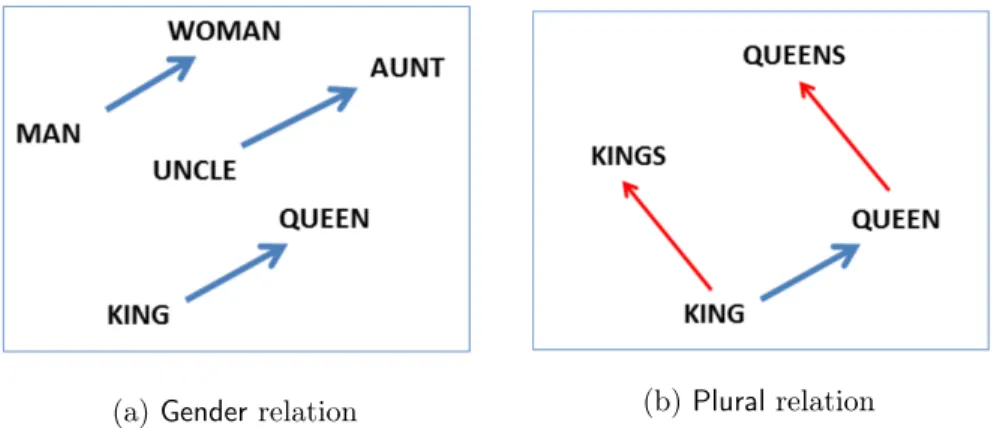
To address the aforementioned sparsity problem of the pattern-based approach for relation representations, we have to obviate the strong co-occurring assumption of related word-pairs to represent relations. Mikolov et al. (2013c) showed that pre-trained word representations (a.k.a embeddings), which are low-dimensional real-valued vectors that are generated typically from distributional information in text, encode remarkable structural properties about semantic relations. As illustrated in Figure 1.2a, the vector offsets woman−man, queen−king and aunt−uncle are approximately parallel, here the notation man is used to denote the embedding of the word man. These vector offsets describe gender
4
These word-pairs are taken from two popularly used benchmarks for relations, namely, SAT and SemEval-2012 Task 2 that are introduced later in Section 3.3.1 and Section 3.3.2, respectively.
(a)Genderrelation (b)Pluralrelation
Figure 1.2: Example of linguistic regularities in word embeddings. The figure is taken from Mikolov et al. (2013c).
directions from male to female in the embedding space. The well-known example is that of the proportional analogy expressed in (1.1). Mikolov et al. (2013c) fill the blank of the analogy by finding the nearest neighbour word vector to the composed vector king−man+woman.
man:woman::king:? (semantic) (1.1)
king:kings::queen:? (syntactic) (1.2)
Such an approach is referred to as compositional because (a) the way in which the relation representation is composed by applying some algebraic relational operator on the represen-tations of the words that participate in a relation, and (b) we infer a relation between a pair without assuming the availability of patterns in which a pair matches in a corpus. In this thesis, compositional methods for relation representations are explored from multiple aspects as will be demonstrated in the next section.
As elaborated in the previous section, unstructured text corpora are not the only source for relations. KGs represent another important source for relational information that organise knowledge bases of relations in the form of nodes (entities) and edges (relations). While relations in text-based sources are latent as they are induced through linguistic patterns, KGs typically consist of a set of well-defined discrete relation types. Such KGs are either constructed manually or using relation extraction techniques on a text corpus (Mintz et al., 2009; Riedel et al., 2010). The advent of KGs in different domains is important for a wide range of NLP tasks such as learning knowledge-enhanced semantics (Faruqui et al., 2015a; Alsuhaibani et al., 2018), question answering (Das et al., 2017) and text summarisation (Baralis et al., 2013). However, the constructed KGs, especially those extracted from text, suffer from sparsity since many plausible facts are missing (Pujara et al., 2017; Paulheim, 2017). One popular way to handle sparsity in KGs is to encode entities and relations of a KG into low-dimensional vector spaces, so-called Knowledge Graph
Figure 1.3: An illustration of diverse sources that are consider in this thesis for learning relation representations.
Embeddings (KGEs). As is customary in the literature, entity and relation embeddings are jointly learnt such that some objective that models the interaction between two entities and a relation that holds between them is optimised (Bordes et al., 2013; Yang et al., 2015; Nickel et al., 2015; Guo et al., 2016; Nickel et al., 2016). By embedding entities and relations that exist in a KG in some space, we can infer previously unseen relations between entities, thereby expanding a given KG.
Although existing KGE methods demonstrated valuable performance in predicting new links between entities, objectives for learning such embeddings are heuristically motivated. Therefore, a theoretical understanding of KGE methods is required. In addition, KGE methods embed existing entities and relations and they are unable to predict representations for unseen relation types. Accordingly, this thesis contributes to solving the above-raised issues of KGEs.
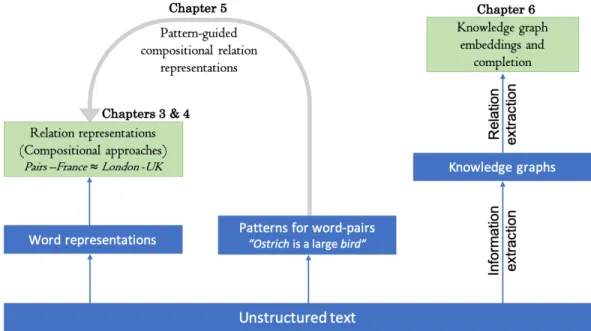
Figure 1.3 shows the different sources of information that are considered in this thesis for relation representations. From an unstructured text corpus, word embeddings are learnt from the corpus and are taken as a source of information for learning compositional operators for word-pair representations. Such compositional methods can be improved by supplying patterns of related word-pairs during training (pattern-guided compositional relation representations). As shown on the right side of the figure, extracting relations from a KG in the form of knowledge graph embeddings to reduce sparsity in the KG is also considered in the conducted research. The section below will present the research question and related issues that are studied in this thesis.
1.3
Research Question and Issues
From the foregoing aims and motivations of this thesis, the main research question considered in this work is as follows: Can we learn relation representations from word representations; and if so what are the appropriate methods and resources for achieving this?
Many issues arise to answer the above question, here are the addressed issues:
• Given pre-trained word embeddings, what is the best unsupervised compositional operator to represent relations between words? and how appropriate is such an operator for various relation types?
• Can we discover discriminating relational features from word representations to measure the relational similarity between two word-pairs?
• Can we systematically investigate a bilinear operator, which is parametrised by a 3D tensor, to map two given word embeddings into a vector representing a relation between the two words?
• Can we learn better compositional operators for relation representations from word representations?
• Can we improve the performance of compositional relation representation methods by training such methods using the two sources of information, namely: (a) word-embeddings of related pairs, and (b) co-occurring patterns extracted from a corpus? • Given a KG, can we enrich the graph by inferring missing links using a theoretically
motivated approach for relation and entity embeddings?
• Given pre-trained KGEs, can we infer embeddings for unseen (i.e., novel) relations using existing relation embeddings and relational logical rules?
1.4
Contributions
The primary goal of this thesis is to explore resources and methodologies to represent relations between words such that we overcome data sparsity of related pairs in texts or KGs. The thesis makes a number of noteworthy contributions, which are:
• A comparative study for unsupervised compositional operators to derive relational features from word embeddings. The contribution of this study aims to compare different unsupervised compositional operators for obtaining relation representations from word-level representations. Such unsupervised operators do not have learnable parameters, and they are applied on word representations learnt in
unsupervised settings. The performance of such unsupervised compositional meth-ods are investigated by measuring the relational similarities using several relational benchmark datasets, and also evaluated in a KG completion task. The performance of the compositional operators among various relation types is also investigated. This contribution was published in the Knowledge-Based System journal (Hakami and Bollegala, 2017), and is presented in Section 3.4 of this thesis.
• A method to discover discriminative features in word representations for measuring relational similarities. Features that accurately express the relational similarity between two word-pairs remain largely unknown. So far, methods have been proposed based on linguistic intuitions such as the functional space proposed by Turney (2012), which consists purely of verbs. In contrast, a data-driven approach for discovering feature spaces for relational similarity measurement is proposed in this thesis. This study was published at PACLING 2017 (Hakami et al., 2017). Section 3.5 is devoted to this contribution.
• A mathematical analysis for bilinear relation representations. A simple, yet surprisingly accurate method for representing a relation between two words is to compute the vector offset (PairDiff) between their corresponding word embeddings. Despite the empirical success, it remains unclear as to whether PairDiff is the best operator for obtaining a relational representation from word embeddings. To this end, a theoretical analysis is conducted of generalised bilinear operators that can be used to measure the`2 relational distance between two word-pairs. This work was published
at COLING 2018 (Hakami et al., 2018), and is included in Chapter 4 of this thesis. • A method to learn compositional operators for relation representations.
Despite that simple unsupervised operators such as the vector offset between two-word embeddings have shown to recover certain relationships between words, how to accu-rately learn generic relation representations from word representations remains unclear. In this thesis, relation representation is modelled as a supervised learning problem and parametrised operators are learnt such that they map pre-trained word embeddings to relation representations. Specifically, a method for learning relation representations using a feed-forward neural network that performs relation prediction is proposed. This contribution was published at Automated Knowledge Base Construction (AKBC) 2019 (Hakami and Bollegala, 2019b), and is presented in Section 5.2 of the thesis. • An exploration of the complementary of lexical patterns and word
embed-dings for representing relations. A semantic relation between two given words can be represented using two complementary sources of information: (a) the semantic representations of the two words and, (b) the lexico-syntactic patterns obtained from
the co-occurrence contexts of the two words. Pattern-based approaches suffer from sparsity, while methods that rely only on word embeddings for the related pairs lack relational information. To this end, a Context-Guided Relation Embedding model that uses the two sources of information is proposed under a self-supervised fashion. The learnt operator is evaluated for its ability to create relation representations for word-pairs that do not co-occur. The code and pre-trained word-pair embeddings are publicly available for reproducibility5. The proposed method was published at
PACLING 2019 (Hakami and Bollegala, 2019a), and is presented in Section 5.3. • A proposed relational walk model for KGEs. Although existing KGE methods
demonstrate good empirical performance on predicting missing links in a graph, theoretical understanding of KGE methods is comparatively underdeveloped. As such, it is not clear how the heuristically defined KGE objectives relate to the generative process of a KG. This thesis seeks to fill this void by providing a theoretical analysis of KGEs. To do so, the random walk model of Arora et al. (2016) of word embeddings was extended in this thesis to KGEs to derive a scoring function that evaluates the strength of a relation between two entities. Specifically, a generative process is proposed where the formation of a relation between two entities using the corresponding relation and entity embeddings is derived theoretically. This contribution is presented in Section 6.2 of this thesis.
• A proposed compositional semantic method to infer embeddings for novel relations. Existing KGE methods can only learn representations for the relations that exist in a KG. However, there are correlations among relations in a graph that allow relation inferences. For instance, given that X born-in Y andY capital-of Z,
we can infer the relation X nationality Z. Relation composition is introduced in this
thesis as the task of inferring embeddings for unseen relations by combining existing relations in a KG. Specifically, a supervised method (modelled as a non-linear neural network) is proposed to compose relational embeddings for novel relations using pre-trained relation embeddings for existing relations. The implementation of the proposed relation composition model is publicly available on GitHub6. The work was
published at PACLING 2019 (Chen et al., 2019), and included in Section 6.3
1.5
Publications
Most of the material presented in the thesis has already been published in NLP conferences and journals. The list of the publications (chronological order) and their corresponding
5
https://github.com/Huda-Hakami/Context-Guided-Relation-Embeddings
chapters or sections is presented below:
1. Danushka Bollegala, Huda Hakami, Yuichi Yoshida, Ken-ichi Kawarabayashi: RelWalk - A Latent Variable Model Approach to Knowledge Base Embedding, under review.
Section 6.2.
2. Huda Hakami and Danushka Bollegala: Context-guided Self-Supervised Relation Em-beddings, Proc. of the 16th International Conference of the Pacific Association for Computational Linguistics (PACLING), October, 2019. Section 5.3.
3. Wenye Chen, Huda Hakami and Danushka Bollegala: Learning to Compose Relational Embeddings in Knowledge Graphs, Proc. of the 16th International Conference of the Pacific Association for Computational Linguistics (PACLING), October, 2019. Section 6.3.
4. Huda Hakami and Danushka Bollegala: Learning Relation Representations from Word Representations, Proc. of the Automatic Knowledge Base Construction Conference (AKBC), May, 2019. Section 5.2.
5. Huda Hakami, Kohei Hayashi and Danushka Bollegala: Why does PairDiff work? - A Mathematical Analysis of Bilinear Relational Compositional Operators for Analogy Detection, Proc. of the 27th International Conference on Computational Linguistics (COLING), pp. 2493-2504, 2018. Chapter 4.
6. Huda Hakami and Danushka Bollegala: Compositional approaches for Representing Relations Between Words: A Comparative Study, Knowledge-Based Systems (KBS), Vol. 136, pp. 172-182, 2017. Section 3.4.
7. Huda Hakami, Angrosh Mandya, and Danushka Bollegala: Discovering Representative Space for Relational Similarity Measurement, Proc. of the 15th International Confer-ence of the Pacific Association for Computational Linguistics (PACLING), pp. 76-87, 2017. Section 3.5.
1.6
Thesis Outline
The overall structure of the reminder of this thesis takes the form of five main chapters and a concluding chapter as follows.
Chapter 2: Background and Related Works. This chapter consists of background knowledge about relations between words that is important to understand the remain-der of this thesis. The chapter introduces semantic spaces in the NLP field. The applications of relational reasoning in NLP are demonstrated. Different methods in the
literature for representing relational information with respect to the work presented in this thesis are also reviewed in this chapter.
Chapter 3: Deriving Relational Features from Word Representations. The first part of this chapter introduces the word embedding models and relational benchmark datasets that are used extensively in this thesis. Then, the chapter presents a systematic comparison of four different unsupervised compositional operators for representing relations, namely: offset, concatenation, addition and multiplication. The last part of the chapter presents a proposed data-driven approach to discover discriminative features form word-level representations for measuring relational similarity between word-pairs.
Chapter 4: Mathematical Analysis for Bilinear Relation Representations. A theoretical analysis of generalised bilinear operators that can be used to measure the
`2 relational distance between two word-pairs is presented in this chapter. Specifically,
a theorem of a bilinear relational operator is proved. The chapter includes empirical validations of the theory to show the rationality of the presented analysis.
Chapter 5: Learning Compositional Operators for Relation Representations. This chapter presents learnable compositional operators to represent relations between words. The first section is about the proposed supervised operators for relation embeddings using word embeddings. The second section introduces self-supervised context-guided compositional relation embeddings, which explore the complementari-ties of training on both word-embeddings and relational patterns.
Chapter 6: Relations in Knowledge Graphs. This chapter considers the problem of representing relational information in a KG for KG completion. The first section presents a theoretically analysed relational walk model for KGEs. The second section shows a relation composition, which is the task of predicting relation embeddings for novel relation types by composing the embeddings for existing relation types. Chapter 7: Conclusion. This chapter summarises the main findings of this thesis and
discuss potential future directions.
1.7
Summary
This chapter has introduced an overview of the research area considered in this thesis. The research aim, motivations and questions were defined. A summary of the main contributions alongside the published articles was also presented. The chapter was concluded with an outline of the structure of the thesis. The next chapter provides background information and a review of the related literature required to understanding the remainder of the thesis.
2
Background and Related Work
2.1
Introduction
As elaborated in Chapter 1, this thesis is concerned with representing relations between words in texts or KGs. This chapter will provide a review of the background information and the related literature on representing relations in the context of NLP. The chapter begins with a brief overview of semantic representations for natural language components in Section 2.2. Then, Section 2.3, provides motivational answers to the question as to why we should care about relations between words. This is followed by Section 2.4 which presents the classical pattern-based approach for representing relations between words in texts. After presenting the pattern-based approach along with its drawbacks, Section 2.5 introduces an alternative approach to capture relational information in a word-pair from the representations of corresponding words in the pair. A hybrid approach that combines the two resources (i.e., patterns and word representations) is presented in Section 2.6. Section 2.7 then introduces multi-relational KGs and related work concerning the task of embedding relations using KGE methods.
2.2
Semantic Spaces in NLP
A well-defined field of linguistics that concerns the analysis of meanings is called semantics, with lexical semantics being a sub-field that deals with meanings of individual words and relations between them (Cruse et al., 1986). We can describe the meaning of a word by considering the word as a container (semantic features) or through its relationships with other words (lexical relations). For example,colour can be a feature when representing the word flower. Considering lexical relations, we can explain the meaning of the worddaffodil
in terms of its relationship toflower because “daffodil is a kind offlower”.
As humans, we use natural languages to communicate and understand the world around 13
us. With the increasing amounts of textual data, it is important to digitise this field and enable computers to understand languages that we humans speak and write. To this end, NLP researchers seek to propose various methods to represent the semantics of linguistic items in such a way that computers can process, reason and perform useful tasks on texts. Semantic VSMs is the most dominant research area in the field of computational semantics. Generally speaking, VSMs make use of geometric spaces to assign data points to vectors using a set of features, where each feature is considered to be a separate dimension in a vector space with a real value. Selecting such features to construct a semantic space profoundly depends on the nature of a concept whose meaning we aim to encode. The key aspect in VSMs is that similar concepts are represented closely in a space. In contrast to discrete representations, the notion of similarity can be directly inferred from VSMs by measuring degrees of similarities between the representations of the corresponding concepts.
Turney and Pantel (2010) provide a comprehensive literature survey about VSMs of semantics that are proposed to represent various linguistic concepts such as words, word-pairs, phrases and documents. Typically, VSMs are constructed automatically relying on the distribution of the concepts to be represented in a text corpus. Impressive successes has been shown for VSMs in information retrieval, analogical reasoning and KG completion, among others. Take for instance the task of analogical reasoning, word-pairs can be represented in a multi-dimensional space where, for instance, linguistic contexts that connect word-pairs are the dimensions of the space, and the elements correspond to the number of times a particular pair appears with a given context. Such representations can be used to measure the relational similarities between word-pairs to find analogies or can be used as features to downstream NLP applications. For KGEs, each relation can be represented as a latent vector that works as an operator on entity vectors to predict relations between entities.
The work in this thesis is broadly connected to three different types of VSMs: (a) word meanings, (b) word-pair representations and (c) KGEs. This chapter presents the necessary background concerning each of these semantic spaces with respect to the conducted research in the thesis. The main focus in this thesis is directed at encoding relational information between words in a semantic space from different aspects as elaborated previously in Sections 1.3 and 1.4.
2.3
Why Do We Care About Relations in NLP?
A relation is a way of describing how two things are connected. Connections exist everywhere around us, and they vary across different domains, ranging from relationships between people that represent a business, to social relations, to mathematical relations between quantities such as equivalence and reflexive relations. In the field of NLP, relations mainly refer to semantic links that hold between words and can be used to define the nature of
word meanings in a language clearly. In this section, we will introduce some properties of relations between words (Section 2.3.1). Then, in Section 2.3.2 we will show how representing relations between words plays a vital role in numerous NLP tasks.
2.3.1 Relations Between Words
In a written or spoken language, a word is the basic lexical unit that is used with others to create a meaningful phrase or sentence. Various types of relations exist between words such as theHypernymbetweenostrich andbird, theAntonymbetweenhot andcold, theMeronym
between car andengine and theAttribute between glass andfragile. If we consider named
entities, we can observe a richer diversity of relations such asFounder-of betweenBill Gates
andMicrosoft, Capital-of betweenTokyo andJapan andCEObetween Tim Cook andApple Inc. Extensive efforts have been made in the literature by linguistics, cognition science and computational linguistics to define taxonomies of relationships between words (Casagrande and Hale, 1967; Levi, 1978; Chaffin and Herrmann, 1984; Nastase and Szpakowicz, 2003; Hendrickx et al., 2009; Jurgens et al., 2012). Many of the datasets used are publicly available for researchers.
Relations between words exist in many flavours. Some relations exist between two words relying on a given specific context in which the two words co-occur. For example, given the sentence “the machine makes a lot ofnoise”, we can infer aCause-Effect relation
betweenmachine andnoise considering the linguistic cluemakes a lot of in this particular sentence. The former interactions that are sensitive to contexts are referred to assyntagmatic
relations, a phrase first coined by Saussure (1959) and then adopted by other studies about relations (Khoo and Na, 2006; Hendrickx et al., 2009). For such syntagmatic relations, we might infer different relations between the same word-pair based on the provided contexts. On the other hand, Saussure (1959) definesassociative(paradigmatic) relations as those that hold between two words regardless of the contexts in which they co-occur. For instance, the
capital-of relation betweenLondon andEngland and is-a relation betweencat and animal.
Associative relations can be lexical (is-a,part-of) or encyclopaedic (capital-of,nationality).
Prior work has also considered associative syntactic relations between words such asplural
(cat,cats) and comparative(weak,weaker) depending on word morphology (Mikolov et al.,
2013c; Vylomova et al., 2016). There are also implicit relations within a noun compound, which is a sequence of two nouns acting as a single noun in English (Downing, 1977). Examples of implicit relations in noun-compounds arecauseinflu virus,containerinapple
cake and location in home town. Several researchers have attempted to automatically
recognise implicit relations among noun compounds (Nastase and Szpakowicz, 2003; Tratz and Hovy, 2010; Shwartz and Dagan, 2018).
Another dimension of variation across relations is the number of linked arguments. In this sense, a binary relation is a link that exists between two arguments. However,
relations might connect more than two arguments, which are termedn-ary relations (where
n indicates the number of linked arguments). For example, the ternaryresponserelation in
the instance (EGFR,L858E,gefitinib) means that theEGFR mutation in the geneL858E
responds to the druggefitinib. The interest in this thesis is directed in particular at binary relation types; the extension ton-ary relations can be investigated in future work.
2.3.2 Applications of Relation Learning
Reasoning about relations between entities, rather than about individual entities, is an essential element of human cognition (Glass et al., 1977; Penn et al., 2008). For computational systems, connecting up entities within a chunk of text performs a battery of NLP tasks in which relational information is essential to conduct the tasks successfully. Such tasks include recognising word analogies, relational information retrieval, textual entailment, machine translation, metaphor detection and knowledge base completion.
Relation representations have been successfully used for relational similarity-based tasks ever since the work of Turney (2005), who demonstrated that the similarity between two pairs could be measured using their relation representations. In the Scholastic Aptitude Test (SAT), a standardised test widely used for college admissions in the United States, an analogy question consists of a stem word-pair and a list of four to five pairs in which only one represents the correct choice for the stem. To answer analogical SAT questions, one is required to determine relations between the pairs to be compared. Turney (2005) proposed an algorithm for representing relations that achieved human-level performance as the average of US college applicants is 57.0%, whereas the state-of-the-art algorithm gave 56.1% accuracy.
In areas of research involving cross-sentence inference, such as textual entailment and question answering, incorporating relational representations between words is beneficial. For textual entailment tasks, given a premise P “a man ate an apple” and a hypothesis H “a man ate a fruit”, a model that can infer the existence of is-arelation between fruit and apple would correctly predict that P entails H. A recent study by Joshi et al. (2019) shows the importance of enriching word representations with relation representations to improve cross-sentence inferences.
Relational reasoning has also been applied to the task of machine translation (Nakov, 2008; Aharoni and Goldberg, 2017; Zhang et al., 2018). For example, Nakov (2008) paraphrases implicit relations in noun compounds of sentences in a source language to generate new sentence variants that are combined with training data. Further, Zhang et al. (2018) improve recurrent neural network encoder-decoder models for translations by learning pairwise relations between words in a source sentence while decoding to a target sentence. Metaphorical language is ubiquitous in our life, which is typically the use of a word to an object to which it is not literally applicable such as “The printer died”, here died is a
Figure 2.1: Example of analogical reasoning for completing rule bases. Taken from Schockaert and Prade (2014).
metaphorically used verb to describe that theprinter cannot be restarted (Lakoff and John-son, 2008). Automatic detection of metaphorical and literal language in discourse has been extensively studied (Barnden and Lee, 2001; Zayed et al., 2018). Interestingly, metaphors are similar to analogies since both employ comparisons between two concepts (Gentner et al., 2001). As such, an implicit comparison in a metaphor can be expressed as an explicit anal-ogy, e.g., “The printer died” expressed as person:die::printer:damage (Turney, 2006).
Consequently, reasoning about relations between words has also its potential applications in identifying metaphors.
Automatic KG completion is another important area of research in which relation representations are successfully applied. Numerous studies have shown that representing entities and relations within a given KG enables predicting missing facts and thus resolves the poor coverage of such graphs (Socher et al., 2013a; Nguyen et al., 2016; Dettmers et al., 2018; Bollegala et al., 2019). Similarly, to deal with missing domain knowledge in rule-based systems, we can use the assumption that analogous changes in the condition of a rule lead to equivalent changes in the conclusion. Figure 2.1 illustrates an example of predicting the missing plausible rule (coyote → predator) from a proportional analogy
cat:lynx::dog:coyote and a given set of if-then rules.
Having discussed the potential applications of relation learning, we now move on to present the most popular approach for representing relations between words, namely the pattern-based approach.
2.4
Pattern-Based Approach for Relations
Several methods have been proposed for learning representations that encode the relationship between two words. This section will introduce the most popular pattern-based strategy for relations, which essentially relies on the contextual patterns that link pairs of words in a text corpus. A definition of linguistic patterns in the context of relational information,
with examples, is discussed in Section 2.4.1. Next, Latent Relational Analysis is presented, which is a pioneering pattern-based model for relations, followed by other recent variants of pattern-based relation representation methods. Section 2.4.4 concludes this part of the chapter by discussing the limitations of the pattern-based approach, which in turn motivate the work presented later in this thesis.
2.4.1 Relational Patterns
An unstructured text corpus forms an important resource to extract information for numerous NLP tasks such as relation extraction where the task is to identify the relation that holds between two named entities (Hearst, 1992; Mintz et al., 2009; Baldini Soares et al., 2019). The linguistic contexts in which two words co-occur in the corpus provide useful clues regarding the relations that exist between the two related words. Such contexts that connect two related entities are expressed as relational patterns. For example, thecausality relation
between smoking and lung cancer can be expressed by multiple text spans as follows: “smoking increases the risk of lung cancer”, “smoking led to lung cancer” and “smoking
causes lung cancer”. Replacing the targeted entities with placeholders produces general patterns that can be matched with any other pairs of entities. For instance, “X increase the risk of Y” is a pattern that might match word-pairs such as (smoking,lung cancer), (obesity,diabetes) and (explosion,damage). Here, X and Y in a pattern refer to the first
and the second entity of a pair, respectively.
Several studies have defined hand-crafted patterns for lexical relations. Hearst patterns are well-known manually constructed lexico-syntactic patterns for the Hypernymtaxonomic
relation (Hearst, 1992). Hearst defines a small set of patterns for hypernym detection; for example, “X and other Y”, “Such Y as X” and “X is a Y that”. Lexical patterns for other relations have also been defined such as Meronym (Berland and Charniak, 1999; Girju
et al., 2003),causality (Marshman, 2002) andprotein-protein inhibit relations (Pustejovsky
et al., 2001). Later on, the limited pre-defined set of patterns for relations was replaced by automatic extraction of lexico-syntactic patterns from a text corpus (Snow et al., 2005; Turney, 2005; Shwartz et al., 2016; Washio and Kato, 2018b; Joshi et al., 2019). Given a set of entity pairs, the sentences containing the two words in each pair are extracted to generate the patterns. To increase the precision of the set of patterns, sentences in which the two words are far apart from each other are not considered because the assumption is that the longer the distance, the less useful the pattern for the relation. Many features can be extracted from the patterns—the two popular types are lexico-syntactic surface tokens (Hearst, 1992; Turney et al., 2003) and dependency paths that give dependencies between tokens in a pattern (Yangarber et al., 2000; Nakashole et al., 2012; Shwartz et al., 2016).
Figure 2.2: An illustration of LRA method for word-pair representations. This Figure is inspired by Figure 1 in Liu et al. (2017).
2.4.2 Latent Relational Analysis
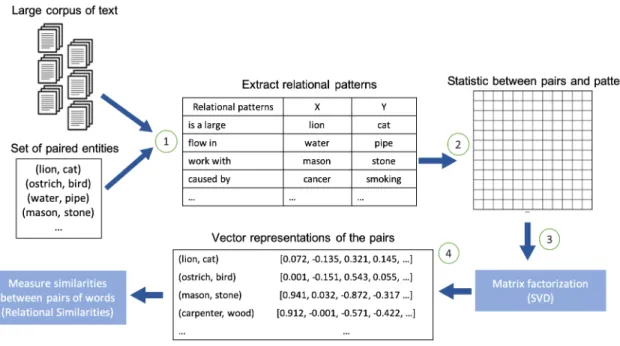
Latent Relational Analysis (LRA) is a pattern-based method for representing word-pairs by adopting latent relational hypothesis, which was coined by Turney et al. (2003) and literally states that: “pairs of words that co-occur in similar patterns tend to have similar semantic relations”. Figure 2.2 summarises the LRA steps for generating word-pair representations. The first step in the process of LRA is to align a given set of pairs with a corpus to extract relational contexts. Then, following the VSM of semantics (Turney and Pantel, 2010), each pair of words is represented using a vector of pattern frequencies, with the elements corresponding to the number of different sentences where the two words in a given pair co-occur with a particular pattern.
A two-dimensional visualisation of word-pair representations using the LRA method can be shown as indicated in Figure 2.3. We notice that the angle between (ostrich,bird) and (lion,cat) is much smaller than the angle between either of the pairs and (mason,stone).
Because the number of automatically defined patterns in the pair-pattern matrix is large, a dimensionality reduction method, such as Singular Value Decomposition (SVD), is applied to obtain dense and latent representations for word-pairs. This representation allows us to measure the relational similarity between two given pairs of words by the cosine of the angle between the corresponding pattern-frequency vectors.
Figure 2.3: Illustrative visualisation of word-pair vectors. Here axes work with and is a large are the relational patterns. Three targeted word-pairs are plotted along with their statistical vectors that indicate co-occurrence frequencies between pairs and patterns.
2.4.3 Other Pattern-Based Methods
Proposed pattern-based methods differ with respect to how they encode pattern features in relation representations. As seen in LRA, each lexico-syntactic pattern is considered to be a dimension in the pair-pattern vector space that involves counting statistical co-occurrences for feature values. In recent years, with the emergence of deep learning, the focus in pattern-based relation representations has shifted to the use of neural networks. Hashimoto et al. (2015) and Fan et al. (2015) represent relations by averaging word embeddings for the words that occur in betweenaand b(more details on word embedding models is presented
in Section 2.5.1). Along similar lines, in a semantic vector network model (SeVeN) that is proposed by Espinosa-Anke and Schockaert (2018), a relation vector for a word-pair (a, b)is defined as the average of the word vectors of the corresponding words in the surface patterns that matchaandb augmented withaandb word vectors. On the other hand, Jameel et al.
(2018) learn global relation vectors by optimising an objective function that can approximate the 3-way co-occurrence statistics between the word pair (a, b) and each context word that
occurs with the pair in a sentence. Rossiello et al. (2019) learn relation representations of entity pairs by first aligning pairs in a KG to a corpus to extract sentences in which the pairs co-occur, then learning pair embeddings by predicting the analogy between entity-pair sentences.
The above-mentioned methods, along with LRA, require word-pairs to co-occur frequently in a corpus, which is a strong condition that suffers from the limitations explained in the following section.
2.4.4 Limitations of Pattern-Based Semantic Spaces
The majority of the previously discussed pattern-based methods for relation representations achieve successful performance on different relation-specific tasks. For instance, the LRA model achieved human-level performance for measuring relational similarity on the SAT multiple-choice word analogy questions. The global relation vectors proposed by Jameel et al. (2018) record the best result in relation induction, which is a binary classification task to decide whether a test pair is related in the same way as the pairs in a given set of word-pairs, compared to other relation representation methods. SeVeN also reports an increase in the performance of text categorisation and sentiment analysis tasks when individual word representations are augmented with their proposed relation vectors.
Although the use of relational patterns has shown good performance when it comes to representing the semantic relations between two words, this approach suffers from data sparseness. In the pair-pattern matrix, most of the elements have zero occurrences because most related words co-occur only with a small fraction of the extracted patterns. This problem necessitates some form of a dimensionality reduction in practice. Besides, such pattern-based methods require two words to co-occur in a specified window to extract patterns and thus to represent the pair. However, not every related pair co-occurs even in a large corpus (as shown in Figure 1.1). Therefore, pattern-based approaches fail to handle such unobserved but related words. Co-occurrences of word-pairs in sentences might also not be relevant for characterising the considered relation, an issue that typically leads to noisy relation representations.
Another limitation of this approach is scalability. For binary relations (relations between two arguments), the representation size in pair-pattern matrix grows quadratically with the number of words in the vocabulary. Therefore, it is computationally costly, especially if the vocabulary size is very large (> 106) and new words are continuously proposed because for each new word we must pair it with existing words in the vocabulary. Furthermore, a continuously increasing set of patterns is required to cover the relations that exist between the two words in each of those word-pairs.
In addition to the drawbacks mentioned above, the pattern-based approach loses gen-eralisation ability. The majority of pattern-based methods assign each word-pair a rep-resentation and would not be able to generate relation reprep-resentations for newly added word-pairs.
To overcome the limitations of the pattern-based approach, an alternative methodology that does not rely on pair-pattern co-occurrences is required. Such alternative methods must be able to represent the semantic relations that exist between all possible pairings of words requiring only semantic representations for the constituent words. These sort of methods are referred to as compositional in this thesis. A reason for this naming is
because the compositional approach manipulates pre-trained word embeddings learnt from co-occurrence statistics in a corpus by applying operators that compose word representations to relation representations. The compositional approach has been inspired by the success of a new-family of word embeddings in solving analogies (as introduced in Section 1.2). The next section introduces word embedding models and relational reasoning in word embedding spaces.
2.5
Relational Reasoning with Word Embeddings
As mentioned earlier in Chapter 1, the work in this thesis seeks to avoid the problems in the pattern-based approach for representing relations between words, particularly sparseness, by adopting compositional methods for representing relations. This section will introduce our motivation for considering such an alternative for representing relations. The section commences by laying out dominant word representation models in Section 2.5.1 before moving to examine how relational information can be captured from the learnt word representations in Section 2.5.2. Then, Section 2.5.3 reviews some theoretical insights that explain the behaviour of word embeddings in solving analo