A publication of
C
C
H
H
E
E
M
M
I
I
C
C
A
A
L
L
E
E
N
N
G
G
I
I
N
N
E
E
E
E
R
R
I
I
N
N
G
G
T
T
R
R
A
A
N
N
S
S
A
A
C
C
T
T
I
I
O
O
N
N
S
S
VOL. 33, 2013
of Chemical Engineering The Italian AssociationOnline at: www.aidic.it/cet Guest Editors:Enrico Zio, Piero Baraldi
Copyright © 2013, AIDIC Servizi S.r.l.,
ISBN 978-88-95608-24-2; ISSN 1974-9791
A Reliability-based Opportunistic Predictive Maintenance
Model for k-out-of-n Deteriorating Systems
Tuan K. Huynh*
a, Anne Barros
a, Christophe Bérenguer
ba
Université de Technologie de Troyes, ICD & STMR UMR CNRS 6279, 12 rue Marie Curie, CS42060, 10004 Troyes cedex, France
b
Gipsa-lab, CNRS, Grenoble Institute of Technology, 11 rue des Mathématiques, BP46, 38402 Saint Martin d’Hères cedex, France
Motivated by the effectiveness of condition-based maintenance (CBM) for single-unit systems, we develop in this paper an opportunistic predictive maintenance model for a k-out-of-n deteriorating system. This model reflects the joint effects of economic dependence and CBM decision on the maintenance cost. Unlike most existing CBM models whose maintenance decision-making relies directly on a condition index of degradation level, we base the decision on the reliability of each component computed conditionally on its degradation level. This makes the model robust with respect to (w.r.t.) measurement errors, more efficient and easier to optimize compared to a corresponding degradation-based maintenance model.
1. Introduction
With the dissemination of condition monitoring techniques, CBM is nowadays a very promising approach to improve the durability, reliability and safety of industrial systems, and hence to bring out competitive advantages. Over the last few decades, many CBM models have been developed and successfully applied for single-unit systems or components (Jardine et al., 2006). However, in practice, an industrial system usually consists of several components which may stochastically, economically and/or structurally depend on each other (Cho et Parlar, 1991). Because of these interactions, the optimal maintenance strategy of multi-unit systems is not a simple juxtaposition of optimal strategies of their components (Castanier et al., 2005). As a consequence, numerous CBM models existing in the literature cannot be properly applied for multi-unit systems. This paper therefore aims to develop a new CBM model for a k -out-of-n deteriorating system in the context of economic dependence among components.
By definition, economic dependence implies that cost saving can be earned when several components are maintained together rather than separately (Dekker et al., 1997). Obviously, considering jointly both economic dependence and CBM decision can lead to significant saving in maintenance cost. However, the literature of such maintenance models is somewhat limited. Generally, these models are oriented toward two main approaches namely grouping maintenance and opportunistic maintenance (Dekker et al., 1997). In the former, pure CBM strategies are firstly applied for components to determine their optimal maintenance times, and then economic dependence among components is taken into account by grouping these optimal times (see e.g., (Bouvard et al., 2011)). In the latter, maintenance decisions usually follow control-limit rule with, in addition to proper preventive maintenance thresholds of components, one or several opportunistic thresholds introduced to exploit the economic dependence (see e.g., (Tian and Liao, 2011)). Compared to the latter, the former does not well characterize the joint effects of CBM and economic dependence because of two relatively independent stages of maintenance decisions. This is why we focus only on opportunistic CBM models in the present paper. Moreover, unlike most existing models whose maintenance decision-making relies directly on a condition index of degradation level, we base the decision on the reliability of each component computed conditionally on its degradation level. We will show in following that using conditional reliability instead of degradation level can make the model more efficient, robust w.r.t. measurement errors, and easier to optimize.
The remainder of the paper is organized as follows. Section 2 is devoted to describe the system, and to compute the reliability of component and system. In Section 3, we present a reliability-based opportunistic predictive maintenance strategy and the associated cost model. The performance and robustness of this strategy are analyzed in Section 4 by comparing with a degradation-based opportunistic CBM strategy. Finally, we conclude the paper and give some perspectives in Section 5.
2. System modeling and reliability analysis
We consider a k-out-of-n system whose components degrade stochastically, independently and gradually over time. To describe such a system, one usually relies on lifetime models (Wang, 2002). These models are however disadvantaged in characterizing the system behavior, because they cannot reflect properly the intermediates states (i.e., degradation state) of system. To avoid this drawback, we base the system modeling on stochastic processes. This will helps us to compute more finely the component and system reliabilities. In the following, for an easier analysis, we divide the system into component level and system
level.
2.1 Component level
Considering the i-th component, i=1,2,…, ,n of the system, its accumulated degradation level at time t can be summarized by a scalar random variableXi t,. Without any maintenance action, this variable evolves as
a continuous-time monotonically increasing stochastic process{Xi t t,}≥0withXi,0=0.As a case study, a
homogeneous gamma process with shape parameterαiand scale parameterβi is used to describe the
degradation path{Xi t t,}≥0(see also (van Noortwijk, 2009) for a thorough review on the use of gamma
process in maintenance modeling). As such, the density functions of the degradation incrementXi t, −Xi s,
between two timessand ,t 0≤ ≤s t,is given by
( ) ( ) 1 ( ), { 0} 1 ( ( )) 1 , i i i i i i i t s t s x t s i i x i t s fα β βα xα e β α − − − − − = Γ − ≥ (1)
where Γ( )α =³(0,+∞)uα− −1euduis the Euler gamma function. The behavior of such a degradation path
depends closely on the couple of parameters (α βi, i),and its average degradation rate and variance are given by mi =α βi iand σi2=α βi i2 respectively.
The component i fails as soon as its degradation level exceeds a critical prefixed threshold Li,its failure time is then expressed by τi =inf {t,Xi t, ≥Li}.Thus, let RτiXi t,(u x i) be its conditional reliability at time u
given its degradation level at timet≤u,Xi t, =xi,it can be computed as follows (van Noortwijk, 2009)
, , { } ( ( ), ) ( ) ( ) ( ( )) ( ) 1 1 , i i i i t i i i i i i i t i x L X i L u t R u u x x u t P x X τ = τ ≥ = = −Γα Γ−α β− − < (2)
where Γ( , )α x =³( ,x+∞)uα− −1e ududenotes the incomplete gamma function. 2.2 System level
The considered system has k-out-of-n:F structure, i.e., it fails if and only if at least k of the n components fail. Let τs be the system failure time, it is equal to k-th smallest value among the set of component failure times{τ τ1, 2,…,τn}.Thus, the conditional reliability of the system RτsX1: ,n t(ux1:n) at time u given the
components degradation level at time t, x1:n( ,x x1 2,…,xn), is computed as (David and Nagaraja, 2003)
1: , , , 1 1: 1: , 1: 1 1 0 ( ) ( ) ( ) ( ) 1 , l l s n t il i tl il i tl j n j k n n s n t n X i X i l l j j C Rτ u Pτ u Rτ u x Rτ u x − = = + = ≥ = = =
¦
¦
∏
−∏
X x X x (3)where RτiXi t,(u x i) is given from (2),
¦
Cnj,
including ! ( !( )!) jn
C =n j n−j terms, denotes the sum over all permutations {τ τi1, i2,…,τin}of the set of indices 1,2,{ …,n}for which i1< <i2 "<ijand ij+1<ij+2<"<in.
3. Reliability-based opportunistic predictive maintenance
We propose, in this section, an opportunistic predictive maintenance strategy for the aforementioned k -out-of-n:F deteriorating system. For this strategy, maintenance decision-making is not based on a classical condition index of degradation level, but on the conditional reliability given from Section 2. Its performance is evaluated through a mathematical cost model developed on the basis of semi-regenerative theory.
3.1 Maintenance assumptions
We assume that the degradation of each component in the system is hidden and the component failure is not-self-announcing. This requires then inspection operations on the total system to reveal the degradation level and the failure/working state of components. The inspection is assumed instantaneous, perfect, non-destructive, and is incurred a costci.Two maintenance operations are available on each component: a preventive replacement (costcp≥ci)and a corrective replacement (cost cc≥cp). Each replacement
operation puts the component back in the as-good-as-new state. Moreover, a replacement (either preventive or corrective) can only be instantaneously performed at inspection times. Therefore, a system downtime may appear within two successive inspection times, hence an additional cost is incurred from the system failure time until the next replacement time at a cost rate cd.Associated with a replacement, operations, such as dismantling and reassembly of the system, sending a maintenance team to the site, etc., are needed, and they incur a set-up cost cs. Thus, economic dependence among components exists and one would like perform maintenance jointly on several components to save set-up costs.
3.2 Maintenance strategy
We aim at an opportunistic maintenance strategy representing both CBM decision and economic dependence. The CBM decision is integrated in the strategy through a pure preventive replacement threshold Rp of the component conditional reliability, while the economic dependence is taken into
account by an opportunistic preventive replacement threshold Ru.More in detail, a periodic scheme with periodΔTis used to inspect the health state of components/system. At an inspection time
· , = 1,2, ,
m
T =m T mΔ … we replace correctively the failed components, and preventively still surviving
components if their conditional reliability at the next inspection time given the actual detected degradation level is less than a threshold Rp (i.e., RτiXi Tm, (Tm+ ΔT x i)≤Rpfor the component i, i = 1,2,…,). When a
component is replaced (either preventively or correctively), this is the opportunity to replace other surviving ones. More precisely, if a replacement is scheduled on the component i, we also opportunistically replaced the componentj≠iif its conditional reliability at the next inspection time given the actual detected degradation level is less than a threshold Ru (i.e., Rp<RτjXj Tm, (Tm+ ΔT x j)≤Ru).Thus, for this
strategy, ,ΔT Rpand Ru are the decision parameters to be optimized. To enhance the importance of the
decision parameters, we call this strategy (ΔT R R, p, u).
Based on the (ΔT R R, p, u) strategy, a degradation-based opportunistic maintenance strategy namely
(ΔT Z Z, p, u) can be easily given by replacing respectively the thresholds Rpand Ruby degradation
thresholds Zp and Zu.One can remark that the (ΔT Z Z, p, u) strategy is less advantageous than
(ΔT R R, p, u) strategy when the system is heterogeneous. In fact, in a heterogeneous system, a same
reliability threshold for all components can correspond to different degradation levels of different components. Making a maintenance decision based on a reliability level is therefore more flexible than based on a same degradation level for all components. As a result, the (ΔT R R, p, u) strategy is generally more profitable than (ΔT R R, p, u) strategy. Of course, one can naturally think about a strategy with various degradation thresholds for different components. However, such a strategy seems infeasible in practical applications, because it is relatively complex. Moreover, optimizing the strategy is really intractable because of a large number of decision parameters. The (ΔT R R, p, u) strategy, whose number of decision parameters is invariant for all size of system, is much easier to be optimized.
3.3 Mathematical cost model
To assess the performance of the proposed maintenance strategy, we focus on a widely used asymptotic criterion which is the long-run expected maintenance cost rate of the overall system (Bérenguer, 2008)
( )
lim , t C t C t ∞ →∞ ª º ¬ ¼ = E (4)where ( )C t denotes accumulated maintenance cost of the system up to time t. According to the structure of the (ΔT R R, p, u) strategy, ( )C t can be given as
= = = = −
¦
− , + +¦
, + +¦
, + 2 1 1 ( ( ) · ( ) ( 1)· ) ( ) ( ) ( ) ( ) · ( ), n n ni Insp s G h p s i Prev c s i Corr d
h i i
C t c N t c h N t c c N t c c N t c W t (5)
where ( )NInsp t is the inspections number in [0,t], Ni Prev, ( )t and Ni Corr, ( )t are respectively the number of
preventive replacements (i.e., either opportunistic replacements or pure preventive replacements) and corrective replacements of the component i in [0,t] independently on operations performed on other components, NG h, ( )t is the number of groups for which h components, 2≤ ≤h n,are replaced at the same time in [0,t], and W t( ) denotes the system downtime in in [0,t].
A classical way to analytically evaluate (4) is to use the renewal-reward theorem to express the cost rate
∞
C on a renewal cycle of system (Tijms, 2003). However, in the present case, owing to very long renewal cycle in which too many scenarios of maintained system evolution may appear, applying this approach is almost impossible. To overcome the problem, we can resort to semi-regenerative theory to express C∞
on a semi-renewal cycle (Bérenguer, 2008). Such a cycle is much shorter and contains simpler maintenance scenarios compared to the renewal cycle, and as a result, it allows computing C∞more easily. In fact, according to the (ΔT R R, p, u) strategy, after an inspection at time Tm,m= 1,2,…, the evolution of every component and hence of the system depends only on the revealed degradation levels. So, let us denote{iX1: ,n t t}≥0the multivariate process representing the evolution of the maintained system
i1: ,
1, 2, ,
(X n t =(X t,X t,…,Xn t) and Xi t, is the degradation level of the i-th maintained component at time t), it
is a semi-regenerative process. The discrete time process describing the maintained system states at inspection times {Y1: ,n m m} ∈`, where Y1: ,n m =Xi1: ,n Tm,is then an embedded Markov chain of {Xi1: ,n t t}≥0 with
stationary law π π= (x1:n). Thus, applying the semi-regenerative properties of the maintained system,
expression (4) can be rewritten as (Bérenguer, 2008)
( )
( )
[ ]
[ ]
( )
(
)
( )
(
)
( )
(
)
( )
( )
1 1 , 1 1 1 2 , 1 , 1 1 1 1 1 lim · 1 · · , n i Insp s G h t h n n p s i Prev p s i Corr d i i C t C T C c N T c h N T t T T c c N T c c N T c W T π π π π π π π π ∞ →∞ = = = ª º ª º ° ¬ ¼ ¬ ¼ ª º ª º = = = ® ¬ ¼− − ¬ ¼ °¯ ½° ª º ª º ª º + + ¬ ¼+ + ¬ ¼+ ¬ ¼¾ °¿¦
¦
¦
E E E E E E E E E (6)where T1 is the first inspection time and Eπis the expectation w.r.t. the stationary law π of {Y1: ,n m m∈} `. Computing the expectation quantities in (6) is quite complicated but classical, and we omit it here because of limit number of pages. Instead, we show the feasibility of (6) by giving an example on a 2-components series system. The following set of parameters is used: α1=2.25,β1=0.75,α2=1,β2=1,L1=10,L2=10,
10, 5, 30, 100, and 25.
i cs p c d
c = = c = c = c = Figure 1 illustrates the stationary law π and the shape of the cost rate C∞ when one of decision parameters is fixed at its optimal value. In fact, for the chosen data set, optimal decision parameters are Rp opt, =0.47,Ru opt, =0.87 and 2.4,ΔTopt = which correspond to the
optimal cost rate C∞,opt=29.1692.
0 10 20 30 0 10 20 30 0 0.005 0.01 0.015 x1 x2 π (x 1 ,x2 ) R
p,opt = 0.47, Rp,opt = 0.87, ΔTopt = 2.4
0.2 0.3 0.4 0.5 0.6 2 4 6 28 30 32 34 36 Rp ΔT C∞ (Δ T, Rp ,R u ) Rp,opt = 0.47 ΔTopt = 2.4 0.2 0.4 0.6 0.8 1 2 4 6 28 30 32 34 36 Ru ΔT C∞ ( Δ T, Rp ,R u ) Ru,opt = 0.87 ΔTopt = 2.4 0.2 0.4 0.6 0.8 1 0.2 0.4 0.6 0.8 1 28 29 30 31 32 Rp Ru C∞ ( Δ T, Rp ,R u ) Ru,opt = 0.87 Rp,opt = 0.47
Figure 1: Shape of the stationary law π and the long-run expected maintenance cost rate C∞ of a
4. Performance and robustness analysis
This section aims to analyze more deeply the performance and the robustness of the (ΔT R R, p, u) strategy through sensitivity studies. For a simpler analysis, the 2-components series system in Section 3.3 is reused, but its characteristic parameters or maintenance costs can be successively changed depending on different case studies. The (ΔT Z Z, p, u) strategy represented in Section 3.2 is used as a benchmark. 4.1 Sensitivity to the maintenance costs
We vary respectively one of intervention costs (i.e.,ci,cs,cp,andcd),fixe the others and we investigate the evolution of optimal cost rate of both (ΔT R R, p, u) strategy and (ΔT Z Z, p, u)strategy. Figure 2 shows the
results. We can remark that the optimal cost rate of (ΔT R R, p, u) strategy is always lower than the one of
(ΔT Z Z, p, u)strategy. This affirms the advantage of the conditional reliability index over the degradation
level in CBM decision-making in the considered case. However, this advantage is decreased for smaller inspection cost and downtime cost rate, or for higher setup cost and preventive replacement cost.
6 17 28 27 29 31 33 35 37 ci C∞ ,o p t (ΔT,Rp,Ru) (ΔT,Zp,Zu) 0 8 16 24 27 29 31 33 35 37 cs C∞ ,o p t (ΔT,Rp,Ru) (ΔT,Zp,Zu) 10 27.5 45 18 21 24 27 30 33 36 cp C∞ ,o p t (ΔT,Rp,Ru) (ΔT,Zp,Zu) 16 51 86 28.5 29 29.5 30 30.5 31 31.5 32 cd C∞ ,o p t (ΔT,Rp,Ru) (ΔT,Zp,Zu)
Figure 2: Evolution of optimal maintenance cost rate w.r.t. the variation of intervention costs
4.2 Sensitivity to the system characteristics Here, the degradation speedm1 and variance 2
1
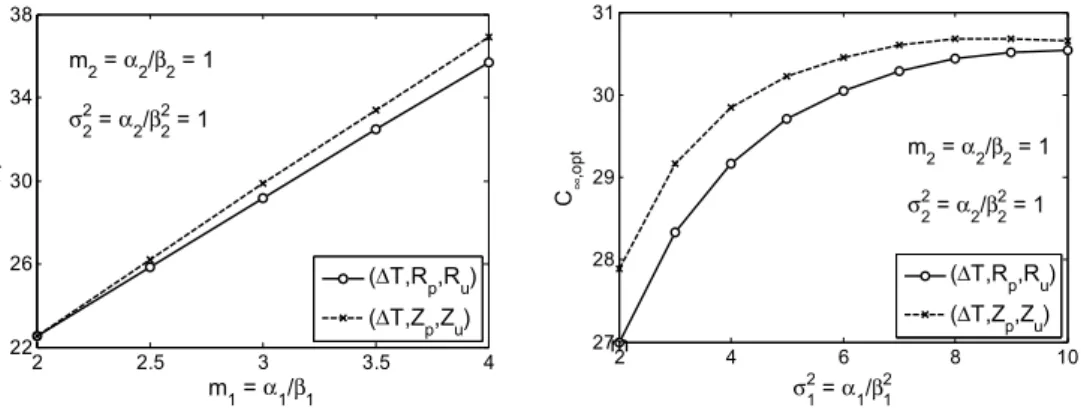
σ of component 1 are respectively varied, other parameters are fixed, and we observe the optimal cost rate evolution of the considered strategies. The (ΔT R R, p, u) strategy is still more profitable than the (ΔT Z Z, p, u)strategy (see Figure 3). However, both strategies give almost the same profit for a quasi-homogeneous system (see left figure below) or for a heterogeneous system whose degradation variances of different components are too different (see right figure below).
2 2.5 3 3.5 4 22 26 30 34 38 m 1 = α1/β1 C ∞ ,opt (ΔT,Rp,Ru) (ΔT,Z p,Zu) m2 = α2/β2 = 1 σ22 = α 2/β2 2 = 1 2 4 6 8 10 27 28 29 30 31 σ12 = α 1/β1 2 C∞ ,opt m (ΔT,Rp,Ru) (ΔT,Zp,Zu) m2 = α2/β2 = 1 σ22 = α 2/β2 2 = 1
Figure 3: Evolution of optimal maintenance cost rate w.r.t. the variation of degradation speed and variance
4.3 Sensitivity to the errors made on maintenance strategy decision parameters
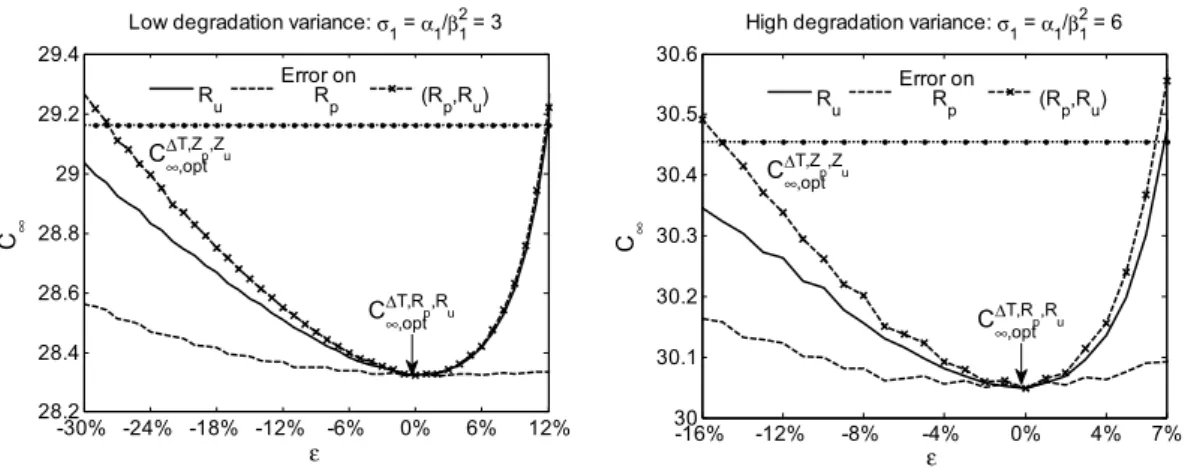
In many practical applications, the estimation of system parameters may be imprecise because of noisy measurements or the lack of data. This can lead to errors in determining the optimal decision parameters of a maintenance strategy, and hence a loss in its performance. This section therefore aims to examine the impact of such an error on the performance of (ΔT R R, p, u) strategy. For this end, we compute its
maintenance cost rate when the decision parameters vary around theirs optimal values, and we compare with the optimal cost rate of (ΔT Z Z, p, u) strategy. Figure 4 shows the results. Obviously, the performance
-30% -24% -18% -12% -6% 0% 6% 12% 28.2 28.4 28.6 28.8 29 29.2 29.4 ε C ∞
Low degradation variance: σ1 = α1/β12 = 3
Ru Error on Rp (Rp,Ru) C ∞,opt ΔT,Z p,Zu C ∞,opt ΔT,R p,Ru -16% -12% -8% -4% 0% 4% 7% 30 30.1 30.2 30.3 30.4 30.5 30.6 ε C∞
High degradation variance: σ1 = α1/β12 = 6
R u Error on R p (R p,Ru) C ∞,opt ΔT,Z p,Zu C ∞,opt ΔT,R p,Ru
Figure 4: Evolution of optimal maintenance cost rate w.r.t. the variation of decision parameters error
of the (ΔT R R, p, u) strategy decreases w.r.t. decision parameters error. However it remains better than the
(ΔT Z Z, p, u) strategy when the error is not too high. This shows the robustness of the (ΔT R R, p, u) w.r.t.
measurement errors. Moreover, the strategy is more robust for smaller variance of degradation process.
5. Conclusion and perspectives
We propose in this paper a reliability-based opportunistic predictive maintenance model which can characterize both aspects of CBM decision and economic dependence among components of system. The numerical results show that the proposed maintenance model is suitable for a k-out-of-n deteriorating system and that using conditional reliability instead of degradation level in maintenance decision-making can make the model simple, profitable, robust w.r.t. measurement errors, and easy to optimize.
Despite these advantages, the proposed maintenance strategy is still a “semi-blind” strategy because the global system health state is not taken into account in maintenance decisions. The future work therefore aims to develop a reliability-based opportunistic maintenance strategy considering the global system health. Moreover, for a complete study, other types of interactions among components (i.e., stochastic dependence and structural dependence) should be introduced into the model.
References
Bérenguer C., 2008, On the mathematical condition-based maintenance modelling for continuously deteriorating systems, International Journal of Materials and Structural Reliability, 6, 133-151.
Bouvard K., Artus A., Bérenguer C., Cocquempot V., 2011, Condition-based dynamic maintenance operations planning & grouping: Application to commercial heavy vehicles, Reliability Engineering & System Safety, 96, 601-610.
Castanier B., Grall A., Bérenguer C., 2005, A condition-based maintenance policy with non-periodic inspections for a two-unit series system, Reliability Engineering & System Safety, 87, 109-120.
Cho D.I., Parlar M., 1991, A survey of maintenance models for multi-unit systems, European Journal of Operational Research, 51, 1-23.
David H.A., Nagaraja H.N., 2003, Order statistics, 3rd ed, John Wiley & Sons, New Jersey, United States. Dekker R., Wildeman R.E., Van der Duyn Shcouten F.A., 1997, A review of multi-component maintenance
models with economic dependence, Mathematical Methods of Operations Research, 45, 411-435. Jardine A.K.S., Lin D., Banjevic D., 2006, A review on machinery diagnostics and prognostics
implementing condition-based maintenance, Mechanical Systems & Signal Processing, 20, 1483-1510. Tian Z., Liao H., 2011, Condition-based maintenance optimization for multi-component systems using
proportional hazards model, Reliability Engineering & System Safety, 96, 581-589
Tijms H.C., 2003, A first course in stochastic models, John Wiley & Sons, West Sussex, England.
van Noortwijk J.M., 2009, A survey of gamma processes in maintenance, Reliability Engineering & System Safety, 94, 2-21.
Wang H., 2002, A survey of maintenance policies of deteriorating systems, European Journal of Operational research, 139, 469-489.