Slow admission and power control for small cell
networks via distributed optimization
Siew Eng Nai, Tony Q.S. Quek, M´
erouane Debbah
To cite this version:
Siew Eng Nai, Tony Q.S. Quek, M´
erouane Debbah. Slow admission and power control for small
cell networks via distributed optimization. WCNC 2013, Apr 2013, Shanghai, China. pp.2261
- 2265,
<
10.1109/WCNC.2013.6554912
>
.
<
hal-00927760
>
HAL Id: hal-00927760
https://hal-supelec.archives-ouvertes.fr/hal-00927760
Submitted on 13 Jan 2014
HAL
is a multi-disciplinary open access
archive for the deposit and dissemination of
sci-entific research documents, whether they are
pub-lished or not.
The documents may come from
teaching and research institutions in France or
abroad, or from public or private research centers.
L’archive ouverte pluridisciplinaire
HAL
, est
destin´
ee au d´
epˆ
ot et `
a la diffusion de documents
scientifiques de niveau recherche, publi´
es ou non,
´
emanant des ´
etablissements d’enseignement et de
recherche fran¸
cais ou ´
etrangers, des laboratoires
publics ou priv´
es.
Slow Admission and Power Control for Small Cell
Networks via Distributed Optimization
Siew Eng Nai
∗, Tony Q. S. Quek
∗†, and M´erouane Debbah
‡∗Institute for Infocomm Research, A∗STAR, 1 Fusionopolis Way, #21-01 Connexis, Singapore 138632
†Singapore University of Technology and Design, 20 Dover Drive, Singapore 138682 ‡SUPELEC, 3 rue Joliot-Curie, 91192 Gif-sur-Yvette, France
Abstract—Although small cell networks are environmentally
friendly and can potentially improve the coverage and capacity of cellular layers, it is imperative to control the interference in such networks before overlaying them in a macrocell network on a large-scale basis. In recent work, we developed the joint admission and power control algorithm for two-tier small cell networks in which the number of small cell users that can be admitted at their quality-of-service (QoS) constraints is maxi-mized without violating the macrocell users’ QoS constraints. The QoS metric adopted is outage probability. In this paper, we investigate the distributed implementation of the joint admission and power control problem where the small cells can determine jointly their admissibility and transmit powers autonomously.
I. INTRODUCTION
Energy consumption and electromagnetic pollution are fast becoming problems that future communication infrastructures need to alleviate. Towards this end, the design of green cellular networks has been considered. One such approach is to overlay a macrocell network with many small cells [1], [2]. With small cells, users can obtain better indoor reception and power savings due to the low transmit powers. In addition, small cells can offload much data traffic from the macrocell network via backhaul. This enhances the overall network coverage and capacity. However, one of the major impediments to the success of two-tier small cell networks is the presence of inter-tier and intra-inter-tier interference.
A significant amount of research is focused on managing inter-tier and intra-tier interference [3]–[15]. In [3], inter-tier interference between the macrocell and small cell tiers can be avoided by using orthogonal spectrum allocation. Clearly, this method is inefficient given a sparse small cell deployment setting and a much higher area spectrum efficiency can be achieved by spectrum sharing [4]. On the other hand, for spectrum sharing in two-tier small cell networks, the inter-tier interference has to be properly controlled by using tech-niques such as access control [4]–[7], power control [8]–[10], multiple antennas [11], [12], or cognitive radio [13]–[15]. All these schemes [3]–[15] involve computational and signalling overhead. If the set of active small cells changes at the rate of Rayleigh fading, there will be very frequent updating and processing at the macrocell base station (MBS) and small cell access points (SAPs). Therefore, we proposed an interference management scheme with joint admission and power control that tracks at a much slower shadowing time-scale in [16].
In [16], we consider a two-tier small cell network, where small cell users (SUs) share the same spectrum with the macrocell user (MU). We assume that the MU has a higher spectrum access priority than the SUs. The proposed joint admission and power control problem aims to maximize the number of small cells admitted with their outage probability constraints satisfied and simultaneously, minimize their total transmit power, while guaranteeing the outage probability constraint of the MU. Different from conventional works [17], [18] which use instantaneous signal-to-interference-plus-noise ratio (SINR) constraints, we apply outage probability constraint for the users because this enables the admission and power updating to be performed at a much slower log-normal shadowing time-scale instead of the Rayleigh fading time-scale. As this formulation is NP-hard, convex relaxation is applied to obtain high quality approximate solutions that exhibit near optimal performance as shown in [16]. However, the centralized approach in [16] is difficult to implement in practice as the SAPs are randomly deployed by their subscribers.
In this paper, we investigate the decentralized implemen-tation of the algorithm in [16] which is developed via dual decomposition. The distributed algorithm enables the small cells to self organize; the small cells can determine jointly (on their own) if they are admitted or rejected for communications and the respective transmit powers should they be admitted into the system. The simulation results show the effectiveness of our proposed distributed algorithm.
II. SYSTEMMODEL ANDPROBLEMFORMULATION
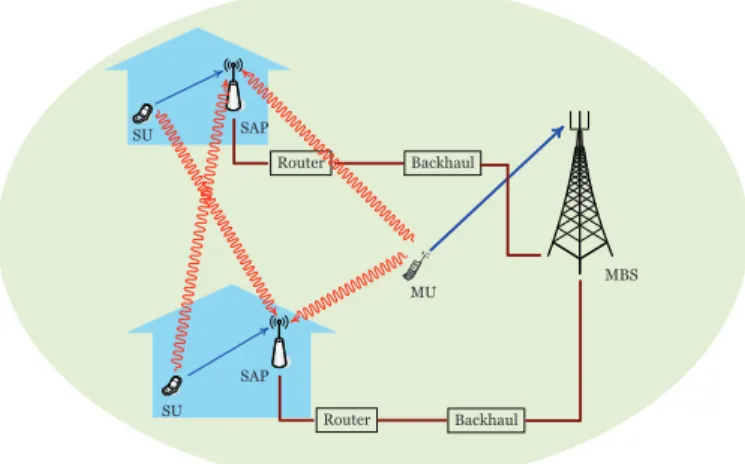
As shown in Fig. 1, we consider an uplink two-tier network where a macrocell network is overlaid withN closed access small cells. The MBS and the SAPs are operating in a common frequency band with one MU1 andN SUs. We assume that there is one SU in each small cell requesting to share the spectrum with the MU in order to communicate with its SAP. Therefore, the received SINR of theith SU can be written as
SINRsi = G ss iiFiissPis PN l=1,l6=iGssilFilssPls+Gsmi0 Fi0smPm+No (1)
1A single MU is considered for brevity of exposition. More QoS constraints
can be added to include multiple MUs which does not alter the structure of the proposed problem.
MBS SAP MU SU Router Backhaul SAP SU Router Backhaul
Fig. 1. Two-tier network where a macrocell network is overlaid with small cells. The straight arrows indicate the desired links while the wavy arrows indicates inter-tier and intra-tier interfering links.
where Gss
il and Filss denote the slow and fast fading gains
from thelth SU to theith SAP, respectively. In the following, we consider the slow fading gain to include the effect of propagation path loss and shadowing, and the fast fading gain is modeled as exponential power fading which corresponds to Rayleigh fading assumption. Similarly, Gsm
i0 and Fi0sm refers
to the slow and fast fading gains from the MU (assigned index “0”) to the ith SAP, respectively. The transmit power of the lth SU is Ps
l, the transmit power of the MU is
Pm, which is assumed to be fixed as the MU does not
cooperate with the SUs, and the noise power is No. With the
Rayleigh fading assumption on the fast fading gains,Fkl ij are
independent exponentially distributed random variables with unit mean. Thus, the outage constraint of the ith SU is given by Pr(SINRsi ≤γis,th)≤ρ s,th i and derived as [10] bs iNo Ps i + N X l=1,l6=i ln(1 +b s iGssilPls Ps i ) + ln(1 +b s iGsmi0Pm Ps i )≤ −ln(1−ρs,thi ) (2) where γs,thi and ρ s,th
i denote the pre-specified SINR and
outage probability thresholds of the ith SU, respectively, and for notational convenience,bs
i ,γ
s,th i /Gssii.
When SUs are operating, the received SINR of the MU is
SINRm= G mm M0FM0mmPm PN i=1GmsMiFMimsPis+No (3) whereGmm
M0 andFM0mmare the slow and fast fading gains from
the MU to the MBS and Gms
Mi and FMims are the slow and
fast fading gains from the ith SU to the MBS. The outage constraint of the MU is then given byPr(SINRm≤γm,th)≤
ρm,th and derived as N
X
i=1
ln(1 +bmsMiPis)≤lnµm (4)
whereρm,th is the pre-specified outage probability threshold
of the MU, µm = (1−ρ¯m)/(1−ρm,th), ρ¯m is the outage
probability of the MU in the absence of SUs, and for notational convenience,bmsMi,(γm,thGMims)/(GmmM0Pm).
The objective of this work is to maximize the number of SUs that can be admitted with a guaranteed QoS while guaranteeing the QoS of the MU and simultaneously minimize the total transmission power of the SUs. In this paper, the QoS provided to the MU as well as the SUs is outage probability constraint. Following the approach in [17], we can provide a compact and elegant single-stage framework [16] which is given by
min Ps i,si ǫPN i=1Pis+ (1−ǫ) PN i=1 1 si+1 (5a) s.t. 0≤Ps i ≤Ps,max, ∀i (5b) si∈[0,1], ∀i (5c) sib s iNo Ps i + PN l=1,l6=iln(1 + sib s iG ss ilP s l Ps i ) + ln(1 +sibsiG sm i0P m Ps i )≤ −ln(1−ρ s,th i ), ∀i (5d) PN i=1ln(1 +bmsMiPis)≤lnµm (5e)
where the auxiliary scheduling variables aresi∈[0,1],Ps,max
is the maximum transmit power of each SU, the value ofsi
determines the admissibility of the ith SU and if the outage constraint of theith SU is taken into consideration in the power control part of the joint admission and power control problem. Ifsi = 0, theith SU is rejected and (5d) reduces to the trivial
inequalityln(1−ρs,thi )≤0; ifsi= 1, theith SU is scheduled
for admission and (5d) becomes an active constraint. The cost function consists of the weighted sum of transmit powers of the SUs which is bounded and the admission cost which is discrete-valued. Intuitively, the weighing parameterǫ < ǫ∗has
to be small enough in order to ensure that admission control is always prioritized before power control. The choice ofǫcan be understood by the following interpretation that dropping any user costs more than can possibly be saved by total power minimization [17].
Remark 1: By choosingǫ < ǫ∗ = 1/(2N Ps,max+ 1), the
solution of (5) is equivalent to firstly, finding the optimal setS˜ that contains the largest number of SUs that can be admitted subject to transmit power constraints (5b), outage probability constraints of the SUs (2), and outage probability constraint of the MU (4) and lastly, minimizing the total transmit power of the SUs inS˜subject to the same constraints (5b), (2), and (4).
Proof:The proof is omitted for brevity.
Different from [17] which constrains the instantaneous SINRs of the SUs, the proposed formulation constrains the outage probabilities of the MU and SUs. Consequently, the objective function, weighing parameter ǫ, and the effect that the scheduling variablessi exert on the constraints in (5) are
entirely different from those in [17].
III. CONVEXRELAXATION
The single-stage reformulation in (5) is non-convex due to the binary constraints (5c) and the term 1/(si + 1) in the
objective function being neither a posynomial nor a monomial. Therefore, we apply the technique of convex relaxation. First, we relax the binary constraints to allow si to take on any
real value within the interval [0,1]. Next, we approximate
f(si) = 1/(si + 1) with a monomial, i.e., csαi = 0.5s
−1 2
i
(details are skipped for brevity) such that the entire optimiza-tion problem can be cast as a geometric programming (GP) problem. Finally, the new convex single-stage formulation is obtained as follows: min Ps i,si ǫPN i=1Pis+c(1−ǫ)P N i=1s −α i (6) s.t. 0≤si≤1, ∀i (5b),(5d),(5e)
which is clearly a GP and it can be solved globally and efficiently. After (6) is solved, if all si = 1, it means that all
the MU and SUs can be served while satisfying their outage constraints. Otherwise, the removal of SUs is triggered in order to admit the maximum number of SUs with their outage constraints and that of the MU met. In this paper, the iterative removal algorithm is used to remove the SU with the minimal
si|si6=1 (one by one) at each iteration of (6). The algorithm
terminates when si= 1for all the remaining SUs.
IV. DISTRIBUTEDOPTIMIZATION
Although (6) can be efficiently solved in polynomial time, it still requires a centralized network controller to solve the optimization problem. Due to the random deployment of the small cells, distributed algorithms are especially favoured so that the small cells can determine their own admissibility and transmit powers (if they are admitted for communications). To this end, the dual decomposition approach is applied [19]. As (5d) is coupled with the transmit powers of other SUs, an auxiliary variablezil=GssilPlsand an additional equality (7d)
are introduced. Let s˜i = lnsi, P˜is = lnPis, and z˜il = lnzil,
then we can rewrite (6) as follows:
min ˜ Ps i,˜si ǫPN i=1exp( ˜Pis) +c(1−ǫ) PN
i=1(exp(˜si))−α (7a)
s.t. P˜s i ≤lnPs,max, ∀i (7b) ˜ si≤0, ∀i (7c) ˜ zil−lnGssil−P˜ls= 0, ∀i6=l (7d) exp(˜si)b s iNo exp( ˜Ps i) +PN l=1,l6=iln(1 + exp(˜si)b s iexp(˜zil) exp( ˜Ps i) ) + ln(1 +exp(˜si)b s iG sm i0P m exp( ˜Ps i) )≤ −ln(1−ρs,thi ),∀i (7e) PN i=1ln(1 +bmsMiexp( ˜Pis))≤lnµm. (7f)
Letγil be the consistency prices corresponding to (7d),ζiand
λ be the dual variables for (7e) and (7f), respectively so the
partial Lagrangian for (7) can be written as
L( ˜Pis,s˜i,z˜il) =ǫ N X i=1 exp( ˜Pis) +c(1−ǫ) N X i=1 (exp(˜si))−α + N X i=1 ζi exp(˜si)bs iNo exp( ˜Ps i) + N X l=1,l6=i ln 1 + exp(˜si)b s iexp(˜zil) exp( ˜Ps i) + ln 1 + exp(˜si)b s iGsmi0Pm exp( ˜Ps i) + ln(1−ρs,thi ) +λ N X i=1 ln(1 +bmsMiexp( ˜Pis))−lnµm + N X i=1 N X l=1,l6=i γil[˜zil−lnGssil −P˜ls] (8)
where for each SU,i= 1,· · · , N, we have
Li( ˜Ps
i,˜si,z˜il) =ǫexp( ˜Pis) +c(1−ǫ)(exp(˜si))−α +ζi exp(˜si)bs iNo exp( ˜Ps i) + N X l=1,l6=i ln 1 + exp(˜si)b s iexp(˜zil) exp( ˜Ps i) + ln 1 +exp(˜si)b s iGsmi0 Pm exp( ˜Ps i) +λln(1 +bmsMiexp( ˜Pis)) + N X l=1,l6=i γilz˜il−( N X l=1,l6=i γli) ˜Pis. (9)
The consistency pricesγil and Lagrange multipliersζi andλ
can be updated according to the following equations:
γil(t+ 1) =γil(t) +δγ(t)[˜zil−lnGssil −P˜ls], (10) ζi(t+ 1) =ζi(t) +δζ(t) exp(˜si)bs iNo exp( ˜Ps i) + N X l=1,l6=i ln 1 + exp(˜si)b s iexp(˜zil) exp( ˜Ps i) + ln 1 +exp(˜si)b s iGsmi0 Pm exp( ˜Ps i) + ln(1−ρs,thi ) , (11) λ(t+ 1) =λ(t) +δλ(t) N X i=1 ln(1 +bmsMiexp( ˜Pis))−lnµm (12) wheretis the iteration index andδγ,δζ, andδλare step sizes,
respectively.
Incorporating all the above equations, we summarize our proposed distributed joint admission and power control algo-rithm as follows:
1) At t= 0, initializeγil= 0 for∀i, l,λ >0,ζi>0, and ˜
zil= 0. First, each SAPiestimates the interference from
the MU, i.e.,Gsm
i0Pm, and channel gains from other SUs,
i.e.,Gssil. Each SAPican getγm,th,GmmM0,Pm, andµm
from the MBS using the backhaul. Each SUican obtain
Gms
Mivia estimatingGsmiMwhen the MBS is broadcasting
or transmitting, after which it informs its SAP.
2) At t ≥1, each SAPisolves (9) subject to its transmit power constraint (7b) forP˜s
i ands˜i using interior point
method.
3) Each SAP ichecks ifP˜s
i and˜si have converged. If so,
go to Step (5). Otherwise, the SAP i broadcasts itsP˜s i
or passes this information to other SAPs over a low-rate control channel.
4) The SAPs can appoint one of themselves as an acting SAP controller to pass their Gms
Mi to. The acting SAP
controller updates λ and informs the other SAPs of λ
via the low-rate control channel. Each SAP i updates
˜
zil,γil, andζi. Go to Step (2).
5) AfterP˜isands˜ihave converged, each SAP can calculate
Ps
i andsi. If si= 1, the SUi is admitted to share the
spectrum with the MU and the SU i then transmits at
Ps
i to communicate with the respective SAP. Ifsi = 0,
the SU iis rejected and it does not transmit at all. V. SIMULATIONRESULTS
The performance of our proposed distributed joint admission and power control algorithm is investigated for a code division multiple access system. The MBS is located in the centre of a square area of length2000m. The small cells are randomly located in the same area excluding a square area of length
100m centred at the MBS. The SAP is located at the centre of each small cell (square area) and the SU is randomly located at either one of the four corners of the cell at a distance of 20m. The small cells are separated from each other by at least 1m. The MU is randomly located outside the small cells by at least 1m. The noise power at the MBS and SAPs is No= 10−10W. The transmit power and SINR threshold of
the MU are Pm = 4W and γm,th = 0dB, respectively. The
total number of requesting SUs is 3. The SINR thresholds of the SUs is 25dB. The maximum transmit power of the SUs isPs,max= 1W. The processing gains of the MBS and SAPs
are P Gm = 10 and P Gs
i = 1, respectively. The MU and
SUs have an outage probability threshold ρm,th = 10% and
ρs,thi = 10%. The slow fading gain between transmitterjand receiver i is modeled as Gij =K0×10βij/10×d−ijη where
dij is the distance between them, K0 = 103 is a factor to
include the effects of antenna gain and carrier frequency,βij
is a Gaussian random variable with zero mean and standard deviation of4dB to account for log-normal shadowing effects, and the path loss exponent isη= 3except thatη= 4forGss
ii.
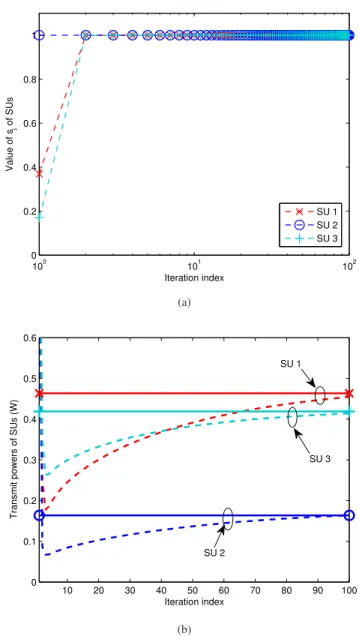
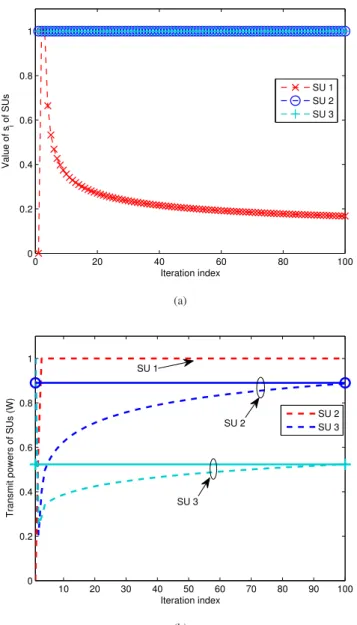
We study the performance of the proposed distributed joint admission and power control algorithm by comparing with its centralized counterpart. In the first example in Fig. 2, the centralized algorithm admits all the requesting SUs while in the second example in Fig. 3, the centralized algorithm admits
100 101 102 0 0.2 0.4 0.6 0.8 1 Iteration index Value of s i of SUs SU 1 SU 2 SU 3 (a) 10 20 30 40 50 60 70 80 90 100 0 0.1 0.2 0.3 0.4 0.5 0.6 Iteration index
Transmit powers of SUs (W)
SU 3 SU 1
SU 2
(b)
Fig. 2. (a) Value of si of SUs obtained by the proposed distributed
algorithm versus iteration index. All SUs are admitted. Note that the x-axis is on a logarithm scale. (b) Transmit powers of SUs obtained by the proposed distributed algorithm versus iteration index. The solid lines indicate the transmit powers of the respective SUs as obtained by the centralized algorithm.
only2 SUs which are SU2and SU3. Fig. 2(a) and Fig. 3(a) show that the distributed algorithm admits the same SUs as that of the centralized algorithm. Note that the x-axis of Fig. 2(a) is on a logarithm scale. Fig. 2(b) and Fig. 3(b) show that the transmit powers of the admitted SUs converge to those obtained by the centralized algorithm (as indicated by the solid lines). In Fig. 3(b), the transmit power of SU 1 after the convergence of the distributed algorithm is not important because it is not admitted for communications since s1 6= 1
0 20 40 60 80 100 0 0.2 0.4 0.6 0.8 1 Iteration index Value of s i of SUs SU 1 SU 2 SU 3 (a) 10 20 30 40 50 60 70 80 90 100 0 0.2 0.4 0.6 0.8 1 Iteration index
Transmit powers of SUs (W)
SU 2 SU 3 SU 2 SU 3 SU 1 (b)
Fig. 3. (a) Value ofsiof SUs obtained by the proposed distributed algorithm
versus iteration index. Only SU2and SU3are admitted. (b) Transmit powers of SUs obtained by the proposed distributed algorithm versus iteration index. The solid lines indicate the transmit powers of the respective SUs as obtained by the centralized algorithm.
VI. CONCLUSION
In this paper, we investigated the distributed implementation of a shadowing time-scale based joint admission and power control algorithm in two-tier small cell networks. In particular, the number of small cell users that can be admitted at their outage probability specifications is maximized and their total transmit power is minimized while guaranteeing the outage probability specification of the macrocell user. As this joint admission and power control problem is NP-hard, convex relaxation is applied to obtain high quality approximate solu-tions. The distributed implementation is developed by applying dual decomposition technique which empowers the small cells to determine their own admissibility into the system and the
transmit powers if they are admitted.
ACKNOWLEGEMENT
This work was supported by the SRG ISTD 2012 037 and the CAS Fellowships for Young International Scientists.
REFERENCES
[1] J. Hoydis, M. Kobayashi, and M. Debbah, “Green small-cell networks,”
IEEE Veh. Technol. Mag., vol. 6, no. 1, pp. 37–43, Mar. 2011. [2] D. L ´opez-P´erez, ˙I. G ¨uvenc, G. de la Roche, M. Kountouris, T. Q. S.
Quek, and J. Zhang, “Enhanced intercell interference coordination chal-lenges in heterogeneous networks,” IEEE Wireless Commun., vol. 18, no. 3, pp. 22–30, Jun. 2011.
[3] V. Chandrasekhar and J. G. Andrews, “Spectrum allocation in tiered cellular networks,”IEEE Trans. Commun., vol. 57, no. 10, pp. 3059– 3068, Oct. 2009.
[4] W. C. Cheung, T. Q. S. Quek, and M. Kountouris, “Throughput opti-mization, spectrum allocation, and access control in two-tier femtocell networks,”IEEE J. Sel. Areas Commun., vol. 30, no. 3, pp. 561–574, Apr. 2012.
[5] A.-H. Tsai, L.-C. Wang, J.-H. Huang, and R.-B. Hwang, “High-capacity OFDMA femtocells by directional antennas and location awareness,”
IEEE Syst. J., vol. 6, no. 2, pp. 329–340, Jun. 2012.
[6] C.-H. Ko and H.-Y. Wei, “On-demand resource-sharing mechanism design in two-tier OFDMA femtocell networks,” IEEE Trans. Veh. Technol., vol. 60, no. 3, pp. 1059–1071, Mar. 2011.
[7] P. Xia, V. Chandrasekhar, and J. G. Andrews, “Open vs. closed acess femtocells in the uplink,”IEEE Trans. Wireless Commun., vol. 9, no. 12, pp. 3798–3809, Dec. 2010.
[8] V. Chandrasekhar, J. G. Andrews, T. Muharemovic, Z. Shen, and A. Gatherer, “Power control in two-tier femtocell networks,” IEEE Trans. Wireless Commun., vol. 8, no. 8, pp. 4316–4328, Aug. 2009. [9] C. W. Tan, S. Friedland, and S. H. Low, “Spectrum management in
multiuser cognitive wireless networks: Optimality and algorithm,”IEEE J. Sel. Areas Commun., vol. 29, no. 2, pp. 421–430, Feb. 2011. [10] C. W. Tan, “Optimal power control in Rayleigh-fading heterogeneous
networks,” inProc. IEEE Int. Conf. Comput. Commun., Shanghai, China, Apr. 2011, pp. 2552–2560.
[11] S. Park, W. Seo, Y. Kim, S. Lim, and D. Hong, “Beam subset selection strategy for interference reduction in two-tier femtocell networks,”IEEE Trans. Wireless Commun., vol. 9, no. 11, pp. 3440–3449, Nov. 2010. [12] Y. Jeong, T. Q. S. Quek, and H. Shin, “Beamforming optimization for
multiuser two-tier networks,”J. Commun. Netw., vol. 13, no. 4, pp. 327– 338, Aug. 2011.
[13] S.-M. Cheng, S.-Y. Lien, F.-S. Chu, and K.-C. Chen, “On exploiting cognitive radio to mitigate interference in macro/femto heterogeneous networks,” IEEE Wireless Commun., vol. 18, no. 3, pp. 40–47, Jun. 2011.
[14] S.-Y. Lien, Y.-Y. Lin, and K.-C. Chen, “Cognitive and game-theoretical radio resource management for autonomous femtocells with QoS guar-antees,”IEEE Trans. Wireless Commun., vol. 10, no. 7, pp. 2196–2206, Jul. 2011.
[15] A. Adhikary, V. Ntranos, and G. Caire, “Cognitive femtocells: Breaking the spatial reuse barrier of cellular systems,” inProc. Inform. Theory Appl. Workshop, San Diego, CA, Feb. 2011, pp. 1–10.
[16] S. E. Nai, T. Q. S. Quek, and M. Debbah, “Shadowing time-scale admission and power control for small cell networks,” inProc. IEEE Int. Symp. Wireless Pers. Multimedia Commun., Taipei, Taiwan, Sep. 2012. [17] E. Matskani, N. D. Sidiropoulos, Z.-Q. Luo, and L. Tassiulas, “Convex approximation techniques for joint multiuser downlink beamforming and admission control,” IEEE Trans. Wireless Commun., vol. 7, no. 7, pp. 2682–2693, Jul. 2008.
[18] I. Mitliagkas, N. D. Sidiropoulos, and A. Swami, “Joint power and admission control for ad-hoc and cognitive underlay networks: Convex approximation and distributed implementation,” IEEE Trans. Wireless Commun., vol. 10, no. 12, pp. 4110–4121, Dec. 2011.
[19] M. Chiang, Geometric Programming for Communication Systems. Hanover, MA: Now Publishers Inc., 2005.