AUTOMATIC CLASSIFICATION OF POWER QUALITY DISTURBANCES USING OPTIMAL FEATURE SELECTION BASED ALGORITHM
SUHAIL KHOKHAR
AUTOMATIC CLASSIFICATION OF POWER QUALITY DISTURBANCES USING OPTIMAL FEATURE SELECTION BASED ALGORITHM
SUHAIL KHOKHAR
A thesis submitted in fulfilment of the requirements for the award of the degree of Doctor of Philosophy (Electrical Engineering)
Faculty of Electrical Engineering Universiti Teknologi Malaysia
DEDICATION
This thesis is dedicated to my beloved father and mother for their endless support and encouragement, and to my kind wife, sweet daughters who supported me and did
ACKNOWLEDGEMENTS
Alhamdulillah, I am greatly thankful to Allah S.W.T. on His mercy and blessing for making this research successful. I would like to acknowledge the advice and guidance of Prof. Dr. Abdullah Asuhaimi Bin Mohd Zin as my supervisor. He always aimed to encourage me to investigate through the experiments and to understand the truth of science. His advices on the morality and affability are certainly expensive lessons for me. I also would like to acknowledge the supervision from my co-supervisor, Dr Ahmad Safawi Bin Mokhtar. Indeed, he persuades me towards deeper investigation on both theoretical and experimental assignments. A special thanks to him by showing me the best academic lifestyle as well as academic communications. I sincerely thank to faculty and all staff of Electrical Engineering for wholehearted support especially for the significant information source and helpful discussion.
I would also acknowledge Quaid-e-Awam University of Engineering, Science and Technology (QUEST), Nawabshah, Pakistan for providing financial support under the university project “Faculty Development and other Immediate Needs Program (FDINP)” sponsored by the Higher Education Commission (HEC), Pakistan.
Finally, I wish everyone to success in this world and hereafter under the guidance and in the path of Allah S. W. T.
ABSTRACT
The development of renewable energy sources and power electronic converters in conventional power systems leads to Power Quality (PQ) disturbances. This research aims at automatic detection and classification of single and multiple PQ disturbances using a novel optimal feature selection based on Discrete Wavelet Transform (DWT) and Artificial Neural Network (ANN). DWT is used for the extraction of useful features, which are used to distinguish among different PQ disturbances by an ANN classifier. The performance of the classifier solely depends on the feature vector used for the training. Therefore, this research is required for the constructive feature selection based classification system. In this study, an Artificial Bee Colony based Probabilistic Neural Network (ABCPNN) algorithm has been proposed for optimal feature selection. The most common types of single PQ disturbances include sag, swell, interruption, harmonics, oscillatory and impulsive transients, flicker, notch and spikes. Moreover, multiple disturbances consisting of combination of two disturbances are also considered. The DWT with multi-resolution analysis has been applied to decompose the PQ disturbance waveforms into detail and approximation coefficients at level eight using Daubechies wavelet family. Various types of statistical parameters of all the detail and approximation coefficients have been analysed for feature extraction, out of which the optimal features have been selected using ABC algorithm. The performance of the proposed algorithm has been analysed with different architectures of ANN such as multilayer perceptron and radial basis function neural network. The PNN has been found to be the most suitable classifier. The proposed algorithm is tested for both PQ disturbances obtained from the parametric equations and typical power distribution system models using MATLAB/Simulink and PSCAD/EMTDC. The PQ disturbances with uniformly distributed noise ranging from 20 to 50 dB have also been analysed. The experimental results show that the proposed ABC-PNN based approach is capable of efficiently eliminating unnecessary features to improve the accuracy and performance of the classifier.
ABSTRAK
Pembangunan sumber tenaga boleh diperbaharui dan penukar elektronik kuasa dalam sistem kuasa konvensional membawa kepada gangguan Kualiti Kuasa (PQ). Kajian ini bertujuan untuk pengesanan automatik dan pengelasan gangguan kualiti kuasa tunggal dan berbilang dengan menggunakan ciri optimum baharu pemilihan berasaskan Jelmaan Wavelet Diskret (DWT) dan rangkaian neural buatan (ANN). DWT digunakan untuk pengekstrakan ciri-ciri berguna, di mana ianya digunakan untuk membezakan di antara gangguan-gangguan kualiti kuasa oleh pengelas rangkaian neural buatan. Pencapaian pengelas itu semata-mata bergantung kepada vektor ciri yang digunakan untuk latihan. Oleh itu, kajian ini diperlukan untuk pemilihan ciri konstruktif berdasarkan sistem pengelasan. Dalam kajian ini, algoritma Rangkaian Neural Kebarangkalian berasaskan Koloni Lebah Buatan (ABC-PNN) telah dicadangkan untuk pemilihan ciri optimum. Jenis-Jenis gangguan kualiti kuasa tunggal yang biasa termasuklah lendut, ampul, sampukan, harmonik, ayunan dan dedenyut fana, kerlipan, takuk dan pancang telah dianalisis. Selain itu, pelbagai gangguan yang terdiri daripada gabungan dua gangguan juga dipertimbangkan. DWT dengan analisis pelbagai resolusi telah digunakan untuk mengurai gelombang gangguan PQ ke lebih terperinci dan pekali anggaran di peringkat lapan menggunakan keluarga Wavelet Daubechies. Pelbagai jenis parameter statistik terperinci dan pekali anggaran telah dianalisis untuk ciri pengekstrakan, yang mana ciri-ciri optimum telah dipilih dengan menggunakan rekaan algoritma ABC. Pencapaian algoritma yang dicadangkan itu telah dianalisis dengan seni bina ANN yang berbeza seperti perceptron berbilang lapisan dan fungsi rangkaian neural fungsi asas jejarian. PNN telah menjumpai pengelas yang paling sesuai. Algoritma yang dicadangkan diuji untuk kedua-dua gangguan kualiti kuasa yang diperolehi daripada persamaan parametrik dan model sistem pengagihan kuasa menggunakan MATLAB/Simulink dan PSCAD/EMTDC. Gangguan PQ dengan penjulatan hingar dari 20 hingga 50 dB juga telah dianalisis. Keputusan eksperimen menunjukkan bahawa pendekatan berasaskan ABC-PNN yang dicadangkan mampu menghapuskan ciri yang tidak perlu untuk meningkatkan ketepatan dan pencapaian pengelas.
TABLE OF CONTENTS
CHAPTER TITLE PAGE
DECLARATION ii
DEDICATION iii
ACKNOWLEDGEMENTS iv
ABSTRACT v
ABSTRAK vi
TABLE OF CONTENTS vii
LIST OF TABLES xii
LIST OF FIGURES xiv
LIST OF ABREVIATIONS xvi
LIST OF SYMBOLS xx
LIST OF APPENDICES xxii
1 INTRODUCTION 1
1.1 Overview of Power Quality 1
1.2 Background of Research Studies 4
1.2.1 Overview of Power Quality Disturbances and Standards
5 1.2.2 Signal Processing Techniques for Feature
Extraction
7 1.2.3 Optimization Techniques for Optimal
Feature Selection
7 1.2.4 Artificial Intelligence Techniques for
Classification
8
1.3 Problem Statement 8
1.4 Objectives of Research 10
1.6 Significance of Research 11
1.7 Organization of Thesis 12
2 LITERATURE REVIEW 13
2.1 Introduction 13
2.2 Architecture of Automatic Classification of Power Quality Disturbances
14 2.2.1 Power Quality Disturbances Generation
Stage
14
2.2.2 Feature Extraction Stage 15
2.2.3 Classification Techniques 16
2.2.4 Feature Selection Stage 16
2.3 Categories of Power Quality Disturbances 17
2.3.1 Transient Disturbances 18
2.3.2 Short-Duration Disturbances 20
2.3.3 Long Duration Disturbances 20
2.3.4 Voltage Unbalance 22
2.3.5 Waveform Distortion Disturbances 22 2.3.5.1 Direct Current Offset 22
2.3.5.2 Harmonics 23
2.3.5.3 Inter-harmonics and Sub-harmonics
23
2.3.5.4 Periodic Notch 24
2.3.5.5 Noise 25
2.3.6 Voltage Fluctuation or Flicker 25
2.3.7 Power Frequency Variations 26
2.4 Signal Processing Techniques for Feature Extraction 27
2.4.1 Fourier Transform 28
2.4.1.1 Discrete Fourier Transform 28 2.4.1.2 Fast Fourier Transform 28 2.4.1.3 Shot-Time Fourier Transform 29
2.4.2 Kalman Filter 30
2.4.3 Wavelet Transform 31
2.4.3.1 Wavelet Transform for Disturbance Detection
32 2.4.3.2 Discrete Wavelet Transform for 33
Feature Extraction
2.4.3.3 Wavelet Neural Network 33 2.4.3.4 Wavelet Packet Transform 34 2.4.3.5 Wavelet Transform based
Compression and De-noising
35 2.4.3.6 Miscellaneous Wavelet Transform 36
2.4.4 Stockwell-Transform 37 2.4.5 Hilbert-Huang Transform 39 2.4.6 Gabor Transform 40 2.4.7 Miscellaneous Signal-Processing Techniques 41 2.5 Artificial Intelligence Techniques for Classification 42
2.5.1 Artificial Neural Network 42
2.5.1.1 Multi-Layer Perceptron Neural Network
43 2.5.1.2 Radial Basis Function Neural
Network
44 2.5.1.3 Probabilistic Neural Network 44
2.5.2 Support Vector Machine 45
2.5.3 Fuzzy Expert System 47
2.5.4 Neuro-Fuzzy Classifier 49
2.6 Optimization Techniques for Feature Selection 50
2.6.1 Genetic Algorithm 51
2.6.2 Particle Swarm Optimization 52
2.6.3 Ant Colony Optimization 53
2.6.4 Artificial Bee Colony Optimization 54 2.7 Proposed ABC-PNN Classification System 55
2.8 Summary 57
3 RESEARCH METHODOLOGY 58
3.1 Introduction 59
3.2 Proposed ABC-PNN Algorithm 60
3.3 Power Quality Data Generation 61
3.3.1 Mathematical Models of PQ Disturbances 62 3.3.2 PSCAD based Simulation of Power Quality
Disturbances
3.3.3 MATLAB/Simulink based Simulation of
Power Quality Disturbances 68
3.4 Feature Extraction 69
3.4.1 Discrete Wavelet Transform 70
3.4.2 Selection of Wavelet Function 71
3.4.3 Multi-Resolution Analysis 71
3.4.4 Discrete Wavelet Transform based De-noising Technique 74 3.4.4.1 Decomposition 74 3.4.4.2 Threshold 74 3.4.4.3 Reconstruction 75 3.4.5 Statistical Features 75 3.4.5.1 Energy 76 3.4.5.2 Entropy 77 3.4.5.3 Standard Deviation 78 3.4.5.4 Mean 79 3.4.5.5 Kurtosis 79 3.4.5.6 Skewness 80
3.4.5.7 Root Mean Square Value 81
3.4.5.8 Range 82
3.4.6 Overall Feature Set 82
3.4.7 Feature Data Normalization 82
3.5 Feature Selection 83
3.5.1 Initialization 83
3.5.2 Evaluation of Fitness Function 84
3.5.2.1 Employed Bees Phase 86
3.5.2.2 Onlooker Bees Phase 86
3.5.2.3 Scout Bees Phase 87
3.5.3 Termination Process 88
3.6 Classification Stage 89
3.6.1 Multi-Layer Perceptron Neural Network 89 3.6.2 Radial Basis Function Neural Network 90 3.6.3 Probabilistic Neural Network Classifier 91
4 RESULTS AND DISCUSSION 95
4.1 Introduction 95
4.2 Data Generation for Power Quality Disturbances 96 4.3 Feature Extraction using Discrete Wavelet
Transform
99
4.4 Results of Statistical Parameters 102
4.5 Classification Performance with Original Feature Sets
107 4.6 Classification Performance with Optimal Feature
Sets
112 4.7 Performance Comparison under Noisy Condition 113
4.8 Power Distribution Network Models 118
4.8.1 Distribution Model in PSCAD 119
4.8.2 Distribution Model in Simulink 120
4.9 Comparative Analysis 123
4.10 Summary 125
5 CONCLUSION AND FUTURE RECOMMENDATION 127
5.1 Conclusions 127
5.2 Significant Contributions of Research 129
5.3 Recommendation for Future Works 129
REFERENCES 131
LIST OF TABLES
TABLE NO. TITLE PAGE
1.1 Classification of power quality disturbances 6 2.1 Mathematical definition of waveform distortion 23 3.1 Single and multiple power quality disturbances 63 3.2 Mathematical models of single and multiple PQ disturbances 64
3.3 ABC Control Parameter setting 84
3.4 Optimal parameters presentation 86
4.1 Energy Features 103
4.2 Entropy Features 103
4.3 Standard deviation Features 104
4.4 Mean values 104
4.5 Kurtosis features 105
4.6 Skewness features 105
4.7 RMS Values 106
4.8 Range values 106
4.9 Target vector for training of neural network 108
4.10 Confusion Matrix for classification 109
4.11 Classification Performance of PNN classifier with all features 110 4.12 Performance comparison of RBF, MLP and PNN 111
4.13 Features selected by ABC 112
4.15 Comparison of classification accuracy results 114
4.16 Recognition rate under noisy environment 115
4.17 Performance comparison under noisy environment 117 4.18 Classification results for distribution system PQ disturbances 123 4.19 Comparison of proposed technique with the existing methods in
literature
124
B.1 Load Data 155
B.2 Section Line Length 156
B.3 Cable Data 157
LIST OF FIGURES
FIGURE NO. TITLE PAGE
1.1 Yearly published papers on power quality 2
2.1 Taxonomy of techniques for PQ disturbances classification 15
2.2 Types of power quality disturbances 18
2.3 Impulsive transients 19
2.4 Oscillatory transients 19
2.5 PQ disturbances waveforms (a) interruption (b) sag (c) swell 21
2.6 Voltage notch waveform caused by rectifier 24
2.7 Envelop of voltage flicker 26
3.1 Stages of PQ disturbances classification system 59 3.2 Flowchart diagram of the proposed ABC-PNN based
classification system
61
3.3 Schematic diagram of a typical distribution system 67 3.4 (a) Electrical Power distribution system (b) Simulink Model 68
3.5 Multi-resolution analysis 72
3.6 Architecture of probabilistic neural network 92 4.1 Single-stage power quality disturbances waveforms 97 4.2 Multiple power quality disturbances waveforms 98 4.3 Plots of DWT coefficients for (a) Normal (b) Sag
(c) Harmonics and (d) Notch
4.4 Proposed architecture of probabilistic neural network 107 4.5 Single stage power quality disturbances with 30db noise 116 4.6 Multiple power quality disturbances containing 30db noise 117 4.7 Voltage swell and interruption disturbances due to SLG Fault 119
4.8 Harmonics disturbances 119
4.9 Voltage sag and swell disturbances 120
4.10 Interruption and Swell PQ disturbances 121
4.11 Oscillatory Transients 121
4.12 Harmonics disturbances 122
B.1 Schematic diagram of a typical distribution system 154 C.1 Voltage sag due to Line-to-Line (LL) fault 159 C.2 Voltage sag and swell due to Double Line-to-Ground
(LLG) fault 160
C.3 Voltage sag due to three-phase (LLL) fault 160
C.4 Harmonics due to the injection of harmonic current 161
C.5 Transient disturbances 161
C.6 a) MATLAB / Simulink diagram of 11 kV distribution
network (b) Non-linear load 162
C.7 Interruption due to SLG fault 163
C.8 Transients and interruption due LLG fault 163
C.9 Interruption due to three-phase fault 164
LIST OF ABBREVIATIONS
2D-DWT - Two Dimensional Discrete Wavelet Transform ABC - Artificial Bee Colony
AC - Alternating Current ACO - Ant Colony Optimization ADALINE - Adaptive Linear Network
AFD - Amplitude and Frequency Demodulation AI - Artificial Intelligence
ANN - Artificial Neural Network AWN - Adaptive Wavelet Network AWGN - Adaptive White Gaussian Noise BFM - Binary Feature Matrix
BFOA - Bacterial Foraging Optimization Algorithm BPNN - Back Propagation Neural Network
CDEA - Chemotactic Differential Evolution Algorithm CI - Computational Intelligence
CT - Chirp Transform
CWT - Continuous Wavelet Transform
DC - Direct Current
DFT - Discrete Fourier Transform DG - Distributed Generation
DOST - Discrete Orthogonal Stockwell Transform
DT - Decision Tree
DTCWT - Dual Tree Complex Wavelet Transform DWPT - Discrete Wavelet Packet Transform DWT - Discrete Wavelet Transform
EEMD - Ensemble Empirical Mode Decomposition
EESDC - Energy Entropy of Squared Wavelet Detailed Coefficients EGA - Extension Genetic Algorithm
ELM - Extreme Learning Machine EMD - Empirical Mode Decomposition
EMTDC - Electromagnetic Transients including Direct Current
EN - European
EPG - Electrical Pattern Generator FAM - Fuzzy Associative Memory
FANN - Fuzzy-ARTMAP Neural Network
FCM - Fuzzy C Means
FDST - Fast variant of the Discrete Stockwell Transform FDT - Fuzzy Decision Tree
FES - Fuzzy Expert System
FFNN - Feed Forward Neural Network FFT - Fast Fourier Transform
FIPS - Fully Informed Particle Swarm FkNN - Fuzzy k-Nearest Neighbour
FL - Fuzzy Logic
FLC - Fourier Linear Combiner
FPARR - Fuzzy Product Aggregation Reasoning Rule
FT - Fourier Transform
GA - Genetic Algorithm
GT - Gabor Transform
GUI - Graphical User Interface HHT - Hilbert Huang Transform
HMM - Hidden Markov Model
HST - Hyperbolic Stockwell Transform
HT - Hilbert Transform
IEC - International Electro-technical Commission IEEE - Institute of Electrical and Electronics Engineers IMF - Intrinsic Mode Function
KF - Kalman Filter
LDD - Long Duration Disturbances
LL - Line-to-Line
LLG - Double Line-to-Ground
LLL - Three phases
LMT - Logistic Model Tree
LS-SVM - Least Square Support Vector Machine LVQ - Learning Vector Quantization
MATLAB - Matrix Laboratory
MCN - Maximum Cycle Number
MFSWT - Modified Frequency Slice Wavelet Transform MLP - Multilayer Perceptron
MM - Morphology Method
MNN - Modular Neural Network
MPNN - Modular Probabilistic Neural Network MRA - Multi-Resolution Analysis
MSD - Multi-Resolution Signal Decomposition MSVM - Multiclass Support Vector Machine MTFM - Module Time Frequency Matrix MUSIC - Multiple Signal Classification MWT - Multi-Wavelet Transform
NE - Norm Entropy
NFC - Neuro-Fuzzy Classifier NN - Nearest Neighbour
OHD - Over-complete Hybrid Dictionary
OVO - One Versus One
OVR - One Versus Rest
PC - Principle Curves
PNN - Probabilistic Neural Network
PQ - Power Quality
PQD - Power Quality Disturbance
PSCAD - Power System Computer Aided Design PSO - Particle Swarm Optimization
p.u. - per unit
QNN - Quantum Neural Network RBF - Radial Basis Function
RBFOA - Reformulated Bacterial Foraging Optimization Algorithm RES - Renewable Energy Sources
RFCM - Reformulated Fuzzy C-Means
RMS - Root Mean Square
SA - Simulated Annealing
SBS - Sequential Backward Selection SDD - Short Duration Disturbances SDV - Short Duration Variation SFS - Sequential Forward Selection
SI - Swarm Intelligence SK - Spectral Kurtosis SLG - Single Line-to-Ground
SOLAR - Self-Organizing Learning Array
SRC - Sparse Representation based Classification SSD - Sparse-Signal Decomposition
SSE - Sum of Squared Error
ST - Stockwell Transform
ST-ELM - Stockwell Transform with Extreme Learning Machine STFT - Short Time Fourier Transform
SURE - Stein’s Unbiased Risk Estimate SVD - Singular Value Decomposition SVM - Support Vector Machine
SWTC - Squared Wavelet Transform Coefficient TDNN - Time Delay Neural Network
TEO - Teager Energy Operator
TFR - Time-Frequency Representation TTT - Time-Time Transform
UKF - Unscented Kalman Filter
URONN - Univariate Randomly Optimized Neural Network UWT - Un-decimated Wavelet Transform
WEE - Wavelet Energy Entropy WEW - Wavelet Entropy Weight
WMRA - Wavelet Multi- Resolution Analysis
WMRVM - Wavelet Multi-Class Relevance Vector Machine WNN - Wavelet Neural Network
WPE - Wavelet Packet Energy WPT - Wavelet Packet Transform
LIST OF SYMBOLS cA - Approximation Coefficient cD - Detail Coefficients dbn - Daubechies at scale n E - Energy Ent - Entropy f - Fundamental frequency 50 Hz - Cost fuction - Fitness fuction Hz - Hertz K - Kilo KT - Kurtosis M - Mega min - minute Ms - Millisecond
MVA - Mega Volt Ampere
Ns - Nanosecond
Ns - Synchronous Speed
P - Number of poles in Synchronous generator pf - Feature vector
pk - Spread Constant
- Accuracy of probabilistic neural network at ith iteration Pst - Short-term flicker sensation
RG - Range RL - Resistance-Inductance S - Second SK - Skewness t, T - Time V - Voltage
X (n) - Fourier transform of the signal - Normalized feature vector - Optimal solution - Threshold value - Mean s - Microsecond - Wavelet Function - Standard Deviation
LIST OF APPENDICES
APPENDIX TITLE PAGE
A List of Publications 152
B 132 / 11 kV Distribution System Data 154
CHAPTER 1
INTRODUCTION
1.1 Overview of Power Quality
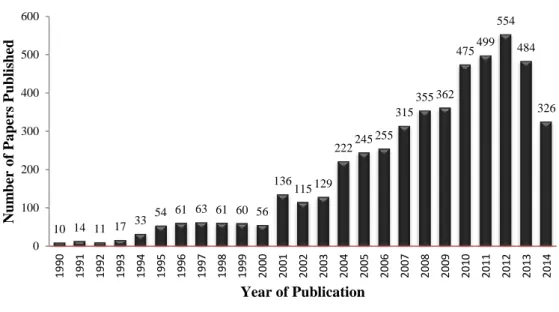
The better quality of electrical power system has become a critical concern for both the utilities and consumers of electricity. For this reason, research in the area of electric Power Quality (PQ) is gaining much interest since the last few decades [1]. PQ has become a significant issue for modern power industry in order to protect the electrical and electronic equipment by identifying the sources of the disturbances and providing a suitable solution to mitigate them [2, 3]. Historically, the increasing research interest in the field of power quality can be observed immediately from Figure 1.1 which shows the statistics of articles published per year indexed by the Scopus database [4] using the exact search phrase power quality in the title of each article. It is obvious that the interest in the field of PQ has increased since the year 2001. The Renewable Energy Sources (RES) and Distributed Generation (DG) systems combined into the power grids utilize power electronic technology which may cause numerous PQ disturbances in the electric power systems. Therefore, further research trend in the field of PQ analysis will be increased in future due to the more applications of the power electronic converters used in RES and DG [5].
The PQ is an active research area consisting of the various components. The main aspects of the PQ research include basic concepts and definitions, simulations and analysis, instrumentation and measurement, causes, effects and solutions of the PQ disturbances [6]. The detection and classification of the PQ problems is necessary
Figure 1.1 Yearly published papers on power quality 10 14 11 17 33 54 61 63 61 60 56 136 115 129 222245 255 315 355 362 475499 554 484 326 0 100 200 300 400 500 600 199 0 199 1 199 2 199 3 199 4 199 5 199 6 199 7 199 8 199 9 200 0 200 1 200 2 200 3 200 4 200 5 200 6 200 7 200 8 200 9 201 0 201 1 201 2 201 3 201 4 Num ber o f P a pers P ub lis hed Year of Publication
in order to find the sources and solutions of the PQ problems. As a result, this research covers the basic concepts and definitions, simulation and analysis and instrumentation and measurement parts of the PQ aspects. The PQ can be guaranteed by monitoring and classifying the disturbances using measurement instruments. The instruments must be able to accumulate enormous quantity of data measurement such as voltages, currents, frequency and disturbance occurrence time duration. Since, the traditional PQ measuring instruments cannot automatically discriminate the PQ disturbances and require offline analysis from the recorded data. Therefore, in this research, the idea of a computational intelligent based instrumentation is suggested to measure the PQ disturbances automatically.
The attempt of PQ definition might be absolutely different in the views of utilities, consumers and equipment suppliers. It is actually a consumer-driven problem, therefore, it can be defined as, “any power problem manifested in voltage, current and/or frequency deviation that gives rise to failure or mal-operation of customer equipment [7]”. The PQ is also an important issue in new, restructured and deregulated power industry. A huge economic loss due to the mal-operation of electronic equipment is one of the most important reasons for the interest in the research of PQ problems [8].
The increasing utilization of the RES and DG technologies is one of the major sources of PQ disturbances in a conventional power system. In general, the main reasons for the PQ disturbances are the enormous implementation of switching equipment, capacitor energization, unbalanced loads, lighting controls, computer and data processing equipment as well as inverters and converters [9]. The PQ disturbances are created from the utilities and the customers driven loads. The customers' loads and equipment that create PQ disturbances consist of power electronic converters, pulse modulated loads, fluorescent and gas discharge lightings, machine drives, certain rotating machines and magnetic circuits based components. The grounding and resonance problems in the utility subsystems of transmission and distribution networks cause PQ disturbances.
In particular, short circuit faults in power distribution network, switching operation of heavy industrial loads and energization of large capacitor banks may cause PQ disturbances. For instance, voltage sag, swell, interruption and transients disturbances [10]. The application of switching devices and loads such as converters and inverters cause steady-state waveform distortion disturbances in voltage and current signals such as Direct Current (DC) offset, harmonics, inter-harmonics, notch and noise. The utilization of the electric arc furnaces create flicker disturbance [11]. Ferro-resonance, transformer energization, or capacitor switching and lightning lead to spikes disturbances. Although the PQ disturbances are created due to the aforementioned types of loads yet these devices are malfunctioning due to the induced PQ disturbances.
The PQ disturbances cause various problems to power utilities and customers; for example, malfunctions, instabilities, short life span and breakdown of electrical equipment. Harmonics disturbances create power losses in transmission lines, power transformers and rotating machines. The most important and the most frequent PQ disturbance is the voltage sag due to short circuits which have a huge economic impact on end users [7].
1.2 Background of Research Studies
In order to maintain the electric PQ in a power system, the sources and causes of the PQ disturbances must be recognized to mitigate them appropriately. The monitoring of PQ disturbances consists of three main stages, namely; i) disturbances data collection, ii) analyses and iii) interpretation of collected data into constructive information. The procedure of data collection is usually accomplished by continuous supervision of voltage and current for an extended period.
The traditional methods of PQ monitoring exercised by the utilities are normally based on visual inspections, which are indeed laborious and time-consuming. Therefore, a highly automated hardware and software based monitoring system is required which can provide sufficient information about whole system, recognize the main sources of the disturbances, search out better solutions and forecast future disturbances. The Artificial Intelligence (AI) and machine learning based techniques provide a better solution of an automatic classification of PQ disturbances to execute the intelligent PQ monitoring instruments in the power system. Therefore, a concentrated research is required for creating intelligent techniques for the PQ monitoring instruments.
In general, the identification of the PQ disturbances involves three steps; signal analysis, feature extraction and disturbance classification. The time and frequency domain information is required to accomplish the classification.
Conventionally, the analysis and interpretation of the PQ disturbances has been carried out manually, which is a difficult task for power engineers [12]. Automatic detection, localization and classification of the PQ disturbances is, therefore, necessary for power engineers to determine the sources and causes of the disturbances. For that reason, it is required to distinguish the type of the disturbances automatically in order to provide an appropriate solution. The recent advances in digital signal-processing and artificial intelligence have made it simple to develop and apply intelligent systems to automatically analyze and interpret raw data into useful information with minimum human intervention [7]. In literature, most of the
researchers have attempted to use efficient and appropriate digital signal-processing and Computational Intelligence (CI) techniques to monitor PQ disturbances continuously and automatically.
1.2.1 Overview of Power Quality Disturbances and Standards
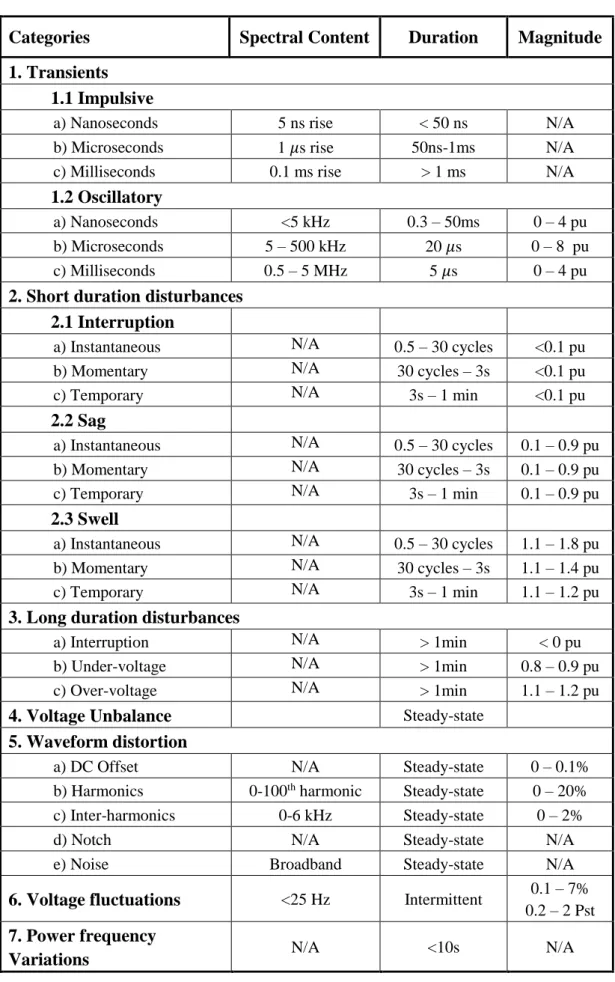
The PQ disturbances are defined as the sudden deviations occurring in the normal power system without interruption of power supply. Occurrences of more than one type of PQ disturbances simultaneously are called multiple PQ disturbances. It is quite necessary to become familiar with the categories and their characteristics for the detection and classification of PQ disturbances. The categories and characteristics of PQ disturbances including spectral content, disturbance duration and magnitude where applicable for each type of disturbance are described in Table 1.1 [7].
There are certain international standards which set the boundaries of PQ disturbance values that are the sources of equipment malfunctioning. The standards consist of the Institute of Electrical and Electronics Engineers (IEEE) standard IEEE 1159-2009 [13], the International Electro-technical Commission (IEC) standard IEC-61000-4-30 [14] and European (EN) Standard EN 50160 [15] which maintain the PQ to an acceptable benchmark. The PQ standards have established the consistent description and electromagnetic phenomena of the PQ disturbances used in the monitoring data. Furthermore, these standards also provide information concerning the nominal operating conditions of the voltage/current supply and their parameters variation within the power supply and the load equipment. Likewise, the selection of the appropriate monitoring instruments, their limitations, application techniques and the interpretation of results have also been illustrated. The IEEE 1159-2009 standard [13] and the European EN 50160 standard [15] classify the PQ disturbances according to thresholds of the Root Mean Square (RMS) values of voltage and current deviations with respect to nominal operating conditions during the time of disturbance.
Table 1.1 : Classification of power quality disturbances
Categories Spectral Content Duration Magnitude 1. Transients
1.1 Impulsive
a) Nanoseconds 5 ns rise < 50 ns N/A
b) Microseconds 1 𝜇s rise 50ns-1ms N/A
c) Milliseconds 0.1 ms rise > 1 ms N/A
1.2 Oscillatory
a) Nanoseconds <5 kHz 0.3 – 50ms 0 – 4 pu
b) Microseconds 5 – 500 kHz 20 𝜇s 0 – 8 pu
c) Milliseconds 0.5 – 5 MHz 5 𝜇s 0 – 4 pu
2. Short duration disturbances 2.1 Interruption
a) Instantaneous N/A 0.5 – 30 cycles <0.1 pu
b) Momentary N/A 30 cycles – 3s <0.1 pu
c) Temporary N/A 3s – 1 min <0.1 pu
2.2 Sag
a) Instantaneous N/A 0.5 – 30 cycles 0.1 – 0.9 pu
b) Momentary N/A 30 cycles – 3s 0.1 – 0.9 pu
c) Temporary N/A 3s – 1 min 0.1 – 0.9 pu
2.3 Swell
a) Instantaneous N/A 0.5 – 30 cycles 1.1 – 1.8 pu
b) Momentary N/A 30 cycles – 3s 1.1 – 1.4 pu
c) Temporary N/A 3s – 1 min 1.1 – 1.2 pu
3. Long duration disturbances
a) Interruption N/A > 1min < 0 pu
b) Under-voltage N/A > 1min 0.8 – 0.9 pu
c) Over-voltage N/A > 1min 1.1 – 1.2 pu
4. Voltage Unbalance Steady-state
5. Waveform distortion
a) DC Offset N/A Steady-state 0 – 0.1%
b) Harmonics 0-100th harmonic Steady-state 0 – 20%
c) Inter-harmonics 0-6 kHz Steady-state 0 – 2%
d) Notch N/A Steady-state N/A
e) Noise Broadband Steady-state N/A
6. Voltage fluctuations <25 Hz Intermittent 0.1 – 7% 0.2 – 2 Pst
7. Power frequency
Variations N/A <10s N/A
Although the IEC 61000-4-30 standard [14] provides some consistent methods for measurement and interpretation of electrical parameters in 50 / 60 Hz power systems. However, the detected PQ disturbances waveforms still require a classifier for the automatic classification in order to protect the equipment of utilities and consumers.
1.2.2 Signal Processing Techniques for Feature Extraction
Feature extraction process contributes a significant role in the automatic detection and classification of PQ disturbances. Each disturbance waveform consists of distinctive features. The extracted features subsequently can be used as the training patterns for the classifiers to complete the classification system of PQ disturbances. The advanced signal-processing techniques are usually concerned with the detection and extraction of features and information from measured discrete signals [16].
The basic signal-processing techniques, which are used for feature extraction of PQ disturbances, consist of Fourier Transform (FT) [17-22], Kalman Filters (KF) [23-26], Wavelet Transform (WT) [10, 27-54], Stockwell Transform (ST) [24, 55-75], Gabor Transform (GT) [76], Hilbert-Huang Transform (HHT) [50, 77-81] and fusion of these transforms. The details of the signal-processing techniques will be discussed in Chapter 2.
1.2.3 Optimization Techniques for Optimal Feature Selection
The performance of the classification tools as well as discovering the distinctive features are equally important in classifying the PQ disturbances. In recent studies, feature selection algorithms have been used to select the most suitable features from a large set of features, whereas to discard the redundant features of the PQ disturbances. The large feature set is extracted from the feature extraction stage, out of which a best suitable feature subset with a high recognition rate has been
selected [52]. The feature selection process is tackled by the evolutionary computation and swarm intelligence based optimization techniques.
The optimization techniques have been proposed in literature for the optimal feature selection and improvement of recognition accuracy. The techniques proposed for the optimal feature selection are Genetic Algorithm (GA) [82], Particle Swarm Optimization (PSO) [83], Simulated Annealing (SA) [49] and Ant Colony Optimization (ACO) [84].
1.2.4 Artificial Intelligence Techniques for Classification
The Artificial Intelligence (AI) can be defined as the computerization of the activities associated with human thinking such as learning from examples, perceptions, reasoning, decision-making and problem solving [12]. The intelligent techniques are required for pattern recognition and decision making. The AI techniques used for the classification of PQ disturbances consist of Artificial Neural Network (ANN) [12, 39, 41, 59, 60, 62, 68, 72, 80, 85-94], Support Vector Machine (SVM) [10, 38, 45, 49, 51-53, 81, 95-97], Fuzzy Logic (FL) [19, 25, 26, 57, 64, 66, 71, 98-103], Neuro-Fuzzy [37, 71, 104-106], Hidden Morkov Model (HMM) [67, 107-109], Nearest Neighbour (NN) [42, 110] and Decision Tree (DT) [66, 70, 111]. The detail of several classification techniques will be explained in Chapter 2.
1.3 Problem Statement
Automatic classification of PQ disturbances is a challenging issue due to a wide range of disturbances and disorders in power system. The classification of the PQ disturbances is a major concern for power engineers. A high level of engineering expertise is required for the proper detection and classification of the PQ disturbances. The conventional methods of PQ disturbances monitoring are usually based on visual inspection. The utilities may not be able to cover huge amount of
records to scrutinize. Therefore, the pressing concern is required to propose a simple and general approach for the automatic classification.
The modern power system can be affected by the multiple PQ disturbances due to the integration of renewable energy sources and power electronics loads. Most of the studies in literature analyse single and only two multiple PQ disturbances using the parametric equations rather than a practical model of any power distribution network. Consequently, the performance of these techniques might be inadequate for the reason that the multiple PQ disturbances in power networks may appear simultaneously.
The feature extraction stage is the critical part due to the fact that the AI classifier system will perform based on the suitable features of the PQ disturbances. The feature extraction technique should reduce the dimension of the original waveform to a lower dimension, consisting of most useful information from the original signal. The WT has the capability to extract the constructive features of both the steady-state and transients PQ disturbance. Despite the fact that the WT is more suitable for the feature extraction of PQ disturbances but the WT alone cannot automatically classify the PQ disturbances. The WT can only detect the disturbances but it cannot accomplish the task of automatic classification without using an appropriate classifier.
Feature selection is one of the main issues among the classification processes. In the existing PQ disturbances classification systems, some essential features have not been taken into account and some nonessential features might be regarded. Therefore, the classification performance is affected due to the unproductive features. In the perspective of this problem, a new optimal feature selection technique based on Artificial Bee Colony (ABC) algorithm has been proposed in this research in order to achieve effective features for improving the classification efficiency as well as to reduce the computational trouble.
1.4 Objectives of Research
Based on the aforementioned problem statement, the main objectives of the proposed research study are as follows:
i. To develop an automatic classification system for the single and multiple PQ disturbances using parametric equations as well as typical distribution models.
ii. To investigate the feature extraction technique using DWT for simplifying and improving the classification system.
iii. To propose a novel optimal feature selection algorithm using ABC in order to enhance efficiency of the PNN classifier and to reduce the computational burden.
1.5 Scope of Research
The main scopes and limitations of the proposed study are as follows:
i. This study covers the basic concepts, simulation and analysis, and instrumentation and measurement aspects of the PQ analysis.
ii. The PQ disturbance data including ten (10) single and six (6) multiple disturbances have been simulated using IEEE standard 1159-2009 [13] based parametric equations as well as typical power distribution networks using MATLAB/Simulink and PSCAD/EMTDC software.
iii. In a normal power system operation, the system voltages and currents are approximately balanced. The IEEE and IEC standards are designed for
the single-phase devices. Thus a single-phase approach is adequate for the analysis.
iv. The DWT based MRA technique is applied for feature extraction. The statistical parameters are calculated from the features of the signals.
v. The Probabilistic Neural Network is used for the automatic classification of PQ disturbances.
vi. The optimal feature selection process is accomplished using the ABC optimization algorithm.
1.6 Significance of Research
The potential practical applications of this research are:
i. The proposed algorithm is simple and could be easily integrated into existing distribution systems.
ii. The continuous monitoring of PQ disturbances has a significant role in order to protect the electrical power system. The various types of faults and events are produced in power system due to the application of power electronic loads and renewable energy sources. The exact cause of the event can be identified, if the PQ disturbance is accurately classified. iii. The extraction of constructive features using a specific classifier is a
problem in the automatic classification of PQ disturbance. The DWT based feature extraction technique is used to reduce the power system signal data.
iv. The optimal feature selection approach is useful to discriminate the essential and non-essential features in order to enhance the classification accuracy of the classifier.
1.7 Organization of Thesis
This thesis is organised into five chapters. The remaining chapters are briefly outlined as follows.
Chapter 2 demonstrates a comprehensive overview of the existing literature. In the literature review a detailed study of the various types of signal-processing techniques, artificial intelligence techniques and optimization techniques which are used in the field of classification of PQ disturbances are discussed.
Chapter 3 provides the methodology for the classification of PQ disturbances. The proposed methodology contains four stages, data generation, feature extraction, feature selection and classification. The parametric equations as well as two 11 kV power distribution network models are developed for PQ data generation. The DWT based MRA is suggested for the feature extraction of the PQ disturbances. The PNN classifier is proposed to evaluate the classification performance of the optimally selected features. The ABC algorithm is proposed for the effective feature selection.
Chapter 4 provides the discussion on results obtained by the proposed methodology. The proposed algorithm is validated using a database of PQ disturbances. The results are obtained using original features and optimal features. The noise corrupted PQ data has been classified using DWT based de-noising technique. The results are also compared with the literature for benchmarking.
Finally, chapter 5 consists of conclusion on the addressed issues and the results of the proposed solutions along with the recommendation for the future work.
REFERENCES
1. Ferreira, D. D., De Seixas, J. M., and Cerqueira, A. S. A method based on independent component analysis for single and multiple power quality disturbance classification. Electric Power Systems Research. 2015. 119(1): 425-431.
2. Chung, I.-Y., Won, D.-J., Kim, J.-M., Ahn, S.-J., and Moon, S.-I. Development of a network-based power quality diagnosis system. Electric Power Systems Research. 2007. 77(8): 1086-1094.
3. Manikandan, M. S., Samantaray, S. R., and Kamwa, I. Detection and Classification of Power Quality Disturbances Using Sparse Signal Decomposition on Hybrid Dictionaries. IEEE Transactions on Instrumentation and Measurement. 2015. 64(1): 27-38.
4. http://www.scopus.com/. accessed on Decmeber 8, 2014
5. Ray, P. K., Mohanty, S. R., and Kishor, N. Classification of Power Quality Disturbances Due to Environmental Characteristics in Distributed Generation System. IEEE Transactions on Sustainable Energy. 2013. 4(2): 302-313. 6. Domijan, A., Heydt, G. T., Meliopoulos, A. P. S., Venkata, S. S., and West,
S. Directions of research on electric power quality. IEEE Transactions on Power Delivery. 1993. 8(1): 429-436.
7. Dugan, R. C., Mcgranaghan, M. F., and Beaty, H. W. Electrical power systems quality. McGraw-Hill New York. 1996
8. Kumar, R., Singh, B., Shahani, D. T., Chandra, A., and Al-Haddad, K. Recognition of Power-Quality Disturbances Using S-Transform-Based ANN Classifier and Rule-Based Decision Tree. IEEE Transactions on Industry Applications. 2015. 51(2): 1249-1258.
9. Bollen, M. H. Understanding power quality problems. New York: IEEE press 2000
10. Eristi, H. and Demir, Y. Automatic classification of power quality events and disturbances using wavelet transform and support vector machines. IET Generation, Transmission & Distribution. 2012. 6(10): 968-976.
11. White, L. W. and Bhattacharya, S. A discrete Matlab–Simulink flickermeter model for power quality studies. IEEE Transactions on Instrumentation and Measurement. 2010. 59(3): 527-533.
12. Monedero, I., Leon, C., Ropero, J., Garcia, A., Elena, J. M., and Montano, J. C. Classification of Electrical Disturbances in Real Time Using Neural Networks. IEEE Transactions on Power Delivery. 2007. 22(3): 1288-1296. 13. Institute of Electrical and Electronics Engineers. IEEE Recommended
Practice for Monitoring Electric Power Quality. New York, USA, IEEE Std 1159-2009. 2009
14. International Electrotechnical Commission. Testing and measurement techniques–Power quality measurement methods. Geneva 20, Switzerland, IEC 61000-4-30. 2003
15. European Standard. Voltage characteristics of electricity supplied by public distribution systems. Brussels Belgium, EN 50160. 2010
16. Mahela, O. P., Shaik, A. G., and Gupta, N. A critical review of detection and classification of power quality events. Renewable and Sustainable Energy Reviews. 2015. 41(1): 495-505.
17. Heydt, G. T., Fjeld, P. S., Liu, C. C., Pierce, D., Tu, L., and Hensley, G. Applications of the windowed FFT to electric power quality assessment. IEEE Transactions on Power Delivery. 1999. 14(4): 1411-1416.
18. Jurado, F. and Saenz, J. R. Comparison between discrete STFT and wavelets for the analysis of power quality events. Electric Power Systems Research. 2002. 62(3): 183-190.
19. Liao, Y. and Lee, J.-B. A fuzzy-expert system for classifying power quality disturbances. International Journal of Electrical Power & Energy Systems. 2004. 26(3): 199-205.
20. Hu, G. S., Zhu, F. F., and Tu, Y. J. Power quality disturbance detection and classification using Chirplet transforms. Simulated Evolution and Learning, Proceedings. 2006. 34-41.
21. Fuchs, E., Trajanoska, B., Orhouzee, S., and Renner, H. Comparison of wavelet and Fourier analysis in power quality. Electric Power Quality and Supply Reliability Conference (PQ), 2012. 2012. 1-7.
22. Latran, M. B. and Teke, A. A novel wavelet transform based voltage sag/swell detection algorithm. International Journal of Electrical Power & Energy Systems. 2015. 71(1): 131-139.
23. Dash, P., Pradhan, A., and Panda, G. Frequency estimation of distorted power system signals using extended complex Kalman filter. IEEE Transactions on Power Delivery. 1999. 14(3): 761-766.
24. Dash, P. K. and Chilukuri, M. V. Hybrid S-transform and Kalman filtering approach for detection and measurement of short duration disturbances in power networks. IEEE Transactions on Instrumentation and Measurement. 2004. 53(2): 588-596.
25. Abdelsalam, A. A., Eldesouky, A. A., and Sallam, A. A. Classification of power system disturbances using linear Kalman filter and fuzzy-expert system. International Journal of Electrical Power & Energy Systems. 2012. 43(1): 688-695.
26. Abdelsalam, A. A., Eldesouky, A. A., and Sallam, A. A. Characterization of power quality disturbances using hybrid technique of linear Kalman filter and fuzzy-expert system. Electric Power Systems Research. 2012. 83(1): 41-50. 27. Santoso, S., Powers, E. J., Grady, W. M., and Hofmann, P. Power quality
assessment via wavelet transform analysis. IEEE Transactions on Power Delivery. 1996. 11(2): 924-930.
28. Heydt, G. T. and Galli, A. W. Transient power quality problems analyzed using wavelets. IEEE Transactions on Power Delivery. 1997. 12(2): 908-915. 29. Santoso, S., Powers, E. J., and Grady, W. Power quality disturbance data compression using wavelet transform methods. IEEE Transactions on Power Delivery. 1997. 12(3): 1250-1257.
30. Angrisani, L., Daponte, P., D'apuzzo, M., and Testa, A. A measurement method based on the wavelet transform for power quality analysis. IEEE Transactions on Power Delivery. 1998. 13(4): 990-998.
31. Gaouda, A. M., Salama, M. M. A., Sultan, M. R., and Chikhani, A. Y. Power quality detection and classification using wavelet-multiresolution signal
decomposition. IEEE Transactions on Power Delivery. 1999. 14(4): 1469-1476.
32. Karimi, M., Mokhtari, H., and Iravani, M. R. Wavelet based on-line disturbance detection for power quality applications. IEEE Transactions on Power Delivery. 2000. 15(4): 1212-1220.
33. Poisson, O., Rioual, P., and Meunier, M. Detection and measurement of power quality disturbances using wavelet transform. IEEE Transactions on Power Delivery. 2000. 15(3): 1039-1044.
34. Santoso, S., Powers, E. J., Grady, W. M., and Parsons, A. C. Power quality disturbance waveform recognition using wavelet-based neural classifier - Part 1: Theoretical foundation. IEEE Transactions on Power Delivery. 2000. 15(1): 222-228.
35. Santoso, S., Powers, E. J., Grady, W. M., and Parsons, A. C. Power quality disturbance waveform recognition using wavelet-based neural classifier - Part 2: application. IEEE Transactions on Power Delivery. 2000. 15(1): 229-235. 36. Haibo, H. and Starzyk, J. A. A self-organizing learning array system for
power quality classification based on wavelet transform. IEEE Transactions on Power Delivery. 2006. 21(1): 286-295.
37. Reaz, M. B. I., Choong, F., Sulaiman, M. S., and Mohd-Yasin, F. Prototyping of wavelet transform, artificial neural network and fuzzy logic for power quality disturbance classifier. Electric Power Components and Systems. 2007. 35(1): 1-17.
38. Hu, G.-S., Zhu, F.-F., and Ren, Z. Power quality disturbance identification using wavelet packet energy entropy and weighted support vector machines. Expert Systems with Applications. 2008. 35(1): 143-149.
39. Kaewarsa, S., Attakitmongcol, K., and Kulworawanichpong, T. Recognition of power quality events by using multiwavelet-based neural networks. International Journal of Electrical Power & Energy Systems. 2008. 30(4): 254-260.
40. Uyar, M., Yildirim, S., and Gencoglu, M. T. An effective wavelet-based feature extraction method for classification of power quality disturbance signals. Electric Power Systems Research. 2008. 78(10): 1747-1755.
41. Oleskovicz, M., Coury, D. V., Felho, O. D., Usida, W. F., Carneiro, A. a. F. M., and Pires, L. R. S. Power quality analysis applying a hybrid methodology
with wavelet transforms and neural networks. International Journal of Electrical Power & Energy Systems. 2009. 31(5): 206-212.
42. Panigrahi, B. K. and Pandi, V. R. Optimal feature selection for classification of power quality disturbances using wavelet packet-based fuzzy k-nearest neighbour algorithm. IET Generation, Transmission & Distribution. 2009. 3(3): 296-306.
43. Erişti, H. and Demir, Y. A new algorithm for automatic classification of power quality events based on wavelet transform and SVM. Expert Systems with Applications. 2010. 37(6): 4094-4102.
44. Masoum, M. a. S., Jamali, S., and Ghaffarzadeh, N. Detection and classification of power quality disturbances using discrete wavelet transform and wavelet networks. IET Science, Measurement & Technology 2010. 4(4): 193-205.
45. Moravej, Z., Abdoos, A. A., and Pazoki, M. Detection and Classification of Power Quality Disturbances Using Wavelet Transform and Support Vector Machines. Electric Power Components and Systems. 2010. 38(2): 182-196. 46. Kapoor, R. and Gupta, R. Statistically matched wavelet-based method for
detection of power quality events. International Journal of Electronics. 2011. 98(1): 109-127.
47. Wang, M.-H. and Tseng, Y.-F. A novel analytic method of power quality using extension genetic algorithm and wavelet transform. Expert Systems with Applications. 2011. 38(10): 12491-12496.
48. Barros, J., Diego, R. I., and De Apráiz, M. Applications of wavelets in electric power quality: Voltage events. Electric Power Systems Research. 2012. 88(1): 130-136.
49. Manimala, K., Selvi, K., and Ahila, R. Optimization techniques for improving power quality data mining using wavelet packet based support vector machine. Neurocomputing. 2012. 77(1): 36-47.
50. Tse, N. C. F., Chan, J. Y. C., Lau, W.-H., and Lai, L. L. Hybrid Wavelet and Hilbert Transform With Frequency-Shifting Decomposition for Power Quality Analysis. IEEE Transactions on Instrumentation and Measurement. 2012. 61(12): 3225-3233.
51. Zhang, M., Li, K., and Hu, Y. Classification of power quality disturbances using wavelet packet energy and multiclass support vector machine.
Compel-the International Journal for Computation and MaCompel-thematics in Electrical and Electronic Engineering. 2012. 31(2): 424-442.
52. Erişti, H., Yıldırım, Ö., Erişti, B., and Demir, Y. Optimal feature selection for classification of the power quality events using wavelet transform and least squares support vector machines. International Journal of Electrical Power & Energy Systems. 2013. 49(1): 95-103.
53. De Yong, D., Bhowmik, S., and Magnago, F. An effective Power Quality classifier using Wavelet Transform and Support Vector Machines. Expert Systems with Applications. 2015. 42(1):
54. Kanirajan, P. and Kumar, V. S. Power Quality Disturbance Detection and Classification using Wavelet and RBFNN. Applied Soft Computing. 2015. 35(1): 470-481.
55. Dash, P. K., Panigrahi, K. B., and Panda, G. Power quality analysis using S-transform. IEEE Transactions on Power Delivery. 2003. 18(2): 406-411. 56. Lee, I. W. C. and Dash, P. K. S-transform-based intelligent system for
classification of power quality disturbance signals. IEEE Transactions on Industrial Electronics. 2003. 50(4): 800-805.
57. Chilukuri, M. V. and Dash, P. K. Multiresolution S-transform-based fuzzy recognition system for power quality events. IEEE Transactions on Power Delivery. 2004. 19(1): 323-330.
58. Fengzhan, Z. and Rengang, Y. Power-Quality Disturbance Recognition Using S-Transform. IEEE Transactions on Power Delivery. 2007. 22(2): 944-950. 59. Bhende, C., Mishra, S., and Panigrahi, B. Detection and classification of
power quality disturbances using S-transform and modular neural network. Electric Power Systems Research. 2008. 78(1): 122-128.
60. Mishra, S., Bhende, C. N., and Panigrahi, K. B. Detection and Classification of Power Quality Disturbances Using S-Transform and Probabilistic Neural Network. IEEE Transactions on Power Delivery. 2008. 23(1): 280-287. 61. Nguyen, T. and Liao, Y. Power quality disturbance classification utilizing
S-transform and binary feature matrix method. Electric Power Systems Research. 2009. 79(4): 569-575.
62. Uyar, M., Yildirim, S., and Gencoglu, M. T. An expert system based on S-transform and neural network for automatic classification of power quality disturbances. Expert Systems with Applications. 2009. 36(3): 5962-5975.
63. Xiao, X., Xu, F., and Yang, H. Short duration disturbance classifying based on S-transform maximum similarity. International Journal of Electrical Power & Energy Systems. 2009. 31(7–8): 374-378.
64. Behera, H., Dash, P., and Biswal, B. Power quality time series data mining using S-transform and fuzzy expert system. Applied Soft Computing. 2010. 10(3): 945-955.
65. Moravej, Z., Abdoos, A. A., and Pazoki, M. New Combined S-transform and Logistic Model Tree Technique for Recognition and Classification of Power Quality Disturbances. Electric Power Components and Systems. 2011. 39(1): 80-98.
66. Biswal, B., Behera, H. S., Bisoi, R., and Dash, P. K. Classification of power quality data using decision tree and chemotactic differential evolution based fuzzy clustering. Swarm and Evolutionary Computation. 2012. 4(1): 12-24. 67. Hasheminejad, S., Esmaeili, S., and Jazebi, S. Power Quality Disturbance
Classification Using S-transform and Hidden Markov Model. Electric Power Components and Systems. 2012. 40(10): 1160-1182.
68. Huang, N., Xu, D., Liu, X., and Lin, L. Power quality disturbances classification based on S-transform and probabilistic neural network. Neurocomputing. 2012. 98(1): 12-23.
69. Rodríguez, A., Aguado, J. A., Martín, F., López, J. J., Muñoz, F., and Ruiz, J. E. Rule-based classification of power quality disturbances using S-transform. Electric Power Systems Research. 2012. 86(1): 113-121.
70. Biswal, M. and Dash, P. Detection and characterization of multiple power quality disturbances with a fast S-transform and decision tree based classifier. Digital Signal Processing. 2013. 23(4): 1071-1083.
71. Biswal, M. and Dash, P. K. Measurement and Classification of Simultaneous Power Signal Patterns With an S-Transform Variant and Fuzzy Decision Tree. IEEE Transactions on Industrial Informatics. 2013. 9(4): 1819-1827. 72. Jashfar, S., Esmaeili, S., Zareian-Jahromi, M., and Rahmanian, M.
Classification of power quality disturbances using S-transform and TT-transform based on the artificial neural network. Turkish Journal of Electrical Engineering and Computer Sciences 2013. 21(6): 1528-1538.
73. Reddy, M. J. B., Raghupathy, R. K., Venkatesh, K. P., and Mohanta, D. K. Power quality analysis using Discrete Orthogonal S-transform (DOST). Digital Signal Processing. 2013. 23(2): 616-626.
74. Shunfan, H., Kaicheng, L., and Ming, Z. A Real-Time Power Quality Disturbances Classification Using Hybrid Method Based on S-Transform and Dynamics. IEEE Transactions on Instrumentation and Measurement. 2013. 62(9): 2465-2475.
75. Erişti, H., Yıldırım, Ö., Erişti, B., and Demir, Y. Automatic recognition system of underlying causes of power quality disturbances based on S-Transform and Extreme Learning Machine. International Journal of Electrical Power & Energy Systems. 2014. 61(1): 553-562.
76. Qian, S. and Chen, D. Discrete gabor transform. IEEE Transactions on Signal Processing. 1993. 41(7): 2429-2438.
77. Messina, A. R. and Vittal, V. Nonlinear, non-stationary analysis of interarea oscillations via Hilbert spectral analysis. IEEE Transactions on Power Systems. 2006. 21(3): 1234-1241.
78. Shukla, S., Mishra, S., and Singh, B. Empirical-Mode Decomposition With Hilbert Transform for Power-Quality Assessment. IEEE Transactions on Power Delivery. 2009. 24(4): 2159-2165.
79. Jayasree, T., Devaraj, D., and Sukanesh, R. Power quality disturbance classification using Hilbert transform and RBF networks. Neurocomputing. 2010. 73(7-9): 1451-1456.
80. Manjula, M., Mishra, S., and Sarma, A. V. R. S. Empirical mode decomposition with Hilbert transform for classification of voltage sag causes using probabilistic neural network. International Journal of Electrical Power & Energy Systems. 2013. 44(1): 597-603.
81. Foroughi, A., Mohammadi, E., and Esmaeili, S. Application of Hilbert-Huang transform and support vector machine for detection and classification of voltage sag sources. Turkish Journal of Electrical Engineering and Computer Sciences. 2014. 22(5): 1116-1129.
82. Ray, P. K., Mohanty, S. R., Kishor, N., and Catalao, J. P. S. Optimal Feature and Decision Tree-Based Classification of Power Quality Disturbances in Distributed Generation Systems. IEEE Transactions on Sustainable Energy. 2014. 5(1): 200-208.
83. Ahila, R., Sadasivam, V., and Manimala, K. An integrated PSO for parameter determination and feature selection of ELM and its application in classification of power system disturbances. Applied Soft Computing. 2015. 32(1): 23-37.
84. Biswal, B., Dash, P. M., and Mishra, S. A hybrid ant colony optimization technique for power signal pattern classification. Expert Systems with Applications. 2011. 38(5): 6368-6375.
85. Ghosh, A. K. and Lubkeman, D. L. The classification of power system disturbance waveforms using a neural network approach. IEEE Transactions on Power Delivery. 1995. 10(1): 109-115.
86. Meher, S., Pradhan, A., and Panda, G. An integrated data compression scheme for power quality events using spline wavelet and neural network. Electric Power Systems Research. 2004. 69(2): 213-220.
87. Zwe-Lee, G. Wavelet-based neural network for power disturbance recognition and classification. IEEE Transactions on Power Delivery. 2004. 19(4): 1560-1568.
88. Dash, P. K., Nayak, M., Senapati, M. R., and Lee, I. W. Mining for similarities in time series data using wavelet-based feature vectors and neural networks. Engineering Applications of Artificial Intelligence. 2007. 20(2): 185-201.
89. Zhengyou, H., Shibin, G., Xiaoqin, C., Jun, Z., Zhiqian, B., and Qingquan, Q. Study of a new method for power system transients classification based on wavelet entropy and neural network. International Journal of Electrical Power & Energy Systems. 2011. 33(3): 402-410.
90. He, Z., Zhang, H., Zhao, J., and Qian, Q. Classification of power quality disturbances using quantum neural network and DS evidence fusion. European Transactions on Electrical Power. 2012. 22(4): 533-547.
91. Liu, Z., Zhang, Q., Han, Z., and Chen, G. A new classification method for transient power quality combining spectral kurtosis with neural network. Neurocomputing. 2014. 125(1):
92. Naik, C. A. and Kundu, P. Power quality disturbance classification employing S-transform and three-module artificial neural network. International Transactions on Electrical Energy Systems. 2014. 24(9): 1301-1322.
93. Valtierra-Rodriguez, M., De Jesus Romero-Troncoso, R., Osornio-Rios, R. A., and Garcia-Perez, A. Detection and Classification of Single and Combined Power Quality Disturbances Using Neural Networks. IEEE Transactions on Industrial Electronics. 2014. 61(5): 2473-2482.
94. Barros, A. C., Tonelli-Neto, M. S., Decanini, J. G. M. S., and Minussi, C. R. Detection and Classification of Voltage Disturbances in Electrical Power Systems Using a Modified Euclidean ARTMAP Neural Network with Continuous Training. Electric Power Components and Systems. 2015. 43(19): 1-11.
95. Ekici, S. Classification of power system disturbances using support vector machines. Expert Systems with Applications. 2009. 36(6): 9859-9868.
96. Eristi, H., Ucar, A., and Demir, Y. Wavelet-based feature extraction and selection for classification of power system disturbances using support vector machines. Electric Power Systems Research. 2010. 80(7): 743-752.
97. Biswal, B., Biswal, M. K., Dash, P. K., and Mishra, S. Power quality event characterization using support vector machine and optimization using advanced immune algorithm. Neurocomputing. 2013. 103(1): 75-86.
98. Dash, P. K., Mishra, S., Salama, M. M. A., and Liew, A. C. Classification of power system disturbances using a fuzzy expert system and a Fourier linear combiner. IEEE Transactions on Power Delivery. 2000. 15(2): 472-477. 99. Zhu, T. X., Tso, S. K., and Lo, K. L. Wavelet-based fuzzy reasoning
approach to power-quality disturbance recognition. IEEE Transactions on Power Delivery. 2004. 19(4): 1928-1935.
100. Biswal, B., Dash, P., and Panigrahi, B. Power quality disturbance classification using fuzzy C-means algorithm and adaptive particle swarm optimization. IEEE Transactions on Industrial Electronics. 2009. 56(1): 212-220.
101. Hooshmand, R. and Enshaee, A. Detection and classification of single and combined power quality disturbances using fuzzy systems oriented by particle swarm optimization algorithm. Electric Power Systems Research. 2010. 80(12): 1552-1561.
102. Meher, S. K. and Pradhan, A. K. Fuzzy classifiers for power quality events analysis. Electric Power Systems Research. 2010. 80(1): 71-76.
103. Decanini, J. G. M. S., Tonelli-Neto, M. S., Malange, F. C. V., and Minussi, C. R. Detection and classification of voltage disturbances using a Fuzzy-ARTMAP-wavelet network. Electric Power Systems Research. 2011. 81(12): 2057-2065.
104. Jiansheng, H., Negnevitsky, M., and Nguyen, D. T. A neural-fuzzy classifier for recognition of power quality disturbances. IEEE Transactions on Power Delivery. 2002. 17(2): 609-616.
105. Liao, C.-C. and Yang, H.-T. Recognizing Noise-Influenced Power Quality Events With Integrated Feature Extraction and Neuro-Fuzzy Network. IEEE Transactions on Power Delivery. 2009. 24(4): 2132-2141.
106. Pires, V. F., Amaral, T. G., and Martins, J. F. Power quality disturbances classification using the 3-D space representation and PCA based neuro-fuzzy approach. Expert Systems with Applications. 2011. 38(9): 11911-11917. 107. Chung, J., Powers, E. J., Grady, W. M., and Bhatt, S. C. Power disturbance
classifier using a rule-based method and wavelet packet-based hidden Markov model. IEEE Transactions on Power Delivery. 2002. 17(1): 233-241. 108. Abdel-Galil, T., El-Saadany, E. F., Youssef, A. M., and Salama, M. M. A. Disturbance classification using Hidden Markov Models and vector quantization. IEEE Transactions on Power Delivery. 2005. 20(3): 2129-2135. 109. Dehghani, H., Vahidi, B., Naghizadeh, R. A., and Hosseinian, S. H. Power quality disturbance classification using a statistical and wavelet-based Hidden Markov Model with Dempster–Shafer algorithm. International Journal of Electrical Power & Energy Systems. 2013. 47(1): 368-377.
110. Gaouda, A., Kanoun, S., and Salama, M. On-line disturbance classification using nearest neighbor rule. Electric Power Systems Research. 2001. 57(1): 1-8.
111. Babu, P. R., Dash, P. K., Swain, S. K., and Sivanagaraju, S. A new fast discrete S-transform and decision tree for the classification and monitoring of power quality disturbance waveforms. International Transactions on Electrical Energy Systems. 2014. 24(9): 1279-1300.
112. Hajian, M. and Akbari Foroud, A. A new hybrid pattern recognition scheme for automatic discrimination of power quality disturbances. Measurement. 2014. 51(1): 265-280.