POUR L'OBTENTION DU GRADE DE DOCTEUR ÈS SCIENCES
acceptée sur proposition du jury: Prof. V. Cevher, président du jury
Prof. B. Falsafi, Prof. B. R. Grot, directeurs de thèse Prof. J. Emer, rapporteur
Prof. A. Seznec, rapporteur Prof. P. Ienne, rapporteur
THÈSE N
O6669 (2015)
ÉCOLE POLYTECHNIQUE FÉDÉRALE DE LAUSANNE
PRÉSENTÉE LE 3 SEPTEMBRE 2015À LA FACULTÉ INFORMATIQUE ET COMMUNICATIONS LABORATOIRE D'ARCHITECTURE DE SYSTÈMES PARALLÈLES PROGRAMME DOCTORAL EN INFORMATIQUE ET COMMUNICATIONS
Suisse PAR
First and foremost, I would like to thank my parents, Nadide and Fatih, for valuing my edu-cation more than anything else and always giving me and my sister the highest priority in their lives. Since my childhood, my parents have always broadened my horizons, set the next challenging goal for me to achieve and then endlessly supported me to achieve the goals that I set for myself as I grew up. They tirelessly put up with my whining without a single complaint and supported me whenever I was lacking confidence and afraid that I was going to fail. I could not have asked for any better parents and I will always feel in debt to them. My sister, Duygu, has always been a source of joy for me since the day she was born. Along with my parents, she is my biggest supporter. I will always be proud to be part of this great team of four.
I would like to thank Babak Falsafi, my advisor, for giving me the opportunity to start this journey. I learned countless things from Babak throughout this journey, the most important being perfectionism. Babak always seeks the very best both at work and in life, never settles for mediocre things, and always has the passion and excitement to motivate people around him to work to achieve the perfect. I will always try to emulate his perfectionism for the rest of my life. I hope, one day, I will be able to achieve his level of perfectionism. Thank you, Babak, for your support and every single bit you have taught me.
Boris Grot, my co-advisor, has been a source of inspiration for me. Although I met Boris half way through my PhD journey, I have incredibly benefited from his knowledge and experience. Working with Boris has always been a pleasure as he is always excited about discovering new
things and pursuing new directions fearlessly. I will always try to emulate his positiveness, friendliness and excitement for the rest of my life.
I would like to thank Joel Emer, Andre Seznec and Paolo Ienne for serving on my thesis committee. Their feedback and suggestions improved this thesis tremendously.
Mike Ferdman, as the most senior member of the group at the time of my arrival at EPFL, was my guide to grad school. Mike tirelessly tried to convey his knowledge to me and was always there to answer my questions and brainstorm with me. He taught me countless things ranging from systems programming to paper writing. I would like to thank Mike for being so patient, willing to teach, and holding my hand in the first few years of this journey. And of course, thanks for being a great friend and entertaining me during Onur’s absences, along with Alisa.
Djordje Jevdjic and Stavros Volos have been great classmates, collaborators, friends, and travel companions. These two guys were always there to help me whenever I needed them, have endless discussions about research, politics and everything else and go for beer. As a group of four, we shared so many fun moments both at work and outside work that I will never forget. Javier Picorel, the latest addition to the team, brought along more fun. This journey would not have been so much fun without these three guys. They will always remain as my brothers.
I would like to thank every single member of the PARSA group, Sotiria Fytraki, Pejman Lotfi-Kamran, Almutaz Adileh, Evangelos Vlachos, Jennifer Sartor, Alexandros Daglis, Stanko No-vakovic, Yorgos Psaropoulos, Nooshin Mirzadeh, Mario Drumond, Dmitrii Ustiugov and Nancy Chong, for their friendship and contributions to this long journey in various ways. I will always miss the PARSA spirit; the unconditional help and support. A special member of the PARSA group, Effi Georgala, has been a great friend to chat about girlie books, fashion, food and many other things. I would like to thank Effi for being such an intimate friend and introducing me to the nitty-gritty of phonetics. Special thanks to Damien Hilloulin for translating the abstract of this thesis into French. Many thanks to Stephanie Baillargues and Valerie Locca for taking
care of all the administrative work. Thanks to Rodolphe Buret for express technical support whenever needed.
I am grateful to Oguz Ergin, my undergrad advisor, for making me like computer architec-ture and supervising my senior project, which in turn led me to pursue a PhD in computer architecture. I would like to thank Oguz for his continuous support and friendship since my undergrad years.
During my six years in Lausanne, the Turkish gang has been my only connection to Turkey and the Turkish culture. I was extremely lucky to have Duygu Ceylan and Pinar Tozun as my closest Turkish friends in Lausanne. I would like to thank Duygu and Pinar for their close friendship and hospitality, the Turkish meals and parties we had together. Baris Can Kasikci and Kerem Kapucu brothers were the source of ceaseless laughter and fun nights. I will really miss this very special group of people.
Last but not least, I would like to thank Onur Kocberber, for always being there for me. I would not have been able to make it this far, if I had not had Onur’s full support from the beginning till the end. Onur has been an excellent collaborator, lab-mate, friend, and travel companion throughout this journey. Most importantly, I could not have asked for a better partner than Onur. I feel very lucky that our ways crossed long before this journey, we finished this journey and will be moving on to new journeys together.
I am grateful to IBM and Google for valuing my research and supporting me with an IBM PhD fellowship and Google Anita Borg scholarship.
Instruction-supply mechanisms, namely the branch predictors and instruction prefetchers, exploit recurring control flow in an application to predict the application’s future control flow and provide the core with a useful instruction stream to execute in a timely manner. Con-sequently, instruction-supply mechanisms aggressively incorporate control-flow condition, target, and instruction cache access information (i.e., control-flow metadata) to improve performance. Despite their high accuracy, thus performance benefits, these predictors lead to major silicon provisioning due to their metadata storage overhead. The storage overhead is further aggravated by the increasing core counts and more complex software stacks leading to major metadata redundancy: (i) across cores as the metadata of cores running a given server workload significantly overlap, (ii) within a core as the control-flow metadata maintained by disparate instruction-supply mechanisms overlap significantly.
In this thesis, we identify the sources of redundancy in the instruction-supply metadata and provide mechanisms to share metadata across cores and unify metadata for disparate instruction-supply mechanisms. First, homogeneous server workloads running on many cores allow for metadata sharing across cores, as each core executes the same types of requests and exhibits the same control flow. Second, the control-flow metadata maintained by individual instruction-supply mechanisms, despite being at different granularities (i.e., instruction vs. instruction block), overlap significantly, allowing for unifying their metadata. Building on these two observations, we eliminate the storage overhead stemming from metadata redun-dancy in manycore server processors through a specialized shared frontend, which enables sharing metadata across cores and unifying metadata within a core without sacrificing the performance benefits provided by private and disparate instruction-supply mechanisms.
Key words: server workloads, manycore server processors, instructions, prefetching, branch prediction, shared predictor metadata.
Les structures d’approvisionnement en instructions, à savoir les prédicteurs de branchement et les prefetchers d’instructions, exploitent les flux de contrôle récurrent dans une application pour prédire le flux de contrôle futur et ainsi fournir à temps au cœur du processeur un flux d’instructions utiles. Par conséquent, ces mécanismes intègrent des informations sur le flot de contrôle tels que les conditions, la cible, et l’accès au cache d’instructions (c’est à dire, des métadonnées sur le flot de contrôle) pour améliorer les performances. En dépit de leur grande précision, améliorant ainsi les performances, ces prédicteurs nécessitent beaucoup de place et de silicium à cause de la taille de ces métadonnées. Cela est encore aggravé par l’augmentation constante du nombre de cœurs dans les processeurs et de la complexité des piles logicielles, amenant à des métadonnées de plus en plus redondantes : (i) entre les cœurs car les métadonnées des cœurs exécutant une même application serveur donnée se recoupent de façon significative, (ii) dans chaque cœur car les métadonnées stockées par les différentes structures sont elles aussi très redondantes.
Dans ce travail, nous identifions les sources de redondance dans les métadonnées et four-nissons des mécanismes pour partager celles-ci entre les cœurs et au sein du même cœur entre des structures disparates. Tout d’abord, nous observons que les applications serveur homogènes s’exécutant sur un processeur comportant de nombreux cœurs permettent le partage des métadonnées entre les cœurs, étant donné que chaque cœur exécute les mêmes types de requêtes et suit le même flux de contrôle. Deuxièmement, nous observons que les mé-tadonnées sur le flux de contrôle maintenues individuellement par les différentes structures, en dépit d’être à différentes granularités (instruction versus blocs d’instructions par exemple), se chevauchent de façon significative, ce qui permet de les rassembler. En s’appuyant sur
ces deux observations, nous minimisons le coût de stockage découlant de la redondance des métadonnées dans les processeurs multi-cœurs pour serveurs en partageant ces métadonnées entre les cœurs et au sein d’un même cœur entre les différentes structures, sans pour autant sacrifier les gains associés à l’utilisation de structures privées et spécialisées.
Mots clefs : applications serveur, processeurs serveur multi-cœurs, instructions, prefetching, prédiction de branchement, prédicteur à métadonnées partagées.
Acknowledgements i
Abstract (English/Français) v
List of figures xiii
List of tables xv
1 Introduction 1
1.1 Instruction Supply in Servers . . . 3
1.2 Thesis and Dissertation Goals . . . 7
1.3 Shared Instruction Streaming Metadata . . . 7
1.4 Unifying Instruction Streaming with BTB . . . 8
1.5 Contributions . . . 9
2 Why a Specialized Processor with a Shared Frontend? 11 2.1 Server Workloads and Processors . . . 11
2.1.1 Common Microarchitectural Characteristics of Server Workloads . . . . 12
2.1.2 Specialized Server Processors . . . 13
2.2 Frontend Metadata Overhead and Commonality . . . 15
2.2.1 Instruction Streaming . . . 17
2.2.2 Branch Predictors . . . 21
2.3 Exploiting Metadata Commonality for Shared Frontend . . . 29
3 SHIFT: A Design for Sharing Instruction Streaming Metadata 31
3.1 SHIFT with Dedicated History Storage . . . 33
3.2 Virtualized SHIFT . . . 36
3.3 SHIFT Design for Workload Consolidation . . . 41
3.4 Methodology . . . 41
3.5 Evaluation . . . 44
3.5.1 Temporal Stream Lengths . . . 44
3.5.2 Instruction Miss Coverage . . . 45
3.5.3 Performance Comparison . . . 47
3.5.4 LLC Overheads . . . 49
3.5.5 Workload Consolidation . . . 50
3.5.6 Performance Density Implications . . . 51
3.5.7 Power Implications . . . 52
3.6 Discussions . . . 53
3.6.1 Choice of History Generator Core . . . 53
3.6.2 Virtualized PIF . . . 53
3.7 Concluding Remarks . . . 54
4 Confluence: Unifying Instruction-Supply Metadata 55 4.1 Performance Limitations and Area Overheads of Instruction-Supply Mechanisms 57 4.1.1 Conventional Instruction-Supply Path . . . 57
4.1.2 Covering L1-I Misses with Stream-Based Prefetching . . . 59
4.1.3 Putting It All Together . . . 60
4.2 Confluence Design . . . 62
4.2.1 AirBTB Organization . . . 64
4.2.2 AirBTB Insertions and Replacements . . . 65
4.2.3 AirBTB Operation . . . 66
4.2.4 Prefetcher Microarchitecture . . . 67
4.3.1 Baseline System Configuration . . . 68
4.3.2 Instruction-Supply Mechanisms . . . 70
4.4 Evaluation . . . 73
4.4.1 Distribution of Branch Types . . . 73
4.4.2 Branch Density in Cache Blocks . . . 74
4.4.3 AirBTB Miss Coverage . . . 75
4.4.4 Dissecting the AirBTB Benefits . . . 77
4.4.5 Competitive BTB Miss Coverage Comparison . . . 78
4.4.6 Competitive Performance Comparison . . . 79
4.4.7 Performance and Area Comparison . . . 82
4.4.8 Performance Benefits without Prefetching . . . 83
4.5 Concluding Remarks . . . 83
5 Related Work 85 5.1 Sharing Core Resources Across Hardware Contexts . . . 85
5.2 Instruction Prefetching . . . 86 5.2.1 Next-Line Prefetchers . . . 86 5.2.2 Discontinuity Prefetcher . . . 87 5.2.3 Branch-Predictor-Directed Prefetchers . . . 87 5.2.4 Speculative-Thread Prefetchers . . . 88 5.2.5 Instruction Streaming . . . 88 5.2.6 Computation Spreading . . . 89
5.2.7 Batching & Time Multiplexing Similar Computations . . . 90
5.2.8 Compiler-Based Techniques . . . 90
5.3 Branch Target Buffer . . . 91
5.3.1 Alternative BTB Organizations . . . 91
5.3.2 Next Cache Line and Set Prediction . . . 92
5.3.3 Compression Techniques . . . 93
5.3.5 Prefetching BTB Metadata . . . 94 5.3.6 Synchronizing Predictor and Cache Content . . . 95
6 Concluding Remarks 97
6.1 Thesis Summary . . . 97 6.2 Future Directions . . . 98
Bibliography 103
2.1 Temporal instruction stream example. . . 17 2.2 PIF’s miss coverage as a function of dedicated history size. . . 18 2.3 Comparison of PIF area overhead and performance improvement for various
core types. . . 20 2.4 Target address prediction of a branch instruction in BTB. . . 22 2.5 BTB MPKI as a function of BTB capacity (in K entries). . . 24 2.6 TAGE branch predictor with a base bimodal predictor and N tagged tables. . . . 26 2.7 TAGE mispredictions per kilo instructions (MPKI) for various TAGE configurations. 28 2.8 TAGE misprediction rate when a 60KB TAGE table is shared across 16 cores
compared to per-core 60KB TAGE. . . 29
3.1 SHIFT’s logical components and data flow to record temporal instruction streams. 34 3.2 SHIFT’s logical components and data flow to replay temporal instruction streams. 35 3.3 SHIFT’s virtualized history and data flow to record temporal instruction streams.
Virtualized history components (index pointers and shared history buffer) are shaded in the LLC. . . 38 3.4 SHIFT’s virtualized history and data flow to replay temporal instruction streams.
Virtualized history components (index pointers and shared history buffer) are shaded in the LLC. . . 39 3.5 Comparison of temporal stream lengths in PIF and SHIFT histories and their
contribution to correct predictions. . . 44 3.6 Percentage of instruction misses predicted. . . 45
3.7 Percentage of instruction misses covered and overpredicted. . . 46
3.8 Performance comparison with a mesh on-chip interconnect. . . 47
3.9 Performance comparison with a crossbar on-chip interconnect. . . 48
3.10 LLC traffic overhead. . . 50
3.11 Speedup for workload consolidation. . . 51
4.1 Relative performance and area overhead of various instruction-supply mecha-nisms. . . 61
4.2 High-level organization of cores around (a) disparate BTB and L1-I prefetcher metadata (b) Confluence with unified and shared prefetcher metadata. . . 62
4.3 Core frontend organization and instruction flow. . . 63
4.4 AirBTB organization. . . 64
4.5 Distribution of dynamic branches according to their target address types. . . . 73
4.6 Density of static and dynamic branches in the demand-fetched instruction cache blocks (The numbers on top of the bars represent the average values). . . 74
4.7 Miss coverage for various AirBTB configurations over a 1K-entry conventional BTB (B = branch entries in a bundle, OB = branch entries in the overflow buffer). 75 4.8 Breakdown of AirBTB miss coverage benefits over 1K-entry conventional BTB. . 77
4.9 PhantomBTB, AirBTB and 16K-entry conventional BTB miss coverages over a 1K-entry conventional BTB. . . 78
4.10 PhantomBTB, Confluence and 16K-entry conventional BTB speedup compari-son over 1K-entry conventional BTB with SHIFT for a 16-core CMP with a mesh on-chip interconnect. . . 80
4.11 PhantomBTB, Confluence and 16K-entry conventional BTB speedup compar-ison over 1K-entry conventional BTB with SHIFT for a 16-core CMP with a crossbar on-chip interconnect. . . 81
4.12 Confluence performance benefits and area savings compared to other design points. . . 82
2.1 Server workload parameters. . . 16
2.2 Instruction cache accesses within common temporal streams. . . 21
2.3 BTB MPKI when 16 cores share a 32K-entry BTB compared to private 32K-entry BTB. . . 25
2.4 Total storage capacities required for various TAGE configurations. . . 27
3.1 Parameters of the server architecture evaluated. . . 42
Servers power today’s information-centric world. Server workloads include but are not limited to business analytics, online transaction processing, media streaming and web search. The steadily increasing demand for these services from their global user base mandates constant performance increase in servers.
While the demand for server performance continues to grow, the breakdown of Dennard scaling (i.e., the ability to increase performance per unit area while keeping power density constant) has put an end to the continuous performance increase with each new technology node [24, 32]. As a result, improving efficiency has become the primary challenge in meeting the ever-increasing performance requirements of server processors. Consequently, both prior research and industry efforts have attempted to address the inefficiencies stemming from the mismatch between what server workloads demand and what commodity server processors provide.
Existing server chips from the major processor vendors, Intel and AMD, rely on architectures developed for the general-purpose market, with only minor modifications to the cache hi-erarchy to accommodate larger working sets in server workloads. These general-purpose commodity processors are typically designed for computation-intensive desktop and engi-neering workloads, featuring only a handful of wide-issue and high-frequency cores. An
important class of emerging server workloads, however, spend most of their execution time waiting for memory while performing pointer chasing and exhibit moderate computational intensity, while enjoying abundant request-level parallelism [21, 26, 53], similar to conven-tional database workloads such as transaction processing and data analytics [2, 45, 63, 82]. As a result, server workloads severely underutilize the computation resources in general-purpose processors, leading to extreme inefficiency.
To maximize the throughput within a given area and power budget, recent research has advocated the use of processors with many cores that are specialized to match the minimal computation needs of server workloads without sacrificing single-threaded performance, just a few MBs of on-chip cache to maintain only the shared instruction working set (due to low on-chip data reuse) and a specialized on-chip interconnect to provide fast access from cores to the instructions in the shared cache, essentially streamlining the instruction-supply path [17, 29, 53].
Even after these first steps of specialization to improve server efficiency, there is still much more room for improvement in the specialized server design space to optimize the instruction-supply path, which is overwhelmed by the large instruction working sets of server workloads. We observe that server workloads are homogeneous, meaning that each core executes the same types of tasks as all the other cores running the same workload. However, all cores are treated as standalone IP blocks, without taking into account the homogeneity of a given server workload. This results in abundant redundancy in the overall chip stemming from the same control-flow information being maintained privately in each core’s instruction-supply path. Therefore, instruction supply still remains as a key efficiency bottleneck in terms of real-estate, performance and energy in manycore server processors.
This thesis is the first to propose and evaluate the next-generation of specialized processors for server workloads with a shared frontend based on the observation that the control-flow in-formation within a core and across cores running a given homogeneous workload is replicated redundantly.
1.1 Instruction Supply in Servers
One of the distinguishing features that is common across many conventional and emerging server workloads is the large instruction working sets. Server software implements complex functionality in a stack of over a dozen layers of services with well-defined abstraction and interfaces from the application all the way through the system. Control flow of each individual request is quite complex and typically spans multiple layers of the software stack, including the application itself, a database engine, a web server, various libraries and the operating system, resulting in multi-megabyte instruction working sets [26, 31, 38, 43, 82].
Continuously supplying a core with a useful instruction stream to execute requires predicting the future flow of instructions correctly and fetching those instructions in a timely manner. The shortage of a continuous and useful instruction stream significantly degrades the overall system performance in several ways. First, the lack of useful instructions to execute results in core stalls preventing the core from making forward progress. Consequently, because the number of instructions that co-exist in the instruction window of a core decreases, the number of independent memory accesses that can be concurrently issued also decreases. As a result, the lack of concurrent memory accesses exposes the core to the entire latency of each long-latency memory access. Overall, the absence of useful instructions to execute and concurrent memory accesses to issue causes severe underutilization of processor resources and significantly hurts overall performance.
Eliminating the performance degradation caused by the lack of a continuous instruction stream necessitates accurate and effective instruction-supply mechanisms to predict and fetch the upcoming stream of correct-path instructions. The instruction-supply mechanisms, namely the branch predictors and instruction prefetchers, exploit the recurring control flow in applications to predict future control flow and proactively fetch instructions respectively. To do so, they maintain the history of an application’s control flow and leverage this history to predict the future control flow.
(i) instruction cache misses. (ii) branch mispredictions and branch target misses.
In order to mitigate the stalls caused by instruction cache misses, researchers have proposed various instruction prefetching techniques to predict future instruction cache misses and fetch the instructions from the lower levels of cache hierarchy ahead of core demand to hide the long access latencies from the core frontend. Simple next-line prefetchers [72] that are common in today’s processors are effective at predicting misses to sequential instruction cache blocks without any storage overhead. However, they fail to predict misses caused by diverging control flow upon taken branches and transitions between application, library and OS codes. Moreover, next-line prefetchers are not timely enough to fully hide the access latency of lower level caches and increasing their lookahead causes pollution due to frequent control flow divergences.
More advanced prefetchers leverage the branch predictor to predict misses to non-sequential blocks in addition to misses to sequential blocks [14, 20, 65, 77, 86]. To do so, these prefetchers let the branch predictor run ahead of the fetch unit to explore the future control flow and prefetch the instruction blocks that are not present in the cache along the way. Although these prefetchers can eliminate more misses than the simple next-line prefetcher, they have two major limitations. First, because the branch predictor can generate one or two predictions per cycle, its lookahead is substantially limited to a few basic blocks, especially when the branch predictor is exploring the local control flow spanning cache-resident instruction blocks (i.e., typically due to loop iterations). Second, because the branch predictor speculatively runs ahead of the fetch unit to provide sufficient prefetch lookahead, its miss rate geometrically compounds, increasingly predicting the wrong-path instructions along the way until receiving feedback from the core backend upon the resolution of the first mispredicted branch. As a re-sult, instruction prefetchers leveraging branch predictors provide only marginal performance benefits.
Because server workloads exhibit high recurrence in processing a large number of similar requests, their control flow tends to repeat significantly. To overcome the limitations of
next-line and branch-predictor-directed prefetchers, the state-of-the-art instruction prefetchers for server workloads rely on temporal streaming to record, and subsequently replay, entire sequences of instructions [27, 28].These instruction streaming mechanisms have been shown to be highly effective at eliminating the vast majority of frontend stalls stemming from instruc-tion cache misses. However, due to the large instrucinstruc-tion footprints and small, yet numerous differences in the control flow among the various types of requests of a given workload, in-struction streaming mechanisms incur significant storage overheads to accommodate the instruction stream history.
Similar to instruction prefetching, branch prediction is a vital component for high perfor-mance in today’s processors. While the instruction prefetcher predicts and fetches the in-struction blocks that will be needed by the core frontend ahead of time, the branch predictor predicts the future instruction flow long before the branch instructions are actually executed to provide the core with a continuous useful instruction stream to execute. The branch direction predictor predicts whether a branch will be taken or not, while the branch target buffer (BTB) provides the address of the next instruction to execute (i.e., target instruction) for predicted taken branches. The BTB essentially caches the target address of each taken branch upon its retirement and uses the cached target address as the predicted target address for subsequent predictions of the same branch.
BTB capacity is limited due to the low access latency constraints as it is required to provide a prediction every cycle. As a result, the large instruction working sets of server workloads defy the limited BTB capacities, causing frequent target address mispredictions (i.e., misfetches) and providing the core with the wrong-path instruction flow (i.e., sequential) upon taken branches [4, 11, 12, 35].
To mitigate the performance penalty of misfetches due to frequent misses in the BTB, prior research has proposed employing hierarchical (i.e., two-level) BTBs [64]. The first-level BTB exhibits low hit rate and low access latency, while the second-level BTB has higher hit rate but higher latency due to its larger capacity. The second-level BTB can later override a wrong
target prediction provided by the first level upon the completion of the corresponding lookup. Although the hierarchical BTB design provides a trade-off between hit rate and access latency, it still exposes the core to the high access latency of the second-level BTB in the case of misses in the first-level BTB.
More recent work has proposed various prefetching schemes to hide the access latency of the second-level BTB. The existing prefetching mechanisms exploit either temporal or spatial correlation between BTB entries to predict future BTB misses. Techniques exploiting temporal correlation [12, 23] form groups of BTB entries that miss consecutively in the BTB and record these groups in a secondary storage. Upon a miss in the predefined code region surrounding the first branch in a group, they prefetch all the entries in a group from the secondary storage into the BTB. Because a branch might exist in multiple paths in the control-flow graph due to various diverges in the control flow (e.g., data dependent if-else construct), it is not guaranteed to co-exist with the same branches in a group every time it is accessed. Such divergences substantially limit the accuracy of the BTB prefetching mechanisms relying on temporal correlation.
Techniques exploiting spatial correlation [11], on the other hand, prefetch all the BTB entries that fall into a contiguous region of code (i.e., 4KB, 64 instruction blocks) upon a BTB miss in that region. Such techniques automatically fail to eliminate the first miss in every region, because the first miss is the prefetch trigger. Moreover, as prior research has shown, because consecutive accesses do not always fall into large contiguous code regions because of diver-gences (i.e., due to taken branches whose targets are in a different region), there is only limited spatial locality that can be exploited by these BTB prefetchers.
As summarized above, the instruction-supply mechanisms incorporate increasingly aggressive control-flow condition [41, 68], target [11, 12], as well as miss [28, 47] and cache reference [27] information, so-calledpredictor metadata, to improve prediction accuracy, thus performance. Furthermore, the storage requirements to store predictor metadata scale with the instruction working set size of an application. The storage requirements are further exacerbated by
the increasing core counts, as each prediction mechanism is private per core, resulting in abundant metadata redundancy in manycore server processors. The metadata redundancy in the instruction-supply mechanisms is twofold: (i) Inter-core redundancy as the predictor metadata of many cores running the same server workload overlap. (ii) Intra-core redundancy as the predictor metadata for different instruction-supply mechanisms overlap significantly.
1.2 Thesis and Dissertation Goals
Given the potential performance benefits and storage overheads of instruction-supply mecha-nisms, the next logical step toward higher efficiency is a specialized frontend that minimizes the overhead without sacrificing performance improvements provided by instruction-supply mechanisms. Therefore, the focus of this dissertation is to first identify the sources of redun-dancy in metadata and then eliminate this redunredun-dancy. The statement of this thesis is as follows:
The redundancy in metadata maintained by instruction-supply mechanisms can be eliminated through sharing and unifying metadata across cores and within a core for resource-efficient single-threaded performance improvement in manycore server processors.
In this thesis, we focus on two performance-critical and storage-intensive instruction-supply mechanisms: the instruction streaming mechanism and the branch target buffer (BTB).
1.3 Shared Instruction Streaming Metadata
We observe that individual server workloads arehomogeneous, meaning that each core exe-cutes the same tasks as all other cores. Consequently, over time, all the cores of a processor executing a common homogeneous server workload tend to generate similar instruction streams. Building on this observation, we make a critical insight that commonality and re-currence in the instruction-level behavior across cores can be exploited to generate common temporal instruction streams, which can then be shared by all of the cores running a given
workload.
In this thesis, we explore hardware mechanisms to effectively share temporal instruction stream history across cores running a given homogeneous server workload. We find that a shared instruction stream history generated by a single core can provide almost the same pre-diction accuracy and performance improvement for all the cores running the same workload by effectively eliminating the majority of instruction cache misses. Moreover, we also describe mechanisms to maintain per-workload temporal instruction stream history in the presence of multiple server workloads consolidated on a CMP.
1.4 Unifying Instruction Streaming with BTB
We observe that in both instruction streaming and BTB prefetching, the required metadata contains a record of the application’s control flow history. In the case of the former, the history is at the instruction block granularity; for the latter, it is at the granularity of individual branches. Because of the different granularities at which history is maintained, existing schemes require dedicated histories and prefetchers for both the instruction cache and the BTB.
The temporal knowledge of the control flow at instruction-block granularity in an instruction streaming mechanism incorporates the branches whose BTB entries that will be soon required, obviating the need for a separate BTB prefetcher. If an instruction block is likely to be accessed, the BTB entries of the branches within that block are also very likely to be accessed. Hence, the prediction of an access to a block is a good indicator of the accesses to the BTB entries of branches in that block too.
Accordingly, we propose a lightweight BTB design whose content is maintained in sync with the instruction cache backed by an instruction streaming mechanism. While the temporal instruction streams provided by the instruction streaming mechanism hint the instruction blocks that are likely to be touched, the BTB eagerly installs all the branches (along with their type information and target addresses) within a block upon the insertion of the block into
the instruction cache. By doing so, the BTB exploits the fact that most instructions (including branches) in a block are likely to be touched due to spatial locality during the residency of a block in the instruction cache. By synergistically combining the coarse-grain control-flow information supplied by temporal streams with fine-grain spatial locality in instruction blocks, the BTB maintains only entries within the active instruction working set of an application, while enjoying a high hit ratio just like the instruction cache.
1.5 Contributions
In this thesis, we explore and propose ways to eliminate redundancy in storage-intensive meta-data maintained by instruction-supply mechanisms through a specialized frontend design. We begin by quantifying the metadata storage overhead and describing the redundancy prob-lem in the context of manycore server processors running homogeneous server workloads. We then quantify the commonality of metadata maintained by storage-intensive instruction-supply mechanisms demonstrating the opportunity for metadata sharing in manycore server processors. Based on our findings, we propose low-overhead but effective metadata shar-ing and unifyshar-ing mechanisms that attain almost the same performance as private per-core instruction-supply mechanisms without incurring their storage overheads.
Through a combination of trace-driven simulation and cycle-accurate modeling of manycore processors running a variety of traditional and emerging server workloads, we demonstrate:
• Commonality of metadata maintained by instruction-supply mechanisms across cores:We demonstrate significant commonality in the metadata maintained by per-core instruction-supply mechanisms, the branch predictors and the instruction streaming mechanism, across multiple cores running a common server workload.
• Design for shared instruction streaming history: We find that among many cores running a server workload, one core picked at random can generate the instruction history to be leveraged by all cores running the same workload. achieving similar
instruction miss coverage as compared to private history of the same size. Based on this observation, We propose Shared History Instruction Fetch, SHIFT, which maintains an instruction history embedded in the LLC and enables history sharing across all cores. We show that SHIFT provides performance benefits similar to that of private history, despite its low storage overhead that is amortized across many cores. Furthermore, we demonstrate SHIFT’s effectiveness in the presence of multiple workloads consolidated on a CMP via per-workload history.
• Unifying Instruction Streaming with BTB:We observe the control-flow history repre-sented with coarse-grain temporal streams leveraged for instruction streaming encap-sulates the history of fine-grain branch accesses, eliminating the need for a separate BTB prefetcher. In order to effectively leverage the temporal stream history maintained for instruction streaming, we propose a lightweight BTB design whose content mir-rors the instruction cache content by maintaining only the BTB entries that are in the active instruction working set (i.e., L1-resident). We show that our lightweight BTB design backed by our shared-history instruction streaming mechanism, SHIFT, provides performance benefits similar to a perfect BTB.
The rest of this thesis is organized as follows. In Chapter 2, we quantify the storage overheads of the state-of-the-art instruction-supply mechanisms and the commonality of their metadata across cores running homogeneous server workloads. In Chapter 3, we propose SHIFT as a hardware mechanism to enable sharing instruction stream history. In Chapter 4, we present Confluence, which maintains a BTB design mirroring the content of the instruction cache and leverages the low-overhead instruction streaming mechanism, SHIFT, to populate the BTB content in parallel with the instruction cache. We discuss related work in Chapter 5 and conclude the thesis with future directions in Chapter 6.
Shared Frontend?
In this chapter, we motivate the need for a specialized processor with a shared frontend for traditional and emerging server workloads. First, we describe the common characteristic fea-tures of server workloads and explain how the technology trends have been shaping the server design space. Then, we present the storage overheads of instruction-supply mechanisms employed in each core’s frontend and explain why they are amenable to sharing. Next, we quantify the sharing opportunities for these storage-intensive instruction-supply mechanisms across many cores. Finally, we touch on the challenges and opportunities associated with a shared frontend design for manycore server processors.
2.1 Server Workloads and Processors
The server workload space has been expanding steadily due to the ever-increasing number of services becoming online. The server software constituting the backbone of these services includes but is not limited to traditional relational databases (e.g., IBM DB2, Oracle, MySQL), modern NoSQL databases (e.g., Cassandra, MongoDB), web servers (e.g., Apache, nginx), in-memory caching systems (e.g., memcached, Redis), streaming servers (e.g., Apple Darwin), and web-search engines (e.g., Apache Nutch). Typical server software relies heavily on third-party libraries and operating system functionalities (e.g., to handle network interrupts, access
the file system). Moreover, server applications are increasingly written in high-level languages to make programming simpler, necessitating interpreters and virtual machines to generate native code at runtime. Such a deep software stack constituting a server workload leads to multi-megabyte instruction working sets [26, 27, 38, 82, 43].
In server workloads, a single client request can be parallelized leveraging multiple threads or processes to minimize response latency (e.g., database systems parallelize the execution of a single analytics query for lower response time as such queries necessitate processing tremendous amounts of data). Furthermore, server workloads inherently exhibit high request-level parallelism as they simultaneously serve a large client base, necessitating use of multiple threads or processes running concurrently. In both cases, intra- and inter-request parallelism, each thread or process executes similar tasks or requests, but only over a small portion of the application data. We call such workloadshomogeneousworkloads.
2.1.1 Common Microarchitectural Characteristics of Server Workloads
Prior work has demonstrated a number of common microarchitectural characteristics dis-tinguishing server workloads from other workload classes such as desktop, engineering, and scientific workloads.
First, the large instruction working sets dwarf the limited capacities of instruction cache and branch predictors, which have stringently low access-latency requirements [2, 26, 63, 82]. Consequently, the frequent misses in the instruction cache and branch predictors introduce one of the major performance bottlenecks in server processors causing frequent misfetches or fetch stalls [2, 4, 11, 12, 35]. Even the mid-level caches in three-level cache hierarchies fall short of accommodating the instruction working sets of server workloads, resulting in frequent accesses to LLC for instruction fetch [26, 38, 43].
Second, server workloads operate on massive datasets that are beyond the reach of limited on-chip last-level caches (LLC). Datasets served by these workloads (i.e., a single server typically accommodates tens of GBs of data in memory) are a few orders of magnitude larger than the
on-chip LLC capacities available in today’s processors. Because server applications process many requests in parallel, the temporal locality that can be captured by the LLC is very limited. As a result, even large on-chip LLCs whose capacities are a few tens of MBs can capture only the instruction working set of a server workload and the operating system data, which exhibit high reuse as opposed to application data. Consequently, server workloads frequently access main memory for application data. Moreover, server workloads typically perform irregular memory accesses due to the use of pointer-intensive data structures (e.g., hash tables, B-tree indices, inverted indices). Because of the dependencies between subsequent memory operations, server workloads exhibit poor memory-level parallelism (MLP) (i.e., cannot overlap multiple memory accesses), exposing the core to the full memory access latency [26, 73, 87]. Therefore, server workloads spend most of their execution time waiting for memory.
Due to frequent memory stalls, server workloads are characterized by their low instruction-level parallelism (ILP). Regardless of how large the instruction window of the underlying core is, the core cannot utilize its resources by extracting independent instructions in the instruction window because of long-latency memory instructions and the subsequent instructions that depend on them. As a result, the data-intensive nature of server workloads results in low ILP and MLP, leading to severe underutilization of computation resources.
2.1.2 Specialized Server Processors
Today’s mainstream server processors, such as Intel Xeon and AMD Opteron, feature a handful of powerful cores targeting high single-threaded performance for computationally intensive workloads. These processors employ wide-issue and high-frequency out-of-order (OoO) cores with large instruction windows to extract as many independent instructions as possible from the incoming instruction stream and execute independent instructions in parallel to boost performance. However, as summarized in Section 2.1.1, due the low ILP and MLP that can be extracted from server workloads, the core resources remain severely underutilized throughout the execution [21, 26, 53]. This underutilization results in considerable energy inefficiency as all the core resources consume power without being fully and effectively utilized. Furthermore,
the large area footprints of wide-issue OoO cores constrain the number of cores that can be integrated within a given area budget, which in turn limits the amount of parallelism that can be exploited.
The mismatch between the server workload characteristics and general-purpose purpose architectures calls for specialized processors that are tuned for the needs of server workloads to maximize efficiency. Accordingly, recent research has demonstrated that server workloads are best served by manycore processors with cores that are specialized for the relatively low computation needs of server workloads, without sacrificing single-threaded performance [29, 53]. The cores employed in such manycore processors typically have narrower issue widths and employ shallower instruction windows. As a result, they consume significantly less power compared to wide-issue OoO cores. Despite their low power consumption, such manycore processors deliver competitive performance when executing server workloads compared to wide-issue OoO cores as server workloads exhibit low ILP. Furthermore, smaller area footprints of these specialized cores allow for a higher core count within a given area budget, further boosting the throughput by exploiting the request-level parallelism prevalent in server workloads. A number of processors in today’s server space exemplify the manycore server processors architected for server workloads. These include Cavium ThunderX [17], Applied Micro’s XGene [6], and EZchip’s Tile-MX series [30], all featuring tens of ARM Cortex cores.
A number of techniques further specialize for server workloads to provide low-latency in-struction delivery from the LLC to the cores. Cavium ThunderX series employ a flat two-level on-chip cache hierarchy to minimize the access latency to LLC-resident instructions, as sug-gested by recent research results [26, 53], as opposed to deeper three-level cache hierarchies in Intel Xeon and AMD Opteron. By doing so, Cavium ThurderX eliminates the latency associated with accessing a mid-level cache in three-level hierarchies, which cannot accommodate the instruction working sets of server workloads and only adds extra latency to frequent LLC accesses for instructions. To further mitigate the inefficiencies in the cache hierarchy, scale-out processors [53] shrinks the LLC to the extent that it can accommodate only the shared
instruction working set, which in turn reduces the access latency to instructions and elimi-nates the silicon waste stemming from low data reuse. NoC-Out [52] proposes a specialized on-chip interconnect for server workloads that do not exhibit inter-core communication by eliminating inter-core links, thus the unnecessary area overhead associated with them, and organizing the cores around the small LLC to minimize the latency of accesses to instructions.
While these approaches propose specialization for high-performance instruction delivery for server workloads, they do not address the inefficiencies associated with the instruction-supply mechanisms employed in the frontend of each core in a manycore server processor for high single-threaded performance. As we show in the rest of this section, further improving the efficiency in server processors mandates specializing the server processors to address remaining inefficiencies in the instruction-supply path.
2.2 Frontend Metadata Overhead and Commonality
As explained in Section 2.1.1, server workloads are characterized by their large instruction working sets. These large instruction working sets defy the capacities of instruction-supply mechanisms of a core, namely the branch predictors and the instruction prefetcher, whose functionality is to provide the core with a continuous and useful instruction stream to exe-cute. The instruction-supply mechanisms exploit the recurring control flow in applications to predict future control flow, thus the upcoming instruction stream. To do so, they collect and record application metadata that is used in identifying certain patterns during an application’s execution. Upon recurrence of a particular pattern, the metadata recorded is leveraged to predict future patterns of the application. Higher prediction accuracy necessitates main-taining metadata for the entire instruction working set of an application to capture all the possible recurring patterns. Therefore, the required metadata storage capacity scales with the instruction working set size of an application.
To make matters worse, each core maintains its own private metadata storage, as the instruction-supply mechanisms are latency-sensitive. As a result, the aggregate area footprint
OLTP – Online Transaction Processing (TPC-C)
DB2
IBM DB2 v8 ESE Database Server
100 warehouses (10GB), 64 clients, 2GB buffer pool Oracle
Oracle 10g Enterprise Database Server 100 warehouses (10GB), 16 clients, 1.4 GB SGA DSS – Decision Support Systems (TPC-H)
Qry 2, 8, IBM DB2 v8 ESE
17, 20 480MB buffer pool, 1GB database Media Streaming
Darwin Darwin Streaming Server 6.0.3 7500 clients, 60GB dataset, high bitrates Web Frontend (SPECweb99)
Apache
Apache HTTP Server v2.0
16K connections, fastCGI, worker threading model Web Search
Nutch
Nutch 1.2/Lucene 3.0.1,
230 clients, 1.4 GB index, 15 GB data segment Table 2.1: Server workload parameters.
dedicated to metadata storage scales with the number of cores in manycore processors. How-ever, in a manycore server processor where each core executes a given homogeneous server workload, the metadata privately maintained by each core overlaps significantly as each core exhibits the same control flow, leading to significant waste of real-estate due to redundancy.
In homogeneous workloads, every thread and/or process executes the same code as all the other threads/processes of the workload. Server applications that rely on multithreading leverage a single application binary that is loaded into the memory and all threads within a process share common virtual-to-physical address translations. In applications leveraging multiple processes, new processes are often launched through forking, which maintains the same virtual-to-physical address mappings of the parent process for the children processes until there is a write operation performed by parent or children processes, upon which a new page is created through a copy-on-write operation. The commonality of addresses across cores running a given homogeneous server workload is the key enabler for sharing the metadata of instruction-supply mechanisms across cores as explained in the rest of this section.
instruction-A B C D X Y instruction-A B C D Z M instruction-A B C D
Temporal Stream Head
Prediction Opportunity
Figure 2.1: Temporal instruction stream example.
supply mechanisms for a suite of traditional and emerging homogeneous server workloads listed in Table 2.1. For each mechanism, we also demonstrate the metadata commonality across cores running a homogeneous server workload by maintaining a shared metadata storage across cores and assuming a hypothetical server system, in which the cores can access shared metadata without any latency penalties.
2.2.1 Instruction Streaming
Instruction prefetching is an established approach to alleviate instruction-fetch stalls prevalent in server workloads stemming from frequent instruction misses. Next-line prefetcher, a common design choice in today’s processors, can eliminate only around 30% of instruction cache misses on average, for the workload suite listed in Table 2.1. Given the remaining performance potential from eliminating more instruction cache misses, server processors call for more sophisticated instruction prefetchers.
To overcome the next-line prefetcher’s inability to predict instruction cache misses that are not to contiguous instruction blocks, instruction streaming mechanisms [27, 28] exploit the recurring control-flow graph traversals in server workloads. As program control flow recurs, the core frontend generates repeating sequences of fetch addresses. The instruction fetch addresses that appear together and in the same order are temporally correlated and together form a so-called temporal stream. For instance, as illustrated in Figure 2.1, in the instruction cache access sequenceA, B, C, D, X, Y, A, B, C, D, Z, M, A, B, C, D, the address sequenceA, B, C, Dconstitutes a temporal instruction stream. Once a temporal stream is recorded, it can be identified by its first address, the stream head (addressAin our example) and replayed to issue
0 10 20 30 40 50 60 70 80 90 100 1K 2K 4K 8K 16K 32K inf L1 -I M is s Cov e rag e (% )
History size (# history entries)
Figure 2.2: PIF’s miss coverage as a function of dedicated history size.
prefetch requests in advance of the core frontend to hide the instruction cache miss latency from the core. If the actual instruction stream matches the replayed stream (addressesB, C, D), the instruction misses are eliminated by the streaming mechanism.
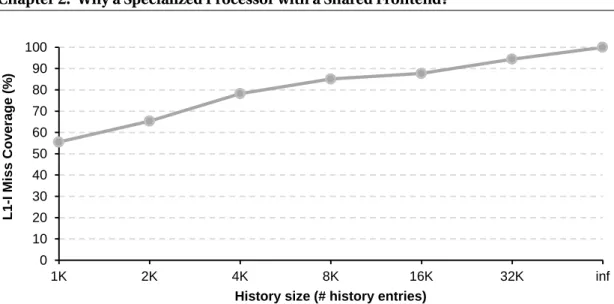
The state-of-the-art instruction streaming mechanism is Proactive Instruction Fetch (PIF) [27], which extends earlier work on temporal streaming [28]. PIF’s key innovation over prior work is its reliance on access streams instead of miss streams. By recording all accesses to the instruction cache, as opposed to just those that miss, PIF eliminates the dependence on the content of the cache. While cache content can change over time, reference patterns that PIF records remain stable. To mitigate the storage overhead associated with recording all instruction cache access addresses, PIF exploits the temporal and spatial locality in instruction access stream to maintain a compact representation of the addresses of the instruction blocks that are in close proximity in the address space and accessed closely in time. Despite the stream compaction optimization, PIF incurs significant storage overhead for high instruction miss coverage (i.e., fraction of misses eliminated). Figure 2.2 illustrates how the miss coverage increases with the history size. For instance, to eliminate an average of 90% of instruction cache misses, thus approaching the performance of a perfect I-cache, PIF requires 32K entries in history, corresponding to over 210KB of history storage per core (Section 3.4 details PIF’s storage cost).
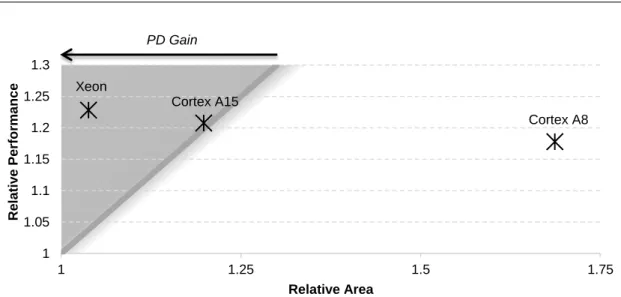
Relative Area Overhead: While the performance benefits of instruction streaming are consis-tently high across the core microarchitecture spectrum, the relative cost varies greatly. For instance, the 210KB of storage required by the PIF prefetcher described above consumes 0.9mm2of the die real-estate in 40nm process technology. Meanwhile, a Xeon Nehalem core along with its private L1 caches has an area footprint of 25mm2. The 4% of area overhead that PIF introduces when coupled to a Xeon core is a relative bargain next to the 23% performance gain it delivers. This makes PIF a good design choice for conventional server processors. (Section 3.4 details the system configurations used for these experiments)
On the opposite end of the microarchitectural spectrum is a lean core like the ARM Cortex-A8 [9]. The Cortex-A8 is a dual-issue in-order design with an area of 1.3mm2, including the private L1 caches. In comparison to the A8, PIF’s 0.9mm2storage overhead is prohibitive given the 17% performance boost that it delivers. Given that server workloads have abundant request-level parallelism, making it easy to scale performance with core count, the area occupied by PIF is better spent on another A8 core. The extra core can double the performance over the baseline core, whereas PIF only offers a 17% performance benefit.
To succinctly capture the area trade-off, we use the metric of performance-density (PD), defined as performance per unit area [53]. By simply adding cores, server processors can effectively scale performance, while maintaining a constant PD (i.e., twice the performance in twice the area). As a result, the desirable microarchitectural features are those that grow performance-density, as they offer a better-than-linear return on the area investment.
Figure 2.3 shows the relative performance-density merits of three PIF-enabled core microar-chitectures over their baseline (without PIF) counterparts. Two of the cores are the Xeon and ARM Cortex-A8 discussed above; the third is an ARM Cortex-A15 [84], an out-of-order core with an area of 4.5mm2.
In the figure, the trend line indicates constant PD (PD = 1), which corresponds to scaling performance by adding cores. The shaded area that falls into the left-hand side of the trend
Cortex A8 Cortex A15 Xeon 1 1.05 1.1 1.15 1.2 1.25 1.3 1 1.25 1.5 1.75 Rel a tiv e Pe rforma nc e Relative Area PD Gain
Figure 2.3: Comparison of PIF area overhead and performance improvement for various core types.
line is the region of PD gain, where the relative performance improvement is greater than the relative area overhead. The right-hand side of the trend line corresponds to PD loss, where the relative performance gain is less than the relative area. In summary, designs that fall in the shaded region improve performance-density over the baseline; those outside strictly diminish it.
The results in the figure match the intuition. For the Xeon core, PIF improves performance-density. In contrast, for the Cortex-A15 core, PIF fails to improve PD, and for the Cortex-A8 core, PIF actually diminishes PD, providing less-than-linear performance density benefit that cannot compensate for its area overhead. Thus, we conclude that processors with specialized lean cores (i.e., ARM Cortex cores) benefit from instruction streaming nearly as much as designs with fat wide-issue cores (i.e., Intel Xeon), but mandate area-efficient mechanisms to minimize the overhead.
Temporal Instruction Stream Commonality:To quantify the similarity between the instruction
streams of cores running a homogeneous server workload, we pick a random core to record its instruction cache access stream. All the other cores, upon referencing the first address in a stream, replay the most recent occurrence of that stream in the recorded history. The commonality between two streams is quantified as the number of matching instruction block
addresses between the replayed stream and those issued by the core replaying the stream. For this study, we use instruction fetch traces from 16 cores and average the results across all of the cores.
Workload % I-cache accesses
OLTP DB2 91 OLTP Oracle 92 DSS Qry2 94 DSS Qry8 92 DSS Qry17 91 DSS Qry20 93 Media Streaming 96 Web Frontend 90 Web Search 95
Table 2.2: Instruction cache accesses within common temporal streams.
Table 2.2 shows the commonality of instruction streams between cores executing a given homogeneous server workload. More than 90% (up to 96%) of instruction cache accesses (comprised of both application and operating system instructions) from all sixteen cores belong to temporal streams that are recorded by a single core picked at random. This result indicates that program control flow commonality between cores yields temporal instruction stream commonality, suggesting that multiple cores running a homogeneous server workload can benefit from a single shared instruction history for instruction streaming.
2.2.2 Branch Predictors
Branch prediction is a vital component for high single-threaded performance. Branch instruc-tions constitute a special class of instrucinstruc-tions as they can divert the control flow of a program from sequential flow to another location in the program. In the absence of a branch predictor, upon an incoming branch instruction, the core would stall until the execution of the branch instruction to resolve the branch (i.e., determine if it is taken or not) and calculate the target instruction address, if the branch is taken, to redirect the control flow to the target address. As a result, each branch instruction would stall the instruction fetch unit of the core until the branch gets resolved and the next instruction address is calculated by the processor, creating
Instruction address (PC) tag index
tag type Branch target buffer (BTB)
target PC
=
1
2
Match 3 target PC Next PC
Figure 2.4: Target address prediction of a branch instruction in BTB.
bubbles in the pipeline. These pipeline bubbles would essentially lead to lower performance.
To mitigate the pipeline bubbles due to branch instructions, today’s processors rely on aggres-sive branch predictors. A branch predictor consists of two orthogonal components: 1) branch direction predictor and 2) branch target predictor. The branch direction predictor predicts whether a branch will be taken or not. If a branch is predicted not taken, the instruction fetch stream continues sequentially with the next instruction in the program. However, if the branch is predicted taken, its target instruction address, from which instruction the fetch stream will continue, needs to be predicted as well.
Branch Target Prediction
The chief mechanism employed to predict the target instruction addresses of taken branches is the Branch Target Buffer (BTB) [79]. Each BTB entry stores the most recent target instruction address for a particular branch instruction and uses the stored target instruction address as the prediction next time that branch instruction is encountered. In doing so, the BTB exploits the fact that, for the majority of branches (i.e., relative branches) the target instruction address is stable throughout the program execution.1BTB, as shown in Figure 2.4, is typically a set-associative table, where each entry is tagged with a branch instruction’s program counter
1Return instructions and indirect branches may have several different target addresses. Because the BTB is
not very effective for these types branches as it only stores one target address per branch instruction, today’s processors employ separate prediction mechanism to predict targets of return instructions and indirect branches.
(PC). Each BTB entry stores the most recent target instruction address (target PC) encountered for a particular branch instruction and optionally a few status bits to indicate the type of the branch (i.e., conditional, unconditional, return).
The BTB needs to be both accurate and timely meaning that it needs to provide the correct branch target address within a cycle to constantly feed the processor pipeline with correct instructions. The single-cycle latency constraint for the BTB can be relaxed in the presence of a branch direction predictor with an access latency higher than one cycle, as retrieving the target address of the branch instruction would be of no use before the direction of the branch is known. In this work, we target a system with a branch direction predictor latency of only single cycle. To achieve maximum hit rate, thus accuracy, the BTB needs to maintain entries of all the taken branches in the instruction working set of an application. As a result, the capacity requirements of the BTB scale with the instruction working set of an application. However, larger BTBs exhibit higher access latencies, resulting in high-latency target address predictions. Consequently, delayed target address predictions offset the performance benefits of accurate predictions as they cause bubbles in the pipeline.
Superscalar cores necessitate the branch prediction unit to provide multiple instructions every cycle depending on the fetch width of the core. To provide multiple instructions to be fetched with a single BTB lookup, the BTB can be organized to provide a basic block range with a single lookup [64, 91]. In this case, each BTB entry is tagged with the starting address of a basic block and maintains the target address of the branch ending the basic block, the fall-through address (the next instruction after the branch ending the basic block) and the type of the branch instruction ending the basic block. Every cycle, a direction prediction is made for the branch instruction terminating the current basic block (i.e., the instruction before the fall-through instruction). Based on the outcome of the direction prediction, the fall-through address or the target instruction address is used to perform a lookup in the BTB for the next basic block. In the rest of the paper, we leverage such a BTB as the baseline BTB design. Whenever a basic block (hence the branch ending the basic block) is not found in the BTB, a basic block with a predetermined number of sequential instructions is passed to the
0 10 20 30 40 50 60 BTB M PKI 1K 2K 4K 8K 16K 32K
Figure 2.5: BTB MPKI as a function of BTB capacity (in K entries).
instruction fetch unit to be fetched.
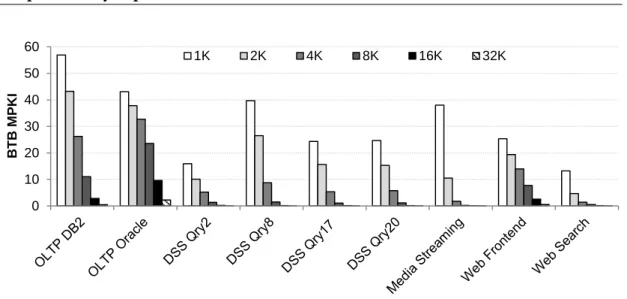
Figure 2.5 shows the BTB MPKI as a function of the total number of BTB entries per core. A BTB miss corresponds to a branch instruction (or the basic block that ends with the branch instruction in the basic-block-based design) whose entry is not present in the BTB and hence is not considered as a branch at prediction time. As a result, BTB misses result in misfetches (i.e., wrong target predictions) if the corresponding branch instruction is taken. The server workloads require up to 16K BTB entries to fully capture the taken branches in the instruction working sets of the workloads, while OLTP on Oracle benefits from even 32K entries, corrobo-rating prior work [11, 12, 35]. The storage capacity requirement of a 32K-entry BTBs is around 290KB (Section 4.3 details the storage cost).
Relative Area Overhead: A 16K-entry BTB (~150KB) in 40nm technology occupies around 0.6mm2area. This area footprint corresponds to 46% of the Cortex-A8, 13% of the Cortex-A15, and only 2.5% of the Xeon area footprint. As the relative area overheads indicate, large BTBs incur a much higher area overhead for the Cortex cores as compared to the Xeon core.
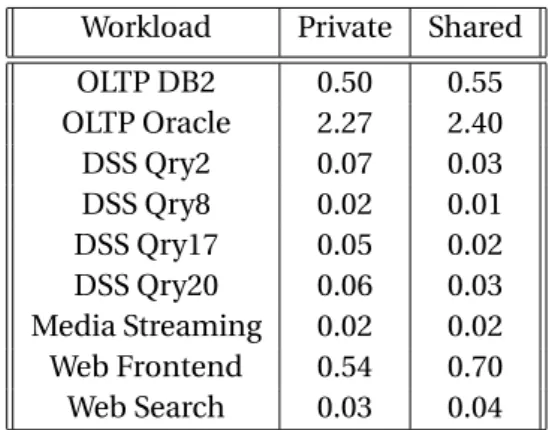
BTB Metadata Commonality: Table 2.3 demonstrates the BTB miss rate when 16 cores running a given server workload leverage a shared 32K-entry BTB. The insignificant increase in BTB MPKI (0.2 in the worst case) in the shared BTB validates our expectations of the commonality
Workload Private Shared OLTP DB2 0.50 0.55 OLTP Oracle 2.27 2.40 DSS Qry2 0.07 0.03 DSS Qry8 0.02 0.01 DSS Qry17 0.05 0.02 DSS Qry20 0.06 0.03 Media Streaming 0.02 0.02 Web Frontend 0.54 0.70 Web Search 0.03 0.04
Table 2.3: BTB MPKI when 16 cores share a 32K-entry BTB compared to private 32K-entry BTB.
of BTB entries between cores running a homogeneous server workload. The subtle increase in the BTB miss rate can be attributed to cold code paths exercised by a random core due to infrequent events such as OS scheduler activity.
To conclude, although the BTB storage requirements for server workloads are as big as 290KB, the commonality of control flow across cores paves the way for sharing the BTB storage, thus eliminating the redundancy and amortizing its storage overhead across many cores.
Branch Direction Prediction
The key enabler for the high accuracy provided by today’s state-of-the-art branch predictors is mainly correlating a branch’s outcome with the outcome ofmany previously executed branch instructions in the dynamic instruction stream [39, 41, 68]. While increasing the prediction accuracy for some branch instructions necessitates maintaining longer branch histories (i.e., hundreds of dynamic branch outcomes), most branches can be predicted accurately by leveraging relatively short histories. Maintaining a fixed-size history for all branches results in an unnecessary explosion in the required predictor size. Instead, only the branches that benefit from longer histories should maintain predictions correlated with long branch histories, while other branches should maintain predictions correlated with shorter branch histories in the predictor table. Furthermore, achieving high accuracy necessitates minimizing aliasing in the predictor tables, preventing two or more different branch patterns
hash hash PC Hist[L1:0] pred tag u Tag match hash hash PC Hist[L2:0] pred tag u Tag match hash hash PC Hist[LN:0] pred tag u Tag match T1 T2 TN
...
PC...
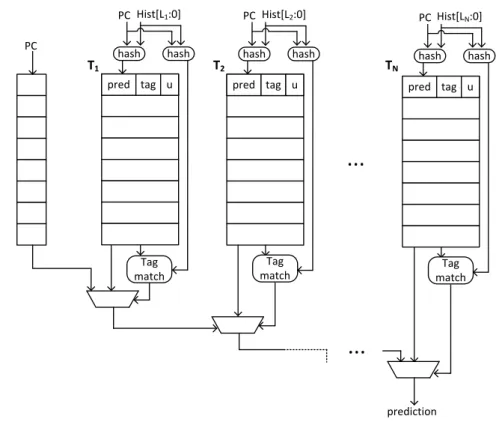
predictionFigure 2.6: TAGE branch predictor with a base bimodal predictor and N tagged tables.
from reading or updating the same entry in the predictor.
Given these requirements for high branch prediction accuracy, the TAGE predictor [68] shown in Figure 2.6, employs a base bimodal predictor and a set of partially tagged predictor tables, each of which maintains predictions for branch outcome patterns with different lengths. The global history lengths used by the tagged tables all together form a geometric series. The base bimodal predictor is indexed by a branch PC and provides a prediction if there is no matching entry in the tagged tables for a given branch history at the time of the prediction. In addition to a partial tag, each tagged table entry contains a 3-bit saturating counter for direction prediction and a 2-bit useful counter. Each tagged table is indexed through a unique function of the current branch PC, global history and path history. Similarly, the partial tags are formed through a unique function of the branch PC and global history.
At prediction time, all tables are accessed in parallel. The predictions from two tables with the longest histories are considered for the actual prediction upon a tag match. Typically, the
prediction from the table associated with a longer history is actually used unless the entry is considered as recently inserted. If the prediction is wrong, a new entry is allocated in a table associated with a longer history than the table that provided the prediction. This way, the branches that cannot be correctly predicted by short histories are promoted to tables with longer histories.
Overall, through the combination of entry tagging and use of variable history lengths in several disparate tables, TAGE outperforms all the other branch predictors in the literature. However, the use of tags in the predictor tables and the need for capturing all the recurring branch patterns in a workload for high accuracy inflate the storage capacity requirements of the TAGE predictor.
Configuration Tage_1 Tage_2 Tage_3 Tage_4 Tage_5 Tage_6
Scaling Factor 1/16 1/8 1/4 1/2 1 2
Aggregate Storage (KB) 4 6 9 16 30 58
Table 2.4: Total storage capacities required for various TAGE configurations.
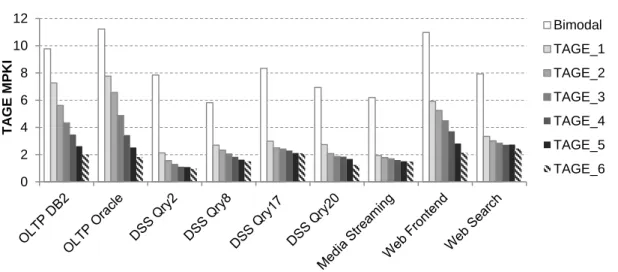
We evaluate TAGE’s accuracy by varying its per-core aggregate storage capacity for the server workloads listed in Table 2.1. We start with the ~30KB TAGE configuration [68], which achieved the highest accuracy in the first Branch Prediction Championship (CBP-1) and set the basis for the predictors that won the subsequent competitions. For the configurations with different aggregate capacities, we keep the size of the bimodal predictor constant as it is a tagless table and requires only 2.5KB storage capacity in total and scale the number of entries in the tagged tables by powers of two for each different configuration. The resulting aggregate table sizes for various configurations evaluated are listed in Table 2.4. We also evaluate the accuracy of the base bimodal predictor to better understand the contribution of tagged tables to higher accuracy.
Figure 2.7 shows the misprediction rates for the base bimodal predictor and the various TAGE configurations listed in Table 2.4. As expected, as the number of entries in tagged tables increases, TAGE achieves higher accuracy because it can accommodate more entries belonging to different branch outcome patterns and different branches. The reduction in the MPKI with