What Intercollegiate Athletes Wish Faculty Knew
Porter E. Coggins, III Ph.D.
Associate Professor of Professional Education Department of Professional Education, Box #35
Bemidji State University 1500 Birchmont DR NE Bemidji, MN 56601 [email protected]
Thomas A. Raunig, Ed.D. Professor of Health and Physical Education
Division of Professional Studies University of Providence
1301 20th St. S. Great Falls, MN 59405
Abstract
Intercollegiate student - athletes in the United States are in an unusual position as both students admitted to the university with declared majors and as athletes under contract with the athletic team to which they have been selected. As such, and much more so than students from other categories, intercollegiate student - athletes are expected to maintain a satisfactory grade point average and make satisfactory progress toward their degree in order to maintain athletic eligibility. This is done while practicing around 20 hours a week and traveling to competitions on a regular basis. This study surveyed 250 student - athletes at two universities to determine if these student - athletes had recommendations for faculty and if they felt faculty were aware of their unique academic needs. One open ended question and three Likert scale questions were asked. The findings indicated that faculty do not create assignments with student - athlete needs in mind. Recommendations were then made for how faculty might better meet the needs of student athletes.
Keywords: Intercollegiate athletics, Student - athlete, Academic success, Higher education
1. Introduction
The voice of student - athletes, when it comes to athletic academic issues, has not always been the first place College Administrators turn for either policy or academic decision making. It may not even be the second or third option. In this study, intercollegiate student - athletes were asked to make their voices heard. College athletes may be young, and they may not always make the best decisions, but the current generation of college student - athletes is not the same as past generations. They come from Generation Z (Pew Research Center, 2018), and they bring a unique view to the collegiate athletic and academic landscape. This generation tends to be more career minded, more open minded, and very aware of both the lives around them and their community, and also tend to be entrepreneurial, “we-centric” and willing to take risks to help others (Loveland, 2017, pg. 36). What sort of impact might this generation have on colleges and on college sports? What adjustments might be made by colleges to help better meet the needs of this unique generation? One statistic that could indicate the uniqueness of this generation is the increase in athletes transferring colleges. For example, in one report, transfer rates for men's college basketball were 36 percent greater than that of the overall student - athlete population (Rishe, 2012). These athletes transfer despite having to sit out one year under NCAA rules in sports like basketball, football, and hockey. The only exception to the rule is if the student - athlete graduates, still has eligibility left, and is accepted into a graduate program at the new school. There is a one-time transfer rule for most other NCAA sports, where a student athlete can transfer one time without having to sit-out a year.
The potential for athletes to transfer is something coaches are very well aware, but are faculty very aware of it? The potential is there for coaches to acquis to the wishes of an athlete threatening to transfer. This creates a far different dynamic between the coach and athlete, compared to what a faculty member is likely to experience. However, it could be argued that faculty have the potential to increase or decrease the odds of a student athlete transferring. Retention and graduation rates are key statistics to institutions of higher education, as well as, to the athletic departments at those institutions. A great deal of time and money has been spent on how increase retention and graduation rates. Advising is often cited as a key factor in retention (Drake, 2011). Academic advising often rests on the shoulders of faculty, even though not all faculty are interested in advising, and may not even be trained in it. Retention research emphasizes the need for institutions to pay attention to the profile of the students they recruit, the progress of the students once they arrive there, the processes for supporting the student, and delivering on the promises made to the student. Everyone on campus has a hand in retention. The 4 P’s of profile, progress, process, and promise may vary in emphasis from one department on campus to another,
but the entire institution has a hand in retention and graduation rates (Kalsbeek, 2013). It could be argued that coaches and faculty make the greatest impact. For example, if a coach decides not to renew the scholarship of a member of their team, they have made it pretty clear that they do now wish to retain that student - athlete. If a faculty member is asked by a student for extra help in a class, and they do not make time to help that student, they too are sending a message that they are not interested in retaining that student. The NCAA has tried to get a handle on the very complicated problem of retention and graduation rates by implementing the Academic Progress Report. They voted to approve the APR at the 2004 NCAA Convention. The measure takes into account all student - athletes on athletically related financial aid. One point is awarded for each student - athlete staying in school and another for them being academically eligible. A team’s total points are divided by the total possible points, then taken times 1000 to come up with the rate. There is a yearly rate kept, as well as, a rolling four-year rate. The four-year average must be 930, if that is not met, teams are not allowed to compete in NCAA Championships. Further penalty’s, such as practice time limitations and coaching suspensions can also be imposed if the APR stays below 930 for an extended period (NCAA, 2015). With so much riding on the academic success of student - athletes, isn’t it important to understand the unique needs and perspective of the student - athlete?
1.1 Intercollegiate Athletics
Intercollegiate athletics in the United States is primarily governed by two organizations, the National Collegiate Athletic Association (NCAA) and the National Association of Intercollegiate Athletics (NAIA). The NCAA is the largest intercollegiate athletics governing body in the United States based on the number of participating schools, with over 1,100 member colleges and universities and 100 intercollegiate athletic conferences (NCAA, 2018a). The NCAA also serves over 13,800 participating student - athletes. Intercollegiate athletics in the NCAA is organized into three divisions as Division I, Division II1, and Division III with the differences between divisions largely based on school resources and sponsorships (NCAA, 2018b). On the other hand, the NAIA has the largest number of participating student - athletes with over 65,000 competing each year, but only 250 college and university members, and just 21 conferences. However, collectively, the National Collegiate Athletic Association (NCAA) and the National Association of Intercollegiate Athletics serve over 78,000 student - athletes in around 1,350 colleges and universities in the United States.
Intercollegiate student - athletes compete in around 25 sports in their membership organization (NAIA, 2018; NCAA, 2018a). Typically, student - athletes have grown up playing sports and have trained in their sport year-round from around age five until they enroll in a college or university having signed a letter of intent to participate on the school intercollegiate team. Upon arriving on a college campus, the student - athletes are asked to sign a great deal of paperwork, which includes signing away some of their rights to privacy in regard their academic work (FERPA) and health information (HIPPA) (NCAA, 2017). These forms are typically presented in a manner that they are not optional, and these procedures are the beginning of a process can lead the student - athlete towards the assumption that they do not have a voice in the academic processes and procedures they are about to engage in.
1.2 Problem Statement
This study investigated intercollegiate student - athletes’ recommendations for university faculty regarding support for student - athlete academic and athletic success. How can the insights from student - athletes inform faculty to better support student - athletes?
1.1.1 Significance of the Problem
Student - athletes, like all students in today’s world do not have the same views as past generations (Moore, Jones, & Frazier, 2017; Pew Research Center, 2018). It can also be argued that they do not have the same academic needs as past generations. This study investigated intercollegiate student - athletes’ recommendations for university faculty regarding support for student - athlete academic and athletic success. How can the insights and recommendations of student - athletes inform faculty to better support student - athletes?
1.1.2 Purpose
The purpose of this study was to solicit recommendations from intercollegiate student - athletes for university faculty related to student - athlete needs.
2. Methods
2.1 Methodology
A mixed-methods convergent parallel design (Mills & Gay, 2016, p. 429) was used to address our research questions and hypotheses. A convenient sample of intercollegiate student - athletes were recruited from two universities and surveyed by written questionnaire with the purpose of identifying student - athlete needs for academic success.
2.2 Research Problems and Questions
The problems to be investigated in this study are the specific needs for academic success of intercollegiate student - athletes from their perspective.
Research Question 1: What are the specific recommendations that intercollegiate student - athletes propose to faculty to help them succeed academically?
Research Question 2: How do intercollegiate student - athletes rate faculty awareness of student - athlete needs with respect to academic success?
Research Question 3: How do intercollegiate student - athletes rate faculty in the construction of course assignments in consideration of student - athletes with respect to academic success?
Research Question 4: How do intercollegiate student - athletes rate faculty expectations of equity and fairness with respect to student - athlete academic success?
2.3 Research Hypotheses
Research Qualitative Open-ended Hypothesis 1: What themes emerge from student - athletes’ free responses to the question of what they wish faculty knew relative to student - athlete academic success?
Research Quantitative Hypothesis 2: Intercollegiate student - athletes will rate the level of faculty awareness of student - athlete needs for academic success as unsure.
Research Quantitative Hypothesis 3: The third research hypothesis stated above was Intercollegiate student - athletes will rate their confidence in the level that faculty construct course assignments with specific needs of student - athletes in mind with respect to student - athlete needs for academic success as unsure.
Research Quantitative Hypothesis 4: The fourth research hypothesis above was Intercollegiate student - athletes will rate their confidence in the level that faculty set expectations for student - athletes in equity and fairness with respect to needs for academic success as unsure.
2.4 Participants
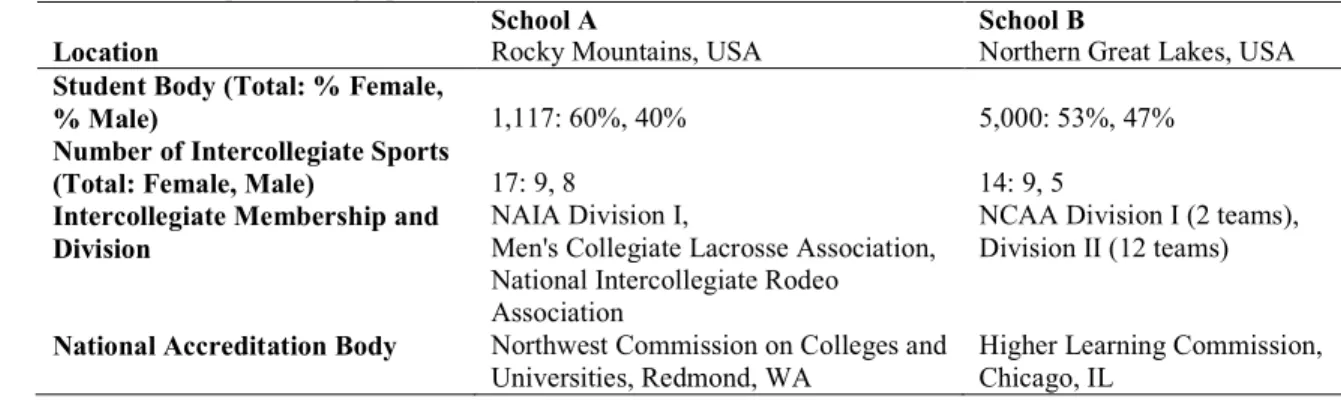
A convenient sample of 250 intercollegiate student - athletes from two universities were recruited to participate in this study. Institutional Review Board approval was secured at both institutions to conduct this research and participates who volunteered both signed an approved informed consent form and received a copy of both the informed consent and a debriefing statement. Participants were not identified by sport or by gender on either the informed consent or the questionnaire.
Table 1. Participant Demographics
School A School B
Location Rocky Mountains, USA Northern Great Lakes, USA
Student Body (Total: % Female,
% Male) 1,117: 60%, 40% 5,000: 53%, 47%
Number of Intercollegiate Sports
(Total: Female, Male) 17: 9, 8 14: 9, 5
Intercollegiate Membership and Division
NAIA Division I,
Men's Collegiate Lacrosse Association, National Intercollegiate Rodeo
Association
NCAA Division I (2 teams), Division II (12 teams)
National Accreditation Body Northwest Commission on Colleges and Universities, Redmond, WA
Higher Learning Commission, Chicago, IL
2.5 Instruments
A four - question, paper and pencil survey questionnaire was constructed for this study. The first question was an open-ended, free-response question worded “What do you wish your college teachers knew, should keep in mind, and do to help student - athletes succeed academically?”
The next three questions were formatted on a Likert scale and stated as:
“1. Most faculty members of this campus are aware of specific needs of student - athletes on your campus. “2. Most faculty members of this campus construct course assignments with specific needs of student - athletes in mind.
“3. Most faculty members of this campus set expectations for student - athletes in equity and fairness (aka, reasonableness and just).”
The three Likert - scale questions used the same response directions with consistent wording for response direction:
“For each question below, please rate your confidence in the following questions using the scale below.” The scale was written as:
2.6 Procedures
Intercollegiate student - athletes were recruited by team coaches. Student - athletes who agreed to voluntarily participate were informed of the minimum age requirement of at least 18 years of age at the time of the administration of the questionnaire. Eligible participants convened in a large classroom, given a pen or pencil, read the informed consent out loud, a paper copy to sign, and both a paper copy and debriefing statement upon completion of the questionnaire. Informed consent included statements of anonymity, right to withdraw from the study without penalty, and anticipation of no side effects from answering the questions, among other information. Student - athletes were encouraged to answer honestly to the best of their knowledge.
2.7 Limitations
This study is limited by the use of a convenient sample from the population of all intercollegiate student- athletes, the characteristics of schools which the sample of student - athletes matriculated, sample size., and the general regions where these institutions are located.
2.8 Assumptions
We assume that each participant answered honestly and to the best of his/her knowledge, that the results would not differ significantly if a larger sample was used from students at similar schools (as opposed to schools that serve primarily as the recruiting ground for professional sports), and that the student - athletes understood the questions asked of them.
3. Results
Both qualitative and quantitative data from the questionnaires were analyzed. The qualitative data was analyzed for emergent themes from the open - ended, free - response question, and the Likert - scale questions were analyzed by appropriate statistical tools as explained below.
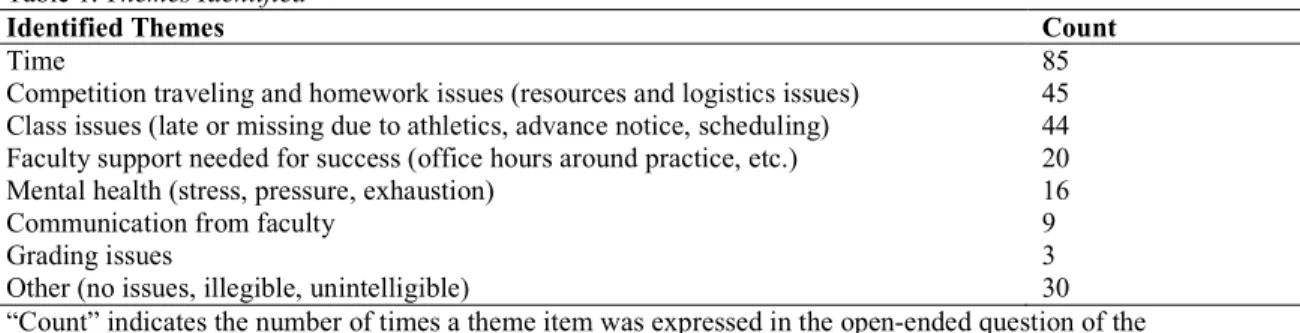
3.1 Emergent Themes Table 1. Themes Identified
Identified Themes Count
Time 85
Competition traveling and homework issues (resources and logistics issues) 45 Class issues (late or missing due to athletics, advance notice, scheduling) 44 Faculty support needed for success (office hours around practice, etc.) 20
Mental health (stress, pressure, exhaustion) 16
Communication from faculty 9
Grading issues 3
Other (no issues, illegible, unintelligible) 30
“Count” indicates the number of times a theme item was expressed in the open-ended question of the questionnaire.
3.2 Statistical Analysis
Figure 1 represents box plots of each of the three Likert scale question responses for each of the 250 participant responses. Table 2 represents percentages of each category of the three Likert scale questions. Table 3 represents the correlation matrix with respect to the three Likert scale questions. A Chi - square goodness of fit was conducted for each of the three Likert scale questions individually, and Friedman’s test was applied to the responses of the three Likert scale questions collectively. Table 4 represents the results of post-hoc Wilcoxon Signed-Rank test with a Bonferroni correction for each pair of combinations for the three Likert scale questions.
Figure 1. Comparison of Question Responses
Quartiles, minimum, maximum, and outlier values are represented in the box plot in Figure 1 above Table 2. Percent of Likert - scale responses for each question.
For each question below, please rate your confidence in the following questions using the scale below. 5 = Strongly Agree / 4 = Agree / 3 = Unsure / 2 = Disagree / 1 = Strongly Disagree
5 4 3 2 1
1 Most faculty members of this campus are aware of specific needs of student – athletes on your campus.
15.2 56.4 20.4 6.4 1.6
2 Most faculty members of this campus construct course assignments with specific needs of student – athletes in mind.
7.6 34.4 33.6 18.4 6.0
3 Most faculty members of this campus set expectations for student – athletes in equity and fairness (aka, reasonableness and just).
20.8 51.2 20.0 7.2 0.8
Aggregate Category Response Scores 14.5 47.3 24.6 10.6 2.8
All numbers are given in percentages. Table 3.
Correlation Matrix Responses of Likert - scale Questions
R Question 1 Question 2 Question 3
Question 1 1 0.48 0.41
Question 2 0.48 1 0.42
Question 3 0.41 0.42 1
Likert - scale Question 1 goodness - of - fit test results: 2 (4, n = 250) = 233.96, p < .05 indicates a statistically significant difference between responses.
Likert - scale Question 2 goodness - of - fit test results: 2 (4, n = 250) = 93.08, p < .05 indicates a statistically significant difference between responses.
Likert - scale Question 3 goodness - of - fit test results: 2 (4, n = 250) = 188.32, p < .05 indicates a statistically significant difference between responses.
A Friedman chi-square test of independence of Likert - scale question responses to the three questions was performed. There was sufficient evidence to reject the null hypothesis of no significant differences between question scores among student - athletes, χ2(2) = 68.6, p < 0.0001. A post-hoc Wilcoxon Signed-Rank test with Bonferroni correction was conducted for each pair of combination of questions and indicated in Table 4.
Table 4. Post-Hoc Wilcoxon Signed-Rank test of Pairs of Likert - scale Responses.
Wilcoxon Signed-Ranks test
Questions 1 and 2 Questions 1 and 3 Questions 2 and 3 W 8384 -869 -8427 Z 7.71 -0.99 -8.15
Two-tail p-value to significance alpha 0.05 with
Bonferroni correction to 0.0167 <0.0001* 0.3222 <0.0001*
Effect Size 0.34 -0.04 -0.36
4. Discussion
Analysis of the questionnaire data revealed several themes from the open-ended, free-response question and surprising overall consistency in the direction of responses on the three Likert - scale questions. With respect to the open-ended question, sometimes student - athletes either wrote a complex statement that could be coded in more than one theme or made multiple simple statements or bullet points that could be coded into multiple themes. We coded accordingly to account for as many themes as appropriate in the response. Intercollegiate student - athletes surveyed in this study noted issues of time, traveling and homework issues, class issues, the need for faculty support, mental health issues, and the need for stronger communication from faculty as most important for academic success. Each of these categories are analyzed below.
4.1 Student - athlete Identified Emergent Themes 4.1.1 Time
The theme with the largest number of comments by student - athletes was time with 85 student - athletes using the word in a relevant context in answer to the open-ended, free-response question. The scope of this theme included multiple commitments student - athletes are bound to uphold and manage including those to the sport and team regarding practice, competition, and traveling, class, required study sessions and homework, and to required service projects. Student - athletes are busy. Example comments include “The huge time commitment athletics requires”, “They should keep in mind that we have a busy schedule and do our best to be on top of everything.”, “Between school and our sport’s, we have a lot on our plate.”, “Time management for a student - athlete is hard.”, “A student – athlete has a lot more going on the athletic side besides practice and travel. There is fundraising, and volunteer work too.”, “I wish they knew how hard we work to keep our schoolwork and athletics schedule balanced.”, “I wish they knew that there is more going on in our lives.”, “They should understand that when we leave on trips we do not have as much time to work on homework and study as they think.”, “Teachers should keep in mind the amount of time we put into our studies and 3 hour practices.”, “Between school and our sport’s [sic], we have a lot on our plate” and “They should keep in mind that we have a busy schedule and do our best to be on top of everything”. Student - athletes know they are extremely busy and time is tight, and that they know they have a foot in two worlds as both a student and an athlete. With respect to practice, some teams practice every day, some practice for the maximum allowable under either NAIA or NCAA rules, and some sports have additional time expectations in addition to regularly scheduled practice and competition. For example, student - athletes competing in rodeo also have veterinary appointments for their horses, and some sports travel great distances for competition requiring lengthy absences from campus. Knowing the magnitude of this theme in the eyes of student - athletes, it was somewhat surprising that over 71% responded to the first Likert - scale question that they agree or strongly agree that faculty are aware of student - athlete needs for academic success, yet, only 42% of student - athletes responded that they agree or strongly agree that faculty that faculty create assignments with them in mind.
The issue of time crosses several themes as a common currency for intercollegiate student - athlete academic success. Student - athletes have complex schedules due to academic course load, course offerings choices, practice and competition schedules, and homework. Managing time is essential for both athletic and academic success.
4.1.2 Competition Traveling Issues
Traveling and homework issues due to competition was the second largest theme identified with 45 student- athletes mentioning it from the open-ended, free-response question. Some example comments include “Hotel wi-fi is terrible, and teachers don’t understand how hard it is to submit assignments from the road.”, “It is hard to do homework on a bus, particularly with no wi-fi.”, “I wish professors read the e-mails sent to them that let the teachers know when teams travel”, “I would also like them to know I will be gone a lot and will always try to find a way to make things up.”, “I think teachers need to be flexible with turn in dates on tournament weekends.”, “It’s hard to do homework traveling.”, “Not all hotels offer wifi”, “Hard to turn in assignments while on the road.”, “That when we are traveling, we don’t always have access to internet and without that access, there are times when we can’t turn our homework in.”, “Have a little less homework and fewer tests when they know more students will be gone for sports.”. For a variety of reasons wireless mobile connectivity cannot be guaranteed in remote or mountainous areas, or hotels.
Issues related to traveling for athletic competition are peripherally connected to classroom issues because assignments and/or explanations given in class may be related to assigned homework that is graded and/or used as preparation for quizzes and exams, which are also graded. Hence, it is imperative that the consequences of travel with respect to homework be mediated at least within the boundaries of any technological impediments. Assignments not requiring technology are still subject to the same classroom related constraints as technological issues because student - athletes may miss important factual, conceptual, procedural, or metacognitive knowledge domains (Anderson, et al., 2001) necessary for the successful completion of assignments and deep
understanding built from completion of the assignments. 4.1.3 Class Issues
Class issues with respect to class attendance, tests, quizzes, returning to campus in the early morning after competition, and course scheduling was the third largest theme with 33 students writing on this theme. Example comments included “When athletes travel and get back at 4 A. M., I feel like teachers should be more aware that we might not be in class”, “All teachers should keep in mind that we don’t choose to miss classes, but we have to because of games. We shouldn’t get penalized or deducted points for missing classes.”, “Know that we can’t help missing class for our events, so we need accommodations [sic] to be made.”, “That as student athletes we will miss class and miss the initial discussion of material and may not fully understand it from a friends [sic] knowledge.”, “It isn’t [sic] our choice to miss class, so please do not punish us when it happens.” Becker, Adams, Orr, and Quilter (2008) reported as far back as ten years ago that a majority of college students surveyed reported a lack of sufficient sleep. Although intercollegiate student - athletes participate in a high level of physical activity, student - athletes in the current study reported the issue of lack of sleep with respect to travel, which coupled with a request for greater faculty support (more or longer office hours and additional recitations or study sessions to accommodate athletic participation), indicates the potential for greater mental health issues related to academic success. It was noteworthy that nine student- athletes mentioned the need for faculty to provide an assignment schedule for the entire term, consider course offerings that did not conflict with practice, and priority registration for student - athletes. Due to the many variables involved in course scheduling, such as faculty availability, classroom size and availability, and course rotations, those responsible for scheduling classes may not have the complete flexibility to accommodate similar constraints athletic departments may face with athletic facility scheduling for various teams. Although most universities require a basic syllabus, the content of syllabi varies by university, and hence the level of detail for assignments, quizzes, exams, study and recitation sessions can vary among instructors. Further, not all university faculty are necessarily willing to put such information out ahead of time for various reasons. However, in light of the particular situation intercollegiate student - athletes are in, whatever advanced information can be given to student - athletes, should be given to them in the interest of academic success. Because the NAIA, NCAA, and universities in general have academic progress requirements, student- athletes are under constant pressure to maintain eligibility in spite of their extremely busy schedules.
Intercollegiate student - athlete academic success with respect to class issues is intimately related to faculty support of all students but given the constraints under which student - athletes operate, accommodations need to be made to meet the special needs of student - athletes. In consideration of Likert - scale question 2, 58% of student - athletes indicated they were unsure, disagreed, or strongly disagreed with the statement that faculty constructed course assignments with student - athletes in mind. Responses to the open-ended, free-response question appear consistent with the number of student - athletes who felt faculty do not construct course assignments with student - athletes in mind. A number of researchers have mentioned that the use of mobile technology is something that Generation Z expects as a part of life (Carter, 2018; Dimock, 2018; Loveland, 2017; Moore, Jones, Frazier, 2017). Perhaps faculty could find ways to better meet student- athletes needs through technology supported assignments?
The fact that the student - athletes thought faculty overall did not construct course assignments with specific needs of student - athletes in mind makes sense. Faculty may take the view that they are students first, and athletes second, so why should assignments be tailored to the needs of student - athletes? The other point of view that could be taken is, the assumption that all faculty expected to find the best approach to meet their students learning needs? Since time issues, along with, traveling and homework issues were the two leading themes mentioned by students, it would seem imperative that potential solutions to these topics be addressed. Are there ways to create assignments to help student athletes address problems with time, travel, and completing homework while traveling? One solution suggested in response to the open-ended question was moving due dates for assignments away from Friday and Saturday, when athletic travel is most often occurring. It is also possible to record lectures on distance learning platforms that support the recording of lectures. Lync by Microsoft Corporation and Collaborate by Blackboard are two such systems. If wi-fi is available where the student - athlete has traveled to, it is even possible for them to join the class live. If there are wi-fi issues, which, according to the student - athlete responses are pretty common, they can watch the recorded version of the class when they return home. The key is for the instructor to be proactive and request teaching in distance enabled classrooms. Teaching on a distance enabled platform can sometimes require the instructor to scan course materials and post them on-line so that students not in class receive the same information as those in class. If this extra work created for the instructor results in greater student success, it seems well worth the effort with academic success of student - athletes in mind.
4.1.4 Faculty Support
Twenty student - athletes mentioned the need for faculty support. Some examples of student comments include “It is hard to come in for extra help due to the student - athlete practice schedule.”, “They should get a better idea
of how the student learns instead of just throwing information at them.”, “I think professors having recitations or sessions for athletes because of travel would be extremely helpful.”, “Teach, not lecture, connect and teach!”, “College teachers should keep in mind that everybody learn [sic] different [sic] and some students don’t learn as fast as others.”, “That student - athletes sometimes have more trouble understanding material because of all the time we spend in our sport.”, “Some teachers schedule appointments at times we have practice and so we can’t [sic] go to extra help.”, “If they could have either differing office hours each day or longer hours because almost all teachers [sic] office hours are during my practice.”, “I wish they would tape lectures of have written outlines of their lecture notes so I don’t get behind from missing class.”, “Keep in mind the fact we may need additional help or time outside of class.”, “In order to succeed academically we need support on and off the court.”, “I hate missing class more than you dislike working with me to catch up.”, “I have never had a college teacher that want [sic] to help athlete students succeed.”. Perhaps the most important step faculty can make with respect to support is to keep in mind differences in prior knowledge that intercollegiate student - athletes may have in courses, provide authentic support (extended office hours, virtual office hours (Facetime or Zoom by Zoom Video Conferencing, Inc., for example) during competition travel, tutorial sessions with competition schedules in mind), and create a genuine, risk-free learning atmosphere for students.
4.1.5. Mental Health
Sixteen student - athletes noted some combination of pressure/stress/exhaustion as student - athletes. Unfortunately, there is an extensive gap in the current scholarly literature on any assessments reported on the prevalence, type, or treatment of mental health issues (anxiety, stress, depression) among intercollegiate student - athletes. This major lack of research is of concern because of the number of student - athletes engaged in intercollegiate athletics in the two major organizations, NAIA and NCAA, and the general level of stress that comes with being a student, let alone an intercollegiate student - athlete (Beiter, Nash, McCrady, Rhoades, Linscomb, Clarahan, & Sammut, 2015). In spite of the lack of extensive academic research, college administrators and coaches might consider a mandatory mental health course or regular mandatory meetings with administrators, coaches, and qualified mental health providers that both remove any stigma attached to issues of mental health, provide engaging and relevant mental health issues, warning signs, symptoms, and resources for intercollegiate student - athletes.
4.2 Research Hypotheses
In addition to the open - ended, free - response question, we were also interested in how student - athletes rated their confidence in how well they thought faculty attended to three aspects relevant to academic success: faculty awareness of specific needs of student - athletes, that faculty construct course assignments with specific needs of student - athletes in mind, and that faculty set expectations for student - athletes in equity and fairness.
4.2.1 Research Hypothesis 2
The second research hypothesis stated above was Intercollegiate student - athletes will rate their confidence in the level of faculty awareness of student - athlete needs for academic success as unsure. There was sufficient evidence to reject the null hypothesis of no difference between responses by Likert-scale category.
Student - athletes indicated their belief of agreed or strongly agreed with the statement that faculty were aware of specific needs of student athletes by a large margin with 71.6% compared to just 8.0% who disagreed or strongly disagreed and 20.4% who were unsure. This may indicate that faculty convey their awareness overtly or possibly that coaches project that sense to their team members. This is in contrast to 45.7% of intercollegiate coaches and 54.3% of faculty who agreed or strongly agreed compared to 20% of coaches and 11.4% of faculty who disagreed or strongly disagreed given this same question as reported in Raunig and Coggins (2018, p. 116). That student - athletes had such a higher number is noteworthy because they have direct and regular contact with course instructors compared to coaches, and interesting to note that faculty who have regular contact with student - athletes had a much lower belief in the confidence of faculty awareness of specific needs of student - athletes.
4.2.2 Research Hypothesis 3
The third research hypothesis stated above was Intercollegiate student - athletes will rate their confidence in the level that faculty construct course assignments with specific needs of student - athletes in mind with respect to student - athlete needs for academic success as unsure. There was sufficient evidence to reject the null hypothesis of no difference between response by Likert-scale category.
Student - athletes indicated they agreed or strongly agreed with the statement that faculty construct course assignments with specific needs of student - athletes in mind with just 42% compared to 24.4% who disagreed or strongly disagreed and 33.6% who were unsure. The number of student - athletes who agreed or strongly agreed was greater than the 28.6 % of intercollegiate coaches 11.4% of faculty, and the number of student - athletes who disagreed or strongly disagreed was much lower than the 40% of intercollegiate coaches and 54.3% of faculty surveyed (Raunig & Coggins, 2018, p. 116). Roughly half of faculty indicated they constructed course assignments with the needs of student - athletes in mind, yet that was not apparent to the majority of student -
athletes. This is relevant with respect to the open - ended, free - response statements made by student - athletes noted above.
4.2.3. Research Hypothesis 4
The fourth research hypothesis above was Intercollegiate student - athletes will rate their confidence in the level that faculty set expectations for student - athletes in equity and fairness with respect to needs for academic success as unsure. There was sufficient evidence to reject the null hypothesis of no difference between responses by Likert-scale category.
As with Likert scale question 1, student - athletes indicated they agreed or strongly agreed with the statement that faculty were aware of specific needs of student athletes by a large margin with 72% compared to just 8.0% who disagreed or strongly disagreed and 20.0% who were unsure. They agree - strongly agree values were slightly higher than those of coaches who responded likewise at 62.9% and 74.3% of faculty (Raunig & Coggins, 2018). Coaches also responded close to the student - athlete responses for disagree - strongly disagree at 11.4% and 0.0% of faculty as noted in Raunig and Coggins (2018, p. 116). Of interest is that faculty believe they are setting fair expectations for student - athletes in similar proportion to the belief of student - athletes. This is encouraging in that apparently faculty set expectations for all students, of which student - athletes are a subset, and student - athletes recognize that equity in expectations. However, in light of the comments made by student - athletes in the open - ended, free - response question, if those expectations are fully conveyed by faculty and realized by student – athletes is not clear.
5. Conclusion
Intercollegiate student - athletes live in a tenuous world as both matriculated students at a university and contracted intercollegiate athletes at that same university. They are expected to meet and excel in both realms and are governed by performance standards by both their university and the intercollegiate governing body of their sport. Intercollegiate student - athletes surveyed in this study noted issues of time, traveling and homework issues, class issues, the need for faculty support, mental health issues, and the need for stronger communication from faculty as most important for academic success. These student - athletes also were confident in their belief that faculty were aware of their specific needs and that faculty set fair expectations for student - athletes. However, the student - athletes indicated they were not confident in their belief that faculty constructed course assignments with their specific needs in mind. The results of this study point toward the need for faculty to develop additional approaches to teach today’s student - athlete. The use of technology to support the delivery of information could prove to be the most effective and most appealing approach for intercollegiate student - athletes. This is based on previously conducted research completed on Generation Z students (Carter, 2018; Loveland, 2017; Moore, 2017), and analysis of the qualitative data from this study. Finding ways to support student - athlete success could be a component in helping with student - athlete retention. The NCAA has been tracking retention since 2004 when the Academic Progress Report (APR) was implemented. The two sports at the NCAA Division I level with the highest transfer rates are men’s soccer and basketball. Women’s basketball has the highest transfer rate among women’s sports (NCAA, 2017). Basketball has a long season, which spans over two semesters, and involves a great deal of travel. Could student - athletes’ ability to manage academics, travel, and their sport be one of the reasons why that sport has such a high rate of transfers? Further investigation into that issue could be useful for colleges and athletic departments as they try to meet federal, NAIA, and NCAA expectations for retention.
References
Anderson, L. W., Krathwohl, D. R., Airasian, P. W., Cruikshank, K. A., Mayer, R. E., Pintrich, P. R., Whittrock, M. C. (2001). A taxonomy for learning, teaching, and assessing: A revision of Bloom’s taxonomy of educational objectives. New York: NY: Longman.
Beiter, R., Nash, R., McCrady, M., Rhoades, D., Linscomb, M., Clarahan, M., & Sammut, S. (2015). The prevalence and correlates of depression, anxiety, and stress in a sample of college students. Journal of Affective Disorders, 173, 90-95.
Carter, T. (2018). Preparing generation z for the teaching profession. SRATE Journal, 27(1), 1-8.
Dimock, M. (2018). Defining generations: Where millennials end and post-millennials begin. Pew Research Center. [Online] Available: http://www.pewresearch.org/fact-tank/2018/03/01/defining-generations-where-millennials-end-and-post-millennials-begin/
Drake, D.K., (2011). The Role of Academic Advising in Student Retention and Persistence, About Campus, (July-August) 8-9.
Kalsbeeck, D.H. (2013). Framing Retention for Institutional Improvement: A 4 Ps Framework. New Directions for Higher Education, 161 (Spring 2013), 5-12.
Loveland, E. (2017). Instant generation. The Journal of College Admission, (Winter), 34-38.
111-126.
National Association of Intercollegiate Athletics. (2018). What is the NCAA? [Online] Available: http://www.naia.org/HomePage.dbml?DB_OEM_ID=27900&KEY=
National Collegiate Athletic Association. (2015) Academic progress rate explained. [Online] Available: http://www.ncaa.org/aboutresources/research/academic-progress-rate-explained
National Collegiate Athletic Association. (2017) Transfer Composition of Division I Teams
http://www.ncaa.org/sites/default/files/2017_Tracking_Transfer_in_DI_MBB_slides_FINAL_20170627.pdf National Collegiate Athletic Association. (2017). Bylaw Article 17 countable athletically related activities, 3-13.
[Online] Available: https://www.ncaa.org/sites/default/files/20-Hour-Rule-Document.pdf
National Collegiate Athletic Association. (2017) HIPPA/Buckley Amendment Waiver Form. [Online] Available: http://www.ncaa.org/sites/default/files/2017_18_HIPAA_Buckley_Amendment_Consent_Form_20170605. pdf
National Association of Intercollegiate Athletics. (2017). Official & policy handbook. (32nd ed.). [Online] Available: http://www.naia.org/fls/27900//1NAIA/pubs/legislative/NAIA_Official_Handbook.pdf
National Collegiate Athletic Association. (2018a). What is the NCAA? [Online] Available: http://www.ncaa.org/about/resources/media-center/ncaa-101/what-ncaa
National Collegiate Athletic Association. (2018b). Our three divisions. [Online] Available: http://www.ncaa.org/about/resources/media-center/ncaa-101/our-three-divisions
Pew Research Center. (2018). The generation gap in American politics: Wide and growing divides in views of racial discrimination. [Online] Available: http://www.people-press.org/2018/03/01/the-generation-gap-in-american-politics/
Raunig, T., & Coggins, III P. E. (2018). What coaches wish faculty knew. Journal of Curriculum and Teaching, 7(1), 111-124. [Online] Available: http://www.sciedupress.com/journal/index.php/jct/issue/view/634 Rishe, P. (2012). Growing transfer rates exacerbate hypocrisy of student - athlete moniker in basketball. [Online]
Available: https://www.forbes.com/sites/prishe/2012/11/07/growing-transfer-rates-exacerbate-hypocrisy-of-student - athlete-moniker-in-revenue-sports/#5be473c2d607
Notes
Note 1. Both Puerto Rico and Canada have participating intercollegiate athletic teams in Division II. Note 2. This is an example for note 2.