Constraints Using Zero-Suppressed Sentential
Decision Diagrams
Yu Nakahata
Graduate School of Informatics, Kyoto University, Japan [email protected]
Masaaki Nishino
NTT Communication Science Laboratories, NTT Corporation, Kyoto, Japan [email protected]
Jun Kawahara
Graduate School of Informatics, Kyoto University, Japan [email protected]
Shin-ichi Minato
Graduate School of Informatics, Kyoto University, Japan [email protected]
Abstract
Subgraph enumeration is a fundamental task in computer science. Since the number of subgraphs can be large, some enumeration algorithms exploit compressed representations for efficiency. One such representation is the Zero-suppressed Binary Decision Diagram (ZDD). ZDDs can represent the set of subgraphs compactly and support several poly-time queries, such as counting and random sampling. Researchers have proposed efficient algorithms to construct ZDDs representing the set of subgraphs under several constraints, which yield fruitful results in many applications. Recently, Zero-suppressed Sentential Decision Diagrams (ZSDDs) have been proposed as variants of ZDDs. ZSDDs can be smaller than ZDDs when representing the same set of subgraphs. However, efficient algorithms to construct ZSDDs are known only for specific types of subgraphs: matchings and paths. We propose a novel framework to construct ZSDDs representing sets of subgraphs under given constraints. Using our framework, we can construct ZSDDs representing several sets of subgraphs such as matchings, paths, cycles, and spanning trees. We show the bound of sizes of constructed ZSDDs by the branch-width of the input graph, which is smaller than that of ZDDs by the path-width. Experiments show that our methods can construct ZSDDs faster than ZDDs and that the constructed ZSDDs are smaller than ZDDs when representing the same set of subgraphs.
2012 ACM Subject Classification Mathematics of computing→Graph algorithms
Keywords and phrases Subgraph, Enumeration, Decision Diagram, Zero-suppressed Sentential Decision Diagram (ZSDD), Top-down construction algorithm
Digital Object Identifier 10.4230/LIPIcs.SEA.2020.9
Funding This work was supported by JSPS KAKENHI Grant Number JP15H05711, JP18H04091, JP18K04610, and JP19J21000.
1
Introduction
Enumerating subgraphs of a given graph under some constraint is a fundamental task in computer science. There are enumeration algorithms for several types of subgraphs such as cliques [5], paths [1], and spanning trees [21]. These algorithms list all subgraphs one by one in a small amount of time per subgraph. However, such algorithms take at least linear time and space to the number of subgraphs. Since the number of subgraphs can be exponentially larger than the size of the input graph, it is trouble when applied to practical problems.
© Yu Nakahata, Masaaki Nishino, Jun Kawahara, and Shin-ichi Minato; licensed under Creative Commons License CC-BY
Instead of explicitly listing subgraphs, some algorithms exploit compressed representations of sets of subgraphs. One such representation is the Zero-suppressed Binary Decision Diagram (ZDD) [15]. ZDDs are compact representations of set families. By regarding a subgraph as its edge set, we can express a set of subgraphs by a ZDD. ZDDs can not only represent set families compactly but also support several poly-time queries such as counting and random sampling [15]. In addition, given two ZDDs, we can efficiently construct a ZDD representing the union or intersection of the set families represented by the input ZDDs in polynomial time to the sizes of the input ZDDs. Such operations are calledApply operations [4]. Due to these merits, ZDDs appear in several graph-related applications such as network optimization [10], network reliability evaluation [7, 8], and balanced graph partitions [12, 16, 17].
A key to use ZDDs effectively for subgraph enumeration is a fast algorithm to construct a ZDD representing the set of subgraphs. It is time-consuming to construct a ZDD by first explicitly listing subgraphs and then combining ZDDs using Apply operations. In contrast, some algorithms can construct ZDDswithout explicitly listing subgraphs. Such algorithms are calledtop-down construction algorithms, while algorithms using Apply operations are calledbottom-up. Researchers have proposed top-down construction algorithms for ZDDs representing several sets of subgraphs [20, 7, 14]. Kawahara et al. [13] generalized the algorithms to obtain a general framework of top-down construction algorithms for ZDDs. Using the framework, we can construct ZDDs representing the sets of subgraphs under several constraints, such as the number of edges, degrees of vertices, and connectivity of vertices. By combining these fundamental constraints, we can specify several types of subgraphs, such as matchings, paths, cycles, and spanning trees.
Recently, Zero-suppressed Sentential Decision Diagrams (ZSDDs) [18] have been proposed as different representations of set families. Since ZSDDs are generalizations of ZDDs, ZSDDs are at least as compact as ZDDs. In theory, there exist set families that have polynomial ZSDD sizes but exponential ZDD sizes [3]. In addition, ZSDDs inherit some poly-time queries of ZDDs: counting, random sampling, and Apply operations. Thus, a natural question is: Can we design top-down construction algorithms for ZSDDs representing sets of subgraphs? The question is partially answered in an affirmative way by Nishino et al. [19]. They proposed top-down construction algorithms for ZSDDs representing sets of specific types of subgraphs: matchings and paths. The sizes of constructed ZSDDs by their algorithms are bounded by the branch-width of the input graph [19], while those of ZDDs are bounded by thepath-width [11].
Since the branch-width of a graph never exceeds the path-width [2], ZSDDs have tighter upper bounds than ZDDs. The efficiency of their algorithms was confirmed in experiments. Despite such striking results, their algorithms are specific to matchings and paths.
In this paper, we propose a novel framework of top-down construction algorithms for ZSDDs. To design a top-down construction algorithm using our framework, one only has to prove a recursive formula for the desired set of subgraphs. Using the recursive formula, we can theoretically show the correctness and the complexity of the algorithm, which was difficult with the existing method. We apply our framework to the three fundamental constraints used in ZDDs: the number of edges, degrees of vertices, and connectivity of vertices. We show that the sizes of constructed ZSDDs are bounded by the branch-width of the input graph, not only for matchings and paths. Experiments show that proposed methods can construct ZSDDs faster than ZDDs and that the constructed ZSDDs are smaller than ZDDs representing the same sets of subgraphs.
(a)A vtree. (b)A ZSDD.
Figure 1A vtree and a ZSDD that respects the vtree.
2
Preliminaries
2.1
Graphs
LetG= (V, E) be an undirected graph whereV is the vertex set andE is the edge set. |V|
and|E|denote the number of vertices and edges, respectively. For edge subsetS ⊆E, the induced subgraph G[S] is the subgraph (V[S], S), whereV[S]⊆V is the set of vertices to which an edge inS is incident. In the following, we identifyS withG[S]. ForS ⊆E and u∈V, thedegreedeg(S, u) ofuinS is the number of edges incident touinS.
2.2
(X,
Y)
-partition and vtree
Letfandgbe set families. We define three operations between set families. We defineunion∪, intersection ∩, andjointasf∪g={a|a∈f ora∈g},f∩g={a|a∈f anda∈g}, and ftg={a∪b|a∈f andb∈g}, respectively.
IDefinition 1. Let f be a set family, and X,Y be a partition of the universe of f. Set family f can be written as
f = h [
i= 1
[pitsi], (1)
wherepi andsi are the set families whose universes are XandY, respectively. The equation is an (X,Y)-decomposition. We call p1, . . . , ph primes and s1, . . . , sh subs. If the primes
are exclusive (pi∩pj=∅ for alli=6 j ), the decomposition is an(X,Y)-partition. 1
IExample 2. Let f1 be the family of subsets of U1 ={A, B, C, D} that contain exactly
two elements. It follows thatf1={{A, B},{A, C},{A, D},{B, C},{B, D},{C, D}}. For
X1={B}andY1={A, C, D}, an (X1,Y1)-partition off1 is f1= [{∅} |{z} prime t f21 |{z} sub ]∪[{{B}} | {z } prime t f22 |{z} sub ], (2) wheref1 2 ={{A, C},{A, D},{C, D}}andf22={{A},{C},{D}}.
1 In [18], an (X,Y)-decomposition is called an (X,Y)-partition if the primes are exclusive andconsistent
(pi6=∅for alli). For simplicity, we do not require consistency for (X,Y)-partitions. If we construct a
The universe of f21 and f22 is U2 = {A, C, D}. For X2 = {A, D} and Y2 = {C}, an (X2,Y2)-partition off21is f21= [{{A, D}} | {z } prime t {∅} |{z} sub ]∪[{{A},{D}} | {z } prime t {{C}} | {z } sub ]. (3)
A ZSDD represents a set family by recursively applying (X,Y)-partitions to decompose the family into sub-families, where the order of partitions is determined by avtree. A vtree is a rooted, ordered, and full binary tree whose leaves correspond to elements of the universe. Figure 1a shows an example. Symbols appearing in leaves represent corresponding elements, and symbols beside nodes represent their names. Each internal node represents a partition of the universe into two subsets: elements appearing in the left and right subtrees. We denote the left and right children of nodev by vl and vr, respectively. In the figure, root node v1 represents the (X1,Y1)-partition of the universe U1 ={A, B, C, D} where X1 = {B}
andY1={A, C, D}. Similarly, nodev2 represents the (X2,Y2)-partition of the universe
U2={A, C, D}whereX2={A, D}andY2={C}. To avoid confusion, we call vtree nodes
vnodes, ZSDD nodes znodes, and graph nodesvertices. We represent them asvi,zi, andui.
2.3
Zero-suppressed Sentential Decision Diagrams
A ZSDD is recursively defined as follows. ZSDDαrespects vnodev if the order of (X,Y )-partitions inαfollows the vtree whose root isv. hαidenotes the set family thatαrepresents. IDefinition 3. αis a ZSDD that respects vnodev if and only if:
α=εorα=⊥. (Semantics: hεi={∅}andh⊥i=∅.)
α =X or α= ±X and v is a leaf with element X. (Semantics: hXi = {{X}} and
h±Xi={{X},∅}.)
α={(p1, s1), . . . ,(ph, sh)},v is internal,p1, . . . , ph are ZSDDs that respect a vnode in
the subtree whose root is vl, s
1, . . . , sh are ZSDDs that respect a vnode in the subtree whose root isvr, andhp1i, . . . ,hphi are exclusive. (Semantics: hαi=Shi=1[hpii t hsii].) If a ZSDD is either ε,⊥, X, or ±X, it is aterminal. Otherwise, it is adecomposition. Figure 1b shows an example ZSDD that represents set familyf1in Example 2 and respects the
vtree in Figure 1a. A circle node and its child rectangle nodes represent an (X,Y)-partition. The symbol in a circle node indicates the vnode that the decomposition respects. A pair of rectangle nodes represent a prime-sub pair in an (X,Y)-partition where the left and right are primepand subs, respectively. Everypandsis either a terminal ZSDD or a pointer to a decomposition ZSDD. Circle nodes aredecomposition znodes, and rectangle nodes areelement znodes. For example, znodes z1 and z2 represent the (X,Y)-partitions in Equations (2)
and (3), respectively. Thesize of a ZSDD is the sum of the sizes of (X,Y)-partitions in the ZSDD. The size of the ZSDD in Figure 1b is 9. 2
3
A novel framework of top-down ZSDD construction
We present a novel framework of top-down ZSDD construction. Our framework is partially identical to that of Nishino et al.’s [19], but we modify it so that we can design algorithms easily for several constraints. Algorithm 1 shows the framework. The algorithm takes graph Gand the root vnode as its inputs and returns a ZSDD representing a set of subgraphs
2 The size of a ZDD is defined as the number of nodes. [15] This is because, every node of a ZDD has
exactly two children. In contrast, nodes of a ZSDD may have different number of children, and thus the size of a ZSDD is defined as the number of arcs.
Algorithm 1 A top-down construction algorithm.
Input :A graphG= (V, E) and the root vtree nodev Output :A ZSDD representing a set of subgraphs ofG 1 Z[v]←rootState() 2 construct(v, Z) 3 Z ←reduce(Z) 4 returnZ Algorithm 2 construct(v, Z). 1 forz∈Z[v]do 2 elems← ∅ 3 for(ml, mr)∈decomp(v, z)do 4 for◦ ∈ {l, r}do
5 if v◦ is a leaf vnodethenz◦←terminal(v◦, m◦) 6 elsez◦←unique(v◦, m◦, Z)
7 elems←elems∪
(zl, zr) 8 Setelemsas the child znodes ofz 9 for◦ ∈ {l, r}do
10 if v◦ is an internal vnodethenconstruct(v◦, Z)
of G. Z[v] stores a set of decomposition znodes that respect vnode v. Since a ZSDD is represented as a set of decomposition znodes, the set ofZ[v]’s for all internal vnodesv can be seen as a ZSDD. The algorithm first callsrootState(), which returns the root znode. The procedure depends on the types of subgraphs. The algorithm next callsconstruct(v, Z), which recursively construct child znodes of znodes respectingv. If we naively construct znodes, the number of child znodes grows exponentially. We thus mergeequivalent znodes during the construction of a ZSDD. Here, two znodes are equivalent if they respect the same vnode and represent the same family of sets. To detect equivalent znodes efficiently, we attach a label to each znode. The labels must be defined depending on the types of subgraphs so that two znodes are equivalent if they respect the same vnode and have the same label. We explain how to design labels in Section 4. The constructed ZSDD may have redundant znodes. Functionreduce(Z) deletes such znodes.
Algorithm 2 shows function construct(v, Z). The function is called only for internal vnodes. In [19], the procedure ofconstruct(v, Z) was designed depending on whethervl is a leaf or not. Instead, we treat all internal vnodes in the same way, which makes it easy to design algorithms for several constraints. For each znodezinZ[v], the function calculates the prime-sub pairs corresponding toz. We first initialize the set of prime-sub pairselemsto the empty set (Line 2). Functiondecomp(v, z) receives vnodev and znodezthat respects v, and returns the set of pairs of labels corresponding to the prime-sub pairs (Line 3). For each
◦ ∈ {l, r}, ifv◦is a leaf vnode, we set znodez◦to a terminal (Line 5). Functionterminal(v, m) receives leaf vnode v and labelm, and returns an appropriate terminal depending on the types of subgraphs. Ifv◦is an internal vnode, we callunique(v, m, Z) (Line 6). The function receives vnodev and labelm, and checks whetherZ[v] contains a znode with labelm. If such a znode exists, the function returns its address. Otherwise, the function creates a new znode that respectsvand has labelm, stores it intoZ[v], and returns its address. We add the prime-sub pair (zl, zr) into
elems(Line 7). After generating all the prime-sub pairs, we setelems as the child znodes ofz(Line 8). Finally, for each◦ ∈ {l, r} such thatv◦ is an internal vnode, we callconstruct(v◦, Z) to recursively construct sub-ZSDDs (Lines 9–10).
The functions reduce(Z) and unique(v, m, Z) can be designed regardless of the types of subgraphs [19]. In contrast, the definition of labels and the procedures ofrootState(),
terminal(v, m), anddecomp(v, z) heavily depend on the types of subgraphs. To easily design them for several constraints, we relate a recursive formula for the desired set of subgraphs to top-down ZSDD construction. Intuitively, in our framework, internal vnodes correspond to recursion steps, while leaf vnodes correspond to base cases. Therefore, we only have to prove a recursive formula for the desired set of subgraphs. The recursive formula directly leads to the definition of labels and the procedures of subroutines. We can also show the correctness of the algorithm and the bound of the constructed ZSDD size from the recursive formula.
4
Subroutines for several constraints
We apply our framework to three fundamental constraints: the number of edges, degrees of vertices, and connectivity of vertices. By combining these constraints, we can specify several types of subgraphs. For each constraint, we show a recursive formula for the set of subgraphs satisfying the constraint. Using the recursive formula, we derive subroutines and bound the sizes of constructed ZSDDs. The proofs are omitted due to the space limitation.
4.1
Cardinality
Given graphG= (V, E), vtreeT whose leaves are labeled by the elements of E, and non-negative integerk∗, we construct a ZSDD that represents the family of sets with exactly k∗ elements. We can also construct a ZSDD that represents the family of sets with at most or at leastk∗ elements (details are omitted). In the following, we focus on the “exactlyk∗” constraint. For vnodev, letE(v)⊆E be the set of graph edges that correspond to the leaf vnodes of the sub-vtree whose root isv. For vnodev and non-negative integerk, letf(v, k) be the family of subsets ofE(v) withkelements, that is, f(v, k) ={S|S⊆E(v),|S|=k}. The desired family isf(vroot, k∗), wherevroot is the root vnode ofT. For leaf vnodev,`(v) denotes the element corresponding tov. We show a recursive formula forf(v, k).
ILemma 4. Letv be a vnode, andkbe a non-negative integer. If v is a leaf vnode, then the following hold:
f(v, k) = {∅} (k= 0) {{`(v)}} (k= 1) ∅ (otherwise) (4)
Ifv is internal, the following is an(E(vl), E(vr))-partition:
f(v, k) = k [ i= 0 f(vl, i)tf(vr, k−i) . (5)
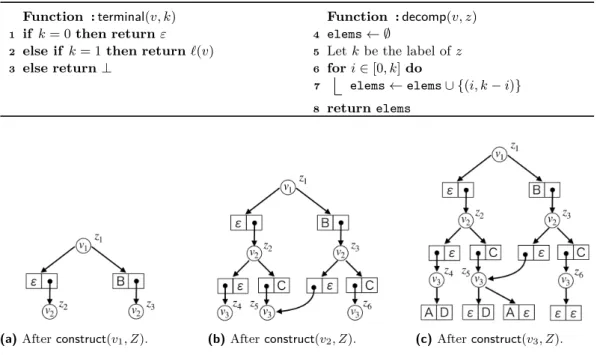
Using the recursive formula, we can design the subroutines of the framework. We use non-negative integers as znode labels. For znodezthat respects vnodev, the label ofz indicates the number of elements that should be adopted fromE(v). Function rootState() returns the root znode with labelk∗, since the desired family isf(vroot, k∗). Algorithm 3 shows the subroutinesterminal(v, k) anddecomp(v, z). terminal(v, k) is obtained from Equation (4). If k= 0, it returnsεsincehεi={∅}(Line 1). If k= 1, it returns`(v) sinceh`(v)i={{`(v)}}
(Line 2). Otherwise, it returns⊥sinceh⊥i=∅(Line 3). Similarly,decomp(v, z) is obtained from Equation (5). The function initializeselemsto the empty set (Line 4). Letkbe the
Algorithm 3 Subroutines for the cardinality constraint. Function :terminal(v, k)
1 if k= 0then returnε 2 else if k= 1then return`(v) 3 else return⊥
Function :decomp(v, z)
4 elems← ∅
5 Letk be the label ofz 6 fori∈[0, k]do
7 elems←elems∪ {(i, k−i)} 8 returnelems
(a)Afterconstruct(v1, Z). (b)Afterconstruct(v2, Z). (c)Afterconstruct(v3, Z). Figure 2Intermediate ZSDDs for the cardinality constraint.
label ofz (Line 5). If the prime has label 0≤i≤k, then the sub has label k−i. Thus, we add the pair (i, k−i) to elems (Lines 6–7). Finally, we return elems (Line 8). The correctness of the algorithm directly follows from the correctness of Lemma 4.
IExample 5. Let us construct a ZSDD that represents the family of subsets of{A, B, C, D}
with exactly two elements. We use the vtree in Figure 1a. First,rootState() creates root znodez1with label 2 and stores it intoZ[v1]. The function then callsconstruct(v1, Z). Z[v1]
contains only one znodez1. Sincez1has label 2,decomp(v1, z1) returns{(0,2),(1,1),(2,0)}.
The function first processes label pair (0,2). Sincevl
1 =v4 is a leaf vnode, the function
callsterminal(v4,0), which returnsε. Sincev1r=v2 is not a leaf vnode, the function calls unique(v2,2, Z). It creates new decomposition znode z2 that respectsv4 and has label 2,
stores it intoZ[v4], and returns its address. Similarly, for label pair (1,1), the corresponding
prime-sub pair is calculated as (B, z3), wherez3 is a new decomposition znode that respects
v2 and has label 1. As for label pair (2,0), since the universe of the prime contains only one
element, we discard this pair. As a result, the function set the prime-sub pairs (ε, z2) and
(B, z3) as child znodes of z1. Figure 2a shows the current intermediate ZSDD. Sincev1l =v4
is a leaf vnode andvr
1=v2 is an internal vnode, the function calls onlyconstruct(v2, Z).
We go on toconstruct(v2, Z). Z[v2] contains two znodesz2andz3. The function processes
z2 first. Since z2 has label 2, decomp(v2, z2) returns {(2,0),(1,1),(0,2)}. However, (0,2)
is discarded because the universe of the sub only contains one element. As a result, the prime-sub pairs are calculated as{(z4, ε),(z5, C)}, wherez4and z5are new decomposition
znodes that respect v3. The labels of z4 and z5 are 2 and 1, respectively. The function
processesz3 next. decomp(v2, z3) returns{(1,0),(0,1)}. Here, znodez5 with label 1 already
exists inZ[v3], and thusunique(v3,1, Z) returnsz5. As a result, the set of prime-sub pairs is {(z5, ε),(z6, C)}, wherez6 is a new znode that respectsv3 and has label 0. Figure 2b shows
the current intermediate ZSDD. Finally,construct(v3, Z) is called and Figure 2c shows the
(a)A graph. (b)Subgraphs.
Figure 3A graph and its subgraphs satisfying a degree constraint.
Using Lemma 4, we can also bound the size of the constructed ZSDD.
ITheorem 6. If αis the ZSDD obtained by Algorithm 3, the size ofαisO(|E|k2).
4.2
Degree
We denote a given degree constraint by function δ∗:V → N, where N is the set of
non-negative integers. For subgraphS ⊆E, we say thatS satisfies δ∗ if deg(S, u) =δ∗(u) holds for allu∈V. For example, for the graph shown in Figure 3a and degree constraintδ∗ such thatδ∗(u1) =δ∗(u4) = 1 andδ∗(u2) =δ∗(u3) = 2, there are two subgraphs satisfyingδ∗as
shown in Figure 3b. GivenG,T, andδ∗, we construct a ZSDD representing the set of all subgraphs satisfyingδ∗. When a subgraph satisfiesδ∗, for every vertexu, the degree ofuin a subgraph must be “exactly”δ∗(u). Although we mainly discuss this “exact” constraint, we can easily modify the algorithm to deal with “at most” or “at least” constraints.
Similarly to Lemma 4, we show a recursive formula for the set of subgraphs satisfying the degree constraint. For vnodev,V(v) denotes the set of vertices to which an edge inE(v) is incident. Let us consider a degree constraint whose domain is limited toV(v) as function δ: V(v)→N. We definef(v, δ) as the family of subsets ofE(v) such that, for allu∈V(v)
andS∈f(v, δ), degree deg(S, u) equalsδ(u). We show a recursive formula forf(v, δ). ILemma 7. Letv be a vnode, andδ be a function fromV(v)to N. Ifv is a leaf vnode, let
u1 andu2 be the endpoints of graph edge`(v). Then, the following hold:
f(v, δ) = {∅} (δ(u1) =δ(u2) = 0) {{`(v)}} (δ(u1) =δ(u2) = 1) ∅ (otherwise) (6)
Ifv is internal, the following is an(E(vl), E(vr))-partition: f(v, δ) = [
(δl,δr)∈P(v,δ)
[f(vl, δl)tf(vr, δr)], (7)
whereP(v, δ)is the set of pairs of functionsδl:V(vl)→Nandδr:V(vr)→Nsuch that
∀u∈V(vl)∩V(vr), δl(u) +δr(u) =δ(u), (8)
∀u∈V(vl)\V(vr), δl(u) =δ(u), (9)
∀u∈V(vr)\V(vl), δr(u) =δ(u). (10)
For vnode v, the frontier of v is F(v) = V(vl)∩V(vr). Let us consider the graph shown in Figure 3a and the degree constraintδ∗, which we defined above. For vnode v, let E(vl) ={A, B, C} andE(vr) ={D, E}. It follows that F(v) is {u
2, u3}. Figure 4a shows
(a)A graph. (b)Prime-sub pairs.
Figure 4A graph and corresponding prime-sub pairs.
respectively. The set of vertices in the shaded area isF(v). We can interpret Equations (7) to (10) as follows. For vertexu∈V(vl)\V(vr),δ(u) edges in E(vl) must be incident tou, and thusδl(u) =δ(u) (Equation (9)). A similar statement holds for vertices inV(vr)\V(vl) (Equation (10)). The remaining vertices are inF(v). For vertexu∈F(v), both edges in E(vl) andE(vr) are incident tou. Here, we guess how many edges inE(vl) are incident to u. This results in generating nine prime-sub pairs, as shown in Figure 4b. We can construct the ZSDD by recursively applying Lemma 7. Here we useδas a label of a znode.
Let us analyze the sizes of ZSDDs constructed by our algorithm. The width of a vtree is maxv∈in(T)V(vl)∩V(vr), where in(T) is the set of internal vnodes.
ITheorem 8. If αis the ZSDD representingf(vroot, δ∗)obtained by our algorithm, the size ofαisO(|E|d2W), whered= max
u∈V δ∗(u) + 1andW is the width of the input vtree. There exists a vtree whose width equals the branch-width of the graph [19]. Given such a vtree, the ZSDD size isO(|E|d2bw(G)), where bw(G) is the branch-width ofG.
4.3
Spanning tree
We construct a ZSDD representing the set of all spanning trees ofG. With a few modifications, we can also construct a ZSDD representing the set of all connected subgraphs. We introduce some notation. If vertices u, u0 are connected in subgraphS ⊆E, we writeu∼S u0. Note that∼S is an equivalence relation onV; an equivalence class (a set of vertices) is aconnected componentofS. Two vertex subsetsC, C0⊆V areconnected if there existu∈Candu0∈C0 withu∼S u0; we write this asC∼S C0. We also writeu∼S C0 ifC∼S C0 forC={u}.
For vnode v, let C be a partition of vertex set F(v), that is, C ={C1, . . . , Cg} where
Ci ⊆ F(v) is a vertex set satisfying Ci ∩Cj = ∅ for i 6= j and Sg
i=1Ci = F(v). Let
R={R1, . . . , Rn}be a disjoint set family defined over vertex sets inC, that is,Ri⊆ Cand
Ri∩Rj =∅ for alli6=j. Let U(R) ={C| ∃i:C∈Ri}. FunctionSame(R, C, C0) returns true if there exists Ri ∈ R such that C, C0 ∈Ri, otherwise false. To represent the set of all spanning trees, we definef(v,C,R) as the set of subgraphs S⊆E(v) satisfying the following:
for every C1, C2∈U(R),C1
S
∼C2holds if and only if Same(R, C1, C2) =true,
for everyC ∈ C \U(R), there exists a uniqueC0 ∈U(R) such thatC∼S C0. Similarly, for every u∈V(v)\F(v), there exists a unique C0∈U(R) such thatu∼S C0, and S does not contain a cycle.
Intuitively,C represents the sets of equivalent vertices. That is, vertices in the same vertex groupC∈ C are regarded to be connected. Rrepresents the connectivity constraints over such equivalent sets of vertices. The first condition above requires that two vertex subsets C and C0 must be connected in S if and only if they appear in the same R ∈ R. The second condition requires that, every equivalent vertex subset appearing inV(v) but does not appear in R must be connected to a vertex subset C0 appearing in R. The third
Algorithm 4 Subroutines for spanning trees. Function :terminal(v,(C,R))
1 Letu1 andu2 be the endpoints of the graph edge`(v) 2 if Same(C, u1, u2) =truethen
3 LetC∈ C be the set containingu1andu2 4 if C∈U(R)then returnεelse return⊥ 5 else
6 LetC1, C2∈ C be the sets containingu1 andu2, respectively 7 if neither C1 norC2 is inU(R)then return⊥
8 else if exactly one ofC1 orC2 is inU(R)then return`(v)
9 else
10 if Same(R, C1, C2) =truethen return`(v)else returnε Function :decomp(v, z)
11 elems← ∅
12 Let (C,R) be the label ofz
13 Cl←C∩F(vl)C∈ C, C∩F(vl)6=∅ ∪
{u}u∈F(vl)\F(v) 14 forRl∈enumPartition(Cl
)do
15 if isCompatible(C,R,Rl) =truethen 16 Cr,Rr←calcSubState(C,R,Rl) 17 elems←elems∪ ((Cl ,Rl ),(Cr ,Rr ))
condition is for acyclicity. The set of all spanning trees of G is f(vroot,C∗,R∗), where C∗={{u} |u∈F(vroot)}andR∗={{C}}for an arbitrary C∈ C∗ since initially there are no equivalent vertices and all vertices must be connected to form a spanning tree.
Unfortunately, it is quite complicated to show a recursive formula forf(v,C,R) and prove it theoretically. Thus, we show pseudo-code of subroutines and explain the behavior using an example. We use (C,R) as a znode label. rootState() returns the root znode label (C∗,R∗). Algorithm 4 shows functionsterminal(v,(C,R)) anddecomp(v, z). terminal(v,(C,R)) returns an appropriate terminal with respect to the label ofz. Let u1 andu2 be the endpoints of
edge`(v). We first consider the case thatu1andu2are contained in the same vertex group
C∈ C (Lines 2–4). IfC6∈U(R),C must be connected to someC0∈U(R). However, now we haveC={C}, and thus there is no suchC0. Therefore, we return⊥. IfC∈U(R), to avoid generating a cycle, we must not adopt edge`(v). Thus we returnε. We next consider the case thatu1 andu2 are contained in different setsC1, C2∈ C(Lines 5–10). If neither C1
norC2 appear in constraintsR, they must be connected to someC0∈U(R), but there are
no suchC0. Thus we return⊥(Line 7). If either ofC1orC2appears inR, the unconstrained
one must be connected with the other one, which has a constraint inR. Thus we return`(v) (Line 8). If bothC1andC2appear inR, we return the corresponding terminal depending on
whether they appear in the sameRi∈ Ror not. If so, edge`(v) must be adopted, and thus we return`(v). Otherwise, the edge must not be adopted, and thus we returnε(Lines 9–10).
We go on todecomp(v, z). We first enumerate all possible set of constraints Rl of the prime. SinceRl is a partition of vertex groups C, functionenumPartition(Cl) enumerates all partitions ofCl. There may be partitions ofCl that are notcompatible with (C,R); If C1 ∈ Ri and C2 ∈ Rj for Ri, Rj ∈ R where i 6= j, they must not appear in the same R∈ Rl. In addition, for every constraintR∈ Rl, a vertex inF(vl) must appear in some C∈Rin order to obtain a spanning tree. If both conditions are satisfied,Rl is compatible with (C,R). FunctionisCompatible(C,R,Rl) returns
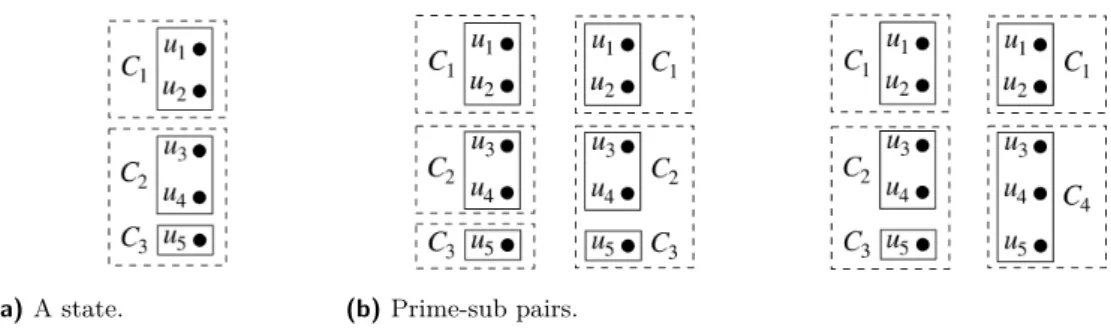
(a)A state. (b)Prime-sub pairs.
Figure 5Label of the connectivity constraint and corresponding prime-sub pairs.
otherwisefalse. calcSubState(C,R,Rl) calculatesCrandRrfrom its arguments. Intuitively,
CrandRr are obtained by updating equivalent vertex groups inC by assuming constraints inRlare satisfied. Let us give an example. Figure 5a shows a label and Figure 5b shows the corresponding prime-sub pairs. Five verticesu1, . . . , u5 are on the frontier. We assume
F(vl) =F(vr) =F(v) in this example. In Figure 5a, the vertices are partitioned into three equivalency groupsC ={C1, C2, C3}, whereC1={u1, u2},C2={u3, u4}, andC3={u5}. C is further partitioned into R = {{C1},{C2, C3}}. C and Rare depicted by solid and
dashed rectangles, respectively. There are only twoRl’s that are compatible with (C,R):
Rl
1 = {{C1},{C2},{C3}} and Rl2 = {{C1},{C2, C3}}. calcSubState(C,R,Rl1) returns
(Cr
1,Rr1), where C1r = {C1, C2, C3} and Rr1 = {{C1},{C2, C3}}. calcSubState(C,R,Rl2)
returns (Cr
2,Rr2), whereC2r={C1, C4},Rr2={{C1},{C4}}, andC4=C2∪C3={u3, u4, u5}.
Finally, the following theorem states the bound of constructed ZSDD size.
ITheorem 9. If αis a ZSDD representing the set of all spanning trees constructed by our top-down algorithm, the size ofαisO(|E|W3W), whereW is the width of the vtree.
As discussed in Section 4.2, there exists a vtree whose width equals the branch-width of the graph. Given such a vtree, the size of a constructed ZSDD isO(|E|bw(G)3bw(G)).
5
Experiments
We conduct experiments to evaluate the performance of the proposed top-down construction algorithms for ZSDDs in the same way as an existing paper [19]. The vtrees for ZSDDs are obtained by a practical algorithm to find a branch decomposition with a small width [6]. To implement the top-down algorithm for ZDDs, we use the top-down algorithm for ZSDDs with a limitation that vtrees must be right-linear. Here, a vtree isright-linear if, for every internal vnode, its left child is a leaf. Since there is a one-to-one correspondence between ZDDs with ZSDDs using right-linear vtrees, by inputting right-linear vtrees, we can simulate ZDD construction. We use two element orders for ZDDs. The first one uses the order obtained by a breadth-first traversal of input graphs, as is used in graphillion [9], a library that implements a top-down construction algorithm for ZDDs. The other one uses the order induced from the vtrees used in the proposed method. Here we say an order is induced if a left-right traversal of a vtree gives the visiting order of variables [22]. We use the benchmark graphs of [19]: TSPLIB and RomeGraph. We constructed ZSDDs representing two types of subgraphs: 1) maximum degree at most two and 2) spanning trees. All code was written in C++ and compiled by g++-5.4.0 with -O3 option. All experiments were conducted on a machine with Intel Xeon W-2133 3.60 GHz CPU and 256 GB RAM.
Table 1Results of constructing ZSDDs and ZDDs representing the set of all subgraphs whose maximum degrees are at most 2.
Time (ms) Size instance |V| |E| TD Z(b) Z(v) TD Z(b) Z(v) att48 48 130 381 6801 2291 194786 1065745 507169 berlin52 52 145 1021 - 36354 807660 - 5229861 eil51 51 142 1012 247736 46524 774280 27277682 5974875 grafo10106 100 119 5 2617 16 2658 15461 7529 grafo10124 100 139 9237 - 40842 3060950 - 3283397 grafo10153 100 136 3784 - 4658 832943 - 561283 grafo10183 100 132 132 - 157837 80127 - 4088915 grafo10184 100 140 4981 - 119366 1006210 - 2002968 grafo10204 100 148 156529 - 303366 15712819 - 19847326 grafo10223 100 135 863 - 5956 330554 - 826121
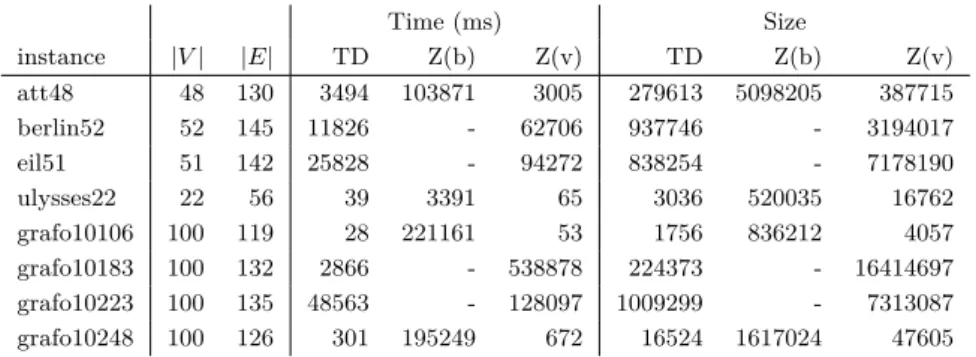
Table 2Results of constructing ZSDDs and ZDDs representing the set of all spanning trees.
Time (ms) Size instance |V| |E| TD Z(b) Z(v) TD Z(b) Z(v) att48 48 130 3494 103871 3005 279613 5098205 387715 berlin52 52 145 11826 - 62706 937746 - 3194017 eil51 51 142 25828 - 94272 838254 - 7178190 ulysses22 22 56 39 3391 65 3036 520035 16762 grafo10106 100 119 28 221161 53 1756 836212 4057 grafo10183 100 132 2866 - 538878 224373 - 16414697 grafo10223 100 135 48563 - 128097 1009299 - 7313087 grafo10248 100 126 301 195249 672 16524 1617024 47605
Tables 1 and 2 show the results. In the tables, TD means the proposed method. Z(b) and Z(v) indicate top-down methods for ZDDs that employ breadth-first ordering and vtree traversing ordering, respectively. The empty fields indicate failure to complete within 600 seconds. We omit the instances for which all the methods finished within a second and at most one method finished within 600 seconds. In almost all cases, TD ran fastest and the sizes of ZSDDs are smaller than those of ZDDs. For example, for spanning trees (Table 2), the time of TD is up to 7898 times faster than Z(b), and 188 times faster than Z(v). The size of TD is up to 476 times smaller than Z(b) and 73 times smaller than Z(v). These results show the efficiency of our method. Using constructed ZDDs and ZSDDs, we can also enumerate subgraphs explicitly in polynomial time per subgraph [15, 18].
6
Concluding remarks
We have proposed a novel framework of algorithms for top-down ZSDD construction. We have shown the solid subroutines for three fundamental constraints: the number of edges, degree of vertices, and connectivity of vertices. We have shown the sizes of constructed ZSDDs can be bounded by the branch-width of the input graph. Experiments confirmed the efficiency of our method. Using Apply operations, we can combine several constraints. For example, we can extract connected subgraphs from ZSDDαby constructing ZSDDβ representing the set of all connected subgraphs and computingα∩β. We believe that our framework can be used to solve various real-world problems.
References
1 Etienne Birmelé, Rui A. Ferreira, Roberto Grossi, Andrea Marino, Nadia Pisanti, Romeo Rizzi, and Gustavo Sacomoto. Optimal listing of cycles and st-paths in undirected graphs. In Sanjeev Khanna, editor,Proceedings of the Twenty-Fourth Annual ACM-SIAM Symposium on Discrete Algorithms, SODA 2013, New Orleans, Louisiana, USA, January 6-8, 2013, pages 1884–1896. SIAM, 2013. doi:10.1137/1.9781611973105.134.
2 Hans L. Bodlaender. A partialk-arboretum of graphs with bounded treewidth.Theor. Comput. Sci., 209(1-2):1–45, 1998. doi:10.1016/S0304-3975(97)00228-4.
3 Simone Bova. Sdds are exponentially more succinct than obdds. In Dale Schuurmans and Michael P. Wellman, editors, Proceedings of the Thirtieth AAAI Conference on Artificial Intelligence, February 12-17, 2016, Phoenix, Arizona, USA, pages 929–935. AAAI Press, 2016.
URL:http://www.aaai.org/ocs/index.php/AAAI/AAAI16/paper/view/12270.
4 Randal E. Bryant. Graph-based algorithms for boolean function manipulation. IEEE Trans. Computers, 35(8):677–691, 1986. doi:10.1109/TC.1986.1676819.
5 Alessio Conte, Roberto Grossi, Andrea Marino, and Luca Versari. Sublinear-space bounded-delay enumeration for massive network analytics: Maximal cliques. In Ioannis Chatzigiannakis, Michael Mitzenmacher, Yuval Rabani, and Davide Sangiorgi, editors, 43rd International Colloquium on Automata, Languages, and Programming, ICALP 2016, July 11-15, 2016, Rome, Italy, volume 55 ofLIPIcs, pages 148:1–148:15. Schloss Dagstuhl - Leibniz-Zentrum für Informatik, 2016. doi:10.4230/LIPIcs.ICALP.2016.148.
6 William J. Cook and Paul D. Seymour. Tour merging via branch-decomposition. INFORMS J. Comput., 15(3):233–248, 2003. doi:10.1287/ijoc.15.3.233.16078.
7 Gary Hardy, Corinne Lucet, and Nikolaos Limnios. K-terminal network reliability measures with binary decision diagrams. IEEE Trans. Reliability, 56(3):506–515, 2007. doi:10.1109/ TR.2007.898572.
8 Hiroshi Imai, Kyoko Sekine, and Keiko Imai. Computational investigations of all-terminal network reliability via BDDs. IEICE Transactions on Fundamentals of Electronics, Commu-nications and Computer Sciences, E82-A:714–721, 1999.
9 Takeru Inoue, Hiroaki Iwashita, Jun Kawahara, and Shin-ichi Minato. Graphillion: software library for very large sets of labeled graphs. Int. J. Softw. Tools Technol. Transf., 18(1):57–66, 2016. doi:10.1007/s10009-014-0352-z.
10 Takeru Inoue, Keiji Takano, Takayuki Watanabe, Jun Kawahara, Ryo Yoshinaka, Akihiro Kishimoto, Koji Tsuda, Shin-ichi Minato, and Yasuhiro Hayashi. Distribution loss minimization with guaranteed error bound. IEEE Trans. Smart Grid, 5(1):102–111, 2014. doi:10.1109/ TSG.2013.2288976.
11 Yuma Inoue and Shin-ichi Minato. Acceleration of ZDD construction for subgraph enumeration via path-width optimization. TCS-TR-A-16-80. Hokkaido University, 2016.
12 Jun Kawahara, Takashi Horiyama, Keisuke Hotta, and Shin-ichi Minato. Generating all patterns of graph partitions within a disparity bound. In Sheung-Hung Poon, Md. Saidur Rahman, and Hsu-Chun Yen, editors,WALCOM: Algorithms and Computation, 11th Inter-national Conference and Workshops, WALCOM 2017, Hsinchu, Taiwan, March 29-31, 2017, Proceedings, volume 10167 ofLecture Notes in Computer Science, pages 119–131. Springer, 2017. doi:10.1007/978-3-319-53925-6_10.
13 Jun Kawahara, Takeru Inoue, Hiroaki Iwashita, and Shin-ichi Minato. Frontier-based search for enumerating all constrained subgraphs with compressed representation.IEICE Transactions on Fundamentals of Electronics, Communications and Computer Sciences, E100-A(9):1773–1784, 2017.
14 Donald E. Knuth. The art of computer programming, Vol. 4A, Combinatorial algorithms, Part 1. Addison-Wesley Professional, 1st edition, 2011.
15 Shin-ichi Minato. Zero-suppressed bdds for set manipulation in combinatorial problems. In Alfred E. Dunlop, editor,Proceedings of the 30th Design Automation Conference. Dallas, Texas, USA, June 14-18, 1993, pages 272–277. ACM Press, 1993. doi:10.1145/157485.164890.
16 Yu Nakahata, Jun Kawahara, Takashi Horiyama, and Shoji Kasahara. Enumerating all spanning shortest path forests with distance and capacity constraints. IEICE Transactions on Fundamentals of Electronics, Communications and Computer Sciences, E101-A(9):1363–1374, 2018.
17 Yu Nakahata, Jun Kawahara, and Shoji Kasahara. Enumerating graph partitions without too small connected components using zero-suppressed binary and ternary decision diagrams. In Gianlorenzo D’Angelo, editor,17th International Symposium on Experimental Algorithms, SEA 2018, June 27-29, 2018, L’Aquila, Italy, volume 103 ofLIPIcs, pages 21:1–21:13. Schloss Dagstuhl - Leibniz-Zentrum für Informatik, 2018. doi:10.4230/LIPIcs.SEA.2018.21. 18 Masaaki Nishino, Norihito Yasuda, Shin-ichi Minato, and Masaaki Nagata. Zero-suppressed
sentential decision diagrams. In Dale Schuurmans and Michael P. Wellman, editors,Proceedings of the Thirtieth AAAI Conference on Artificial Intelligence, February 12-17, 2016, Phoenix, Arizona, USA, pages 1058–1066. AAAI Press, 2016. URL:http://www.aaai.org/ocs/index.
php/AAAI/AAAI16/paper/view/12434.
19 Masaaki Nishino, Norihito Yasuda, Shin-ichi Minato, and Masaaki Nagata. Compiling graph substructures into sentential decision diagrams. In Satinder P. Singh and Shaul Markovitch, editors,Proceedings of the Thirty-First AAAI Conference on Artificial Intelligence, February 4-9, 2017, San Francisco, California, USA, pages 1213–1221. AAAI Press, 2017. URL:
http://aaai.org/ocs/index.php/AAAI/AAAI17/paper/view/14919.
20 Kyoko Sekine, Hiroshi Imai, and Seiichiro Tani. Computing the tutte polynomial of a graph of moderate size. In John Staples, Peter Eades, Naoki Katoh, and Alistair Moffat, editors, Algorithms and Computation, 6th International Symposium, ISAAC ’95, Cairns, Australia, December 4-6, 1995, Proceedings, volume 1004 ofLecture Notes in Computer Science, pages 224–233. Springer, 1995. doi:10.1007/BFb0015427.
21 Akiyoshi Shioura, Akihisa Tamura, and Takeaki Uno. An optimal algorithm for scanning all spanning trees of undirected graphs. SIAM J. Comput., 26(3):678–692, 1997. doi: 10.1137/S0097539794270881.
22 Yexiang Xue, Arthur Choi, and Adnan Darwiche. Basing decisions on sentences in decision diagrams. In Jörg Hoffmann and Bart Selman, editors,Proceedings of the Twenty-Sixth AAAI Conference on Artificial Intelligence, July 22-26, 2012, Toronto, Ontario, Canada. AAAI Press, 2012. URL:http://www.aaai.org/ocs/index.php/AAAI/AAAI12/paper/view/4977.