Qazi, Abroon and Dickson, Alex and Quigley, John and Gaudenzi,
Barbara (2018) Supply chain risk network management : a bayesian
belief network and expected utility based approach for managing supply
chain risks. International Journal of Production Economics. pp. 24-42.
ISSN 0925-5273 , http://dx.doi.org/10.1016/j.ijpe.2017.11.008
This version is available at
https://strathprints.strath.ac.uk/62225/
Strathprints is designed to allow users to access the research output of the University of Strathclyde. Unless otherwise explicitly stated on the manuscript, Copyright © and Moral Rights for the papers on this site are retained by the individual authors and/or other copyright owners. Please check the manuscript for details of any other licences that may have been applied. You may not engage in further distribution of the material for any profitmaking activities or any
commercial gain. You may freely distribute both the url (https://strathprints.strath.ac.uk/) and the
content of this paper for research or private study, educational, or not-for-profit purposes without prior permission or charge.
Any correspondence concerning this service should be sent to the Strathprints administrator:
The Strathprints institutional repository (https://strathprints.strath.ac.uk) is a digital archive of University of Strathclyde research outputs. It has been developed to disseminate open access research outputs, expose data about those outputs, and enable the
Supply Chain Risk Network Management: A Bayesian Belief Network and
Expected Utility Based Approach for Managing Supply Chain Risks
Abroon Qazia,∗, Alex Dicksonb, John Quigleya, Barbara Gaudenzic a
Department of Management Science, University of Strathclyde, William Duncan Building, 130 Rottenrow, Glasgow, G4 0GE, Scotland
b
Department of Economics, University of Strathclyde, William Duncan Building, 130 Rottenrow, Glasgow, G4 0GE, Scotland
c
Department of Business Administration, University of Verona, Via Cantarane 24, Verona, Italy
∗Corresponding author
Email addresses: [email protected](Abroon Qazi),[email protected](Alex Dickson),
[email protected](John Quigley),[email protected](Barbara Gaudenzi)
*Title page including author details
Bayesian Belief Networks Expected Utility Theory
Safety and Reliability Engineering Multi-Criteria Decision Analysis
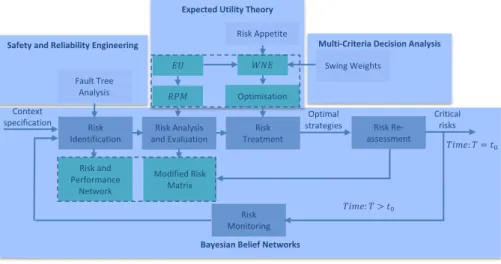
Risk Identification Risk Analysis and Evaluation Risk Treatment Context specification Optimisation Critical risks Risk Re-assessment Fault Tree Analysis Risk Monitoring Risk Appetite Swing Weights Risk and Performance Network Modified Risk Matrix Optimal strategies Graphical Abstracts (for review)
Highlights
• A SCRM process integrating all stages of the risk management process is proposed and
opera-tionalised.
• The operationalisation scheme adapts and integrates various techniques from diversified research
areas.
• ‘Probability-conditional expected utility’ matrix is introduced to assess interdependent risks.
• ‘Weighted net evaluation of risk mitigation’ is proposed to capture the decision maker’s risk
appetite.
• Propositions are introduced to elucidate the significance of modelling interdependent risks.
1 2 3 4 5 6 7 8 9 10 11 12 13 14 15 16 17 18 19 20 21 22 23 24 25 26 27 28 29 30 31 32 33 34 35 36 37 38 39 40 41 42 43 44 45 46 47 48 49 50 51 52 53 54 55 56 57 58 59 60 61 62
Supply Chain Risk Network Management: A Bayesian Belief Network and
Expected Utility Based Approach for Managing Supply Chain Risks
Abstract
The paper develops and operationalises a supply chain risk network management (SCRNM) process that captures interdependencies between risks, multiple (potentially conflicting) performance measures and risk mitigation strategies within a (risk) network setting. The process helps in prioritising risks and strategies specific to the decision maker’s risk appetite. The process is demonstrated through a case study conducted in a global manufacturing supply chain involving semi-structured interviews and focus group sessions with experts in risk management. Theoretically grounded in the framework of Bayesian Belief Networks (BBNs) and Expected Utility Theory (EUT), the modelling approach has a number of distinctive characteristics. It utilises a top-down approach of Fault Tree Analysis (FTA). Performance measures are identified first and subsequently connected to risks. A ‘probability-conditional expected utility’ matrix is introduced to reflect the propagation impact of interdependent risks on all performance measures identified. A ‘weighted net evaluation of risk mitigation’ method is proposed and the method of ‘swing weights’ is used to capture the trade-off between the efficacy of strategies and the associated cost keeping in view the decision maker’s risk appetite. The approach adapts and integrates techniques from safety and reliability engineering (FTA), decision making under uncertainty (EUT), and multi-criteria decision analysis (swing weights). The merits and challenges associated with the implementation of interdependency based frameworks are discussed. Propositions are presented to elucidate the significance of modelling interdependency between risks and strategies.
Keywords: Supply Chain Risk Network Management, Interdependencies, Multiple Performance
Mea-sures, Risk Mitigation Strategies, Bayesian Belief Networks, Expected Utility.
1. Introduction
Aiming for competitive advantage, firms operating across the global marketplace are exposed to considerable risk (Tang & Tomlin, 2008; Christopher et al., 2011; Blos & Miyagi, 2015). The com-mencement of research in supply chain risk management (SCRM) dates back to the early years of 21stcentury (Harland et al., 2003; Christopher & Peck, 2004; Manuj & Mentzer, 2008). There is an extensive literature on SCRM that considers conceptual theory building facets as well as empirical investigations of best practice in managing risks. This literature has been well-considered in numerous literature reviews (J¨uttner et al., 2003; Tang, 2006; Tang & Nurmaya Musa, 2011; Colicchia & Strozzi, 2012; Heckmann et al., 2015). There are two major research gaps that necessitate immediate attention: first, the existing SCRM processes/frameworks have limited focus on the interdependency modelling
*Manuscript
1 2 3 4 5 6 7 8 9 10 11 12 13 14 15 16 17 18 19 20 21 22 23 24 25 26 27 28 29 30 31 32 33 34 35 36 37 38 39 40 41 42 43 44 45 46 47 48 49 50 51 52 53 54 55 56 57 58 59 60 61 62
of risks (Colicchia & Strozzi, 2012; Garvey et al., 2015; Ho et al., 2015; Qazi et al., 2017); and second, the risk appetite of a decision maker is not exclusively captured in general while prioritising risks and risk mitigation strategies (Heckmann et al., 2015).
Supply chains operate within an integrated setting of interdependent firms and even within a single firm, entities and risks are not isolated; rather, there are complex chains of interaction. Classification of supply chain risks has been explored comprehensively resulting in identification of independent categories of risks for aiding the risk identification stage of the SCRM process (Manuj & Mentzer, 2008; Ho et al., 2015; Heckmann et al., 2015). However, risk identification must involve different stakeholders and capture the interdependent interaction between risks ranging across the entire supply network (Ackermann et al., 2014). Current risk classification schemes and methods investigating optimal treatment of individual risks can prove to be sub-optimal if there are correlations between risks and strategies (Garvey et al., 2015). According to Ho et al. (2015): “Investigating the joint impact of such risks can lead to better management of supply chains than treating each risk type in isolation. ... However, there is lack of research measuring the correlations between risk factors and corresponding risk types, or the probability of occurrence of particular risk types associated with their
factors” (Ho et al., 2015, p. 5060).
The risk appetite of a decision maker drives the tolerance level with respect to the acceptance of risks and therefore, it is extremely important to integrate risk appetite within the decision making
framework. According to Heckmann et al. (2015, p. 127): “The decision maker’s degree of acceptance
with respect to the deterioration of target-values defines his attitude towards supply chain risk. Risk-averse supply chain managers only accept a minor deterioration of target values of an efficiency- (or ) based supply chain goal in exchange for the adherence or increase of an effectiveness-(or efficiency-) based supply chain goal. Risk-seeking decision makers, however, accept higher degrees of value deterioration of a specific goal in exchange for the adherence or increase of an opposite one.
Risk-neutral supply chain managers prefer neither of the two objective types”. Very few frameworks in
SCRM have captured the risk appetite of a decision maker, and where they have risks are treated as independent (Knemeyer et al., 2009; Lavastre et al., 2012). To the best of the authors’ knowledge, no existing study has ever investigated designing a risk management framework within a network setting of interacting risks in which the risk appetite of a decision maker is taken into account.
Risk mitigation strategies are implemented in order to reduce the likelihood of occurrence and/or negative impact of risks (Tang & Tomlin, 2008). Robust strategies must be developed in order to help firms reduce cost and/or improve customer satisfaction under normal conditions and enable firms to sustain operations during and after the occurrence of a disruption (Tang, 2006). Despite the significance of evaluating risk mitigation strategies specific to a portfolio of supply chain risks, very few studies have proposed tools to prioritise strategies subject to a budget constraint (Micheli et al., 2014; Aqlan
1 2 3 4 5 6 7 8 9 10 11 12 13 14 15 16 17 18 19 20 21 22 23 24 25 26 27 28 29 30 31 32 33 34 35 36 37 38 39 40 41 42 43 44 45 46 47 48 49 50 51 52 53 54 55 56 57 58 59 60 61 62
& Lam, 2015; Qazi et al., 2017), and where they have risk preferences have not been taken into account. Although Expected Utility Theory (EUT) provides a standardised normative framework to make decisions under uncertainty, it is not so much used in practice mainly because of the difficulty associated with assigning utility values to all possible outcomes (Aven & Kristensen, 2005).
A number of established techniques have been utilised to identify, assess and treat supply chain risks (Colicchia & Strozzi, 2012; Ho et al., 2015). Fault Tree Analysis (FTA) being widely used in the literature on system safety and reliability engineering (Ashrafi et al., 2015) is considered an effective technique for managing supply chain risks (Oehmen et al., 2009; Sherwin et al., 2016). The technique is used to identify a top event (occurrence of a risk) and develop a network of causal factors leading to the top event. It can serve as a useful framework for identifying performance measures (top events) and developing a risk network (comprising supply chain risks) leading to the performance measures. However, there is a need to overcome the limitation of FTA by means of modelling common cause factors within the risk network. Bayesian Belief Networks (BBNs) provide a very useful framework for capturing probabilistic interdependency between uncertain variables and some recent studies have proposed BBN based frameworks to model and assess supply chain risks (Garvey et al., 2015; Qazi et al., 2017).
There are several contributions of this paper. First, we develop and operationalise a supply chain risk network management (SCRNM) process that captures interdependencies between risks, multi-ple (potentially conflicting) performance measures and risk mitigation strategies helping to prioritise risks and strategies specific to the decision maker’s risk appetite, and demonstrate its application through a case study. Second, the proposed operationalisation scheme adapts established techniques from safety and reliability engineering, decision making under uncertainty and multi-criteria decision analysis, and integrates these together across different stages of the risk management process: risk identification- BBNs and FTA are utilised to develop a risk and performance network thereby cap-turing interdependency between risks (including common cause failures) and focussing exclusively on material risks specific to the performance measures identified; risk analysis- BBNs and EUT are used to assess and map risks on the proposed ‘probability-conditional expected utility’ matrix in order to capture the impact of risks on all performance measures rather than a single monetary measure used in the conventional risk matrix based tools; risk treatment- ‘weighted net evaluation of risk mitigation’ is introduced and the method of ‘swing weights’ (Belton & Stewart, 2002) utilised to establish the trade-off between efficacy of potential risk mitigation strategies and the associated cost considering the decision maker’s risk appetite. There is an added benefit of the process as besides modelling interde-pendency between risks, the utility for both risk appetite and trade-off across performance measures is exclusively captured whereas modelling these features in silo would undermine the integrated effect of complex interactions involved. Third, we present merits and challenges associated with the
1 2 3 4 5 6 7 8 9 10 11 12 13 14 15 16 17 18 19 20 21 22 23 24 25 26 27 28 29 30 31 32 33 34 35 36 37 38 39 40 41 42 43 44 45 46 47 48 49 50 51 52 53 54 55 56 57 58 59 60 61 62 “C‘M Demonstration Research Focus Supply Chain Risk Management Integrated Process for interdependent risks and stages
Bayesian Belief Networks Case Study Component Manufacturing Supply Chain in Aerospace Industry Risk Appetite of the Decision Maker Proposed Process (Supply Chain Risk Network Management) Expected Utility Theory
Figure 1: Research focus and methodology.
mentation of such interdependency based frameworks. Fourth, we develop propositions to elucidate the importance of accounting for interdependence of risks and risk mitigation strategies.
Responding to the call for developing and empirically evaluating a SCRM process that not only captures interdependency between risks but also integrates all stages of the process (Colicchia & Strozzi, 2012; Ho et al., 2015), we address the following research questions in this study:
RQ1: How can we develop and operationalise a SCRM process that captures interdependencies between risks, multiple (potentially conflicting) objectives (performance measures) and risk mitigation strategies specific to the risk appetite of a decision maker?
RQ2: What are the merits and challenges associated with the implementation of the proposed process?
An overview of the research focus and the methodology adopted is shown in Figure 1. The remainder of the paper is organised as follows: An overview of the relevant literature is presented in Section 2. The proposed process and the methodology are described in Sections 3 and 4, respectively. The case study conducted for demonstrating the application of the proposed process is presented in Section 5. We discuss the implications of our findings and introduce propositions in Section 6. Finally, we present conclusions and directions for future research in Section 7.
1 2 3 4 5 6 7 8 9 10 11 12 13 14 15 16 17 18 19 20 21 22 23 24 25 26 27 28 29 30 31 32 33 34 35 36 37 38 39 40 41 42 43 44 45 46 47 48 49 50 51 52 53 54 55 56 57 58 59 60 61 62 2. Literature Review
In the following sections, we give an overview of the literature on supply chain risk management process and interdependency modelling of supply chain risks.
2.1. Supply Chain Risk Management Process/Framework
SCRM is“the identification and management of risks for the supply chain, through a co-ordinated
approach amongst supply chain members, to reduce supply chain vulnerability as a whole” (J¨uttner
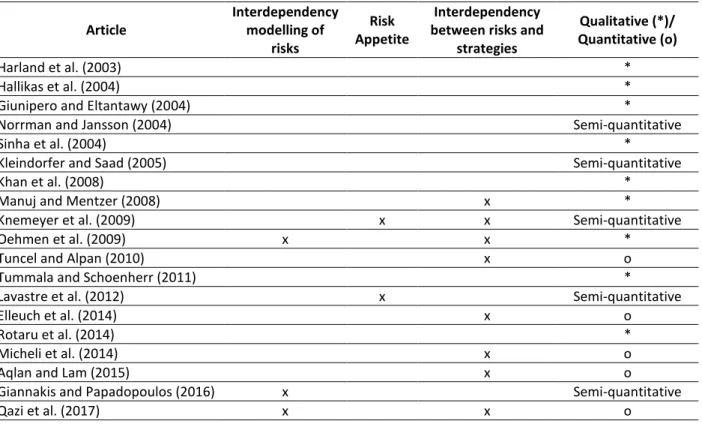
et al., 2003, p. 201). Several risk management frameworks have been proposed using different ter-minology; however, there is a consensus that a SCRM process involves five sequential stages: risk identification; assessment; analysis; treatment; and monitoring (Giannakis & Papadopoulos, 2016). Selected articles conforming to the research focus of the paper (see Figure 1) have been classified into four categories including interdependency modelling of risks, the risk appetite of a decision maker, interdependency between risks and strategies, and research methodology as shown in Table A.1 (see Appendix A).
Ritchie & Brindley (2007) identified five components of a SCRM process: risk drivers (primary and secondary level); risk management influencers (rewards, supply chain risks, timescales, portfolio); decision maker characteristics (perceptions, risk profile, attitudes, experiences); risk management re-sponses (risk taking, avoidance, mitigation, monitoring); and performance outcomes (profit related, strategic positioning, personal). We will briefly describe the merits of some of the frameworks proposed in the literature, and delineate the main limitations of these.
A number of qualitative frameworks have been proposed to identify risks and prescribe generalised strategies to deal with important risks. These frameworks generally utilise qualitative scales to discre-tise the conventional risk matrix across the probability and impact levels. Utilising a Failure Modes and Effects Analysis (FMEA) based technique, Sinha et al. (2004) developed a process to manage risks in the aerospace industry whereas Giannakis & Papadopoulos (2016) proposed a risk management pro-cess to identify and manage sustainability related risks across the environmental, social and economic facets with its application demonstrated through empirical case studies and a survey questionnaire. Khan et al. (2008) reported the conventional risk matrix based process used in a major UK retailer that helps the company deal with design oriented supply chain risks. Bringing the perspective of a global supply chain and consolidating the concepts from logistics, supply chain management, operations management, strategy and international business management, Manuj & Mentzer (2008) proposed a procedure to help global supply chain managers identify risks and select appropriate strategies.
Quantitative frameworks have utilised hybrid methods to assess and manage risks. For example, Elleuch et al. (2014) combined FMEA, design of experiments, discrete event simulation, Analytical Hierarchy Process (AHP) and desirability function approach to develop a process and applied it to a
1 2 3 4 5 6 7 8 9 10 11 12 13 14 15 16 17 18 19 20 21 22 23 24 25 26 27 28 29 30 31 32 33 34 35 36 37 38 39 40 41 42 43 44 45 46 47 48 49 50 51 52 53 54 55 56 57 58 59 60 61 62
pharmaceutical supply chain case study. Similarly, Aqlan & Lam (2015) proposed a hybrid approach of bow-tie analysis and stochastic integer programming to identify critical risks and assess suitable strategies taking into account their cost and effectiveness in reducing the risk exposure. Systems thinking has also been applied to develop a comprehensive process both in its qualitative (Oehmen et al., 2009) and quantitative forms (Ghadge et al., 2013).
There are mainly three limitations of the existing frameworks including the aforementioned studies. First, the frameworks have drawn limited focus on modelling the common cause failures and assessing their propagation impact. As such common cause failures can have a far reaching impact on the efficiency of a supply network, there is a need to model and evaluate such factors (Ho et al., 2015). Second, researchers generally focus on limited stages of the risk management process whereas “there is a significant relationship between all SCRM processes, (therefore) more attention should be given to legitimately integrated processes instead of individual or fragmented processes. ... Similarly, the effectiveness of risk mitigation strategies requires explicit quantification of effectiveness and efficiency
of such strategies” (Ho et al., 2015, p. 5053). Third, there has been a very limited focus on the need for
integrating risk appetite in the risk management process as Heckmann et al. (2015) argue that“More advanced (context-sensitive) approaches especially with respect to the risk attitude of the decision maker
and with respect to the environment of the affected supply chain are needed” (Heckmann et al., 2015, p.
130). We endeavour to fill the mentioned gaps by developing and empirically evaluating an integrated SCRNM process to establish how practitioners perceive correlations between risks specific to their risk appetite and whether they are able to evaluate the impact of risk mitigation strategies on the network of risks.
2.2. Interdependency Modelling of Supply Chain Risks
Various models have been proposed to capture interdependency between supply chain risks. In-terpretive structural modelling (ISM) is a hierarchy based technique that establishes the order and direction of complex relationships among elements of a system. It has been used to determine causal relationships between risk mitigation strategies (Faisal et al., 2006) and supply chain risks (Pfohl et al., 2011). Related to the same family of causal mapping techniques, fishbone diagram has been utilised to identify cause-effect relationships between risks (Lin & Zhou, 2011). Mapping a supply network as a web of interconnected nodes, measures from the Social Network Analysis have been adapted to identify critical supply nodes (Kim et al., 2011). The main limitation of aforementioned techniques is the inability to capture the strength of interdependency between risks.
AHP is a technique to conduct pair-wise comparisons between variables and identify their relative importance. Its application varies from the risk assessment of suppliers (Ganguly, 2014) to the pri-oritisation of supply chain performance measures (Gaudenzi & Borghesi, 2006). FMEA is a technique to prioritise risks depending on the relative product of probability, severity and detectability
1 2 3 4 5 6 7 8 9 10 11 12 13 14 15 16 17 18 19 20 21 22 23 24 25 26 27 28 29 30 31 32 33 34 35 36 37 38 39 40 41 42 43 44 45 46 47 48 49 50 51 52 53 54 55 56 57 58 59 60 61 62
ated with each risk. It has been extensively used in SCRM to identify critical risks (Nepal & Yadav, 2015; Dong & Cooper, 2016). Similarly, utilising established techniques from the field of reliability engineering, Aqlan & Lam (2015) proposed a bow-tie analysis based process to capture the interde-pendency of supply chain risks whereas Oehmen et al. (2009) and Sherwin et al. (2016) introduced FTA based frameworks to assess risks. The main problem with these techniques is their limited focus on capturing common cause failures. Although the conventional FTA does not capture common cause failures, the technique following a top-down approach is helpful in terms of brainstorming the causes of a consequence and is widely used in the literature on engineering risk management (Sherwin et al., 2016).
Mainly, supply chain risks are classified into distinct categories like process, control, demand, supply and environmental risks (Christopher & Peck, 2004). The first two risk categories relate to factors internal to an organisation, the third and fourth include factors internal to the supply chain, but external to the organisation and the fifth category relates to factors external to the supply chain. Similar to the concept of mapping causal chains in project risk management (Ackermann et al., 2014), Badurdeen et al. (2014) proposed a risk taxonomy capturing interdependency between supply chain risks that is in contrast with the established classification schemes.
In response to the call for understanding the relationships between a set of strategies for managing risks and corresponding impact on performance measures (Colicchia & Strozzi, 2012), a few models have been developed (Micheli et al., 2014; Aqlan & Lam, 2015); however, these models do not explicitly
capture interdependency between risks. Another issue relates to the focus of these models on
“min-imising cost or max“min-imising profit as a single objective” (Colicchia & Strozzi, 2012, p. 412) as “purely
cost-and waste-considering objectives, however, evaluate supply chain’s performance in retrospect. They miss to assess both operational effectiveness and important strategic achievements like product quality
and customer satisfaction” (Heckmann et al., 2015, p. 130). In this study, we overcome the limitation
of earlier studies by not only capturing interdependencies between risks but also across the entire risk management process. We also consider optimising a set of potentially conflicting performance measures within an interdependent setting of interacting risks and strategies, and propose a new technique for prioritising risk mitigation strategies subject to a budget constraint.
2.2.1. Application of Bayesian Belief Networks in Supply Chain Risk Management
BBNs offer a unique feature of modelling risks combining both the statistical data and subjective judgement in case of non-availability of data (Sigurdsson et al., 2001; Kelangath et al., 2011). Although BBNs have been extensively used in the field of risk management (Norrington et al., 2008), their application to the field of SCRM is mainly focussed on addressing specific problems involving supplier selection, supplier assessment and ranking of suppliers. Recently, few models have been proposed to capture the supply network-wide web of risks. However, existing approaches have not considered
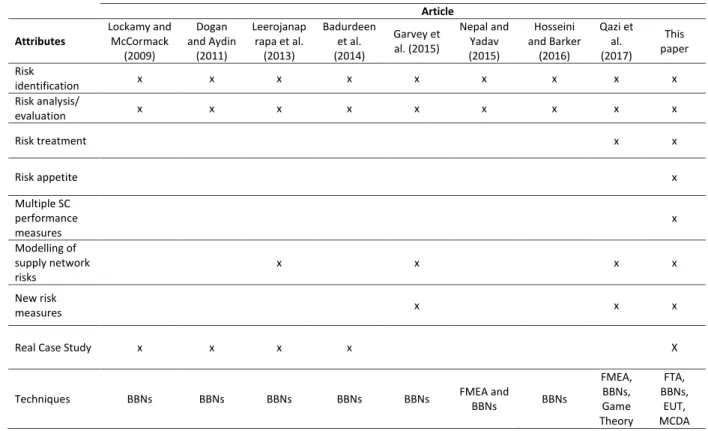
1 2 3 4 5 6 7 8 9 10 11 12 13 14 15 16 17 18 19 20 21 22 23 24 25 26 27 28 29 30 31 32 33 34 35 36 37 38 39 40 41 42 43 44 45 46 47 48 49 50 51 52 53 54 55 56 57 58 59 60 61 62 Article Attributes Lockamy and McCormack (2009) Dogan and Aydin (2011) Leerojanap rapa et al. (2013) Badurdeen et al. (2014) Garvey et al. (2015) Nepal and Yadav (2015) Hosseini and Barker (2016) Qazi et al. (2017) This paper Risk identification x x x x x x x x x Risk analysis/ evaluation x x x x x x x x x Risk treatment x x Risk appetite x Multiple SC performance measures x Modelling of supply network risks x x x x New risk measures x x x
Real Case Study x x x x X
Techniques BBNs BBNs BBNs BBNs BBNs FMEA and
BBNs BBNs FMEA, BBNs, Game Theory FTA, BBNs, EUT, MCDA
Table 1: Comparison of the Proposed Approach with Existing BBN Based SCRM Models.
framing and operationalising a comprehensive risk management process integrating suitable techniques across all stages of the process. Furthermore, the merits and challenges involved in implementing such a framework remain unexplored. A comparison of the merits of this paper with existing studies is presented in Table 1.
Lockamy & McCormack (2009) developed a model for benchmarking supplier risks involving risk events related to supplier network, internal operations and external factors. They used surveys and interviews for collection of data from both the internal and external company sources and applied the model on a group of 15 automotive casting suppliers for a major automotive company in US. Similarly, Badurdeen et al. (2014) proposed a tool for assessing supply risks and conducted sensitivity analysis to help Boeing company benchmark its Tier 1 suppliers. Addressing the supplier selection problem, Dogan & Aydin (2011) developed a model combining Total Cost of Ownership and BBN methods and applied it in automotive industry to help Tier 1 suppliers select their own suppliers whereas Hosseini & Barker (2016) introduced a framework focussing on resilience-based supplier criteria. The main problem with the utility of these models relates to their exclusive focus on a specific problem without adapting BBNs to the realm of SCRM and capturing complex nature of interdependent supply chain risks. For example, the criteria related to the supplier selection or benchmarking process are well established and BBNs can readily be applied to formulate a network structure without any adaptation. However, in the case of modelling interdependent risks across a supply chain, there is an added complexity involved in
1 2 3 4 5 6 7 8 9 10 11 12 13 14 15 16 17 18 19 20 21 22 23 24 25 26 27 28 29 30 31 32 33 34 35 36 37 38 39 40 41 42 43 44 45 46 47 48 49 50 51 52 53 54 55 56 57 58 59 60 61 62
establishing the network structure that necessitates adapting BBNs to the context of SCRM whereas the literature does not provide an illustration of developing such models.
Leerojanaprapa et al. (2013) and Leerojanaprapa (2014) proposed a generic BBN modelling pro-cess to support supply chain risk analysis based on expert knowledge and conducted a case study in the medical supply chain to demonstrate its efficacy. In their effort to capture the probabilistic interdependency between supply chain risks, Garvey et al. (2015) introduced an algorithm to map risks and proposed supply chain risk measures. The main limitation of these studies is their focus on limited stages of the risk management process and ignoring the risk appetite of a decision maker. Also, modelling of risks in accordance with the process flow of a supply chain makes it infeasible to capture risks relating to substantial supply networks. However, these studies serve to illustrate the efficacy of BBNs in modelling and managing supply chain risks as BBNs can effectively measure the propa-gation impact of these risks within a network setting. Utilising BBNs, Qazi et al. (2017) introduced probabilistic supply chain risk measures to prioritise interdependent risks and strategies. Although one of the measures introduced captures an aversion to risk, the entire risk management process does not explicitly model the risk attitude (utility) of a decision maker and also, the process only helps in optimising a portfolio of strategies specific to a single performance measure (objective) rather than considering multiple (potentially conflicting) measures (objectives). We endeavour to fill these gaps through introducing and operationalising a comprehensive SCRNM process that adapts key features of established techniques from safety and reliability engineering, decision making under uncertainty and multi-criteria decision analysis to the context of SCRM.
3. Proposed SCRNM Process
There are many studies in the literature with exclusive focus on the impact of supply chain risks on performance measures (J¨uttner et al., 2003; Zhao et al., 2013), however, the main limitation of these studies is modelling risks in silo whereas we focus on modelling a risk network and evaluating its holistic impact on performance measures. We also capture the moderating effect of a risk management process through modelling risk mitigation strategies within the risk network. Therefore, the established framework proposed by J¨uttner et al. (2003) is modified to account for the holistic (negative) impact of a supply chain risk network on (potentially conflicting) supply chain performance measures as shown in Figure 2. Also, the efficacy of a risk management process influences the impact of a risk network on performance measures as selecting effective strategies would mitigate the consequence of risks. The steps involved in the risk management process are shown in Figure 3. Like the standard risk management process (SA, 2009), the proposed process starts with establishing the context in terms of defining the scope of the supply chain and its boundaries. The main purpose of the modelling and analysis is ascertained through interviewing the decision maker or the main stakeholders. The decision
1 2 3 4 5 6 7 8 9 10 11 12 13 14 15 16 17 18 19 20 21 22 23 24 25 26 27 28 29 30 31 32 33 34 35 36 37 38 39 40 41 42 43 44 45 46 47 48 49 50 51 52 53 54 55 56 57 58 59 60 61 62
A risk management process integrating a web of interacting risks and performance measures
Supply Chain Performance
Supply Chain Risks
Efficacy of Supply Chain Risk Management
Process
P C‘ M
( - ) ( - )
Figure 2: Supply chain risk management framework (adapted from J¨uttner et al. 2003).
maker also helps in identifying the key performance measures pertinent to the supply chain.
A focus group session must be conducted to identify risks and develop a causal network. We found it very useful to develop the causal network using the top-down approach where the informants were asked to link each performance measure with the corresponding risk(s) that were in turn linked back to causal factors. In a way, it mimics the technique adopted in conventional FTA (Sherwin et al., 2016); however, FTA does not capture the common-cause failures whereas we model such factors in our framework. Studies on developing the qualitative part of the BBNs and causal maps are useful in establishing the risk network (Nadkarni & Shenoy, 2004). Once the qualitative network is developed, there is a need to validate the structure and ensure whether all relevant risks have been considered. A focus group session involving all participants from the previous session and adding some new members is helpful in refining the structure and adding some missing risks. It is important to note that it is an iterative process until the final structure is validated and the participants are satisfied with the structure of the risk network.
The next stage relates to the quantitative modelling of the already validated qualitative risk network where the participants establish the strength of interdependency between the risks either through semi-structured interviews or a focus group session. Once all the conditional probability values have been elicited, a focus group session must be held to validate the model. Again studies specific to the quantitative modelling of BBNs are useful in developing and validating the model (Norrington et al., 2008). Sensitivity analysis is carried out to evaluate the impact of individual risks on each performance measure and ascertain whether the results make sense and conform to the perception of the participants. In case of any discrepancy, the quantitative model is revisited and amendments incorporated until the sensitivity results are agreed upon.
Following the validation of a quantitative model, the decision maker is consulted with regard to the identification of potential risk mitigation strategies, associated cost and the budget constraint. A focus group session must be held to identify the connection of strategies with relevant risks and establish the efficacy of strategies in reducing the probability of risks. There is also a need for validating the efficacy
1 2 3 4 5 6 7 8 9 10 11 12 13 14 15 16 17 18 19 20 21 22 23 24 25 26 27 28 29 30 31 32 33 34 35 36 37 38 39 40 41 42 43 44 45 46 47 48 49 50 51 52 53 54 55 56 57 58 59 60 61 62
Establish the Context
Interview with the decision maker Identify supply chain performance
measures
Identify risks and develop a causal network Focus group using FTA
Validate the qualitative part of risk
network Focus group
Establish the strength of interdependency Interviews and/or focus group
Validate the quantitative part of risk
network Sensitivity analysis and focus group
Identify potential risk mitigation actions
and costs Interviews and/or focus group
Establish the impact of actions on the network
Establish the utility function for cost and performance measures
Identify optimal strategies
Focus group
Interview with the decision maker
Constraint optimisation
Communicate results Focus group
Validate the model specific to the risk
treatment stage Sensitivity analysis and focus group
Identify critical risks after implementing
optimal strategies Plot risks on the risk map
Ri sk Mo n ito ri n g an d Re v ie w Risk Identification Risk Analysis Risk Evaluation and Treatment
1 2 3 4 5 6 7 8 9 10 11 12 13 14 15 16 17 18 19 20 21 22 23 24 25 26 27 28 29 30 31 32 33 34 35 36 37 38 39 40 41 42 43 44 45 46 47 48 49 50 51 52 53 54 55 56 57 58 59 60 61 62
of risk mitigation strategies. The decision maker is again consulted to determine the utility function corresponding to the performance measures and the cost of strategies. The model is subsequently run for all possible combinations of strategies subject to various budget constraints and the strategies are selected that maximise the overall expected utility of the decision maker. Finally, a focus group session is conducted to communicate the results to the participants and help the decision maker understand the impact of implementing different combinations of strategies. As risk management is a continuous process, the entire process is repeated requiring minimal changes in the model once new risks are discovered and updated.
4. Methodology
An important aim of this study is to empirically evaluate the proposed process through a case study in order to demonstrate the application of the process and establish the benefits and challenges associated with its implementation. The empirical evaluation of the process involved establishing the context of a specific organisation (case) and developing a model based on how the decision makers perceived interdependencies between risks and why certain risks and performance measures were given
due importance (study). As the “case study method is an appropriate choice for investigating ‘how’
and ‘why’ questions” (Yin, 2009, p. 27), we adopted the same methodology to address the research
questions.
Aero (a leading global technology provider) was selected for conducting the case study as their risk managers were keen on improving the risk management process within the company and assessing the merits and challenges of our proposed process. The initial interview protocol was piloted with Zanardi Fonderie (an Italian global manufacturing company specialising in the heat treatment of iron and its alloys) that helped in revising the questions to clarify the terms and adopting a well-structured method to develop the risk network in the case study. The main data collection method was semi-structured interviews as“the overwhelming strength of the face-to-face interview is the ‘richness’ of the
communication that is possible” (Gillham, 2000, p. 62) and “the semi-structured interview is the most
important form of interviewing in case study research and it can be the richest single source of data” (Gillham, 2000, p. 63). As our research involved developing a risk network, the case study design utilised a mix of quantitative and qualitative evidence.
In order to obviate the chance of misrepresentation and loss of data, all interviews were audio-taped with the permission of respondents. Also, two researchers were engaged in conducting the case study in order to ensure the validity of research and the guidelines provided by Nadkarni & Shenoy (2004) and Pitchforth & Mengersen (2013) were strictly followed to validate the models developed. Following the interviews, the authors transcribed the recordings and validated the data internally and performed content analysis for data reduction and concept identification. Subsequently, the transcripts
1 2 3 4 5 6 7 8 9 10 11 12 13 14 15 16 17 18 19 20 21 22 23 24 25 26 27 28 29 30 31 32 33 34 35 36 37 38 39 40 41 42 43 44 45 46 47 48 49 50 51 52 53 54 55 56 57 58 59 60 61 62
and deduced themes were shared with the interviewees for validation. Besides interviews, secondary data including publicly available corporate reports, case studies and annual performance reports were collected and analysed in order to triangulate the data collected through interviews and focus group sessions. Finally, a case study report was prepared and shared with the company to validate the authenticity of results and help the participants identify any issues.
4.1. Proposed Modelling Approach
A number of techniques including but not limited to AHP, Analytical network process, Fuzzy set theory, ISM, Network theory, FMEA and hybrid methods integrating these have been extensively used in modelling supply chain risks. The main limitation of these techniques is the inability to comprehensively capture probabilistic interdependency between risks and to propagate and update beliefs upon receiving new information. Based on the efficacy of BBNs in capturing interdependencies between risks, we consider BBN based modelling of a risk network as an effective approach. Such a modelling technique can help managers visualise supply chain risks and take effective mitigation strategies. BBNs have already been explored in the literature on risk management (Ashrafi et al., 2015; Wu et al., 2015) and SCRM (Garvey et al., 2015; Nepal & Yadav, 2015; Qazi et al., 2017) for modelling and assessing risks. However, to the best of the authors’ knowledge, BBNs have not been explored in the literature on SCRM to establish the impact of supply chain risks on multiple (potentially conflicting) objectives and to prioritise supply chain risk mitigation strategies considering the risk appetite of a decision maker. Another contribution of the proposed approach relates to the adaptation of established techniques from safety and reliability engineering, decision making under uncertainty and multi-criteria decision analysis, and integrating these together to operationalise the proposed process.
Interdependency modelling has been extensively explored in other research areas especially the reliability and safety of engineering systems and also, well-established techniques like BBNs and EUT are commonly used in capturing interdependency between risks and modelling the risk appetite of a decision maker, respectively (Aven & Kristensen, 2005; Aven, 2015). However, these methods and risk management frameworks are not readily (directly) applicable to modelling and managing supply chain risks mainly because of the complex and unique features of supply chain risks: unlike risks associated with engineering (physical) systems, supply chain risks involve soft factors like people risks and corpo-rate governance issues; the layout (qualitative causal structure) of a physical system is generally known whereas it is very difficult (not viable) to accurately model a supply network and corresponding risks because of the number of suppliers and entities involved; components within a physical system can readily be monitored for any malfunction whereas it might not be possible to detect a risk occurring within a supply chain where not all stakeholders are incentivised to share any private information with regards to the realisation of a risk or their reliability; engineering systems are maintained and improved
1 2 3 4 5 6 7 8 9 10 11 12 13 14 15 16 17 18 19 20 21 22 23 24 25 26 27 28 29 30 31 32 33 34 35 36 37 38 39 40 41 42 43 44 45 46 47 48 49 50 51 52 53 54 55 56 57 58 59 60 61 62
through the use of established interdependency based models and maintenance (and accident) data recorded whereas such data is not readily available in the case of supply chain risks as practitioners rely on risk matrix based tools and interdependency modelling is generally ignored (Leerojanaprapa, 2014). Therefore, there is a need to adapt the interdependency based tools commonly used in other areas to the context of SCRM such that the complexity associated with supply chain risks is managed effectively and the tools developed fit well with the requirements and competence of practitioners who prefer to use simple risk matrix based tools.
In order to capture the risk appetite of a decision maker, we make use of EUT. However, instead of utilising the conventional technique to elicit a decision maker’s preference over the entire combination of risks, we introduce a new approach of mapping the combination of risks to a set of performance measures making it feasible for capturing the risk appetite over a substantial risk network. This adaptation not only reduces the elicitation burden of ascertaining utility values but also helps in evaluating risks specific to global supply chains where the complex nature of interdependency between risks is not amenable to conventional SCRM techniques. Integrating BBNs with EUT provides an added benefit as besides modelling interdependency between risks, the utility for both risk appetite and trade-off across performance measures is exclusively captured whereas modelling these features in silo would undermine the integrated effect of the complex interactions involved. As such, the complexity relates to the interdependent nature of supply chain risks, non-linear interactions between risks and performance measures, utility of the decision maker with regards to the trade-off across these measures, and their risk appetite in terms of establishing the maximum level of risk exposure and the utility of risk mitigation with regards to the cost incurred in introducing strategies. Our approach deals with capturing this complexity in a unique manner and integrates all these features in a holistic framework. In the following sections, we provide a brief overview of the BBNs and EUT as these have been used to develop the proposed modelling approach.
4.1.1. Bayesian Belief Networks
BBN is a graphical framework for modelling uncertainty. BBNs have their background in statis-tics and artificial intelligence and were first introduced in the 1980s for dealing with uncertainty in knowledge-based systems (Sigurdsson et al., 2001). They have been successfully used in addressing problems related to a number of diverse specialties including reliability modelling, medical diagnosis, geographical information systems, and aviation safety management among others. For understand-ing the mechanics and modellunderstand-ing of BBNs, interested readers may consult Sigurdsson et al. (2001); Nadkarni & Shenoy (2004); Jensen & Nielsen (2007). A BBN consists of the following elements:
• A set of variables (each having a finite set of mutually exclusive events) and a set of directed edges between variables forming an acyclic directed graph; a directed graph is acyclic if there is
1 2 3 4 5 6 7 8 9 10 11 12 13 14 15 16 17 18 19 20 21 22 23 24 25 26 27 28 29 30 31 32 33 34 35 36 37 38 39 40 41 42 43 44 45 46 47 48 49 50 51 52 53 54 55 56 57 58 59 60 61 62
no directed pathX1→...→Xnso thatX1 =Xn, furthermore, the directed edges represent sta-tistical relations if the BBN is constructed from the data whereas they represent causal relations if they have been gathered from experts’ opinion,
• A conditional probability tableP(X|Y1, ...Yn) attached to each variableXwith parentsY1, ..., Yn.
Chain Rule for Bayesian Belief Networks. Let a Bayesian Network be specified over X =X1, ..., Xn.
The structure of a BBN implies that the value of a particular node is conditional only on the values of its parent nodes. Therefore, the unique joint probability distribution P(X) representing the product of all conditional probability tables is given as follows:
P(X) = n
Y
i=1
P(Xi|pa(Xi)) (1)
where pa(Xi) are the parents of Xi.
Merits and Challenges. BBNs present a useful technique for capturing interdependency between supply
chain risks (Badurdeen et al., 2014). Another advantage of using BBNs for modelling supply chain risks is their ability of back propagation that helps in determining the probability of an event that may not be observed directly. They provide a clear graphical structure that most people find intuitive to understand. Besides, it becomes possible to conduct flexible inference based on partial observations, which allows for reasoning. Another important feature of using BBNs is to conduct what-if scenarios. There are certain problems associated with the use of BBNs: along with the increase in number of nodes representing uncertain variables, a considerable amount of data is required in populating the network with (conditional) probability values; similarly, there are also computational challenges associated with the increase in number of nodes.
4.1.2. Expected Utility and Decision Making under Uncertainty
Within the context of decision making under uncertainty, risk can be related to a utility function that reflects the preferences of a decision maker with regard to various possible consequences of a decision. Expected utility theory posits that a decision-maker’s preferences over an outcome xcan be represented by a utility function u(x), and if there arei= 1, . . . , n possible states of the world each of which occurs with probabilitypi and in which the outcome is xi then the decision-maker cares about their expected utility Pni=1piu(xi). Faced with a set of alternatives, a decision maker will choose among those alternatives by selecting the option that yields the highest expected utility. The shape of the utility function captures the risk attitude of a decision maker: for a risk averse individual it will be concave; for risk seeking convex; and for a risk neutral individual it will be linear. Risk averse (seeking) decision makers would always choose (decline) a certain option over a risky option with the same expected value; so in particular risk averse individuals need compensating for taking on risk.
1 2 3 4 5 6 7 8 9 10 11 12 13 14 15 16 17 18 19 20 21 22 23 24 25 26 27 28 29 30 31 32 33 34 35 36 37 38 39 40 41 42 43 44 45 46 47 48 49 50 51 52 53 54 55 56 57 58 59 60 61 62 4.1.3. Proposed Approach
Although EUT provides a standardised normative framework to make decisions under uncertainty, it is not so much used in practice mainly because of the difficulty associated with assigning utility values to all possible outcomes (Aven & Kristensen, 2005). If a network consists of N risks each of which has binary outcomes then there are 2N utility values that must be elicited, which is potentially a very large number. To circumvent this difficulty, we introduce a new approach to evaluating a network of interconnected risks.
Let a risk network be combined of j = 1, . . . , N interdependent binary risks denoted Rj that can take the value ‘true’ or ‘false’. Rather than assessing the state of each risk, it will be assumed that the
combination of these risks can be summarised in M < N binary performance measures denoted ml,
l= 1, . . . , M, that can take the value ‘good’ or ‘bad’. The probability that each risk is realised in the network combines to determine the probability of each performance measure being ‘good’ or ‘bad’.
A state of the network is a particular realisation of performance measures, each of which can be either ‘good’ or ‘bad’. We denote a typical state si ∈ {good, bad}M; there are 2M possible states in the set of states that we denote byI. Decision makers are assumed to evaluate a realisation of the network in a particular state by the combination of performance measures that are realised in that state. As such, we define the decision-maker’s utility function as
u:{good, bad}M →[0,1] (2)
where utility evaluations are scaled to take a value on the unit interval. The probability that state i occurs is the joint probability that each of the performance measures takes its value specified by the state, that we denote pi. Decision makers are then assumed to evaluate the expected utility of the network:
EU =X
i∈I
piu(si). (3)
As the state of risks influences performance measures, we introduce the notion of risk propagation measure (RP M) to capture the relative impact of each risk on the set of performance measures modelled within a risk network. RP Mj is the probability weighted expected utility of the network if risk j is realised.
RP Mj =p(Rj =true)EU|Rj =true. (4)
We will now consider that the decision maker has a set of a = 1, . . . , A risk mitigation actions available that change the probability of some risks occurring and therefore, because of interdependence between risks, influence the whole network of risks. These actions can be combined in any way to
1 2 3 4 5 6 7 8 9 10 11 12 13 14 15 16 17 18 19 20 21 22 23 24 25 26 27 28 29 30 31 32 33 34 35 36 37 38 39 40 41 42 43 44 45 46 47 48 49 50 51 52 53 54 55 56 57 58 59 60 61 62
form a mitigation strategy and we denote a typical risk mitigation strategy by σk. We letσ0 denote the (costless) strategy ‘do nothing’ so the network is in its original configuration; σ2A
−1 means do
everything. There are 2A combinations of risk mitigation actions (including doing nothing) in the set of mitigation strategies that we denote K. By undertaking a risk mitigation strategy the probability with which each state of the network (in terms of performance measures) is realised is influenced, and therefore we write these probabilities as a function of the risk mitigation strategy adopted,pi(σk). Risk mitigation is a costly exercise; we write Ck as the cost of undertaking the strategyσk. To evaluate a realisation of the network after undertaking a mitigation strategy, we should write a decision-maker’s utility as a function of both si, the state of the performance measures andCk, the cost of mitigation, so the expected utility resulting from undertaking risk mitigation strategy k would be
X
i∈I
pi(σk)U(si, Ck).
However, operationally this specification would require that we elicit utility values over each state of the network in every possible cost realisation, which is often not feasible. To circumvent this problem, we assume that utility is separable in the evaluation of the state of the network and the cost of mitigation (Wilson & Quigley, 2016). To scale the evaluation of the cost of mitigation strategies we define a utility value for the cost v(Ck) that yields a utility of 1 if there is no cost and then reduces to a minimum value of zero as the cost of mitigation increases. Further, we consider a ‘weighted net evaluation’ (WNE) of a mitigation strategy, which is defined as
W N E(σk) = (1−α)EU(σk) +αv(Ck) (5)
where
EU(σk) =X i∈I
pi(σk)u(si). (6)
α captures the importance of cost to the decision maker, and we propose using the method of ‘swing
weights’ (Belton & Stewart, 2002) to determine the value of this parameter. The decision maker is first asked to consider that both utility (relative to objectives) and cost are at the least preferred states (all risks realised and maximum possible cost of strategies incurred amounting to the utility value of 0). Subsequently, he is given a scenario that only one of these could be improved to the best possible state (giving a utility of 1) and is asked which he would prefer; the one picked by him should receive the maximum weight (100) reflecting the significance of that criterion. He is then required to assess the overall value (over a scale of 0−100) arising from a swing from 0 to 1 on the other criterion. Letting this be x, the weight assigned to the chosen criterion is 100/(100 +x) and that assigned to the other is x/(100 +x). This process thus determines the value of α for a decision maker.
1 2 3 4 5 6 7 8 9 10 11 12 13 14 15 16 17 18 19 20 21 22 23 24 25 26 27 28 29 30 31 32 33 34 35 36 37 38 39 40 41 42 43 44 45 46 47 48 49 50 51 52 53 54 55 56 57 58 59 60 61 62
Problem of Selecting Optimal Risk Mitigation Strategies. Having defined the way in which decision
makers assess the outcome of undertaking a mitigation strategy, we now define the objective function of a decision maker, which is to choose the mitigation strategy that maximises the WNE of risk mitigation, subject to the constraint that the cost of mitigation must not exceed a threshold, ¯C:
max
σk∈KW N E(σk) s.t. Ck≤ ¯ C.
5. Application of the Proposed Process
5.1. Description of the Case Study
Founded in the early 20th Century, Aero is a leading global supplier of products, solutions and services within rolling bearings, seals, mechatronics, services and lubrication systems. Having 120 manufacturing units established in 29 countries and a distribution network across 130 countries, Aero serves a diversified mix of industries, including cars and light trucks, marine, aerospace, renewable energy, railway, metal, machine tool, medical and food and beverage.
The respondents were selected on the basis of their expertise in risk management in general and SCRM/project risk management in particular. A total of seven semi-structured interviews were con-ducted with details of the experts given in Table A.2. Each interview lasted for 90 minutes on average (with the minimum and maximum time of 70 and 120 minutes, respectively). A total of three focus group sessions were also held involving the development and validation of the model and communication of the results with each session lasting for 2 hours on average.
5.2. Model Development and Results
Five performance objectives namely quality, timeliness, market share, profit and sustainability were identified during the interviews. These objectives are interrelated as market share influences the profit margin and also, quality, timeliness and profit are potentially conflicting objectives. Instead of following a bottom-up approach as adopted in the Event Tree analysis, we developed the network using the FTA that utilises a top-down approach. The network was developed involving two members from the risk management group. They were asked to focus on a one-year time horizon and assess the probability of risks within that timeframe. Furthermore, the main focus was on identifying only main risks that would ultimately influence the performance objectives of the company. This exercise of brainstorming and linking risks to the performance measures identified (as used in the FTA) was guided by the principles of modelling a BBN (Nadkarni & Shenoy, 2004).
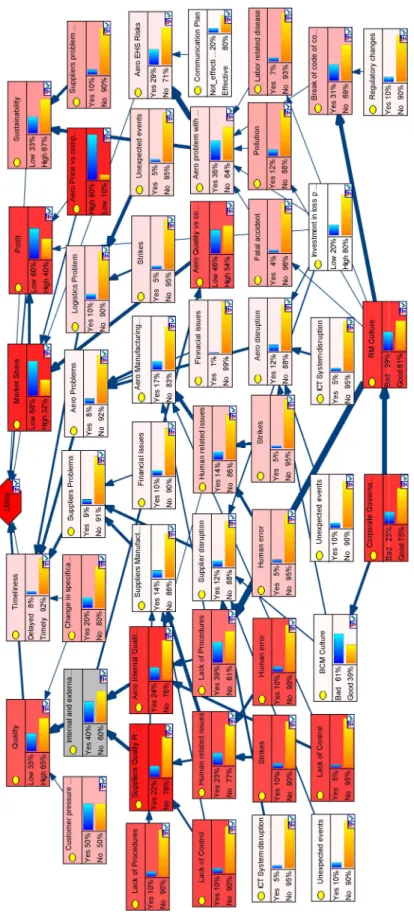
Once the qualitative structure of the network was developed, two other members of the group were involved in validating the structure. Some changes were suggested by the members in terms of adding new nodes to the network like financial issues and communication plan among others that were finally included after deliberation. The final qualitative part of the model is shown in Figure 4 with details of
1 2 3 4 5 6 7 8 9 10 11 12 13 14 15 16 17 18 19 20 21 22 23 24 25 26 27 28 29 30 31 32 33 34 35 36 37 38 39 40 41 42 43 44 45 46 47 48 49 50 51 52 53 54 55 56 57 58 59 60 61 62
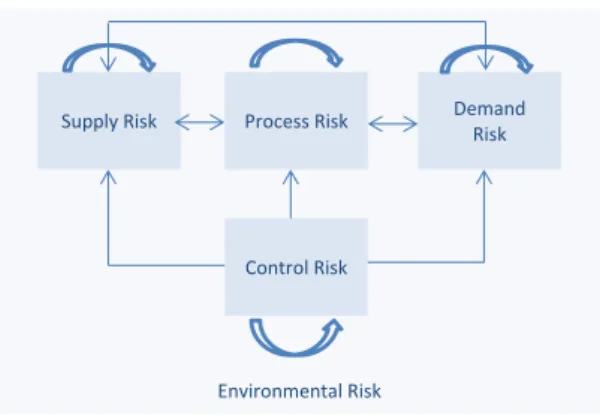
risks presented in Table A.3. One main feature of the developed structure is capturing interdependency between risks ranging across different categories namely supply, demand, process and control risks (Christopher et al., 2011) and therefore, instead of conceptualising risks into distinct categories, we focus on intra- and inter- dependency across all such categories in the form of a risk network as shown in Figure 5. Control risks represent the problems associated with the management policies and these can be considered as the common causes affecting the entire network of risks as shown in Figure 4. For example, poor management policies might adversely affect the motivation of employees which in turn would influence the production rate and even the quality might be compromised triggering customer dissatisfaction.
Following the qualitative validation of the risk network, another focus group session was held to quantify the model. Two of the participants were engineers and well conversant with the fundamentals of probability theory and therefore, it was not difficult to elicit conditional probability values. However, not all participants were comfortable with providing the probability values. Therefore, a qualitative scale was introduced to elicit probability and utility values as shown in Figure A.1 and Figure A.2, respectively.
The quantitative part was validated through conducting the sensitivity analysis during which some conditional probability values had to be revised as the participants were not satisfied with some of the sensitivity results. The updated probabilities of the quality (low), timeliness (delayed), market share (low), profit (low) and sustainability (low) were calculated as 0.35, 0.08, 0.68, 0.60 and 0.33, respectively. The (red) shade of a node represents its relative importance for the utility node in terms of the propagation impact whereas the thickness of an arc reflects the strength of interdependency (influence) between the interconnected nodes. The participants agreed with the optimistic results for quality, timeliness and sustainability and somehow justified their concern with regard to the higher probabilities associated with market share and profit. The results also conformed to their perception about the efficacy of already implemented strategies.
The decision maker was interviewed to determine the ‘utility’ associated with different values of the objectives as shown in Table A.4 and potential mitigation strategies were identified during another focus group session with associated costs shown in Table A.5. The strategies were finally mapped on the risk network as shown in Figure A.3 and the impact of each strategy was established through eliciting the relevant conditional probability values. The rectangular shaped nodes (except the objectives appearing at the top) represent all possible strategies. Once all the potential strategies were implemented, the updated probabilities of the quality (low), timeliness (delayed), market share (low), profit (low) and sustainability (low) were calculated as 0.23, 0.05, 0.37, 0.33 and 0.24, respectively. The efficacy of strategies elicited was validated through conducting sensitivity analysis.
1 2 3 4 5 6 7 8 9 10 11 12 13 14 15 16 17 18 19 20 21 22 23 24 25 26 27 28 29 30 31 32 33 34 35 36 37 38 39 40 41 42 43 44 45 46 47 48 49 50 51 52 53 54 55 56 57 58 59 60 61 62 Lo w 35 % Hi gh 65 % Q ua lit y De la ye d 8% Ti m el y 92 % Ti m el in es s Lo w 68 % Hi gh 32 % M arke t S ha re Lo w 33 % Hi gh 67 % Su st ai na bi lit y Ye s 22 % N o 78 % Su pp lie rs Q ua lity P r. .. Ye s 24 % N o 76 % Ae ro In te rn al Q ua lit ... Ye s 10 % N o 90 % La ck of P ro ce du re s Ye s 10 % N o 90 % La ck of C on tro l Ye s 23 % N o 77 % H um an re la te d is su es Ye s 39 % N o 61 % La ck of P ro ce du re s Ye s 5% N o 95 % La ck of C on tro l Ye s 14 % N o 86 % H um an re la te d is su es Ye s 9% N o 91 % Su pp lie rs P ro bl em s Ye s 17 % N o 83 % Ae ro M an uf act uri ng ... Ye s 12 % N o 88 % Su pp lie r d is ru pt io n Ye s 10 % N o 90 % Lo gi st ic s Pr ob le m Ba d 39 % G oo d 61 % R M C ul tu re Ba d 61 % G oo d 39 % BC M C ul tu re Lo w 60 % Hi gh 40 % Pr of it Hi gh 90 % Lo w 10 % Ae ro P rice v s co m p. .. Lo w 46 % Hi gh 54 % Ae ro Q ua lit y vs co ... Ye s 10 % N o 90 % Su pp lie rs p ro bl em .. . Ye s 36 % N o 64 % Ae ro p ro bl em w ith .. . Ye s 12 % N o 88 % Po llu tio n Ye s 7% N o 93 % La bo r re la te d di se as e Ye s 4% N o 96 % Fa ta l a cci de nt Ye s 31 % N o 69 % Br ea k of co de o f co ... Ba d 25 % G oo d 75 % C or po ra te G ov er na ... U til ity Ye s 14 % N o 86 % Su pp lie rs Ma nu fa ct ... Ye s 8% N o 92 % Ae ro P ro bl em s Ye s 12 % N o 88 % Ae ro d is ru pt io n Ye s 10 % N o 90 % U ne xp ect ed e ve nt s Ye s 5% N o 95 % IC T Sy st em d is ru pt io n Ye s 5% N o 95 % IC T Sy st em d is ru pt io n Lo w 20 % Hi gh 80 % In ve st m en t i n lo ss p ... Ye s 5% N o 95 % St rike s Ye s 5% N o 95 % U ne xp ect ed e ve nt s Ye s 50 % N o 50 % C us to m er pre ss ur e ... Ye s 20 % N o 80 % C ha ng e in s pe ci fica ... Ye s 10 % N o 90 % R eg ul at ory ch an ge s N ot _e ffe ct i. .. 20 % Ef fe ct iv e 80 % C om m un ic at io n Pl an Ye s 10 % N o 90 % U ne xp ect ed e ve nt s Ye s 1% N o 99 % Fi nn aci al is su es Ye s 10 % N o 90 % Fi na nci al is su es Ye s 29 % N o 71 % Ae ro E H S R is ks Ye s 10 % N o 90 % St rike s Ye s 10 % N o 90 % H um an e rro r Ye s 5% N o 95 % St rike s Ye s 5% N o 95 % H um an e rro r Ye s 40 % N o 60 % In te rn al a nd e xt er na ...
1 2 3 4 5 6 7 8 9 10 11 12 13 14 15 16 17 18 19 20 21 22 23 24 25 26 27 28 29 30 31 32 33 34 35 36 37 38 39 40 41 42 43 44 45 46 47 48 49 50 51 52 53 54 55 56 57 58 59 60 61 62 Environmental Risk
Supply Risk Process Risk Demand Risk
Control Risk
Figure 5: The relationship between supply chain risks (adapted from Christopher et al. 2011).
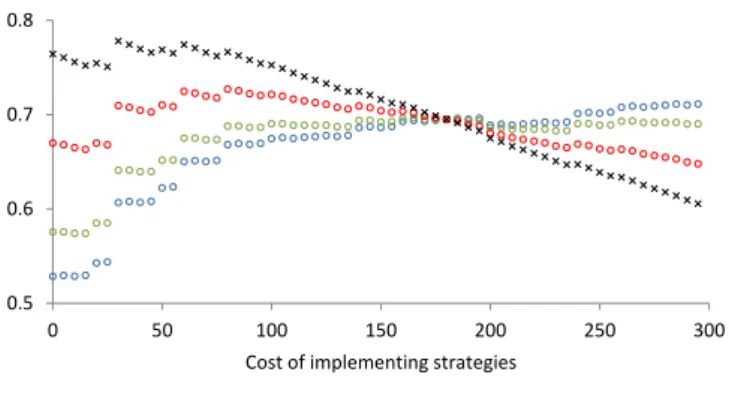
0.5 0.6 0.7 0.8 0 50 100 150 200 250 300 E xp e cte d u ti li ty
Cost of implementing strategies
Figure 6: Variation of expected utility (specific to performance measures) with mitigation cost.
utility value evaluated for each instance. Figure 6 plots the cost and expected utility combinations for each of the strategies. If a decision maker was targetting a particular cost of implementation they should choose the strategy that gives the highest expected utility for that cost. Note that increasing the cost of mitigation does not always improve utility, as can be seen in the range 195−235 units of cost.
The maximum weighted net evaluation of risk mitigation was mapped subject to different weights assigned to the expected utility and cost of strategies as shown in Figure 7. This graph provides as a validity check as the cost of the optimal solution is decreasing as the weight attached to cost increases
(higher α). Next, the optimal investment level (one maximising the W N E of risk mitigation) with
respect to the budget constraint was determined as shown in Figure 8. A decision maker assigning equal importance to the improvement in expected utility value and the mitigation cost must never invest in strategies costing more than 30 units. Similarly if the decision maker attributes 90% of the importance to the improvement in expected utility, the investment level should be increased to 165 units.
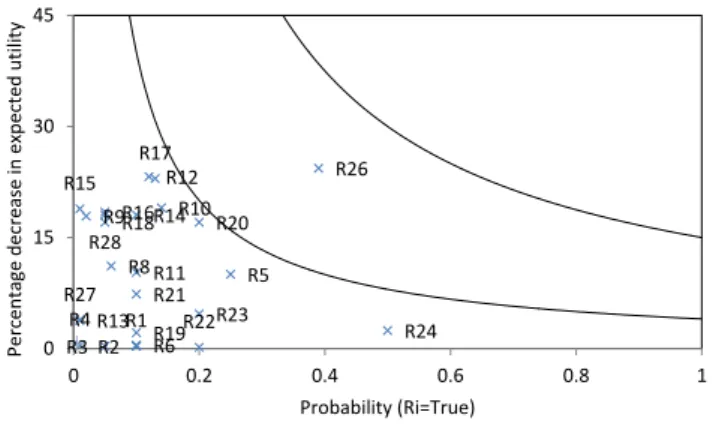
The efficacy of undertaking a risk mitigation strategy can be conveniently illustrated to decision makers. With the network in a particular state, consider a plot of the probability of each risk being realised against the expected utility consequence if it is realised, as in Figure 9. Following Ruan
1 2 3 4 5 6 7 8 9 10 11 12 13 14 15 16 17 18 19 20 21 22 23 24 25 26 27 28 29 30 31 32 33 34 35 36 37 38 39 40 41 42 43 44 45 46 47 48 49 50 51 52 53 54 55 56 57 58 59 60 61 62 0.5 0.6 0.7 0.8 0 50 100 150 200 250 300
Cost of implementing strategies
WNE ( WNE ( WNE ( WNE (
Figure 7: Variation of maximum weighted net evaluation (W N E) of risk mitigation with different importance weights
for cost (α) and mitigation cost.
0 50 100 150 200 250 300 0 50 100 150 200 250 300 O p ti m al In v e stm e n t Budget Constraint
WNE ( WNE ( WNE ( WNE (
1 2 3 4 5 6 7 8 9 10 11 12 13 14 15 16 17 18 19 20 21 22 23 24 25 26 27 28 29 30 31 32 33 34 35 36 37 38 39 40 41 42 43 44 45 46 47 48 49 50 51 52 53 54 55 56 57 58 59 60 61 62 R1 R2 R3 R4 R5 R6 R7 R8 R9 R10 R11 R12 R13 R14 R15 R16 R17 R18 R19 R20 R21 R22 R23 R24 R26 R27 R28 0 15 30 45 0 0.2 0.4 0.6 0.8 1 P e rc e n tag e d e cr e as e i n e xp e cte d u ti li ty Probability (Ri=True)
Figure 9: Risk matrix representing current state of risks (with no potential strategies implemented).
R1 R2 R3 R4 R5 R6 R8 R9 R10 R11 R12 R13 R14 R15 R16 R17 R18 R19 R20 R21 R22 R23 R24 R26 R27 R28 0 15 30 45 0 0.2 0.4 0.6 0.8 1 P e rc e n tag e d e cr e as e i n e xp e cte d u ti li ty Probability (Ri=True)
Figure 10: Risk matrix representing state of risks after implementation of the strategy “do everything” (all actions).
et al. (2015), this space can be partitioned into high, medium and low risk zones by using appropriate indifference curves. Implementing a risk mitigation strategy changes the location of risks as illustrated in Figure 10, and visualising the effect of a risk strategy on the location of those risks - in particular in relation to the critical thresholds - can assist decision-makers in reaching an optimal conclusion if such thresholds exist in the decision-maker’s value system that are not captured by a simple expected utility measure.
6. Discussion and Implications
As the main aim of our research was to address two related questions, we discuss hereafter the implications of the research findings in order to explicitly address each question.
6.1. A SCRM Process Integrating Interdependent Factors and the Risk Appetite
In this section, we present a brief comparison of the proposed approach with the interdependency based approaches applied in other research areas and discuss the theoretical and managerial implica-tions of the research.
RQ1: How can we develop and operationalise a SCRM process that captures interdependencies between risks, multiple (potentially conflicting) objectives (performance measures) and risk mitigation strategies specific to the risk appetite of a decision maker?
1 2 3 4 5 6 7 8 9 10 11 12 13 14 15 16 17 18 19 20 21 22 23 24 25 26 27 28 29 30 31 32 33 34 35 36 37 38 39 40 41 42 43 44 45 46 47 48 49 50 51 52 53 54 55 56 57 58 59 60 61 62
6.1.1. Comparison of the Proposed Approach with Interdependency Based Approaches in other Appli-cation Areas
With respect to interdependency modelling, there are a number of approaches (similar to the ones discussed in Section 2.2) applied to other application areas including but not limited to project risk management (Qazi et al., 2016; Zhang, 2016), enterprise resource planning (Aloini et al., 2012a,b) and reliability of engineering systems (Ashrafi et al., 2015). Using the unique features of BBNs and EUT, the proposed approach not only captures probabilistic interdependency between risks but also integrates the risk appetite of a decision maker within the risk management process. We are not aware of any such risk management process especially in the literature on SCRM and project risk management that utilises the concept similar to W N E or introduces the ‘probability-conditional expected utility’ matrix for prioritising strategies and risks, respectively specific to the risk appetite of a decision maker. Network theory and ISM based tools are useful in assessing the driving and dependency influence of risks (Aloini et al., 2012a,b) whereas the proposed framework integrates these key features with the ability to model strength of interdependency between risks. The risk network provides an effective visual tool to help the decision maker prioritise risks on the basis of relative probability and propaga-tion impact values thereby considering a holistic view of multiple factors including the posipropaga-tion of a risk within the network, its influence on the key performance measures identified, and its probability of occurrence. The operationalisation scheme introduced in the paper provides an opportunity for researchers from diversified fields including but not limited to safety and reliability engineering, deci-sion making under uncertainty, data analytics, and multi-criteria decideci-sion analysis to explore similar combinations of suitable techniques that could be adapted to the context of SCRM and easily adopted by practitioners.
6.1.2. Theoretical Implications
For better understanding, a block diagram is presented as Figure 11 which manifests the method-ological contribution of this study to the established risk management process (SA, 2009). Although the application of the proposed process is demonstrated for a one-time decision problem of prioritising risks and mitigation strategies (at time: T =t0), it can easily be extended to monitor and re-evaluate risks and strategies periodically. One of the key merits of the SCRNM process shown in Figure 3 is the operationalisation of each stage to help supply chain managers adopt an empirically tested technique for managing risks. This process also presents a unique integration of modelling interdependent risks, the decision maker’s risk appetite and the trade-off across performance measures. There is a great deal of complexity associated with capturing the non-linear interactions between supply chain risks and performance measures, utility of the decision maker with regards to the tradeoff across these measures, and their risk appetite with regards to the cost and benefit of risk mitigation. For a detailed discussion on each stage of the risk management process, interested readers may consult SA (2009).