XPath Processing in a Nutshell
∗
Georg Gottlob, Christoph Koch, and Reinhard Pichler
Database and Artificial Intelligence Group Technische Universit¨at Wien, A-1040 Vienna, Austria
{gottlob, koch}@dbai.tuwien.ac.at, [email protected]
Abstract
We provide a concise yet complete formal definition of the semantics of XPath 1 and summarize efficient algorithms for processing queries in this language. Our presentation is intended both for the reader who is looking for a short but comprehensive formal account of XPath as well as the software developer in need of material that facilitates the rapid im-plementation of XPath engines.
1
Introduction
XPath [10] is a practical language for selecting nodes from XML document trees. Its importance stems from its suitability as an XML query language per se and it being at the core of several other XML-related tech-nologies, such as XSLT, XPointer, and XQuery.
Previous semantics definitions of XPath have either been overly lengthy [10, 12], or were restricted to frag-ments of the language (e.g. [6, 7]). In this paper, we provide a formal semantics definition of full XPath, in-tended for the implementor or the reader who values a concise, formal, and functional description. As an extension to [3], we also provide a brief but complete definition of the XPath data model.
Given a query language, the prototypical algorith-mic problem is query evaluation, and its hardness needs to be formally studied. The query evaluation problem was not addressed for full XPath in any depth until recently [3, 2, 4]1. We summarize the main ideas
of that work in this paper, with an emphasis on use-fulness to a wide audience.
Since XPath and related technologies will be tested in ever-growing deployment scenarios, implementa-tions of XPath engines need to scale well both with respect to the size of the XML data and the growing ∗This work was supported by the Austrian Science Fund
(FWF) under project No. Z29-INF. All methods and algorithms presented in this paper are covered by a pending patent. Fur-ther resources, updates, and possible corrections are available athttp://www.xmltaskforce.com.
1
The novelty of our results is a bit surprising, as considerable effort has been made in the past to understand the XPath query containment problem (e.g. [1, 5, 8]), which – with its relevance to query optimization – is only a means to the end of efficient query evaluation.
size and intricacy of the queries. (Database theoreti-cians refer to this ascombined complexity.)
We present main-memory XPath processing algo-rithms that run in time guaranteed to be polynomial in the size of the complete input, i.e. queryand data. As experimentally verified in [3], where these and other results where first presented, contemporary XPath en-gines do not have this property, and require time ex-ponential in the size of queries at worst.
We present polynomial-time XPath evaluation algo-rithms in two flavors,bottom-upandtop-down2. Both
algorithms have the same worst-case polynomial-time bounds. The former approach comes with a clear and simple intuition why our algorithms are polynomial, while the latter requires to compute considerably fewer useless intermediate results and consequently performs much better in practice.
The structure of this paper is as follows. Sec-tion 2 introduces XPath axes. SecSec-tion 3 presents the data model of XPath and auxiliary functions used throughout the paper. Section 4 defines the seman-tics of XPath in a concise way. Section 5 houses the bottom-up semantics definition and algorithm. Sec-tion 6 comes up with the modificaSec-tions to obtain a top-down algorithm. We conclude with Section 7.
2
XPath Axes
In XPath, an XML document is viewed as an unranked (i.e., nodes may have a variable number of children), ordered, and labeled tree. Before we make the data model used by XPath precise (which distinguishes be-tween several types of tree nodes) in Section 3, we introduce the main mode of navigation in document trees employed by XPath – axes – in the abstract, ig-noring node types. We will point out how to deal with different node types in Section 3.
All of the artifacts of this and the next section are defined in the context of a given XML document. Given a document tree, let dom be the set of its nodes, and let us use the two functions
firstchild, nextsibling : dom→dom,
2
By this we refer to the mode of traversal of the expression tree of the query while computing the query result.
child := firstchild.nextsibling∗
parent := (nextsibling−1
)∗.firstchild−1
descendant := firstchild.(firstchild∪nextsibling)∗
ancestor := (firstchild−1
∪nextsibling−1
)∗.firstchild−1
descendant-or-self := descendant∪self ancestor-or-self := ancestor∪self following := ancestor-or-self.nextsibling.
nextsibling∗.descendant-or-self
preceding := ancestor-or-self.nextsibling−1
.
(nextsibling−1
)∗.descendant-or-self
following-sibling := nextsibling.nextsibling∗
preceding-sibling := (nextsibling−1
)∗.nextsibling−1 Table 1: Axis definitions in terms of “primitive” tree relations “firstchild”, “nextsibling”, and their inverses. to represent its structure3. “firstchild” returns the
first child of a node (if there are any children, i.e., the node is not a leaf), and otherwise “null”. Let n1, . . . , nk be the children of some node in document
order. Then, nextsibling(ni) = ni+1, i.e.,
“nextsib-ling” returns the neighboring node to the right, if it exists, and “null” otherwise (ifi =k). We define the functions firstchild−1and nextsibling−1as the inverses
of the former two functions, where “null” is returned if no inverse exists for a given node. Where appropriate, we will use binary relations of the same name instead of the functions. ({hx, f(x)i | x∈dom, f(x)6= null}
is the binary relation for functionf.)
The axesself, child, parent, descendant, ancestor,
descendant-or-self,ancestor-or-self,following, preced-ing,following-sibling, andpreceding-sibling are binary relations χ ⊆ dom×dom. Let self :={hx, xi | x ∈
dom}. The other axes are defined in terms of our “primitive” relations “firstchild” and “nextsibling” as shown in Table 1 (cf. [10]). R1.R2,R1∪R2, andR1∗
de-note the concatenation, union, and reflexive and tran-sitive closure, respectively, of binary relationsR1 and
R2. Let E(χ) denote the regular expression defining
χ in Table 1. It is important to observe that some axes are defined in terms of other axes, but that these definitions are acyclic.
Definition 2.1 (Axis Function) Let χ denote an XPath axis relation. We define the function χ : 2dom → 2dom as χ(X0) = {x | ∃x0 ∈ X0 : x0χx}
(and thus overload the relation nameχ), whereX0⊆
dom is a set of nodes.
Algorithm 2.2 (Axis Evaluation)
Input: A set of nodesS and an axisχ
Output: χ(S)
Method: evalχ(S)
functionevalself(S) :=S.
functionevalχ(S) := evalE(χ)(S).
functionevale1.e2(S) := evale2(evale1(S)).
functionevalR(S) :={R(x)|x∈S}.
3
Actually, “firstchild” and “nextsibling” are part of the XML Document Object Model (DOM).
functionevalχ1∪χ2(S) := evalχ1(S)∪evalχ2(S).
functioneval(R1∪...∪Rn)∗(S)begin
S0 :=S; /*S0 is represented as a list */
whilethere is a next element xin S0 do append{Ri(x)|1≤i≤n, Ri(x)6= null,
Ri(x)6∈S0}toS0;
returnS0;
end;
whereS⊆dom is a set of nodes of an XML document, e1 ande2 are regular expressions, R, R1, . . ., Rn are
primitive relations, χ1 and χ2 are axes, and χ is an
axis other than “self”.
Clearly, some axes could have been defined in a simpler way in Table 1 (e.g., ancestor equals parent.parent∗). However, the definitions, which use a limited form of regular expressions only, allow to compute χ(S) in a very simple way, as evidenced by Algorithm 2.2.
The function eval(R1∪...∪Rn)∗ essentially computes graph reachability (not transitive closure). It can be implemented to run in linear time in terms of the data in a straightforward manner; (non)membership inS0is checked in constant time using a direct-access version of S0 maintained in parallel to its list representation (naively, this could be an array of bits, one for each member of dom, telling which nodes are in S0).
Lemma 2.3 Let S ⊆ dom be a set of nodes of an XML document and χ be an axis. Then, (1) χ(S) =
evalχ(S)and (2) Algorithm 2.2 runs in timeO(|dom|).
3
Data Model
Let dom be the set of nodes in the document tree as introduced in the previous section. Each node is of one of seven types, namely root, element, text, comment, attribute, namespace, and processing instruction. As in DOM [9], the root node of the document is the only one of type “root”, and is theparent of the document element node of the XML document. The main type of non-terminal node is “element”, the other node types are self-explaining (cf. [10]). Nodes of all types besides “text” and “comment” have a name associated with it. Anode test is an expression of the formτ() (where τ is a node type or the wildcard “node”, matching any type) orτ(n) (wherenis a node name andτ is a type whose nodes have a name). τ(∗) is equivalent toτ(). We define a function T which maps each node test to the subset of dom that satisfies it. For instance, T(node()) = dom and T(attribute(href)) returns all attribute nodes labeled “href”.
Example 3.1 Consider a document consisting of six nodes – the root node r, which is the parent of the document element node a (labeled “a”), and its four children b1, . . . , b4 (labeled “b”). We have
dom = {r, a, b1, . . . , b4}, firstchild = {hr, ai,ha, b1i},
nextsibling = {hb1, b2i,hb2, b3i,hb3, b4i}, T(root()) = {r}, T(element()) = {a, b1, . . . , b4}, T(element(a)) = {a}, andT(element(b)) ={b1, . . . , b4}.
Now, XPath axes differ from the abstract, untyped axes of Section 2 in that there are special child axes “attribute” and “namespace” which filter out all re-sulting nodes that are not of type attribute or names-pace, respectively. In turn, all other XPath axis func-tions remove nodes of these two types from their re-sults. We can express this formally as
attribute(S) := child(S)∩T(attribute()) namespace(S) := child(S)∩T(namespace()) and for all other XPath axesχ(letχ0be the abstract
axis of the same name),
χ(S):=χ0(S)−(T(attribute())∪T(namespace())).
Node tests that occur explicitly in XPath queries must not use the types “root”, “attribute”, or “names-pace”4. In XPath, axis applications χand node tests
talways come in location stepexpressions of the form χ::t. The node test n(wherenis a node name or the wildcard *) is a shortcut forτ(n), whereτ is the prin-cipal node typeofχ. For the axis attribute, the princi-pal node type is attribute, for namespace it is names-pace, and for all other axes, it is element. For exam-ple, child::a is short for child::element(a) and child::* is short for child::element(*).
Note that for a set of nodes S and a typed axisχ, χ(S) can be computed in linear time – just as for the untyped axes of Section 2.
Let <doc be the binary document order relation,
such that x <doc y (for two nodes x, y ∈ dom) iff
the opening tag of x precedes the opening tag of y in the (well-formed) document. The function first<doc
returns the first node in a set w.r.t. document order. We define the relation<doc,χ relative to the axisχ as
follows. For χ∈ {self, child, descendant, descendant-or-self, following-sibling, following},<doc,χis the
stan-dard document order relation<doc. For the remaining
axes, it is the reverse document order>doc. Moreover,
given a node x and a set of nodesS with x ∈ S, let idxχ(x, S) be the index ofxin S w.r.t.<doc,χ(where
1 is the smallest index).
Given an XML Document Type Definition (DTD) [11] that uses the ID/IDREF feature, each element node of the document may be identified by a unique id. The function deref ids : string→2dom interprets its input string as a whitespace-separated list of keys and returns the set of nodes whose ids are contained in that list.
The function strval : dom → string returns the string value of a node, for the precise defini-tion of which we refer to [10]. Notably, the string value of an element or root node x is the concate-nation of the string values of descendant text nodes
{y|descendant({x})∩T(text())}visited in document order. The functions to string and to number convert
4
These node tests are also redundant with ‘/’ and the “at-tribute” and “namespace” axes.
P[[χ::t[e1]· · ·[em]]](x) :=
begin
S :={y|xχy, y∈T(t)};
for1≤i≤m(in ascending order) do
S :={y∈S|[[ei]](y,idxχ(y, S),|S|) = true}; returnS; end; P[[π1|π2]](x) :=P[[π1]](x)∪P[[π2]](x) P[[/π]](x) :=P[[π]](root) P[[π1/π2]](x) :=Sy∈P[[π1]](x)P[[π2]](y)
Figure 1: Standard semantics of location paths. a number to a string resp. a string to a number ac-cording to the rules specified in [10].
This concludes our discussion of the XPath data model, which is complete except for some details re-lated to namespaces. This topic is mostly orthogonal to our discussion, and extending our framework to also handle namespaces (without a penalty with respect to efficiency bounds) is an easy exercise. 5
4
Semantics of XPath
In this section, we present a concise definition of the semantics of XPath 1 [10]. We assume the syntax of this language known, and cohere with itsunabbreviated
form [10]. We use a normal form syntax of XPath, which is obtained by the following rewrite rules, ap-plied initially:
1. Location stepsχ::t[e], whereeis an expression that produces a number (see below), are replaced by the equivalent expressionχ::t[e= position()].
2. All type conversions are made explicit (using the conversion functions string, number, and boolean, which we will define below).
3. Each variable is replaced by the (constant) value of the input variable binding.
The main syntactic construct of XPath are expres-sions, which are of one of four types, namelynode set,
number,string, orboolean. Each expression evaluates relative to a context~c=hx, k, niconsisting of acontext node x, acontext position k, and acontext size n[10].
C = dom× {hk, ni | 1≤k ≤n ≤ |dom|}is the do-main of contexts. Let ArithOp ∈ {+,−,∗,div,mod},
RelOp ∈ {=,6=, ≤, <,≥, >}, EqOp ∈ {=,6=}, and
GtOp ∈ {≤, <, ≥, >}. By slight abuse of notation, we identify these arithmetic and relational operations with their symbols in the remainder of this paper. However, it should be clear whether we refer to the operation or its symbol at any point. Byπ, π1, π2, . . .
we denote location paths. 5
To be consistent, we also will not discuss the “local-name”, “namespace-uri”, and “name” core library functions [10].
Note that names used in node tests may be of the form NCName:*, which matches all names from a given namespace named NCNAME.
Definition 4.1 (Semantics of XPath) Each XPath expression returns a value of one of the following four types: number, node set, string, and boolean (abbre-viated num, nset, str, and bool, respectively). Let T
be an expression type and the semantics [[e]] :C→ T
of XPath expressionebe defined as follows. [[π]](hx, k, ni) := P[[π]](x) [[position()]](hx, k, ni) := k
[[last()]](hx, k, ni) := n
For all other kinds of expressions e=Op(e1, . . . , em)
mapping a context ~c to a value of type T, [[Op(e1, . . . , em)]](~c) := F[[Op]]([[e1]](~c), . . . ,[[em]](~c)),
whereF[[Op]] :T1×. . .×Tm→ T is called theeffective
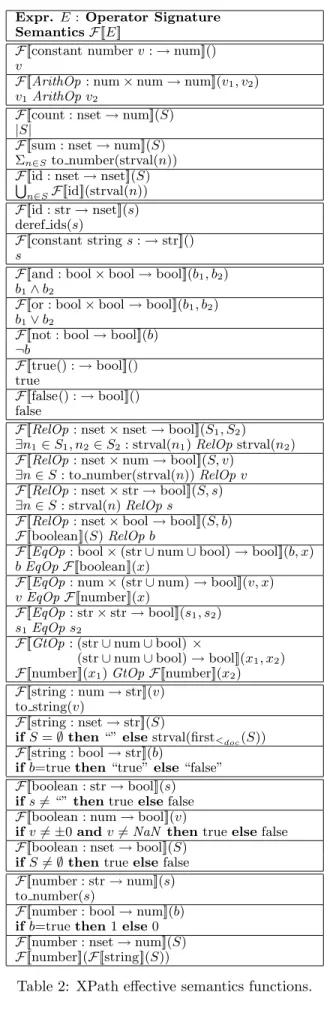
semantics function of Op. The function P is defined in Figure 1 and the effective semantics function F is defined in Table 2.
To save space, we at times re-use function defi-nitions in Table 2 to define others. However, our definitions are not circular and the indirections can be eliminated by a constant number of unfolding steps. Moreover, for lack of space, we define nei-ther the number operations floor, ceiling, and round nor the string operations concat, starts-with, contains, substring-before, substring-after, substring (two ver-sions), string-length, normalize-space, translate, and lang in Table 2, but it is very easy to obtain these definitions from the XPath 1 Recommendation [10].
The compatibility of our semantics definition (mod-ulo the assumptions made in this paper to simplify the data model) with [10] can easily be verified by inspec-tion of the latter document.
It is instructive to look at the definition ofP[[π1/π2]]
in Figure 1 in more detail. It is easy to see that, if this semantics definition is followed rigorously to obtain an analogous functional implementation, query eval-uation using this implementation requires time expo-nential in the size of the queries. All systems evaluated in [3] went into this (or a very similar) trap.
5
Bottom-up Evaluation of XPath
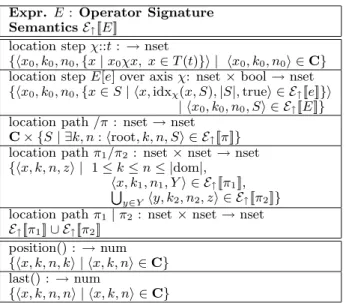
In this section, we present a bottom-up semantics and algorithm for evaluating XPath queries in polynomial time. We discuss the intuitions which lead to poly-nomial time evaluation (which we call the “context-value table principle”), and establish the correctness and complexity results.Definition 5.1 (Semantics) We represent the four XPath expression types nset, num, str, and bool using relations as shown in Table 3. The bottom-up seman-tics of expressions is defined via a semanseman-tics function
E↑: Expression→nset∪num∪str∪bool, given in Table 4 and as
E↑[[Op(e1, . . . , em)]] :=
{h~c,F[[Op]](v1, . . . , vm)i |~c∈C,h~c, v1i ∈ E↑[[e1]], . . . , h~c, vmi ∈ E↑[[em]]}
Expr. E: Operator Signature SemanticsF[[E]]
F[[constant numberv:→num]]()
v
F[[ArithOp : num×num→num]](v1, v2)
v1ArithOpv2
F[[count : nset→num]](S)
|S|
F[[sum : nset→num]](S) Σn∈Sto number(strval(n))
F[[id : nset→nset]](S)
n∈SF[[id]](strval(n))
F[[id : str→nset]](s) deref ids(s)
F[[constant strings:→str]]()
s
F[[and : bool×bool→bool]](b1, b2)
b1∧b2
F[[or : bool×bool→bool]](b1, b2)
b1∨b2
F[[not : bool→bool]](b)
¬b
F[[true() :→bool]]() true
F[[false() :→bool]]() false
F[[RelOp: nset×nset→bool]](S1, S2)
∃n1∈S1, n2∈S2: strval(n1)RelOpstrval(n2)
F[[RelOp: nset×num→bool]](S, v)
∃n∈S: to number(strval(n))RelOpv F[[RelOp: nset×str→bool]](S, s)
∃n∈S: strval(n)RelOps
F[[RelOp: nset×bool→bool]](S, b)
F[[boolean]](S)RelOpb
F[[EqOp : bool×(str∪num∪bool)→bool]](b, x)
bEqOpF[[boolean]](x)
F[[EqOp : num×(str∪num)→bool]](v, x)
vEqOpF[[number]](x)
F[[EqOp : str×str→bool]](s1, s2)
s1EqOps2
F[[GtOp: (str∪num∪bool)×
(str∪num∪bool)→bool]](x1, x2)
F[[number]](x1)GtOpF[[number]](x2)
F[[string : num→str]](v) to string(v)
F[[string : nset→str]](S)
ifS=∅then“”elsestrval(first<doc(S))
F[[string : bool→str]](b)
ifb=truethen“true”else“false”
F[[boolean : str→bool]](s)
ifs6= “”thentrueelsefalse
F[[boolean : num→bool]](v)
ifv6=±0andv6=NaN thentrueelsefalse
F[[boolean : nset→bool]](S)
ifS6=∅thentrueelsefalse
F[[number : str→num]](s) to number(s)
F[[number : bool→num]](b)
ifb=truethen1else0
F[[number : nset→num]](S)
F[[number]](F[[string]](S))
Expression Type Associated RelationR
num R⊆C×
bool R⊆C× {true,false}
nset R⊆C×2dom str R⊆C×char∗
Table 3: Expression types and associated relations.
Expr.E : Operator Signature SemanticsE↑[[E]]
location stepχ::t: →nset
{hx0, k0, n0,{x|x0χx, x∈T(t)}i | hx0, k0, n0i ∈C}
location stepE[e] over axisχ: nset×bool→nset
{hx0, k0, n0,{x∈S| hx,idxχ(x, S),|S|,truei ∈ E↑[[e]]}i
| hx0, k0, n0, Si ∈ E↑[[E]]}
location path/π: nset→nset
C× {S| ∃k, n:hroot, k, n, Si ∈ E↑[[π]]}
location pathπ1/π2 : nset×nset→nset
{hx, k, n, zi | 1≤k≤n≤ |dom|, hx, k1, n1, Yi ∈ E↑[[π1]],
y∈Y hy, k2, n2, zi ∈ E↑[[π2]]}
location pathπ1|π2 : nset×nset→nset
E↑[[π1]]∪ E↑[[π2]]
position() : →num
{hx, k, n, ki | hx, k, ni ∈C}
last() :→num
{hx, k, n, ni | hx, k, ni ∈C}
Table 4: Expression relations for location paths, posi-tion(), and last().
for the remaining kinds of XPath expressions.
Now, for each expressione and eachhx, k, ni ∈C, there is exactly onev s.t.hx, k, n, vi ∈ E↑[[e]].
Theorem 5.2 Let e be an arbitrary XPath expres-sion. Then, for context node x, position k, and size
n, the value ofeisv, wherev is the unique value such that hx, k, n, vi ∈ E↑[[e]].
The main principle that we propose at this point to obtain an XPath evaluation algorithm with polynomial-time complexity is the notion of a context-value table (i.e., a relation for each expression, as dis-cussed above).
Context-value Table Principle. Given an ex-pressionethat occurs in the input query, the context-value table ofespecifies all valid combinations of con-texts ~c and values v, such that e evaluates to v in context~c. Such a table for expressioneis obtained by first computing the context-value tables of the direct subexpressions ofeand subsequently combining them into the context-value table fore. Given that the size of each of the context-value tables has a polynomial bound and each of the combination steps can be ef-fected in polynomial time (all of which we can assure in the following), query evaluation in total under our principle also has a polynomial time bound6.
6
The number of expressions to be considered is fixed with the parse tree of a given query.
Query Evaluation. The idea of Algorithm 5.3 below is so closely based on our semantics definition that its correctness follows directly from the correct-ness result of Theorem 5.2.
Algorithm 5.3 (Bottom-up algorithm for XPath)
Input: An XPath queryQ;
Output: E↑[[Q]].
Method:
let Tree(Q) be the parse tree of queryQ;
R:=∅;
for each atomic expressionl∈leaves(Tree(Q))do
compute tableE↑[[l]] and add it toR;
whileE↑[[root(Tree(Q))]]6∈R do
begin
take an Op(l1, . . . , ln)∈nodes(Tree(Q))
s.t.E↑[[l1]], . . . ,E↑[[ln]]∈R;
computeE↑[[Op(l1, . . . , ln)]] usingE↑[[l1]], . . . ,E↑[[ln]];
addE↑[[Op(l1, . . . , ln)]] toR;
end;
returnE↑[[root(Tree(Q))]].
Example 5.4 Consider the document of Exam-ple 3.1. We want to evaluate the XPath query Q, which reads as
descendant::b/following-sibling::*[position() != last()] over the input contextha,1,1i. We illustrate how this evaluation can be done using Algorithm 5.3: First of all, we have to set up the parse tree
E2: E3[E4] E3: following-sibling::* E4: E5 !=E6 E6: last() E5: position() Q: E1/E2 E1: descendant::b
of Q with its 6 proper subexpressions E1, . . . , E6.
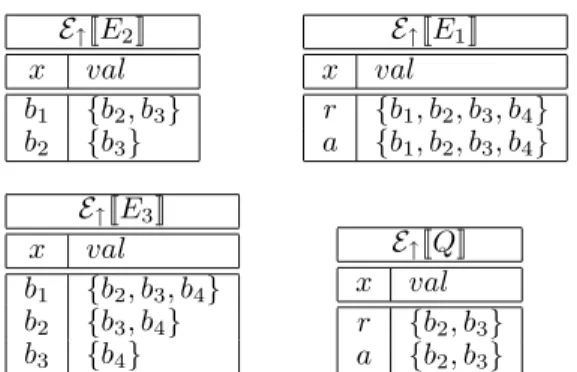
Then we compute the context-value tables of the leaf nodes E1, E3,E5 andE6 in the parse tree, and from
the latter two the table forE4. By combiningE3 and
E4, we obtainE2, which is in turn needed for
comput-ingQ. The tables7forE
1,E2,E3andQare shown in
Figure 2. Moreover,
E↑[[E5]] = {hx, k, n, ki | hx, k, ni ∈C} E↑[[E6]] = {hx, k, n, ni | hx, k, ni ∈C} E↑[[E4]] = {hx, k, n, k6=ni | hx, k, ni ∈C}
The most interesting step is the computation ofE↑[[E2]]
from the tables for E3 andE4. For instance, consider hb1, k, n,{b2, b3, b4}i ∈ E↑[[E3]]. b2 is the first, b3 the
second, andb4the third of the three siblings following 7
Thek and ncolumns have been omitted. Full tables are obtained by computing the cartesian product of each table with
E↑[[E2]] x val b1 {b2, b3} b2 {b3} E↑[[E3]] x val b1 {b2, b3, b4} b2 {b3, b4} b3 {b4} E↑[[E1]] x val r {b1, b2, b3, b4} a {b1, b2, b3, b4} E↑[[Q]] x val r {b2, b3} a {b2, b3}
Figure 2: Context-value tables of Example 5.4. b1. Thus, only forb2andb3is the conditionE2
(requir-ing that the position in set{b2, b3, b4}is different from
the size of the set, three) satisfied. Thus, we obtain the tuplehb1, k, n,{b2, b3}iwhich we add toE↑[[E2]].
We can read out the final result {b2, b3} from the
context-value table ofQ.
Theorem 5.5 XPath can be evaluated bottom-up in polynomial time (combined complexity).
(For a proof sketch of this result see [3].)
6
Top-down Evaluation of XPath
In the previous section, we obtained a bottom-up semantics definition which led to a polynomial-time query evaluation algorithm for XPath. Despite this favorable complexity bound, this algorithm is still not practical, as usually many irrelevant intermediate re-sults are computed to fill the context-value tables which are not used later on. Next, building on the context-value table principle of Section 5, we develop a top-down algorithm based on vector computation for which the favorable (worst-case) complexity bound carries over but in which the computation of a large number of irrelevant results is avoided.Given an m-ary operationOp : Dm→ D, its
vec-torized versionOphi: (Dk)m→Dk is defined as
Ophi(hx
1,1, . . . , x1,ki, . . . ,hxm,1, . . . , xm,ki) :=
hOp(x1,1, . . . , xm,1), . . . , Op(x1,k, . . . , xm,k)i
For instance, hX1, . . . , Xki ∪hi hY1, . . . , Yki :=
hX1∪Y1, . . . , Xk∪Yki. Let
S↓: LocationPath → List(2dom) → List(2dom) be the auxiliary semantics function for location paths defined in Figure 3. We basically distinguish the same cases (related to location paths) as for the bottom-up semantics E↑[[π]]. Given a location path π and a list hX1, . . . , Xki of node sets, S↓ determines a list hY1, . . . , Ykiof node sets, s.t. for everyi∈ {1, . . . , k},
the nodes reachable from the context nodes inXi via
the location pathπare precisely the nodes inYi. S↓[[π]] can be obtained from the relationsE↑[[π]] as follows. A nodeyis inYiiff there is anx∈Xiand somep, ssuch
that hx, p, s, yi ∈ E↑[[π]].
S↓[[χ::t[e1]· · ·[em]]](X1, . . . , Xk) :=
begin
S :={hx, yi |x∈Ski=1Xi, x χ y,andy∈T(t)};
for each1≤i≤m(in ascending order)do begin
fix some orderS~=hhx1, y1i, . . . ,hxl, yliiforS;
hr1, . . . , rli:=E↓[[ei]](t1, . . . , tl) wheretj =hyj, idxχ(yj, Sj), |Sj|i andSj :={z| hxj, zi ∈S}; S :={hxi, yii |ri is true}; end; for each1≤i≤kdo Ri :={y| hx, yi ∈S, x∈Xi}; returnhR1, . . . , Rki; end; S↓[[/π]](X1, . . . , Xk) := S↓[[π]]( ktimes z }| { {root}, . . . ,{root}) S↓[[π1/π2]](X1, . . . , Xk) :=S↓[[π2]](S↓[[π1]](X1, . . . , Xk)) S↓[[π1|π2]](X1, . . . , Xk) := S↓[[π1]](X1, . . . , Xk)∪hiS↓[[π2]](X1, . . . , Xk)
Figure 3: Top-down evaluation of location paths.
Definition 6.1 The semantics function E↓ for arbi-trary XPath expressions is of the following type:
E↓: XPathExpression → List(C) → List(XPathType)
Given an XPath expressioneand a list (~c1, . . . , ~cl) of
contexts, E↓ determines a listhr1, . . . , rli of results of
one of the XPath types number, string, boolean, or node set. E↓ is defined as
E↓[[π]](hx1, k1, n1i, . . . , hxl, kl, nli) := S↓[[π]]({x1}, . . . ,{xl}) E↓[[position()]](hx1, k1, n1i, . . . , hxl, kl, nli) := hk1, . . . , kli E↓[[last()]](hx1, k1, n1i, . . . , hxl, kl, nli) := hn1, . . . , nli and E↓[[Op(e1, . . . , em)]](~c1, . . . , ~cl) := F[[Op]]hi(E ↓[[e1]](~c1, . . . , ~cl), . . . ,E↓[[em]](~c1, . . . , ~cl))
for the remaining kinds of expressions.
Example 6.2 Given the query Q, data, and con-text ha,1,1i of Example 5.4, we evaluate Q as E↓[[Q]](ha,1,1i) = S↓[[E2]](S↓[[descendant::b]]({a})) whereS↓[[descendant::b]]({a}) =h{b1, b2, b3, b4}i.
To computeS↓[[E2]](h{b1, b2, b3, b4}i), we proceed as
described in the algorithm for location steps in Fig-ure 3. We initially obtain the set
S={hb1, b2i,hb1, b3i,hb1, b4i,hb2, b3i,hb2, b4i,hb3, b4i}
and the list of contexts ~t = hhb2,1,3i, hb3,2,3i, hb4,3,3i,hb3,1,2i,hb4,2,2i,hb4,1,1ii.
The check of conditionE4returns the filter
~r=htrue,true,false,true,false,falsei. which is applied toS to obtain
S={hb1, b2i,hb1, b3i,hb2, b3i}
Thus, the query returnsh{b2, b3}i.
The correctness of the top-down semantics fol-lows immediately from the corresponding result in the bottom-up case and from the definition of S↓ andE↓.
Theorem 6.3 (Correctness of E↓) Let e be an arbitrary XPath expression. Then, hv1, . . . , vli =
E↓[[e]](~c1, . . . , ~cl)iffh~c1, v1i, . . . ,h~cl, vli ∈ E↑[[e]]. S↓ and E↓ can be immediately transformed into function definitions in a top-down algorithm. We thus have to define one evaluation function for each case of the definition ofS↓ andE↓, respectively. The func-tions corresponding to the various cases of S↓ have a location path and a list of node sets of variable length (X1, . . . , Xk) as input parameter and return a
list (R1, . . . , Rk) of node sets of the same length as
result. Likewise, the functions corresponding to E↓ take an arbitrary XPath expression and a list of con-texts as input and return a list of XPath values (which can be of type num, str, bool or nset). Moreover, the recursions in the definition of S↓ and E↓ correspond to recursive function calls of the respective evaluation functions. Analogously to Theorem 5.5, we get
Theorem 6.4 The immediate functional implemen-tation of E↓ evaluates XPath queries in polynomial time (combined complexity).
Finally, note that using arguments relating the top-down method of this section with (join) optimization techniques in relational databases, one may argue that the context-value table principle is also the basis of the polynomial-time bound of Theorem 6.4.
7
Conclusions
The algorithms presented in this paper empower XPath engines to deal efficiently with very sophisti-cated queries while scaling up to large documents.
In [3, 4], in addition to an experimental verifica-tion of our claim that current XPath engines evalu-ate queries in exponential time only, we have also pre-sented fragments of XPath which contain most of the XPath queries likely to be used in practice and can be evaluated particularly efficiently, using methods that are beyond the scope of this paper.
We have made a main-memory implementation of the top-down algorithm of Section 6. Resources such as this implementation and publications will be made accessible athttp://www.xmltaskforce.com.
Acknowledgments
We thank J. Sim´eon for pointing out to us that the mapping from XPath to the XML Query Algebra, which will be the preferred semantics definition for XPath 2, in an direct functional implementation also leads to exponential-time query processing on XPath 1 (which is a fragment of XPath 2).
References
[1] A. Deutsch and V. Tannen. Containment and In-tegrity Constraints for XPath. InProc. KRDB 2001, CEUR Workshop Proceedings 45, 2001.
[2] G. Gottlob and C. Koch. “Monadic Queries over Tree-Structured Data”. In Proceedings of the 17th An-nual IEEE Symposium on Logic in Computer Science (LICS 2002), pages 189–202, Copenhagen, Denmark, July 2002.
[3] G. Gottlob, C. Koch, and R. Pichler. “Efficient Algo-rithms for Processing XPath Queries”. InProceedings of the 28th International Conference on Very Large Data Bases (VLDB’02), Hong Kong, China, Aug. 2002.
[4] G. Gottlob, C. Koch, and R. Pichler. “XPath Query Evaluation: Improving Time and Space Efficiency”. In Proceedings of the 19th IEEE International Con-ference on Data Engineering (ICDE’03), Bangalore, India, Mar. 2003. to appear.
[5] G. Miklau and D. Suciu. “Containment and Equiv-alence for an XPath Fragment”. In Proceedings of the 21st ACM SIGACT-SIGMOD-SIGART Sympo-sium on Principles of Database Systems (PODS’02), pages 65–76, Madison, Wisconsin, 2002.
[6] P. Wadler. “Two Semantics for XPath”, 2000. Draft paper available at
http://www.research.avayalabs.com/user/wadler/. [7] P. Wadler. “A Formal Semantics of Patterns in
XSLT”. In Markup Technologies, Philadelphia, De-cember 1999. Revised version in Markup Languages, MIT Press, June 2001.
[8] P. T. Wood. “On the Equivalence of XML Patterns”. In Proc. 1st International Conference on Computa-tional Logic (CL 2000), LNCS 1861, pages 1152–1166, London, UK, July 2000. Springer-Verlag.
[9] World Wide Web Consortium. DOM Specification http://www.w3c.org/DOM/.
[10] World Wide Web Consortium. XML Path Language (XPath) Recommendation. http://www.w3c.org/TR/xpath/, Nov. 1999.
[11] World Wide Web Consortium. “Extensible Markup Language (XML) 1.0 (Second Edition)”, Oct. 2000. http://www.w3.org/TR/REC-xml.
[12] World Wide Web Consortium. “XQuery 1.0 and XPath 2.0 Formal Semantics. W3C Working Draft Aug. 16th 2002, 2002.