Trip Planning
A thesis submitted in fulfillment of the requirements for
the degree of Doctor of Philosophy
Mohammad Saiedur Rahaman
M.Sc (Computer Science)
B.Sc (Computer Science and Engineering)
American International University Bangladesh (AIUB)
School of Science
College of Science, Engineering, and Health
RMIT University
Melbourne, Victoria, Australia
March, 2018
I certify that except where due acknowledgement has been made, the work is that of the author alone; the work has not been submitted previously, in whole or in part, to qualify for any other academic award; the content of the thesis is the result of work which has been carried out since the official commencement date of the approved research program; and, any editorial work, paid or unpaid, carried out by a third party is acknowledged.
Mohammad Saiedur Rahaman March 29, 2018
All praise and thanks to my God for granting me the opportunity to undertake this research and giving me the strength, knowledge, and ability to persevere and complete satisfactorily.
I am greatly indebted to my supervisors A/Prof. Margaret Hamilton and Dr. Flora Salim for their guidance, support, encouragement, constructive criticism and continuous effort to improve my skills throughout this thesis. I would like to thank Dr. Yongli Ren and Dr. Yi Mei for their valuable mentoring. I thank my guru Dr. Ashfaqur Rahman for his important suggestions at the beginning of my candidature. I acknowledge my colleagues and management of AIUB and my teachers of Dhaka Residential Model College.
I remember the sacrifice of my parents Sharif Hossain and Gulara Banu who always pro-vided me courage and prayed for my success and good health. I acknowledge the prayer and appreciation of my in-laws Habibur Rahman and Mansura Habib. I sincerely thank my brothers Touhidour Rahman, Wahidur Rahman and Tanzilur Rahman for their supports. My gratitude to my wife Farzana Afrin for her unfailing support and care. I would like to express my thanks to our daughter Rida Safeerah Rahman for being such a good girl always cheering me up.
Thanks to my friends Mahfuz and Azim for their extraordinary support on my arrival at Melbourne. Life in Melbourne would have been far less interesting and very different without Himel, Saif, Tasin, Halim, Debajyoti, Ripon and Zakaria. My appreciation to Tasnim Nasrin, Nadia Hasin, and Shahnaz Pervin for their exceptional care to my family. I thank the members of CRUISE oldies Irvan, Jonathan, Amin, Wei, Hui, and Rumi who have provided friendship and support, and with whom I have shared laughter, frustration and companionship.
I would like to acknowledge the Australian Research Council (ARC) and RMIT University for providing me scholarships, resources and environment to support my research.
Portions of the materials used in this thesis have previously appeared or under consideration in the following scientific publications:
• M.S. Rahaman, Y. Mei, M. Hamilton, and F.D. Salim, CAPRA: A Contour-based Ac-cessible Path Routing Algorithm. In: Information Sciences, Volume: 385, pp. 157–173, December 2016. (Impact Factor: 4.83, SJR: Q1) - Chapter 4
• M.S. Rahaman, M. Hamilton, and F.D. Salim, Predicting Imbalanced Taxi and Passenger Queue Contexts in Airport. In: Proceedings of the 21st Pacific Asia Conference on Information Systems (PACIS 2017), pp. 172, Langkawi, Malaysia, July 2017. (CORE Rank: A) - Chapter 2
• M.S. Rahaman, M. Hamilton, and F.D. Salim, Queue Context Prediction Using Taxi Driver Intelligence. In: Proceedings of the 9th International Conference on Knowledge Capture (K-CAP 2017), Article no. 35, Austin, Texas, United States, December 2017. (CORE Rank: A) - Chapter 3
• M.S. Rahaman, M. Hamilton, and F.D. Salim, CoAcT: A Framework for Context-Aware Trip Planning Using Active Transport. In: Proceedings of the 16th IEEE International Conference on Pervasive Computing and Communications Workshops (PerCom Work-shops), Athens, Greece, March 2018. - Chapter 4
• M.S. Rahaman, M. Hamilton, and F.D. Salim, Using Big Spatial Data for Planning User Mobility. In: Encyclopedia of Big Data Technologies, pp. 1–6, February 2018. -Chapter 1
• M.S. Rahaman, Y. Ren, M. Hamilton, and F.D. Salim, Neighborhood Identification from Heterogeneous Contextual Features for Taxi Driver Queue Wait Time Prediction at Airports, 2018 (Under review). - Chapter 3
This research was supported by the Australian Research Council (ARC) through the provision of a linkage grant (project number LP120200305) for the project titled “Integrated Smart Airport Services” partnered with ARUP. Participations and travels to the conferences were supported by RMIT School of Graduate Research and RMIT School of Science in the provisions of conference travel, research support, and publication grants.
Declaration iii
Acknowledgement iv
Credits v
Contents vii
List of Figures xi
List of Tables xiv
Abstract 2
1 Introduction 3
1.1 User Mobility and Motivating Scenario . . . 5
1.2 Research Challenges . . . 8
1.3 Research Questions . . . 10
1.4 Research Contributions . . . 11
1.5 Thesis Organization . . . 13
2 Context-aware Mobility Analytics Using Heterogeneous Data 16 2.1 Motivation and Contribution . . . 17
2.2 Related Work . . . 19
2.3 The Queue Context Prediction Framework . . . 21
2.3.1 Problem Definition . . . 21
2.3.2 Contextual Data Fusion, Context Inference and Preliminary Analysis . 23 2.3.2.1 Contextual Data Fusion . . . 23
2.3.2.2 Queue Context Inference . . . 24
2.3.2.3 Extraction of Associated Factors and Preliminary Analysis . . 28
2.3.3 Queue Context Prediction . . . 31
2.3.3.1 Identifying Sampling-Classifier Pair(s) . . . 32
2.3.4 Evaluation and User Perspective Based Analysis . . . 34
2.4 Conclusion . . . 36
3 Modelling Associated Factors for Mobility Context Prediction 38 3.1 Motivation and Contribution . . . 39
3.2 Related Work . . . 42
3.3 Datasets . . . 44
3.4 Neighborhood Identification Using Feature Weight Score for Mobility Context Prediction . . . 46
3.4.1 Scenario 1: Queue Wait Time Prediction . . . 47
3.4.1.1 Contextual Analysis . . . 47
3.4.1.2 Feature Selection . . . 51
3.4.1.3 Feature Weight Calculation Scheme . . . 52
3.4.1.4 Formulation ofk-NN Methods . . . 53
3.4.1.5 Experiments and Results . . . 54
3.4.2 Scenario 2: Queue Context Prediction . . . 63
3.4.2.1 Formulation ofk-NN Methods . . . 63
3.4.2.2 Feature Weight Calculation Scheme . . . 64
3.4.2.3 Experiments and Results: Feature Selection . . . 65
3.4.2.4 Experiments and Results: Feature Weight Calculation . . . 66
3.4.2.5 Analyzing Prediction Performance . . . 67
4 Inferring and Integrating Mobility Contexts in Trip Planning 71
4.1 Motivation and Contribution . . . 71
4.2 Related Work . . . 75
4.2.1 Mobility Aspects for the Elderly and People with Special Needs . . . 75
4.2.2 Crowdsourcing as a Tool for Data Collection and Route Recommendation 76 4.2.3 Measuring Route Scores . . . 77
4.2.4 Mobility Assistance . . . 78
4.3 The CoAcT Framework . . . 79
4.3.1 Contextual Data Collection . . . 80
4.3.2 Fusion and Query Processing . . . 80
4.4 Context-aware Trip Planning . . . 81
4.4.1 Data Preprocessing: Contour-based Graph Generation . . . 81
4.4.2 Query-Based Adaptation . . . 85
4.5 Single Context Trip Planning . . . 86
4.5.1 Steepness Rating of the Route . . . 86
4.5.2 Route Planning . . . 87
4.5.3 Experimental Studies . . . 88
4.5.3.1 Case Study-1: Rosanna . . . 89
4.5.3.2 Case Study-2: Heidelberg . . . 90
4.5.4 Discussion of Results . . . 92
4.6 Multiple Context Trip Planning and User Perspectives . . . 94
4.6.1 Accessibility Evaluation of Paths . . . 94
4.6.2 Path Routing Based on Distance and Accessibility . . . 97
4.6.3 Experimental Studies . . . 100
4.6.3.1 Case Study-1 in San Francisco, USA . . . 101
4.6.3.2 Case Study-2 in San Francisco, USA . . . 103
4.6.3.3 Case Study in Lisbon, Portugal . . . 105
4.6.3.4 Bukit Timah, Singapore . . . 107
4.7 Conclusion . . . 110
5 Conclusion 112
5.1 Limitations and Future Directions of Research . . . 115
1.1 Ubiquitous Data Sources Facilitating User Mobility Solutions. . . 4
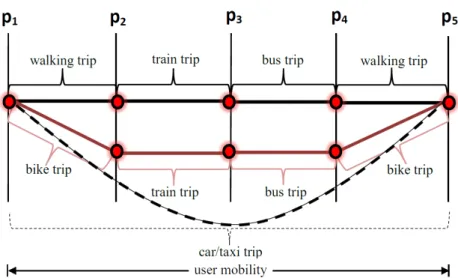
1.2 Example of User Mobility Options Connecting Several Trips. . . 6
1.3 Example of Diverse Situational Factors and User Perspectives of Contexts. . . 7
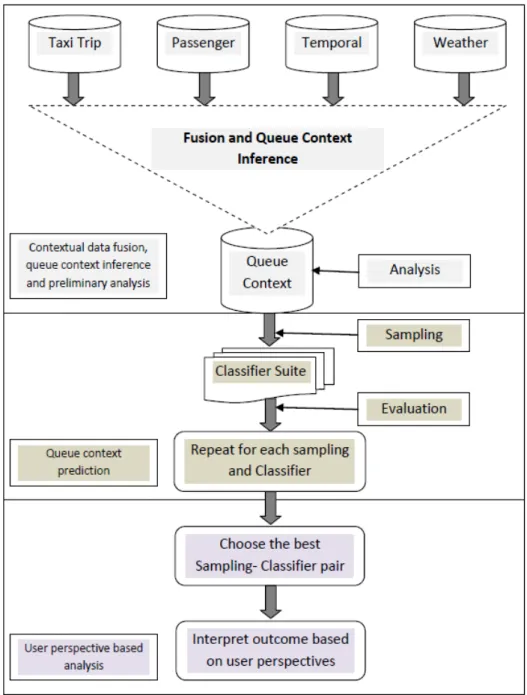
2.1 Queue Context Prediction Framework . . . 22
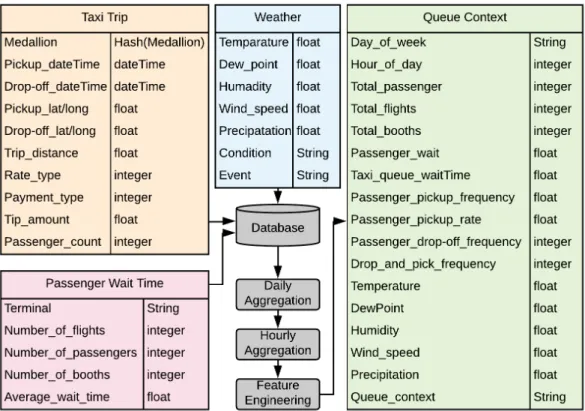
2.2 Data Fusion and Extracted Features for the Queue Context Dataset . . . 28
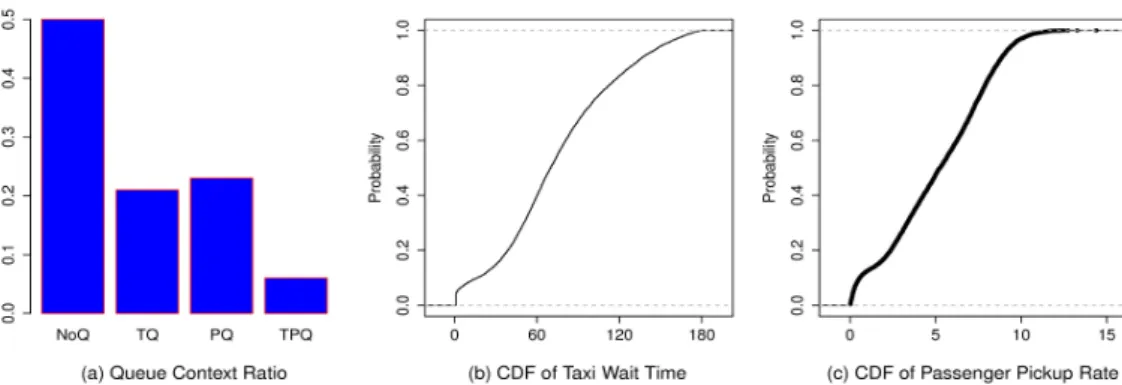
2.3 (a) Proportion of Queue Contexts. (b)-(c) CDF of Taxi Wait Times and Passenger Pickup Rate at the John F. Kennedy (JFK) airport. . . 29
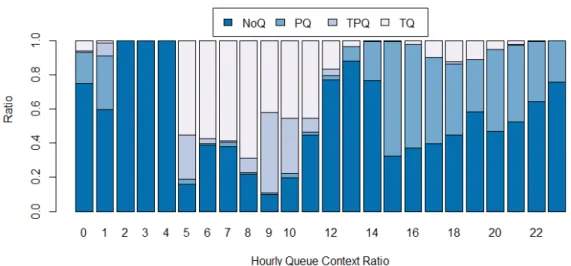
2.4 Hourly Proportions of Four Queue Contexts From Midnight of a Day to Midnight of the Next Day. . . 30
2.5 Heat Maps of Hourly a) Taxi Wait Times b) Passenger Pickup Frequency and c) Passenger Arrivals at the John F. Kennedy (JFK) airport. Note: x-axis represents the days of the year in 2013 andy-axis represents 24 hours of a day from midnight of a day to midnight of the next day. For example, 50 in the x-axis corresponds to 50th day of the year of 2013 while 10 in they-axis corresponds to 10:00 am. . 31
3.1 Taxis Waiting at The Central Taxi Holding Area at the JFK International Airport in New York City (left). The drivers experience different waiting times on two Mondays over two different weeks of May 2013 (top right). The Density Map (bottom right) shows the variation of wait times w.r.t. current passenger pickup frequency. . . 40
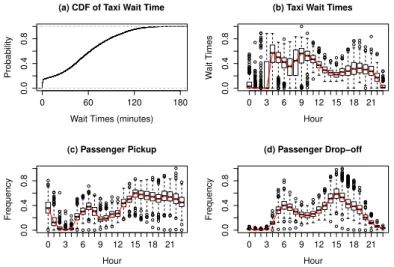
3.2 (a) Cumulative Density Function of Taxi Wait Times and (b) Taxi Wait Times,
(c) Frequency of Passenger Pick-up, (d) Frequency of Passenger Drop-off . . . 47
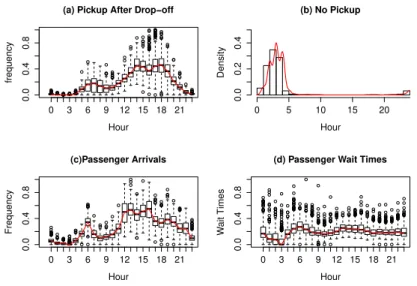
3.3 (a) Frequency of Passenger Pickup After Subsequent Passenger Drop-off by a Taxi, (b) Density of Zero Passenger Pickups After subsequent Passenger Drop-offs by a Taxi, (c) Frequency of Passenger Arrivals, (d) Passenger Wait Times. . . 48
3.4 Contextual Analysis of Taxi Wait Times with Daily Patterns of (a) Taxi Wait Times, (b) Frequency of Passenger Pick-up, (c) Frequency of Passenger Drop-off, (d) Frequency of Passenger Pickup After Subsequent Passenger Drop-off by a Taxi (e) Frequency of Passenger Arrivals, (f) Passenger Wait Times. . . 49
3.5 Percentage of Median Prediction Errors Using Various Feature Weighting Tech-niques for Varyingk-values Between 1 and 15. This shows that the driver intelligence-biased feature weighting scheme gives the least amount of median errors. . . 55
3.6 Percentage Mean Prediction Errors Using Various Feature Weighting Techniques for Varying k-values Between 1 and 15. This shows that the driver intelligence-biased feature weighting scheme gives the least amount of mean errors. . . 56
3.7 Empirical Cumulative Distribution Functions (ECDFs) of Inter Neighbor Dis-tances: Comparison Among LR-trained weights,Equal weights,MI-based weights, DI-biased weights and theBaseline ([1]). . . 58
3.8 Densities of Inter Neighbor Distances: Comparison Among LR-trained weights, Equal weights,MI-based weights,DI-biased weights and theBaseline ([1]). . . 59
3.9 Empirical Cumulative Distribution Functions (ECDFs) of Inter Neighbor Dis-tances UsingDI-biased weightsShowing the Improvements Achieved for Increasing k. . . 60
3.10 Density of Inter Neighbor Distances Using DI-biased weights Showing the Im-provements Achieved for Increasing k. . . 61
3.11 Accuracy (%) vs Number of Features . . . 65
3.12 Feature Importance Scores Based on TDID-biased Mutual Information . . . 66
4.1 Overview of the CoAcT Framework for Context Aware Active Transport Trip
Planning . . . 80
4.2 Google Map of an area in Melbourne City, Australia. . . 82
4.3 A contour map showing road segment AB with two different slopes. . . 83
4.4 An Example of Including a Query Point into the Network Graph. . . 85
4.5 An Example of Gradient Calculation. Given a 1 meter rise, the gradients of three lines: AB1,AB2, andAB3 can be calculated by dividing each rise: O1B1,O2B2, and O3B3 by the respective runs: AO1,AO2, and AO3 of 14, 24 and 33 meters. 86 4.6 Accessibility Distribution of Surroundings in Rosanna, Melbourne, Australia . . . 89
4.7 Steepness Context Aware Trip Planning in Rosanna, Melbourne, Australia . . . . 90
4.8 Accessibility Distribution of Surroundings in Heidelberg, Melbourne, Australia . 91 4.9 Steepness Context Aware Trip Planning in Heidelberg, Melbourne, Australia . . 91
4.10 An Example of Moving Up a Slope of Incline αfrom A to B. . . 95
4.11 San Francisco, USA: The paths from 817 Lombard St to 1132 Union St. The solid path is obtained by Google Directions, and the dashed paths are obtained by CAPRA. . . 101
4.12 The Elevation (in meters) Changes Along the Paths Given in Fig. 4.11. . . 103
4.13 San Francisco, USA: The paths from 1260 Green St to 1398 Lombard St. The solid path is obtained by Google Directions, and the dashed paths are obtained by CAPRA. . . 103
4.14 The Downhill Elevation (in meters) Changes Along the Paths Given in Fig. 4.13. 104 4.15 Lisbon, Portugal: The paths from Rua S˜ao Boaventura 182 to Travessa Horta 21. The solid path is obtained by Google Directions, and the dashed paths are obtained by CAPRA. . . 105
4.16 The Elevation (in meters) Change Along the Paths Given in Fig. 4.15. . . 107
4.17 Singapore: The paths from 23 Victoria Park Rd to 21 Duke’s Rd. The solid path is obtained by Google Directions, and the dashed paths are obtained by CAPRA. 107 4.18 The Elevation (in meters) Change Along the Paths Given in Fig. 4.17. . . 108
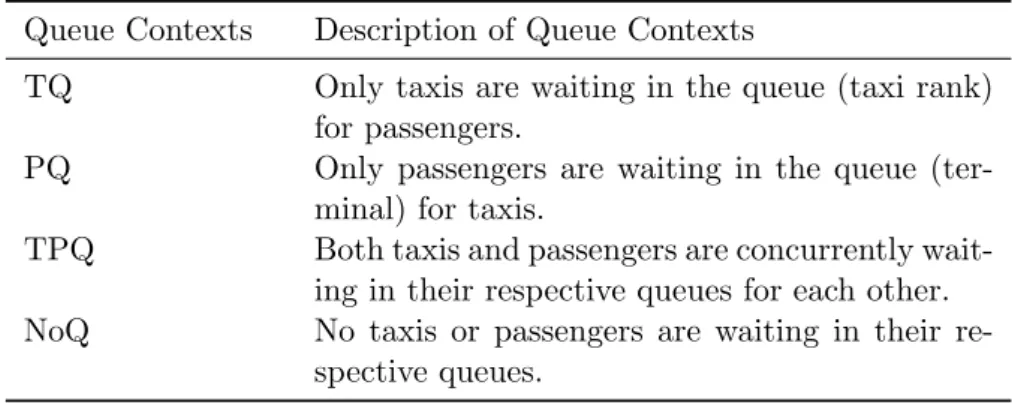
2.1 Description of Four Queue Contexts at Airport . . . 19
2.2 Fields in the NYC Taxi Trip Dataset . . . 24
2.3 Performance Evaluation Under Different Sampling Techniques . . . 33
2.4 Confusion Matrix-SVM . . . 35
2.5 Confusion Matrix-RF . . . 35
3.1 List of Notations . . . 46
3.2 Pearson’s Correlations between Average Queue Wait Times and all the Contextual Features Extracted From Three Heterogeneous Contextual Datasets, sorted by Passenger,Trip, and Weather. . . 50
3.3 Statistically Significant Features Computed From Time Contexts and the Three Heterogeneous Contextual Datasets, includingPassenger,Trip, and Weather. . . 51
3.4 Driver Intelligence (DI)-biased Mutual Information . . . 52
3.5 Paired t-Test of Prediction Errors Between Different Feature Weighting Tech-niques. This shows that the DI-biased weighting scheme provides the most signif-icant improvement compared to other techniques. . . 57
3.6 Relationships Between the Identified Neighborhood and the Taxi Queue Wait Time Prediction Errors Using K-S (Kolmogorov-Smirnov) Test which Shows the Existence of Correlations. . . 62
3.7 Results Obtained From Paired t-Test . . . 68
4.1 Summary of Evaluation Metrics for Four Different Routes . . . 93
4.2 The accessibility measure values of the paths obtained by Google Directions and CAPRA in the scenario are shown in Fig. 4.11. “Distance”, “Vertical” and “Slope” stand for the total horizontal distance, total vertical distanceW(P), and maximal slope F(P), respectively. There is no accessibility measure value for Google from the 5m contour interval network graph, since the path is obtained by the Google API. . . 102 4.3 The accessibility measure values of the paths obtained by Google Directions and
CAPRA in the scenario shown in Fig. 4.13. “Distance”, “Vertical” and “Slope” stand for the total horizontal distance, total vertical distanceW(P), and maximal slope F(P), respectively. There is no accessibility measure value for Google from 5m contour interval network graph, since the path is obtained by Google API. . . 104 4.4 The accessibility measure values of the paths obtained by Google Directions and
CAPRA in the scenario shown in Fig. 4.15. “Distance”, “Vertical” and “Slope” stand for the total horizontal distance, total vertical distanceW(P), and maximal slope F(P), respectively. There is no accessibility measure value for Google from 5m contour interval network graph, since the path is obtained by Google API. . . 106 4.5 The accessibility measure values of the paths obtained by Google Directions and
CAPRA in the scenario shown in Fig. 4.17. “Distance”, “Vertical” and “Slope” stand for the total horizontal distance, total vertical distanceW(P), and maximal slope F(P), respectively. There is no accessibility measure value for Google from 5m contour interval network graph, since the path is obtained by Google API. . . 108 4.6 Summary of the Four Scenarios. . . 109
The study of user mobility is to understand and analyse the movement of individuals in the spatial and temporal domains. Mobility analytics and trip planning are two vital components of user mobility that facilitate the end users with easy to access navigational support through the urban spaces and beyond. Mobility context describes the situational factors that can influence user mobility decisions. The context-awareness in mobility analytics and trip planning enables a wide range of end users to make effective mobility decisions. With the ubiquity of urban sensing technologies, various situational factors related to user mobility decisions can now be collected at low cost and effort. This huge volume of data collected from heterogeneous data sources can facilitate context-aware mobility analytics and trip planning through intelligent analysis of mobility contexts, mobility context prediction, mobility context representation and integration considering different user perspectives. In each chapter of this thesis such issues are addressed through the development of case-specific solutions and real-world deployments. Mobility analytics include prediction and analysis of many diverse mobility contexts. In this thesis, we present several real-world user mobility scenarios to conduct intelligent contextual analysis leveraging existing statistical methods. The factors related to user mobility decisions are collected and fused from various publicly available open datasets. We also provide future prediction of important mobility contexts which can be utilized for mobility decision making. The performance of context prediction tasks can be affected by the imbalance in context distribution. Another aspect of context prediction is that the knowledge from domain experts can enhance the prediction performance however, it is very difficult to infer and incorporate into mobility analytics applications. We present a number of data-driven solutions aiming to address the imbalanced context distribution and domain knowledge incorporation problems
for mobility context prediction. Given an imbalanced dataset, we design and implement a framework for context prediction leveraging existing data mining and sampling techniques. Furthermore, we propose a technique for incorporating domain knowledge in feature weight computation to enhance the task of mobility context prediction.
In this thesis, we address key issues related to trip planning. Mobility context inference is a challenging problem in many real-world trip planning scenarios. We introduce a framework that can fuse contextual information captured from heterogeneous data sources to infer mobility contexts. In this work, we utilize public datasets to infer mobility contexts and compute trip plans. We propose graph based context representation and query based adaptation techniques on top of the existing methods to facilitate trip planning tasks. The effectiveness of trip plans relies on the efficient integration of mobility contexts considering different user perspectives. Given a contextual graph, we introduce a framework that can handle multiple user perspectives concurrently to compute and recommend trip plans to the end user.
This thesis contains efficient techniques that can be employed in the area of urban mobility especially, context-aware mobility analytics and trip planning. This research is built on top of the existing predictive analytics and trip planning techniques to solve problems of contextual analysis, prediction, context representation and integration in trip planning for real-world scenarios. The contributions of this research enable data-driven decision support for traveling smarter through urban spaces and beyond.
Introduction
The users of urban spaces need to travel from one place to another for various reasons such as work, leisure, and freight distribution. The study of user mobility describes this movement of individuals which consists of sequences of trips using different modes of transports [2]. As cities are becoming more and more complex day by day [3], the concerns over providing decision support for user mobility are also growing [4,5,6, 7]. In response to growing concerns over user mobility in many modern cities, we have witnessed worldwide growth of urban sensing infrastructures [8] enabling us to capture user movement and various factors related to user mobility in the cityscape [9,10]. Context-awareness is the key to deliver effective user mobility decision support as it allows us to analyse and predict various situational factors related to user mobility and to compute tailored mobility solutions based on different user perspectives [11, 12, 13]. Furthermore, it contributes to the application domain of urban computing [14,
15,16] utilizing big spatial and temporal data [17,18].
Mobility analytics arise from conducting intelligent analysis and prediction on associated spatio-temporal factors [19,20,21] and diverse mobility contexts [22] that influence the users’ mobility decisions. The context-aware mobility contexts can better describe users situations for making mobility decisions [16,23]. Therefore, context-aware mobility analytics enables the provision of intelligent analysis on mobility contexts [24] considering different user perspec-tives. The success of many applications such as transport management and location recom-mendation requires the discovery of valuable knowledge through extensive analysis of related
Figure 1.1: Ubiquitous Data Sources Facilitating User Mobility Solutions.
factors [25,26]. Figure 1.1 depicts various heterogeneous data sources from where important mobility-associated factors for user mobility decisions can be collected and stored to be used for context-aware user mobility analytics and mobility solution development. These data can aid knowledge discovery which can further be used in future mobility context prediction. The prediction of future mobility contexts [20, 25, 27] is necessary in many application areas for providing seamless mobility decision support given the fact that the user mobility contexts can change over time and situation. For example, an airport can be regarded as the first and last impression of a city. Since a longer passenger wait time for a taxi ride can diminish the satisfaction rating of an airport [26], the authorities try hard to maintain a higher customer satisfaction rating by providing various mobility services such as easy and comfortable airport transfer to the city using taxicabs. However, the demand-supply equilibrium of taxis is highly dependent on the taxi drivers’ decisions to make airport trips. The ubiquitous data can help with managing the mobility of airport users by detecting different mobility contexts (i.e. situa-tions of the concurrent queues related to passengers and taxis) [28,26]. The intelligent analysis
and prediction [26] of different mobility contexts can help with making mobility decisions for airport passengers and taxis [29] at different times of the day. The mobility context prediction also can help airport authorities to alleviate possible chaos due to lack of taxis at the airport by ensuring the demand-supply equilibrium of taxis.
Trip planning is an important component of user mobility which provides navigational support to users by integrating trips using single or multiple transport modes [30,31,32, 33] such as public transport, private car, taxi, Uber and active transport. Context-awareness in trip planning provides the opportunity to integrate trips based on different user perspectives [34, 35] of mobility contexts. Moreover, an effective trip plan must have the capability to consider multiple mobility contexts simultaneously during the computation of trip plans [16]. For example, the list of recommended plans in active transport (i.e. walking) trip planning may include mobility contexts such as distance and steepness of the routes simultaneously. The effectiveness of recommended trip plans varies along with the variation in user perspectives of these mobility contexts. The inferred contextual information collected from ubiquitous data sources has the potential to aid user-specific trip planning [34]. Furthermore, the growing need for efficient urban intelligence in user mobility has led us to conduct context-aware mobility analytics and trip planning.
1.1
User Mobility and Motivating Scenario
User mobility is defined as the movement of individuals between two meaningful places [2]. For example, the user mobility of ‘home to office’ and ‘office to home’ can be termed as user mobility since both home and office are two meaningful places [22]. User mobility can be decomposed into small segments called ‘trips’. Essentially, a sequence of trips connecting two arbitrary places defines user mobility between two meaningful places [2]. Each trip is accomplished using a mode of transport such as bike, car, taxi, public transport or walking. Let us consider an example of user mobility between two meaningful places p1 and p5 which consists of a sequence of inter-connected trips using different modes of transport. The selection of different transport modes by a user can result in different route recommendations for user mobility between p1 and p5. Three different routes from p1 top5 are marked with three different line
Figure 1.2: Example of User Mobility Options Connecting Several Trips.
styles as shown in Figure 1.2. Each of these routes has a different combination of transport modes. The first two routes (i.e. black and brick red) integrate trips with public transport modes and the corresponding sequences of transport modes from p1 to p5 are (walk, train,
bus, walk) and (bike, train, bus, bike), respectively. These two routes have some segments in common, as seen between p2 and p4. The third route (black dashed) employs only car or
taxicab to travel between p1 andp5.
Trip planner systems facilitate user mobility by selecting and integrating several trips in the trip plans [34,36, 37]. Usually, a trip planner integrates trips on the basis of user preference chosen from a predefined list of options which may include shortest time, shortest distance, number of transport mode changes and the preferred mode of transport [16]. However, the consideration of different user perspectives of mobility contexts during trip planning can signifi-cantly improve the effectiveness of recommended trip plans. The reason is because different user perspectives of mobility contexts in trip planning can better describe the user situation. This enables a wider range of users to make appropriate mobility decisions. However, the diversity of user perspectives provides a challenge to the current trip planning systems [26,16,13,38]. Let us consider two scenarios to discuss two different users and their perspectives on mo-bility contexts. We discuss how momo-bility contexts describe the situations of users and influence the user mobility decisions. The first user is a person with limited mobility in a wheelchair,
Figure 1.3: Example of Diverse Situational Factors and User Perspectives of Contexts.
and the second person is a taxicab driver. We can see from Figure 1.3 that the trip planning for the first person may consider mobility contexts such as distance and accessibility of the route. The accessibility of the route can be quantified by many external associated factors such as steepness along the route [16], weather, and road crossings. This user may also prefer information about other associated factors including ramps and lifts at the trip end location to ensure comfortable mobility. The inference of accessibility from the associated factors is vital for this user’s mobility decisions. However, the inference and integration of mobility con-texts (i.e. accessibility, distance) in trip planning is challenging due to the diversity in user perspectives about mobility contexts. Intelligent data fusion and computation can be applied to address this challenge. In contrast, Figure 1.3 shows the trip plan that a taxicab driver may consider for information about mobility contexts such as the likelihood and wait time for getting a passenger. The prediction based techniques can be used to infer these mobility contexts. Moreover, these mobility contexts can be influenced by many associated factors in-cluding traffic congestion, weather [39], hotness of the passenger pick-up spots [40] and the spatio-temporal trip lucrativeness [41]. Therefore, predicting the mobility contexts in the pres-ence of many associated factors is an important task as they contain the potential to provide better decision making about user trips.
Context-awareness in mobility analytics [42,43] and trip planning [44,45,46,16,13,38] has gained significant attention in recent years especially in the field of urban computing. It requires
dealing with large spatio-temporal complex datasets [47] which opens many research challenges in the field to intelligent contextual analysis and mobility context prediction, representation and integration in trip planning. The main objective of this work is to conduct intelligent analysis and prediction of mobility contexts from large datasets. We are interested in designing a model that can be used to process imbalanced mobility context datasets [26]. We examine the process of domain knowledge incorporation [48, 49, 50] in context prediction tasks. We also aim to represent and integrate mobility contexts based on user perspectives during trip planning. Considering the diversity of user perspectives, we are interested in designing a conceptual framework that can infer and represent mobility contexts to be integrated in trip planning algorithms. The objective of our study also includes testing and evaluating our developed models and techniques with real-world user mobility scenarios including airport ground transport management [51] and active transport trip planning [16,52].
1.2
Research Challenges
In this thesis, we aim to address key challenges related to context-aware user mobility ana-lytics and trip planning. The rapid growth of urban sensing tools and techniques facilitates the collection of diverse spatio-temporal factors associated to user mobility. This has the po-tential to provide valuable information for making user mobility decisions. The ubiquity of these associated factors and the heterogeneous nature of the data sources has raised various research challenges [53] in areas such as the analysis of mobility contexts and their prediction, representation and integration in user specific trip plans.
For intelligent analysis of mobility contexts, cross-domain data fusion is required since it can better represent the effects of mobility-associated factors for user mobility management and planning. However, it is challenging due to the diversity of applications [54]. In user mobility applications, the mobility contexts and user perspectives of mobility contexts are also diverse in nature. The context-aware mobility analytics consider different user perspectives concurrently to provide intelligent analysis and context prediction. For example, the airport ground transport managers send requisition to the taxi service providers by estimating the taxi demand in a future time window. This is to ensure the seamless passenger mobility from
the airport using taxis. However, the flawed manual estimation can lead to enormous queue waiting times for passengers as well as taxis.
It is challenging to deal with such scenarios since it requires some key related issues to be addressed. Different machine learning techniques can be used to predict future mobility contexts (i.e. queue situations). The machine learning techniques are trained using historical mobility context data for the prediction task. However, the predictive analytics suffer from mobility context imbalance problem because some mobility contexts occur very infrequently compared with others making the predictive analytics more challenging. Many researchers have addressed this issue in different application areas [55] but they have not been adapted to user mobility analytics where many parties with different perspectives can be involved in a common user mobility scenario. Therefore, our aim is to design a common framework for user mobility analytics which can provide intelligent analysis and prediction for enhanced user mobility management and planning considering different user perspectives.
Some researchers have shown that the incorporation of knowledge from experts can improve the prediction accuracy in many application areas [48, 49]. However, it is difficult in user mobility scenario due to the presence of diverse mobility-associated factors. An investigation on how expert knowledge can be inferred and incorporated into this problem domain is required. We aim to investigate and model multiple associated factors for user mobility and to design an approach to incorporate the inferred expert-like knowledge in mobility context prediction.
Another important component of user mobility is to provide effective trip plans to support user navigation. However, the effectiveness of trip plans depends on appropriate consideration of user mobility contexts. This is a challenging issue to deal with since there are many diverse user perspectives. Several algorithmic approaches have been proposed to handle user-defined contextual preferences but they mainly require a user to select a preference from pre-defined list of preferences and hence cannot serve the purpose where the aim is to consider multiple mobility contexts from a single user and different user perspectives of contexts during trip planning. Trip planning also suffers from context sparsity requiring specific contexts to be inferred before designing trip planning algorithms. The inferred contexts need to be represented in such a manner to ensure efficiency of the trip planning task. Our aim is to design a model
that can infer and represent sparse mobility contexts and provide context-aware trip planning considering multiple mobility contexts of a user and different user perspectives of a specific mobility context.
In summary, the core challenges in effective context-aware mobility analytics and trip plan-ning are as follows:
• Fusion and representation of collected large mobility-associated factors from heteroge-neous data sources.
• Providing intelligent analysis and prediction on mobility contexts.
• Incorporating expert knowledge for enhanced mobility context prediction. • Inferring sparse mobility contexts from heterogeneous data sources.
• Representing inferred mobility contexts for efficient computation of trip plans.
• Handling user trip planning queries by considering multiple mobility contexts simultane-ously and different user perspectives of a specific mobility context.
1.3
Research Questions
In order to overcome the research challenges, we define the following research questions (RQs) to achieve context-aware mobility analytics and trip planning.
RQ-1. How to provide context-aware mobility analytics from heterogeneous large datasets?
This research question addresses the challenges related to data fusion, representation and con-text imbalance for intelligent analysis and prediction of mobility concon-texts. The significance of dealing with these issues is primarily to ensure that we can handle various datasets of mobility-associated factors collected from heterogeneous data sources to provide context-aware mobility analytics using a common approach.
RQ-2. How to model different associated factors to improve the mobility context prediction task?
This research question is designed to address the challenges related to modelling the associated factors to enhance the mobility context prediction tasks in RQ-1. Specifically, the aim of this research question is to investigate diverse associated factors and incorporate knowledge from domain experts during mobility context prediction in different scenarios.
RQ-3. How to integrate multiple mobility contexts in context-aware trip planning?
The solutions from RQ-1 and RQ-2 can be used for prediction based mobility context infer-ence. However, there are some mobility contexts which cannot be inferred using a prediction based method. This research question addresses the issues regarding context sparsity and multiple mobility context integration in trip planning considering different user perspectives. The framework presented here provides fusion based inference of sparse mobility contexts. By utilizing the inferred mobility contexts, a technique is developed that can consider different user perspectives of a specific mobility context and integrate multiple mobility contexts during the computation of context-aware trips.
1.4
Research Contributions
To address the aforementioned research questions, the contributions of this thesis are as follows: 1. Context-aware mobility analytics using heterogeneous data
To provide context-aware mobility analytics, large heterogeneous datasets of user mobility-associated factors are required to be fused and analyzed. These datasets are also a great source for inferring different mobility contexts. The prediction of future mobility con-texts is very important for better user mobility management and planning. In this thesis, we take airport ground transport management as a case scenario of user mobility where different parties including passengers, taxi drivers, and ground transport managers are
involved to ensure seamless airport ground transport operation. Another reason to choose this scenario is that the user mobility situation at the airport is influenced by a diverse set of associated factors and hence is a complex issue faced by almost every busy airport in the world.
We use large publicly available datasets of associated factors to infer various mobility contexts. We present a framework to predict future mobility contexts with imbalanced distribution leveraging existing data mining and sampling techniques. We also conduct intelligent analysis of mobility contexts to provide useful information to the parties in-volved in our scenario.
2. Modelling associated factors for mobility context prediction
In relation to the first contribution, we further investigate various mobility-associated factors and present a technique to model factors for mobility context prediction. Since research has shown that the domain-specific knowledge can improve the prediction perfor-mance, we develop and present a technique to extract and incorporate domain knowledge in terms of feature weights for mobility context prediction. Specifically, we explore sim-ilarity based data mining techniques (i.e. neighborhood based methods) to incorporate domain knowledge during the mobility context prediction task. This technique is useful for making mobility decisions.
3. Inferring and integrating mobility contexts in context-aware trip planning
There are various user perspectives of a specific mobility context that need to be consid-ered during trip planning using active transport (i.e. walking, biking, wheeling). Some mobility contexts are sparse in nature and the development of new technique is required to infer them. Moreover, existing trip planners are not built to consider different user perspectives for the same specific mobility context and hence cannot serve the purpose. In this thesis, new algorithms are designed to tackle the above challenges. The new trip planner presented here can satisfy the perspectives of a wide range of users using active transport and can be extended to trip planning using other transport modes.
1.5
Thesis Organization
The organization of this thesis includes the following chapters as below:
• Chapter 2: Context-aware mobility analytics using heterogeneous data. A framework for mobility context prediction is presented in this chapter illustrating the problem of predicting imbalanced taxi and passenger queue contexts at the airport. The solution presented here is in relation to RQ-1. The technique to infer mobility contexts that are useful for airport transport managers, taxi drivers and passengers is also presented. A number of intelligent analyses of mobility contexts are also highlighted. Copyright/ credit/ reuse notice: The contents of this chapter have been taken and revised as needed from our paper published as:
M.S. Rahaman, M. Hamilton, and F.D. Salim, Predicting Imbalanced Taxi and Passen-ger Queue Contexts in Airport, In: proceedings of the 21st Pacific Asia Conference on Information Systems, Langkawi, Malaysia, 16–20 July 2017, PACIS 2017 Proceedings. 172.
DOI:http://aisel.aisnet.org/pacis2017/172
c
2017 Association for Information Systems Electronic Library (AISeL).
• Chapter 3: Modelling associated factors for mobility context prediction. In relation to RQ-2, this chapter presents the modelling of mobility-associated factors for mobility context prediction. In addition to the scenario demonstrated in Chapter 2, we introduce another real-world scenario where the mobility of taxi drivers depends on the queue wait times before a passenger pickup from airport. We predict different situations of taxi and passenger queues along with the queue wait times for taxi drivers by introducing a domain knowledge incorporation technique as the means of feature weighting scores. Specifically, the similarity based data mining techniques are explored in this chapter for incorporating domain knowledge for prediction of these mobility contexts. Copyright/ credit/ reuse notice: The contents of this chapter were taken and revised as needed from two of our papers published as:
M.S. Rahaman, M. Hamilton, and F.D. Salim, Queue Context Prediction Using Taxi Driver Intelligence, In: proceedings 9th International Conference on Knowledge Capture, 35, Austin, Texas, United States, 4–6 December 2017.
DOI:http://dx.doi.org/10.1145/3148011.3154474
M.S. Rahaman, Y. Ren, M. Hamilton, and F.D. Salim, Neighborhood Identification from Heterogeneous Contextual Features for Taxi Driver Queue Wait Time Prediction at Airports, 2018 (Under review).
• Chapter 4: Inferring and integrating mobility contexts in trip planning. In this chapter, new algorithms are presented in relation to the challenges stated in RQ-3. The solutions associated with sparse mobility context inference and integration of multiple mobility contexts considering different user perspectives during context-aware trip planning are introduced. A real-world case study is illustrated where we consider active transport trip planning. The developed techniques are deployed in several locations around the world.
Copyright/ credit/ reuse notice: The contents of this chapter has taken and revised as needed from two papers published as:
M.S. Rahaman, Y. Mei, M. Hamilton, and F.D. Salim, CAPRA: A Contour-based Ac-cessible Path Routing Algorithm, In: Information Sciences, Volume: 385, pp. 157–173, December 2016.
DOI:https://doi.org/10.1016/j.ins.2016.12.041
M.S. Rahaman, M. Hamilton, and F.D. Salim, CoAcT: A Framework for Context-Aware Trip Planning Using Active Transport, In: Proceedings of the 16th IEEE International Conference on Pervasive Computing and Communications Workshops (PerCom Work-shops), Athens, Greece, March 2018.
c
2018 IEEE. Reprinted, with permission, from M.S. Rahaman, M. Hamilton, and F.D. Salim, CoAcT: A Framework for Context-Aware Trip Planning Using Active Transport, March 2018.
• Chapter 5: Conclusion.
This chapter concludes the thesis by summarizing the main contributions, key findings and limitations of the proposed methods. In addition, the significance of this research and potential future directions are also discussed.
In short, the succeeding core chapters (Chapter 2–4) of this thesis contribute to a number of key research questions on context-aware mobility analytics and trip planning with a concluding summary and future research directions. Note that the core chapters appear in a self-contained and self-explanatory manner which includes real-world scenarios. Different contexts require different types of reasoning. Therefore, the relevant contexts and content including discussions on related work, developed models, datasets, experimental setups and evaluation metrics are presented in each of these chapters separately.
Context-aware Mobility Analytics
Using Heterogeneous Data
As discussed in Chapter 1, intelligent analysis and prediction of mobility context are important for making mobility decisions. The proliferation of urban sensing technologies facilitates the collection of large volumes of heterogeneous data related to user mobility. This can provide mobility management and planning considering different user perspectives through intelligent analytics. However, it requires cross-domain data fusion to better represent the effects of mobility-associated factors. To predict different mobility contexts, prediction algorithms are employed and trained using historical mobility context data. This requires dealing with im-balanced context distribution problem since some mobility contexts are very infrequently oc-curring as compared to the others. Many techniques have been reviewed to address this issue in different application areas. In relation toresearch question (RQ-1), this chapter presents a framework that integrates the solutions of the above issues to provide mobility analytics.
We consider the taxi-passenger queue context prediction scenario at the airport. The taxi and passenger queue contexts indicate various situations of queues related to taxis and passengers (i.e. taxis are waiting for passengers, passengers are waiting for taxis, both are waiting for each other, none is waiting). The queue contexts are good examples of mobility contexts and the prediction of these queue contexts in a future time is very important for better airport ground transport operations by considering different user perspectives including taxi
drivers and air passengers. We choose this scenario to demonstrate that the queue contexts are influenced by many diverse mobility-associated factors and to explain our developed a framework to predict imbalanced queue contexts.
We begin with investigating different mobility-associated factors including time, frequency of taxi trips, passenger arrivals and weather for queue context prediction. We predict the queue contexts by following the detailed approach of our developed framework. Specifically, we generate a queue context dataset by fusing three real-world datasets including taxi trip logs, passenger arrivals and processing times, and weather condition at a major international airport. The following sections of this chapter show a number of experimental results and analyses to demonstrate our queue context prediction framework.
2.1
Motivation and Contribution
Taxis are considered to be the most convenient transportation option for passenger mobility between the airport and the city. Hence the management of passenger and taxi queues plays an important role in the running of an airport. Either taxis or passengers can experience unexpected wait times for each other causing disruption and chaos for passengers and taxi drivers at the airport if either queue becomes too long. A queue context describes who is waiting in a given time window (i.e. taxi driver or passenger or both or none) [28]. Therefore, predicting different queue contexts at different times of the day can help to improve the airport satisfaction rating by providing timely taxi and passenger mobility management. This can help the taxi drivers within the airport vicinity by providing timely information about the passenger queues in different passenger terminals as well.
The queue context prediction at the airport is challenging for many reasons. First, the formation nature of both taxi and passenger queues is dynamic and influenced by factors such as flight arrivals, passenger processing, frequency of taxi trips and weather conditions. Second, the queue contexts are imbalanced i.e. some of the queue contexts occur far less frequently than other queue contexts. The problem of queue prediction in terms of wait time has been studied in other applications by employing various machine learning algorithms [1, 56, 57]. However, the existing approaches are not sufficient to provide prediction and corresponding
analyses of imbalanced queue contexts since there are several stakeholders involved with the two simultaneously occurring queues at the airport. This is due to the fact that a single technique serves the purpose of one party at a time. Therefore, the development of a common framework is required to address all these integrated issues.
In this chapter, we develop a framework that provides step by step procedures to predict the taxi and passenger queue contexts and provides contextual analysis on the prediction outcomes considering different user perspectives. We also extract various factors and patterns from the associated datasets fused for queue context prediction. Specifically, our framework employs a suite of sampling and machine learning techniques to predict the imbalanced queue contexts related to taxi and passenger queues. Our experiments with the dataset generated for the JFK (John F. Kennedy) airport demonstrates the reasonableness of our developed framework. The reason to choose the JFK airport for our experiment is that it is one of the busy airports in the U.S. The taxi rank called the central taxi holding (CTH) area at the JFK is far away from the passenger terminals. Any taxis planning for an airport passenger pickup job must join a waiting queue at the CTH area before picking a passenger up. The taxi dispatch managers at the JFK are responsible for dispatching taxis from this CTH based on the demand at several passenger terminals [51]. Another airport in New York City is the LaGuardia airport. However, this airport is not covered by the border control facility and hence no passenger arrival and wait time information is available. Therefore, we take the JFK international airport as our case location to prepare our dataset of taxi-passenger queue contexts at the airport. The contributions of this chapter include the followings:
• Fusion of three real-world heterogeneous contextual datasets for the research of imbal-anced mobility context prediction (i.e. taxi and passenger queue context prediction): taxi trip data, airport passenger wait time data and weather condition data.
• Extraction and analysis of heterogeneous mobility associated factors and patterns from the airport queue context dataset.
• Development of a framework to provide step by step procedures for queue context pre-diction and analysis.
Table 2.1: Description of Four Queue Contexts at Airport Queue Contexts Description of Queue Contexts
TQ Only taxis are waiting in the queue (taxi rank) for passengers.
PQ Only passengers are waiting in the queue (ter-minal) for taxis.
TPQ Both taxis and passengers are concurrently wait-ing in their respective queues for each other. NoQ No taxis or passengers are waiting in their
re-spective queues.
2.2
Related Work
The airport provides the impression of a city and the air-passengers’ satisfaction about an airport depend on the availability of taxis at the terminals. Several recent works analyze the demand-supply equilibrium of airport taxicabs [58, 59]. However, both taxi drivers and the passengers at the airports can experience long wait times [60, 61] in their respective queues for many reasons such as flawed manual taxi demand estimation. Moreover, the taxi drivers’ decisions about making future airport trips are influenced by the current and speculated situa-tions of these queues [29]. Hence it is important to analyze and predict the different situations of both taxi and passenger queues at the airport for providing better mobility management of taxis and passengers.
The queue contexts describe the existence of any one of the four states of taxi and passenger queues [28] which include ‘taxi queue only’ (TQ), ‘passenger queue only’ (PQ), ‘both taxi and passenger queues’ (TPQ) and ‘no queue’ (NoQ). Table 2.1, describes the four queue contexts that are observed in the airport. The airport trips are lucrative for taxi drivers. However, the presence of too many taxis exceeds the actual demand can cause long waiting times for taxi drivers at the airport taxi rank. On the other hand, the lack of taxis at the taxi rank can cause long passenger queues waiting for taxis.
Many researchers have investigated citywide taxi trips with a view to providing recommen-dations for the taxi drivers and passengers. The recent works focus on finding profitable taxi cruising routes for passenger pickup [62,63,64]. A profitable taxicab parking location analysis
framework to help taxi drivers was proposed by [65] which utilizes the knowledge of passen-gers’ mobility patterns and taxi drivers’ pick-up behaviors inferred from taxi GPS trajectories. Taxi GPS trajectory data have been widely used to predict city-wide traffic conditions and to analyze the behavior and movement patterns of the population [66,67,68,69,70,71,72]. The frequency of city-wide taxi passenger pickup is predicted using machine learning techniques and associated factors are investigated in [73]. A recommendation system for finding vacant taxis and passengers is presented by [74]. A spatio-temporal factor analysis model to find the best passenger pickup location is presented in [75]. The four factors considered by this model include distance, wait time, fare, and cluster transition probability. However, airports are often located in a designated area and supported by various transport modes. There is another research project that aims to estimate the passenger waiting time before a taxi ride by observing the behavior of vacant taxis [76]. A real-time taxi trip information system is proposed in [77] where passengers are able to know their estimated trip time and fare before their trip. A technique presented in [78] recommends pickup points to avail a taxi ride. The pickup points within a specified distance are ranked based on potential wait time. A passenger wait time prediction model from historical taxi trajectories is presented in [79]. The model is built by considering the arrival and departure events of taxis at a given location. A context aware system for spatio-temporal traffic prediction in different road segments is proposed in [80]. A system for monitoring taxis at a pickup location by mining GPS trajectories is pre-sented in [81]. It also provides real time information about any taxi stand and surrounding traffic condition via RESTful web services. A taxi and passenger queue context detection framework is presented by [28] which utilizes taxi traces and taxis’ mobile data terminal logs in Singapore. However, these techniques are effective for citywide taxi operations and cannot be applied directly to predict airport taxi or passenger queue contexts since the regulations for airport taxi operation is different than the citywide taxi operation. In the airport, any taxi must join the airport taxi rank queue and wait to be called by the ground transport manager to pickup a passenger from the passenger terminal.
There are very few research papers that deal with managing airport taxi operations. In [29], logistic regression is used to model the taxi drivers next pickup decision for an airport
trip. The model uses binary decisions of airport pick-up or cruising for customers at the end of each trip. Research projects related to the airport taxi operations mainly focus on taxi queue modeling [58, 82] to direct taxi drivers to the terminal with passenger queues. Airport taxi and passenger queue context prediction is different and challenging since queues at airports form dynamically. Also, the airport taxi and passenger queue context data suffers from the imbalanced queue context problem which compromises the learning and prediction performance of prediction algorithms. Different sampling techniques can be used to deal with this issue [55]. In the rest of this chapter, we introduce the formal problem definition and develop a framework that illustrates the step by step procedures for queue context prediction and analysis considering user perspectives.
2.3
The Queue Context Prediction Framework
2.3.1 Problem Definition
Let, CQ ={T Q, P Q, T P Q, N oQ} be the set of four possible queue contexts corresponding to
an hourly time window whereT Q,P Q,T P Q, andN oQindicate ‘taxi queue only’, ‘passenger queue only’, ‘both taxi and passenger queues’ and ‘no queue’ queue contexts respectively. Let, each sample instance (time slot),x in the training data be described by ad-dimensional vector of attributesRdand a queue context labelc(x)∈C
Q. Therefore, the instancexcan be written
asha1(x), a2(x), ..., ad(x), c(x)i whereai is theith attribute of x and i= 1 to d. Iff(.) is the
queue context prediction function then for a set of d-features corresponding to a query time slot xq, f(.) predicts ˆc(xq) such as f(xq) : Rd → ˆc(xq) where ˆc(xq) is the predicted queue
context of the query time slot xq.
In this section, we present our developed queue context prediction framework. The frame-work provides step by step procedures to be followed for heterogeneous data fusion, queue context inference, and queue context prediction. The framework can also be used for intelli-gent contextual analysis. The queue context prediction framework utilizes a set of classifier and sampling techniques. To satisfy different user perspectives, the framework identifies the best pairs of sampling techniques and prediction algorithms. There are three main
compo-Figure 2.1: Queue Context Prediction Framework
nents of the queue context prediction framework known as i) data fusion, context inference and preliminary analysis ii) queue context prediction and iii) user perspective based analysis. The components of the framework are illustrated in Figure 2.1.
2.3.2 Contextual Data Fusion, Context Inference and Preliminary Analysis
In this module, different contextual data such as time, taxi trips, passenger arrivals and weather conditions are fused together and different queue contexts are inferred to generate the taxi and passenger queue context dataset. An instance in the queue context dataset is an hourly timewindow with a queue context label. A preliminary analysis is conducted to learn the influence and patterns of different associated factors. In this study, we prepare the taxi queue context dataset for the JFK (John F. Kennedy) airport by adapting a state of the art queue context inference algorithm.
2.3.2.1 Contextual Data Fusion
Our framework fuses temporal information and three other real-world contextual datasets from the New York City (NYC) and represents on the basis of hourly time windows. It facilitates to capture the influence of extracted associated factors in our scenario. The fused datasets are: i) the taxi trip log data, ii) the JFK airport passenger wait times data and iii) the JFK weather condition data.
Taxi Trip Logs: This dataset is a real-world dataset from New York City containing taxi trip logs. The NYC taxi trip dataset is available through the Taxi & Limousine Commission [83]. In NYC, 13 thousand taxis generate 0.5 million trips on an average per day totaling 175 million trips per year. Each record in this dataset represents one taxi trip. A taxi trip record is described by its start and end geo-location with corresponding time-stamps, trip distance, passenger count, fare type and mount, tip amount, and taxi’s medallion number. Table 2.2 describes the fields for each record in the NYC taxi trip dataset. In this chapter, we process all the taxi trips made during the year of 2013 in NYC.
Airport Passenger Wait Time Data The passenger wait time data is available through the U.S. Customs & Border Protection 1. This dataset provides information about passenger wait times at different U.S. airports. Additional features include hourly frequencies of flight
Table 2.2: Fields in the NYC Taxi Trip Dataset
Fields Description
Medallion Taxi identification number. Pickup date-time Start time and date of the trip. Drop-off date-time End time and date of the trip. Pickup lat/long Start location of the trip. Drop-off lat/long End location of the trip.
Trip distance Distance traveled during the trip. Rate type Type of fare (i.e., fixed or not). Payment type How the payment was made. Tip amount The amount of tips.
Passenger count Number of passengers in the trip.
and passenger arrivals with the numbers of passengers processed at the passenger processing booths. It also provides the hourly passenger wait times at different terminals at the JFK airport.
Weather Condition Data The weather condition data for JFK airport is collected from Weather Underground 2. This dataset provides historical weather condition information in-cluding precipitation, temperature, wind speed, dew point, weather events (e.g., normal, rain, snow, rain-snow) and weather conditions (e.g., clear, overcast, mostly cloudy) at JFK.
2.3.2.2 Queue Context Inference
To infer the taxi and passenger queue contexts, it is required to estimate the taxi arrival rate and job wait time in a given hourly time window. However, the taxi arrival rate and job wait times cannot be estimated directly for all the taxi trips that start from the JFK airport. The reason is because a large volume of empty taxis arrive anytime without any pre-booking request. These trips with no passengers are not stored in the taxi trip dataset and the taxi arrival times are unknown.
2
To overcome this problem, we rely on the findings of survey results presented in recent literature [65]. This research reveals that experienced drivers use their own expertise to choose nearby parking places to wait for their next passenger pickup rather than cruising randomly after a passenger drop-off. Motivated by this fact, we choose those taxi drivers who join the airport taxi rank for their next passenger pickup after an earlier passenger drop-off at the airport. Another reason to choose these taxis is that we know their arrival and departure times to and from the passenger pickup queue. We assume that these trips are able to provide insights about the average taxi waiting times in a time slot. We consider the trips that start or end at the JFK airport for our experiments in this chapter. To separate these trips we consider the latitude/longitude bounding box for the JFK airport given in [84]. For a given a time slot, we design Algorithm 1 to separate the JFK airport trips.
Algorithm 1:Separating airport trips from trip datasetTx[...] Input: taxi trip datasetTx[...], airport latitude/longitude bounding
box using (minLat, maxLat, minLong, maxLong) Output: Airport taxi trip dataset Ax[...]
// Initialization
1 Ax[...]=NULL, minLat=minLat, maxLat=maxLat, minLong=minLong, maxLong=maxLong;
2 function
separateAirportTrips(Tx[...],minLat,maxLat,minLong,maxLong)
3 foreach tx∈Tx[...]do
4 if minLat < tx·T rip end lat()< maxLat and
minLong < tx·T rip end long()< maxLong then 5 Ax[...]←tx;
// Separate tx from Tx and insert in to Ax
6 else
7 if minLat < tx·T rip start lat()< maxLat and
minLong < tx·T rip start long()< maxLong then 8 Ax[...]←tx;
// Separate tx from Tx and insert in to Ax
9 end
10 end
11 return Ax[...] ;
We also design two other algorithms to compute the hourly average taxi wait times and the passenger pickup rates. These are used by the queue context inference algorithm to infer
Algorithm 2:Computation of Hourly Average Wait Time Input: An hourly time window of a day (ti,tj), Ax[...]
// ti and tj are the start and end time of the time window
Output: Hourly average taxi queue wait time ¯τ
// Initialization
1 trip count= 0;
2 function hourlyAverageTaxiQueueWaitTimes(Ax[...],ti,tj) 3 foreach tx∈Ax[...]do
4 if ti< tx·T rip end dateT imes()< tj then
5 if minLat < tx·N ext T rip startlat()< maxLat and
minLong < tx·N ext T rip start long()< maxLong then
6 Tarr←tx·T rip end dateT ime();
7 Tdep←tx·N ext trip start dateT ime(); 8 w←Tarr−Tdep;
// taxi queue wait time
9 trip count+ +;
10 end 11 end
12 return ¯τ ←sum(w)/trip count;
Algorithm 3:Computation of Hourly Pickup Rate Input: An hourly time window of a day (ti,tj), Ax[...]
// ti and tj are the start and end time of the time window
Output: Hourly passenger pickup rate ρ
// Initialization
1 pick count= 0;
2 function passengerPickupRate(Ax[...],ti,tj) 3 foreach tx∈Ax[...]do
4 if ti< tx·T rip start dateT imes()< tj then
5 pick count+ +; 6 end
7 return ρ←pick count/|(ti, tj)|;
// |(ti, tj)|is the length of time window (ti,tj) in minutes
taxi-passenger queue contexts for any given hourly time window. For calculating the average taxi queue wait times and passenger pickup rates we use Algorithms 2 and 3. First, an hourly time window is selected. Then all the passenger drop-off times of the airport taxi trips within that hour are stored to calculate the time difference with their next passenger pickup times. Similarly, the hourly passenger pickup rate is calculated considering all the taxi trips that
initiated from the airport within that hour. The taxi trips that only started from the airport without a precedent airport drop-off are also considered in this case.
For queue context inference, we utilize the Queue Context Disambiguation (QCD) algorithm proposed by [28] which performs well with the taxi GPS trip traces and taxi mobile data terminal (MDT) log data and needs adaptation in our scenario where none of these are avaialble. However, the QCD algorithm relies on two core assumptions. First, a time slot is labeled as ‘taxi queue only’ when the average waiting time (¯τ) of taxis is more than a waiting time threshold (τ). This is not valid for the time slots during airport off-peak hours in our case. Some of the drivers willingly join the taxi waiting queue during this time and wait for the arrival of the first flight in the early morning. These drivers may experience long wait times which do not constitute the existence of taxi queue context. We remove off-peak hours from our dataset and setτ = 90 minutes for inferring the taxi queues. Second, a time slot is labeled as the ‘passenger queue only’ when taxi arrival rate of empty taxis or overall passenger pickup rate (ρ) is very high. The arrival rate indicates the number of taxi arrivals per minutes while the pickup rate indicates the number of passenger pickups by taxis per minute. However, these assumptions cannot be used directly in the scenario of an airport. The most common reason is due to the large volume of empty taxis arriving anytime without any pre-booking request from airport passengers. Moreover, a passenger queue also can occur for a low passenger pickup rate if there is a shortage of taxis for a very high demand.
Unlike the QCD algorithm, we use a new threshold pickup rate which combines the upper (ρ−up) and lower (ρ−low) bounds of the pickup rate. This new threshold labels a time slot as ‘passenger queue only’ when ρ−up < ρ < ρ−low. Note that this assumption is not valid for airport off-peak hours since there are very few or no passenger pickup events observed. We arbitrarily setρ−low= 2.5 and ρ−up= 8.0 to infer the corresponding queue context labels for all the hourly timestamps except airport off-peak hours. In the final dataset, each record represents a time stamp of one hour duration. A timestamp in this queue context dataset is described by the extracted associated factors from the three real-world datasets discussed below in Section 2.3.2.3 (Extraction of Associated Factors and Preliminary Analysis).
Figure 2.2: Data Fusion and Extracted Features for the Queue Context Dataset
2.3.2.3 Extraction of Associated Factors and Preliminary Analysis
We extract various features to generate the queue context dataset by fusing three real-world datasets and temporal information. Note that all these features correspond to the current hour and we extract and compute the values of the similar features in the previous and next hours as well. We also consider temporal features including the hour of the day, the day of the week, and the week number of the year. In total each record is described by 44 features and one of the four queue context labels. Figure 2.2 shows the steps to generate the final ‘queue context’ dataset. In data fusion stage, the daily and hourly aggregation is performed to ensure that all the data points are computed under the same time window length. In feature engineering, additional features including drop-off and pickup frequencies, pickup rates, and wait times are calculated. The extracted features are summarized as below:
Figure 2.3: (a) Proportion of Queue Contexts. (b)-(c) CDF of Taxi Wait Times and Passenger Pickup Rate at the John F. Kennedy (JFK) airport.
• NYC taxi trip data: The extracted features include hourly taxi queue wait time, passenger pickup and drop-off frequencies, and frequency of taxi trips that start subsequent to an airport passenger drop-off.
• Passenger wait time data: The features include the frequency of hourly flight and passen-ger arrivals, number of passenpassen-ger processing booths and hourly average passenpassen-ger wait times at the passenger processing booths.
• Weather condition data: The features are hourly precipitation, temperature, dew point, wind speed, weather events (i.e. rain, snow, normal), and different weather conditions (i.e. clear, fog, cloud).
Further, we conduct a preliminary analysis to identify the proportions of different queue contexts. From Figure 2.3(a), we can see that the proportion of NoQ context is very high compared to other three while the proportion of TPQ is low. This may lead to poor prediction performance. On the other hand, Figure 2.3(b) illustrates the cumulative distribution function (CDF) of taxi queue wait times. We can see that some taxis wait in the queue for more than one hour for 60% of the instances. Another analysis from Figure 2.3(c) shows that about 60% cases the pickup rate (ρ) indicates an existence of passenger queues since passenger queues exist when ρ−up < ρ < ρ−low. This is the reason why it is so important to provide an accurate prediction for the taxi and passenger queue contexts for smooth running of the airport.
Figure 2.4: Hourly Proportions of Four Queue Contexts From Midnight of a Day to Midnight of the Next Day.
We also conduct an analysis from the perspective of time. Figure 2.4 shows the hourly ratio of the four queue contexts. We can see that the ratio of TQ dominates the other three queue contexts during the morning hours and PQ is the minority queue context during this time. As we approach the afternoon, we can see that the PQ and NoQ become the majority where TPQ is the minority context of all. We also note that the off-peak hours are dominated by NoQ context. We also examine the three heat maps in Figure 2.5 that represent the hourly taxi wait time, passenger pickup and passenger arrivals. Here,x-axis represents the days of the year in 2013 and y-axis represent 24 hours of a day. In the heat maps, the red color indicates higher values while blue color indicates lower values. From Figure 2.5(a), we can see that the taxi drivers mostly wait longer roughly between 03:00 and 13:00. Figure 2.5(c) shows that a large number of passengers arrive roughly between 11:00 and 22:00. This clearly indicates that a major portion of the taxi drivers sit idle in the airport while waiting for a passenger. Also, it is clear from Figure 2.5(b) that only a small portion of these taxi drivers are able to pick a passenger between 05:00 and 09:00 in the morning. This clearly indicates the taxi demand-supply imbalance in most of the occasions during the year of 2013 at the JFK airport.
Figure 2.5: Heat Maps of Hourly a) Taxi Wait