Prepared by:
THE MULTI-AGENCY TESTING COMMITTEE Mark Shaw, Chair
Rich Aull, Vice Chair Paul Lindahl, Vice Chair
For:
The Cooling Technology Institute P.O. Box 73383
Houston, Texas 77273
February 8, 2010
COOLING TECHNOLOGY INSTITUTE
MULTI-AGENCY
TESTING PROGRAM
2009 ANNUAL REPORT
1.0 Introduction
1.1 Background
For over fifty years, the Cooling Technology Institute (CTI) has provided cooling tower
performance testing services to members and non-members alike. Starting in January 1993, the CTI has provided these testing services through several testing agencies, each examined, qualified, and licensed by the CTI to conduct such tests. The documents establishing the program, and under which it currently operates, were developed by a task force under the auspices of the CTI
Performance & Technology Committee. Currently, four agencies are licensed to conduct thermal performance tests -- CleanAir Engineering, Inc.; Cooling Tower Testing Associates, Inc.; Cooling Tower Technologies Pty. Ltd.; and McHale & Associates, Inc. Also, two agencies are licensed to conduct drift testing -- CleanAir Engineering, Inc.; and McHale & Associates, Inc.
For additional information on the licensed test agencies (as of January 1, 2010), addresses, and whom to contact, please see Appendix A.
1.2 Organization
The program is administered by the CTI Multi-Agency Testing Committee, which works closely with the licensed agencies to ensure tests bearing the CTI name are conducted by qualified, impartial personnel; using good, calibrated instrumentation; in full compliance with the intent of the applicable CTI codes and standards.
The licensed agencies operate in accordance with a License Agreement, which includes a Testing Manual prepared specifically for this program. The first level of oversight for the general operation of the program is the Thermal Testing Program Committee, which is comprised of the licensed thermal testing agencies and includes the chair of the Multi-Agency Testing Committee and the chair of the Performance and Technology Committee as non-voting members. This committee also provides a forum where the licensed agencies can discuss, and hopefully resolve among themselves, any technical or administrative problems that may arise.
The resolution of questions regarding the activities of the licensed testing agencies falls to either of two CTI committees:
The Multi-Agency Testing Committee, supported as necessary by the Performance and Technology Committee, maintains the License Agreement Testing Manual, screens potential new agencies, and conducts technical audits of agencies as required. The Multi-Agency Testing Committee has responsibility for business related audits of new and current agencies, and coordinates the activities of the Thermal and Drift Testing Program Committees. It should be emphasized that these review and oversight activities are in no way permitted to compromise the confidential aspects of
individual tests.
Although the Multi-Agency Testing Committee and the P & T Committee are available to assist in the resolution of any questions concerning interpretation and implementation of CTI Codes and Standards as they may pertain to a specific test, such involvement is provided only at the request of all the official parties to the test.
CTI endeavors to meet the testing needs of the worldwide cooling tower industry, including tower users, manufacturers, contractors, and suppliers. The Thermal and Drift Testing Program
Committees, chaired by the chair of the Multi-Agency Testing Committee, works to ensure the needs of the users of the CTI testing services are being met.
The Multi-Agency Testing Committee is structured with a Chair and two Vice Chairs. The User, Supplier and Manufacturer categories of the CTI membership are each represented, assuring that at least one of the three is likely to be free of a conflict of interest in any specific situation.
2.0 Testing Services
2.1 General
The CTI currently offers the following tower testing services as part of the Multi-Agency Testing Program:
Thermal Performance Acceptance Testing.
Thermal Performance Status Testing.
Special Tests.
Drift Testing.
Agencies licensed under the Thermal Testing Program may conduct acceptance, performance status, and special thermal testing. Acceptance and performance status tests are generally conducted in accordance with CTI ATC-105, although tests may be conducted using another thermal testing code with the consent of all the parties to the test. Special testing includes any sub-part of testing according to CTI ATC-105. A parallel licensing program for Drift Testing is in
place, with testing conducted in accordance with CTI ATC-140.
Thermal testing agencies are licensed to conduct Type A, Type B, or both types of testing. Type A testing utilizes mercury-in-glass thermometry with manual readings. It is generally used when the expense of Type B testing is inconsistent with the cost of the tower being tested. Type B testing employs remote data acquisition equipment for temperature measurement and some other measurements. Agencies with a Type A license are required to have the minimum amount of equipment to conduct a mercury-in-glass test on a small cooling tower such as a factory assembled tower. Agencies with a Type B license are required to have the minimum amount of equipment required to test a single, large tower in full accordance with ATC-105 and the Testing Manual.
Information on testing services can be obtained from the CTI offices in Houston or from any of the licensed CTI testing agencies. When an inquiry for a specific test is received at the CTI office, a list of the licensed agencies, including a brief summary of their capabilities, is provided. A copy of the agency information summary, current as of the date of this report, is included in Appendix A. Potential clients contact the agency of their choice to obtain pricing and scheduling information. When requested, the agency sends a copy of CTI FSP-156, Preparation for an Official CTI Thermal Performance, Plume Abatement, or Drift Emission Test. After the test has been conducted by the CTI agency selected by the customer, a report number is issued by the CTI office and a final report is sent to the parties to the test.
2.2 Thermal Performance Acceptance Testing and Performance Status Testing Thermal performance acceptance and performance status tests of natural draft and mechanical draft, evaporative and wet/dry cooling towers, and closed circuit cooling towers are conducted under the provisions of CTI ATC-105, Acceptance Test Code for Water-Cooling Towers or Supplement to ATC-105, Acceptance Test Code for Closed Circuit Cooling Towers, unless otherwise specified by the parties to the test. An acceptance test is conducted on a new or
refurbished tower to determine if the performance meets the manufacturer’s contractual guarantee. The tower manufacturer and tower purchaser are given sufficient notice to witness the acceptance test and the collected test information is distributed to both parties. If a thermal performance test is not being conducted to determine compliance with a contractual guarantee, it is considered a performance status test.
2.4 Special Tests
Special tests include any tests which can be conducted using a portion of ATC-105 without determining tower capacity. An example is measurement of water flow rate by Pitot traverse.
2.5 Other, Non-licensed Testing
CTI test codes exist for other types of testing, including Sound (ATC-128) and Plume Abatement (ATC-150). At this time, a thermal testing license program and a drift testing license program are available. Testing according to other CTI test codes, such as for sound, are not subject to the license and are available outside the CTI Licensing Program. CTI intends to develop a licensed testing program for sound testing, but currently this activity remains outside the scope of a CTI Testing License.
3.0 CTI Testing Activities for 2009
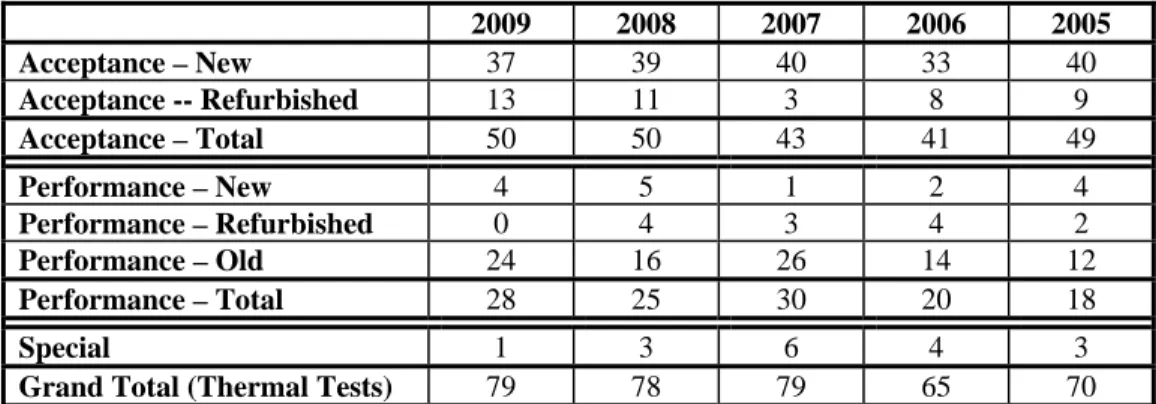
In calendar year 2009, a total of seventy-nine (79) thermal and special tests were conducted. A distribution of the tests by type is shown in Table 1 below.
Table 1. Distribution of Tests by Type
2009 2008 2007 2006 2005 Acceptance – New 37 39 40 33 40 Acceptance -- Refurbished 13 11 3 8 9 Acceptance – Total 50 50 43 41 49 Performance – New 4 5 1 2 4 Performance – Refurbished 0 4 3 4 2 Performance – Old 24 16 26 14 12 Performance – Total 28 25 30 20 18 Special 1 3 6 4 3
Grand Total (Thermal Tests) 79 78 79 65 70
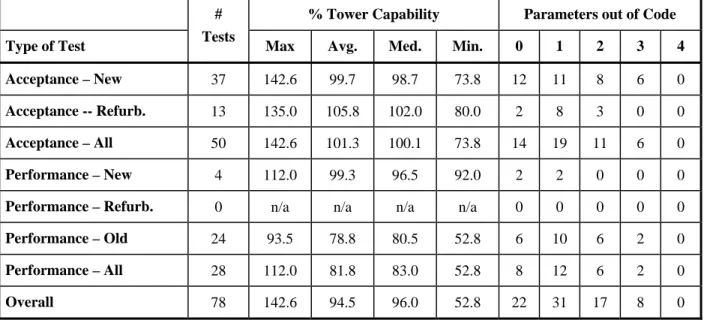
The overall average of the Tower Capabilities, the maximum and minimum capabilities, and the number of tests with one or more parameters out of code are shown for each type of test in Table 2 below. Approximately two-thirds of the tests (68%) were conducted with no more than one parameter out of code. The acceptance tests also had 66% falling into this category.
Table 2. Summary of 2009 Thermal Test Results
% Tower Capability Parameters out of Code Type of Test
# Tests
Max Avg. Med. Min. 0 1 2 3 4
Acceptance – New 37 142.6 99.7 98.7 73.8 12 11 8 6 0
Acceptance -- Refurb. 13 135.0 105.8 102.0 80.0 2 8 3 0 0
Acceptance – All 50 142.6 101.3 100.1 73.8 14 19 11 6 0
Performance – New 4 112.0 99.3 96.5 92.0 2 2 0 0 0
Performance – Refurb. 0 n/a n/a n/a n/a 0 0 0 0 0
Performance – Old 24 93.5 78.8 80.5 52.8 6 10 6 2 0
Performance – All 28 112.0 81.8 83.0 52.8 8 12 6 2 0
Overall 78 142.6 94.5 96.0 52.8 22 31 17 8 0
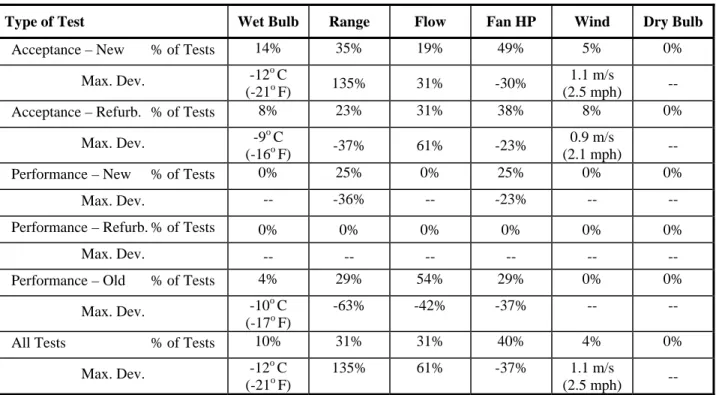
The number of tests (expressed as a percentage) with any particular parameter out of code are shown in Table 3 below for each type of test and overall. The parameter most often out of code was the fan horsepower, which occurred on 40% of all tests, followed by cooling range and flow on approximately 31% of all tests. On acceptance tests on new cooling towers, fan horsepower was out of code on 49% of the tests and cooling range was out of code on 35% of the tests.
Table 3. Test Parameters Out of Code – Percentage of Tests
The thermal test results are shown graphically in several figures. The thermal acceptance test results for new cooling towers are shown on Figure 1 as a function of the design circulating water flow rate. The average capability of tests that were less than 100% was 93%. The thermal acceptance test results for rebuilt cooling towers are shown on Figure 2. The performance test (tests performed without contractual guarantee compliance determination) results are shown on Figure 3. The combined thermal test results for all thermal tests are shown on Figure 4. A historical overview of the thermal performance testing is shown on Figure 5.
The thermal test results were analyzed to determine if there were any obvious trends or insights. The test results were grouped into the design flow bands identified in STD-202, shown on Figure 6, to determine if a particular cooling tower size range was problematic with regard to thermal performance on new cooling tower acceptance tests. Also shown on Figure 6 is the thermal capability without the horsepower correction for the same tests, the test results for each design flow range segregated
between initial tests and retests, and the average as-tested capability of tests with a capability less than 100%.
The test results were analyzed to show the affect of the number of parameters out of code, as shown on
Type of Test Wet Bulb Range Flow Fan HP Wind Dry Bulb
Acceptance – New % of Tests 14% 35% 19% 49% 5% 0%
Max. Dev. -12 o C (-21o F) 135% 31% -30% 1.1 m/s (2.5 mph) --
Acceptance – Refurb. % of Tests 8% 23% 31% 38% 8% 0%
Max. Dev. -9o C
(-16o F) -37% 61% -23%
0.9 m/s
(2.1 mph) --
Performance – New % of Tests 0% 25% 0% 25% 0% 0%
Max. Dev. -- -36% -- -23% -- --
Performance – Refurb. % of Tests 0% 0% 0% 0% 0% 0%
Max. Dev. -- -- -- -- -- --
Performance – Old % of Tests 4% 29% 54% 29% 0% 0%
Max. Dev. -10o C
(-17o F)
-63% -42% -37% -- --
All Tests % of Tests 10% 31% 31% 40% 4% 0%
Max. Dev. -12o C
(-21o F)
135% 61% -37% 1.1 m/s
Figure 7, on new cooling tower acceptance tests.
The test results were analyzed to show the thermal performance results on acceptance tests on new cooling towers as a function of the degree of difficulty as shown on Figure 8. The degree of difficulty was calculated as the ratio of temperature cooling range to enthalpy approach (saturated enthalpy of air at the cold water temperature minus the saturated enthalpy of the entering wet bulb). A trend line was added to the data, which indicates a slightly positive trend with increasing degree of difficulty.
The test results were analyzed, as shown on Figure 9, to show the thermal performance test results for acceptance tests on new cooling towers as a function of the design hot water temperature.
The test results for thermal acceptance tests were sorted, as shown on Figure 10, to show a breakdown of the thermal performance test results for crossflow and counter flow cooling towers for both new and rebuilt towers and new back-to-back towers.
A histogram of the thermal capability test results of acceptance tests on new towers for the last five years is shown on Figure 11. It is interesting to note that although the mean capability is nearly 100 percent, the standard deviation is approximately 10 percentage points.
The CTI Office requested feedback from each test representative party to each test performed by the licensed test agencies. A total of 18 survey responses were received. Every response indicated that they would use the test agency again and would recommend them to others for testing services. A summary of the survey responses is shown on Table 4.
8
Table 4. Quality Survey Response Summary
Number of Responses Statistical Data
Cooling Technology Institute (CTI)
Multi-Agency/Client Feedback Form
Un sat isf a c to ry Somewhat Di ssatisfied Satis fac tory Very G ood Exce ede d Expectatio n s
Average Median Mode Standard De
viation
1 Overall quality of the work. 0 0 0 12 6 4.3 4.0 4.0 0.5
2 Usefulness of the testing results. 0 0 2 11 5 4.2 4.0 4.0 0.6
3 The effectiveness and professionalism of written communication. 0 0 1 13 4 4.2 4.0 4.0 0.5
4 Proposals were clear and appropriate. 0 0 1 13 4 4.2 4.0 4.0 0.5
5 Responsiveness of client requests. 0 0 0 8 10 4.6 5.0 5.0 0.5
6 Timeliness and flexibility of test scheduling. 0 0 0 7 10 4.6 5.0 5.0 0.5
7 Timeliness of preliminary result. 0 0 2 8 8 4.3 4.0 5.0 0.7
8 Timeliness of final report. 0 0 2 10 6 4.2 4.0 4.0 0.6
9 Completeness and professionalism of reports. 0 0 1 13 4 4.2 4.0 4.0 0.5
10 Professionalism and conduct while on site. 0 0 0 10 8 4.4 4.0 4.0 0.5
11 Test preparation was adequate and appropriate equipment was
available for testing. 0 0 1 12 5 4.2 4.0 4.0 0.5
12 Safety awareness and conduct while on site. 0 0 0 14 4 4.2 4.0 4.0 0.4
13 Accuracy and completeness of billing/invoicing. 0 1 0 11 4 4.1 4.0 4.0 0.7
14 Condition of equipment. 0 0 1 13 4 4.2 4.0 4.0 0.5
15 Test completed within budget. 0 0 2 9 5 4.2 4.0 4.0 0.7
Yes No
16 Would you use this test agency again for testing purposes? 18 0
Figure 1
2009 COOLING TOWER THERMAL TESTS
ACCEPTANCE TESTS -- NEW COOLING TOWERS
40 50 60 70 80 90 100 110 120 130 140 150 160 10 100 1,000 10,000 100,000
Water Flow Rate (l/s)
Test
C
a
pabi
li
ty
-- %
D
e
si
gn Fl
ow
10
Figure 2
2009 COOLING TOWER THERMAL TESTS
ACCEPTANCE TESTS -- REBUILT COOLING TOWERS
40 50 60 70 80 90 100 110 120 130 140 150 160 10 100 1,000 10,000 100,000
Water Flow Rate (l/s)
Test
C
a
pabi
li
ty
-- %
D
e
si
gn Fl
ow
Figure 3
2009 COOLING TOWER THERMAL TESTS
PERFORMANCE TESTS
40 50 60 70 80 90 100 110 120 130 140 150 160 10 100 1,000 10,000 100,000Water Flow Rate (l/s)
Test
C
a
pabi
li
ty
-- %
D
e
si
gn Fl
ow
12
Figure 4
2009 COOLING TOWER THERMAL TESTS
ALL TESTS
40.0 50.0 60.0 70.0 80.0 90.0 100.0 110.0 120.0 130.0 140.0 150.0 160.0 10 100 1,000 10,000 100,000Water Flow Rate (l/s)
Test
C
a
pabi
li
ty
-- %
D
e
si
gn Fl
ow
Figure 5
THERMAL PERFORMANCE -- HISTORIC OVERVIEW
30 40 50 60 70 80 90 100 110 120 130 1984 1985 1986 1987 1988 1989 1990 1991 1992 1993 1994 1995 1996 1997 1998 1999 2000 2001 2002 2003 2004 2005 2006 2007 2008 2009
YEAR
Note: From 1988 to 1994, acceptance test data did not distinguish betw een new and refurbished tow ers
Test
C
a
pabi
li
ty
%
D
esi
gn Fl
ow
14
Figure 6
2009 Thermal Acceptance Tests
New Cooling Towers
80
85
90
95
100
105
110
0-100 (0-1,585)
101-1,000
(1,586-15,850)
1,001-10,000
(15,851-158,500)
10,001-100,000
(158,501-1,585,000)
Design Flow Band, l/s (gpm)
A
v
er
age C
a
p
a
bi
li
ty
,
%
Figure 7
Capability versus Parameters Out-of-Code
for Acceptance Tests on New Towers
40
60
80
100
120
140
160
0
1
2
3
4
5
Parameters Out-of-Code
C
a
p
a
b
ilit
y
, %
16
Figure 8
Capability vs Degree of Difficulty
for Acceptance Tests on New Cooling Towers
40
60
80
100
120
140
160
0
1
2
3
4
5
Ratio of Range to Enthalpy Approach
C
a
pa
bi
li
ty
, %
Figure 9
Capability versus Hot Water Temperature
for New Towers
40
60
80
100
120
140
160
25
30
35
40
45
50
55
Hot Water Temperature, C
C
a
pa
bi
li
ty
, %
18
Figure 10
2009 Thermal Acceptance Tests
80
85
90
95
100
105
110
115
New
Crossflow
Rebuilt
Crossflow
New
Counterflow
Rebuilt
Counterflow
New
Back-to-back
Cooling Tower Type
A
v
e
ra
g
e
C
a
p
a
b
ility
,
%
Figure 11
Histogram of Capability of Acceptance Tests
of New Cooling Towers 2005-2009
0
10
20
30
40
50
60
70
75
80
85
90
95
100
105
110
115
120
125
130
Mo
re
Fr
e
q
ue
nc
y
Mean: 99.8 Std Dev: 10.020
APPENDIX A
CTI Licensed Thermal Testing Agencies
Effective 1/1/2010
License
Type* Agency Name Address
Contact Person / E-mail / Web site
Telephone Number
FAX Number
A, B Clean Air Engineering, Inc. Powell, TN 37849 7936 Conner Rd U.S.A.
Kenneth Hennon
www.cleanair.com
(800) 208-6162 (865) 938-7569
A, B Cooling Tower Technologies Pty. Ltd.
PO Box N157 Bexley North, NSW 2207
AUSTRALIA
Ronald Rayner
[email protected] 61 2 9789 5900 61 2 9789 5922
A, B Cooling Tower Test Associates
15325 Melrose Drive Stanley, KS 66221 U.S.A. Thomas E. Weast [email protected] www.cttai.com (913) 681-0027 (913) 681-0039
A, B McHale & Associates, Inc.
6430 Baum Drive Knoxville, TN 37919 U.S.A. Thomas C. Wheelock [email protected] www.mchale.org (865) 588-2654 (865) 934-4779
* Type A license is for the use of mercury-in-glass thermometers; typically used for smaller towers.
CTI Licensed Drift Testing Agency
Effective 1/1/2010
Agency Name Address
Contact Person / E-mail / Web site
Telephone Number
FAX Number
Clean Air Engineering, Inc. 7936 Conner Rd
Powell, TN 37849 U.S.A. Kenneth Hennon [email protected] www.cleanair.com (800) 208-6162 (865) 938-7569
McHale & Associates, Inc.
6430 Baum Drive Knoxville, TN 37919 U.S.A. Thomas C. Wheelock [email protected] www.mchale.com (865) 588-2654 (865) 934-4779
Data on CTI Licensed Thermal Testing Agencies
Effective 1/1/2010 Agency Name License Type* Licensed Testing Agency Since Number of Lead Testers** Number of Data Loggers** Pipe Diameters covered by Pitot Tubes Total Number Wet Bulb Instruments Geographic PreferenceCleanAir Engineering, Inc. A&B 5/1/2006 9 20 150 – 5260 mm
(6” – 207”) >150 Worldwide
Cooling Tower
Technologies Pty. Ltd. A&B 3/19/1992 1 4
150 - 3600 mm
(6" - 142") 40 Worldwide
Cooling Tower Test
Associates A&B 1/1/1997 2 9
50 - 4265 mm
(2" - 168") 60 Worldwide
McHale & Associates, Inc. A&B 1/1/2006 4 >60 150 - 5500 mm (6" - 216") >100 Worldwide
* Type A license is for the use of mercury-in-glass thermometers, typically used for smaller towers.
Type B license is for the use of remote data acquisition devices, which can accommodate multiple measurement locations required by larger towers. ** Maximum number of concurrent tests will be limited by the number of lead testers and/or the number of data loggers.
Data on CTI Licensed Drift Testing Agencies
Effective 1/1/2010 Agency Name Licensed Testing Agency Since Number of Lead Testers* Number of Drift SamplingTrains* Geographic Preference
CleanAir Engineering, Inc. 5/1/06 4 3 Worldwide
McHale & Associates, Inc. 5/1/06 3 3 Worldwide
* Maximum number of concurrent tests will be limited by the number of lead testers and/or the number of drift sampling trains.