
Two Decades of Web Application Testing—A Survey of
Recent Advances
Yuan-Fang Li∗,1, Paramjit K. Das2, David L. Dowe3
Clayton School of Information Technology Faculty of Information Technology, Monash University
Clayton, VIC, 3800, Australia
Abstract
Since its inception of just over two decades ago, the World Wide Web has be-come a truly ubiquitous and transformative force in our life, with millions of Web applications serving billions of Web pages daily. Through a number of evo-lutions, Web applications have become interactive, dynamic and asynchronous. The Web’s ubiquity and our reliance on it have made it imperative to ensure the quality, security and correctness of Web applications. Testing is a widely-used technique for validating Web applications. It is also a long-standing, active and diverse research area. In this paper, we present a broad survey of recent Web testing advances and discuss their goals, targets, techniques employed, input-s/outputs and stopping criteria.
Key words: Software testing, Web applications, World Wide Web, Web
testing, Survey
1. Introduction
Software testing [1] has been widely used in the industry as a quality as-surance technique for the various artifacts in a software project, including the specification, the design, and source code. As software becomes more impor-tant and complex, defects in software can have a significant impact to users and vendors. Therefore, the importance of planning, especially planning through testing, cannot be underestimated [1]. In fact, software testing is such a critical
∗Corresponding author
Email addresses: [email protected](Yuan-Fang Li),[email protected]
(Paramjit K. Das),[email protected](David L. Dowe)
1Yuan-Fang Li is a Lecturer at Clayton School of Information Technology, Faculty of
Information Technology, Monash University.
2Paramjit K. Das is a PhD student at Clayton School of Information Technology, Faculty
of Information Technology, Monash University.
3David L. Dowe is an Associate Professor at Clayton School of Information Technology,
Faculty of Information Technology, Monash University.
part of the entire process of producing high-quality software that an industry may devote as much as 40% of its time on testing to assure the quality of the software produced.
In software testing, a suite of test cases is designed to test the overall func-tionality of the software—whether it conforms to the specification document or exposes faults in the software (e.g., functionality or security faults). However, contrary to the preconceived notion that software testing is used to demonstrate the absence of errors, testing is usually the process of finding as many errors as possible and thus improving assurance of the reliability and the quality of the software [1]. This is because, in order to demonstrate theabsence of errors in software, we would have to test for all possible permutations for a given set of inputs. However, realistically, it is not possible to test for all the permutations of a given set of input(s) for a given program, even for a trivial program. For any non-trivial software systems, such an exhaustive testing approach is essen-tially technologically and economically infeasible [1]. The main objectives of any testing technique (or test suite) can be summarised as:
• Testing is carried out mainly to demonstrate the presence of errors that exist during a program execution.
• A good testing technique will have a higher chance of discovering an error.
• A successful test case should discover a new fault or a regression fault. Ever since the creation of the World Wide Web in the early 1990s [2], there has been a tremendous increase in the usage of Web applications in our daily lives. The idea behind the World Wide Web was possibly envisioned by C. S. Wallace as early as 1966 [3, pp 244-245], where he envisioned that a central computing system (or the server), or a bank of computers, could be used to carry out various computing tasks, such as paying bills, ordering goods, carrying out engineering tasks, etc., for a large number of users. In these instances, the time required would be shared equally amongst all users, which would make the process economically feasible. This concept was appropriately labeled “Time-Sharing”, since the time would be shared amongst all users.
AWeb applicationis a system which typically is composed of a database (or the back-end) and Web pages (the front-end), with which users interact over a network using a browser. A Web application can be of two types - static, in which the contents of the Web page do not change regardless of the user input;
anddynamic, in which the contents of the Web page may change depending on
the user input, user interactions, sequences of user interactions, etc.
The profound transformative impact the Web and Web applications have brought about on our society has long been acknowledged. Somewhat surpris-ingly, however, there seems to be very limited research that has been done in surveying the different recent advancements made in the field of Web applica-tion testing over the past 20 years. To the best of our knowledge, the only other surveys in this field consists of an early review by Di Lucca and Fasolino [4] on general approaches to Web application testing, and a survey by Alalfi et
al. [5] focussed on the modeling aspects of Web application testing. Therefore, this survey paper provides a much needed source of detailed information on the progress made in and the current state of Web application testing.
Compared to traditional desktop applications, Web applications are unique in a number of ways, and such uniqueness presents new challenges for their quality assurance and testing.
• Firstly, Web applications are typically multilingual. A Web application usually consists of a server-side backend and a client-facing frontend, and these two components are usually implemented in different programming languages. Moreover, the frontend is also typically implemented with a mix of markup, presentation and programming languages such as HTML, Cascading Style Sheets (CSS) and JavaScript. The presence of multiple languages in a Web application poses additional challenges for fully auto-mated continuous integration (CI) practices, as test drivers for different languages need to be integrated into the CI process and managed coher-ently.
• Secondly, the operating environment of typical Web applications is much more open than that of a desktop application. Such a wide visibility makes such applications susceptible to various attacks, such as the distributed denial-of-service (DDOS) attacks. Moreover, the open environment makes it more difficult to predict and simulate realistic workload. Levels of stan-dards compliance and differences in implementation also add to the com-plexity of delivering coherent user experiences across browsers.
• Thirdly, a desktop application is usually used by a single user at a time, whereas a Web application typically supports multiple users. The effective management of resources (HTTP connections, database connections, files, threads, etc.) is crucial to the security, scalability, usability and function-ality of a Web application. The multi-threaded nature of Web applications also makes it more difficult to detect and reproduce resource contention issues.
• Last but not least, a multitude of Web application development tech-nologies and frameworks are being proposed, actively maintained and fast evolving. Such constant evolution requires testing techniques to stay cur-rent.
The rest of this paper is organised as follows. We begin in Section 2 by motivating the importance of Web application testing and then outlining major techniques covered in subsequent sections. In Section 3 we cover graph and model based testing techniques, including finite state machine-based techniques. In Section 4, we briefly discuss mutation testing techniques. In Section 5, we present search based software engineering techniques, where testing problems are treated as optimisation problems. Section 6 is devoted to the discussion of some popular scanning and crawling techniques and present their application to security testing of Web applications. In Section 7, we present random testing,
with the use of assertions as the primary oracle, and describe examples of how random testing can be applied to Web services. Fuzz testing is a form of random testing that generates invalid inputs with an aim of discovering defects that are severe and hard to detect. Section 8 is devoted to fuzz testing. We introduce some white-box fuzz testing techniques that makes use of symbolic execution techniques introduced in Section 9. A black-box fuzz testing framework for JavaScript [6] will also be covered. Concolic testing, a technique that combines symbolic and concrete random execution to improve testing effectiveness, is covered in Section 9. We also show how they can be applied to testing dynamic PHP [7] and JavaScript applications using a number of examples. In Section 10, we discuss user session-based techniques and some of the ways to minimize the number of user sessions during testing. Lastly, in Section 11, we provide a summary of the different testing techniques and lay out future directions in which Web application testing research can proceed.
2. Motivation, Challenges and Overview of Techniques
Many aspects of a Web application may be subject to testing, which has been a major challenge due to their heterogeneous nature. Web applications usually comprise different components that are typically implemented in differ-ent programming languages, application developmdiffer-ent frameworks and encoding standards. Additionally, as we stated above, compatibility testing has also be-come a major challenge with the increased availability of a number of popular browsers. Large Web-based software systems can be quite complicated and con-tain thousands to millions of lines of code, many interactions among objects, and involve significant interaction with users. In addition, changing user profiles and frequent small maintenance changes complicate automated testing. In the following 2 subsections we motivate the importance of testing with two chal-lenges facing Web applications: interoperability andsecurity. In Section 2.4, we then provide a quick overview of the major testing techniques which are also summarised in a number of tables for easy reference.
2.1. Interoperability
According to the World Wide Web Consortium (W3C),4 the main interna-tional standards organisation for the World Wide Web (WWW), testing in Web applications is very significant. In order for the Web to reach its full potential, it is paramount that all the basic Web technologies are compatible with each other and allow any hardware and software used to access the Web to work together.5 This goal is referred to as “Web interoperability” by the W3C. Two different implementations of a technology are compatible if they both conform to the same specifications. Conformance to specifications is a necessary but
4http://www.w3.org/Consortium/. This site was last accessed on January 31, 2013. 5http://www.w3.org/QA/WG/2005/01/test-faq#why. This site was last accessed on
insufficient condition for interoperability; the specifications must also promote interoperability (by clearly defining behaviors and protocols). Therefore, in the case of Web applications and Web technologies, testing must be done to ensure that the overall functionality of a Web application conforms to the specifica-tion document(s) in addispecifica-tion to ensuring compatibility across different browsers (e.g., Chrome, Firefox, Internet Explorer and Safari) and platforms (e.g., differ-ent operating systems such as, Windows, Linux, Mac OS X, Android and iOS). Such an articulate version of testing will also help uncover contradictions, lack of clarity, ambiguity, and omissions in specification documents.
2.2. Security
Web applications are used by virtually all organisations in all sectors, in-cluding education, health care, consumer business, banking and manufacturing, among others. Thus, it is important to ensure that the Web applications de-veloped are properly tested due to the importance and the sensitivity of the information stored in databases of such Web applications [8, 9]. Thus, the secu-rity of Web application becomes an issue of critical importance. This is because Web applications can be accessed by a large number of anonymous users and as a result, the information can be easily misused, possibly resulting in huge damages to the organisation and its clients.
Although it is important that Web applications are dependable, recent re-ports have indicated that in practice they are usually not. For example, one study of Web application integrity found that 29 of 40 leading e-commerce sites and 28 of 41 government sites exhibit some type of failure when exercised by a “first-time user” [10]. Similarly, another study by Kals et al. [8] showed that be-tween 4 and 7 percent of randomly chosen Web site forms (from a list of 21,627 forms) were vulnerable to different categories of Cross-site scripting (XSS) and SQL injection attacks (more specifically, 6.63% to SQL injection, 4.30% to Sim-ple XSS injection, 5.60% to Encoded XSS injection, 5.52% to Form-Redirecting XSS injection, see Section 6 for more details). Additionally, there have been recent cases in some high profile corporations, where lack of security in Web ap-plications resulted in hackers gaining unauthorised access to the organisation’s network and privileged information. For instance, the PlayStation Network of Sony Computer Entertainment was attacked in April 2011, resulting in hackers gaining access to the e-mail addresses, usernames, passwords, online user IDs and credit card details of nearly 70 million customers who were registered with Sony’s PlayStation Network.6. This large-scale breach of the security system of the PlayStation Network is believed to have cost Sony as much as $24 billion,7 in addition to dealing a major blow to Sony’s reputation worldwide.
6
http://www.wired.com/gamelife/2011/04/playStation-network-hacked/. This site was last accessed on January 31, 2013.
7http://www.businessinsider.com/playStation-network-breach-could-cost-sony-24-billion-2011-4.
This site was last accessed on January 31, 2013.
2.3. Dynamics
Many non-trivial Web applications are divided into a server-side backend and a client-side frontend. The backend is responsible for data processing and persistence, and it often implements complex business logics. The frontend, traditionally concerned about the presentation of data, is becoming more and more sophisticated and rich in features. Dynamics are present in Web applica-tions in several ways, and they bring unique challenges to the testing of Web applications.
Firstly, the Web applications themselves may be dynamic in nature. The so-called Web 2.0 [11] applications are characterised by their abilities to support not only static data presentation, but also interactive user participation and content creation. In these interactive Web applications, page contents can be updated by client-side scripts without a page refresh, made possible by languages and technologies such as JavaScript [6] and AJAX (Asynchronous JavaScript and XML) [12]. Such dynamic content generation mechanisms make capture-replay style of testing more difficult [13]. For example, the test driver needs to understand when page contents are ready to consult the test oracle for validating test results. The increasing prevalence of single-page Web applications8further amplifies the importance of dynamic Web application testing.
Secondly, predominant Web programming languages, including JavaScript [6], PHP [7], Python [14] and Ruby [15], are dynamic in nature. For example, JavaScript is the lingua franca for client-side scripting in Web applications. It is a powerful language with many advanced features, including dynamic typing and evaluation, functions as objects, and various forms of delegation. These fea-tures make it very challenging to thoroughly test a JavaScript application. For instance, a JavaScript application may accept many kinds of inputs, including responses from the server and user input from from fields, which are structured as strings [16]. Therefore, a JavaScript testing tool must be able to discern the different kinds of inputs and handle them accordingly.
2.4. Overview of Techniques
In this survey we broadly categorize Web application testing techniques into a number of groups, including those based on graphs and models, scanning and crawling techniques, search-based techniques, mutation testing, concolic testing, user session-based testing and random testing.
Each of these groups of testing techniques can be described along a number of dimensions, including a main purpose (to determine which technique should be used given the basic testing objectives), evaluation criteria, inputs and outputs, and criteria for stopping the test. For easy reference, these dimensions are highlighted in a number of tables in this subsection.
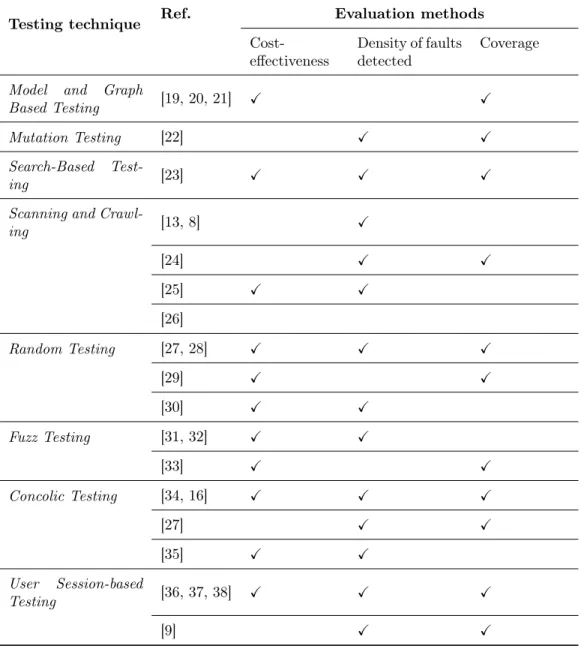
Table 1 summarizes the main purpose of these testing techniques. Table 2 highlights the different testing techniques, evaluation criteria on the basis of
8
http://itsnat.sourceforge.net/php/spim/spi_manifesto_en.php. This site was last accessed on November 15, 2013.
cost-effectiveness, density of faults detected, and coverage. Table 3 describes the inputs, outputs and stopping conditions for each testing technique.
The graph and model based testingapproach essentially creates a model of
a Web application. Test cases are then derived on the basis of the model con-structed. The test cases are generated according to either the all-statement (all statements must be covered/tested) or all-path (all paths/branches must be covered) coverage criterion. Thegraph and model based approachinclude finite state machine-based testing, where a finite state machine depicting the model of the system is first constructed, from which test cases are then derived. A variant offinite state machinesis the probable finite state machines, where transitions are associated with probabilities (this is similar to the probabilistic finite state machines discussed in [17, Section 7.1], where the shortest length message can be inferred from the data).
Mutation testingis aimed at detecting the most common errors that typically exist in a Web site or a Web application. In this form of testing, some lines of source code are randomly changed in a program to check whether the test case can detect the change. For example, the destination address on the client side, in an HTML form, may be replaced with an invalid address, or invalid files may be included in the server side of the program. If the test suite can detect the errors (i.e., testing has been properly conducted), then an error message will be displayed. This form of testing is mainly intended to ensure that testing has been done properly and also to cover additional faults which may exist in a Web site, and for which testing has not been performed.
Search-based software testing aims at testing a majority of the branches in a Web application. The main aim of this form of testing is to cover as many branches as possible and thus improve testing coverage. Usually, some heuristic is used to ensure that a large number of branches are tested and thus testing is sufficiently thorough.
Scanning and crawling techniques are mainly intended to check the security
of Web applications. In such techniques, a Web application is injected with unsanitised input, which may result in malicious modifications of the database if not detected. The main idea is to detect any such vulnerabilities that a Web application may have. This is a very important form of testing, because, as discussed earlier, many Web site designers do not pay enough attention to security threats, thus making their Web site vulnerable to potential intrusion. This form of testing aims to improve the overall security of a Web site.
Inrandom testing, random inputs are passed to a Web application, mainly
to check whether the Web application functions as expected and can handle invalid inputs. A special case of random testing isfuzz testing, where boundary values are chosen as inputs to test that the Web site performs appropriately when rare input combinations are passed as input.
The major aim ofconcolic testing(concrete, symbolic testing) is also to cover as many branches as possible in a program. In this form of testing, random inputs are passed to a Web application to discover additional and alternative paths which are taken by the Web application as a result of different inputs. The additional paths are stored in a queue in the form of constraints, which are
then symbolically solved by a constraint solver. The process continues until the desired branch coverage is achieved.
In user session-based testing, testing is done by keeping track of user ses-sions. In this case, a list of interactions performed by a user is collected in the form of URLs and name-value pairs of different attributes, which are then used for testing. Due to the large number of user sessions that can result when a user interacts with a Web site, there are several techniques for reducing the number of sessions to test, such as lattice construction, batch test suite reduction, in-cremental reduced test suite update, and test case reduction through examining URL traces.
One of the aspects of Web application testing that we do not cover in this survey isusability testing [18]. Usability testing is primarily a black-box testing technique. The major aim is to test how users use an application and discover errors and/or areas of improvement (intended to make the product more in-tuitive and user-friendly). Usability testing generally involves measuring how well users respond in four main areas while using the application: efficiency, accuracy, recall, and emotional response. The results obtained from the first test is usually treated as a baseline against which all subsequent tests are then compared to indicate improvement. Generally speaking, in the case of Web applications, such usability testing would involve the testing of, e.g., (1) the ease of using the application, (2) the layout and appearance of the Web applica-tion on different devices such as desktops, laptops, and mobile systems, and (3) whether different messages displayed during the application are sufficient and appropriate.
Table 1: The main purpose of each group of testing techniques and whether or not the techniques are automated.
Testing technique Ref. Automated Main purpose
Model and Graph
Based Testing [19, 20, 21] × Create a model of the application
to test
Mutation Testing [22] X Find out rare and most common
errors by changing the lines in the source code
Search-based Testing [23] X To test as many branches as
possi-ble in an application via the use of heuristics to guide the search Scanning and
Crawl-ing [8, 13, 24, 25] X Detect faults in Web applications
via injection of unsanitised in-puts and invalid SQL injections in user forms, and browsing through a Web application systematically and automatically
[26] × Detects navigation and page errors
by systematically exploring pages and filling out form
Random Testing [27, 28, 29, 30] X Detect errors using a combination
of random input values and asser-tions
Fuzz Testing [31, 32, 33] X Test the application by passing in
random, boundary or invalid in-puts
Concolic Testing [34, 27, 35, 16] X To test as many branches as
pos-sible by venturing down different branches through the combination of concrete and symbolic execution User Session Based
Testing [36, 9] X Test the Web application by
col-lecting a list of user sessions and replaying them
[37, 38] X Reduce the test suite size in User
session-based testing
Table 2: The main evaluation methods of each of the testing techniques. The evaluation methods are indicated by a ‘X’ for each technique.
Testing technique Ref. Evaluation methods
Cost-effectiveness
Density of faults detected
Coverage
Model and Graph
Based Testing [19, 20, 21] X X
Mutation Testing [22] X X
Search-Based
Test-ing [23] X X X
Scanning and
Crawl-ing [13, 8] X [24] X X [25] X X [26] Random Testing [27, 28] X X X [29] X X [30] X X Fuzz Testing [31, 32] X X [33] X X Concolic Testing [34, 16] X X X [27] X X [35] X X User Session-based Testing [36, 37, 38] X X X [9] X X
T able 3: The main inputs, outputs, and stopping c o n ditions for eac h testing tec hnique. T esting tec hnique Ref. Inputs Outputs Condition to stop test-ing Mo del and Gr aph Base d T esting [19, 21] Mo de l of the application Regular expressions from whic h test cases can b e cre-ated Dep ends (e.g., all path/all statemen t criteria) [20] Lo w er lev el finite-state ma-chine (FSM) of the applica-tion An appli cation-le v el FSM from whic h test cases can b e generated Dep ends (e.g., all path/all statemen t criteria) Mutation Testing [22] A program a n d m utation op erators Mutated pro gram created as a result of applying the m utation op erators Required m utation op era-tors are applied Se ar ch-b ase d T esting [23] Mutation of application in-puts as generated b y differ-en t heuristics suc h as hill clim bing, sim ulated anneal-ing and ev olutionary algo-rithms A test suite with the aim of maximise branc h co v erage A pre-determined, fixed n um b er of test executions Sc anning and Cr aw ling [24, 13, 8, 25] Unsanitise d user inputs to crash the W eb application (e.g., the database or force the use r to en ter unsafe W eb sites) T yp e of defects and n um b er of defects Un til all the forms for a giv en W eb application is in-jected with differen t forms of unsanitised user input 11
T able 3: The main inputs, outputs, and stopping c o n ditions for eac h testing tec hnique. T esting tec hnique Ref. Inputs Outputs Condition to stop test-ing [26] A starting URL T yp e of de fects and n um b er of defects A maxim um depth of explo-ration is reac hed R andom T esting [27] WS-CDL W eb service choreograph y sp e cifications T est oracles (a test suite in-cluding assertions) The stop instrumen t in the con trol flo w graph is reac hed [28] State mac hine m o dels of WSDL W eb service descrip-tions A test suite, and its execu-tion and vis ualisation Dep ends (e.g., all path/all statemen t criteria) [29] A Ja v aScript program A set of test cases a n d their execution results A pre-determined, fixed n um b er of test cases [30] A Ja v aScript program T est oracles in the form of con tracts and random tes t cases based on con tracts All con tracts exhausted F uzz T esting [31] Random user inputs whic h test rare or unlik ely system b eha vior (e.g., v alues near the b oundaries) T est cases with oracles Dep end s (e.g., all path/all statemen t criteria) [32] A Ja v aScript program and a b enign input A tes t suite and th e iden-tified p oten tial clien t-side v alidation vulnerabilities All iden tified data flo ws ex-hausted
T able 3: The main inputs, outputs, and stopping c o n ditions for eac h testing tec hnique. T esting tec hnique Ref. Inputs Outputs Condition to stop test-ing [33] A Program, a grammar and an initial input A test suite and the iden ti-fied defects All generated inputs ex-hausted Conc olic T esting [34, 27, 35, 16] Concrete inputs from sym-b olically solv ed previous it-eration, start with random initial input P ath constrain ts at eac h it-eration All constrain ts exhausted User Session-base d T esting [36, 38, 9] User ses sions A com bination of URL and the parameters to b e passed to the serv er Dep ends (e.g., certain se-lected user sessions ha v e b een tested or reas onable co v e rage has b een ac hiev ed) [37] User sessions An up dated concept lattice and a up dated test suite Con tin ue till all the user sessions to b e tested ha v e b een exhausted and the test suite and the lattice cannot b e mo dified an ymore 13
3. Graph- and Model-based White-box Testing Techniques
These testing techniques starts with constructing a graph or a state machine model of the Web application and then generate test cases from these models.
3.1. Graph-Based Testing
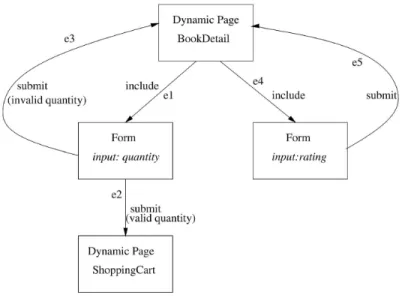
The most popular white-box graph based testing approach is the one pro-posed by Ricca and Tonella [19], which creates a graph-like model in which nodes in the graph represent Web objects such as Web pages, forms and frames, and edges represent the relationship between these objects (e.g., submit, include, split and link).
To generate test requirements and test cases, a regular expression to match the graph is generated. For example, Figure 1 depicts the graph for a sample Web application. The regular expression “e1e2 +e1e3∗+e4e5∗”, where a “*”
indicates that a transition may be visited any number of times and a “+” indi-cates choice, can then be used to generate test requirements by identifying the set of linearly independent paths that comprise it, and applying heuristics to minimize the number of requirements generated. A linearly independent path is defined as the path in which at least one edge has not been traversed earlier while constructing the paths and all the linearly independent paths together test all the edges of the graph at least once.
3.1.1 WB-1: Complete Test Requirements with Ad Hoc Selection of Inputs
Our first white-box technique attempts to match the methodology presented in [30]. We generate test require-ments from path expressions following the procedure just outlined, but we make the following assumptions about the process where [30] omits details: 1) we test only linearly independent paths, 2) we exercise forms that are included in multiple Web pages, but perform the same functionality independent of context (e.g, provide search capability) from only one source, and 3) we ignore circular links represent-ing edges to the same page (included just to facilitate navigation within a page). After test requirements are generated from path expressions, we fill in the relevant forms so that the test cases can be executed.
3.1.2 WB-2: Complete Test Requirements with Formalized Selection of Inputs
Our second white-box implementation relaxes some of the assumptions established for WB-1 and incorporates a more elaborate approach for input value selection. In contrast to WB-1, WB-2 uses boundary values as inputs, and utilizes a strategy for combining inputs inspired by the “each condition/all conditions” strategy [4]. The test suite that results consists of a set of test cases in which for each form, each input variable is considered in isolation (all the other variables are set to the empty string), plus one test case in which all variables have values assigned. For the test cases that consider just one variable, the values are selected based on the boundary conditions for such variables. For the test case that includes all variables at once, one random combination of values is selected. The objective behind this strategy is to add formalism to the process of inputting data
3.2 User-Session-Based Techniques
One limiting factor in the use of white box Web application testing techniques such as Ricca and Tonella’s is the cost of finding inputs that exercise the system as desired. The selection of such inputs is complex and must be accom-plished manually [30]. User-session-based techniques can help with this problem by transparently collecting user interactions (clients’ requests) in the form of URLs and name-value pairs, and then applying strategies to these to generate test cases.
Because normal Web application operation consists of receiving and processing requests and because a Web application runs in just one environment which the organization performing the testing controls, the collection of client request information can be accomplished easily. For example, with minimal configuration changes, the Apache Web server can log all received get-requests [1]. A slightly more powerful but less transparent alternative that can capture all name-value pairs involves adding snippets of javascript to the delivered Webpages so that all requests invoke a server-side logging script. Utilizing Java servlet filters is yet another alternative that enables the dynamic interception of requests and responses at the server side. Given a particular collection mechanism, user-session-based techniques require little additional infrastructure to collect the required data, limiting the impact on Web application performance. Another advantage of collecting just the requests is that at that higher abstraction level, some of the complexities introduced by heterogeneous Web application architectures are hidden. This lessens the dependencies of user-session-based techniques on changes in Web application components.
190 IEEE TRANSACTIONS ON SOFTWARE ENGINEERING, VOL. 31, NO. 3, MARCH 2005
Fig. 2. Simplified model for an e-commerce application.
Figure 1: The graph model of a sample Online Book Shopping Web application from [19, Figure 2].
The test cases are sequences of Web pages to be visited together with their corresponding values (generated from the path expressions). There are two versions [19] of this implementation:
• Complete test requirements with ad hoc selection of inputs: This white-box technique attempts to match the methodology presented in [19]. Test cases are generated from the path regular expressions and the following assumptions are made: (1) only linearly independent paths are tested, (2) we exercise forms that are included in multiple Web pages, but perform the same functionality independent of context (e.g, provide search capability) from only one source, and (3) ignore circular paths which link back to the starting page (included just to facilitate navigation within a page). Then the forms are filled and test cases are generated.
• Complete test requirements with formalised selection of inputs: This tech-nique uses boundary values as inputs, and utilizes a strategy for combining inputs inspired by the “each condition/all conditions” strategy [39]. The test suite contains test cases such that the test cases for each form com-prise tests of empty values for all variables and one additional test case in which all the variables have values assigned. For the test cases that consider just one variable, the values are selected based on the boundary conditions for such variables. For the test case that includes all variables at once, one random combination of values is selected. The objective be-hind this strategy is to add formalism to the process of inputting data into the forms, as recommended in one of the examples in [19].
One of the main limitations of this approach by Ricca and Tonella [19] is that the construction of the graph has to be done manually. Therefore it is very difficult to automate the process. In addition, only linearly independent paths are tested. The advantage of this approach seems to be that there is not much overhead involved in obtaining the regular expressions after a model of the system is constructed (manually). Moreover, the testing involves inputs chosen randomly, thus making the process simple to implement.
3.2. Finite State Machine Testing
A finite state machine usually has a finite set of states S, a finite set of inputs I, a finite set of outputs O, a transition function T which determines the transition from the current state s1 to a next state s2, depending on the
inputi1, and an output functionO, which determines the output produced by
a transition.
A few methods have been proposed for deriving test cases for software sys-tems from finite state machines (FSM) [40]. Finite state machine-based ap-proaches have also been applied to Web testing because a Web application is essentially a system in which transitions occur from one Web page to another and outputs are produced according to the inputs/actions at and the current state.
Test cases for testing a Web application can be generated from FSMs. The methodology required to generate test cases from FSMs is described in [20]. A simple Web application can face thestate space explosion problem as there can be a very large number of possible inputs to a text field, a large number
of options (e.g., checkboxes, links) can be available on a particular page, and a large number of different orders in which the options can be selected. For example, for a simple set of 5 questions each containing 4 possible options (in the form of checkboxes), there can be 45 (1024) different combinations of user
selected options. Thus, the FSMs must be expressive enough to test the system effectively and also be small enough to be practical [20].
Hierarchical FSMs [20] have been employed to alleviate the state space ex-plosion problem, by reducing the number of states and transitions in a FSM. The bottom level FSMs are formed from Web pages and parts of Web applica-tion known aslogical Web pages, and the top level FSM represents the entire Web application. AlogicalWeb page may either be a simple physical Web page or an HTML form which accepts inputs from the user and sends it to a different software module. The logical Web pages (LWP) can be easily extracted because these are embedded with HTML “Form” tags.
Next, in order to generate test cases manually from the Web applications, the following four steps are performed [20]:
1. Partitioning the Web application intoclusters, where a clustercomprises software modules and Web pages which implement a certain logical func-tion. Clustering is done to identify the different layers of abstracfunc-tion. At the top level, clusters are abstractions that implement functions that can be identified by users. At lower levels, clusters are a set of Web pages and software modules which communicate with each other to implement some user-level functions. At the lowest level, clusters may be individual Web pages and software modules that represent single major functions themselves. Individual clusters can be identified from the layout of the site navigation, coupling relationships among the components, and the information that can be obtained from site design [20]. This process is manual, and as a result, the clusters and the entire partitioning process can have an impact on the resulting tests [20].
2. Extracting Logical Web Pages (LWP). This process can be automated, because HTML Forms that accept input data from the user and send it to a back-end software module are embedded with HTML “Form” tags. The identification of LWPs can, therefore, be carried out by extracting these HTML tags.
3. Building FSMs for each cluster. A bottom-up approach is followed to construct these FSMs. First, the FSMs are generated from bottom-level clusters that contain software modules and Web pages (i.e., no clusters). Next, higher-level cluster FSMs are built by aggregating lower-level FSMs. Each state or node in these higher-level FSMs represents a lower-level FSM. This process is completed manually.
4. Building an application FSM for the entire Web application. Lastly, an application finite state machine (AFSM) defines a finite state model of the entire Web application, in which the edges represent the navigation or links between different Web pages in different clusters. Each FSM is assumed to have a single entry and exit node (“dummy” or extra nodes
may be added to guarantee this requirement). The final result of this partitioning is a collection of autonomous (separate but interacting) finite state machines with the following two properties. First, they are small enough to efficiently allow test sequences to be generated. Second, they clearly define the information that propagates among the FSMs. This process is accomplished manually.
The state space explosion problem in finite state machines can be dealt with more effectively by defining a BNF grammar for the input constraints on the Web application. For input values, [20] defines five broad choices, namely, R (if the input is required, i.e., the user has to enter a value to transition from one state to another),R(parm=value) (if the input is required and can only be chosen from a subset to transition from one state to another), O (if input is optional),C1 (if the user only needs to selectone input from a given list of
inputs, e.g., a radio button) andCn (if the user needs to select multiple values from a list, e.g., check-boxes). In order to define theorderof values, [20] defines two symbols,S (if the values must be entered in a particular order) andA (if the values can be entered in any order). The types of inputs can be further broken down into “text” and “non-text”. FSMs with input constraints are called “annotated FSMs”. The advantage of “annotated FSMs” over normal FSMs are shown clearly in Figure 2(a) and Figure 2(b). Assuming that there is a Web application with input fields “username” and “password”, where the username and password must differ from each other and there are only3 possible choices for usernames and passwords, namely “a”, “b” and “c”, then the normal FSM with different states and transitions will be constructed as shown in Figure 2(a). But, if annotated FSMs are used, then the different states and transitions can simply be replaced with the “annotated constraints” (such as “R”, “S” and “A” to test for the order of entered values as well as for the actual values entered).
The FSMs defined above are then used to generate tests. Tests are generated as sequences of transitions and the values for inputs are then selected randomly. A test sequence is a sequence of transitions in an FSM and the associated constraints.
The main limitation of this approach is that the finite state machines have to be constructed manually. Thus, the process is difficult to be fully automated. The advantage of this approach is in the reduction in the number of states in an FSM, which helps solve the state space explosion problem as discussed above. Also, the extraction of the logical Web pages (LWPs) can be done automatically. The use of annotated FSMs also makes it easier to derive a model of the complete Web application incrementally.
3.3. Probable FSM
An extension of the FSM described above is theprobable(probabilistic) FSM. A method for generating test cases from the probable FSM is described in [21], where the probabilistic FSM is constructed manually, and the test sequences are selected on the basis of probabilities of a given sequence. In such an FSM, in addition to the states and transitions, a probability is also assigned to each
A.A. Andrews et al.: Testing Web applications by modeling with FSMs 333 3.3 Annotating FSMs and logical Web pages
The partitioning of the logical Web pages results in a hier-archical collection of finite state machines. At the low-est level, logical Web pages are represented by nodes in FSMs that model behavior of software modules and Web pages. Edges represent transitions among logical Web pages and software modules. Each cluster in turn forms a node in a higher level FSM that models behavior of clus-ters. Edges in both levels of FSMs are annotated with inputs and constraints that may be associated with the transition.
3.3.1 Input selection constraints for logical Web pages Logical Web pages are described via the sets of related in-puts and actions. In addition, there may be rules on the inputs. For example, some inputs may be required and others may be optional. A user may be allowed to enter inputs in any order, or a specific order may be required. Table 5 shows input constraints of both types; other con-straints may be defined in future work. A precise defin-ition of our language used to express the constraints is given in a BNF grammar in Appendix A.
A possible set of input constraints for logging on would be:R(user-name, password, submit) andS (user-name, password, submit). This means that the three re-quired inputs can be entered in order. If password and user name can be entered in any order, the constraint for sequencing would beS(A(user-name, password), sub-mit). Single constraints (C1) mean that a single input must be selected from a set of choices and multiple choice constraints (Cn) mean that multiple inputs must be se-lected from a set of choices.
Inputs also can be of a variety of types, including text (from single digits to single lines to large files), tons (from single button to choices from a set of but-tons), links, etc. Table 6 shows a list of the types of in-puts found in Web applications (based on HTML Form elements).
Figure 6 shows the login constraints, under the as-sumption that user name and password may be entered in any order. The advantage of these kinds of constraints can be observed from this example. Figure 6 only has two nodes. Without the constraints, the FSM would have five nodes, as in Fig. 7, which has explicit transitions to
repre-Table 5.Constraints on inputs
Input Choice Order
Required (R) Sequence (S)
Required Value (R(parm=value)) Any (A) Optional (O)
Single Choice (C1) Multiple Choice (Cn)
Table 6.Types of inputs
Text Non-text
digit links
line buttons
email radio button
phone drop-down list
URL check boxes
multi-line file
Fig. 6.Annotated FSM for login
Fig. 7.FSM for login without constraint annotation
Fig. 8.FSM for three button UI
with no constraint annotation
sent the two different orderings. In effect, the transitions introduce a simple type of controlled non-determinism into the FSM. The savings in FSM size are even more pro-nounced for optional, single, and multiple choice sets of inputs.
For example, if an LWP requires choosing two of three buttonsa,b, andcin no required order, the annotated FSM consists of two nodes and one edge with the anno-tationC2(a, b, c);A(a, b, c). If the corresponding FSM with single inputs is used, then we can have the inputs afollowed byborc,bfollowed byaorc, orcfollowed byaorb. This FSM would have 10 nodes and 9 edges as shown in Fig. 8. Similarly, having three required inputs
(a) Normal FSM for a simple Web application with fields username and password.
A.A. Andrews et al.: Testing Web applications by modeling with FSMs 333
3.3 Annotating FSMs and logical Web pages
The partitioning of the logical Web pages results in a hier-archical collection of finite state machines. At the low-est level, logical Web pages are represented by nodes in FSMs that model behavior of software modules and Web pages. Edges represent transitions among logical Web pages and software modules. Each cluster in turn forms a node in a higher level FSM that models behavior of clus-ters. Edges in both levels of FSMs are annotated with inputs and constraints that may be associated with the transition.
3.3.1 Input selection constraints for logical Web pages Logical Web pages are described via the sets of related in-puts and actions. In addition, there may be rules on the inputs. For example, some inputs may be required and others may be optional. A user may be allowed to enter inputs in any order, or a specific order may be required. Table 5 shows input constraints of both types; other con-straints may be defined in future work. A precise defin-ition of our language used to express the constraints is given in a BNF grammar in Appendix A.
A possible set of input constraints for logging on would be:R(user-name, password, submit) andS (user-name, password, submit). This means that the three re-quired inputs can be entered in order. If password and user name can be entered in any order, the constraint for sequencing would beS(A(user-name, password), sub-mit). Single constraints (C1) mean that a single input must be selected from a set of choices and multiple choice constraints (Cn) mean that multiple inputs must be se-lected from a set of choices.
Inputs also can be of a variety of types, including text (from single digits to single lines to large files), tons (from single button to choices from a set of but-tons), links, etc. Table 6 shows a list of the types of in-puts found in Web applications (based on HTML Form elements).
Figure 6 shows the login constraints, under the as-sumption that user name and password may be entered in any order. The advantage of these kinds of constraints can be observed from this example. Figure 6 only has two nodes. Without the constraints, the FSM would have five nodes, as in Fig. 7, which has explicit transitions to
repre-Table 5.Constraints on inputs
Input Choice Order
Required (R) Sequence (S) Required Value (R(parm=value)) Any (A) Optional (O)
Single Choice (C1) Multiple Choice (Cn)
Table 6.Types of inputs
Text Non-text
digit links line buttons email radio button phone drop-down list URL check boxes multi-line
file
Fig. 6.Annotated FSM for login
Fig. 7.FSM for login without constraint annotation
Fig. 8.FSM for three button UI with no constraint annotation
sent the two different orderings. In effect, the transitions introduce a simple type of controlled non-determinism into the FSM. The savings in FSM size are even more pro-nounced for optional, single, and multiple choice sets of inputs.
For example, if an LWP requires choosing two of three buttonsa,b, andcin no required order, the annotated FSM consists of two nodes and one edge with the anno-tationC2(a, b, c);A(a, b, c). If the corresponding FSM with single inputs is used, then we can have the inputs afollowed byborc,bfollowed byaorc, orcfollowed byaorb. This FSM would have 10 nodes and 9 edges as shown in Fig. 8. Similarly, having three required inputs
(b) Annotated FSM for the same Web application.
Figure 2: A demonstration of the advantages of an annotated FSM over a normal FSM, as given by [20, Figure 8].
transition. In this case, the transition function T is redefined to include the current state, the transition t1 and the probability associated with t1. Thus,
the transition function δ(s1, t1, pr) = s2 means that if the current state is s1
and there is a transition t1 from s1 with the probability pr (such that 0 ≤ pr ≤ 1), then there will be a transition from s1 to s2. The sum of all the
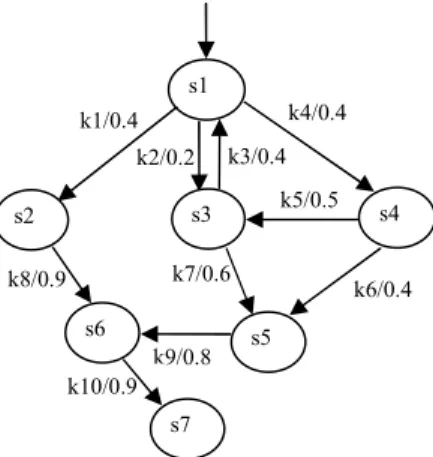
values from a given state may not add up to1. This is because the individual probabilities of different transitions represent the probability with which it is possible to get to another state (e.g., user session). Thus, there are other events, of very low or negligible probability, which are not usually modelled in the probable finite state machine. The proposed PFSM usage model can capture information about control flow, data flow, transaction processing and associated probabilistic usage, and criticality information. An example probable FSM [21] with transitions and states is shown in Figure 3.
A test case is defined as any path from the source node (start state) to the target node (final state). In order to generate test cases, a list of all the path transitions from the source node to the target node is generated. Then proba-bilities are calculated for all the individual paths that have been generated (by multiplying the individual probabilities for the transitions). A specific threshold value is also obtained. The test suite then comprises all the paths which have a probability higher than the threshold value.
For example, in the probabilistic finite state machine depicted in Figure 3, there are at least four potential paths from states1 tos5, namely:
Path A: k4→k5→k7(s1→s4→s3→s5) Path B: k4→k6 (s1→s4→s5)
The usage model based-on PFSM
A PFSM usage model comprises a unique start state, a set of final states, a set of intermediate
usage states, and transitions between states. User actions are represented as state transitions in the
PFSM usage model. The probability that a user performs a given action (input) in a particular state
is represented by the associated transition probability in the PFSM usage model.
The usage model of our approach is obtained by decorating the general FSM model with
probabilities deduced from the Web log files. Web logs can be used to produce PFSMs that can be
employed to generate user sessions. These user sessions can then be combined into effective test
suites. To selectively generate user sessions that are more or less likely to occur in practice, it needs
to produce the probability of each possible user session. Usually, the probability of a user session
can be represented as the product of the probability of each request within the session.
As discussed above, the PFSM usage model originates from FSM with transitions weighted
with probabilities, so the resulting model typically describes the state of usage rather than the state
of the Web application. The probabilities of all transitions leading away from a state need to add up
to 1. Note that, the probabilities from some of the states are not added up to 1 in Fig. 1, because
there may be other situations, in which the user quits the Web application from the given state
without following the normal navigations. The user can, for example, traverse to s3 via k5 with the
probability 0.5, to s5 via k6 with the probability 0.4 from s4. The sum of the values of the
probabilities from state s4 equals to 0.9 (0.5+0.4), not 1. This means that other events may also
happen. For example, the user quits the Web application by just closing the Web browser window.
In a PFSM usage model, the state transitions can be represented as a two-dimensional table with
the state labels as indices and the direct transition probabilities as entries. Note that exit transitions
for each state have probabilities that sum to 1. The number in cell (si, sj) of the transition table
represents the probability of a transition directly from state si to state sj. Table 1 gives the transition
table constructed according to the PFSM usage model shown in Fig. 1.
Table 1. The probability transition table
s1
s2
s3
s4
s5
s6
s7
s1 s2 s3 s4 s5 s6 s7
0
0.4
0.2
0.4
0
0
0
0
0
0
0
0
0.9
0
0.4
0
0
0
0.6
0
0
0
0
0.5
0
0.4
0
0
0
0
0
0
0
0.8
0
0
0
0
0
0
0
0.9
0
0
0
0
0
0
0
A multi-leveled usage model
The whole PFSM usage model for a complete Web application will be too large to manage. We
divide a Web application into a set of modules/functions, each of which can be considered as a sub
Fig.1. The STD of an example PFSM
k3/0.4 k9/0.8 k4/0.4 k8/0.9 k7/0.6 k1/0.4 k10/0.9 k6/0.4 k2/0.2 k5/0.5 s1 s4 s3 s2 s6 s5 s7Figure 3: An example probable FSM as described in [21, Figure 1].
Path D: k4→k5→k3→k2→k7 (s1→s3→s1→s3→s5)
The probabilities for each of these individual paths are simply the multiplica-tions of the individual probabilities of the different transimultiplica-tions. Thus, as per Figure 3, the probabilities are as follows:
Path A: 0.4∗0.5∗0.6=0.12
Path B: 0.4∗0.4=0.16
Path C: 0.2∗0.6=0.12
Path D: 0.4∗0.5∗0.4∗0.2∗0.6 =0.0096
Now, only the test cases which meet the threshold value are selected. Thus, assuming that the threshold value was set to 0.1, only Paths A and B will be selected as the test cases for the test suite. A high threshold value can be selected to test only the most frequently used operations and gradually lowered to involve the rarer and more unique operations and ensure the satisfactory coverage or reliability for a wider variety of operations. Thus, the threshold value can be modified to control the number of test cases generated and its coverage.
The limitation of this work is that the probable FSM cannot be generated automatically and thus the testing process will be slow since the FSM construc-tion has to be done manually. This work also does not explain thoroughly as to how the probabilities are assigned to different transitions from different states. Also, the FSMs represent an incomplete model of the system, since only the most “likely” transitions are modelled, and the unlikely events are not included in the FSM. Thus, it would be very hard to test for “rare events” which may be crucial to the security of Web applications.
4. Mutation Testing
Mutation testing is a form of testing in which a program P is taken as input. A modified version of the programP is then created by applying certain
mutation operators to the original program. Test cases are designed with the
aim of detecting program modifications. The modified versions of the program are calledmutants[41, 42, 43] and if a test case can detect a mutant (i.e., the line of code where the mutation operator has been applied), then the test case is said tokill the mutant. Otherwise the mutant stayslive.
Praphamontripong and Offutt [22] implement mutation testing for Java Server Pages (JSP) and Java Servlets. The mutation operators are defined specifically for these applications and are implemented in a tool called mu-Java [44]. mumu-Java automatically creates mutants and allows tests to be run against the mutants. Tests are created manually as sequences of requests [22].
11 new mutation operators are defined specifically for Web applications [22]. These mutation operators are grouped into two categories, (1) operators modify-ing HTML applications and (2) operators modifymodify-ing JSP applications. Some of the operators for HTML include, e.g., “simple link replacement (WLR)” which replaces the “<a href=>” attribute value with another address in the same do-main. The “W” in WLR indicates that the mutation operator deals with Web-specific features, “R” indicates that the operator replaces some field and “L” indicates that it exercises thelinks in a Web application (e.g., non-existent or incorrect URLs). Similarly, mutation operator exists for (a) deleting a link (“simple link deletion (WLD)”, where “D” indicates that the operator deletes a field), (b) replacing the destination address of an HTML form (“form link replacement (WFR)”), (c) replacing “GET” requests with “POST” requests and vice-versa (“transfer mode replacement (WTR)”), and (d) replacing and delet-ing the form values of typehidden. Also, in order to detect server side faults, Praphamontripong and Offutt [22] create mutation operators for replacing and deleting server side “include” statements (which basically describes what other files need to be included in a particular application). Mutation operators for JSP include operators which change the forwarding destination of a redirect transi-tion specified in “<JSP:forward>” (“redirect transition replacement (WRR)”), and deleting the destination address (“redirect transition deletion (WRD)”).
Praphamontripong and Offutt [22] apply testing on a moderate-sized appli-cation called the “Small Text Information System (STIS)” [45]. STIS comprises 18 Java Server Pages (JSPs) and 5 Java bean classes and stores the information in a MySQL database. Praphamontripong and Offutt [22] applied mutation operators to only the JSPs and excluded 2 JSPs. A total of 219 mutants of the application were tested, where the mutants were created by using the mutation operators described above. The total number of live mutants in the applica-tion (i.e., the mutants which reveal different faults) and which were undetected by the tool muJava are 29 [22]. Most of these undetected faults were related with replacing the form values of typehidden(23 out of 29). Thus Praphamon-tripong and Offutt [22] show that mutation testing could be used to reveal a large number of faults in a Web application (nearly86% in this case). A total
of 147 hand-seeded faults are also planted in the application, out of which 118 were detected (∼80%) [22].
One of the main advantages of mutation testing approaches for Web appli-cations is that it tests for most crucial errors which are likely to occur in a Web application. For example, a lot of the server errors occur in a Web applica-tion either due to some invalid form attributes, missing files or as a result of not validating user inputs properly. The mutation testing technique proposed by Praphamontripong and Offutt [22] is particularly effective in detecting such defects which may occur on the server side. Similarly, on the client-side of the application, a large number of errors are due to broken links (i.e., errors in the destination links), missing files or invalid HTML. Again the mutation testing approach [22] can be effectively applied for these defects.
5. Search Based Software Engineering (SBSE) Testing
Search Based Software Engineering (SBSE) is an approach that treats soft-ware engineering problems as optimisation problems whose solutions require searching through a state space [23]. The possible solutions need to be encoded in a way that makes similar solutions proximate in the search space. A fitness function is then defined which is then used to compare possible solutions. Hill climbing is an iterative incremental algorithm often used in SBSE and found to be effective for testing [46]. In hill climbing, a random solution is first chosen and evaluated and then the nearest neighbours (determined by some heuris-tic, e.g., distance) are evaluated. This process is iterated by changing a single element in the solution and thus obtaining new solutions. If the value of the fitness function of the new solution is better than the value of fitness function of the older solution, then the newer solution replaces the previous one. This process is repeated iteratively until no further improvements can be made to the solution. Thus, the algorithm aims to find a solution which maximises the fitness function (or the heuristic). This approach is simple and fast. However, it is dependent on the randomly chosen starting point of the solution.
For the hill climbing algorithm, Korel [47] introduced the Alternating Vari-able Method (AVM) into the search process. This method changes one variVari-able while ensuring other variables remain fixed. Branch distance is used to measure how close an input comes to covering the traversal of a desired branch. When the execution of a test case does not converge on the target branch, thebranch distanceexpresses how close an input came to selecting the correct path/branch at a particular level and satisfying the predicate [48]. It also helps in determin-ing the level along the target branch of the predicate at which control for the test case went “wrong”; i.e., how close the input was to descending to the next branch level. The branch distance is computed using the formula |of f set−1 | +K, where K is the constant added when an undesired, alternate branch is taken by the test case. The lower the absolute value of of f set−1, i.e., the closer the value ofof f setis to 1, the closer the test case is to traversing along the correct target branch [48]. A different branch distance formula is applied depending on the type of relational predicate. In the case of relational equals, the branch
distance is equal to| a−b |+K. The formulas for different branch distances depending on the type of relational predicates is described in [49].
If the changes to a variable affect branch distance, a larger change is applied in the same direction in the next iteration. In case, as a result of applying this change, a false local optimum is chosen, the search is re-started at the previ-ous best solution seen. The process continues until the branch is covered or no further improvement is possible.
Alshahwan and Harman [23] apply Search Based Software Engineering to testing PHP Web applications. The main aim of this technique is to maximise the branch coverage of the application. The algorithm starts with a static analysis phase that collects static information to aid the subsequent search based phase. The search based phase uses an algorithm that is derived from Korel’s Alternating Variable Method (AVM) in addition to constant seeding.
Several issues affect the application of search based techniques to Web ap-plications, such as Dynamic typing (e.g., in different languages such as Ruby and PHP, variables are dynamically typed, which makes it hard to determine the type of variables used in predicates, which may in turn lead to problems when deciding which fitness function to use). Another important issue is In-terface Determination, which means that there is no way of determining the interface in different PHP or JSP applications. In other words, there is no way of knowing how many inputs are required for the application to execute. Other problems also include client-side simulation of dynamic Web pages and dynamic
server-side includestatements.
The algorithms for test data generation in [23] are based on hill climbing using Korel’s AVM [47]. When a target branch is selected, AVM is used to mutate each input in turn while all other inputs remain fixed. When the selected mutation is found to improve fitness value, the change in the same direction is accelerated. To avoid overestimating (or over shoot), the change is decelerated when the fitness function nears0. Branches which have been reached but not covered are then targeted in subsequent iterations. That is, a branch is reached if its immediately controlling predicate is executed, while a branch is covered if the branch itself is traversed. The algorithm(s) attempt to cover a branch only when it is reached, i.e., all transitively controlling predicates on some path have been satisfied. This technique is called an explorative approach [23]. At each iteration the algorithm also keeps track ofnear miss input values. A near miss input vector results in fitness improvement for a branch other than the targeted branch. Near misses are used in place of random values when initialising a search to cover that branch. This approach is called Near Miss Seeding (NMS). The fitness function employed in this approach is similar to that used by Tracey et al. [49]. This means that for a predicate “a op b” where op is a relational operator, fitness is zero when the condition is true and the absolute value of |a−b| when the condition is false. A fitness function has the value 0 if the test case covers the desired branch of the program. The main aim of the technique is to minimize the fitness function values throughout the search process. The fitness function value is incremented in a similar technique as Tracey et al. [49]. That is, if the test case is incorrect, then the value of the fitness
functionk is incremented by 1. For strings, Levenshtein distance [50] is used as a fitness function, following Alshraideh and Bottaci [51]. The Levenshtein distance is the minimum number of insert, delete and substitute operations needed to convert one string to another string [23].
Each execution of a test case returns a list (F) of all branches in that execu-tion and the branch distances. For every branch (B) that recorded an improve-ment in the branch distance, the list,F, is used to update a coverage table (C), and the resulting test suite (T). A list of branches, known as thework list, that have been reached/traversed is extracted from the coverage table, and is then processed in an attempt to cover it. To start, the database is initialised and the user logs into the application. The input vector is then constructed using the analysis data. Values for variables are initialised to values that caused a par-ticular branch to be reached, and random values are selected for any additional input variables. The input variables are mutated one at a time, and the process continues until the branch has been traversed or no further improvements to the fitness function are possible. Themutation algorithm is quite simple and is described in [23]. Initially, if no input was selected for mutation, or the last mutation had no effect on the branch distance, a new input variable is selected. If the branch distance is increased as a result of performing a mutation, then a new mutation operator is selected. Conversely, if the branch distance decreased as a result of the mutation operation, the operation is accelerated [23].
Alshahwan and Harman [23] developed a tool called the “Search based Web Application Tester” (SWAT) to implement this approach and embed it within an end-to-end testing infrastructure. SWAT’s architecture is illustrated in Figure 4. The tool is composed of a pre-processing component, the Search Based Tester and the Test Harness [23]. The description of the architecture is given below.
The original source code is transformed through thePredicate Expanderand Instrumenter. In the resulting transformed version of the code, predicates with logical operators are expanded and control statements are modified to calculate fitness and the original behaviour of the predicates. The code is also instru-mented to collect run-time values to be used in subsequentdynamically mined
value seeding. The Static Analyser performs the analysis needed to resolve
issues that are associated with the standard Web scripting and development languages, such as Ruby, JavaScript, JSP, ASP, PHP, etc. Some issues may include the distinction between different data types (such as Integer and String) in dynamically-typed languages, the absence of an explicit header that speci-fies how many inputs a program expects and/or their types, handling dynamic
includestatements in PHP applications, and identifying top-level pages when trying to generate the test data.
The results obtained from the above step are stored in the Analysis Data repository and used later by theSearch Based Tester. TheConstant Extractor mines the code for constants to be used in subsequentStatic Constant Seeding.
TheInput Format Extractoranalyses the code to extract the input vector
com-prising the values for input variables. TheFile Tree Analyser then generates a tree. In this tree, the nodes are used to represent files and edges represent include relationships. This is then used to determine the top-level test units to



![Figure 6: A diagram showing SecuBat architecture as described in [8, Figure 3]](https://thumb-us.123doks.com/thumbv2/123dok_us/1618417.2719846/32.918.255.667.349.598/figure-diagram-showing-secubat-architecture-described-figure.webp)
![Figure 9: A simple JavaScript program with contracts [30, Figure 1].](https://thumb-us.123doks.com/thumbv2/123dok_us/1618417.2719846/42.918.209.696.185.361/figure-simple-javascript-program-contracts-figure.webp)
