3916 SERVICE DELIVERY
SWITCH
Features and Benefits
> Provides advanced Carrier Ethernet
and low TCO, powered by Ciena’s SAOS
> Supports 2 GbE NNI/UNI Small
Form-factor Pluggable (SFP) ports
> Supports 4 GbE NNI/UNI ports
including 2 100/1000 Base-X SFP ports and 2 dual-mode ports: RJ-45 10/100/1000 Base-T and 100/1000 Base-X SFPs
> Incorporates on-board RFC 2544 Performance Benchmark testing capabilities, enabling end-to-end SLA verification without a truck roll
> Features a state-of-the-art hardware design for advanced Ethernet resiliency and encapsulation capabilities
> Features rich flow classifications
and service stratification to ensure predictable service delivery and Carrier-class, MEF-14-compliant QoS
Ciena’s 3916 Service Delivery Switch is an
advanced Carrier Ethernet demarcation device
providing sophisticated Quality of Service
(QoS) capabilities for Ethernet business
service applications. The 3916 incorporates
an advanced Operations, Administration, and
Maintenance (OAM) suite to provide detailed
service and network performance monitoring
while reducing network operating costs
The 3916 software architecture is based on a common Service-Aware Operating System (SAOS) used in all Ciena service delivery and service aggregation switches to provide advanced Carrier Ethernet features, with consistent system and service attributes to improve operational efficiency. The feature capabilities address the widely varying demands of end-customers and a multitude of deployment scenarios. The 3916 exemplifies Ciena’s focus on OAM and the Total Cost of Ownership (TCO) to deliver Carrier Ethernet services by supporting all the leading OAM standards, and by expanding OAM capabilities to include RFC 2544 Performance Benchmarking generation and reflection capabilities. This functionality enables detailed Service Level Agreement (SLA)-conformance testing to be accomplished from the Network Operations Center (NOC) and dramatically lowers OPEX. In combination with the low-touch deployment methods provided by Ciena, the 3916 architecture enables operators to achieve a profitable business case, even in highly competitive markets. The 3916 features a high-capacity switching fabric, two NNI SFP ports that support 1GbE, two 100/1000M SFP UNI ports, and two dual-mode UNI ports (10/100/1000 RJ-45 and 100/1000 SFP). The 3916 provides a built-in AC or DC power supply, front access to all power data and management ports, and a compact form factor that facilitates desktop, wallmount, or rackmount installations.
G.8032 Ethernet Ring Protection Switching
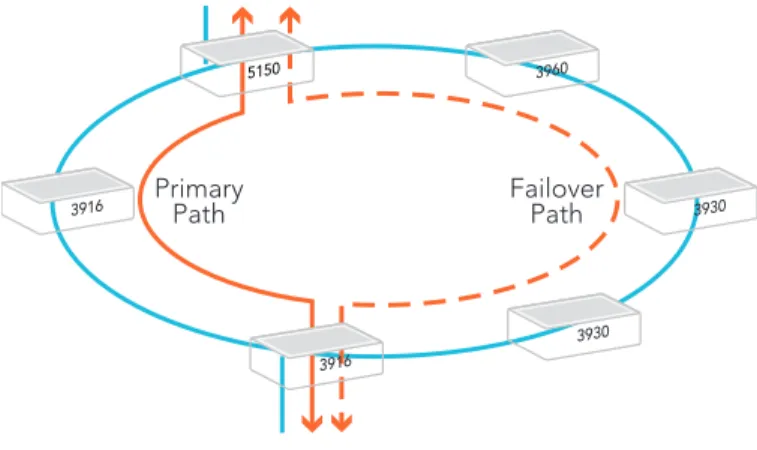
The 3916 supports multiple resiliency options, including G.8032 Ethernet Rings. G.8032 provides deterministic sub-50 ms protection switching, enabling operators to deliver carrier-grade Ethernet services and attain the resiliency capabilities of the legacy SONET infrastructure without the associated costs. Ciena’s solution is highly scalable, permitting the number of network elements on the ring to increase as needs grow. Additionally, spans on the ring can be based on 1GbE or other bandwidths, and can include spans based on other service layer technologies and speeds—permitting exceptional flexibility that allows operators to create G.8032 rings and provide sub-50 ms resiliency.
Ethernet Services Manager
Ciena’s Ethernet Services Manager (ESM) is a groundbreaking carrier-grade, automated service activation, creation, and management platform for managing a service provider’s service delivery and service aggregation networks. ESM lets users build and deploy large-scale Carrier Ethernet networks quickly and easily; cuts time to market for new services; accelerates service revenue; maximizes service availability; assures service quality; leverages existing systems; and enables subscriber-managed services. All of these functions cut TCO and reduce time to revenue and time to market. The ESM also paves the way to implement new services quickly and cost-effectively for increased revenue and competitiveness.
True Carrier Ethernet® QoS
The 3916 implements true carrier-class, MEF-14-compliant QoS that permits delivery of a wide range of traffic types and rates over a single access infrastructure without interference or degradation. These capabilities enable greater revenue generation by utilizing available network resources efficiently, while improving customer relations with enforceable and reliable SLAs. These capabilities are enabled by:
>Eight hardware queues/port, up to 64 ingress meters per port
>Per-port, per-VLAN QoS with CIR/EIR settings
> Two rate Three Color Metering (trTCM), marking, policing,
shaping
> Random Early Detection (RED), flexible Deficit Weighted
Round Robin (DWRR) and Strict Priority Scheduling
>Hierarchical QoS (H-QoS)
The 3916 enables automated service provisioning, resulting in a more comprehensive deployment of QoS at a significantly lower cost.
Industry-Leading OAM Suite
Successful Carrier Ethernet service deployments require an effective strategy to monitor the health and performance of the network and end-customer EVCs. The approach to OAM can make or break the business case, as customers demand expanded SLA verification and inefficient approaches drive OPEX. Ciena’s portfolio has a strong OAM feature suite providing comprehensive link, service, and network monitoring and performance metrics. OAM features available today include:
> IEEE 802.1ag Connectivity Fault Management (CFM)
> IEEE 802.3ah Ethernet in the First Mile (EFM)
> IEEE 802.1AB Link Layer Discovery Protocol (LLDP)
> ITU-T Y.1731 Performance Monitoring: Delay, Jitter, Loss
> IETF RFC 5618 TWAMP Sender and Responder for L3 SLA
Monitoring
> IETF RFC 2544 Performance Benchmarking Test Generation
and Reflection
The 3916 integrates RFC 2544 Performance Benchmarking generation and reflection capabilities directly within the service delivery switch, enabling exceptional OPEX savings. Most mobile operators and other demanding end-customers require performance test and characterization before service
acceptance. Typically, this testing is performed by technicians with expensive handheld test sets, leading to scheduling delays and the associated high OPEX.
Ciena’s low-touch turn-up simplifies system turn-up and enables RFC 2544 performance testing from the NOC. This capability minimizes service personnel costs and ensures consistent, reproducible test reports for immediate transmission to the customer for service acceptance.
Primary
Path Failover Path
Figure 1. G.8032 ring
Turn-up Acceptance and SLA Conformance Testing IETF RFC 2544 Generator/Reflector
ITU-T Y.1564 Generator/Reflector
Layer 3 SLA Monitoring & Metrics: Delay, Jitter IETF RFC 5357 TWAMP
Two-Way Active Measurement Protocol
Layer 2 SLA Monitoring & Metrics: Delay, Jitter, Frame Loss ITU-T Y.1731 Ethernet OAM
Service Heartbeats, End-to-End & Hop-by-Hop fault detection IEEE 802.1ag CFM
Connectivity Fault Management
Enhanced troubleshooting, rapid network discovery IEEE 802.3ah EFM
Physical Link
Figure 2. 3916 OAM suite
1GbE/10GbE 1GbE 1GbE/10GbE 1GbE nx10GbE (PBB-TE*; G.8032) Multi-Tenant Office Building Government Medium Business Larger Enterprise Small Business
Built-in RFC 2544 also empowers the operator to be highly responsive to service disruptions. When service impacts are detected by ongoing PM tests (Y.1731 or TWAMP) or upon report by the end-customer, performance tests can be initiated immediately by the NOC; no technician scheduling is required, no trucks are rolled. Testing to isolate and localize the issue and then focus resources on addressing the specific root cause can occur at virtually no cost. This responsiveness means troubles are fixed faster, minimizing service impact and creating higher customer satisfaction.
The 3916 enhances the RFC 2544 standard by providing additional metrics like Packet Delay Variation (PDV), including more expedient test suite results and architecting to the ITU-T Y.1564 standard for even greater capabilities.
Proven Service-Aware Operating System
Ciena’s SAOS delivers consistent benefits across all Ethernet access and aggregation applications, including:
> Rapid implementation of the latest advances in Ethernet
technologies, as well as new services and standards proposed by the IEEE, IETF, MEF, and ITU
> Interoperability with Ethernet equipment from other vendors
> Improved efficiency and cost savings resulting from a common
deployment and service provisioning model
> Service offering ubiquity, permitting rapid rollout of new
services across the entire network
> Complete MEF-compliant Ethernet service offerings
> Ethernet Private Line, Ethernet Private LAN
> Ethernet Virtual Private Line, Ethernet Virtual Private LAN
4
Interfaces
2 x 1G SFP NNI/UNI ports 2 x 100/1000M SFP NNI/UNI ports 2 x 10/100/1000M RJ-45; 100/1000M SFP
NNI/UNI combo ports 1 x Console Port (RJ-45, EIA-561) Ethernet
IEEE 802.3 Ethernet IEEE 802.3u Fast Ethernet IEEE 802.3z Gigabit Ethernet IEEE 802.1D MAC Bridges
IEEE 802.1Q VLANs - Including .1p Priority IEEE 802.1ad Provider Bridging (Q-in-Q) VLAN
full S-VLAN range
VLAN tunneling (Q-in-Q) for Transparent LAN Services (TLS)
Per-VLAN MAC Learning Control Per-Port MAC Learning Control IEEE 802.3ad Link Aggregation Control
Protocol (LACP)
ITU-T G.8032 Ethernet Ring Protection Switching Jumbo Frames to 9216 bytes
Layer 2 Control Frame Tunneling Multicast Management RFC 2236 IGMPv2 Snooping IGMP Domains
IGMP Message Filtering IGMP Inquisitive Leave
Broadcast/Multicast Storm Control Unknown Multicast Filtering Well-known Protocol Forwarding Quality of Service
8 Hardware Queues per-Port
Committed and Excess Information Rate (CIR and EIR)
Classification based on IEEE 802.1D priority
VLAN, source port, destination port, TCP/UDP port
IP Precedence and IPDSCP Layer 2, 3 Quality of Service Ingress metering per-port Ingress metering per-port per-CoS Ingress metering per-port per-VLAN Up to 64 Ingress Meters per-port Up to 512 Ingress Meters per-system C-VLAN Priority to S-VLAN Priority Mapping
S-VLAN Priority based on C-VLAN ID Per-VLAN Classification, Metering, and
Statistics
Per-port, per-VLAN QoS with CIR and EIR traffic on Egress Queues
Carrier Ethernet OAM
IEEE 802.1ag Connectivity Fault Management (CFM)
IEEE 802.3ah Ethernet in the First Mile (EFM) IEEE 802.1AB Link Layer Discovery Protocol
(LLDP)
ITU-T Y.1731 Performance Monitoring RFC 2544 Performance Benchmarking Test
Generation and Reflection ITU-T Y.1564-compliant architecture RFC 5618 TWAMP Responder and Receiver TWAMP Sender
TWAMP +/- 1ms timestamp accuracy Dying Gasp with Syslog and SNMP Traps MPLS/VPLS
RFC 2205, 3031, 3036, 3985 MPLS Pseudowire Emulation Edge-to-Edge (PWE3)
RFC 3916, 3985, 4446, 4447, 4448 Pseudowires RFC 5654 MPLS-Transport Profile
MPLS Virtual Private Wire Service (VPWS) RFC 4664, 4665 L2VPNs
RFC 4762 VPLS (Virtual Private LAN Service) and Hierarchical VPLS (H-VPLS)
Provider Edge (PE-rs) Functionality for VPLS and H-VPLS
Provider Edge (PE-rs) Functionality with Spoke and Mesh Virtual Circuits
MTU-s Functionality for H-VPLS deployment MTU-s Multihoming (redundant VCs to
different PE-s switches)
MPLS Virtual Circuit as H-VPLS spoke Virtual Circuit
PBB-TE Service Instance as H-VPLS spoke Virtual Circuit
Q-in-Q Ethernet Virtual Circuit as H-VPLS spoke Virtual Circuit
MPLS Label Switch Path (LSP) Tunnel Redundancy
Layer 2 Control Frame Tunneling over MPLS Virtual Circuits
RFC 3209 RSVP-TE (for MPLS Tunnel Signaling) RFC 3630 OSPF-TE (for MPLS Tunnel Routes) RFC 3784 IS-IS-TE (for MPLS Tunnel Routes) RFC 3036 Targeted LDP (for VPLS VC signaling)
RFC 4090 MPLS Fast ReRoute (via RSVP-TE) MPLS Performance Monitoring
RFC 4379 LSP Ping RFC 4379 LSP Traceroute
RFC 5085 LSP Ping and Traceroute extensions to work over Pseudowires (PW VCCV) PBB-TE (Provider Backbone Bridging-Traffic Engineering*)
IEEE 802.1Qay PBB-TE IEEE 802.1ah PBB frame format PBB-TE Multi-homed Protection Failover IEEE 802.1ag CFM for PBB-TE Tunnels IEEE 802.1ag CFM for PBB-TE Service
Interfaces
PBB-TE Full B-VID & I-SID address ranges PBB-TE Tunnel & Service metering Network Management
Enhanced CLI
CLI-based configuration files SNMP v1/v2c/v3
SNMPv3 Authentication and Message Encryption
RFC 1213 SNMP MIB II RFC 1493 Bridge MIB
RFC 1643 Ethernet-like Interface MIB RFC 1573 MIB II interfaces
RFC 1757 RMON MIB - including persistent configuration
RFC 2021 RMON II and RMON Statistics Per-VLAN Statistics
RADIUS Client and RADIUS Authentication TACACS + AAA
RFC 2131 DHCP Client RFC 1305 NTP Client RFC 1035 DNS Client Telnet Server
RFC 1350 Trivial File Transfer Protocol (TFTP) RFC 959 File Transfer Protocol (FTP) Secure File Transfer Protocol (SFTP) Secure Shell (SSHv2)
Syslog with Syslog Accounting Port State Mirroring
Local Console Port
Comprehensive Management via Ethernet Services Manager
Remote Autoconfiguration via TFTP, SFTP Software download/upgrade via TFTP, SFTP Technical Information
Service Security Egress Port Restriction
IEEE 802.1X Port-Based Network Access Control (RADIUS/MD5)
Layer 2, 3 Protocol Filtering Broadcast Containment User Access Rights
Per-port or per-VLAN Service Access Control Hardware-based DOS Attack Prevention Hardware-based Access Control Lists (ACLs) MAC Address Table Capacity
32,000 MAC addresses Power Requirements
DC Input: -48, -24, +24 VDC (nominal) AC Input: 100V, 240V AC (nominal) AC Frequency: 50/60 Hz
Maximum Power Input: 38 W
Agency Approvals
Safety: UL/CSA 60950-1-07; IEC 60950-1:2005 (2nd edition); EN 60950-1:2006
Emissions: FCC Part 15 (2009); EN 55022 (2006+A1 2006); CISPR 22 (2005 + A1 2005); AS/NZS CISPR 22 (2006); EN61000-3-2 (2006); EN 300 386 (v1.4.1, 2008); ICES-003 Issue 4 (2004); EN 300 132-3 (2003-08) Environmental: WEEE 2002/96/EC
RoHS 2002/95/EC
Immunity: CISPR 24 (1997, +A1 2001 + A2 2002); EN 55024 (1998 + A1 2001 + A2 2003); EN 300 386 (v1.4.1, 2008); EN 61000-4-11 (2005); EN 61000-3-3 (2008); EN 300 132-3 (2003-08)
Laser Safety: CDRH Letter of Approval (US FDA Approval); FCC 21 CFR subpart (J) (Safety of Laser Products); IEC 60825-1:2007 Environmental Characteristics
GR-63-CORE, Issue 3 – NEBS Level 3 GR-1089 Issue 5 – NEBS Level 3
GR-3108 Issue 2 Network Equipment in the Outside Plant (OSP) Class 1
EN 300 019 Class 1.2, 2.2, 3.1 Operating Temperature: 32°F to +122°F (0°C to +50°C) Storage Temperature: -40°F to +158°F (-40°C to +70°C) Relative Humidity: 5% to 90% (non-condensing) Physical Characteristics Mounting: Rack, wall, desktop Dimensions:
(AC/Dual AC) 10.8” (W) x 6.8” (D) x 1.7” (H); 276mm (W) x 172mm (D) x 43mm (H) (DC/AC/Dual AC) 13.1” (W) x 7.9” (D) x 1.75”
(H); 333mm (W) x 201mm (D) x 44mm (H) Weight: (AC/Dual AC) Weight: 3.5 lbs; 1.6 kg (DC/AC/Dual AC) Weight: 6 lbs; 2.7 kg Ordering Information
3916, (2) 1G SFP, (2)100M/1G SFP/RJ45, (2)100M/1G SFP, AC Power, Req. Power Cable 170-3916-900
3916, (2) 1G SFP, (2)100M/1000M SFP/RJ45, (2)100M/1G SFP, DC Power 170-3916-901 3916, (2) 1G SFP, (2)100M/1G SFP/RJ45,
(2)100M/1G SFP, Dual AC Power, Req. Power Cable 170-3916-902 3916, (2) 1G SFP, (2)100M/1G SFP/RJ45,
(2)100M/1G SFP, AC Power, Req. Power Cable 170-3916-904
3916, (2) 1G SFP, (2)100M/1G SFP/RJ45, (2)100M/1G SFP, Dual AC Power, Req. Power Cable 170-3916-906 Technical Information continued
* Denotes features available in a future release
Ciena may from time to time make changes to the products or specifications contained herein without notice. Copyright © 2014 Ciena® Corporation. All rights reserved. DS212 5.2014