Assessing challenges of continuous
integration in the context of software
requirements breakdown: a case study
Master of Science thesis in Software Engineering
Adam
Debbiche
Mikael
Dien´
er
Chalmers University of Technology
University of Gothenburg
Department of Computer Science & Engineering
purpose make it accessible on the Internet. The Author warrants that he/she is the author to the Work, and warrants that the Work does not contain text, pictures or other material that violates copyright law.
The Author shall, when transferring the rights of the Work to a third party (for example a publisher or a company), acknowledge the third party about this agreement. If the Author has signed a copyright agreement with a third party regarding the Work, the Author warrants hereby that he/she has obtained any necessary permission from this third party to let Chalmers University of Technology and University of Gothenburg store the Work electronically and make it accessible on the Internet.
Assessing challenges of continuous integration in the context of
software requirements breakdown: a case study
Adam Debbiche Mikael Dien´er
c
Adam Debbiche, June 2014. c
Mikael Dien´er, June 2014.
Supervisor: Dr Richard Berntsson Svensson Examiner: Dr Miroslaw Staron
Chalmers University of Technology
University of Gothenburg
Department of Computer Science & Engineering
SE-412 96 G¨
oteborg
Sweden
Acknowledgements
The authors of this thesis would like to thank the supervisor Dr Richard Berntsson Svensson for his invaluable feedback and the examiner Dr Miroslaw Staron. We would also like to thank Ericsson for giving us the opportunity to conduct this research on their premises. We thank our industry supervisor Claes Hansen for helping us throughout our work. Special thanks goes to Emil ¨Oberg and Christer Brander Nilsson for making this thesis project possible!
The complexity of software development has increased over the last few years. Customers today demand higher quality and more stable software with shorter delivery time. Soft-ware companies strive to improve their processes in order to meet theses challenges. Agile practices have been widely praised for the focus they put on customer collabora-tion and shorter feedback loops. Companies that have well established agile practices have been trying to improve their processes further by adopting continuous integration - the concept where teams integrate their code several times a day. However, adopting continuous integration is not a trivial task since it requires frequent integration of smaller units of requirements that can be tested separately. This thesis presents a case study in which we, based on interviews at a major Swedish telecommunication services and equipment provider, assess the challenges of continuous integration and software require-ments breakdown and their influence on the implementation of a continuous integration process.
Contents
1 Introduction 1
2 Background and Related Work 3
2.1 Background . . . 3
2.2 Related Work . . . 4
2.2.1 Lean Software Development . . . 4
2.2.2 Agile Methodologies . . . 5
2.2.3 Continuous Integration . . . 5
2.2.4 Continuous Deployment . . . 7
2.2.5 Software Requirements Breakdown . . . 7
2.2.6 DevOps . . . 9 3 Research Approach 10 3.1 Research Purpose . . . 10 3.2 Research Questions . . . 10 3.3 Research Methodology . . . 11 3.4 Data Collection . . . 11 3.5 Data Analysis . . . 12 3.6 Validity Threats . . . 16 3.6.1 Construct validity . . . 16 3.6.2 Internal validity . . . 17 3.6.3 External validity . . . 17 3.6.4 Reliability . . . 17 4 Case Study 19 4.1 Continuous Integration at Ericsson . . . 19
4.2 Requirements Breakdown at Ericsson . . . 21
5 Results 22 5.1 RQ1 - Continuous integration adoption challenges . . . 22
5.1.1 Mindset . . . 23
5.1.2 Tools & Infrastructure . . . 25
5.1.3 Testing . . . 27 5.1.4 Domain applicability . . . 28 5.1.5 Understanding . . . 29 5.1.6 Code dependencies . . . 31 5.1.7 Software requirements . . . 31 5.1.8 Summary . . . 32
5.2 RQ2 - Software requirements breakdown challenges . . . 33
5.2.1 Requirements abstraction . . . 33
5.2.2 Alignment of requirements and tests . . . 35
5.2.3 Customer value . . . 36
5.2.4 Guiding principle . . . 37
5.2.5 Summary . . . 39
5.3 RQ3 - Software requirements breakdown’s influence on continuous inte-gration . . . 39
5.3.1 The necessity of software requirements breakdown . . . 40
5.3.2 Implications of software requirements breakdown . . . 42
5.3.3 Summary . . . 44
6 Discussion 45 6.1 RQ1 - Continuous integration adoption challenges . . . 45
6.2 RQ2 - Software requirements breakdown challenges . . . 48
6.3 RQ3 - Software requirements breakdown’s influence on continuous inte-gration . . . 49
7 Conclusion 51 7.1 Implications for practitioners . . . 52
7.2 Contributions to academic research . . . 52
7.3 Future work . . . 53
Bibliography 57
A Interview Questions 58
1
Introduction
Software organizations today face a market with ever changing requirements and pressure to release more often. The use of agile practices has increased because of the emphasis they put on customer collaboration and embracing change [32]. Still, companies have been looking into shortening the feedback loop further and releasing more often to the customer by embracing continuous integration [32].
Continuous integration relates to the frequency at which changes are checked in [50]. Each check in results in a new working build of the software provided that all tests are passed. Continuous integration emphasizes multiple code check-ins on a daily basis as opposed to nightly builds. It is the next step in the evolution of an agile R&D company that has established agile practices in place [32]. It has been suggested that continuous integration increases the frequency of software releases and shortens the feedback cycle [16]. Additionally, Miller and Carter [30, 31] state that continuous integration reduces the time developers spend on checking in new code while maintaining the same level of product quality.
When it comes to integration frequency, most teams have a fixed window during a sprint where integration takes place. For instance Launchpad [25] has a four week iteration where integration takes place between week one and three. However, adopting continuous integration entails integrating more often, possibly several times per day [14]. Lacoste [25, p. 387] reports on the difficulties of introducing a continuous integration system at Launchpad: “So by the end of week 3, everybody is rushing to squeeze in their remaining features and bug fixes. The integration queue is congested because running the whole test suite takes nearly 2 hours on a fast computer”. Seemingly, this quote reports on difficulties related to integration queue congestion. However, one could question the reason behind last minute integrations. A team using an efficient continuous integration process should be able to treat the integration as a nonevent [14].
In order to support more frequent integration, requirements need to be small enough in order for developers to test them separately then integrate multiple times a day. This
is not always a trivial task in the context of continuous integration [16].
Breaking down large user stories into small enough stories with the right level of detail and visible business and customer value has been identified as a challenge for the clothing retailer GAP after the adoption of continuous integration [16]. Similarly, the open source project FreeBSD also struggled with the break down of work tasks into smaller pieces when implementing Symmetric Multi-Processing (SMP) into the kernel using a continuous integration process [19]. This thesis, through a case study at Ericsson, explores the challenges of continuous integration and requirements break down and how the latter influences the implementation of a continuous integration process. Semi-structured interviews were conducted with a total of 13 subjects in both Sweden and China.
The remainder of this thesis is structured as follows: in the next section, we present the background and related work. In section 3, we describe our research approach. In section 4, the company where this case study was conducted is introduced along with how continuous integration and requirements breakdown are currently done. Section 5 presents the results of our data collection followed by the discussion in section 6. The thesis ends with a conclusion and a future work section.
2
Background and Related Work
The purpose of this section is to provide the background of this study and a review of related literature. First, the background is introduced followed by a related work section about agile methodologies, continuous integration, devops, continuous deployment and requirements breakdown.
2.1
Background
Continuous Integration has its roots in the eXtreme Programming (XP) agile method [25]. The goal for each developer is to commit new code several times a day then build and test the software. A successful test run results in a new build that the team can deploy. A continuous integration system often involves using a continuous integration server that automates the building process [14]. When a developer has added a feature or fixed a bug then the code is tested locally and built before being pushed to a continuous integration server. At this stage, the server merges the new code with the latest version on the server. A new version of the software is built provided that the merge is successful. Otherwise, the developer is directly notified of the conflicts.
Figure 2.1 shows the concepts of continuous integration and its relationship to other related concepts. These are further described in the next section. Lean software de-velopment’s principles of eliminating waste has influenced agile methodologies which in turn has impacted DevOps as an emerging concept [21]. Similarly, software requirements breakdown supports agile methods in that customer features are broken down into user stories or scenarios to be implemented by developers. This becomes more apparent when adopting continuous integration [16, 19]. Continuous integration itself can be seen as an enabler of continuous deployment [32].
Figure 2.1: Concepts (e.g. processes, principles and methodologies) and their relationships.
2.2
Related Work
This section presents current literature related to the concepts in figure 2.1.
2.2.1 Lean Software Development
Lean is a software development process that has its roots in the Toyota Production Sys-tem [36]. Toyota wanted to eliminate waste from its car production line and deliver the product as fast as possible to the customer. Lean is the adoption of Toyota’s successful process to software development. It is guided by 7 fundamental principles [35, 36]:
• Eliminate waste: eliminate anything that doesn’t add value to the customer and the product.
• Amplify learning: increase knowledge by constantly learning from customer feed-back.
• Decide as late as possible: delay decision making in order to stay flexible and embrace change.
• Deliver as fast as possible: release to the customer often and without delay.
• Empower the team: engaging the team is important in order to unlock its full potential.
Chapter 2. Related Work CHAPTER 2. BACKGROUND AND RELATED WORK
• Build integrity in: focus on quality assurance early on and embed it in the process.
• See the whole: identify the whole picture and not only focus on parts of it.
Lean software development principles are seen as compatible with the mindset of agile methodologies such as Scrum, Kanban and XP [35]. Additionally, recent software de-velopment practices such as continuous deployment have been used within lean software development [7].
2.2.2 Agile Methodologies
Agile development methods have been researched in previous literature due to their widespread use and increased interest shown by the software industry [34]. A systematic review of previous agile literature [10] revealed that agile methods have lead to increased productivity in teams, closer customer collaboration and higher quality software releases thanks to the faster discovery of bugs. Tacit knowledge transfer also improved when using agile practices such as pair programming [10]. Different success factors of adopting agile practices have been identified such as the need for senior management to have a clear strategy as well as offering ample support for agile deployment efforts [34]. Furthermore, a proper software process improvement should be undertaken where the organisation studies the impact of change and its impact on the development teams [18, 47] that are about to transition to agile.
The effects of introducing agile practices were also studied in previous literature. First, introducing Scrum in a team not only resulted in an increase in customer sat-isfaction but also made the team more efficient and decreased overtime hours [26]. In addition, developers’ satisfaction was higher when using eXtreme Programming (XP) as opposed to a traditional development method. Moreover, the same developers enjoyed a better and more relaxed working environment [27]. Project management was also easier when using agile methods since they offer a higher degree of flexibility compared to plan driven projects which leads to higher quality releases [6].
According to the stairway to heaven model [32], Agile research and development (R&D) is the preceding step of continuous integration. Where the product development organization should have successfully adopted an agile approach to R&D in order to continue upwards in thestairway to heaven.
2.2.3 Continuous Integration
Fowler [14] presents a set of benefits related to the implementation of continuous inte-gration. First, the risk of integration errors decreases since integration is no longer a daunting and unpredictable task that is done at the end of each sprint. Rather, a small one that takes place several times a day, meaning that integration is no longer post-poned. Second, bugs are discovered and fixed earlier due to the frequency of builds and tests. Bugs are also easier to catch since each small change to the code is checked in and tested separately before being integrated into the mainline [14]. A typical continuous integration process can be seen in figure 2.2.
Despite the advantages of adopting continuous integration. Many organizations have faced a lot of challenges when migrating to it. Challenges related to moving from agile practices to continuous integration have been identified [32] : A company that specialises in embedded hardware had problems with handling component dependencies during development and integration. Automatic testing in the context of continuous integration was also a barrier since it involved testing code running on embedded hardware. The authors also note that the different tools available for continuous integration make it hard to know which ones to choose from.
The practice and implementation of continuous integration varies in industry [46]. This is due to the fact that the concept is interpreted differently. Sth˚al and Bosch [46] developed a descriptive model that facilitates the documentation of continuous integra-tion practices and implementaintegra-tions. The model consists of an Integraintegra-tion Flow Anatomy which is essentially a directed acyclic graph (DAG) that shows the activities of a contin-uous integration process. The graph consists of two types of nodes: input (e.g. source code) and activity (e.g. executing test cases) [46]. Each node type has a set of attributes that outline its scope and characteristics. The purpose of the attributes is to describe and address the different variation points of continuous integration implementation iden-tified by St˚ahl and Bosch [46]. The model proposes different attributes related to activity nodes such as scope (testing, acceptance, deploying) and build characteristics (execution frequency and duration). The input nodes attributes presented are pre-integration pro-cedure and integration target [46]. While the model has not been fully validated due to the small sample size, it has nevertheless been tested on a real project and the authors were able to identify areas of future improvement for the project and team [46].
Holck and Jørgensen [19] have researched the use of a decentralized continuous inte-gration process in the open source community (FreeBSD and Mozilla) where developers are often distributed. The paper focuses on quality assurance with regards to the work processes, developer skills and work output. Submitting changes of good quality is used as the basis for granting commit access to outside contributors [19]. The authors found that developers working on open source projects are often free to pick any tasks or bugs they want to work on. Deciding when to integrate changes is also delegated to the de-veloper. This is an advantage when compared to the more plan-driven work assignment process of traditional projects [19]. Breaking down tasks into smaller pieces is also preva-lent in open source. However, breaking down large tasks is not trivial. For instance, adding support for Symmetric Multi-Processing (SMP) to the FreeBSD kernel resulted in multiple build errors and severely disrupted the work of other developers [19]. When it comes to using continuous integration, both FreeBSD and Mozilla have guidelines that any contribution needs to adhere to before it can be integrated into the mainline without breaking it. Both projects have an automated build system that verifies new commits. Any problems are quickly fixed and kept on the main trunk instead of being deleted [19]. Holck and Jørgensen argue that open source projects’ ability to adopt a decentralized and bureaucracy free continuous integration process is mainly due to two factors: the developers’ freedom to integrate their contributions as they see fit and the ”don’t break the build rule”[19].
Chapter 2. Related Work CHAPTER 2. BACKGROUND AND RELATED WORK
Figure 2.2: The continuous integration concept [7]
2.2.4 Continuous Deployment
Continuous deployment complements continuous integration in an agile software devel-opment process. Indeed, Olsson et al. [32] argue that continuous deployment is the next step in their stairway to heaven model for a team or organization that has already suc-cessfully implemented continuous integration. Moreover, having a continuous integration server is seen as the pillar of a continuous deployment system [38].
Previous research argues that continuous deployment results in software being de-ployed faster to the customer [32]. Ries [38] notes that continuous deployment reduces cycle times with organizations deploying new version of their software up to fifty times a day [13, 51]. Furthermore, the company Atlassian points out that continuous deployment has increased the overall quality of their software products due to bugs being discovered earlier and being easier to fix since committed changes are often small [41].
Implementing a continuous deployment system is not a trivial task and does not happen overnight. Starting small with a simple continuous integration server, a version control system and a deployment script is enough according to Ries [38]. The deployment system will eventually become more elaborate over time as the entire process matures [13]. Indeed, IMVU has been working with continuous deployment for the past few years and is today able to run up to a million automated test cases a day [13].
2.2.5 Software Requirements Breakdown
Requirements are the basis of any software development project. The first step of the requirements engineering process is the identification of direct and indirect stakeholders. Failure to capture the correct stakeholders will result in incorrect requirements being elicited. This can negatively affect the project’s outcome [43]. Once the stakeholders are identified, requirements are captured and documented. Different standards have
also been presented for documenting requirements such as IEEE Std 830-1998. Elicited requirements can come from different sources, in different types (functional and non functional) and in varying degrees of complexity [17].
Requirements often need to be prioritized so that product managers know what to focus on and what requirements to include in a specific release. Previous literature proposes a number of models to assist in this task such as the cost value approach [22], the QUPER model [1] and Planguage [15].
Breaking them down to an appropriate level of abstraction is a challenging task. Indeed, effective requirements abstraction has been identified as a challenge in current literature that needs further research [37]. With regards to the different abstraction levels and its challenges, Gorschek and Wohlin [17] developed the Requirements Abstraction Model (RAM) with the aim of helping requirements engineers and project managers with handling requirements from different sources and abstraction levels.
The model has four steps: first, requirements are gathered from different sources. The requirements need to be understood by product management [17]. A number of attributes are used to help describe the requirements such as description, rationale, title and restrictions. The second step is placing the elicited requirements in one of the four abstraction levels: product level, feature level, function level or component level. The last step consists of working up or breaking down a requirement depending the original level of abstraction such as they obey two rules in the model [17]:
1: Any requirement needs to have a connection to a product goal
2: All the requirements need to be broken down to function level
The model does not consider necessary breaking down each requirement to the com-ponent level of abstraction [17]. When taken in the context of continuous integration, however, this could be an important step. In addition to that, the model stresses the im-portance of having adequate levels of abstractions which could be essential for breaking down requirements when using a continuous integration process.
Although earlier research has defined quality attributes for specifying unambiguous and testable requirements [3]. These quality attributes and standards do not guarantee that requirements have been broken down enough with regards to continuous integration. In fact, to the authors best knowledge, there is a lack of previous literature that studied large software requirements breakdown in the context of continuous integration. The problem has however been reported in earlier studies [16, 19].
As seen in previous literature [14, 32], both continuous integration and breaking down larger requirements has its own set of challenges. A team that uses an agile method like Scrum has a high degree of flexibility as to when integration ought to take place. For instance, a team with three week sprints can work easier with large requirements compared to a a team that has one week sprints. This is because longer sprints offers more time between implementation and integration which makes it easier to accommodate larger requirements. Such was the case for the Launchpad team [25] that integrated all of their work at the end of week 3 of each sprint.
Chapter 2. Related Work CHAPTER 2. BACKGROUND AND RELATED WORK
Introducing continuous integration means each developer should integrate new code at least once a day but in practice it should be doneseveral times a day[14]. This concept is a fundamental part of continuous integration. Regardless, having large requirements makes it very difficult to satisfy this condition unless a team has a well thought out process that allows them to break down large requirements without jeopardizing the core concept of continuous integration.
2.2.6 DevOps
DevOps is a term coined by Patrick Dubois back in 2009. It’s a set of practices that advocate the collaboration between software developers and IT operations. It aims to shorten the feedback loop while aligning the goals of both the development and IT operations departments [21]. According to H¨uttermann [21], DevOps emphasises the empowerment of people over processes, the need of automation in the development of new software, establishing quality measurements and creating a culture of sharing among people.
DevOps emerged to address the underlying disconnect between the development and IT operations departments [21]. H¨uttermann [21] argues that conflict is inherently ”baked” into this system where developers strive for change while IT operations strive for stability. Each department continuously improves its internal processes in order to become more efficient at achieving its goals.
The widespread adoption of agile methodologies has improved the performance of software developers teams [10]. DevOps widens the spectrum of agile methodologies by not only bringing together programmers, testers and quality assurance engineers but also the IT operations staff by fostering communication, collaboration and aligning objectives [21].
3
Research Approach
This section introduces the purpose and approach of this study. First, the research objectives and the the research questions are presented. Next, the methodology and the approach for collecting data are introduced. The section ends with the data analysis and validity threats sections.
3.1
Research Purpose
The purpose of this study is to identify the challenges of continuous integration and re-quirements break down and how the latter influences the implementation of a continuous integration process.
3.2
Research Questions
Currently, little research has been done on the challenges of adopting a successful con-tinuous integration process. To the authors best knowledge even less has been done on software requirements breakdown within the context of a continuous integration pro-cess and the challenges that may arise. Current literature reports on problems that could emerge from the emphasis continuous integration puts on integrating new code several times per day. For instance, Lacoste [25] reports on difficulties while introducing continuous integration which in LaunchPad’s case might be due to integration queue congestion. However, a team using a healthy continuous integration process should be able to treat integration as non-event and new code should be pushed every few hours without any obstacles [14]. Also, previous studies state that breaking down software requirements while working with continuous integration is a challenge [16, 19]. As a result, the following research questions were defined:
RQ1: What are the challenges of implementing a continuous integration process in practice?
Chapter 3. Research Approach CHAPTER 3. RESEARCH APPROACH
RQ2: What are the challenges of software requirements breakdown in practice?
RQ3: How could the breakdown of software requirements influence the adoption of continuous integration?
3.3
Research Methodology
This thesis reports on a 6 month (January 2014 - June 2014) case study. The choice of methodology was based on the real-life context of this particular research case. Indeed, case study research is considered particularly suitable where the context under study could be difficult to control [29]. Case study research mainly results in qualitative data which is deeper and extensive in its nature, as opposed to quantitative research (e.g. sur-vey and experiments) [40]. The purpose of case study research is to investigate a specific contemporary phenomenon [52]. This thesis was conducted as a single case study where the focus and case is an organisation (Ericsson, see section 4). The phenomenon being investigated is the adoption of continuous integration by teams working on the SGSN-MME product (see Section 4). Consequently, the unit of analysis is the teams under study that are adopting continuous integration. Moreover, this research was conducted with an interpretive perspective, as described by Klein and Meyers [23]. That is, to bet-ter understand social and organizational contexts where each individual’s inbet-terpretation is of importance [23]. In addition, this study follows the explanatory-descriptive purpose as classified by Robson [39]. According to this classification [39], there are four different purposes of research, namely exploratory, descriptive, explanatory and improving. The explanatory-descriptive purpose does not only focus on describing a situation and how things work but also on finding causal relationships between problems and situations.
3.4
Data Collection
Semi-structured interviews [40] were used as the method of collecting data in this study. When performing case study research interviews are considered an important and com-mon technique for collecting data [40]. The primary objective is to collect data based on the interviewees memory, opinion or impression [42]. Semi-structured interviews of-ten include an interview protocol but are not necessarily followed strictly. Additionally, a balance of open and closed questions is used. That is, to allow for exploration and improvisation regarding the subject [40].
In order to identify relevant subjects for this study, the selection process was car-ried out with help from a ”gatekeeper” at the company under study. The presence of a ”gatekeeper” could improve the chance of ”gaining access” to the selected subjects [45]. Including different roles, personalities and teams is one of the goals when selecting sub-jects in order to get a better distribution of viewpoints. This is recommended due to the qualitative nature of case studies [40]. The selected subjects were invited by email through a common email template containing a short description of the purpose of the study along with a proposed date and time. A total of 13 interviews were performed for
this study. More specifically, eight subjects from Sweden and five subjects from China. Table 3.1 contains more details about the subjects.
The interview protocol (Appendix A) was inspired by the work of Claps [7]. However, many questions were changed or added to fit the scope of this study. As suggested by Yin [52], a pilot interview with an employee relevant to the study, was conducted in order to check the validity of the interview protocol. The goal was also to assure that an interview session is not too long and more importantly that the questions would be both relevant and at an appropriate level of detail. Feedback from the pilot interview was used to make minor refinements to the interview protocol.
Interviews were conducted during working hours and were either performed at Eric-sson (Lindholmen, Sweden) or via video conference. The interviews lasted between 25 and 65 minutes. Both researchers took part in all interviews. One asked the questions while the other focused on taking notes. The author taking notes also asked follow up questions in some cases. All interviews, upon permission, were recorded. That is, to secure a backup of interview details. Even though written notes were taken during the interviews, it’s hard to capture every important detail [40].
During an interview session, the subject is first introduced to the purpose of the study and its objectives then guaranteed anonymity and asked for consent about recording. The interview is divided into three parts and follows the Pyramid model [40] which begins with specific questions and continues with open ended ones. The first part is about background and understanding. The goal is to make the interviewee comfortable and to establish trust. The second part contains more open-ended questions related to continuous integration. The third part is about requirements break down. The interview ends with two wrap up questions where the interviewee can add anything they feel is relevant to the research.
After each interview, extensive notes were taken while listening to the recording and consulting the written notes taken during the actual interview session. Taking extensive notes is an alternative to full transcription, where the goal is to pick out relevant passages, quotes and examples [39]. The purpose is to interpret the answer of the interviewee to each question. Once done, the extensive notes were sent to the subject for verification via email in order to make sure that the interpretation was accurate [40]. All subjects verified the written extensive notes with none or, minor clarifications.
3.5
Data Analysis
Case study research often results in large amounts of qualitative data. Especially when using interviews as the primary method for collecting data. In order to properly anal-yse qualitative data, specific techniques are commonly preferred [42]. The purpose of analysing collected data is to be able to draw conclusions in the end. Yin [52] argues that this needs to be done with a clear chain of evidence. That is, the reader must be able to follow all the phases from how the data was collected and analysed to how the conclusion were derived [40, 52].
Chapter 3. Research Approach CHAPTER 3. RESEARCH APPROACH
similarities such as coding and finding patterns [39]. Data analysis in this study was done using thematic analysis [4]. It follows a six steps method presented by Braun and Clarke [4]. Thematic analysis was chosen due to its flexibility and ability to extract important features from large sets of data [4]. It is often seen as similar, to some extent, to content analysis when extracting patterns. However, according to Braun and Clarke [4], content analysis usually focuses on smaller details while providing qualitative frequency count. The main goal is to identify themes and patterns from the collected data. In this case study, both authors took part in all the steps as described below:
Step 1 - Familiarize yourself with the data: The goal of this step is for the re-searchers to get acquainted with the data collected. For this study it meant trans-lating interview recordings into extensive notes while interpreting the interviewee’s answer to each question.
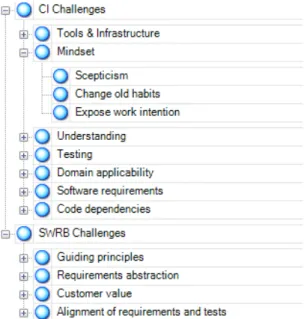
Step 2 - Generating initial codes: This phase involves creating the initial codes from the data set [4]. Qualitative data analysis software offers a systematic way of orga-nizing, storing and visualizing collected data [39]. For this reason, NVivo (http: //www.qsrinternational.com/), a specialised software for qualitative data anal-ysis was used for the coding process in this thesis. Open coding as described by Robson [39] was used throughout the analysis phase since it is useful for catego-rizing data. For this study, the answers in the extensive notes obtained from the interviews were coded into categories, each piece of data coded can belong to more than one category. It is important to note that none of the categories were obtained prior to coding as this is highly discouraged when using open coding [39]. The ex-tensive notes were imported into NVivo and then initial codes were generated. In order to get used to coding the data in NVivo, answers of simple questions from the interviews were initially coded from each of the 13 subjects. After that, the focus was on generating initial codes from questions 15, 24 and 32 since they represent a natural entry point to RQ1, RQ2 and RQ3 respectively. Finally, initial codes were extracted from the remainder of all thirteen extensive notes. See figure 3.1 for an actual view of the nodes in NVivo.
Step 3 - Searching for themes: This step entails classifying the codes initially gener-ated into broader themes. This usually results in codes being grouped into themes and sub-themes [4]. For this study, the initial codes were put into three main categories based on the three research questions. Each main category was in turn divided into sub-categories containing sub-themes. Each sub-theme contained any related codes. Also, any codes that did not fit into any of the categories were grouped into a separate category in order to minimize the risk of disregarding potential new data leads.
Step 4 - Reviewing themes: In this phase, the themes identified in the preceding step are refined. This means that some codes might be merged if they are deemed too similar. Others might be moved from one category to another. For this thesis, the focus was on determining whether the identified categories were appropriate
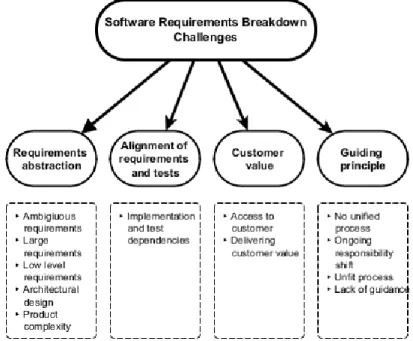
and reflective of the actual data. This was decided based on recurring patterns found in the data and whether they are supported by multiple subjects. That said, through an iterative process, new sub-categories were identified (alternatively renamed or removed). New codes were created as well as renamed or removed. The purpose is to get an accurate representation of the data set [4]. Figure 5.1. 5.2 and 5.3 show the output of this step in the form of thematic maps for RQ1, RQ2 and RQ3 respectively which is useful to demonstrate the relationship between codes [4].
Step 5 - Defining and naming themes: This step requires the scope of each main category to be clearly defined. This includes making sure that the codes included within are consistent. Braun and Clarke [4] argue that the ’story’ of each theme needs to be identified. This step is essentially a refinement built upon the previous step. For this study, all the codes in each category were verified in order to make sure that they were consistent with the overall theme of the category. As part of this step, the final name of each theme was also decided upon before producing the results.
Step 6 - Producing the report: As the name suggest, the final step is to produce the final report detailing the results of the analysed data. The findings of the data analysis need to be produced in a concise, logical manner that is easy to follow in order to convince the reader of the points the study is trying to demonstrate [4]. Results of this study are reported in section 5.
T eam N u m b er o f mo n th s u s in g CI Av er ag e ti me b et w een in te g ra-ti o ns b efo r e C I (i n w eek s ) Av er ag e ti me b et w een in t eg ra-ti o n s u s in g C I (in w eek s) R o le Y e ars o f ex p er ien ce O rgani sat ion S oft w ar e D ev elop me n t S oft w ar e D ev el-op er Li ne M anage r CI Driv er Agi le Coac h Con fig-u rat ion M anage r P ro d u ct O wn er 1-3 3-10 10+ 1-3 3-10 10+ T1 18-24 4-7 1 2 0 0 0 0 0 0 0 2 0 0 2 T2 2 12-24 1-2 1 0 0 0 0 0 0 1 0 0 0 1 T3 12 4-24 < 1 1 0 0 0 0 0 0 0 1 0 0 1 T4 0 2-6 0 2 0 0 0 0 0 0 1 1 0 1 1 T5 2-3 4 1 1 0 0 0 0 0 1 0 0 1 0 0 T6 12 4-8 1 1 0 0 0 0 0 0 1 0 0 0 1 T7 8 4 < 1 0 0 1 0 0 0 0 1 0 0 1 0 No team N/A N/A N/A 0 1 1 1 1 1 0 2 2 0 1 3 T o tal N/A N/A N/A 8 1 2 1 1 1 1 6 6 1 3 9 T ab le 3 .1 : S tud y su b jec ts an d team de mogr aph ics -Y ear s of ex p er ien ce is inc lu d ed as in te rv al s du e to con fi de n ti al it y reas ons .
3.6
Validity Threats
Qualitative research often receives much criticism by positivists, mostly regarding trust-worthiness [44]. This is due to the opinion that qualitative research cannot address issues of reliability and validity in the same way as quantitative research. Dealing with these issues directly throughout the research is essential in order to ensure a measure of aca-demical soundness [44]. This study has adopted the four aspects of validity (construct validity, internal validity, external validity and reliability) by Runeson and H¨ost [40] in order to address the issues of reliability and validity. These aspects were defined espe-cially for qualitative research studies (e.g. case study research) and based on commonly used aspects of validity and threats to validity in literature. However, they choose to operationalise these aspects directly towards qualitative research.
3.6.1 Construct validity
Construct validity reflects to what extent the research methodology captures studied concepts and what is investigated according to the research questions [40].
The interview protocol was designed based on work done by Claps [7] and tested during one pilot interview. Minor revisions were made based on the feedback from the pilot interview. To reduce bias during the selection of subjects, a ”gatekeeper” [45] at the studied company was used. That is the researchers did not influence the selection of subjects. In order to obtain a true image of the subjects’ opinion, absolute anonymity was guaranteed, both within the company and externally. Key concepts, such as continuous integration, were clarified to minimize the risk of different interpretations between the researchers and the subjects. To minimize the risk of subjects having different interpretations or guessing the purpose of the study, a common introduction manuscript during the interview was used. This manuscript contains the purpose of the study, an anonymity clause and some general information about the interview and its structure.
Triangulation is important within empirical research, especially when performing research that primarily relies on qualitative data [40]. For this reason, triangulation has been kept in mind when performing this research, for instance, interviews have been performed with subjects from different teams, roles and countries to triangulate data. However, a limitation to this study is the use of a single method for collecting data. On the contrary, the case under study did not include much documentation that would benefit this particular study, which left interviews as the main source of data.
Another limitation of this study is that it only included thirteen interviews, all within the same company. However, they were performed until a saturation point was reached. This means that relatively little new information would be discovered if further interviews are to be performed.
Chapter 3. Research Approach CHAPTER 3. RESEARCH APPROACH
3.6.2 Internal validity
Internal validity refers to the risk of interference in causal relations within the research. For instance, if the researcher investigates whether factor A affects factor B there is a risk that factor B is also affected by factor C. Researchers need to pay close attention to alternative factors that might affect the investigated factor, otherwise there is a threat to internal validity [40].
One of the objectives of this research is to find a causal relationship between chal-lenges of breaking down software requirements and chalchal-lenges of adopting a continuous integration process. Since the challenges of adopting a healthy continuous integration process can be caused by numerous other factors than the challenges of breaking down software requirements, this research also investigates the existence of other factors that might be an impediment to adopting continuous integration.
The process of breaking down software requirements was undergoing a major overhaul during the time of the study. This meant that there was a risk of misunderstanding the context for which a statement had been provided. To mitigate this risk, follow up questions were asked to clarify the context of the said statement.
3.6.3 External validity
External validity refers to what extent the findings of the research can be generalised and of interest to other cases, such as other companies or individuals outside the study [40].
This study included interviews with different roles and teams to benefit the external validity of this research, on the other hand, only performing interviews at one company affects the generalisability of the results negatively. However, the purpose of qualitative studies puts more focus on describing and understanding a contemporary phenomenon and less on the ability to generalize the findings beyond the boundaries of the stud-ied settings [2]. Nevertheless, results from this study may benefit the investigation of phenomena within similar contexts [2].
Context and characteristics of the teams and subjects included in this research can be found in Table 3.1. This to simplify the process of identifying the context for which the findings are relevant. However, replicating a research of qualitative nature is often difficult, due to the fact that identical situations cannot be reproduced [2].
3.6.4 Reliability
Threats to reliability relate to what extent the findings of the study are dependent on the researchers that executed the research. For instance, to what extent can the study be reproduced with similar results [40].
This study has been performed by two researchers which increases the reliability and reduces the risk of single researcher bias. In addition, all research design artifacts (e.g. interview protocol), findings and each step of the research have been peer reviewed by an external researcher (university supervisor).
All data collected and documented, such as interview notes, audio recordings, in this study were digitalized and stored. This in order to allow for future external assessment. In addition, this report will try to provide a clear chain of evidence throughout the research to further increase the reliability of the study [40].
As suggested by Robson [39], no pre-determined codes were applied to the collected data. Thus avoiding forcing the data into a specific code or category. Codes were instead induced from the data collected.
4
Case Study
This section provides a more in depth view of the company studied in this thesis work. Ericsson AB is a world leading provider of telecommunication equipment and services. It supplies solutions to telecoms operators, government agencies, media, transport and automotive industries. Ericsson offers a wide range of products such as base stations, radio access networks (such as GSM and LTE), microwave networks as well as products for television and video such as content and video management. Ericsson has more than 100.000 employees and offers its services to customers in 180 countries [12].
This case study was conducted within the Serving GPRS Support Node Mobility Management Entity (SGSN-MME) program. Meaning the study was done in collab-oration with employees working on the development of the SGSN-MME product [11]. SGSN-MME is a product developed by Ericsson that consists of both hardware and soft-ware modules. It is essentially used to deliver packets of data through networks (such as GSM, WCDMA and LTE) [11].
4.1
Continuous Integration at Ericsson
Ericsson has heavily engaged in improving its approach to software development amid the increasing competition in the market. This is evident in the endeavors undertaken to transform the company from a plan driven organisation to a more lean and agile one [33]. A number of cross functional teams (XFT) working on the SGSN-MME [11] product have adopted continuous integration as part of their development process, albeit with a varying degree of maturity.
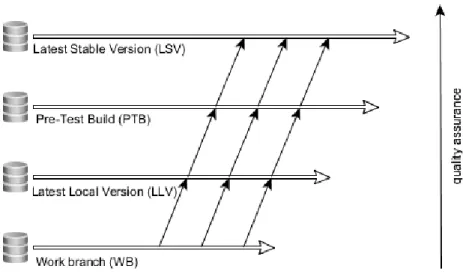
The teams working on the SGSN-MME product use multiple branches for develop-ment and integration with different quality assurance policies (see figure 4.1):
• Work branch (WB): used by team members locally first when a new feature is being developed.
• Latest Local Version (LLV): this branch includes tests that cover expected changes in functionality.
• Pre-Test Build (PTB):full regression tests are run on this branch by.
• Latest Stable Version (LSV): complete system tests are run on this branch. Once a team begins working on a new feature or a bug fix, changes are first pushed to their work branch. When a feature is finished then the changes are pushed to the team’s LLV where the new functionality is tested. If the LLV tests are successful then the new changes are delivered to the PTB branch where full regression tests are run. Finally, the new code is integrated with the LSV branch where the system is tested as a whole.
Figure 4.1: Illustration of the continuous integration branch strategy used at Ericsson. Note the stricter quality assurance measures between different branches.
The quality assurance policies of the branches listed above increase as illustrated by figure 4.1. Each branch has more rigorous tests that new code needs to pass in order for it to be accepted. For instance, integrating code to the PTB branch requires that the code to first pass the tests of the LLV branch. Likewise, the LSV branch has even higher quality assurance tests in place than PTB. Any new features or code integrated to the LSV branch must be of high quality that can be delivered to the customer. Therefore only stable changes are committed, unexpected and unknown bugs should not show up (only known issues).
Note: The Pre-Test Branch (PTB) was subsequently removed, however the concept and function of the branch remains and is fulfilled by other branches.
Chapter 4. Case Study CHAPTER 4. CASE STUDY
4.2
Requirements Breakdown at Ericsson
Ericsson has thousands of requirements that come from different sources. Some require-ments stem from international telecommunication standards and specifications such as 3GPP while others are from customers. IBM Rational RequisitePro is sometimes used to document and keep track of requirements.
In recent years, Ericsson has introduced the concept of cross functional teams (XFT) and operational product owners (OPOs) as part of its agile transformation program. The OPO’s task is to work with the feature product backlog and decide what requirements should be implemented and in which order (when). A cross functional team uses this as input to create the sprint backlog (typically during sprint 0). It is largely up to the cross functional teams to decide how their requirements (for a sprint) are broken down. System managers have previously been responsible for breaking down requirements and conducting pre-studies. This has however changed and now system managers are more integrated into the teams.
5
Results
This section presents the findings of this study after the data was analysed according to the method by Braun and Clarke [4] (see Data Analysis).
The structure is divided with the aim of clearly answering the research questions presented earlier. First, the challenges of adopting continuous integration are presented as answer to research question one. Next, the challenges of breaking down software requirements are laid out (research question two). The last section deals with research question three and how the challenges of requirements breakdown relate to the adoption of continuous integration. The challenges in section 5.1, 5.2 and 5.3 are structured according to their respective thematic maps (see figure 5.1, figure 5.2 and figure 5.3). Each theme (e.g. Mindset) illustrated in the 3 thematic maps has a respective source count. It reflects the number of interviewees that have mentioned said theme during the interviews. The source count is calculated by aggregating the individual source counts of each sub-theme (e.g. Scepticism).
5.1
RQ1 - Continuous integration adoption challenges
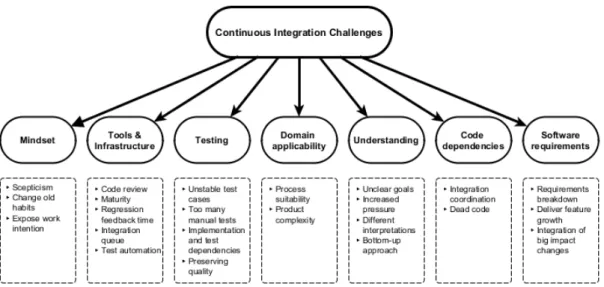
This section answers the first research question related to the challenges of adopting continuous integration in an organisation. The identified challenges are shown in the form of a thematic map in figure 5.1.Chapter 5. Results CHAPTER 5. RESULTS
Figure 5.1: Thematic map of continuous integration challenges
The aggregated source count for each theme is as follows: Mindset: 10, Tools & Infrastructure: 13, Testing: 9, Domain applicability: 11, Understanding: 10, Code de-pendencies: 5 and Software requirements: 8. More details regarding source and reference count for each theme and sub-theme can be found in Appendix B.
5.1.1 Mindset
The results of this research found that challenges related to the developer mindset play an important role when transitioning to continuous integration.
Scepticism One of the mindset challenge identified at the studied company is being convinced about the benefits that come from adopting continuous integration. In-terviewees (7 out of 13) report that they are positive about the concept of contin-uous integration but need to, by themselves, experience the benefits that comes with the change. This to be fully convinced and furthermore promote the adop-tion. Introducing such a big process change to about 30 teams can be a challenge, as described by a CI driver:
“In the summer of last year, when we started to pilot CI we introduced this change to the team. However, not all of the people are buying the change, not all of them like this change. So we just had a very small group, like 4 designers. They started to pilot first, these four designers, I think they are the designers who liked challenge or liked the change so we started the pilot first to know what we should do, define the process and everything. And then, we later adapted this to the whole team. Maybe, the first introduction to the team is not very smooth because not everyone wanted but after the small group has already defined the draft version of the practice
and later on it’s much easier. People just follow.” - CI Driver
Some developers that were interviewed are not fully persuaded about the benefits that continuous integration might bring to the SGSN-MME program described by agile coach:
“From the very beginning, the team they question about the value for that, how much benefit we can get from the CI because actually, SGSN-MME we have already the streamline and we have already monthly delivery and they just want to know what’s the benefit, if we want to improve delivery frequency to a weekly delivery. what’s the benefit for that. That’s the vision, the value we should introduce to the team.” - Agile Coach
Similarly, a CI Driver involved in coaching and helping teams with transitioning to continuous integration highlights the importance of questioning a change: “I don’t see the reason why we should use CI because of CI, it should always be
beneficial to use it, not be a rule.” - CI Driver
Even though the interviewees report on issues related to mindset and experiencing the benefits of continuous integration, some think this challenge could be overcome, as put by one software developer:
“Sprint delivery is once a month, but CI is deliver as quickly as possible and I think only need two persons mindset change then we can deliver it as quickly as possible, don’t think it’s very hard for Ericsson to adopt CI.” - Software Developer
The fact that many developers are questioning the benefits of continuous integra-tion has led to more efforts being done in order to convince people, one software developer reports on work being done to increase the experience regarding the benefits:
“I think all the teams, both from Lindholmen and Shanghai, we have discussions about how to do CI and how to let teams think it’s very good and it can bring benefits to us.” - Software Developer
Interestingly, a developer from one of the pilot teams, report that their team strug-gled with mindset related problems, mostly regarding seeing the benefits, and that they have now overcome these issues. This was done by a step-wise approach and constant team discussions regarding benefits.
Change old habits Developers often get used to working in a certain way. The in-troduction of continuous integration challenged those habit. Consequently, some developers found it hard to give up their old habits. A line manager mentioned that people that have been working at the company for a long time are harder to change compared to junior people because they got used to working in a certain way.
A developer part of the continuous integration pilot group stated that adopting continuous integration is a big change for SGSN-MME. Therefore, changing peo-ple’s mindset and habit is a challenge that takes time. Before, developers could
Chapter 5. Results CHAPTER 5. RESULTS
work on their code and deliver it at the end of the month. Presently, they are forced to think about integrating, checking regression results, reviewing code and writing test cases more often.
Exposing work intention Continuous integration emphasises early and frequent inte-grations. As a result, developers are compelled to expose their work earlier. Some interviewees (4 out of 13) found this to be challenge because they were used to big bang integrations at the end of a sprint. This gave them enough time to polish their code before integrating it. With the adoption of continuous integration and the increase in integration frequencies, developers are worried about integrating low quality code that could be questioned by experts and managers, as an agile coach put it:
“Some teams they are not familiar or used to frequent delivery, because they feel safe if they can deliver once a month because they can make everything ready, if they have some changes, he can correct it on his own branch, don’t have to deliver to the main branch and then everybody can see your faults right. It’s a mindset change, and actually for the CI, we want to be open minded with your code, even to your code, and you should be confident to show your code to others even you have some faults...it’s mindset change.” - Agile Coach
Developer confidence plays a role in this issue. Teams that are more experienced working with continuous integration seem to be more comfortable about exposing their work earlier as stated by a configuration manager:
“Some of the teams have gotten into it and are used to it, but of course for new teams it’s kind of a different mindset to actually deliver code that you know is not ready..., that’s the mindset ” - Configuration Manager
The line manager interviewed for this study argues that the shift in habits requires that developers be given enough time to adjust to the new ways of working with continuous integration.
5.1.2 Tools & Infrastructure
The tools and infrastructure supporting the continuous integration process are developed and maintained in-house at the studied company. These include tools for reviewing code, visualising regression test results, running automated test suites, checking in code and such. Below, the challenges of said tools are presented.
Code review: Tools for reviewing integrated code has been reported to lack the nec-essary features for supporting an efficient continuous integration process. For in-stance, visualisation of the ”bigger picture” while performing a code review has been requested. However, current code review tools only support visualisation of each integrated change separately. This limits the ability to see the impact of smaller changes and how they related to the ”bigger picture”.
In Shanghai, Technical Area Responsibles (TAR) are responsible for performing code reviews. However, due to their limited number and availability this has become a bottleneck in the continuous integration process. In addition, the current limitations of code review tools mentioned earlier further complicate this matter. The increased integration frequency, as a result of the ongoing adoption of continu-ous integration, has increased the number of code reviews needed. This in turn has increased the daily workload and pressure, especially for the TARs in Shanghai.
Maturity: The maturity of the tools and their surrounding infrastructure that devel-opers use when integrating code has been reported as a challenge. These tools are often seen as not ready for an efficient continuous integration process. The infrastructure team responsible for developing and maintaining the tools currently has a long backlog that needs to be addressed in order to improve support for a smooth integration process.
Currently, it takes a long time for developers to integrate their work, especially to the PTB and LSV branches. This in turn prevents them from reaching the desired integration frequency. For example, it takes a considerable amount of time to rebase (updating local repository to the latest version) from the main branch when integrating new code. Similarly, the build framework and the delivery tools are lacking in terms of maturity and new ways for developers to integrate their codes need to be developed, as one configuration manager puts it:
“After years of developing a product, process and tools tend to be tightly inter-twined. When new processes come along then you need to adopt the tools for it.” -Configuration Manager
This highlights the challenge that the introduction of continuous integration has placed on the tools used at the moment. They need to be better adopted to facilitate continuous integration.
Regression feedback time One common opinion at the studied company is that the feedback loops from the automated regression tests are too long. Regression feed-back times are reported to take anywhere from four hours to two days, depending on which part of the product you are working on. The long feedback loops take valuable time and adds pressure to everyday work. One software developer ex-pressed frustration regarding the long feedback loops:
“...all my changes were done on Wednesday and I started a build Wednesday af-ternoon and at night, this Friday almost two days later I got a mail... that all the regressions were all passed, that’s not CI.” - Software Developer
This highlights the problem of getting feedback from regression tests up to two days after integrating code. By then, it could already be out of date. One software developer, stated that fast feedback loops are important when adopting continuous integration:
Chapter 5. Results CHAPTER 5. RESULTS
“Fast feedback loops are, very important for CI to work we discovered.” - Software Developer
This statement stresses the importance of fast feedback loops within a continuous integration process. This in order to fully derive the efficiency benefits that could come with the change of process. Nevertheless, long feedback loops, in contrast to ”big bang integrations” are still preferable as mentioned by one software developer: “I think that doing it every day actually is better than doing it in a big bang as we
used to do.”
Integration queue The process of managing the integration queue has been difficult due to the nature of the SGSN-MME product. There are hundreds of developers working on common and different parts at the same time from different loca-tions. This means that new code is constantly added to the integration queue. Consequently, two issues emerge. First, keeping track of all the deliveries while preserving quality becomes difficult. Second, the chance of blocking the integration queue increases due to the surge in integrations which can lead to the branch being blocked for several days. These two challenges manifest themselves primarily when integrating to the Pre-Test Branch (PTB).
Test automation The support of test automation is lacking in the current infrastruc-ture. This makes maintaining the quality of the product difficult according to one developer. There are a lot of manual steps involved in integrating new code. Some system tests are run manually. The ability to automate tests is highly sought after by developers when checking in new code.
How to make system tests automated is still an open issue according to a CI driver interviewed, although a team has started looking into developing a new testing framework that better supports automation.
5.1.3 Testing
Challenges associated with testing at the studied company are the lack of automated tests along with a stable test framework according to developers.
Unstable test cases Test cases at the studied company are sometimes unstable and may fail regardless of the code. This makes the evaluation of the results difficult. The varying test coverage between different branch levels, for instance the Last Local Version (LLV) and the Pre-Test Branch (PTB), further complicates the evaluation of the integrated code. Since the PTB covers more tests that are stricter, teams may not able to guarantee that integrated code will not break the PTB branch, based solely on LLV test results.
Too many manual tests Automated tests are considered a prerequisite for continuous integration according to an interviewee. The current amount of manual tests is an obstacle to the efforts of adopting continuous integration. Many developers state
that there are a lot of tests that need to be run manually before the code can be integrated. This resulted in gaps in the current testing frameworks.
The problem is more prevalent on the platform level (e.g. link and routing) of the SGSN-MME product. This means that teams working closer to the hardware suffer from more manual tests compared to the teams working on the application level.
Implementation and test dependencies A problem related to writing test cases is syncing them with the code they are supposed to test. Often, code is implemented before its test cases are written (or vice versa). This makes it complex to coordinate the integration of new code with its corresponding test cases. Developers don’t always know what to do with new code that has no corresponding tests yet or test cases without implemented code (if using test driven development).
Preserving quality Maintaining the right level of quality while adopting continuous integration has been a concern. According to a CI driver, there has been too much focus on how how to introduce continuous integration but not so much on how to retain the quality of the product to be delivered. Additionally, the large amount of people working on the SGSN-MME product means that guaranteeing the quality of the increased integrations becomes challenging.
Finding an appropriate integration frequency without threatening quality is cur-rently an issue. This is closely related to another identified challenge while adopting continuous integration, more specifically the increased pressure regarding higher integration frequencies (see 5.1.5). Pushing the integration frequency goal too eagerly could jeopardise the quality of each individual integration.
5.1.4 Domain applicability
The challenges related to the suitability of continuous integration at the studied company and the related product are presented in this sub-section.
Process suitability While taking a step towards more frequent integrations using con-tinuous integration, the studied company has been experiencing problems using the same desired frequency throughout all parts of the product. Additionally, some subjects (6 out of 13) are of the opinion that continuous integration is not feature, domain and task independent. Meaning, the possible integration frequency differs depending on what kind of work being carried out.
Continuous integration might not be invented with all types of domains or indus-tries in mind, as one line manager puts it:
“...CI is not invented for all types of industries, but the general concept is good...” - Line Manager
Several software developers highlight the problem of using continuous integration for all parts of the product and features, with one stating that:
Chapter 5. Results CHAPTER 5. RESULTS
“It depends a bit, I guess for the application parts, we have a lot of application teams here also, I guess for them it’s a bit easier, when they have one main flow that they deliver, and then all the exceptional flows they can deliver one after another. For the platform teams, yeah as I said, for some features they might break it down to smaller deliverable packages, but not always. Like when they introduced a new version of the Linux Kernel. I mean, you cannot do that in small parts.” - Software Developer
Another identified challenge related to the suitability of continuous integration is the ability to break down software requirements (see 5.1.7), as one software developer described:
“Other challenges are...when you work in the platform area, it’s often hard to break down one feature in many deliverable work tasks, if you for example change the whole communication on the ”backplane”, that you are using..., that was one legacy feature, you cannot deliver small parts of it, either you use... on the ”backplane” or you don’t” - Software Developer
Product complexity SGSN-MME is a mature product that has been developed for over 15 years with around 30 teams currently working on it. This complexity is something that the developers struggle with when transitioning to continuous integration. As a result, many think that continuous integration is difficult to adopt in regards to the product and that it cannot be followed by the book. Compared to smaller products, where all code is merged to a single branch, the SGSN-MME development makes use of many branches which adds to the complexity.
Some believe that the complexity is due to how the SGSN-MME is designed: some changes (sometimes minor) require the node to be rebooted which is not appreci-ated by the customer. The use of quick workarounds rather than fixing the main problem also contributes to the complexity of the product.
While the size of the organisation, product and people involved in it has been recognized as a challenge by most interviewees (7 out of 13). Some think that the complexity of the product and the difficulty of transitioning to continuous integration is more related to the confidence of the teams and the tools at their disposal.
5.1.5 Understanding
Introducing continuous integration is not a trivial task. Results indicate that teams and management interpret the concept differently. This resulted in some challenges being identified as described below.
Unclear goals Setting up clear goals for the teams migrating towards continuous inte-gration is currently an impediment for the SGSN-MME program. Pilot teams are used to explore the possibilities of working with continuous integration. These pilot teams later help other teams migrating. How teams adopt continuous integration
has been up to them. While this freedom is generally welcome, some interviewees (5 out of 13) still believe that the overall goals are unclear. One line manager thinks that there are often some differences in how teams work with continuous integration which can lead to coordination problems and that a more general way ought to be developed.
Some developers indicated that they want the organisation to provide clearer in-structions on how to proceed with the adoption of continuous integration. Another CI coach believes that more feedback from the pilot teams is needed before any clear goals can be established while emphasising that the aim should be to maxi-mize integration frequencies while enabling teams to set their own pace and goals.
Increased pressure The initiative to adopt continuous integration has resulted in in-creased pressure on the teams according to some interviewees (4 out of 13). Despite the positive support and attitude towards the concept of continuous integration, teams feel that management would like it to happen faster than currently pos-sible which leads to increased pressure. Some developers feel that they lack the confidence and experience to reach desired integration frequencies.
This increased pressure could lead to lower quality. One developer believes that focus should be on quality of the integrations and not the frequency as stated: “My understanding is: I agree, totally agree with CI, just the issue of how often
we do the delivery, we do the integration. I think in different products, in different organisations, in different ways of working, we might need different frequency, we have to accept that reality, sometimes we can’t deliver, integrate that often. It’s OK, we just try to continuously improve” - Software Developer
There seems to be a general consensus among developers that transitioning to continuous integration carries risks and a period of chaos and increased pressure. Hence, the frequency of integrations and how to proceed should be done in steps in order to minimize the risk of increased pressure.
Different interpretations According to a line manager, most managers have their own understanding of what continuous integration is and should be. There is also a difference in what the goal with adopting it is. For this reason, managers risk misunderstanding the concerns of their teams. One developer also thought that this disparate understanding is not limited to the managers but is also present among teams.
Bottom-up approach The findings of this study indicate that continuous integration is being implemented with a bottom up approach as stated by a CI driver: “We haven’t really done this as a top down method...we are growing from beneath
instead...we have been on management meetings and convincing the management .” - CI Driver
A pilot team was initially established to pilot the continuous integration concept. Currently, the pilot team members act as CI drivers. They provide assistance and
![Figure 2.2: The continuous integration concept [7]](https://thumb-us.123doks.com/thumbv2/123dok_us/9619638.2449492/13.892.284.608.173.455/figure-the-continuous-integration-concept.webp)