TABLE OF CONTENTS
Chapter 1: Introduction
1.1 Background: The Creative Economy...3
1.2 Research Question...6
1.3 Thesis Outline...7
Chapter 2: Creativity 2.1 Two typologies of creativity………..9
2.2 Conceptualizing creativity………13
2.3 Contextual Theories of Organizational Creativity...18
Chapter 3: Intrinsic Motivation 3.1 Intrinsic motivation as mediator between context and creativity………...25
3.2 Alternative theories………..26
3.3 Explaining behavior: Preferences versus constraints………...28
Chapter 4: Management 4.1 The Construction of Management………31
4.2 Developments in Management Theory………32
Chapter 5: Managing Creativity: interviews with creative professionals and their managers 5.1 Introduction………..36
5.2 Research set-up………37
5.3 Respondents’ accounts of creativity and motivation…………39
5.4 Organizational implications of motivation crowding effects 5.4.1 The role of the manager………43
5.4.2 Organizational forms………46
5.4.3 Reward systems………55
5.4.4 Shared values………56
Chapter 6: Conclusions……….62
References: ……….68
Appendix 1: Survey for managers of creative companies………..74
CHAPTER 1: INTRODUCTION
1.1Background: The Creative Economy
Peter Drucker (1968) was among the first scholars to recognize profound changes in last century’s world economy. A shift took place from economies largely based upon the manufacturing of bulk products, to an economy that was increasingly based upon communication, services and information, which he described as a ‘knowledge society’. Many scholars (e.g. Howkins, 2002; Pink, 2006) argue that the evolution of the economy has now even taken a step further. Creativity is increasingly recognised as a source of growth and success in contemporary economies. Not so much physical assets, nor knowledge, but creativity and ideas are said to become the primary sources of value of organizations, hence we speak of a Creative Economy.
Regarding this creative economy, author John Howkins writes: “People with ideas -people who own idea-shave become more powerful than people who work machines and, in many cases, more powerful than people who own machines.” Therefore, he adds, “the creative economy will be the dominant economic form in the twenty-first century.” (2002, ix). The organizations that will thrive in the 21st century, it seems, are those that value creativity above everything else.
Now what has caused this trend? For one, the world is changing with
increasing pace, so companies need to change continuously in order to respond to new opportunities. Profit margins are diminished, consumers are more critical. Companies therefore need to keep reinventing themselves, their relationship with the markets, their way of doing things, and envision new business niches to serve.
The consumer demand for added value and meaning is another factor that has contributed to the importance of creativity to modern-day organizations. The creative industries1 are booming-including among others advertisers, designers, publishers, but also the massive amount of amateur bloggers and video-artists who are triggering the explosion of digital content (Cunningham, 2006). To be more precise: the annual growth of the creative industries is twice that of service industries in OECD countries,
11
There is a wide variety of definitions of creative industries. By much used definition of the UK Government Department for Culture, Media and Sport, creative industries are “those industries which have their origin in individual creativity, skill and talent and which have a potential for wealth and job creation through the generation and exploitation of intellectual property.” (DCMS, 2001, p.04) They include advertising, architecture, arts and
and even four times that of manufacturing (Howkins, xvi). Cultural economist Baumol (2006) marks the ‘dissemination revolution’ -the alteration of the means of allocating cultural goods by technical developments- as one of the foundations of this development, expanding the role of cultural products in international trade. Whereas in the past one would have had to travel for hours or days to be able to hear a musical performance of the London Orchestra, now we can listen or see that performance, or at least a reproduction of it, any minute of the day on computer, television or stereo.
In this complex and rapidly changing environment, the traditional logical-rational perspective seems no longer adequate to solve business problems. Insight, intuition, metaphor, emotion and ideals have found their way in management debate, that had been dominated since the industrial revolution by rational, fact-based thinking and figures.
That is, in western society. In Japan for example, business problems are claimed to be addressed in a different way. Because of the enduring growth of the Japanese economy at the end of last century, people here in the West were more than interested to understand the determinants of the Japanese success. In 1995 Ikujiro Nonaka and Hirotaka Tacheuki published The Knowledge Creating Company, a book that gave many manager insight in the successful Japanese approach, and limitations of their own management paradigm. With their book, Nonaka and Tacheuki brought the concept of tacit knowledge into management discourse. Tacit knowledge is
implicit knowledge, a-rational, learned from experience and communicated indirectly, for example by metaphor. Nonaka argues that creating knowledge is not a matter of processing objective information (e.g. explicit knowledge), but merely a matter of “tacit and often highly subjective insights, intuitions, and ideals of employees.” (Nonaka, 1998: 175) Once the source of implicit knowledge is tapped and once it has been converted into explicit knowledge, he argues, successful new products, systems and services can be brought into being.
Authors and ‘management guru’s’ in the West have come to predict substantial changes in organizations. “Gone is the age of ‘left-brain’ dominance”, author Daniel H. Pink, for example, argues. “The future belongs to a different kind of person with a different kind of mind: designers, inventors, teachers, storytellers – antique markets, crafts, design, designer fashion, film, video and photography, music and the visual performing arts, publishing, software, computer games and electronic publishing.
creative and emphatic ‘right brain’ thinkers whose abilities mark the fault line between who gets ahead and who doesn’t.”2
On the other hand, the management theories and practices that are still common in many organizations are inherited from the Industrial Era, and place a premium on rational planning, coordination and control (Morgan, 2000). This idea about management seems to be so deeply rooted in our society, that it has shaped our most basic understandings of what organization is about.
It is, then, evident that creativity has become a primary source of value to many companies, and a source increasingly recognized as important to the economy at large. Yet, it needs to be questioned to what extent changes in microeconomics –at the level of organizations- reflect the changes in the economy at the macro level. If we want to respond to the creative imperative, we might need to rethink our ways of management.
It needs to be said that, anno 2009, the current economic crisis has altered the priority attributed to the subject of creativity in our thinking about management and
government policy. Whereas only a year ago economic talk was dominated by discussion about technological innovation, ‘green’ entrepreneurship and creative industries, about awareness of and investing in change, now we merely focus on how we can best prevent our (old) institutions from collapsing and protect our employees from getting fired. But, as management consultant Ben Tiggelaar (2009) argues, a crisis can also be a time of ‘creative destruction’, a time for the old to make place for the new. In that regard, a lot of creativity is called for, especially now and in the near future, which makes the subject of creativity as urgent as it has been in the previous few years.
2
1.2 Research Question
Managing creativity:
A study on the organizational implications of Motivation Crowding Effects on creative professionals
Acknowledging the above mentioned changes in the economy, this thesis aims to investigate the implications of these changes for the ways in which we organize work. How do companies respond to the creative imperative?
‘Managing creativity’ is quite an intriguing phrase, combining two seemingly
contradictory terms. Whereas creativity is a rather elusive force, with connotations of intuitiveness, eccentricity, autonomy or even anarchy; management is pictured as rational and calculative, and traditionally concerned with matters like coordination and control. They seem to represent two polarized spheres- it is not hard to believe that a marriage between the two could be problematic.
To understand how we can build on organizations that foster creativity, we firstly need to understand what creativity is. The questions that are to be addressed are the following:
What is creativity; What are the processes that guide creative behavior; And under what conditions is it likely to occur?
Students of creativity (e.g. Amabile, 1983; Woodman, Sawyer & Griffin, 1993) stress the importance of motivation on creative performance. Without the motivation, Amabile argues, creativity will unlikely occur. To explore the role of motivation in creativity, the following questions will be investigated:
What is the role of motivation in creative behavior? Under what conditions does motivation in- or decrease?
Managers can play an important role in fostering or inhibiting creativity, first by their own behavior and actions, and by their influence on the work environment.
century and continue to do so. The earliest account of the word dates from the 16th century, when ‘to manage’ -from the Italian ‘maneggiare’- meant ‘to handle a horse’.3 Later on that century the use of the term was extended to objects of business. What still lasts from the old connotation though is the sense of coordination and control. For creative professionals though, a controlling environment does not bring about the most inspiring of organizations. Investigating the developments in management theory, the questions will be addressed:
Do developments in management principles and practices reflect the changes of the economy and motivational requirements of creative employees?
Lastly, I will address the primary question of this thesis:
What are the organizational implications of Motivation Crowding Effects on creative professionals?
To answer this question, a close understanding of the tension between creativity, motivation and managerial control is crucial. The interplay between these elements is the subject of this thesis, which is outlined in the following section.
1.3 Thesis Outline
To investigate the organizational implications of motivation crowding effects on creative professionals, I start off with an analysis of the nature of creativity processes and associated behavior in chapter 2. What are the processes and variables that creativity embodies? Regarding creativity, I will argue, we tend to look at the people who appear to make it happen: the scientist who came up with the invention, the author who wrote the masterpiece. But it might not be sufficient to explain creativity as an individual quality alone; the environment of the creative individual could be equally important. To explain the interactions between social and environmental forces and the creative individual, the socio-psychological dimensions of creativity
3Online Etymology Dictionary
are addressed. A social psychology of creativity specifies the characteristics of environment and social setting that influence the creativity of individuals. Amabile (1983) describes creativity as a combination of intrinsic motivation, domain-relevant knowledge and abilities, and creativity-relevant skills. Out of these three components, she argues, intrinsic motivation – the ability to engage in an activity because the activity itself is motivating and exciting to someone- is the most important, as it makes the difference of being able to do a job, or actually doing it.
Chapter 3 further explores the role of motivation as a mediator between external events and creative performance. The differences between economic and
psychological approaches to explain behavior will be addressed. We discuss Frey’s Motivation Crowding Theory, an economical theory based on the psychological Cognitive Evaluation Theory (Deci & Ryan, 1985). These theories aim to identify the conditions under which the motivation of employees is in- or decreased, and the effects of intrinsic and extrinsic motivation -Crowding Effects- on each other.
In Chapter 4 I investigate the management theories that are common today. Do changes in management reflect the change of the economy? The idea that we inherited from the Industrial Era is that management is a process of rational planning,
coordination and control. What are the alternatives?
Chapter 5 discusses the organizational implications of motivation crowding effects. Based on the findings of the interviews and literature study: Which working
environments are most conductive to creative performance? This chapter illustrates how creative employees and their managers cope with the creative imperative, and each other, by findings from in-depth interviews with managers, creative or technical directors and employees from companies where creativity is at the core of their business; whether architect, software developer, advertiser, space engineer, R&D or graphic designer.
In Chapter 6, at last, the conclusions of this thesis are presented.
CHAPTER 2: CREATIVITY
This chapter reviews literature on creativity from various disciplines. The literature reviewed is not intended to be exhaustive: it would take hundreds of pages to give an accurate review of all the literature written about said subject. What it does intend is to present some of the most influential theories and studies on creativity, illustrating important variables and relationships.
2.1 Two typologies of creativity
The definition and measurement of creativity has been a much-debated subject. Over the last decades, scholars have taken many different angles towards this phenomenon, using a broad scope of research methods -often leading into considerable
disagreement. At other times researchers from particular disciplines studying creativity (as psychologists, sociologists, or economists) focus narrowly on their domain and seem to ignore the efforts of their colleagues in other disciplines.
An overview of the literature on creativity is best presented in a typology, as the one proposed by one of the earlier researchers of the subject, Rhodes (1961) (in Runco, 2003), who distinguished definitions of creativity according to their focus on one of the dimensions of creativity: the creative product, person, process or press. The content of press research may be the least obvious in this list: it refers to pressures on creativity, or situations that influence creativity.
The person centered approach has guided a vast amount of earlier research on
creativity. This research aimed to identify the personality traits of creative individuals. But, despite the focus on the person in creativity research, most formal definitions have used the creative product as a distinguishing mark of creativity (Amabile, 1983). Product definitions are generally held to be the most useful for creativity studies. Having said that: few studies closely follow any explicit definition of creative products.
What definitions of creative products have in common is that they generally point us to two conditions: a product or an idea will be judged creative when it is both a) novel and b) useful. (e.g. Amabile,1983; Shalley,1991; Oldham and Cummings, 1996) A product or idea that is novel but does not make sense is unlikely to be marked as creative, but rather as odd. Until this day researchers haven’t found objective criteria for creativity and the question is if they ever will. Even though some researchers have developed methods to quantitatively assess originality by objective measures, like Simonton (1980) accomplished in the case of musical compositions, it was not possible to at the same time distinguish the creative -novel and appropriate- from the merely bizarre.
Another example that can enlighten us about what creativity constitutes is computer-generated art, in which the role of the computer is to produce variability of images, often using a random process. Since this art form has gained popularity over the last decades and has found its way in many galleries, it seems that creativity can be born out of pure random- or novelness. But there is a flaw in that argument, as the artist has an important role, too, as designer of the algorithm and as judge of the images, of which some are more and some are less appealing and of which only a few are selected to be exposed in public as art.
It seems, then, that we need some subjective analysis to define what is creative. Fortunately, creativity is something that people often recognize and agree upon also without having objective criteria at hand. Just like the assessment of what is art and what not, or who is physically attractive and who is not, it seems that all we can is to depend on people’s judgment.
The person approach has mainly focused on personal characteristics. Gough’s Creative Personality Scale (Gough, 1979) is a widely used measure to mark the personal characteristics that determine one’s level of creativity. Gough’s CPS has predicted high levels of creative performance in various studies, with diverse samples. Barron and Harrington (1981) summarized the research on personality traits of
creative people as follows: Creative individuals have a “high valuation of aesthetic qualities in experience, broad interests, attraction to complexity, high energy, independence of judgment, autonomy, intuition, self-confidence, ability to resolve antinomies or to accommodate apparently opposite or conflicting traits in one’s self-concept, and a firm sense of self as creative” (p.453). Other ways to measure
creativity of individuals are divergent thinking tasks (e.g. brainstorming), and the CAQ, a lifetime creative achievement measure (Carson, Peterson & Higgins, 2003).
Process research has been performed by for example Csikszentmihalyi (2003). The perspective of this research may be less personal and more behavioral (Runco, 2003). The systems theory in which is explained that creative ideas stem from an individual, are judged by a particular field of experts and may have an impact on the general domain, on which I will elaborate in the next chapter, is an example of process research. Other studies have tried to determine the cognitive processes related to creativity. Associative processes, for example, seem to be involved in creative thinking (Schweitzer, 2006).
Press refers to the influences of an environment on individuals. Much of the research with this perspective has a social-psychological grounding (e.g. Amabile, 1983). The difficulty with press research is that it is often not clear whether objective aspects of pressures are reflected or the individual’s interpretation of these pressures. One person may experience more time pressure than another in a given task, even though the task and the amount of time at their disposal is the same. It is therefore that sometimes the person’s interpretation of a contextual pressure is what we want to assess, and then the relationship of these interpreted pressures with the objective reality. Press research deals for example with family backgrounds, but also, and most importantly for this thesis, with organizational influences on creativity.
This organization of the literature though, despite its practical value, leaves a number of gaps. To be thoroughly exhaustive, an organization can be made according to the various disciplines in which the subject has been studied. Runco (2003) proposes the following framework, in which studies are categorized according to discipline. Creativity is studied from a behavioral, biological, clinical, cognitive, developmental, economic, educational, historiometric, organizational, psychometric, and social perspective. The disciplines, though, show considerable overlap. As this thesis focuses on creativity from an organizational perspective, that does not mean that taking an organizational perspective alone is necessarily sufficient. Knowledge about creativity in any social context can provide insight in organizational creativity.
purpose of this study, that have been neglected in the above presentation of Rhodes’ scheme (of Product, Person, Process and Press) are addressed next.
The biological perspective of creativity studies includes neurocognitive studies on the workings of the human brain. Over the last decades, more refined medical instruments such as fMRI have lead to more accurate assessments of the brain’s workings. It is often implied that creativity comes about by activity of the right-brain hemisphere: the part of the brain that is held to be responsible for among others intuition, empathy and meaning. Creativity is not entirely intuitive though. It seems to require both
hemispheres, as it combines intuition and logic, originality as well as appropriateness. “Creative activity cannot be localized as a special function to one of the cerebral hemispheres. Rather, productive thought involves the integration and coordination processes subserved by both hemispheres” (Katz ,1997 in Runco, 2003: 664).
Social studies of creativity include among others research on group creativity. What creative problem solving is concerned, people who work alone often produce more and better ideas than groups (Rickards & deCock, 2003). This can be explained by the occurrence of ‘group think’. On the other hand, contemporary research on creativity does acknowledge the inherently social nature of the creative process. The social processes that influence creativity will be discussed further in section 2.3.
A question regarding creativity that has attracted the attention of several scholars is whether creativity is domain-specific or universal. Gardner (1983) distinguished seven separate domains of creativity- musical, verbal-symbolic, bodily-kinesthetic, mathematical, spatial, interpersonal and intrapersonal. Creativity is expressed differently in these dimensions, and is linked to different thought patterns and
cognitive styles. An individual that is creativity in a certain discipline does not have to be creative in another per se. It also provides us an explanation about cultural
differences regarding creative expressions around the world.
It is noteworthy that despite the differences in domain-related creativity, most of the students of creativity do take up various kinds of creative individuals in their research population, regardless of the domain of their creativity (e.g. Chikszemtihalyi, 1996; Amabile, 1996; Davis & Scase, 2000). The similarities between domain-related forms of creativity are, apparently, regarded in most cases to be more profound.
Conclusion
A few preliminary conclusions can be drawn so far. With Amabile (1983), Shalley (1991), Oldham and Cummings (1996) we will mark a product creative when it is both new and useful. The measurement of creativity is problematic, in that there are, so far, no valid criteria to quantitavely assess creativity. The implication for this study is, that qualitative methods will be used. In the empirical study that is to follow this theoretical framework in chapter 5, I will make an assessment of the respondents own understandings of creativity.
Furthermore, in this thesis, multiple levels of interest will be taken into account. The dominant approach in creativity research has been for decades to take only a single perspective on creativity, by focusing narrowly on product, person, process or press, as discussed. But to understand creativity in a social context, all of the four perspectives may have to be addressed. Under which circumstances (press level) do which persons (person level) increase creative output (product level)? -And what are the processes that guide this action?
Multilevel research has gotten relatively little attention because of the
academic orientations of researchers and the methodological problems that arise when data are analyzed across different levels. It seems though that it is necessary for a useful theory of organizational creativity. In the next sections, I will therefore include multiple levels of interest, and take the subtle nuances of this complex process into account.
2.2 Conceptualizing Creativity
To understand creativity, we tend to look at the people who appear to make it happen: the artist who made the masterpiece, the scientist who came up with the invention. Mankind has always recognized such exceptional individuals who have proven capable of advancing our culture with extraordinary accomplishments. For long, people believed that excelling in for example arts, science or sports, could be
attributed to divine intervention, or the position of the stars. Nowadays these explanations are less acceptable, although we still like to honor the greatness of individuals sometimes as if they were half-gods. Scientific research has pointed us to other causal relationships though, which will be discussed in this chapter.
One misconception about creativity seems to be that individual creativity alone is accountable for a discovery or invention. It are Sir Isaac Newton’s words: “If I have seen further it is by standing on the shoulders of giants” (a phrase that, fittedly, also serves as the slogan of Google Scholar). His words can teach us that some
humbleness might be appropriate. Would there have been a Hegel if there had not been a Kant? A Monet without a van Gogh? Creativity is never only in the mind of one person: it builds upon ideas that others had before him or her.
The ‘shoulders of giants’ Newton is talking about, would be described by Csikszentmihalyi (1992, 1997) as a ‘domain’. According to Csikszentmihalyi creativity can be comprehended only in relation to the system it inheres in. It is not just about the inventor or discoverer- there are other components involved. Original ideas need prior knowledge, nested in what he calls a domain of symbolic rules and procedures. Psychology is such a domain, as is mathematics or graphic design. Secondly, creativity needs a field of competent outsiders to recognize and implement new ideas, or reject them. Members of a field function as gatekeepers to a domain, deciding what counts as creative and what is valuable enough to be recognized and remembered. And then, lastly, we need the individual person who comes up with an idea that is new to a particular domain, hence advancing that domain by adding the knowledge or ideas on which others can build on afterwards.
The consequence of this systems model is that the recognition (by the field) of a creative idea is inseparable from creativity itself. So, imagine you would be the last person on earth, drawing a brilliant post-apocalyptic artwork on a wall of your cave. Or think of Vincent van Gogh, before he was recognized as an important artist and his paintings were used to fence off a hen house. Following Csikszentmihalyi’s line of reasoning, we cannot speak of creativity in those cases, until it gets recognized as such by experts. He argues that an idea always needs the social context. Firstly, it needs the consensus of (a critical part of) society to decide that the idea counts as creative. But it also needs the social environment for support, and successful implementation of the idea (Csikszentmihalyi,1992).
It also follows that a creative person does not necessarily have to be different from the rest of people. Every human being is capable to be creative to some extent. In everyday life a person encounters numerous little challenges for which he does not have a manual, but by discovering the way as he goes accomplishes to perform this new acts, usually without serious injuries. No day is the same as the previous, hardly any conversation is exactly the same as the one before, sometimes one realizes too late that he is out of toilet paper- to cope with these changing circumstances, one uses creativity.
But there is a difference between this kind of creativity and, let’s capitalize, Creativity- the creative achievements that have altered our culture. Chikszmentihalyi therefore marks different levels of creativity. What distinguishes the one from the other is whether or not the creativity brings changes, or new content, to the existing domain. What counts is that the creative efforts are witnessed, and accepted by the field.
It follows that the notion of the ‘creative genius’ can be regarded as a convenient simplification of reality. Although there seem to be exceptions to the rule. A famous example of someone who changed the world with his extraordinary creativity, Albert Einstein, published in 1905 three articles in the German scientific magazine Annalen der Physik that would lay the foundations of modern physics. At that time he was employed as an office clerk, was not connected to a university, did not have access to a laboratory or even a library other than the one of the patent office in Bern. The publication of his article in which he presented his Special Relativity Theory was remarkable, not just because of its history-changing content, but also because of the complete lack of quotations and footnotes, or the mentioning of other works or scientists that had inspired or funded his theory. It seemed, according to novelist and physicist C.P. Snow, as if Einstein had reached his conclusions by thinking alone, without any help and without listening to other people’s opinions (Bryson, 2006).
Exceptional as this story is, it does not necessarily falsify the theory. If creativity is a function of a person and the social setting, or characteristics of the environment, it does not mean that all variables have in all cases equal weight. In Einstein’s case, the role of the person was much more pronounced than the role of the circumstances, as it is also possible that in other cases it is the other way around.
From the fields of cognitive psychology, Anders Ericsson et al. (1993) have pointed us to other causes of ‘genius’. Ericsson elaborately conducted empirical research on people who excel in their performance, and found that excellence is not as scarce as people generally believe. Excellent performance, Ericsson, Krampe and Tesch-Romer (1993) argue, has two causes. One of these is genes: characteristics that are
responsible for excellent performance are partly innate and genetically transmitted. The other cause is less obvious: in most domains of expertise, they argue, people begin in their childhood with deliberate practice to optimize their skills. Intense practice over a period of more than 10 years causes to a great extent their exceptional performance. So the people we admire and honor because of their great achievements may not be that special- these people just practiced a lot. Critical to effective practice is that one focuses on what he cannot yet do instead of on what he has already
mastered, to keep pushing the limits of what he or she is capable of. According to Ericsson, the amount of practice determines ones level of excellence.
What Ericsson did not research though is the influence of the environment on the performance. In said example a child has been exposed to a certain domain at early age –e.g. got a microscope, joined an athletics club, got piano lessons-, has been able to master the domain’s rules and procedures by having read the right books or being mentored by teachers, and has finally been able to contribute to a domain because his or her efforts have been witnessed and accepted by the field. Perseverance has sharpened his or her skills, but it has, except perhaps in Albert Einstein’s case, unlikely been a sufficient condition to the success.
Malcolm Gladwell searches in his book ‘Outliers’ (2008) for an explanation of the success of ‘superstars’ like The Beatles, Tiger Woods and Bill Gates. His opinion is congruent with Ericsson’s about the effort that is needed to be able to really master the thing you do; it takes about ten years of hard practice. But what is equally important is the right environment, or being the right person at the right time at the right place. In an interview in the Intermediair (February 2009) he gives an interesting example: Bill Gates was born in 1955, was thirteen when his parents sent him to a school with a (for those days quite rare) computer terminal, which lead to the opportunity that at age twenty, when personal computers came into people’s households, Gates had the necessary expertise (and yet the freedom from
Steve Jobs from Apple and Eric Schmidt from Google were also born in 1955; Founder of Sun Microsystems Bill Joy was born in 1954.
With the booming of e-business, virtual offices and all other ways in which
information is so easily transported across the globe, it does not seem at all likely that psychical places are still of such importance to the occurrence of creativity. Yet, the geographical dimension of creativity plays a big role in research on cultural clustering or mapping (see for example the works of Richard Florida (2002; 2005), that has become popular in government debate. Place and time matters to creativity. This is why in the course of history certain places –take sixteenth century Antwerp, Paris at the fin du siècle, San Francisco in the 60’s- have shown to facilitate the success of creative minds, who found a place where they could be inspired, where the exchange rate of ideas was high and where there was the necessary market to sell their creative manifestations to, or display those ideas to the critical field.
Teresa Amabile too hypothesizes in her ‘Social Psychology of Creativity’ (1983) that the environment plays an important role in creativity. A social psychology of
creativity aims to identify the characteristics of environment and social setting that influence the creativity of individuals. Being a psychologist, she, more than
Chikszmentihalyi, focuses on the forces inside the person that are related to creativity. She describes creativity as a combination of three components: intrinsic motivation, domain-relevant knowledge and abilities, and creativity-relevant skills (Amabile, 1983). Domain-relevant knowledge is another way of saying ‘expertise’. It encompasses all the knowledge that a person has in a certain domain. Take a mathematician, who has experience with thinking scientifically, and also acquired expertise in the fields of for example algebra and number theory. This knowledge constitutes the “network of possible wanderings” (Amabile, 1998, p.79) that a person can use to solve problems in his or her work. Without a vast amount of knowledge on a domain, like mathematics or visual arts, one cannot explore the boundaries of it and it will be unlikely that he will be able to bring in something truly new and creative.
Aside from this, people also need creative thinking skills to be able to work creatively. This refers to the personality traits and cognitive thinking abilities linked to creative performance. Creative thinking refers to how people tackle problems. If somebody is comfortable with ambiguity, naturally explores ideas that challenge the
status quo or combines knowledge from different fields it will be likely that he or she will be more creative.
Motivation, or better: intrinsic motivation also seems to be a very important component for creativity. The difference between ex- and intrinsic motivation is that extrinsically motivated people do something for a treat that is outside that person – like a biscuit for a dog; people’s main treat being money. While extrinsically
motivated people will do the job, most likely they will take the shortest, simplest route to a possible solution, thereby not being very creative. Intrinsically motivated people on the other hand engage in an activity because the activity itself is motivating them. They do the job simply because they enjoy it or feel challenged by it and because they have the internal desire to do so. Amabile (1983) argues that this intrinsic motivation is even the most important component of creativity. Although expertise and creative thinking skills determine if a person can be creative: the motivation level determines if people are creative. If someone with a lot of knowledge and a great record of innovative solutions to problems is not motivated to do a task, he will simply not do it. Rather he will use his talents for something else. The motivation component of creativity also influences the other components. Without being motivated, individuals will not likely spend 10 years of his or her life mastering the skills that make them excel in what they do- 10 years of gathering domain-specific knowledge and sharpening creativity-relevant skills.
Other researchers also stress the importance of intrinsic motivation for creativity (Chikszmentihalyi, 1996; Barron & Harrington, 1981; Oldham and
Cummings, 1996). According to Oldham and Cummings people who are intrinsically motivated are more likely to engage in higher risk taking, being playful with ideas and exploring new cognitive paths –hence being more creative- while in addition staying focused on the task longer than individuals that are not intrinsically motivated.
2.3 Contextual Theories of Organizational Creativity
Now, how do the theories discussed in the previous sections apply to the micro-level, the organization?
Woodman, Sawyer and Griffin (1993) developed an interactionist model, accounting for the contextual aspects that are related to organizational creativity. They argue that creative behavior of employees is a complex person-situation interaction influenced by various ‘antecedent conditions’- events of the past as well as features of the current situation. The proposed framework combines the knowledge from
different fields of study on creativity, integrating elements of the personality, cognitive and social psychology.
Figure 2: An Interactionist Model of Organizational Creativity Source: Woodman, R., Sawyer, J., Griffin, R. (1993)
Toward a Theory of Organizational Creativity,
The Academy of Management Review, Vol. 18, No. 2, p. 295
Figure 2 shows the framework of this interactionist perspective on organizational creativity. We see in this model that individual creativity (Ci) is the sum of antecedent conditions (A), cognitive styles and abilities (CS), personality (P) knowledge (K), intrinsic motivation (IM), social (SI) and contextual influences (CI).
Antecedent conditions are the biographical variables and the history of a person, that cause him or her to act and respond in a certain way. We can place this in the context of Csikszentmihalyi’s system theory, in which he explains creativity as the result of interaction between individual, domain and field. Access to and familiarity with a domain in one’s childhood is an important antecedent variable determining creative capabilities later in life. Other antecedent conditions, like the loss of a loved one or growing up as a middle child in a family (Csikszentmihalyi, 1996) can have a profound influence on a person’s intrinsic motivation to achieve. These biographical variables thus influence, and form to an extent, the characteristics that are responsible for one’s creative achievement.
The factors within a person -cognitive styles and abilities, personality, knowledge and intrinsic motivation- are closely related to what Amabile (1983) describes as domain-specific knowledge (being K in the model of Woodman et al), creativity-relevant skills (e.g. personality and cognitive abilities) and motivation. Social influences can be certain social rewards, while contextual influences include time and task constraints and the physical environment.
Other levels of social organization also influence organizational creativity. As we can see in the model, group creativity is a function of the individual creative inputs (Ci), group composition (Gcomp; e.g. diversity), group characteristics (Gchar; e.g. norms and size), Group processes (Gproc; e.g. approaches to problem solving) and, again, contextual influences (CI; e.g. characteristics of the group task and influences of other areas of the organization). Organizational creativity at last is a function of group creativity and contextual influences, like the company culture, recourse constraints and the environment outside the organization. All these factors on the different levels of organization can either inhibit or stimulate overall creative performance in an organization.
The arrows in the figure represent feedback loops between individuals and situations, as well as the influence that each level of organization has on the other levels: the group creates social influences on individuals; individual factors influence social and contextual factors and so on.
The model is valuable as it combines knowledge from different research fields, and brings the theories of Chikzmentihalyi and Amabile, introduced in the former paragraphs, together in one model. This is relevant as it shows that the theories of the two of them, which form the basis of this theoretical framework, are
complementary rather than opposing. Important too is the model’s emphasis on person-context interactions, which make us understand some of the crucial dynamics of creativity in the workplace.
The theories about creativity that have been discussed showed that the environment is critically important to creativity. It follows, that managers in organizations can affect creativity, in two ways: direct, through their own behaviors and actions, or indirect, by creating a favorable work environment in which creativity is supported instead of inhibited (Zhou & George, 2003).
What direct influences is concerned, Oldham & Cummings (1996) identified two types of supervisor behavior that influences creativity. Controlling supervision, which entails that employees are pressured to think, feel or behave in a certain way, was negatively correlated to creative performance. Supportive supervision on the other hand, which means for example that employees are encouraged to express their concerns and feelings, was positively correlated.
But managers can also influence creative performance by creating a work environment that fosters creativity. Studies by Amabile (1983) among others showed that the context in which an employee performs a task influences his or her intrinsic motivation, which is in turn correlated with higher levels of creative performance. As we saw, Amabile describes creativity as a function of expertise (or domain-relevant knowledge), creativity-relevant skills and intrinsic motivation. She argues that although seminars and conferences will undoubtedly add to the expertise of the (creative) professional, and training to increase creative thinking skills will make an employee more equipped for creative tasks- the amount of time and money needed to get the employee to do all this is very high. This, while working on the third
dimension- intrinsic motivation- can be easier and less time consuming. “Intrinsic motivation”, she argues, “can be increased considerably by even subtle changes in the environment” (Amabile, 1998, p.80). Her opinion is in that regard congruent<< to Chiksmentihalyi’s, as he states at the first page of his book ‘Creativity: Flow and the Psychology of Discovery and Invention’, that “it is easier to enhance creativity by changing conditions in the environment than by trying to make people think more creatively”(1997, p.1).
Together with Conti, Coon, Lazenby and Herron (1996), Amabile identified aspects of the work environment that were related to creative performance. Or rather: they focus on the perception employees have of certain features of the work environment, and the relation of those perceptions with creative performance. The correspondence of these perceptions with actual objective aspects of the work environment is not necessarily direct. They argue though that according to contextual theories of organizational creativity (e.g. Amabile, 1988, 1996; Woodman et al., 1993), it is largely the psychological meaning of the events that affect levels of creativity.
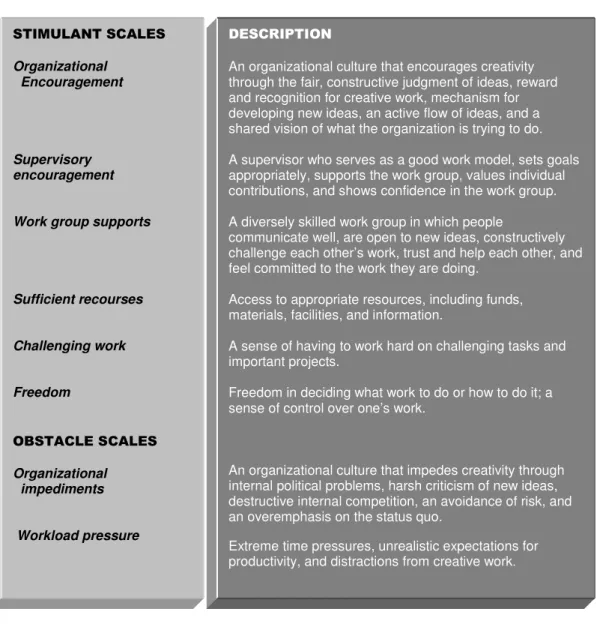
The conceptual model of the researchers shows several features of the environment that affect creativity. The managerial practices that influence creativity fall into six categories: work-group features, supervisory encouragement,
Figure >><<
Figure 1: Features of the work environment that affect creativity. Amabile et al. (1996) ‘Assessing the Work Environment for Creativity’,
The Academy of Management Journal, 39(5): 1154-1184
As figure 1 shows, encouragement of creativity in an organization is positively related to creative performance. This can take place on three levels, namely
organizational encouragement (e.g. constructive judgment of ideas, recognition for creative work and a shared vision of what the organization is trying to do),
supervisory encouragement (e.g. a supervisor who supports the work group and sets goals appropriately) and work group supports (e.g. a diversely skilled work group in which people communicate well and trust and help each other). Autonomy is another variable positively influencing creativity, as is sufficient recourses, including funds, materials and information. At last, challenging work leads to higher creative
STIMULANT SCALES Organizational
Encouragement
Supervisory encouragement
Work group supports
Sufficient recourses Challenging work Freedom OBSTACLE SCALES Organizational impediments Workload pressure DESCRIPTION
An organizational culture that encourages creativity through the fair, constructive judgment of ideas, reward and recognition for creative work, mechanism for developing new ideas, an active flow of ideas, and a shared vision of what the organization is trying to do. A supervisor who serves as a good work model, sets goals appropriately, supports the work group, values individual contributions, and shows confidence in the work group. A diversely skilled work group in which people
communicate well, are open to new ideas, constructively challenge each other’s work, trust and help each other, and feel committed to the work they are doing.
Access to appropriate resources, including funds, materials, facilities, and information.
A sense of having to work hard on challenging tasks and important projects.
Freedom in deciding what work to do or how to do it; a sense of control over one’s work.
An organizational culture that impedes creativity through internal political problems, harsh criticism of new ideas, destructive internal competition, an avoidance of risk, and an overemphasis on the status quo.
Extreme time pressures, unrealistic expectations for productivity, and distractions from creative work.
performance. Scales predicted to be negatively related are workload pressure (e.g. extreme time pressures) and organizational impediments to creativity, like internal political problems, harsh criticism of new ideas and avoidance of risk.
Conclusion
In this chapter the importance of person-context interactions has been stressed. Creativity can be understood as a function of a person’s characteristics, the characteristics of the environment, as well as the interactions between those
characteristics. The consequence is that creativity cannot be attributed to an individual alone, as the environment has a critical role, too. If we want to create work
environments that foster creativity, changing critical factors in the work context is therefore imminent. The key to change, has been argued, lies in intrinsic motivation. In the next chapter, the role of intrinsic motivation as mediator between environment and creativity will be addressed.
CHAPTER 3: INTRINSIC MOTIVATION
3.1 Intrinsic motivation as mediator between context and creativity
Drawing on the theories discussed in the former chapter, I will explore the role of intrinsic motivation as a mediator between contextual characteristics and creativity. We defined intrinsic motivation as the ability to engage in an activity because the activity itself is motivating and exciting to someone. This in contrast to extrinsic motivation, which refers to an external impetus for action- like a biscuit for a dog, a whip for a horse, or, in human reality, mostly prices or command. According to Frey, “Intrinsic motivation depends on the perceived locus of control. If the impetus for an action is attributed to an external influence, the perceived cognitive self-determination is undermined”- leading to a decrease of intrinsic motivation and hence, creativity.
Many scholars (e.g. Shalley, Zhou & Oldham, 2004; Amabile, 1983; Amabile et al. 1996) have argued that intrinsic motivation encourages people to be more curious, cognitively flexible, persistent in times of difficulty, and risk taking, all of which result in higher levels of creativity.
The effects of external influences on intrinsic motivation can be explained by the psychological Cognitive Evaluation Theory by Deci and Ryan (1985). This theory aims to identify the conditions under which the motivation of employees is in- or decreased. The authors argue that contextual characteristics have two dimensions: an informing and a controlling one. Which one of these aspects is perceived to be more dominant determines the effect it has on intrinsic motivation: if the informing aspect is dominant, and individuals feel encouraged by their environment and get valuable feedback on their competence, the effect on intrinsic motivation is positive.
Subsequently, these people are expected to express high levels of creativity. But when the controlling aspect is perceived to be dominant, people feel that their behavior, thoughts and feelings are constrained by their environment, which undermines their self-determination and causes a decrease of intrinsic motivation. People are in this case expected to express less creativity.
3.2 Alternative theories
Shalley, Zhou & Oldham (2004), three of the leading researchers on the subject of management and creativity, argue that while many studies have provided results that are consistent with the argument of intrinsic motivation being the mediator between context and creativity, few studies have actually tested it. If they did do so, they found results that were not in all cases that consistent. This could be due to the difficulty with measuring intrinsic motivation, which is not an easy task. It is not something that can be counted, and in addition, often enough you do things without knowing exactly why. Or people can be bluntly dishonest about what motivates them: there are likely many more people who make choices for the easy money, than those who will actually say so. The borders between intrinsic and extrinsic motivation can be blurry. Take money for example, extrinsic motivator pur sang: this can also motivate people intrinsically when the informing aspect is dominant to the controlling aspect, which is different in every case, for every different individual. In addition to being a
compensation for the time and effort you spend on a job, money can also be perceived as information about how competent and valuable you are. In the latter case, it does stimulate intrinsic motivation. Frey (2000) also takes note of the distinction between motivation to participate versus motivation to produce, as suggested by March and Simon (1958). While intrinsic motivation is important for functioning in a team, pooling ones ideas and (tacit) knowledge, the decision to join a team oftentimes depends on extrinsic factors as salary or reputation.
Another possibility is that intrinsic motivation is important to creativity, but that it has to co-exist with other variables to trigger employee creativity.
Finally, it could be that the inconsistent results found in some studies to intrinsic motivation and creativity are due to alternative mediating conditions. The role of mood states as a mediator between context and creativity, for example, is investigated in a number of studies (e.g. Isen, 1999; George & Zhou, 2002). Moods are “pervasive generalized affective states that are relatively transient in nature, are experienced over the short run, fluctuate, and may be affected by contextual factors (George & Brief, 1992 in Shalley, Zhou & Oldham, 2004)”. Positive mood states (like excitation and elatedness) are suggested to have a positive influence on cognitive
processes, motivation and social relations in the workplace and have hence a stimulating effect on creativity.
On the other hand, history has given us many examples of Angry Young (Wo-) Men whose anguish inspired them to make beautiful art. Ever since Romanticism, some centuries ago, artists have been expected to suffer in order to make good art. But although many great artists have suffered from psychopathology and addictions, leading sometimes to hospitalization (e.g. Charlie Parker, Thelonius Monk, Charles Mingus) or even suicide (e.g. Vincent van Gogh, Kurt Cobain, Ernest Hemingway, Frida Kahlo), there are also many artists who live happy, satisfied lives and are not tormented at all. In some cases a melancholic pose might be helpful to be taken more seriously, and gain more recognition in the art world.
There are a few studies (e.g. George & Zhou, 2002) that suggest that under specific circumstances negative moods, like fear and distress, do increase creativity. In a business setting, this can happen in the case of job dissatisfaction, when
employees come to think that the status quo is no longer acceptable and contribute new ideas to make things better. But these employees might well choose to exit, instead of voice, or accept the status quo out of loyalty to the company, even if it is causing them distress.
George and Zhou also found that in case of clarity of feelings and high-perceived recognition and reward for creativity, negative mood states stimulate creativity where positive ones do not. Clarity of feelings expresses to what extent people are aware of their feelings and capable of meaningful reflection about how they feel and why.
Considering the lack of consensus so far in research to the relation between mood and creativity, it is necessary to explore this subject in further research. But by no means this makes the necessity to study the relation between intrinsic motivation and creativity redundant. Even in mood studies, the role of intrinsic motivation is important. Positive mood states are enhancing creativity also because of its stimulation of motivation. And as negative mood states are beneficial to creativity only when recognition and reward for creativity as well as clarity of feelings are high, it might well be that the effect of negative mood on creativity is positive only when
this leads to an increase of motivation. In this regard, intrinsic motivation itself is a mediating condition in the study to the relationship between mood and creativity.
3.3 Explaining behavior: Preferences versus constraints
Economists focus on constraints such as (relative) prices, limited time and income to account for people’s behavior. Take for example the supply and demand graph, the famous X, by which one can easily determine how high the demand of a product will be at a given price. At the equilibrium price, the point at which the market system is in balance, supply equals demand.
Psychologists like Deci and Ryan on the other hand focus on preferences, or attitudes reflecting people’s set of values, to account for their actions. These
preferences determine the level of motivation one has to do something. Put simply: economists look at the outside world to explain behavior (taking values as constant), psychologist at the internal world.
Frey (1997; 2000) proposes in this ‘crowding theory’ to combine economic and psychological approaches. He acknowledges that behavior is the result of both preferences and constraints, and argues further that both can influence each other. External constraints can have a corrupting effect on intrinsic motivation, which he calls crowding out, or can have a positive influence, called crowding in.
Intrinsic motivation is undermined when rewards that are granted to someone are perceived to be controlling. An example of this crowding effect Frey (2000) mentions is the case of a blood bank, where people normally donate their blood for free. Contrary to what traditional economists might believe, less people are in fact willing to give their blood when they are offered monetary compensation, than when they aren’t paid at all. But no crowding out effect can occur when there was no intrinsic motivation to begin with. In case of dull or simple work, in a factory for example, people will response positively to a pay-for-performance price incentive, and work output will rise.
As pointed out, external interventions have two aspects: an informing and a controlling one. A reward can be perceived as informing, as it gives the receiver feedback about his competence, which “strengthens the feeling of internal control” (Frey, 2000, p. 541). But when the controlling aspect is perceived to be dominant, people feel stressed by their environment, which undermines their intrinsic motivation to do the thing they are rewarded for. The effect of the price system can thus work in
two directions. In case of command on the other hand, the crowding effect takes place in one way alone: out. There can be no doubt to where the locus of control is.
Falk and Kosfeld (2006) provided empirical evidence for the negative effects of managerial control on intrinsic motivation. The relation between employer and employee can be typified as a principal-agent relation, because of the asymmetric information between the principal –employer, and the agent –employee. When given a high amount of autonomy to the employee, the employer remains in insecurity about whether the employee does his work (well) or takes opportunistic actions, for which the employer carries the risk. Therefore, employers often try to control the behavior of the employees to eliminate their most opportunistic actions. But many of the people who are confronted with a controlling decision perceive it as a signal of distrust and as a limitation of their autonomy. The emotional perceptions of control in turn affect the agents’ behavior. The results of the experiment undertaken by Falk and Kosfeld show that the decision to control, instead of trust the agent, significantly reduces the agents' willingness to act in the principal’s interest. Because of this, performance of the agent is lower when the employer controls in comparison to if he trusts.
According to Frey (1993) monitoring doesn’t necessarily crowd out the agent’s intrinsic work motivation. In some cases monitoring the employee does not have a psychological effect, or even a productive one. The latter is the case in abstract relationships like in a competitive market. If the relationship between a principal and agent is personal, Frey finds a crowding out effect of control on intrinsic motivation and work effort. Like Falk and Kosfeld, he argues that monitoring is perceived as distrust, which causes employees to reduce their work effort. The result is that, to speak with Argyris (1964), strong control leads to an ever-expanding need to increase control.
Conclusion
In this chapter, the role of intrinsic motivation as a mediator between contextual characteristics and creativity has been explored. Economists typically explain
economic behavior by means of constraints such as prices and costs. Psychologists on the other hand, like Deci and Ryan, hold the preferences and values of individuals
responsible for their actions. Frey’s Crowding Theory can be understood as a
combination of economic and psychological approaches. Behavior, has been argued, is the result of both preferences and constraints, and both can influence each other. External constraints can have a corrupting effect on intrinsic motivation, called
crowding out, or can have a positive influence, called crowding in. An external influence has a positive affect on intrinsic motivation when the feeling of internal control is strengthened. When people feel controlled by their environment on the other hand, intrinsic motivation is undermined. The consequences of these Crowding Effects on the management of creativity will be addressed further, theoretically in chapter 4; empirically in chapter 5.
CHAPTER 4: MANAGEMENT
In the former chapters, I have stressed the role of intrinsic motivation to creativity. This has implications for a suitable management style. Intrinsically motivated employees will feel patronized rather than motivated by dominant management behavior. As Harry Starren, director of de Baak management centre puts it:
“Knowledge workers (…) are intrinsically motivated, until they meet their boss. If you push someone in the direction he is already going, is he going to walk faster?” (Weggeman; 2007; 5)
4.1 The construction of management
Let us first try to answer the question: what is management? There seems to be no straightforward answer to that. This is why the phrase ‘management is what managers do’ is often used in an attempt to define management. Nevertheless, to speak with Christopher Grey, one of the leading authorities in the area of critical management studies, “The existence of an identifiable group of people who are labeled 'managers' has been one of the most significant aspects of the organization of work and society for well over a century” (Grey, 1999, pp. 1).
The meaning of management –what people think management is and should be- has been subject to change over the centuries. But although management as a social construction is ever changing, textbooks about management more often than not postulate conclusive definitions -thereby ignoring the many contestations about the term. A famous example of a conceptualization of management is Henri Fayol’s
General and Industrial Management (1949), in which he defines management as a function of planning, organizing, command, coordination and control.
The impact that Fayol, together with other classical management theorists such as Frederick Taylor and Max Weber, have had on management practice can hardly be overestimated. For one, it led to the explosive rise of organizations we now usually call bureaucracies. But their ideas have even shaped our most basic
The view of classic management theorists is that organizations are, or should be, rational systems that strive towards maximum efficiency. The main focus is on organization design, since it is believed that if the engineering is right, everything else will fall into place. Thrust of their theories is the idea that management is a process of rational planning, coordination and control- an idea that is, although regularly
questioned, still the dominant view on management up till today. The modern management techniques that are based on classical management theories are
numerous: management by objectives; planning; budgeting systems and programming are but a few of the common management practices based on their ideas.
Due to the changing dynamics of the new economy, with the increasing importance of innovation and creativity for business survival, the limitations of classical
management became apparent.
A company has little power to innovate when people and systems are only programmed to meet predetermined objectives. The little power to innovate rests solely with upper management- those who do the thinking- neglecting the knowledge and ideas of the rest of the human capital. The system described here is not adequate to deal with uncertainties and instabilities, as it encourages only processes of single-loop learning (checking if objectives are met), but discourages double-single-loop learning (questioning the validity of objectives and ever reframing goals), as has been shown to be important for organizations to evolve (Morgan, 2006; Argyris, 1978; Senge, 1990).
Furthermore, the flow of knowledge and ideas throughout the organization gets obstructed when hierarchical and horizontal divisions are strong, which is typically the case in bureaucracies. With such a division of information and
knowledge, it is hard for employees –just busy within the narrow framework of their job description, doing what they are told to do- to get a grasp of what is facing the organization as a whole, thus further reducing the power to innovate.
But the affect of these management practices on motivation can be even more profound. The sociologist Weber (1946) noticed early on in his famous account on bureaucracies that treating people as if they were only cogs and wheels of a machine can have a dehumanizing effect on people and cause a lack of motivation. Furthermore, people are not machines, and they will oftentimes not act as they are
designed to do. Even more so when the system people are working in is rigid, it can cause disruptive rebellion.
4.2 Developments in management theory
Insight in the downside of the classical management paradigm has lead up to many new management theories and practices. Bureaucratic organizations in all sectors of the economy have been reassessed (David & Scase, 2000). Many big bureaucracies have been subject to processes of decentralization, fragmentation and flattening of hierarchical structures. Where specific services were once delivered in-house, they are now often outsourced to networks of market based purchasers and providers.
Also, the way that management is apprehended and the status that it has seems to have changed in recent years. The concepts of ‘empowerment’ and self-managing teams for example, that are popular subjects in the discourse of
organizational change, suggest that the historical distinction between managers and non-managers is diminishing (Grey, 1999).
Many organizations have adopted more flexible, ‘post- bureaucratic’ organizational forms, with flattened hierarchies, making middle-management often redundant. In addition, management techniques have come to include much less rational, more ‘soft’ issues: over the last decades academic and popular management literature have come to stress the importance of culture management, human resource management, total quality management, organizational learning and creativity. This all seems to indicate a whole new role for the modern manager. Instead of planners, designers and organizers, the manager of today is pictured in much less a rational way. They are visionaries, facilitators, team builders, change agents or coaches (Gee at al., 1996). It is not so much that managers should perform a narrow set of
management tasks, as that they have to shape the conditions under which employees get empowered, and can unleash their full creative potential. The emphasis of managing thus seems to have shifted from controlling, to enabling employees.
What is interesting is that in non-profit organizations like for example arts organizations and universities, a reverse dynamic is visible. Whereas management in for-profit organizations increasingly emphasizes the ‘soft issues’, e.g. culture,
rational elements of management, as strategy, structure and systems.4 The current emphasis on cultural entrepreneurship and professionalisation that is all around in the art world today illustrates this trend.
That managers are now pictured as equal partners or facilitators of the workforce seems to erode the historically shapen high status of the manager. In their ‘post-management manifesto’, Koch and Godden (1996) even predict the death of management in the near future. “There is a strong case that management, (…) the creation of the Industrial Revolution in the last half of the eighteenth century, could finally die out sometime early in the twenty-first century’ (p.17)
But maybe this is just some speculation, and is the truth that management actually flourishes. Grey for example points out that although a number of managers has been fired from their jobs, they are often rehired again as consultants, to avoid the costs that are associated with hierarchies. In addition, managers might grant their acquaintances of the MBA’s ‘old boys network’ positions with considerable power.
Organization theorist and management consultant Matthieu Weggeman would likely disagree with Koch and Godden’s prediction, too. In his book, bluntly called (as translated to English)‘Managing Professionals: Don’t Do It!’5 (Weggeman, 2008: 76), he describes the way that an acquainted manager leads his company. In this manager’s ‘oval office’, two rows of monitors are placed against the walls, where the latest balanced scorecard, AEX and the levels of production and stocks are visible, as well as live images of the work floor and meetings, which he can interrupt whenever necessary. The anecdote continues with Weggeman gasping: “Incredible. You could even login from home so you can watch all the images there, and never even have to set foot in the office anymore!” The manager replies that ‘he thought about it, but he just likes the feeling of coming home too much after work’. He would not want to miss that.
The anecdote is humorous as it is depressing. Increasingly, the author claims,
managers are sticking ‘vertical thermometers’ in primary work processes. Everything
4
These six elements of organizations –strategy, structure, systems, management style, people, culture- are deducted from the ESH-framework for analysing organizations, as described in Weggeman, M. (1992)
gets measured, everything is controlled. The consequence is that employees and work processes get frustrated and on top of that do these practices not even give real control but rather an illusion of it. In fact, strong control leads to an ever expanding need to increase control, as has been shown in the previous chapter.
Conclusion
In this chapter we investigated the common practices and principles of management. We argued that the idea that we inherited from the Industrial Era is that management is a process of rational planning, coordination and control. Subsequently, the negative impact of management on intrinsic motivation and creativity can be profound. But the way that management is apprehended has changed over the last few decades. From a manager in the traditional sense, the role of the contemporary manager has changed to more of a mediator. That the emphasis of managing seems to have shifted from controlling, to enabling employees, is beneficial to creativity in that the perceived self-determination of employees is enhanced. Nevertheless, more often than not creative professionals picture managers as a threat to their autonomy, or as people who unnecessarily frustrate creative processes. It follows, then, that the dilemma of the manager of creativity seems not yet resolved.