STRATEGIC HUMAN RESOURCE MANAGEMENT PRACTICES AND EMPLOYEE RETENTION IN THE SOFTWARE DEVELOPMENT
INDUSTRY IN KENYA
ASETTO DIANA ATIENO
D53/CTY/PT/22138/2011
A RESEARCH PROJECT SUBMITTED IN PARTIAL FULFILLMENT OF THE REQUIREMENT FOR THE AWARD OF MASTER DEGREE OF BUSINESS ADMINISTRATION IN HUMAN RESOURCE MANAGEMENT
AT KENYATTA UNIVERSITY
DECLARATION
This thesis is my original work and has not been presented in any other institution for examination purposes.
Signature ……… Date ………
Asetto Diana Atieno
D53/CTY/PT/22138/2011
This thesis has been submitted for review with my approval as the University supervisor.
Signature ……… Date ………
Supervisor
DR. JEDIDAH MULI
DEDICATION
ACKNOWLEDGEMENT
The completion of this work would have been impossible without the material and moral support from various people. First and foremost, I thank the Almighty God for granting me good health and for His grace throughout the entire course.
Special thanks to my supervisor Dr. Jedidah Muli for her effective supervision, guidance, availability and professional advice as I undertook this research project. I also extend my gratitude to all lecturers who taught me in the MBA (HRM) programme for enriching my research with knowledge.
TABLE OF CONTENTS
DECLARATION ... i
DEDICATION ... ii
ACKNOWLEDGEMENT ... iii
TABLE OF CONTENTS ... iv
LIST OF TABLES ... viii
LIST OF FIGURES ... ix
OPERATIONAL DEFINITION OF TERMS ... x
ABBREVIATIONS AND ACRONYMNS ... xii
ABSTRACT ... xiii
CHAPTER ONE: INTRODUCTION ... 1
1.1 Background of the Study ... 1
1.1.1 Strategic Human Resource Management Practices ... 4
1.1.2 Employee Retention ... 6
1.1.3 The Software Development Industry in Kenya ... 7
1.2 Statement of the Problem ... 9
1.3 General Objective ... 11
1.4 Specific Objectives ... 11
1.5. Research Questions ... 12
1.6 Justification of the Study ... 12
1.7 Significance of the Study ... 13
1.8 Scope of the Study ... 14
1.9 Limitations to the Study ... 14
2.1 Introduction ... 16
2.2 Theoretical Review ... 16
2.2.1 Social Exchange Theory ... 16
2.2.2 Human Capital Theory ... 18
2.2.3 Universal Theory... 19
2.2.4 Resource Based View Theory... 21
2.3 Empirical Review ... 22
2.3.1 Employee Compensation and Employee Retention ... 22
2.3.2 Career Management Practices and Employee Retention ... 26
2.3.3 Employee Work-Life Balance and Employee Retention ... 29
2.3.4 Employee Engagement and Employee Retention ... 32
2.4 Summary of Literature and Research Gaps ... 35
2.5 Conceptual Framework ... 37
CHAPTER THREE: RESEARCH METHODOLOGY ... 39
3.1 Introduction ... 39
3.2 Research Design ... 39
3.3 Target Population ... 39
3.4 Sample and sampling design ... 40
3.5 Data Collection ... 41
3.6 Validity of the Research Instrument ... 42
3.7 Reliability of the Research Instrument ... 42
3.8 Data Analysis ... 42
4.1 Introduction ... 46
4.2 Demographic Information ... 46
4.2.1 Gender Distribution of the Respondents ... 47
4.2.2 Age Distribution of the Respondents ... 47
4.3.3 Education Level of the Respondents ... 49
4.2.4 Years Worked in the Organization ... 49
4.2.5 Respondents’ Level of Management in their Organization ... 50
4.3 Employee Compensation and Employee Retention ... 51
4.3.1 Extent to which Compensation was used to Enhance Employee Retention in Respondents’ Organization ... 51
4.3.2 Respondents’ Level of Agreement with Statements on Employee Compensation ... 53
4.4 Career Management Practices and Employee Retention ... 55
4.4.1 Extent to which Career Management Practices were used to Enhance Employee Retention in Respondents’ Organization ... 55
4.4.2 Respondents’ Level of Agreement with Statements on Career Management Practices ... 56
4.5 Employee Work-Life Balance and Employee Retention ... 58
4.5.1 Extent to which Employee Work-Life Balance Aspects were used to Enhance Employee Retention in Respondents’ Organization ... 58
4.5.2 Respondents’ Level of Agreement with Statements on Employee Work-Life Balance ... 60
4.6 Employee Engagement and Employee Retention ... 62
4.6.1 Level of Employee Engagement and Respondents’ Continued Working with their Organization ... 62
4.6.3 Respondents’ Level of Agreement with Statements on Employee
Engagement ... 65
4.7 Inferential Statistics ... 66
CHAPTER FIVE: SUMMARY, CONCLUSIONS AND RECOMMENDATIONS ... 73
5.1 Introduction ... 73
5.2 Summary ... 73
5.2.1 Employee Compensation and Employee Retention ... 73
5.2.2 Career Management Practices and Employee Retention ... 74
5.2.3 Employee Work-Life Balance and Employee Retention ... 74
5.2.4 Employee Engagement and Employee Retention ... 75
5.3 Conclusions ... 76
5.4 Recommendations... 77
5.5 Suggested Areas for Further Research ... 78
REFERENCES ... 79
APPENDICES ... 90
LIST OF TABLES
Table 3.1 Sample size distribution ... 41
Table 3.2 Operationalization of study variables... 44
Table 4.3 Response rate ... 46
Table 4.4 Education level of the respondents ... 49
Table 4.5 Respondents’ Management Level in their Organization ... 51
Table 4.6 Respondents’ level of agreement with statements on employee compensation... 53
Table 4.7 Respondents’ level of agreement with statements on career management practices ... 57
Table 4.8 Respondents’ level of agreement with statements on employee work-life balanceSouth Africa ... 60
Table 4.9 Respondents’ level of agreement with statements on employee engagement ... 65
Table 4.10 Model Summary... 67
Table 4.11 ANOVA (Analysis of Variance) ... 68
Table 4.12 Regression analysis results ... 69
LIST OF FIGURES
Figure 2.1 Conceptual framework ... 37
Figure 4.2 Respondents’ gender distribution ... 47
Figure 4.3 Age distribution of the respondents ... 48
Figure 4.4 Respondents’ distribution based on the number of years worked in their organization ... 50
Figure 4.5 Extent to which compensation was used to enhance employee retention in respondents’ organization ... 52
Figure 4.6 Extent to which career management practices were used to enhance employee retention in respondents’ organization ... 55
Figure 4.7 Extent to which employee work-life balance aspects were used to enhance employee retention in respondents’ organization ... 59
Figure 4.8 Whether the respondents considered the level of employee engagement as important to their continued working with their current organization ... 62
OPERATIONAL DEFINITION OF TERMS
Employee retention: This is a voluntary move by an organization to create an environment which engages employees for a long term. It involves deliberate actions/strategies by the organization to prevent competent employees from leaving the organization
Employee compensation: These are all forms of direct and indirect pay and rewards received by employees of an organization for the performance of their jobs
Career management practices: These are human resource policies and programs that support the development of employees’ competencies (knowledge and skills) in an organization
Work-life balance: These are human resource policies and programs that include interventions instituted by an organization that seek to create harmony between an employee’s family life and his/her work commitments
Employee engagement: It is the positive and fulfilling relationship between an employee and the organization that has employed him/her, where the employee is fully absorbed by and enthusiastic about his/her work and so takes positive action to further the organization's reputation and interests
Human resource management: This refers to the system of firm activities, policies and strategies that deal with the successful and effective utilization of organizational employees at all levels for the achievement of organizational objectives.
Strategic human resource management: This is an approach of human resource management that focuses on the alignment of an organization’s human resource policies and practices to its overall firm strategy as a means of gaining competitive advantage and enhancing organizational performance.
ABBREVIATIONS AND ACRONYMNS
BSA Business Software Alliance
CSK Computer Society of Kenya
EAPs Employee Assistance Programs
EE Employee Engagement
FOSSFA Free and Open Source Software Foundation for Africa
HR Human Resource
ICT Information and Communication Technology
KeSIA Kenya Software development Industry Association
KEPSA Kenya Private Sector Alliance
KIS Kenya Information Society
KSDA Kenya Software Developers Association
SHRM Strategic Human Resource Management
SPSS Statistical Package for Social Sciences
ABSTRACT
CHAPTER ONE: INTRODUCTION
1.1 Background of the Study
Strategic Human Resource Management (SHRM) is valuable and serves as the backbone of organizations in the whole world and has an immense influence on employee retention. Employees are a key resource that can be strategically placed for an organization to attain competitive advantage (Denisi & Griffin, 2008). Khan (2010) argued that organizations can increase and sustain competitive advantage through effective management of human resource as the success of any organization is dependent on the quality and efficiency of its human resources. The retention of talented employees is paramount to an organization because employees’ knowledge and skills are central to a company’s ability to be economically competitive. Employee retention becomes increasingly important to organizations because periodic labour shortages can reduce the availability of high performing employees; thus, workers are searching for better employment opportunities, and firms are seeking to improve the productivity of the workforce (Yazinski, 2009). However, there are challenges in attempting to retain employees, and sometimes, organizations can find it difficult to attract and retain best talent due to varied reasons, some of which could be economic, structural or cultural (Samuel & Chipunza, 2009).
Chipunza, 2010). Some people view employee retention as the result of the implementation of strategic human resource policies and processes that assist employees to remain with the company because of the provision of a work environment that meets the employees’ needs (Dernovsek, 2008). Organizations are more worried about retention of employees because loss of key staff can greatly affect organizational performance. According to Lockwood and Ansari (2009), organizations have to tolerate the cost of hiring and the cost of losing employees; and therefore, organizations should try to keep the existing staff. In fact, retention of employees and the employees’ appreciated skills helps the organization to save on its investment of employee recruitment and training, the resources of which can be utilized in other value adding activities for the organization. Given this, organizations should take steps to retain employees, to avoid unwanted turnover due to stress, low‐job satisfaction, unsatisfactory working condition and inadequate benefits (Atif, Ijaz-Ur-Rehman, Abdul & Nadeem, 2011).
software development companies, then they could be retained. As a result, the software development industry has become turbulent, and probably, the major companies have not been able to identify the reasons behind the employees’ lower productivity (Oluoch, 2006). This calls for emphasis on the essence of Strategic Human Resource Management practices so that the software development companies can be able to retain competitive staff and talent for longer periods (Samuel & Chipunza, 2009).
Sound and proficient strategic human resource management (SHRM) practices normally help out organizations in achieving the most advantageous use of available resources, leading them to consistently contribute to effectiveness and continuous improvement of the organization (Li-Qun, 2013). Competitive organizations worldwide rely on employees to provide innovative solutions to the problems they might have (Waldman & Arora, 2004). Indeed, in the current business environment that is turbulent in that; competition is high, and technologies, processes and products can be easily duplicated by competitors, employees are the key and most reliable resource that can keep an organization a step ahead of its competitors (Samuel & Chipunza, 2009). Pfeffer (2004) affirms that acquisition, development and retention of talent form the basis for developing competitive advantage in many industries and countries. Accordingly, for any organization to thrive and remain competitive it is important that it attracts and retains competent human resources. This implies that human resource plays a vital role in the growth of organizations, specifically by determining the level of employee turnover (Njenga, 2008). The foregoing therefore sought to establish the effect of SHRM practices on employee retention in the software development industry in Kenya.
1.1.1 Strategic Human Resource Management Practices
approach argues that a good fit between various SHRM practices and organizational strategy would improve the SHRM-firm performance relationship (Becker & Gerhart, 2006). Although the approaches differ, a number of familiar SHRM practices intersect in the three approaches and they aim at improving commitment and retention. This study will focus on compensation, career management, work-life balance and employee engagement as these factors are common across the three theories.
According to Bratton and Gold (2009), Strategic Human Resource Management practice is a strategic approach to managing employment relations which emphasizes that leveraging people’s capabilities is critical to achieving competitive advantage, this being achieved through a distinctive set of integrated employment policies, programmes and practices. According to Stavrou-Costea (2005), effective SHRM practices can be the main factor accounting for the success of an organization. Further, SHRM practices can be used to elicit some positive behavioral outcomes as well as advance the skills and abilities of employees.
This study acknowledges that best practices in human resource management include career management, appropriate compensation, employees’ work life balance and employee engagement. These practices will ensure that the organization is giving equal opportunity to all qualified people without discrimination; proper matching of the individual capabilities and interests with the demands and rewards given by the organization against the job. Also, regular training and development activities that are aimed at not only improving employee performance at work, but also boosting self confidence of the individual employee; use of flexible work arrangements to enable employees to mix work and family responsibilities without hurting any side (Njenga, 2008). Making performance appraisal to be part of the organizations culture and linking it to organizational objectives and good labor relationships that include diversity management is also essential in an organization that wishes to retain good talent (Torrington, Laura & Taylor, 2008).
1.1.2 Employee Retention
employees from leaving an organization as this could have adverse effect on productivity and profitability (Samuel & Chipunza, 2009).
Hiring knowledgeable people for the job is essential for an employer but retention is even more important than hiring. This is true as many employers have underestimated costs associated with turnover of key staffs (Lockwood & Ansari, 2009). Turnover costs can be incurred through issues such as reference checks, security clearance, temporary worker costs, relocation costs, formal training costs and induction expenses. Other invisible and hidden costs such as missed deadlines, loss of organizational knowledge, low morale and client’s negative perception of company image may also take place (Gurbuz & Mert, 2011). Employee retention has become an important issue to many organisations, because the ability to hold on to highly talented core employees can be crucial to the future survival of the organization. Employee retention brings all kinds of benefits especially since globalization and the creation of regional economic blocs have increased labour mobility across nations. Considering the economic impacts of losing adroit employees it is prudent that organizations do not create an environment that contributes to turnover. Rather, they must introduce and integrate SHRM practices that maximize employee retention for the well-being of the organization (Yazinski, 2009).
1.1.3 The Software Development Industry in Kenya
Technology Federation (KIF) which is the ICT arm of the Kenya Private Sector Alliance (KEPSA). Other professional bodies exist such as the Computer Society of Kenya (CSK), the Kenya Information Society (KIS), the Business Software Alliance (BSA) and the Free and Open Source Software Foundation for Africa (FOSSFA) just to name a few. In light of its informal history, the local software development industry is now guided by policy, regulation and structure with the enactment of the Kenya ICT Board in February 2007 as a state corporation (World Bank, 2002).
Research by World Bank (2002) has shown that over 80% of software application products sold locally comprise of off-the-shelf packages made by leading international software houses such as Oracle, Microsoft, SAP and Accpac. A separate study carried out by World Business Council for Sustainable Development (2004) revealed that; although local software companies have the advantage of leapfrogging older obsolete technologies, they still have not kept up with cutting edge technological innovations, have had problems with retention of employees, hence inadequate performance or performance that still below the expected point.
human resource management, talent retention becomes untenable. This implies that competitive Human Resource Management practices have to be emphasized in order for the software development industry to not only attract competent individuals in the field of ICT but also retain that talent.
1.2 Statement of the Problem
The aim of human resource strategy is to devise ways of managing people in order to assist in achievement of organizational objectives (Njenga, 2007). The current environment in major companies in Kenya, especially in the software development industry is turbulent, and marked by overwhelming challenges facing employee retention. First, the majority of organizations have poor human resources management strategies; which imply a negative effect on workplace productivity. In most cases, workers are not enthusiastic or engaged in job duties and responsibilities due to the failure of organizations to recognize them as equally productive and important (Derrick, Laura & Stephen, 2007). In many cases, poor management, lack of motivation and changes in organizational structure are at the forefront of an unproductive workplace. Thus; studies carried out recently have shown that turnover rates are high in most companies; meaning that retention of competitive employees is currently posing a big challenge.
companies that offer what they lack in others. Also, today, there is rampancy of unorganized and poorly planned hiring practices that lead to the employment of unqualified and inept workers due to Human Resource (HR) departments’ failure to plan practical recruiting strategies. Hence, the integrity of the workforce is compromised, making it hard for companies to attract competent talents (Hitt, Bierman, Shimizu & Kochhar, 2011). This is worsened by poor compensation structures and a lack of engagement of employees in decision making processes and other important functions carried out within the organization (Hytter, 2007).
Rajendran and Chandramohan (2010) maintains that all firms seek to gain competitive advantage through proper strategies and evidence has shown that effective service delivery is achieved by systematically melding strategic human resource management practices with selected employee retention strategies. According to Derrick, Laura and Stephen (2007), there are certain strategic human resource management practices and approaches which will invariably help an organization in achieving competitive advantage. These strategic human resource management practices include; attractive compensation, appropriate career management, appropriate employee work-life balance as well as adequate employee engagement in organization functions.
employees with expanded responsibilities so that they can make full use of individual skills and abilities. Also, Mutuku (2003) did a survey of managers’ attitude and responses to work force diversity in telecommunication sector in Nairobi and found out that the attitudes of the managers as well as how they treated the workforce had great impact on employee retention. Where managers value and engage employees in decision making and other important processes, employee turnover was found out to be lower compared to where managers’ attitudes and responses were not pleasing.
However, though there are various local studies that have focused on employee retention, none was identified by the researcher that sought to explain employee retention in the software development industry in Kenya. It is against this background that this study sought to establish the effects of strategic human resource management practices on employee retention in the software development industry in Kenya.
1.3 General Objective
The general objective of this study was to establish the effect of strategic human resource management practices on employee retention in the software development industry in Kenya.
1.4 Specific Objectives
i. To examine the effect of compensation on employee retention in the software development industry in Kenya.
iii. To establish the effect of employee work-life balance on employee retention in the software development industry in Kenya
iv. To find out the effect of employee engagement on employee retention in the software development industry in Kenya
1.5. Research Questions
i. How does compensation affect employee retention in the software development industry in Kenya?
ii. How does career management practices on employee retention in the software development industry in Kenya?
iii. How does employee work-life balance affect employee retention in the software development industry in Kenya?
iv. How does employee engagement affect employee retention in the software development industry in Kenya?
1.6 Justification of the Study
employee retention problem among most of the software development firms in the country yet this is an area that is currently under‐researched. This study sought to establish how strategic HRM practices affect employee retention in the software development companies in the country. The choice of employee compensation, career management practices, employee work-life balance and employee engagement as the study variables that affect employee retention was informed by the knowledge that these variables form an integral part of the work environment and are key components of any HRM policy.
1.7 Significance of the Study
This study on SHRM practices and employee retention is relevant to many stakeholders. First, the findings of the study provide an insight as to the effects of SHRM practices on employee retention in companies operating in the software development industry in Kenya. This may inform the decisions of the software development companies in Kenya as to how to leverage on SHRM practices to achieve talent retention.
Theoretically, this study is significant as it adds to the existing literature in the area of strategic human resource management practices and employee retention. The study has enumerated suggested areas of further research that can form the basis of research for other scholars.
1.8 Scope of the Study
The study was limited to the investigation of the effects of strategic human resource management practices on employee retention in the software development industry in Kenya. Specifically, the study analyzed the effect of compensation, career management practices, employee work-life balance and employee engagement on employee retention. The unit of analysis was the employees of the 304 registered software development companies in Nairobi, Kenya, from whom relevant study data was collected in the course of a month to meet the study objectives.
1.9 Limitations to the Study
The researcher encountered various limitations that could have hindered access to information sought for the study. First, the respondents approached were initially reluctant in giving the required information fearing that the information could be used to intimidate them or paint a negative image of the organization. To counter this limitation, the researcher assured them of confidentiality of information provided and that the information would be used for the purpose of the research only. The researcher also approached the targeted respondents personally to explain the purpose of the research.
work to facilitate the data collection. The researcher also encountered challenges of the staff being too busy at their workplace. To counter this, the researcher had to extend the data collection period by two weeks to allow the respondents adequate time to respond to the research tool.
1.10 Organization of the study
CHAPTER TWO: LITERATURE REVIEW
2.1 Introduction
This chapter presents the theoretical review, the empirical review and the conceptual framework of the study. The chapter further gives the summary of the empirical review and the research gap of the study.
2.2 Theoretical Review
This section should discuss current/relevant theory that supports the research problem been studied.
2.2.1 Social Exchange Theory
imply a two-sided, mutually contingent and rewarding process involving transactions or simply exchange (Cook, Cheshire, Rice & Nakagawa 2013).
In relation to human resource management practices and employee retention, the exchange theory views employment relationship as consisting of social or economic exchanges (Aryee, Budhwar & Chen, 2002). Economic exchange relationships involve the exchange of economic benefits in return for employees’ efforts and are often dependent on formal contracts which are legally enforceable. On the other hand, social exchanges are ‘voluntary actions’ which may be initiated by an organization’s treatment of its employees with the expectation that the employees will be obligated to reciprocate the good deeds of the organization (Gould & Davies, 2005). The exchange approach view of organizational commitment and engagement posits that individuals attach themselves to their organizations in return for certain rewards from the organizations. According to this view, employees enter the organization with specific skills, desires and goals, and expect to find an environment where they can use their skills, satisfy their desires and achieve their goals. Perception of favorable exchange and rewards from the employees’ viewpoint are expected to result in increased retention to the organization. On the other hand, failure by the organization to provide sufficient rewards in exchange for employees’ efforts is likely to result in decreased organizational retention (Gong, Chang & Cheung, 2010).
also been used to explain the employees’ retention to the organization. According to the exchange perspective, employees exchange their identification, loyalty and attachment to the organization, in return for incentives from the organization. This implies that an individual’s decision to become and remain a member of an organization is determined by their perception of the fairness of the balance of organizational inducements and the employee contribution (Gould & Davies, 2005). Cascio (2006) argue that unless employees believe they have been treated fairly, they will not be committed to the organization.
2.2.2 Human Capital Theory
Human capital theory was proposed by Schultz (1961) and developed extensively by Becker (1964) as cited in his publication titled “Human Capital: A theoretical and Empirical Analysis to special reference to education”. Human capital theory was developed in the 1960s on the realization that the growth of physical capital was only a small part of the growth of organizational income (Becker & Gerhart, 2006). Economist Theodore Schultz introduced return-on-investment, which highlighted the cost-benefit analysis of training and education. On his part, Becker developed the human capital theory based on Schultz’s research on return-on-investment. Becker introduced the concept of general-purpose human capital and firm-specific human capital that is widely used by human resource development practitioners worldwide (Dernovsek, 2008).
postulates that expenditure on training and education is costly and should be considered an investment since it is undertaken with a view to increasing personal incomes. The human capital approach is often used to explain occupational wage differentials (Campbell, Coff & Kryscynski, 2012). Human capital can be viewed in general terms, such as the ability to read and write, or in specific terms, such as the acquisition of a particular skill with a limited industrial application (Denisi & Griffin, 2008). In Becker’s view, human capital is similar to “physical means of production”, e.g., factories and machines meaning one can invest in human capital (via education, training, medical treatment) and a firm’s output depends partly on the rate of return on the human capital one owns. Thus, human capital is a means of production, into which additional investment yields additional output (Bratton & Gold, 2009). Therefore, by investing in human capital the organization is able to have talented workforce who will feel motivated and be part of the firm (retention of employees) hence leading to better organizational performance (Gurbuz & Mert, 2011).
However, there is criticism to this theory that argued on the assumption that education in fact guarantees employee retention. The theorists clearly did not take into account the transfer of learning. Is the duration of education and training an assurance of retaining the employee in the organization? Certainly, this notion is ideal, but questionable. This is because a highly skilled employee could as well look for a much more paying job (Hutchings, De Cieri & Shea 2011).
2.2.3 Universal Theory
circumstances (Becker & Gerhart, 2006). According to Baraza (2008) universal or best practice human resource management also known as high-commitment or high performance was originally identified in the early United States models of human resource management many of which advanced the idea that adoption of certain best practice HR practices would lead to improved organizational performance, through improved attitudes and behaviors, lower levels of absence and turnover, higher levels of skills and thus improved quality and efficiency (Armstrong, 2006). The model may take many forms and there is no consensus on the correct bundle of HR policies and practices since it is difficult to demonstrate the link between best practice HRM and improved organizational performance (Cascio, 2006).
The universal theory may not reflect reality because what works well in one organization will not necessarily work in another. HR techniques adopted may not fit the local customs, organizational or social traditions about the role of managers and their relationship with employees will determine which HR strategies are likely to be effective and also the relationship between employees’ attitude to work in their lives (Derrick et al., 2007). Social factors may need to be taken into account at the technical design stage to avoid demoralized working arrangements with the motivational problems that may arise as a consequence (Porter, 2008). Walsh and Taylor (2007) argue that although an organizational HRM policies and practices should be coherent in all its operations, companies operating in more than one country need to decide whether this is possible and sensible.
the performance regardless of the location of their subsidiary. Best practices discovered in one location can be spread across the world, without the costly and often ineffective need for each subsidiary to re-invent the wheel and also due to the fact that global alignment of systems will facilitate an internal labor market and make expatriation and other forms of cross border movement of personnel easier (Chiu, Luk & Tang, 2002).
2.2.4 Resource Based View Theory
The origins of the Resource Based View Theory can be traced to the works of Birger Wernerfelt who developed an article titled “A Resource-Based View of the Firm” in 1984. However, the concepts of the Resource Based View Theory can be traced back to earlier research in the works of Coase in 1937, Selznick in 1957, Penrose in 1959, Stigler in 1961 and Williamson in 1975, where emphasis was put on the importance of resources and its implications for firm performance (Khan, 2010). This theory argues that organizations should not try to achieve strategic fit with the external environment but aim to maximize their internal resources to create and dominate future opportunities (Porter, 2008). This approach assumes that the core competencies in the organization are unique; people are viewed as an investment and not a cost, learning, knowledge sharing, innovation and experimentation are encouraged, and employees are involved in decision making (Wright, Dunford & Snell, 2011).
workforce is a unique and inimitable resource that can generate a competitive advantage for the organization if effectively harnessed (Falcone, 2006).
Armstrong (2006) argues that a resource-based view approach to strategic human management focuses on satisfying the human capital requirements of the organization. Wright et al. (2004) suggests that the human resource policies and values of an organization constitute an important non-imitable resource and this is achieved by ensuring that; - the firm has higher quality people than its competitors, organization learning is encouraged, organization-specific values and a culture exist which bind the organization together (and) gives it focus, and the unique intellectual capital possessed by the business is developed and nurtured. Thus, the aim of a resource based approached is to improve resource capability achieving strategic fit between resources and opportunities and obtaining added value from the effective deployment of resources (Mello, 2010). Critiques of this theory however argue that the effectiveness of the resource-based approach is inextricably linked to the external context of the firm and that the resource-based approach provides more value when the external environment is less predictable (Hitt et al., 2011).
2.3 Empirical Review
This chapter presents a review of the literature related to the problem and purpose of the study.
2.3.1 Employee Compensation and Employee Retention
that there is an underlying assumption that money can influence behaviour hence a fair remuneration is understood to be the cornerstone of the contractual and implied agreement between employees and employers. They noted that, as a result, some companies may even provide remuneration packages which are well above the market rate to attract and retain critical talents. They also found that most managers believed that money was the prime retention factor. Similarly, many employees cited better pay or higher compensation as the reason for leaving one employer for another. Parker and Wright (2010) concluded that comprehensive compensation and rewards augmented by an effectual system of disbursement played an important role in attracting the best candidates, shaping employee behaviour, enhancing employees’ performance outcomes and facilitating retention of talents.
Mokaya and Kipyegon (2014) did a study on the determinants of employee engagement in the banking industry in Kenya using a case of Cooperative Bank. The study sought to assess the determinants of employee engagement in the banking industry in Kenya. The determinants covered were performance management system, personal development and growth opportunities, and workplace recreation and remuneration. The study adopted a descripto-explanatory research design, covering a sample of 214 respondents drawn from a target population of 496 employees of Cooperative Bank of Kenya. The data was collected through a self-administered questionnaire and analyzed using descriptive and inferential statistics. All the variables covered had a positive influence on employee engagement. However, remuneration was the highest contributor of employee engagement with workplace recreation having the least influence. The study recommended that bank managers should give special attention to programmes and activities that promoted employee engagement through fair and competitive remuneration packages with outstanding job performance being rewarded through various financial and nonfinancial incentives.
retaining and motivating employees - compensation preferences in Hong Kong and China, Chiu et al. (2002) observed that rewards were substantially related to employees’ retention as employees who were satisfied with the organizational rewards and who believed that they would not find such compensation elsewhere, were likely to choose to stay. They concluded that organizational rewards to employees enabled them to form a calculative and psychological attachment to the organization.
Cho, Woods, Jang and Erdem (2006) in a study of the relationship between HRM practices and organizational performance found out that companies providing incentive plans to employees are more likely to experience lower turnover rates among non-managerial employees. They further asserted that, a firm would further reduce its labour turnover rate if it applies reward systems in the form of incentive plans to more employees across the organisation. In their study, Casper and Buffardi (2004) asserted that an organisation can compensate for moderate salaries in a form of non-cash compensation, by offering a large amount of benefits. They proved that potential employees, irrespective of sex and culture, were willing to accept lower salaries if benefits of importance to them were also offered. Employee benefit packages increase worker commitment to the organisation and reduce the tendency to think about other job opportunities.
than any single reward. Both intrinsic and extrinsic rewards must be seen as timely and tied to performance and the employee must perceive the reward being offered as attractive. Similarly, according to a study by Tian-Foreman (2009) on job satisfaction and turnover in the Chinese retail industry, to maintain employee satisfaction with pay, corporations have developed systems that are intended to maintain pay equity with comparable internal persons or groups. The study noted that the consequences of inequity in employee pay regarding the external labour markets are potentially very severe for a corporation, which would be unable to attract and keep the talent required. The study concluded that, high total compensation does not however, ensure that the best employees are retained. To keep them, a company must also pay its better performers more than it pays poorer performers and the difference must be significant in the judgments of the employee. If employees feel the company takes good care of them, they are, in return, likely to take time to provide a better service to meet and/or exceed customers' expectations (Tian-Foreman, 2009).
2.3.2 Career Management Practices and Employee Retention
stay with organization. Further, strong positive inter-relationships were found between human resource management practices and employees’ retention. It is concluded that adoption of human resource management practices enhances employees’ retain-ability of organizations.
Kenyatta University. Descriptive statistics and inferential statistics were used in this study to analyze quantitative data, which was obtained from the closed ended questions. The study established that there is a positive relationship between the employees training and employee retention at Kenyatta University. The study found that Kenyatta University does not conduct a needs analysis before offering training. In addition, training helps organization to increase employee retention and decrease turn over, helps employees to develop and identify the career development strategies, serves as a tool to enhance the commitment with organization and improves employee’s skills.
competency analysis on regular basis in order to address staff training and development needs.
Nyanjom (2013) evaluated factors influencing employee retention in the state corporations in Kenya. The study adopted a cross-sectional design. The target population of the study included all 155 state corporations in Kenya as of December 31st, 2012. The study took a sample of 54 state corporations and collected primary data using a self-administered questionnaire. The data was analyzed using descriptive statistics. A summary of the findings showing the relative importance of factors influencing employee retention in the state corporations in Kenya ranked employee training and career development first as the most important factor followed by performance appraisal, employee empowerment, employee commitment and lastly employee compensation. The study concluded that employee’s retention is significantly influenced by training and career development, performance appraisal, employees’ empowerment aspects.
2.3.3 Employee Work-Life Balance and Employee Retention
and urban locations, and effective communication strategies. They however noted that more needed to be done by employers in the sector to attract employees through offering more flexible work practices for employees, and better work-life balance particularly for firms operating in the remote locations. They identified a need for employers to give greater attention to diversity and work-life balance issues. The study recommended that there was a need for work-life balance strategies to increase the attractiveness of work in remote locations.
A study by Maxwell (2005) indicated that HRM policies such as the introduction of flexible working hours and arrangements, provision of better training, breaks from work and better work support do not only address WLB issues but also enhance employee retention. He noted that flexible work plans allow employees to adjust working conditions within constraints set by the company and may include such options as flex-time, a compressed work-week, job sharing, and home-based work. Flex-time involves adjusting an employee's daily time schedule; it can be as simple as allowing a worker to come into work an hour earlier and leave an hour earlier than the normal 8-to-5 work day. His study indicated that the existence of family support (such as alternative schedules, supervisor support, co-worker support, flex-time, work-family culture and work-family benefits etc) within the organization helped a lot in the retention of talented employee. He concluded that organizations that supported their employees in integrating family responsibilities and work reduce the employees’ intentions to leave the job.
relationship between employer turnover intention and organization support such as supervisor support, flex time, work family culture and coworker support and concluded that organization support reduced the employee turnover intention. In Kenya Safaricom has managed to retain most of their female employees through provision of child care facilities.
2.3.4 Employee Engagement and Employee Retention
Oketch (2016) did a study on the effect of employee engagement on a firm's competitive advantage using a case of Kenya Electricity Generating Company Limited. The study reviewed available literature that focused on employee commitment, employee voice, employee motivation and employee productivity and how it affected competitive advantage of a firm. The study adopted descriptive research design and used a sample of 196 respondents. The study findings showed that employees who are committed to their respective firms are more likely to remain with the firm and will probably exert more efforts on behalf of the firm and work towards its success, exhibiting better performance that the uncommitted employees. The study findings also showed that a firm which provides an environment that allows staff to develop skills and talents, and acquire knowledge is highly likely to have committed staff which ensures a high guarantee of enhancing competitive advantage within the business environment. This is because employees who are committed and highly motivated to contribute their time and energy in the pursuit of organizational goals and objective are increasingly recognized to be a major benefit to an organization. It was revealed that a firm can enhance its competitive advantage by enabling employees to feel able to voice improvement-oriented ideas, communicate with the management on issues affecting them, for the benefit of the firm. This increases the levels of employee engagement which has been established to have a significant effect on competitive advantage.
census method was used since the sample was equal to the target population. A questionnaire was used as the data collection instrument. Data was analyzed both descriptively and inferentially. The study established that organizational support and growth opportunities foster learning which enhances employee competence. It was further established that engaged employees were more involved in organization’s issues and performed better. The findings led to the conclusion that employees would work harder if they were well engaged in organizational activities. The study recommended that organizations should provide more participation opportunities for their employees in decision making in an attempt to enhance their commitment to the organization.
On her part, Agoi (2015) studied the effect of work engagement on employee turnover intention in public sector in Kenya. The main objective of the study was to determine the effect of work engagement and employee turnover intention in Kenyan public institution. The study employed explanatory research design and the target population was the managers from the public institutions. The researcher used questionnaires as the data collection tool and relied on both primary data and secondary data which was analyzed through descriptive statistics. The study findings indicated a negative significant effect of dedication and absorption on turnover intention. It is therefore important for organizations to employ individuals with a secure attachment style since they are more likely to experience at work. It is utmost necessary for the organization to reward dedicated employees by promoting them. The organizations should therefore design employees job schedule in such a way that they can find meaning and purpose in the work that they do.
2.4 Summary of Literature and Research Gaps
organisations with career management systems, positive employee engagement and a good work-life balance for the organization’s staff have lower employee turnover, higher productivity and better results. It is important that these positive assertions are empirically tested.
2.5 Conceptual Framework
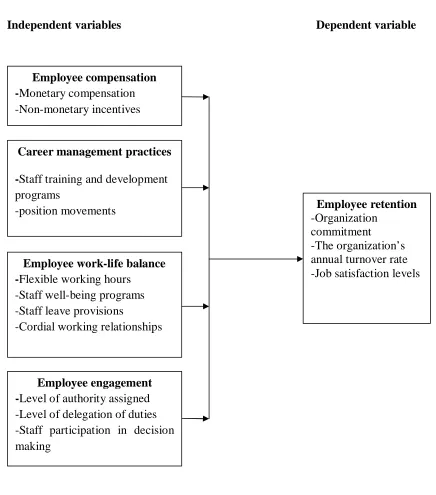
Independent variables Dependent variable
Figure 2.1 Conceptual framework
Based on the conceptual framework illustrated above, the dependent variable of this study was retention of employees. This was measured by considering the employees’ job satisfaction levels, employees’ level of commitment/loyalty to the organization
Employee compensation -Monetary compensation -Non-monetary incentives
Employee retention -Organization
commitment -The organization’s annual turnover rate -Job satisfaction levels Employee work-life balance
-Flexible working hours -Staff well-being programs -Staff leave provisions
-Cordial working relationships
Employee engagement -Level of authority assigned -Level of delegation of duties -Staff participation in decision making
Career management practices -Staff training and development programs
-position movements
CHAPTER THREE: RESEARCH METHODOLOGY
3.1 Introduction
This chapter covers the methodology that the researcher used to conduct the study. It is presented in the following order: research design, target population, sampling design, data collection and analysis and ethical considerations.
3.2 Research Design
The research design chapter emphasizes on defining the design, revealing its merits and providing justification for its selection.
This study adopted a descriptive cross-sectional research design. This was because descriptive cross-sectional research design is appropriate where the study seeks to describe the characteristics of certain groups, estimate the proportion of people who have certain characteristics and make predictions at a given point in time (Cooper and Schindler, 2011). The design was also suitable since it helped to describe the state of affairs as it existed without manipulation of variables which was the aim of the study (Kothari, 2004).
3.3 Target Population
registered software development companies operating in Nairobi, Kenya (CAK database, 2016). The target respondents comprised of a mix of low-level, middle-level and top-level management employees working in the head offices of the 304 firms. In all, there were 4,560 employees working in the head offices of the 304 software development firms (HR Departments of the firms). This formed the study’s target population.
3.4 Sample and sampling design
In this study, employees working in the 304 software development companies operating in Nairobi, Kenya were sampled. In all, the firms had a total employee population of 4,560, working in their head offices, of which 10% represented the top level management employees, 30% represented the middle level management employees and 60% represented the low level management employees.
Table 3.1 Sample size distribution
Management category Target population
Target population
%
Sample size
Sample size
%
Top level 456 10 45 10
Middle level 1,368 30 137 10
Low level 2,736 60 274 10
Total 4,560 100 456 10
Source: Researcher, 2016
3.5 Data Collection
3.6 Validity of the Research Instrument
Validity indicates the degree to which an instrument measures what it is supposed to measure; the accuracy, soundness and effectiveness with which an instrument measures what it is intended to measure (Kothari, 2004) or the degree to which results obtained from the analysis of the data actually represent the phenomena under study (Mugenda & Mugenda, 2003). The research instrument was availed to the lecturers in the School of Business in Kenyatta University and peers who helped establish its content and constructed validity to ensure that the items were adequately representative of the subject under study.
3.7 Reliability of the Research Instrument
Reliability is a measure of the degree to which a research instrument yields consistent results after repeated trials (Nsubuga, 2006). The reliability of the instrument was estimated using Cronbach’s Alpha Coefficient which is a measure of internal coefficient. A reliability of at least 0.70 at =0.05 significance level of confidence was accepted while adjustments were made accordingly.
3.8 Data Analysis
The study also used both regression and correlation analysis to test the relationship between the study variables. Mugenda and Mugenda (2003) postulate that regression analysis helps one understand how the typical value of a dependent variable (or ‘criterion variable’) changes when any one of the independent variables is varied, while the other independent variables are held constant while correlation analysis helps in identifying the form/nature and strength of the relationship between the independent variable(s) and the dependent variable. Thus, Pearson Correlation Coefficient was used to test the direction and magnitude of the relationship between the dependent and independent variables at 95% confidence level (or 5% level of significance).
The regression model specification was as follows;
Y=α + β1X1 + β2X2 +β3X3 +β4X4+ ε
Where;
Y = Dependent variable (employee retention) X1 = Employee compensation
X2 = Career management practices X3 = Employee work-life balance X4 = Employee engagement
The operationalization and measurement of the study variables was as shown in Table 3.2 below.
Table 3.2 Operationalization of study variables
Type
Variable
Operationalization Level Of
Measurement Hypothesized Direction Dependent variable Employee retention
-Intent to stay/leave
-Job satisfaction level
-Organization commitment level Ratio Independent variables Employee compensation
Monetary and non-monetary
compensation
Ordinal Positive
Career management practices
-Availability of staff
training and
development opportunities
-Position movement -Mentoring
programmes
-Career progression policy
Ordinal Positive
Employee work-life balance
-Flexible work hours
-Work leave policy
-Company sponsored
family events
-Nature of work
environment
Employee engagement
- Level of delegation of duties
-level of staff participation in decision making
Ordinal Positive
Source: Researcher, 2016
3.9 Ethical Considerations
CHAPTER FOUR: DATA ANALYSIS, PRESENTATION AND INTERPRETATION
4.1 Introduction
This chapter presents the analysis and findings of the study as set out in the research methodology. The results were presented on the effect of strategic human resource management practices on employee retention in the software development industry in Kenya.
4.1.1 Response Rate
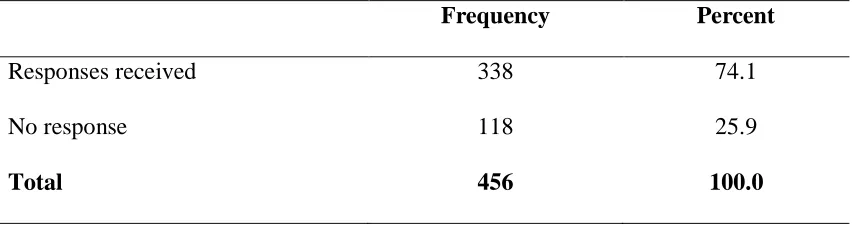
The study targeted 456 employees of software development companies in Kenya as study respondents. Out of the 456 questionnaires administered, 338 were adequately filled and returned contributing to a response rate of 74.1% (Table 4.3). This response rate was sufficient and representative and conforms to Mugenda and Mugenda (2003) stipulation that a response rate of 50% is adequate for analysis and reporting, a rate of 60% is good while a response rate of 70% and over is excellent.
Table 4.3 Response rate
Frequency Percent
Responses received 338 74.1
No response 118 25.9
Total 456 100.0
4.2 Demographic Information
4.2.1 Gender Distribution of the Respondents
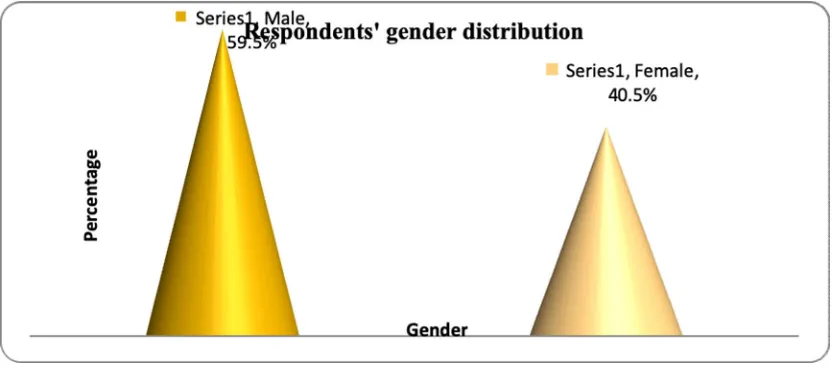
The study sought to establish the gender of the respondents. The findings are as shown in Figure 4.2.
Figure 4.2 Respondents’ gender distribution
Based on Figure 4.2 above, majority (59.5%) of the respondents were male while 40.5% were female. This showed that the study did not suffer from gender biasness as it involved both male and female respondents though the majority of the study respondents were male.
4.2.2 Age Distribution of the Respondents
Figure 4.3 Age distribution of the respondents
4.3.3 Education Level of the Respondents
The study sought to establish the education level of the respondents. The findings are as illustrated in Table 4.4.
Table 4.4 Education level of the respondents
Frequency Percent
Certificate 25 7.4
Diploma 101 29.9
Graduate 156 46.1
Masters 52 15.4
PhD 4 1.2
Total 456 100.0
According to Table 4.4 above, most (46.1%) of the respondents were graduates, 29.9% were Diploma holders, 15.4% were Masters holders while 7.4% were Certificate holders. Only 1.2% had a PhD. This inferred that majority of the respondents had a sound academic background and as such had a good understanding of the effect of strategic human resource management practices on employee retention in their organizations.
4.2.4 Years Worked in the Organization
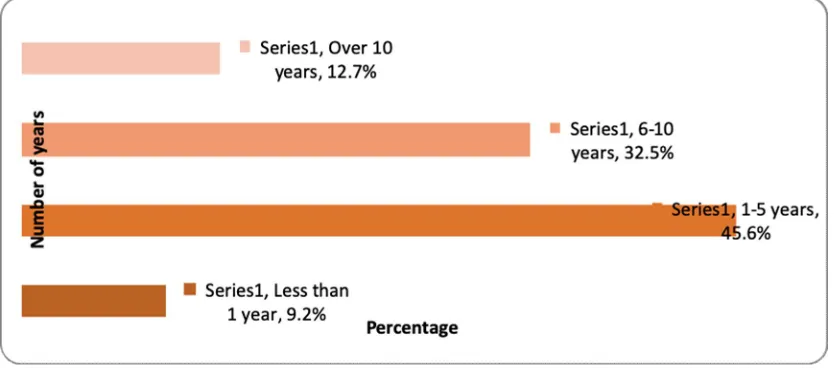
Figure 4.4 Respondents’ distribution based on the number of years worked in their organization
Figure 4.4 above indicates that 45.6% of the respondents had worked in their organization for 1-5 years, 32.5% had worked for 6-10 years, 12.7% had worked for over 10 years while 9.2% of the respondents had worked in their organization for less than 1 year. This implied that majority of the study respondents had worked in their respective organizations for long enough to be able to provide crucial information relating to the effect of strategic human resource management practices on employee retention in their organizations.
4.2.5 Respondents’ Level of Management in their Organization
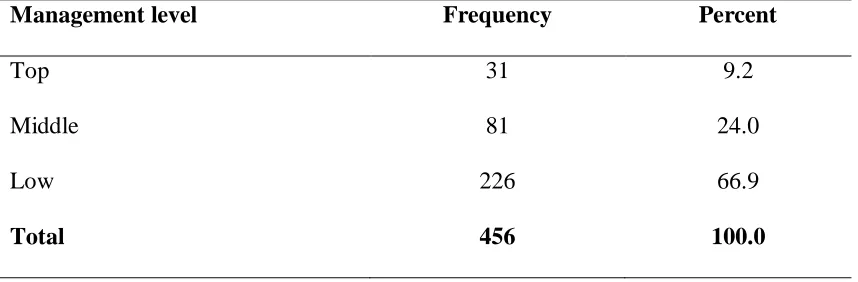
Table 4.5 Respondents’ Management Level in their Organization
Management level Frequency Percent
Top 31 9.2
Middle 81 24.0
Low 226 66.9
Total 456 100.0
Table 4.5 above indicates that majority (66.9%) of the respondents served as low level management employees in their organization, 24% served as middle level management employees while 9.2% of the respondents were in top management positions in their organization. This implied that the opinions expressed in the study by the respondents were representative of the organizations’ workforce.
4.3 Employee Compensation and Employee Retention
The first objective of the study sought to examine the effect of compensation on employee retention in the software development industry in Kenya. The findings are as discussed in the subsequent subsections.
4.3.1 Extent to which Compensation was used to Enhance Employee Retention in Respondents’ Organization
Figure 4.5 Extent to which compensation was used to enhance employee retention in respondents’ organization
who were satisfied with the organizational rewards and who believed that they would not find such compensation elsewhere, were likely to choose to stay.
4.3.2 Respondents’ Level of Agreement with Statements on Employee Compensation
The study evaluated the respondents’ level of agreement with various statements on employee compensation using a scale of 1-5 where 5-strongly agree, 4-agree, 3-neutral, 2-disagree and 1-strongly disagree. The findings are as illustrated in Table 4.6.
Table 4.6 Respondents’ level of agreement with statements on employee compensation
Statements Mean Std. Dev
I earn more than others who occupy similar positions in other software development companies
3.077 1.1709
I feel that the non-monetary benefits, such as vacation time and medical insurance that I receive here are better than those I could get in other software development companies
4.083 0.8327
People who are hard working and results-oriented are rewarded in my organization
4.225 0.6420
The salary and benefits I receive in my organization is commensurate with my responsibilities
3.926 0.9036
Compensation is satisfactorily reviewed from time to time 4.068 0.8429
Different types of rewards used in my organization have a deep and long lasting effect on employees’ motivation and retention
The study findings as shown on Table 4.6 above showed that the employees of the software development companies in Kenya agreed that people who were hard working and results-oriented were rewarded in their organization (mean = 4.225); different types of rewards used in their organizations had a deep and long lasting effect on employees’ motivation and retention (mean = 4.192); they felt that the non-monetary benefits, such as vacation time and medical insurance that they received in their organization were better than those they could get in other software development companies (mean = 4.083); compensation was satisfactorily reviewed from time to time (mean = 4.068) and that the salary and benefits they received in their organizations was commensurate with their responsibilities (mean = 3.926). However, the employees of the software development companies in Kenya neither agreed nor disagreed with the statement that they earned more than others who occupied similar positions in other software development companies (mean = 3.077). This implied that employee compensation as a strategic HRM practice played a significant role in enhancing employee retention in the software development companies in Kenya.
4.4 Career Management Practices and Employee Retention
The second objective of the study sought to explore the effect of career management practices on employee retention in the software development industry in Kenya. The findings are as discussed in the subsequent subsections.
4.4.1 Extent to which Career Management Practices were used to Enhance Employee Retention in Respondents’ Organization
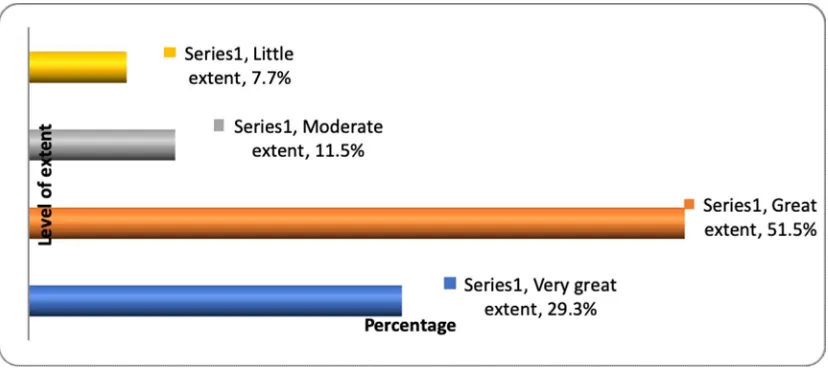
The study sought to establish the extent to which career management practices were used to enhance employee retention in the respondents’ organizations. The findings are as illustrated in Figure 4.6.
Figure 4.6 Extent to which career management practices were used to enhance employee retention in respondents’ organization
little extent. This implied that career management practices as a strategic HRM practice were applied to a great extent to enhance employee retention in the respondents’ organizations and hence were integral to employee retention in the software development companies in the country. This agreed with Nyanjom (2013) who in a summary of findings on factors influencing employee retention in state corporations in Kenya found employee training and career development ranked first as the most important factor. The findings were also in line with Hussain and Rehman (2013) who argued that adoption of career management practices enhanced employees’ retain-ability of organizations given that, generally, employees react positively to career development and advancement opportunities.
4.4.2 Respondents’ Level of Agreement with Statements on Career Management Practices
Table 4.7 Respondents’ level of agreement with statements on career management practices
Statements Mean Std. Dev
I have received sufficient training in my organization to enable me do my job effectively
4.311 0.5723
My organization provides opportunities for staff training and career development on a regular basis
4.228 0.7216
I feel there are better career and learning opportunities in my organization as compared to others
4.041 0.8637
My organization sometimes sponsors me to participate in training or career development programmes
4.234 0.8126
My supervisor takes an interest in my professional growth and career development
4.266 0.6934
There are opportunities for me to advance my career in my organization
3.979 0.9756