Available Online atwww.ijcsmc.com
International Journal of Computer Science and Mobile Computing
A Monthly Journal of Computer Science and Information Technology
ISSN 2320–088X
IMPACT FACTOR: 5.258
IJCSMC, Vol. 5, Issue. 9, September 2016, pg.6 – 15
FINGERPRINT BASED
BIOMETRIC AUTHENTICATION
Esther Rani.D
1
, Dr. J. John Raybin Jose
2
Research Scholar
1, Department of Computer Science,
Bishop Heber College, Tiruchirappalli,
Assistant Professor & Head
2, Department of Information Technology, Bishop Heber College,
Tiruchirappalli, [email protected].
[email protected]
.
Abstract---- The biometric plays the major role in the everybody’s life. The biometric is used to tracking and monitoring the things movable. To identify one’s identity the finger is one of many forms of the biometrics, are generally used. Fingerprint is the authenticated function to identify a match between two person’s fingerprints. A very efficient automatic identification system using for finger verification technique is developed and mentioned here. This project based on a program is developed and it performs a simulation test using biometric sensor hardware to check the fingerprint and compare with the preloaded fingerprint in the database. The pixel value of the image is adjusted and enhanced. The image is cropped and extracts a center position. Then apply the histogram equivalence to the test image and it is cropped and compared to the stored database images. A match is found indicates image detection and enabled the access. The detection technique is used for hardware interfacing in future.
Keywords – Biometric, tracking, identify, authenticated, detection, verification.
I. INTRODUCTION
An accurate personal identification has become very essential in today‟s world. With the rapid changes in electronics and information technology, people are becoming connected with the electronic devices in the automatic modern universe. As an output, the ability to achieve highly precise, automatic and reliable personal identification has become more tough and demanding.
A broad variety of systems needs a reliable personal authentication scheme to either confirm or discover the identity of individuals requesting their services. The motive of such scheme is to ensure the rendered services are acquired by a legal user and not another user. Examples of these systems comprise computer laps, mobile phones, and automated teller machine. In the absence of robust and accurate authentication schemes, these types of systems are endangered to the wiles of a pretender.
The advantages of this conventional personal identification are, i) They are very straightforward
ii) They are also easily combined with different systems with a cheap cost.
However, in this point of view are not based on any a single personal identification that causes a number of snag like tokens are lost and it is stolen or unremembered. There is the possibility of PIN forgotten or PIN number may be identified by other unknown party.
The simple passwords are easy to guessed, on the other hand difficult passwords are tough to recollect. So, they are unable to satisfy the authentic and optimal security need to our electronically interconnected information body. The disclosure of biometric sensors with the real algorithm has addressed the problems that invasion conventional verification.
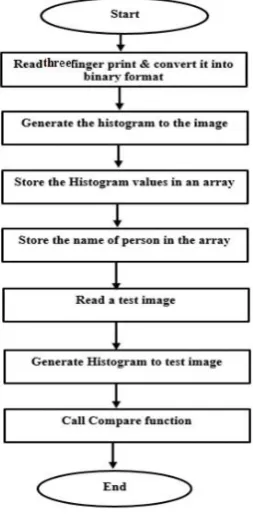
Fig 1. Fingerprint Authentication Process
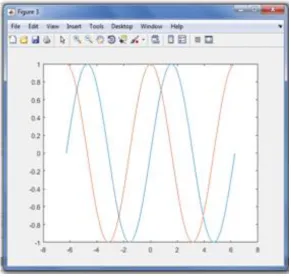
Enhancement and Comparing Histogram::
Fig 3. Image Comparison of Histogram
II. LITERATURE REVIEW
system is used to record the student data and the match is found it display and generate the result otherwise it is not match found. Fingerprint scanner is used widely the today‟s attendance system. It provides security. PadmaRekha [4] proposed the attendance is handled in every institution. In the old, the attendance is handled in written work. In this paper, to avoid the human work, the automatic process is maintained. The face recognition and face detection systems are used for this process. Image processing produced the output. Hitesh Walia [5] explained the finger print technologies are used for attendance system they are LabVIEW, GSM, ZigBee, Android, RFID, Net. For all these they comparative study of speed, security, power consumption, cost, portability, and functionality. Kamta Nath Mishra, [6] briefly told about the thumbprint based identification system used with the help of soft computing technique. The proposed system was tested fifty person‟s datasets and rotation and translation of the thumbprint. It finds the angles and direction of the thumbprint. Saumyarup [7] explained about the finger verification technique to display the match found otherwise no match found. It checks the fingerprint of the person‟s. Er Mohd Ahmed [8] explained about the cost effective and portable wireless system using ZigBee technology. The finger print is unique to each and every person in the world. To using the fingerprint and make the attendance system. It is cheap and cost effective. Gaddam Jyothi [9] briefly proposed about the RFID technology. The RFID technology is the one of recent technology used in the education as well as employment field. RFID technology keeps on creating, and the time has desired us to benefit ourselves of its guarantee and accommodation. The principle point of this examination has been to exhibit potential employments of RFID-innovation and fabricate a framework dependent on it. Fawzi. M. Al. Naima [10] the Radio Based Identification based student or employee attendance system. The record of student‟s attendance system is done by called out the roll number. It is waste of time. The new system is proposed, it will be applied the college environment to administrate the college, monitoring the environment. It gives the time and easy to control. It gives the accurate data of the students.
III. PROGRAM DESCRIPTION
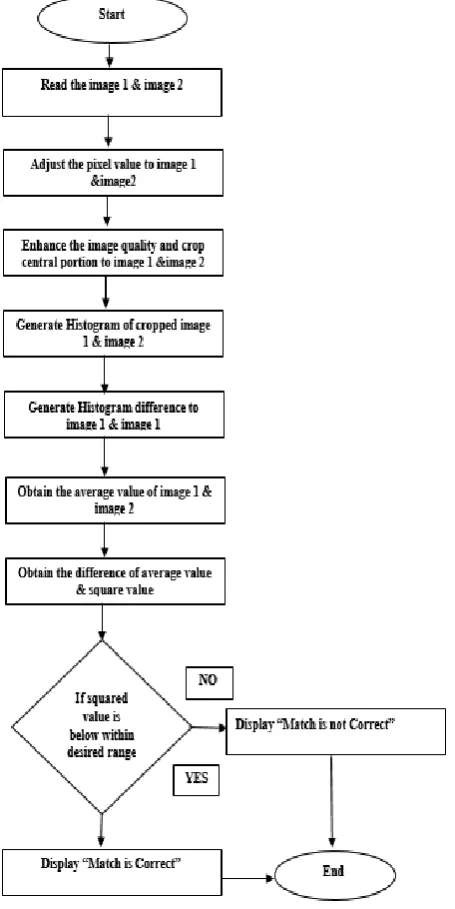
The program corresponding to this project work is done in Matlab-R2016. It is followed by four sections named A, B, C. The test program (A) reads three finger images. The first image is divided into two types image 1(a), image 1(b).These images are converted into binary format after which their histogram is applied and the values are stored in an array. Another array is created to store the name of the people already stored. Then the test image of the fingerprint is read and the histogram is applied to the test image. The program compares both functions and displays the difference between them. The program (B) detects the difference between two images and find the histogram error between them. The test image of the fingerprint was compared with all three images stored. When the match condition is checked its display „Match is correct‟ and show the name of the specified person. Then, the center portion of the two images is cropped and compared with the same program (A). The mean value is taken for the cropped images. The difference value of two mean is checked. The mean difference between two images is either positive or negative and the square value is proceeded for the two image. The compared image square value is within the desired range the match is correct otherwise not correct. The correct match is displayed.
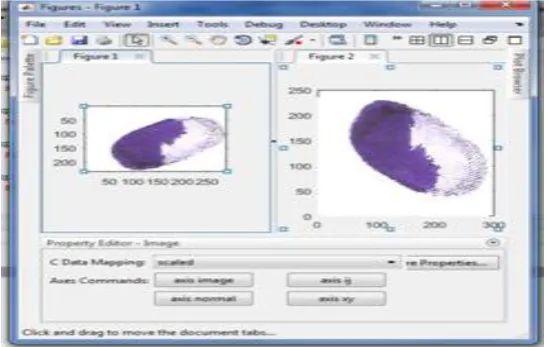
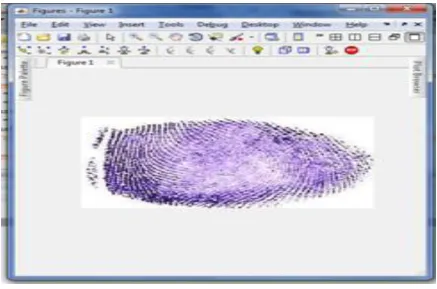
Figure 3.1 explains about the thumb impression of the single person
Fig 3.2.The rotation direction of the Image 1(a)
Fig 3.4. The rotation direction of the Image 1(b)
Figure 3.6 Thumb finger Image 2
Fig 3.8. Thumbprint of Image 3
Result from the Image Comparison with Tolerance Program
Result from the image comparison with the tolerance program is the mean difference of the two histogram image value is greater than the square value. So the value of histogram difference is less than the mean value. Finally the match is correct and it is display the match is correct and the squared value is within the range
.
Table 3.1 Histogram Values
Description Values
Mean difference of 2 image 0.1073
Square value of histogram difference 0.0115
Histogram Difference to the Image 1(a) and
Image 1(b) 9967820
IV. CONCLUSIONS
The efficiency and reliability of the automatic biometric identification system strongly relies on the threshold value set which is the difference between the mean of intensity of the image under test and the one evaluated and stored in database. Threshold settings with high precision and accuracy guarantee the quality of results. First, taken the three finger print image of the persons. The first image is divided into two types of images are converted into binary format after which their histogram is applied and the values are stored in an array. Another array is created to store the name of the people already stored.
Then the test image of the fingerprint is read and the histogram is applied to the test image. The program compares both functions and displays the difference between them. The next image 2 and image 3 can be find the same order and give the result simultaneously and so on. The program C detects the difference between two images and finds the histogram error between them. This program also takes up the mean values of the cropped images. The difference to the two means is found. As the mean difference could be either positive or negative, a squared value of the difference is generated. The detection technique is used for hardware interfacing in future.
REFERENCES
[1] Dr. Naik, P. G. and Patil, M. B, “BIOMETRIC DATA ANALYSIS OF STUDENT ATTENDANCE SYSTEM AT CSIBER”, International Journal of Current Research,8(2), 26751-26762, 2016.
[2] Mohit Bais, Deeksha Rawat, Prof. Gunjeet Kaur, “BIOMETRIC ATTENDANCE SYSTEM CIRCUIT”,
International Journal of Engineering Applied Science and Technology, 1(6), 19-199, 2016.
[3] Fathema A. Shaikh, Prof.S.O. Rajanakar, “BIOMETRIC AUTHENTICATION SYSTEM USING RPI”,
International Journal of Engineering Sciences & Research Technology, 5(4), 2016.
[4] P. Padma Rekha, D. Amudhan, V. Narendhiran, N. Pavithra, S. Ramya, “AUTOMATIC ATTENDANCE MONITORING SYSTEM”.
[5] Hitesh Walia, Neelu Jain, “Fingerprint Based Attendance Systems-A Review” International Research Journal of Engineering and Technology, 3(5), 1166-1171, 2016.
[6] Kamta Nath Mishra, Anupam Agarwal, “A Soft Computing Technique for Improving the fidelity of thumbprints Based Identification Systems”, I.J. Intelligent Systems and Applications, 7, 14-27, 2016.
[7] Saumyarup Rana, “ATTENDANCE MONITORING USING BIOMETRIC SENSOR”American Journal of
Electronics & Communication, 1, 26-29,2016.
[8] Er Mohd Ahmed, Qureshi Sualaheen Mohd Amin, Ansari Suhail Mohd Saeed & Shaikh Zind Parvaiz, “Cost Effective and Portable Wireless Fingerprint Device for Classroom Attendance Using ZigBee Technology”,
[9] Gaddan Jyothi, Kola Sridhar, Reddem, Ramakrishna Reddy, Gujjale Rakesh, K. Raveena, “Attendance Checking Framework for Online Understudies in Classroom Utilizing Radio Frequency Identification Technology”, International Journal of Innovative Technology and Research, 66-69, 2016.
[10] Fawzi M. Al-Naima, Hussain A. Ameen, “Design of an RFID Students/Employee Attendance System”,