Authentication Protocol
Masoumeh Safkhani1
, Nasour Bagheri2
and Majid Naderi1
1 Electrical Engineering Department, Iran University of Science and Technology,
Tehran, Iran.{M Safkhani,M Naderi}@iust.ac.ir 2
Electrical Engineering Department, Shahid Rajaee Teacher Training University, Tehran, [email protected]
Abstract. In this paper we consider the security of a PUF based RFID
Authentication protocol which has been recently proposed by Bassilet al.[2]. The designers have claimed that their protocol offers immunity against a broad range of attacks while it provides excellent performance. However, we prove in contrary to its designers claim, this protocol does not provide any security. We present an efficient secret disclosure at-tack which retrieves all secret parameters of the protocol. Given those secret parameters, it would be trivial to apply any other attack in the context on the protocol. However, to highlight other weaknesses of the protocol we present extra reader traceability, impersonation and desyn-chronization attacks that do not require disclosing the secret parameters necessarily. Success probability of all mentioned attacks is almost “1” while the complexity is at most two runs of protocol.
Keywords:RFID, Authentication, PUF, Traceability Attack, Reader Impersonation Attack, Tag impersonation Attack, Desynchronization At-tack.
1 Introduction
[12,16,18,20] and [24]. However, the later analysis demonstrated that it is not any easy task to design a secure protocol in this way [1,4,11,22,26–28]. On the other hand, some recent works attempted to employee Physically Unclonable Functions (PUF) to design ultralightweight authentication protocols [2, 14, 15].
A Physically Unclonable Function (PUF), is a piece of hardware that produces a signature, either based on the unique characteristics of a par-ticular instance alone, or in concert with a user defined input. Several different types of PUFs exist [10]. Common to all solutions is that they rely on the variation of delays in wires and gates that exist in all electronic devices. Furthermore, despite efforts to reduce this normally unwelcome feature, delays seem to increase with newer technology as IC designs are becoming smaller [9]. The reason why PUFs are so attractive in the secu-rity field is not only that they are cheap to implement, both monetarily and in hardware, they are also hard for an attacker to tamper with. If the attacker tries to evaluate the PUF or IC, e.g. using probes to measure wire delays, the characteristics of that particular PUF will be changed (per-haps forever), therefore it will not give the information that the attacker expected.
1.1 Overview of the Current Work
In this paper we consider the security of a PUF based RFID Authenti-cation protocol which has been recently proposed by Bassil, El-Beaino, Kayssi and Chehab [2] which we denote it in short by BEKC proto-col henceforth. They have claimed that the designed protoproto-col resists the known attacks despite of its excellent performance. However, in this paper we demonstrate that BEKC protocol does not provide resistance against secret disclosure attack, traceability attack, tag and reader impersonation attack and desynchronization attack.
Paper Organization :The notations used in the paper are presented in Section 2. BEKC protocol is described in Section 3. In Section 4, Sec-tion 5, SecSec-tion 6 and SecSec-tion 7 we present our secret disclosure attack, traceability attack, reader impersonation attack and desynchronization attack respectively. Finally, we conclude the paper in Section 8.
2 Preliminaries
• Ri: RFID reader i. • Ti: RFID tag i.
• P U F: Physically Uncloneable Function.
• SV Ti: The 96 bits secret value of Ti which is generated by a PUF embedded in Ti.
• SV Ri: The 96 bits secret value of Ri which is generated by a PUF embedded in Ti.
• Rotl(x, y): is a circular shift on the value ofxby (y mod 96) to the left. • Rotr(x, y): is a circular shift on the value of x by (y mod 96) to the
right.
• n1 and n2 : Two 96 bits random numbers generated by the reader.
• ⊕: The XOR operation.
• +: The bitwise OR operation. • A←B: Refers to assigningB toA.
3 Description of BEKC Protocol
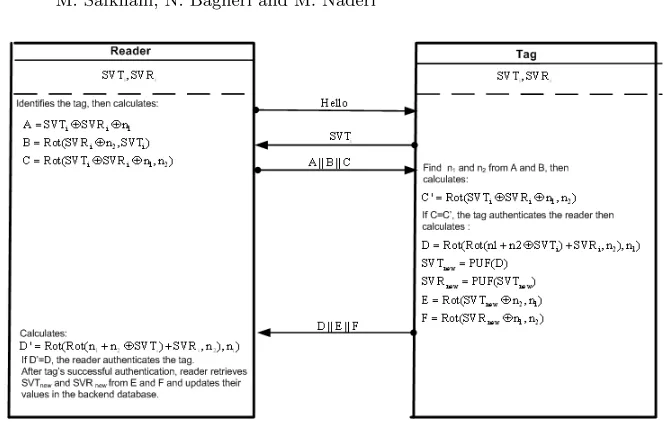
In BEKC protocol, a PUF is embedded inside each tag to produce the se-cret value of the tag,SV Ti, which is computed asSV Ti =P U F(challenge), wherechallengeis provided from an external source during an initializa-tion phase before deploying the tags. Hence, due to the nature of the PUF function, each tagTi will have a different secret value. Moreover, another secret value related to the reader,SV Ri, is stored in the tag which is com-puted as SV Ri=P U F(SV Ti). Therefore, each tag has a unique pair of
SV Ti and SV Ri stored in it initially. In addition, this pair is also stored in the back-end database. In BEKC protocol, which is depicted in Fig. 1, a reader Ri and a tagTi authenticates each other as follows:
1. Ri sends the ”Hello” message toTi.
2. On receiving the message,Ti responds with itsSV Ti.
3. OnceRireceipt the message, it will search for the entry corresponding toSV Ti in the back-end database. If there is no record for theSV Ti in the back-end database, a new request is sent byRi toTi, however, this timeTi replies with the old un-updatedSV Tito consider possible desynchronization between the reader and the tag. But if Ri finds a record for SV Ti in the back-end database, it generates two 96-bit random numbers n1 and n2, computes A = SV Ti ⊕SV Ri⊕n1,
B = Rotl(SV Ri+n2, SV Ti) and C = Rotl(SV Ti ⊕SV Ri⊕n1, n2) and sendsAkBkC toTi.
Fig. 1. BEKC Protocol.
SV Ri⊕n1, n2) and compares it with the received C. If C 6= C′ the tag will stop the authentication procedure, otherwise the reader is authenticated. Next, the tag computesD,EandF and updatesSV Ti and SV Ri and sends DkEkF to Ri. To calculate D, E and F and updateSV Ti and SV Ri, the tag does as follows:
D=Rotl(Rotl(n1+n2⊕SV Ti) +SV Ri, n2), n1)
SV Tnew=P U F(D)
SV Rnew =P U F(SV Tnew)
E =Rotl(SV Tnew⊕n2, n1)
F =Rotl(SV Rnew⊕n1, n2)
5. On receiving the message, Ri computes D′ = Rotl(Rotl(n1 +n2 ⊕
SV Ti) +SV Ri, n2), n1) and compares it with the receivedDto make sure that the tag was able to retrieve the correct random numbersn1 and n2. If D′ =D, Ri authenticates Ti as a legitimate tag, retrieves
4 Secret Disclosure Attack
In this section, we present an efficient secret disclosure attack which leads to disclose all secret values of the reader and the tag that participate in BEKC protocol. To disclose the secret values, the adversaryA can do as follows:
1. Aeavesdrops one successful run of protocol between tagTi and legit-imate reader Ri and stores the transferred values include SV Ti, A,
B,C,D,E and F where :
A=SV Ti⊕SV Ri⊕n1 (1)
B =Rotl(SV Ri+n2, SV Ti) (2)
C=Rotl(SV Ti⊕SV Ri⊕n1, n2) (3)
D=Rotl((Rotl(n1+n2⊕SV Ti) +SV Ri, n2), n1) (4)
SV Tnew =P U F(D) (5)
SV Rnew=P U F(SV Tnew) (6)
E =Rotl(SV Tnew⊕n2, n1) (7)
F =Rotl(SV Rnew⊕n1, n2) (8)
2. Asends a ”Hello” message toTiandTiresponds with its currentSV T which isSV Tnew in the above equations.
3. Adoes the following computations: (a) ∀ i= 0 . . . 95:
i. If Rotr(C, i) =A then returns iasn2 mode 96. (b) ∀ i= 0 . . . 95:
i. n1 mode 96←i ii. n′
2 ←(Rotr(E, n1))⊕SV Tnew iii. If n′
2 mode 96 =n2 mode96 then returns n′2 as n2.
(c) Given B, C and SV Ti from the eavesdropping phase of attack (Step 1) and n2 from step 3(b)iii, to eavesdrop SV Ri and n1, A does as follows:
i. SV Ri ←(Rotr(B, SV Ti))−n2 ii. n1 ←(Rotr(C, n2))⊕SV Ri⊕SV Ti
4. To confirm the correctness of the retrieved parameters, the returned
n2 from Step 3(b)iii and the returned n1 and SV Ri from Step 3c,A
An attacker which follows the above attack would be able to dis-close all secret values involved in the protocol, i.e., n1, n2, (SV Ri)old, (SV Ri)new, (SV Ri)old and (SV Ri)new. The success probability of our secret disclosure attack is ”1” and the complexity is only two runs of pro-tocol. It must be noted that at the end of the attack the current record of the back-end database for Ti is (SV Ri)new and (SV Ti)new and Ti holds (SV Ri)old, (SV Ti)old, (SV Ri)new, and (SV Ti)new.
It must be noted that since the adversary knows all secret parameters then it can easily do what attack it wants. For example it can impersonate the tag, impersonate the reader, desynchronize the tag and the reader, trace the tag and etc. However, to show other weaknesses of the protocol we present other attacks against the protocol in the rest of the paper.
5 Traceability Attack
BECK protocol’s designers have claimed that their protocol provides tag’s location privacy. They have stated since each tag have a unique PUF which is used to updateSV Ti andSV Ri and the reader uses two random numbersn1 and n2 in its responses, the tag responses in different run of protocol can not be linked and it is not possible to trace the tag. However, it is easy that as far as the tag has not updated its SV Ti and SV Ri it will return a sameSV Ti as response to the “Hello” command sent by the legitimate reader or the adversary. This property is enough to trace the tag between two successful runs of protocol. In addition, following the protocol decryption, tag keeps a record of (SV Ri)old and (SV Ti)old and if the reader repeats the “Hello” command, tag will reply with (SV Ti)old as a response to the second “Hello” sent by the reader. Hence, even after one successful run of the protocol the adversary would be able to trace the tag.
The adversary will fail in its attack if two tags comes up with the sameSV Ti. SinceSV Ti is assumed to be random, the success probability of the given traceability attacks are not less than (1−2−96
)2
while the complexities are at most two runs of protocol.
6 Reader Impersonation Attack
Bassil et al. claimed that their protocol resists against reader
in this section, we prove that this claim unfortunately does not hold. To impersonate the reader, an adversaryA can do as follows:
1. (Phase 1: Learning) A eavesdrops one successful run of protocol and storesSV Ti,A,B,C,D,E and F.
2. (Phase 2: Impersonation)To impersonate Ri,A does as follows:
(a) AsupplantsRi and starts another session of protocol and sends a “Hello” command to the tag and the tag responds with its updated value of SV Ti, (SV Ti)new.
(b) A sends again “Hello” command to the tag and the tag responds with its old value ofSV Ti,SV Ti.
(c) Asends the eavesdropped AkBkC toTi.
(d) OnceTi receipt the message, it employeesA andB to extract the random numbersn1 andn2. Then, it computesC′ =Rotl(SV Ti⊕
SV Ri⊕n1, n2)) and compares it with the receivedC. SinceC =C′ the tag authenticates Aas a legitimate reader.
The success probability of our reader impersonation attack is ”1” and the complexity is only two runs of BECK protocol.
7 Desynchronization Attack
BECK protocol’s designers have claimed that in their protocol desynchro-nization problem can be overcame by storing two sequential versions of
SV TiandSV Ri at the tag, one pair before the updating and the other af-ter the updating. In addition, they have mentioned that an explicit ACK may be sent by the reader to confirm the updating stage. However we show that their protocol suffers from explicit desynchronization attack. The given desynchronization attack is based on this fact that when in the last step of the protocolTi sendsDkEkF toRi,Riverifies the correctness of Dto authenticate the tag and ifD passes the verification successfully it also accept the received E and F to extract the new recodes of SV Ti andSV Rito be stored in the database. However, an active adversary can manipulate the transferred DkEkF and replace it by DkE′kF′ for some
E′ 6= E and F′ 6= F. Therefore, the reader retrieves different values for
8 Conclusion
In this paper we investigated the security of a PUF based RFID authen-tication protocol which recently has been proposed by Bassil et al. [2].
We have shown that, in contrary to its designers’ claims, this protocol does not provide resistance against secret disclosure attack, traceabil-ity attack, reader impersonation attack and desynchronization attacks. Success probability of all mentioned attacks is almost “1” while the com-plexity is at most two runs of protocol. This result shows that designing a secure lightweight protocol is not an easy task.
References
1. N. Bagheri, M. Safkhani, M. Naderi, and S. K. Sanadhya. Security Analysis of LM AP++
, an RFID Authentication Protocol. Cryptology ePrint Archive, Report 2011/193, 2011. http://eprint.iacr.org/.
2. R. Bassil, W. El-Beaino, A. Kayssi, and A. Chehab. A PUF-Based Ultra-Lightweight Mutual-Authentication RFID Protocol. In 6th International Con-ference on Internet Technology and Secured Transactions, 11–14 December 2011, Abu Dhabi, United Arab Emirates, pages 495–499, 2011.
3. M. Burmester, B. de Medeiros, J. Munilla, and A. Peinado. Secure EPC gen2 com-pliant radio frequency identification. In P. M. Ruiz and J. J. Garcia-Luna-Aceves, editors,ADHOC-NOW, volume 5793 ofLecture Notes in Computer Science, pages 227–240. Springer, 2009.
4. T. Cao, E. Bertino, and H. Lei. Security Analysis of the SASI Protocol. IEEE Transactions on Dependable and secure Computing, 6(1):73–77, 2009.
5. Y.-Y. Chen, M.-L. Tsai, and J.-K. Jan. The design of RFID access control pro-tocol using the strategy of indefinite-index and challenge -response. Computer Communication, 34(3):250–256, 2011.
6. H.-Y. Chien and C.-H. Chen. Mutual authentication protocol for RFID conform-ing to EPC Class 1 Generation 2 standards. Computer Standards & Interfaces, 29(2):254–259, 2007.
7. J.-S. Cho, S.-S. Yeo, and S. K. Kim. Securing against brute-force attack: A hash-based RFID mutual authentication protocol using a secret value. volume 34, pages 391–397, 2011.
8. E. Y. Choi, D. H. Lee, and J. I. Lim. Anti-cloning protocol suitable to EPCglobal class-1 generation-2 RFID systems.Computer Standards & Interfaces, 31(6):1124– 1130, 2009.
9. K. K. D. Chinnery. Closing the gap between asic and custom: An asic perspective. Inin Design Automation Conference, pages 637–642, 2000.
10. S. D. G. E. Suh. Physical unclonable functions for device authentication and secret key generation. Inin Design Automation Conference - DAC 2007, pages 495–499, 2007.
12. C. Hung-Yu. SASI: A New Ultralightweight RFID Authentication Protocol Provid-ing Strong Authentication and Strong Integrity.IEEE Transactions on Dependable and Secure Computing, 4(4):337–340, December 2007.
13. G. Jin, E. Y. Jeong, H.-Y. Jung, and K. D. Lee. RFID authentication protocol conforming to EPC class-1 generation-2 standard. In H. R. Arabnia and K. Daimi, editors,Security and Management, pages 227–231. CSREA Press, 2009.
14. L. Kulseng, Z. Yu, Y. Wei, and Y. Guan. Lightweight Mutual Authentication and Ownership Transfer for RFID systems. In The proceedings of IEEE INFOCOM 2010, pages 1–5, March 2010.
15. Y. S. Lee, Y. Park, S. Lee, T. Kim, and H. J. Lee. Rfid mutual authentication protocol with unclonable rfid-tags. InICMIC, pages 74–77, 2011.
16. T. Li. Employing Lightweight Primitives on Low-Cost RFID Tags for Authenti-cation. InVTC Fall, pages 1–5. IEEE, 2008.
17. N.-W. Lo and K.-H. Yeh. An efficient mutual authentication scheme for EPCglobal class-1 generation-2 RFID system. In M. K. Denko, C.-S. Shih, K.-C. Li, S.-L. Tsao, Q.-A. Zeng, S.-H. Park, Y.-B. Ko, S.-H. Hung, and J. H. Park, editors, EUC Workshops, volume 4809 ofLecture Notes in Computer Science, pages 43–56. Springer, 2007.
18. P. Peris-Lopez, J. C. H. Castro, J. M. Est´evez-Tapiador, and A. Ribagorda. LMAP:A Real Lightweight Mutual Authentication Protocol for Low cost RFID tags. InRFIDSec, 2006.
19. P. Peris-Lopez, J. C. H. Castro, J. M. Est´evez-Tapiador, and A. Ribagorda. M2ap: A minimalist mutual-authentication protocol for low-cost rfid tags. In J. Ma, H. Jin, L. T. Yang, and J. J. P. Tsai, editors,Ubiquitous Intelligence and Comput-ing, Third International Conference, volume 4159 of Lecture Notes in Computer Science, pages 912–923. Springer, 2006.
20. P. Peris-Lopez, J. C. H. Castro, J. M. Est´evez-Tapiador, and A. Ribagorda. Ad-vances in Ultralightweight Cryptography for Low-Cost RFID Tags: Gossamer Pro-tocol. In K.-I. Chung, K. Sohn, and M. Yung, editors, WISA, volume 5379 of LNCS, pages 56–68. Springer, 2008.
21. P. Peris-Lopez, J. C. Hernandez-Castro, J. M. Estevez-Tapiador, and A. Ribagorda. EMAP: An Efficient Mutual Authentication Protocol for Low-Cost RFID Tags. In OTM Federated Conferences and Workshop: IS Workshop – IS’06, volume 4277 of LNCS, pages 352–361, Montpellier, France, November 2006. Springer-Verlag. 22. R. C.-W. Phan. Cryptanalysis of a New Ultralightweight RFID
Authentica-tion Protocol - SASI. IEEE Transactions on Dependable and Secure Computing, 6(4):316–320, 2009.
23. Y. W. Q Cai, Y Zhan. A minimalist mutual authentication protocol for rfid sys-tem and ban logic analysis[c]. InIn Proceedings of the 2008 ISECS International Colloquium on Computing, Communication, Control, and Management, volume 2, page 449453, 2008.
24. A. Sadighian and R. Jalili. FLMAP: A Fast Lightweight Mutual Authentication Protocol for RFID Systems. InThe 16th IEEE International Conference On Net-works (ICON 2008), pages 1–6, New Delhi, India, 2008.
25. A. Sadighian and R. Jalili. AFMAP: Anonymous Forward-Secure Mutual Authen-tication Protocols for RFID systems. InThe Third IEEE International Confer-ence on Emerging Security Information, Systems and Technologies(SECURWARE 2009), pages 31–36, Athens, Greece, 2009.
Internet Technology and Secured Transactions (ICITST 2011), Abu Dhabi, UAE, Dec. 2011.
27. M. Safkhani and M. Naderi. Cryptanalysis and Improvement of a Lightweight Mutual Authentication Protocol for RFID system. In 7th
International ISC Con-ference on Information Security and Cryptology 2010(ISCISC’10), pages 57–59, 2010.
28. M. Safkhani, M. Naderi, and H. F.Rashvand. Cryptanalysis of the Fast Lightweight Mutual Authentication Protocol (FLMAP). International Journal of Computer& Communication Technology (IJCCT), 2(2,3,4):182–186, 2010.
29. J. Shen, D. Choi, S. Moh, and I. Chung. A Novel Anonymous RFID Authentication Protocol Providing Strong Privacy and Security. In2010 International Conference on Multimedia Information Networking and Security, 2010.
30. B. Song and C. J. Mitchell. RFID Authentication Protocol for Low-cost Tags. In WiSec’ 08, pages 140–147, 2008.
31. B. Song and C. J. Mitchell. Scalable RFID security protocols supporting tag ownership transfer. Computer Communications, 34(4):556–566, 2011.
32. H.-M. Sun and W.-C. Ting. A Gen2-Based RFID Authentication Protocol for Security and Privacy. IEEE Transactions On Mobile Computing, 8(8):1052–1062, 2009.
33. C. C. Tan, B. Sheng, and Q. Li. Secure and Serverless RFID Authentication and Search Protocols. IEEE Transactions on Wireless Communications, 7(4):1400– 1407, 2008.
34. R. Xueping and X. Xianghua. A Mutual Authentication Protocol For Low-cost RFID System. In2010 IEEE Asia-Pacific Services Computing Conference, pages 632–636, 2010.
35. W. W. Y. Gu. A light-weight mutual authentication protocol for ISO 18000-6B standard RFID system . InProceedings of ICCTA 2009, pages 21–25, 2009. 36. T.-C. Yeh, C.-H. Wu, and Y.-M. Tseng. Improvement of the RFID Authentication