Abstract
Objectives: We sought to identify the proportion of systematic reviews of adverse effects which search for unpublished data and the success rates of identifying unpublished data for inclusion in a systematic review.
Study Design and Setting: Two reviewers independentlyscreened all records published in 2014 in the Database of Abstracts of Reviews of Effects (DARE) for systematic reviews where the primary aim was to evaluate an adverse effect or effects. Data were extracted on the types of adverse effects and interventions evaluated, sources searched, how many unpublished studies were included and source or type of unpublished data included.
Results: From 9129 DARE abstracts, 348 met our inclusion criteria. Most of these reviews evaluated a drug intervention (237/348, 68%) with specified adverse effects (250/348, 72%). Over a third (136/348, 39%) of all the reviews searched a specific source for unpublished data, such as conference abstracts or trial registries and nearly half of these reviews (65/136, 48%) included unpublished data. An additional 13 reviews included unpublished data despite not searching specific sources for unpublished studies. Overall, 22% (78/348) of reviews included unpublished data/studies.
Conclusion: The majority of reviews of adverse effects do not search specifically for unpublished data but, of those that do, nearly half are successful.
Keywords: Adverse effects, systematic review, unpublished data, grey literature, trial
registry, information retrieval
What is new?
39% of systematic reviews of adverse effects specifically search for unpublished data 22% of systematic reviews of adverse effects include unpublished data
The most popular sources searched for unpublished data are conference scanning/databases, contacting authors or searching ClinicalTrials.gov
The success rate of searching in specific sources for unpublished data ranged from 0% to 39% with contacting authors and conference abstract searches being most
successful.
We need more research into the most effective sources for searching for unpublished data
Most systematic reviews of adverse effects do not include unpublished
data
Introduction
incomplete if they rely on peer reviewed journal publications alone, or if the reviewers conduct only a relatively limited search for unpublished sources.
A consensus on a clear definition of ‘published’ and ‘unpublished’ data is difficult to reach. For practical reasons, and to maintain consistency with our previous research work,(10) ‘published’ will refer to peer reviewed journal articles and ‘unpublished’ data will refer to all other material. It is acknowledged, however, that unpublished data can be publically available (for example, through web registries or regulatory agencies)) but these do not undergo the processes of peer-reviewing, editing, formatting and document identification that are part and parcel of established journal publications.
Serious concerns have emerged regarding publication bias or selective omission of outcomes data whereby negative results are less likely to be published than positive results and where adverse effects are underreported (11). One way to attempt to overcome these biases is to include unpublished studies or data. Current guidance for all types of systematic reviews (irrespective of outcome) recommends searching unpublished sources (12-14) such as contacting authors or manufacturers, seeking conference abstracts and searching trial registries (including industry trial registries). For reviews of adverse effects the Cochrane Handbook also recommends searching regulatory authorities websites such as the US Food and Drug Administration (FDA), the Medicines & Healthcare products Regulatory Agency (MHRA) and the European Medicines Agency (EMA)(12). Such guidance may have led to more systematic reviewers searching for unpublished data.
Nevertheless, previous research of systematic reviews of adverse effects from 1994 to 2011 has indicated that, few attempts are made to search for unpublished data or industry funded data (10, 15). This may be due to an expected low return or the difficulties of searching for unpublished data or in obtaining and incorporating unpublished data into systematic reviews (16) or a concern that unpublished data is not peer reviewed. In addition, it is unknown whether this situation is improving.
In contrast, research has indicated that much of the data on adverse effects are unpublished accounting for between 43%-100% of the number of adverse effects and also a wider range of types of adverse effects are reported in the unpublished literature (9, 17-25). A
considerable amount of otherwise ‘missing’ adverse effects data therefore may potentially be retrieved from a diverse range of other sources such as trial registries, regulatory agencies or authors. This has particularly important implications for evaluations of adverse effects because conclusions based on only published studies may not present a true picture of the adverse effects.
A lack of searching for and identification of unpublished data may pose serious threats to the validity of systematic reviews of adverse effects. Yet little is known as to whether 1)
systematic reviewers fail to search for unpublished data or 2) whether they fail to identify unpublished data when they search and 3) which data sources are most fruitful for searching for unpublished data. Hence, we aimed to estimate the extent to which unpublished data is sought and identified within systematic reviews of adverse effects by carrying out a retrospective analysis of systematic reviews published in 2014.
Methods
Search strategy
Systematic reviews of adverse effects were identified by screening all records published in
2014 in the Database of Abstracts of Reviews of Effects (DARE) (via the Centre for Reviews and Dissemination (CRD) website, April 2015). No search strategy was implemented, as previous research has indicated that even very broad search strings would missrelevant records (26). The DARE database was chosen because it was the most accessible major collection of systematic reviews of healthcare interventions. DARE was compiled through rigorous monthly searches of bibliographic databases, including MEDLINE and EMBASE, as well as handsearching of key journals, grey literature, and regular searches of the Internet. It also contains all Cochrane reviews, both new and updated. DARE ceased production in March 2015 but continues to be available in archive format.
Inclusion/exclusion criteria
A review was included if the primary aim was to evaluate an adverse effect or effects, known to be, or suspected to be, associated with an intervention, regardless of whether the review author's hypothesis or conclusions stated that the intervention increased the outcome. Articles that investigated the complete safety profile of an intervention were included if this was their primary aim. The author and another researcher independently screened titles and abstracts and selected full articles for inclusion. Any discrepancies between the researchers were resolved by discussion and consensus.
Data extraction
Pre-defined descriptive data on review methodology were abstracted using a standardised form created in Microsoft Access 2010. For each review, baseline data were collected on: the types of intervention (for example, drug intervention, diagnostic procedure or surgical
technique); and the type of adverse effects evaluated (for example, pre-specified named adverse effects or generic adverse effects).
Details were extracted on how information on adverse effects was retrieved by the authors of the reviews, namely:
Which bibliographic databases were searched, for example, MEDLINE or Embase. Other sources of information consulted or additional approaches to information
gathering employed, for example, reference checking, handsearching, or contacting authors.
Whether any sources specifically containing only unpublished data were searched such as conference abstracts or trial registries.
Whether any sources that contain some unpublished references in addition to published articles were searched, such as Embase (which contains conference abstracts in addition to published journal articles), Cochrane CENTRAL (which contains records identified from multiple sources including conferences,
handsearching and contacting experts as well as records from MEDLINE and
Embase) or reference lists from published articles (which can be compiled by multiple methods).
In addition we extracted data on whether unpublished data were included in the systematic review and if so
How many included references were unpublished and what proportion of the total number of included references this represented.
What type of unpublished data were included (such as conference abstracts, trial registry data, or data from manufacturers or authors).
Where indicated by the review authors we also extracted the source of each unpublished study.
We checked the abstract, figures (particularly the flow diagrams), appendices and reference lists of the systematic reviews as well as the full text for an explanation as to the sources searched and the publication status of included studies.
Analysis
Data were categorized and a descriptive summary presented. Although our primary aim was to assess the level of unpublished data searched for and used in systematic reviews of adverse effects, we could also analyse some time trends with respect to the sources searched. The results were compared, where possible, with a previous survey on the retrieval of
information for systematic reviews of adverse effects (27, 28). In the previous survey, data were collected on a range of aspects related to the retrieval of information including the sources/databases searched. Similar methods were used in the previous survey as the current survey including the same Access database, same definition of published versus unpublished, and the same authors conducting the data extraction. This comparison may give some
indication as to whether specific sources for unpublished data are increasingly searched in systematic reviews of adverse effects.
Results
From 9129 DARE abstracts screened, 451 full reports were retrieved and 348 reviews met the inclusion criteria. Overall 4% (348/9129) of reviews in DARE with a publication date of 2014 focused on adverse effects.
Scope of adverse effects evaluation
The majority of the reviews concentrate on pre-specified adverse effect outcomes (such as thrombosis or stroke) (198/348, 57%) or a pre-specified class of effects (such as
gastrointestinal or cardiovascular) (52/348, 15%), rather than analysing all potential adverse effects for a given intervention (98/348, 28%).
Types of interventions studied
The included reviews are predominantly those evaluating the adverse effects of drugs (237/348, 68%) followed by those evaluating surgical or dental procedures (83/348, 24%). Only a few studies (31/348, 9%) examine physical or device interventions, such as
acupuncture, tai chi or hearing aids, and fewer still examine diagnostic/screening
interventions (6/348, 2%) (some reviews evaluate more than one type of intervention). The most common interventions studied are, corticosteroids (11 reviews), statins (9 reviews), and non-steroidal anti-inflammatory drugs (NSAIDs) (6 reviews).
Bibliographic databases and other sources searched
Nearly all of the reviews (345/348, 99%) list the resources used to identify the primary studies for the review. Only three reviews do not report on the search methods used.
The median number of bibliographic databases searched is three (range 1 to 16). 24/348 reviews (7%) search one database and in all but one case this is MEDLINE. Around a quarter
of the reviews search two or fewer bibliographic databases (91/348, 26%). A previous survey of reviews published from 1994 to 2011 found that 20% of reviews of adverse effects search one database and that 43% searched two or fewer bibliographic databases (27, 28) . This indicates a trend towards fewer reviews restricting their search to a small number of bibliographic databases. In the current survey (as with the previous survey) the most
frequently searched database is MEDLINE (342/348, 98%), followed by Embase (235/348, 68%).
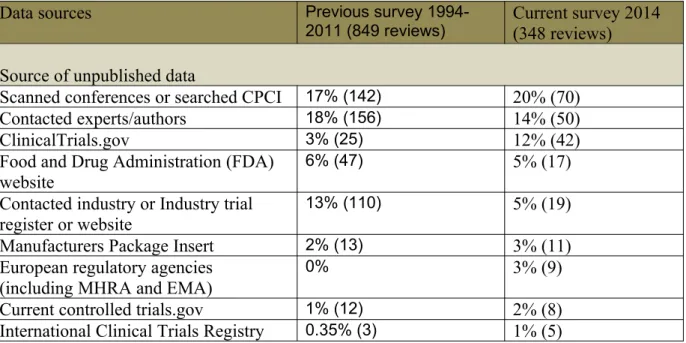
Many reviews report searching at least one source other than bibliographic databases. The median number of other sources searched is one (range 0 to 5). Reference lists are by far the most popular non-database resource (268/348, 77%) (Table 1).
Searching for unpublished data
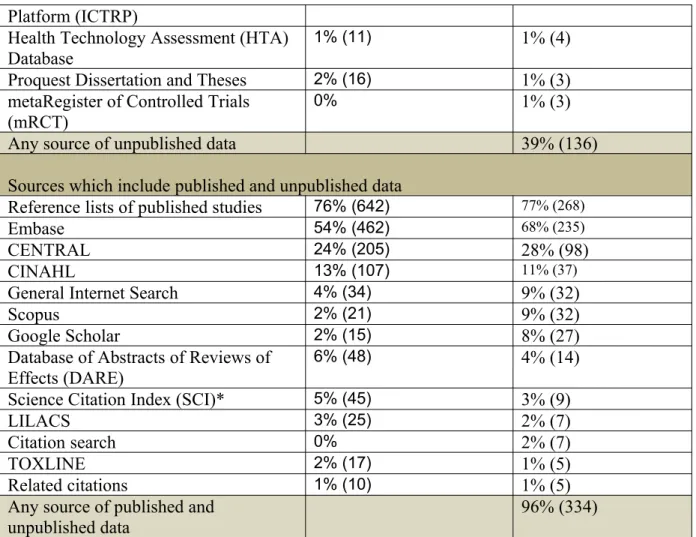
Over a third (136/348, 39%) of all the reviews searched at least one specific source for unpublished data, such as conference databases or trial registries (Table 1). Table 1 also compares the percentage of reviews that search each data source and demonstrates that many unpublished sources have not increased in popularity for systematic reviewers of adverse effects with the exception of ClinicalTrials.gov (3% to 12%) and conference abstract searches (17% to 20%). In fact some sources of unpublished data have decreased in popularity
including contacting authors (18% to 14%) and industry/industry trial registers (13% to 5%).
The majority of the reviews (334/348, 96%) searched at least one source that contained unpublished data in addition to published journal articles. These sources included databases such as CENTRAL, Embase, or Google Scholar (Table 1). Only four reviews limited their search to sources which contained no unpublished data whatsoever. Six reviews only search specific sources of unpublished data (such as ClinicalTrials.gov or conference sources) and three reviews do not report on the sources searched. Within those sources which contain both published and unpublished data the Internet (4% to 9%), Google Scholar (2% to 8%), Scopus (2% to 9%) and Embase (54% to 68%) are becoming increasingly popular sources to search (Table 1).
Table 1: Sources with unpublished data searched compared to previous survey
Data sources Previous survey
1994-2011 (849 reviews) Current survey 2014 (348 reviews)
Source of unpublished data
Scanned conferences or searched CPCI 17% (142) 20% (70)
Contacted experts/authors 18% (156) 14% (50)
ClinicalTrials.gov 3% (25) 12% (42)
Food and Drug Administration (FDA) website
6% (47) 5% (17)
Contacted industry or Industry trial register or website
13% (110) 5% (19)
Manufacturers Package Insert 2% (13) 3% (11)
European regulatory agencies (including MHRA and EMA)
0% 3% (9)
Platform (ICTRP)
Health Technology Assessment (HTA) Database
1% (11) 1% (4)
Proquest Dissertation and Theses 2% (16) 1% (3) metaRegister of Controlled Trials
(mRCT)
0% 1% (3)
Any source of unpublished data 39% (136)
Sources which include published and unpublished data
Reference lists of published studies 76% (642) 77% (268)
Embase 54% (462) 68% (235)
CENTRAL 24% (205) 28% (98)
CINAHL 13% (107) 11% (37)
General Internet Search 4% (34) 9% (32)
Scopus 2% (21) 9% (32)
Google Scholar 2% (15) 8% (27)
Database of Abstracts of Reviews of Effects (DARE)
6% (48) 4% (14)
Science Citation Index (SCI)* 5% (45) 3% (9)
LILACS 3% (25) 2% (7)
Citation search 0% 2% (7)
TOXLINE 2% (17) 1% (5)
Related citations 1% (10) 1% (5)
Any source of published and unpublished data
96% (334)
NB Sources searched in three reviews or fewer in the current survey are excluded.
*Science Citation Index is likely to be search in more reviews as it is often referred to as Web of Science
Inclusion of unpublished data
Whilst 78 reviews (22%) include studies that are unpublished or make use of unpublished data in their analysis, 258 reviews (74%) include only published articles from peer-reviewed journals and 12 reviews (3%) do not list or describe the included studies (Figure 1). Of the different types of interventions, drug intervention reviews are most likely to include unpublished data with 28% of all drug intervention reviews including unpublished data (Table 2). This is followed by reviews of physical or device interventions (13%) and reviews of surgical or dental procedures (10%) (Table 2).
Table 2: Types of interventions studied and inclusion of unpublished data
Type of intervention and
number of reviews Includes unpublished data (n=78) Includes only peer-reviewed journal articles (n=258)
Included studies not reported (n=12) Drug interventions
(n=237)
28% (67) 68% (161) 4% (9)
Surgical or dental
procedures (n=83) 10% (8) 87% (72) 4% (3)
Physical or device 13% (4) 81% (25) 6% (2)
interventions (n=31) Diagnostic/screening interventions (n=6)
0 (0%) 100% (6) 0 (0%)
Other (n=8) 0 (0%) 100% (8) 0 (0%)
NB: Many reviews included more than one type of intervention
Number of unpublished studies or data included
Figure 1: Flow diagram of systematic reviews
8 Systematic review
records sifted in DARE (n=9129)
Full systematic reviews ordered (n=451)
Systematic reviews of adverse effect(s) included (n=348)
No details of
included studies (n=7) Included only
peer reviewed journal articles (n=66)
Included unpublished data (n=65)
Without corresponding publication (n=51) With
corresponding publication (n=24)
Without corresponding publication (n=13) With
corresponding publication (n=0)
Included unpublished data (n=13) Included only
peer reviewed journal articles (n=192)
No details of
included studies (n=5) Searched specific
source for unpublished data (n=136)
Reviews including unpublished studies (without corresponding publications)
Within the 64 reviews which included at least one unpublished study (without a
corresponding publication), the number of unpublished studies included in each review varied from 1 to 56 studies with a median of 2 (mean of 5). The total number of included studies in each of the 64 reviews varied from 5 to 157 studies with a median of 23 (mean of 29). As we had the numbers of both the included unpublished studies and the total number of studies included, we could calculate the percentage of included papers in each review that were unpublished. A median of 13% (mean of 17%) of the included studies in each review were unpublished (range 1% to 100%).
The types of unpublished studies included in the reviews varied. Many reviews included more than one unpublished study from the same source. The highest number of unpublished records included in total from the reviews were from ClinicalTrials.gov, followed by
conference journal abstracts and conference proceedings (Figure 2).
Figure 2: Number of included unpublished studies from each source
Clin icalTr ials.g ov Conf eren
ce jo urna
l arti cle
Conf eren
ce p roce
edin g
Indu stry r
egist ers (
e.g.G SK) Thes is/di sser tatio n Uncle ar Othe r reg
istry datab
ase FDA/ EMA webs ite Indu stry c
onta ct Pers onal cont act Pres s rele
ase 0 20 40 60 80 100 120 140 160
Unpublished Data (in addition to published data)
additional unpublished data from more than one source).
Success rates of searching for unpublished data
Overall of the 136 reviews that specifically searched for unpublished data, 65 included unpublished data, 66 included only peer reviewed journal articles and 5 did not give any details of the included studies. This indicates a successful search rate of nearly half (48%, 65/136). However, the majority of reviews that searched for unpublished data used more than one source and each source had a varying success rate.
Where possible the source of the unpublished studies or data were recorded. Table 3 indicates that the most successful sources for unpublished data are scanning conferences (36%), Proquest Dissertation and Theses (33%) (based on only 3 reviews), contacting
experts/authors (31%), ClinicalTrials.gov (29%) and the US Food and Drug Administration (FDA) website (29%). Many of these figures, however, will be under estimates as not all the reviews indicated where the included studies were obtained.
Table 3: Success rates of searching individual sources
Source and number of reviews Identified unpublished data for inclusion from source*
Contacted experts/authors (n=50) 39% (19) Scanned conferences or searched CPCI (n=70) 36% (25) Proquest Dissertation and Theses (n=3) 33% (1)
ClinicalTrials.gov (n=42) 29% (12)
Food and Drug Administration (FDA) (n=17) 29% (5) Industry trial register or website or contacted
industry (n=15) 20% (3)
International Clinical Trials Registry Platform
(ICTRP) (n=5) 20% (1)
Current controlled trials.gov (n=8) 13% (1) European regulatory agencies (including MHRA
and EMA) (n=9)
11% (1)
Health Technology Assessment (HTA) Database (n=4)
0 (0%)
Manufacturers Package Insert (n=11) 0 (0%) metaRegister of Controlled Trials (mRCT) (n=3) 0 (0%) Any review that searched a specific unpublished
data source (n=136)
48% (65)
*Likely to be underestimated as not always clear where included studies identified.
Whilst 65 of the 136 reviews which searched specifically for unpublished data included unpublished data, in total 78 reviews included unpublished data. There were therefore 13 reviews which included unpublished studies in their analysis but did not report searching a specific source of unpublished data. These 13 reviews may not have reported their searches fully or may have identified unpublished data from sources which are not specific to
unpublished data (e.g. checking reference lists). In actuality, of these 13 reviews, 9 included conference abstracts (identified from reference checking, Google Scholar and CENTRAL or source not reported), one a dissertation (source not reported), one a record from
ClinicalTrials.gov (source not reported but does not state that ClinicalTrials.gov was
searched) and one a record from current controlled trials.com (again source not reported and does not state that Current Controlled Trials.com was searched). For the majority of the 13 reviews, therefore, it was not stated where the included unpublished studies were obtained but it is likely that deficiencies in the reporting of searches are leading to the underreporting of unpublished data sources searched.
Limitations
The number of reviews searching for or including unpublished data can only be estimated in this study due to poor reporting in the systematic reviews. For instance, few reviewers stated the results of contacting authors or industry and whether further data were obtained and at least two reviews searched unpublished data sources (ClinicalTrials.gov and current controlled trials.com) without listing these sources in the methods section.
There is also a tendency to search the traditional bibliographic databases such as MEDLINE and Embase first. There may have been instances, therefore, where although no new studies were identified from searching data sources such as ClinicalTrials.gov, scanning conferences or reference checking, the same studies were identified. In these instances the duplicate studies may not have been recorded.
In addition, unpublished data may have contributed to the review by providing information on ongoing studies, useful background information or by informing the search process. The value of unpublished data to the systematic review overall, however, was not measurable.
Discussion
39% (136/348) of systematic reviews of adverse effects published in 2014 searched at least one source of unpublished studies (such as conference abstract databases or trial registries). Encouragingly nearly half of these reviews (65/136, 48%) were successful in identifying and including an unpublished study or unpublished data.
The overall proportion of all systematic reviews of adverse effects including unpublished data or studies, however, remains low at just over a fifth (22%, 78/348). This is due to a
combination of reviewers not searching for unpublished data and searches being unsuccessful.
The number of systematic reviews assessing harms has been growing rapidly over the past five years. The Database of Abstracts of Reviews of Effects (DARE) includes 104 reviews of adverse effects published in 2010 and 348 in 2014.(26) However, this increase is in line with the overall trend of numbers of systematic reviews being published, such that the proportion of total reviews of adverse effects from DARE has remained relatively stable.
Overall there has been an increase in 2014 in those systematic reviews of adverse effects focusing on non-drug interventions as compared to reviews published between 1994 and 2011. The proportion of reviews which examined surgical or dental procedures rose from 13% to 24%, those examining physical interventions rose from 7% to 9%, and diagnostic or screening interventions rose from 1% to 2%.
between 1994 and 2010. In particular, searching of Embase (54% to 67%), ClincialTrials.Gov (3% to 11%) and the Google Scholar (2% to 8%) or a general Internet search (0% to 9%) have all risen.
It is encouraging to note that, in line with current guidance (12-14) , some systematic reviewers are increasingly searching more widely to include unpublished sources, such as conferences, and trial registries. However, the proportion of reviews conducting specifc searches for unpublished data (39%) or including unpublished data remains low (22%) and worryingly the use of some sources for unpublished data such as industry and authors has declined. While we have used a very inclusive definition of ‘unpublished’ if a narrower definition were adopted (such as not in the public domain) then the proportion of reviews including unpublished data would have been much smaller at 19/348 (5%). In addition some reviews still have inclusion criteria that purposefully excludes unpublished material such as the requirement that the study needs to be published in peer-review journal or to not be a conference abstract. This is despite empirical data suggesting that conclusions of systematic reviews can change when unpublished data are used. A classic example is the review of reboxetine, where publication bias has been clearly demonstrated (29, 30)
Although some systematic reviewers in this cohort contacted manufacturers, the decline in reviewers contacting manufacturers is of great concern and requires research into the reasons. This may ironically be a result of the recent publicity on the difficulties experienced by reviewers when attempting to obtain unpublished data from manufacturers (31) and the very long delays before a response is received (32), or with such small numbers may not be an overall trend.
Clinical Study Reports (CSRs) are increasingly being discussed as an important source of data for adverse events in systematic reviews that are not available elsewhere (including published articles or publically available unpublished studies) (20, 33-36). Starting from September 2016 the European Medicines Agency (EMA) intends to provide access to clinical trial data - 60 days after a decision on an application for approval of a new drug has been made. Access will be made available via the EMA website, either on screen after a registration process or will be downloadable for identified users without the need for Freedom of Information requests. The changes at the EMA will certainly make it easier for systematic reviewers to access data on clinical trials carried out by pharmaceutical
companies. This could lead to a major change in the sources used in systematic reviews of drug interventions, making systematic reviews less prone to publication and reporting bias (37). None of the 348 reviews in the current study reported using Clinical Study Reports (CSRs), even though 237 included drug interventions.
We recognize that systematic reviewers may face constraints on time or resources, and there may be an additional burden in searching for unpublished sources. Doshi and Jefferson reported that whilst half of their Freedom of Information requests to the European Medicines Agency (EMA) were fulfilled within 9 weeks, the remaining half took between 15 and 58 weeks before receipt of any data (32). The authors also remarked on the substantial amount of correspondence engaged with the regulators, particularly because of the absence of a publicly available or searchable list of holdings according to drug compounds. There may be similar delays in obtaining data from industry sponsors, with complaints regarding opacity of the process and lack of clear transparent criteria for granting or withholding access (31). Although access to clinical data from the EMA is set to change, at the time these reviews were conducted it was far easier for systematic reviewers to access trial registries (such as
clinicaltrials.gov) or regulatory authority websites, but major limitations include the lack of indexing terms or systematic, validated search strategies, as well as the potentially low yield because only 13.4% of trials report results within a year of study completion (38).
Overall, of those reviews which searched specifically for unpublished data just under 50% were able to subsequently include additional data. This suggests that the exercise may not be entirely fruitless, and the benefits of searching for unpublished adverse effects data
potentially outweighs the time or costs involved. However, there appears to be wide variation between the sources searched. In particular, scanning conferences, contacting authors, searching trial registries, searching the FDA website appears most fruitful in terms of identifying at least one relevant study whereas scanning conferences and searching ClinicalTrials.gov appears most fruitful in terms of identifying a larger volume of records (Figure 2)
The disappointingly low proportion of reviews including unpublished data may be a result of a combination of limited search approaches and variable success rates of searching. Further research examining the success rates of exhaustive searching for unpublished data would be useful to ascertain whether important data could be found and if so where. There needs to be a new focus on developing access to unpublished adverse effects data, rather than the current restrictive model. Ease of access to adverse effects data and greater transparency of reporting will help reviewers move away from complicated, onerous searches that have an
uncomfortably low yield. This will encourage systematic reviewers to search more widely as guidance suggests.
Overall the current situation within systematic reviews of adverse effects could be
substantially improved. One way to achieve this would be to reduce the barriers and improve accessibility to unpublished data. Another would be to ensure that trial registries have
updated results summaries, unlike the current situation where results are not made available despite completion of the trial (38-41). In addition, systematic reviewers need guidance and training on the most effective means to access unpublished data and the most useful data sources in terms of yield.
Conclusions
The majority of reviews of adverse effects do not search specifically for unpublished data but, of those that do, nearly half are successful. Given the potential for publication and outcome reporting bias, easier access and greater transparency in reporting of adverse effects data is urgently required, and more reviews should make efforts to identify such unpublished data.
We also need detailed guidance on the most useful sources to search for unpublished adverse effects data. Further research, therefore, to uncover the most successful sources of
unpublished data should be a priority.
References
2. Hodkinson A, Kirkham JJ, Tudur-Smith C, Gamble C. Reporting of harms data in RCTs: a systematic review of empirical assessments against the CONSORT harms extension. BMJ Open. 2013;3(9):e003436.
3. Anderson PA, Hart RA. Adverse events recording and reporting in clinical trials of cervical total disk replacement. Instr Course Lect. 2014;63:287-96.
4. Haidich AB, Birtsou C, Dardavessis T, Tirodimos I, Arvanitidou M. The quality of safety reporting in trials is still suboptimal: survey of major general medical journals. J Clin Epidemiol. 2011;64(2):124-35.
5. Hussein HM, Baybutt TR, Zhou JY, Divani AA, Qureshi AI. The quality of adverse event reporting in drug-related hemorrhagic stroke trials from the stroke trials registry. Stroke. 2007;38(2):543-.
6. Liebeskind DS, Kidwell CS, Sayre JW, Saver JL. Evidence of publication bias in reporting acute stroke clinical trials. Neurology [Internet]. 2006 [cited x o]; 67(6):[973-9 pp.]. Available from: http://onlinelibrary.wiley.com/o/cochrane/clcmr/articles/CMR-10965/
frame.html.
7. Pezo RC, Seruga B, Krzyzanowska MK, Bedard P. Quality of safety reporting in oncology-randomized controlled trials (RCTs). Journal of Clinical Oncology. 2011;1). 8. Pitrou I, Boutron I, Ahmad N, Ravaud P. Reporting of safety results in published reports of randomized controlled trials. Arch Intern Med. 2009;169(19):1756-61.
9. Scharf O1 CA. Adverse event reporting in publications compared with sponsor database for cancer clinical trials. J Clin Oncol. 2006;24(24):3933-8.
10. Golder S, Loke YK, M. B. Unpublished data can be of value in systematic reviews of adverse effects: methodological overview. J Clin Epidemiol. 2010;63(10):1071-81.
11. Hart B, Lundh A, Bero L. Effect of reporting bias on meta-analyses of drug trials: reanalysis of meta-analyses. Bmj. 2012;344(7838):1-11.
12. Higgins J, Green S, (editors). Cochrane Handbook for Systematic Reviews of Interventions Version 5.1.0 [updated March 2011]. The Cochrane Collaboration, 2011. Available from www.cochrane-handbook.org.
13. Centre for Reviews & Dissemination (CRD). Undertaking systematic reviews of effectiveness: CRD guidance for those carrying out or commissioning reviews. 2nd ed ed. York: Centre for Reviews & Dissemination (CRD); 2008.
14. Institute of Medicine. Finding What Works in Health Care: Standards for Systematic Reviews. Washington: National Academies Press; 2011.
15. Golder S, Loke YK. Is there evidence for biased reporting of published adverse effects data in pharmaceutical industry-funded studies? Br J Clin Pharmacol. 2008;66(6):767-73.
16. van Driel ML, De Sutter A, De Maeseneer J, Christiaens T. Searching for unpublished trials in Cochrane reviews may not be worth the effort. Journal of Clinical Epidemiology. 2009;62(8):838-44.
17. Carragee EJ1 HE, Weiner BK. A critical review of recombinant human bone morphogenetic protein-2 trials in spinal surgery: emerging safety concerns and lessons learned. Spine J. 2011;11(6):471-91.
18. Hartung DM, Zarin DA, Guise JM, McDonagh M, Paynter R, Helfand M. Reporting discrepancies between the ClinicalTrials.gov results database and peer-reviewed publications. Ann Intern Med. 2014;160(7):477-83.
19. Hughes S, Cohen D, Jaggi R. Differences in reporting serious adverse events in industry sponsored clinical trial registries and journal articles on antidepressant and antipsychotic drugs: A cross-sectional study. BMJ Open. 2014;4(7).
20. Maund E, Tendal B, Hróbjartsson A, Jørgensen KJ, Lundh A, Schroll J, et al. Benefits and harms in clinical trials of duloxetine for treatment of major depressive disorder:
comparison of clinical study reports, trial registries, and publications. BMJ: British Medical Journal. 2014;348(7962):1-11.
21. Rodgers MA BJ, Heirs MK, Higgins JP, Mannion RJ, Simmonds MC, Stewart LA. Reporting of industry funded study outcome data: comparison of confidential and published data on the safety and effectiveness of rhBMP-2 for spinal fusion. BMJ 2013 Jun
20;346:f3981 2013.
22. Jefferson T DP, Thompson M, Heneghan C,. Ensuring safe and effective drugs: who can do what it takes? Bmj. 2011;342.
23. Le Noury J, Nardo JM, Healy D, Jureidini J, Raven M, Tufanaru C, et al. Restoring Study 329: efficacy and harms of paroxetine and imipramine in treatment of major depression in adolescence. Bmj. 2015;351(h4320).
24. Pranić S, A. M. Changes to registration elements and results in a cohort of
Clinicaltrials.gov trials were not reflected in published articles. J Clin Epidemiol. 2015;[in press].
25. Tang E RP, Riveros C, Perrodeau E, Dechartres A. Comparison of serious adverse events posted at ClinicalTrials.gov and published in corresponding journal articles. BMC Med. 2015;13:189.
26. Golder S, McIntosh HM, Loke Y. Identifying systematic reviews of the adverse effects of health care interventions. BMC Med Res Methodol. 2006;8(6):22.
27. Golder S, Loke YK, Zorzela L. Some improvements are apparent in identifying adverse effects in systematic reviews from 1994 to 2011. J Clinical Epidemiol.
2013;66(3):253-60.
28. Golder S, Loke YK, Zorzela L. Comparison of search strategies in systematic reviews of adverse effects to other systematic reviews. Health Info Libr J. 2014;31(2):92-105.
29. Eyding DL, M.; Grouven, U.; Harter, M.; Kromp, M.; Kaiser, T.; Kerekes, M. F.; Gerken, M.; Wieseler, B. Reboxetine for acute treatment of major depression: Systematic review and meta-analysis of published and unpublished placebo and selective serotonin reuptake inhibitor controlled trials. Bmj. 2010;341(7777):816.
30. Gupta S. Agomelatine-Is it another reboxetine? Another case of publication bias. The Psychiatric Bulletin. 2014;38(2):88.
31. Mayo-Wilson E, Doshi P, Dickersin K. Are manufacturers sharing data as promised? Bmj. 2015;351(h4169).
32. Doshi P, Jefferson T. Open data 5 years on: a case series of 12 freedom of information requests for regulatory data to the European Medicines Agency. Trials. 2016;17(1):78.
33. Doshi P, Jefferson T. Clinical study reports of randomised controlled trials: An exploratory review of previously confidential industry reports. BMJ Open. 2013;3(2). 34. Doshi P, Jefferson T, Del Mar C. The imperative to share clinical study reports: recommendations from the tamiflu experience. PLoS Medicine. 2012;9(4):e1001201. 35. Wieseler B, Wolfram N, McGauran N, Kerekes MF, Vervolgyi V, Kohlepp P, et al. Completeness of reporting of patient-relevant clinical trial outcomes: comparison of
unpublished clinical study reports with publicly available data. PLoS Med. 2013;10(10):e1001526.
36. Wieseler B KM, Vervoelgyi V, McGauran N, Kaiser T. Impact of document. Impact of document type on reporting quality of clinical drug trials: a comparison of registry reports, clinical study reports, and journal publications. Bmj. 2012;344:d8141.
37. Wieseler B, McGauran N, Kerekes MF, Kaiser T. Access to regulatory data from the European Medicines Agency: the times they are a-changing. Syst Rev. 2012;1:50.
38. Anderson ML, Karen Chiswell K, Peterson ED, Tasneem A, Topping J, Califf RM. Compliance with Results Reporting at ClinicalTrials.gov. NEJM. 2015;372:1031-9.
trial results on ClinicalTrials.gov: cross sectional study. Bmj. 2012;344:d7373.
40. Law MR, Kawasumi Y, Morgan SG. Despite law, fewer than one in eight completed studies of drugs and biologics are reported on time on ClinicalTrials.gov. Health Aff
(Millwood). 2011;30(12):2338-45.
41. Riveros C, Dechartres A, Perrodeau E, Haneef R, Boutron I, Ravaud P. Timing and completeness of trial results posted at ClinicalTrials.gov and published in journals. PLoS Med. 2013;10(12):e1001566.