HOHENHEIMER
DISKUSSIONSBEITRÄGE
A Model for Forecasting
Swedish Inflation
by
Ansgar Belke and Thorsten Polleit
Nr. 246/2004
Institut für Volkswirtschaftslehre (520)
Universität Hohenheim, 70593 Stuttgart
A Model for Forecasting
Swedish Inflation
by ANSGAR BELKE† and THORSTEN POLLEIT‡ †University of Hohenheim‡Barclays Capital and Business School of Business and Finance
November 2004
Summary
We apply a simple “P-Star” model to explain the inflation process in Sweden for the period of the early 1980s to the beginning of 2004. In this context we provide empirical considerations on the stability of the demand for a “broadly defined” money function in Sweden; the latter being a precondition for money having a reliable impact on (future) inflation. Against the background of our theoretical and empirical approach, we find that money – when measured by P-star or, alternatively: the “real money gap” – plays an important role for explaining inflation in Sweden. Our results might thus suggest that money should play a (more) prominent role in the Riksbank’s policy making compared to the status quo.
JEL code: E31, E41
Keywords: Inflation forecast, money demand, price gap, “P-star” model, cointegration.
Contact:
Professor Dr. Ansgar Belke University of Hohenheim Department of Economics
Chair for International Economics (520E) 70593 Stuttgart Germany Tel.: ++49 (0) 711 – 45 93 246 Fax: ++49 (0) 711 – 45 93 815 E-mail: [email protected] Dr. Thorsten Polleit
European Economics Barclays Capital and Honorary Professor at the
Business School of Finance & Management Sonnemannstrasse 9 – 11 60314 Frankfurt Germany Tel.: ++49 (0) 69 – 56 04 32 29 Fax: ++49 (0) 69 – 71 61 15 99 E-mail: [email protected]
1. Introduction
After being forced to withdraw from the European Exchange Rate Mechanism (ERM) in November 1992, the Riksbank’s Governing Board decided in January 1993 to adopt
an explicit “inflation targeting” (IT) regime (Heikensten and Vredin (2002), p. 8).1 The
bank announced to keep “headline” inflation, measured as the change in the consumer price index, to be limited to 2 per cent, with a tolerance of ±1 percentage point. The level of inflation targeted by the Riksbank corresponds to that chosen by most other central banks that aim monetary policy at price stability, especially those in the European Union at that time. Also, the bank chose a headline inflation measure as its target since the public was familiar with such a measure. The main purpose of the tolerance interval was to indicate that deviations from the target level would probably occur and, at the same time, emphasise the Riksbank’s ambition to restrict such deviations.
IT has become a prominent monetary policy concept for central banks in a number of countries since the early 1990s. For instance, New Zealand adopted such an approach in 1989, Canada in 1991, the UK and Finland in 1992. Under IT, which has often been characterised as an antipode to monetary targeting (MT), the central bank bases its interest rate decision on deviations of the bank’s inflation forecast from its (explicitly) pre-announced inflation target. That is, the inflation forecast is actually the key variable for monetary policy making. This leads, of course, to the classical question about the factors actually driving (future) inflation: Is inflation a “demand pull” or “cost push” phenomenon in the Keynesian sense? Or is inflation, according to the dictum of Milton Friedman, “always and everywhere a monetary phenomenon”?
As of today, many central banks generally hold the view that money is of little use as
1 After allowing for a “transition period”, the framework became operational only from 1995 onwards.
an indicator for monetary policy aiming at stable and low inflation. This is largely due to the assumed instability of money demand relations in economies with well-developed financial markets. This general view is also expressed by the Riksbank, which states that “(…) technological developments, deregulation and internationalisation have all made it more difficult to utilise the quantity of money as an intermediate goal towards a
final price stability goal.” (Mitlid and Versterlund (2001), p. 23).2 Against this
background, the new theoretical approaches have analysed equilibrium inflation determination without any reference to either money supply or demand (see, for instance, Woodford (1997)).
For the period ranging from the second quarter of 1972 to the fourth quarter of 1995 Baumgartner et al. (2003) showed that narrow money M0 was the most powerful leading indicator for Swedish inflation and that broadly defined money M3 as well as inflation expectations had significant predictive information for inflation: “Both monetary aggregates contain information about inflation sufficiently far into the future to allow the policymakers to respond to this information in a meaningful way” (Baumgartner et al. (2003), p. 14). Interestingly enough, these findings did not attract much attention either in further research on the role of money for future inflation in Sweden or in the Riksbank’s actual monetary policy making. In particular, the body of empirical analyses on the stability of money demand – which is a prerequisite for money having a reliable influence on (future) inflation – is actually scarce to say the least.3
In what follows, we start with outlining the major characteristics of the Riksbank’s IT
2 It is interesting to note in the current environment of “no money” in monetary policy that Söderström
(2001) argues that giving a prominent role to money can be a sensible strategy for a central bank pursuing IT under discretion as it would make discretionary policy more inertial.
3 For discussion of the difficulties of sustaining, inter alia, monetary targets as the strategy for controlling
concept. In this context we will also put forward conceptual and theoretical criticism which can be levied against IT as such. In a second step we will outline the “P-Star” model, which will form the starting point of explaining the Swedish inflation process. This analysis actually includes empirical considerations about the stability of the money demand function in Sweden as the latter is a precondition for money having a reliable impact on (future) inflation. In this context we also provide the model’s “out-of-sample” forecasts for inflation. The analysis concludes with a summary of the findings and an outlook on future challenges under a policy framework of IT.
2. The Riksbank’s inflation targeting concept
Bernanke et al. (1999) described IT the following way: “Inflation targeting is a framework for monetary policy characterised by the public announcement of official quantitative targets (or target ranges) for the inflation rate over one or more time horizons, and by explicit acknowledgement that low, stable inflation is monetary policy's primary long-run goal. Among other important features of inflation targeting are vigorous efforts to communicate with the public about the plans and objectives of the monetary authorities, and, in many cases, mechanisms that strengthen the central
bank's accountability for attaining those objectives.”4
In line with this widely accepted definition, the Riksbank has shown an increasing desire to formulate explicit and increasingly precise objectives for monetary policy, in particular numerical inflation targets (Heikensten and Vredin (2002), p.6). Moreover, steps have been taken to create an institutional setting that makes the central bank strongly committed to its objectives, in particular making the central bank politically
independent.5 Also, the central bank has developed particular decision making processes in which inflation forecasts play a very important role. Finally, the Riksbank has taken great efforts to render its policy more transparent because this makes it easier for the public to understand the central bank’s actions. An explicit objective also makes it easier for the public at large to evaluate monetary policy and hold the central bank accountable for its decisions, thereby making policy more credible from the point of view of market agents.
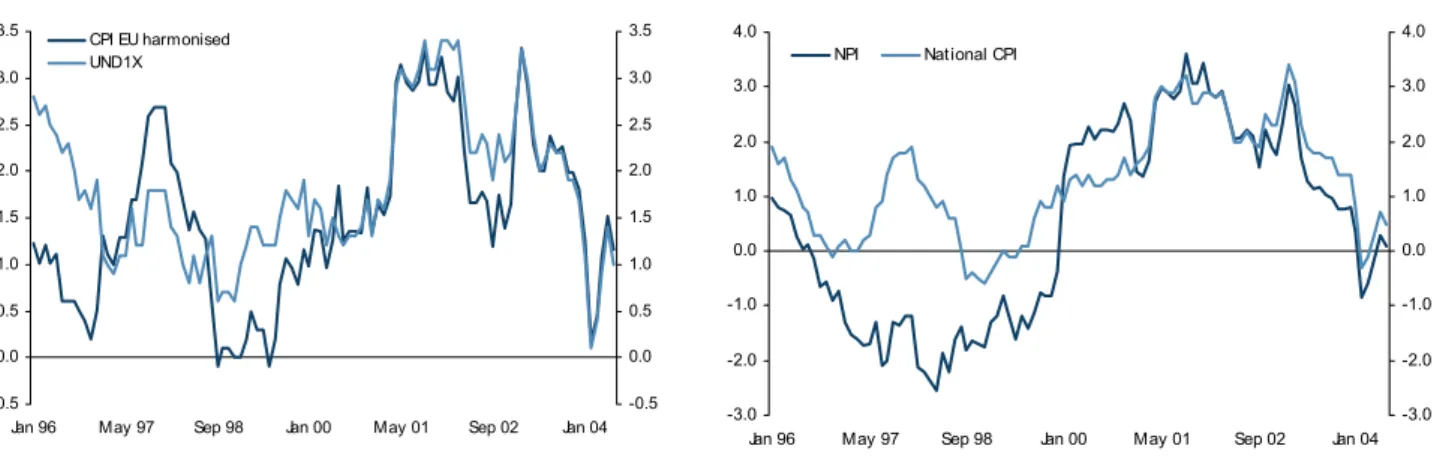
As far as the policy objective is concerned, the Riksbank makes, in addition to headline inflation, use of various “core inflation” measures that exclude certain price components such as, for instance, indirect taxes and subsidies as well as house mortgage interest payments. In fact, the bank has decided not to use one specific core index for all situations. The intention instead is always to communicate exactly on what forecast or other grounds the interest rate decision has been based and which deviations from the target are acceptable in any given situation because of temporary supply shocks. Figure 1 summarizes the Riksbank’s inflation measures. Figure 2 shows the latest developments of Swedish inflation measures. As can be seen, inflation has declined in recent years, developing more or less closely aligned to the bank’s stability promise.
- Insert Figure 1 here - - Insert Figure 2 here -
In general there is agreement that a pre-emptive, forward-looking monetary policy such as IT shall take action if and when there is a divergence between expected, or projected
( ) and envisaged ( ) inflation. The policy recommendation under an IT framework
could be described as follows: e
t
π πˆt
5 The new Constitution and amended Riksbank Act came into effect in 1999 granting political
independence to the central bank. The Riksbank Act now states that the “objective of the Riksbank’s operations shall be to maintain price stability.” See Heikensten and Vredin (2002, p. 9).
(1) i f( e ˆt ). t π π λπ − = ∆
The central bank would have to increase (decrease) the interest rate, i, that is ∆i > 0 (∆i
< 0), if expected future inflation exceeds target inflation; > 0 shows the intensity with which rates are changed in response to the expected deviation from target inflation. From the point of view of monetary policy, it seems advisable to analyse risks to price stability by taking into account both monetary and non-monetary variables. Such an analysis would combine Milton Friedman’s dictum that “inflation is always and everywhere a monetary phenomenon” with the fact that consumer prices are also temporarily influenced by “cost push” and “demand pull” variables (for instance, variations in the output gap, the oil price, the wage level and the exchange rate).
π
λ
In this context it should be noted that conceptually, IT and MT are much more closely
aligned than most discussions would suggest.6 Both concepts aim to keep (future)
inflation in check; both favour a pre-emptive stance for monetary policy; and both favour policy-making on the basis of inflation forecasts. MT proponents would argue for using money supply as the central inflation indicator, whereas those in favour of IT recommend a central bank’s “self-made” inflation forecast as the main guideline for policy-making. That is, MT and IT would be identical if money supply were used as the inflation forecast variable. The only difference remaining in such a case would be that MT has an explicitly announced money growth target and an implicit inflation goal, whereas IT has an explicit inflation target and an implicit money growth goal. In view of the above, it is fair to say that IT could be characterised as an “umbrella strategy” under which money supply and other variables can be analysed in order to identify risks for future price stability.
- Figure 3 about here -
Under IT, a central bank’s inflation forecast plays the key role in policy making. However, it is not quite clear how such forecasts are actually calculated. Of course, in its quarterly Inflation Reports the Riksbank provides – along with its inflation forecasts one to two years ahead, and nowadays there is also a brief outlook three years ahead – some input variables for its forecasts. At the same time, however, it is not at all clear which role each variable plays, e.g. which weight is assigned to it in the Riksbank’s
forecasting exercise.7 In fact, its inflation forecasts – as is the case with other central
bank pursuing IT – appear to emerge from a kind of “black box”, which would imply a great deal of discretion on the part of the forecasters. This conjecture is actually confirmed by the bank: “(…) the Riksbank’s forecasts (like those of other central banks) are largely determined by judgement.” (Jansson and Vredin (2001), p. 206).
A wide scope of discretion in calculating the Riksbank’s IT inflation forecast might not only raise questions about the actual “transparency” of its monetary policy: if the bank derives the essential policy making variable on an “ad hoc” basis and under a rather opaque procedure, it could well be that in a “period of stress” (such as, for instance, big financial market and/or cost push crises) the public looses confidence in the bank’s assessment. (Interestingly enough, even the most vigorous advocates of central bank policy transparency seem to be satisfied with the actual status quo.) It might also raise questions about the actual empirically reliable relation between (future) inflation and its “driving forces”. That is, we try to shed some more light on the actual role money plays in the inflation process in Sweden. To this end, we will make use of the well-known
7 “The discussion of Swedish inflation is more or less based on an expectations-augmented Phillips curve
framework. Thus, supply and demand conditions in the Swedish economy are discussed along with various measures of the “output gap”, and the picture of inflation is elaborated with inflation expectations and possible supply shocks.“ (Heikensten and Vredin (2002), p. 16). It is interesting to note in this context that Baumgartner et al. (2003, p. 5) note: ”(…) the output gap (…) has some predictive information on inflation, but the predictive information of the output gap is confined to a shorter horizon than the monetary aggregates (…).”
star” model.
3. The “P-Star” model
To set the ball rolling, Figure 4 shows the annual rise in consumer price inflation (left hand scale) and the income velocity of the stock of M3 (right hand scale) in Sweden for
the period Q1 85 to Q1 04.8 As can be seen, there is a certain co-movement between the
swings of inflation and the behavior of the velocity of money: rising (falling) inflation seem to be associated with upwards (downward) swings in the velocity of money. That is, “swings” in the velocity of money or, to put it differently, swings in the demand for money, seem to be accompanied by movements in inflation. This finding, however, is by no means “spurious” when taken into account the well-known “transaction equation” and – on the basis of this – the so-called “P-star” model. We will now look into this in more detail.
- Insert Figure 4 here -
For setting up an inflation forecasting model for Sweden, we make use of the well-known “transaction equation” which can be written as follows:
P Y V
M⋅ = ⋅ , (1)
where M is the stock of money, V the velocity of money, Y real output and P price level.
Equation (1) simply says that the stock of money, multiplied by the number of times a money unit is used for financing purposes, equals the real output valued with its price level. Taking logarithms, equation (1) can easily be written as:
p y v
m+ = + . (2)
Now let us turn to the “P-star” model (Hallman, Porter and Small (1991)). To start with,
8 The velocity of money is the frequency with which a money unit is used to finance nominal output in
the period under review. Economically speaking, the velocity of money is the reciprocal of the demand for money. It is simply calculated by dividing nominal GDP by the stock of money.
the actual price level is simply:
y v m
p= + − . (3)
The long-term price level can be formalised as: *
*
* m v y
p = + − , (4)
where asterisks represent the long-run or equilibrium values. The difference between equations (4) and (3) is the so-called price gap:
*) ( ) * ( * p v v y y p − = − + − . (5)
The price gap (p− p*) consists of (i) the liquidity gap (v−v*) and (ii) the output gap
. If, for instance, actual output exceeds potential ( )
*
(y −y y*< y) and actual velocity
equals the long-term equilibrium (v = v*), the actual price level can be expected to rise
in the future. The price gap can also be written as:
* *
* ) ( )
(p − p = m +v − p −y . (6)
According to equation (6), the price gap is a function of the “output gap”, that is the difference between actual and potential GDP, and the “liquidity gap”, defined as the difference between the equilibrium velocity of money and its actual value. It is
important to note that an increase in real GDP (y) will not cause a change of the price
gap, because v will decrease as y increases. Equation (6) shows that the price gap is independent from the output gap: it is simply the difference between real money (adjusted by the trend velocity) and real potential output. Figure 5 shows the output gap and the price gap for Sweden.
- Figure 5 about here -
Lately, there is an alternative version of the price gap, namely the “real money gap” (Gerlach and Svensson (2001)). It is defined as actual money supply less actual price
level:
p m
mreal = − . (7)
The equilibrium real money holding is: *
* m p
mreal = − . (8)
The difference between equation (7) und (8) is the real money gap, which represents nothing other than the price gap with a negative sign:
*) ( * *) ( ) ( * m p m p p p p p m mreal − real = − − − =− + =− − . (9)
The real money gap is thus very closely affiliated with the so-called P-star model.9 It is
crucial to identify a stable velocity of money or, equivalently, a stable demand function for money. Only when there is a stable demand for money, monetary signals might contain information for future inflation. This issue will be dealt with what follows next. 4. Identifying a stable demand function for money
Theory suggests that holdings of real balances depend, in the simplest case, on output and interest rates, that is opportunity costs of money holdings. An increase (decline) in output should be accompanied with rising (falling) demand for transaction balances. As a result, the income elasticity of money should be positive. The higher (lower) the opportunity costs of real money holdings are, the lower (higher) should be the demand for real balances. Also, a rise (decline) in the own rate on deposits included in the monetary aggregate can be expected to increase (reduce) the demand for real money. A parsimoniously specified type money demand can thus be written as follows:
9 Against the background of these findings, it is easily shown that a simple comparison between actual
money growth and an annual growth rate (such as, for instance, represented by the ECB’s reference value concept) might lead to misleading policy signals as monetary expansions, which occurred in the past and will have a bearing on future prices, are systematically neglected.
t short t long t t t t p y i i m − = β0 +β1 −β2 +β3 +ε (10)
where m is the logarithm of money, p is the price level, y represents real GDP and i are
interest rates, and ε is the error term. The ßs are the parameter to be estimated.
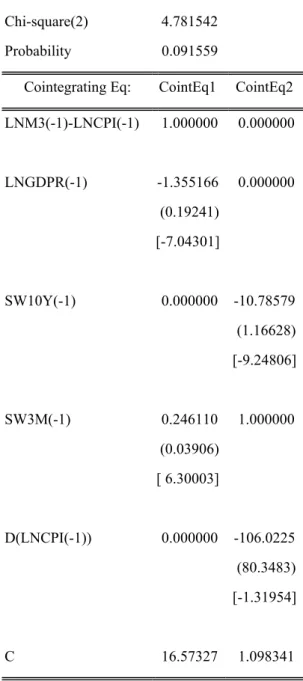
To analyse the stability of money demand functions, the cointegration analysis suggested by Johansen (1988, 1991) and Johansen and Juselius (1992) has become the standard econometric approach (see Appendices C to E for further details). Without going into detail at this juncture, the rationale of the procedure is to identify linear relationships between non-stationary variables, in our case real money, output, interest rates and inflation. Moreover, our multivariate approach can be subject to various restrictions. For instance, we assumed that there are linear combinations between (i) real M3 holdings, real GDP and interest rates and (ii) short-term interest rates, long-term rates and inflation. The first assumption actually implies the existence of a demand for money function, the second assumes that the “term structure of interest rates” and the “Fisher parity” jointly hold. Our approach therefore amounts to a structural vector error correction model (S-VECM), a special case of the structural vector auto regression model (S-VAR). The cointegration analysis for the period Q1 84 to Q1 04 reveals the following results: ∆ − − − − = t short t long t t t t t cpi i i y p m X ) 80 . 0 ( ) 6 . 1 ( ) 04 . 0 ( ) 19 . 0 ( 11 . 0 1 7 . 10 0 0 0 25 . 0 0 35 . 1 1 ' ˆ β (11)
The first vector represents the demand for money function. The income elasticity of
money is 1.31, which is economically plausible and broadly in line with other studies.10
10 The finding that the income elasticity exceeds 1 can be explained by the „omitted wealth effect”,
The demand for balances rises (declines) when the opportunity costs declines (rises). Also, the demand for real money increases (declines) if the own yield on money deposit increases (declines). The second vector actually implies that the term structure of interest rates and the Fisher parity hold (that is that they are jointly stationary). We also
tested the system using a measure of core inflation, ∆cpicoret. (Fore the co-movement
of headline and core inflation see Figure 6.) The analysis yields the following results, which are closely related to the system using headline inflation:
∆ − − − − = t short t long t t t t t cpicore i i y p m X ) 13 . 0 ( ) 7 . 1 ( ) 04 . 0 ( ) 19 . 0 ( 19 . 0 1 3 . 15 0 0 0 26 . 0 0 43 . 1 1 ' ˆ β (12)
We take these findings as sufficient to consider the demand for M3 function as reasonably stable. That is, we will set up an inflation forecasting model using the price gap as an inflation determining factor.
- Insert Figure 6 here - 5. Inflation estimating model and out-of-sample forecasts
In view of the findings above, our inflation forecasting model describes the dynamics of inflation as follows:
∑
= − + = + − + + + n i t t i t i t t t p p N 1 1 0 1 β β ( * ) βπ ε π (13)where πt+1 is future inflation. pt*−pt is the price gap (see equation (6)). If the actual
price level is lower (higher) than the equilibrium level, future inflation will accelerate
(slow down) to close the “gap”. As a result, one would expect the parameter β1 to be
shown by
∑
. represents a vector of non-monetary “cost push” variables (oil, wages, exchange rates, unemployment etc.). Finally, the term= − n i i t i 1 π β Nt t
ε is the (i.i.d.) error term.
We regressed inflation – expressed as the first difference of the log consumer price index – on own lagged values (for doing justice to the “stickiness” of the inflation
process), and (first changes in the logs of) various variables, namely the price gap (pg),
output gap (og), oil prices (oil), the USDSEK exchange rate (exsek), unemployment rate
(u) and nominal wages (w). Figure 7 shows the regression results and a selection of
diagnosis tests for the period Q3 84 to Q1 04. The equation explains 79% of the variance in the change of inflation and appears to be stable according to standard tests. This finding is also confirmed when various sub-periods are tested. For instance, Figure 8 shows an out-of-sample calculation where the parameters were established for the (sub-)period Q3 84 to Q4 95.
- Insert Figure 7 here - - Insert Figure 8 here -
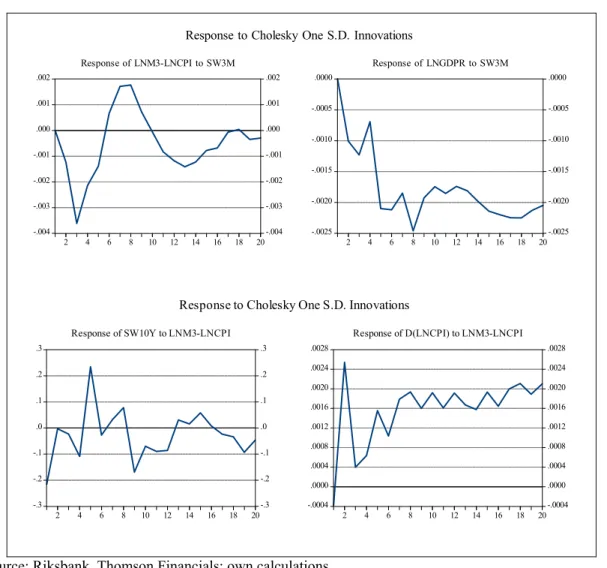
It is interesting to note that the price gap enters the forecasting model with a time lag of five quarters whereas the output proved to be insignificant according to standard tests. That said, the past (current) values of the changes in the price gap exert a rather strong impact on current (future) inflation. Given the latest benign development of the price gap, there is only very moderate upward pressure on the consumer price level around the beginning of 2004. Figure 9 shows impulse-response functions for real money holdings and real output due to a change in the interest rate and the response of the long-term interest rate and inflation following a shock to the real money supply. The variables under review reveal economically plausible reactions.
It is possible for an equation that has a very good statistical fit to have a very poor simulation or forecast fit. For this reason, we finally make use of both static and dynamic out-of-sample forecasts. Static forecasting performs a series of one-step ahead forecasts of the dependent inflation variable, while dynamic forecasting relies on a multi-step forecast of inflation. Both methods yield identical results for the first forecast period. However, the two methods will differ for subsequent periods since there are lagged dependent variables included in our empirical model. Let us start now with the static out-of-sample forecast which starts in the first quarter of 1996.
Static forecasts
Figure 10 plots the inflation forecasts with plus and minus two standard error bands which provide a 95% forecast interval and report a table of statistical results evaluating our static forecast. The first two forecast error statistics depend on the scale of the dependent variable and hence should be used to compare forecasts for the inflation rate across different models. The popular Root Mean Squared Error (RMSE) turns out to be small and implicitly weights large forecast errors more heavily than small ones and is appropriate in situations in which the cost of an error increases as the square of that error. In addition, the mean absolute deviation is rather small. This appears to be more important in our IT context since the cost of inflation forecast errors is proportional to the absolute size of the forecast error and not so much to the percentage error as implicitly assumed by the Mean Absolute Percentage Error (MAPE) (see, for instance, Kennedy (2003), pp. 361).
- Insert Figure 10 here -
However, we emphasize the remaining two statistics which are scale invariant. The Theil inequality coefficient always lies between zero and one, where zero indicates a perfect fit. Our forecast appears to be rather good since Theil falls below 50% and the
bias and variance proportions are so small that most of the bias is concentrated on the covariance proportions. Hence, the mean of the forecast is not far away from the mean of the actual series. The same is valid for the variation of our forecast (see, e.g., Pindyck and Rubinfeld (1991), chapter 12). Also the MAPE turns out to be small. However, note that a well-known problem connected with this indicator is that it promotes a kind of underestimating due to the fact that the actual and not the forecasted value is the base for calculating the percentage error. Figure 11 shows the results.
- Insert Figure 11 here -
Dynamic Forecast
The first forecasted quarter of our dynamic forecast is Q1 96. Figure 12 plots the inflation forecasts with plus and minus two standard error bands which provide a 95% forecast interval and report a table of statistical results evaluating our dynamic forecast.
- Insert Figure 12 here -
Again, like in the static forecast case, the forecast evaluation leads to a rather positive assessment of our empirical model. The RMSE and the MAPE turn out to be small again. The Theil inequality coefficient is nearly unchanged in spite of our change from a static to a dynamic forecast perspective. However, the bias and variance proportions are slightly higher than before. Hence, the mean and the variance of the forecast are more far away from the mean and the variation of the actual series, a finding typical for and inherent in dynamic forecasts. Finally, also the MAPE turns out to be small, and thus acceptable. Figure 13 shows the actual and dynamically forecasted inflation.
6. Summary and outlook
Applying the P-star model to Swedish data from the early 1980 to 2004 suggests that broadly defined money, measured by the concept of P-star or real money gap, plays an important role in explaining Swedish inflation. This finding rests on the observation that the demand for money function, e.g. the income velocity of money, appears to be stable in the long-run. Our findings are supported by statistically satisfactory out-of-sample inflation forecasts based on the P-star approach. Our findings on the role of money for future inflation may come as a surprise as the Riksbank has not assigned – at least explicitly – any important role to the stock of money in its monetary policy making. Our findings may thus provide a basis from which further research on whether money should in fact be assigned an intermediate function in the Riksbank’s policy making could be done.
Moreover, our findings may also be taken as a starting point to discuss some “weak spots” in the Riksbank’s IT approach. Perhaps most importantly in this context, it should be mentioned that – despite the successful policy results in recent years – there is little evidence that could inspire confidence in the Riksbank’s inflation forecasts playing an important role of determining future inflation. The well-known phenomenon of “surprise inflation” – that is actual inflation in excess of market agents’ originally expected inflation – attests to this. The role of excess money as measured by the real money gap, in turn, provides a theoretically and empirically sound explanation of the policy transmission mechanism linking monetary policy action with the ultimate policy target, that is consumer price inflation.
To the outside world, inflation forecasts are rather opaque: it is not quite clear which variables are included in the projection model; nor is it known how much weight is assigned to each of the variables. So the public’s confidence in the accuracy of the
inflation projections – and the appropriateness of its policy recommendations – can be assumed to hinge de facto on the bank’s credibility, that is the bank’s perceived willingness and ability to deliver on its price stability promise. It therefore seems questionable whether inflation forecasts themselves further monetary policy transparency and build up central bank credibility. It seems to work more the other way round: Inflation projections (or forecasts) are only reliable if central bank credibility is already in place.
Finally, IT has gained in prominence in a period in which world wide inflation was set to decline – for reasons that might have been well beyond the factors considered important in the traditional IT approach. For instance, the political, financial and operational independency granted to numerous central banks – including the Riksbank – should have played a role in making monetary policy credible from the point of view and bringing inflation down to the desired levels. In the Swedish case, though, our findings show in particular that the decline in the real money gap seems to be at the heart of the disinflation process, i.e. in bringing inflation to the envisaged level. This result would indeed suggest that the Riksbank might have to assign a (more) prominent role to money in setting its policy compared to the status quo.
References
Baltensperger, Ernst (2000), Die Europäische Zentralbank und ihre Geldpolitik, in: Swiss National Central Bank, Quarterly Bulletin 1/2000, pp. 49-73.
Baumgartner, Josef, Ramaswamy, Ramana, Zettergren, Goran (2003), Monetary Policy and Leading Indicators of Inflation in Sweden, IMF Working Paper WP97/34, April.
Bernanke, Ben S., Laubach, Thomas, Mishkin, Frederic S., Posen, Adam S. (1999), Inflation Targeting. Lessons from the International Experience, Princeton University Press.
Engle, Robert F., Granger, Clive W. J. (1987), Cointegration and Error-Correction Representation: Estimation and Testing, in: Econometrica, Vol. 55, pp. 251-276. Gerlach, Stefan, Svensson, Lars E. O. (2001), Money and Inflation in the Euro Area: A
Case for Monetary Indicators?, BIS Working Paper No. 98.
Hallman, Jeffrey J., Porter, Richard D., Small, David H. (1991), Is the Price Level Tied to the M2 Monetary Aggregate in the Long Run?, in: American Economic Review, Vol. 81, No. 4, pp. 841-858.
Heikenstein, Lars, Vredin, Anders (2002), The Art of Targeting Inflation, in: Economic
Review, 4/2002, pp. 5-34, (http://www.riksbank.com/upload/Dokument_riksbank/Kat_publicerat/Artiklar_PV/
pv02_4_artikel1.pdf).
Jansson, Per, Vredin, Anders (2001), Forecast-based monetary policy in Sweden 1992-98: a view from within, Sveriges Riksbank Working Papers No. 120, pp. 204-220. Johansen, Søren (1988), Statistical Analysis of Cointegrated Vectors, in: Journal of
Johansen, Søren (1991), Estimation and Hypothesis Testing of Cointegrating Vectors in Gaussian Vector Autoregressive Models, in: Econometrica, Vol. 55, pp. 251 - 276. Johansen, Søren (1995), Likelihood Based Inference in Cointegrated Vector
Autoregressive Models, Oxford University Press, Oxford.
Johansen, Søren, Juselius, Katarina (1992), Testing Structural Hypotheses in a Multivariate Cointegration Analysis of the PPP and UIP for the UK, in: Journal of Econometrics, Vol. 53, pp. 211-244.
Kennedy, Peter (2003), A Guide to Econometrics, 5th ed., Cambridge.
Mitlid, Kerstin, Versterlund, Magnus (2001), Steering Interest Rates in Monetary Policy – How Does It Work?, in: Riksbank Economic Review 1/2001, pp. 19-41.
Obstfeld, Maurice, Rogoff, Kenneth (1995), The Mirage of Fixed Exchange Rates, in: Journal of Economic Perspectives, Vol. 9, No. 4, pp. 73-96.
Pindyck, Robert S., Rubinfeld, Daniel L. (1991), Econometric Models & Economic
Forecasts, 3rd ed., New York et al.
Riksbank Inflation Report, 3/2004, (http://www.riksbank.com).
Söderström, Ulf (2001), Targeting Inflation with a Prominent Role for Money, Sveriges Riksbank Working Paper Series No. 123.
Svensson, Lars E. O. (1994), Fixed Exchange Rates as a Means of Price Stability: What have we learned?, in: European Economic Review, Vol. 38, No. 3/4, pp. 447-468. Svensson, Lars E. O., (1999), “Inflation Targeting as a Monetary Policy Rule”, in:
Woodford, Michael (1997), Doing Without Money, Controlling Inflation in a Post-Monetary World, NBER Working Paper No. w6188, September.
Appendix
A The price gap
To derive P-star, a simple demand for money function may be used:
ε β β − + + = p y i m 1 2 , (A1)
where m is the (log) of the stock of nominal money, p the price level and i the interest
rate, e.g. the opportunity costs of holding money. The parameter β1 represents the
income elasticity of money, β2 is the (semi-)elasticity of money demand. The term ε
represents the error term. In the long run, or equilibrium, nominal money holdings can be described as follows:
* * * p 1y 2i
m = +β −β , (A2)
whereas the asterisks stand for long-term, that is equilibrium, values. The difference between the current money stock and the equilibrium money stock is the “money gap”:
ε β β − − − + = −m* 1(y y*) 2(i i*) m . (A3)
Instead of measuring these disequilibria in units of the (logarithmic) money stock, they can also be expressed in an equivalent manner in units of the (logarithmic) price level. To do this, the equilibrium price level (P-star) is defined as the price level that would emerge given the current holdings of money if both the goods market and the money market were in equilibrium:
* * * m 1y 2i
p = −β +β . (A4)
The equilibrium price level is thus an indicator of the level of goods prices that would
emerge over the longer term given the existing money stock if the disequilibria (y – y*, i
– i*, ε) had disappeared. As may easily be seen, the price gap and the money gap are
ε β β − − − + = − ( *) ( *) * p 1 y y 2 i i p , (A5)
so that we can write:
ε + − = − ( * ) * p m m p (A6) B Data
Nominal and real GDP, consumer prices, interest rates, the oil price and exchange rates were taken from Thomson Financials. The stock of M3 was taken from the Riksbank and was seasonally adjusted (Census X12). Core consumer prices were taken from the OECD. Except for interest rates, all variables are seasonally adjusted and were used in the form of natural logarithms.
C Overview of the Johansen cointegration approach
The finding that many macro time series may contain a unit root has spurred the development of the theory of non-stationary time series analysis. Engle and Granger (1987) pointed out that a linear combination of two or more non-stationary series may be stationary. If such a stationary linear combination exists, the non-stationary time series are said to be cointegrated. The stationary linear combination is called the cointegrating equation and may be interpreted as a long-run equilibrium relationship among the variables.
The purpose of the cointegration test is to determine whether a group of non-stationary series are cointegrated or not. As explained below, the presence of a cointegrating relation forms the basis of the vector error correction (VEC) specification. To outline the Johansen (1991, 1995) cointegration technique, consider a vector autoregressive
(VAR) model of the order p:
t t p t p t t A y A y Bx y = 1 −1+...+ − + +ε (A1)
where is a -vector of non-stationary I(1) variables, x is a d-vector of deterministic
variables, and
t
y t
t
ε is a vector of innovations. We can rewrite this VAR as:
t t p i i t i t t y y Bx y =Π + Γ∆ + +ε ∆
∑
− = − − 1 1 1 (A2) where∑
= − = Π p i t I A 1 and∑
. (A3) + = − = Γ p i j j i A 1Granger’s representation theorem asserts that if the coefficient matrix Π has reduced
rank r < k, then there exist k x r matrices α and β each with rank r such that Π = αß' and
is I(0). r is the number of cointegrating relations (the rank) and each column of ß is
the cointegrating vector. The elements of α are known as the adjustment parameters in
the VEC model. Johansen's method is to estimate the Π from an unrestricted VAR and
to test whether we can reject the restrictions implied by the reduced rank of Π.
t y ß'
To determine the number of cointegrating relations conditional on the assumptions
made about the trend, one can proceed sequentially from r = 0 to r = k – 1 until one fails
to reject.
The trace statistic reported in the first block tests the null hypothesis of r cointegrating
relations against the alternative of k cointegrating relations, where k is the number of
endogenous variables, for r = 0, 1, …, k – 1. The alternative of k cointegrating relations
corresponds to the case where none of the series has a unit root and a stationary VAR may be specified in terms of the levels of all of the series. The trace statistic for the null hypothesis of r cointegrating relations is computed as:
tr LR (r|k) =
∑
(A4) + = − − k r i i T 1 ) 1 log( λwhere λi is the i-th largest eigenvalue of the Π matrix in (A3) which is reported in the
second column of the output table. The maximum eigenvalue statistic shows the results
of testing the null hypothesis of r cointegrating relations against the alternative of r + 1
cointegrating relations. This test statistic is computed as:
max
LR (r|r + 1) = −Tlog(1+λr+1) (A5)
= LRtr(r|k) – LRtr(r|r + 1) for r = 0, 1, …, k – 1.
D Cointegration Analysis, Headline Inflation Table A2: Cointegration rank tests
Unrestricted Cointegration Rank Test
Hypothesized Trace 5 Percent 1 Percent No. of CE(s) Eigenvalue Statistic Critical Value Critical Value None ** 0.593715 140.7056 68.52 76.07 At most 1 ** 0.394824 67.74881 47.21 54.46 At most 2 0.185623 27.06776 29.68 35.65 At most 3 0.119402 10.43590 15.41 20.04 At most 4 0.001682 0.136394 3.76 6.65 *(**) denotes rejection of the hypothesis at the 5%(1%) level
Trace test indicates 2 cointegrating equation(s) at both 5% and 1% levels
Hypothesized Max-Eigen 5 Percent 1 Percent No. of CE(s) Eigenvalue Statistic Critical Value Critical Value None ** 0.593715 72.95678 33.46 38.77 At most 1 ** 0.394824 40.68105 27.07 32.24 At most 2 0.185623 16.63186 20.97 25.52 At most 3 0.119402 10.29951 14.07 18.63 At most 4 0.001682 0.136394 3.76 6.65 *(**) denotes rejection of the hypothesis at the 5%(1%) level
Max-eigenvalue test indicates 2 cointegrating equation(s) at both 5% and 1% levels
Table A3: Test of hypothesis about the conintegration space
Cointegration Restrictions: B(1,1)=1,B(1,3)=0,B(1,5)=0 B(2,1)=0,B(2,2)=0,B(2,4)=1 Maximum iterations (500) reached.
Restrictions identify all cointegrating vectors LR test for binding restrictions (rank = 2): Chi-square(2) 4.781542 Probability 0.091559
Cointegrating Eq: CointEq1 CointEq2 LNM3(-1)-LNCPI(-1) 1.000000 0.000000 LNGDPR(-1) -1.355166 0.000000 (0.19241) [-7.04301] SW10Y(-1) 0.000000 -10.78579 (1.16628) [-9.24806] SW3M(-1) 0.246110 1.000000 (0.03906) [ 6.30003] D(LNCPI(-1)) 0.000000 -106.0225 (80.3483) [-1.31954] C 16.57327 1.098341
E Cointegration Analysis, Core Inflation Table A4: Cointegration rank tests
Unrestricted Cointegration Rank Test
Hypothesized Trace 5 Percent 1 Percent No. of CE(s) Eigenvalue Statistic Critical Value Critical Value None ** 0.576955 139.4359 68.52 76.07 At most 1 ** 0.410480 69.75338 47.21 54.46 At most 2 0.178335 26.94924 29.68 35.65 At most 3 0.127339 11.03905 15.41 20.04 At most 4 7.61E-05 0.006161 3.76 6.65 *(**) denotes rejection of the hypothesis at the 5%(1%) level
Trace test indicates 2 cointegrating equation(s) at both 5% and 1% levels
Hypothesized Max-Eigen 5 Percent 1 Percent No. of CE(s) Eigenvalue Statistic Critical Value Critical Value None ** 0.576955 69.68248 33.46 38.77 At most 1 ** 0.410480 42.80413 27.07 32.24 At most 2 0.178335 15.91020 20.97 25.52 At most 3 0.127339 11.03289 14.07 18.63 At most 4 7.61E-05 0.006161 3.76 6.65 *(**) denotes rejection of the hypothesis at the 5%(1%) level
Max-eigenvalue test indicates 2 cointegrating equation(s) at both 5% and 1% levels
Table A5: Test of hypothesis about the conintegration space
Cointegration Restrictions: B(1,1)=1,B(1,3)=0,B(1,5)=0 B(2,1)=0,B(2,2)=0,B(2,4)=1 Maximum iterations (500) reached.
Restrictions identify all cointegrating vectors LR test for binding restrictions (rank = 2): Chi-square(2) 3.435574 Probability 0.179463
Cointegrating Eq: CointEq1 CointEq2 LNM3(-1)-LNCPIC(-1) 1.000000 0.000000 LNGDPR(-1) -1.431439 0.000000 (0.19681) [-7.27321] SW10Y(-1) 0.000000 -15.30001 (1.69988) [-9.00062] SW3M(-1) 0.258439 1.000000 (0.03795) [ 6.81002] D(LNCPIC(-1)) 0.000000 -198.5671 (128.957) [-1.53979] C 16.61850 2.006364
Figure 1: Swedish inflation measures
Consumer price index (CPI): The change in the CPI measures how the prices of goods and services for private consumption develop over time.
Underlying inflation (UND1X): CPI inflation excluding household mortgage interest expenditure and the direct effects of changes in taxes and subsidies.
Domestic underlying inflation (UNDINHX): UND1X excluding mainly imported goods and services.
Imported underlying inflation (UNDIMPX): UND1X excluding mainly domestically produced goods and services.
Harmonised index of consumer prices (HICP): An EU-harmonised index that was developed to measure inflation in the EU and that enables comparisons between EU countries. A significant part of the changes in housing costs that are included in the CPI are not included in the HICP. However, the HICP includes certain components that are currently excluded from the CPI, such as charges for childcare and care of the elderly.
Figure 2: Swedish Inflation Measures, % y/y
-0.5 0.0 0.5 1.0 1.5 2.0 2.5 3.0 3.5
Jan 96 May 97 Sep 98 Jan 00 May 01 Sep 02 Jan 04 -0.5 0.0 0.5 1.0 1.5 2.0 2.5 3.0 3.5 CPI EU harmonised UND1X -3.0 -2.0 -1.0 0.0 1.0 2.0 3.0 4.0
Jan 96 May 97 Sep 98 Jan 00 May 01 Sep 02 Jan 04 -3.0 -2.0 -1.0 0.0 1.0 2.0 3.0 4.0 NPI National CPI
Figure 3. – Underlying inflation (UND1X) and the Riksbank’s inflation forecasts 0.0 1.0 2.0 3.0 4.0
Jan 97 Jan 99 Jan 01 Jan 03 Jan 05
UND1X, outcome Inflation Report 2004:1 Inflation Report 2004:2
Source: Riksbank, Inflation Report 3/2004.
Figure 4: Swedish Inflation and the Income Velocity of M3
-0.02 0.00 0.02 0.04 0.06 0.08 0.10 0.12 Q1 85 Q1 87 Q1 89 Q1 91 Q1 93 Q1 95 Q1 97 Q1 99 Q1 01 Q1 03 6.28 6.30 6.32 6.34 6.36 6.38 6.40 6.42 6.44 6.46 6.48 6.50 6.52 Inflation (LS) M3 velocity (RS)
Source: Riksbank, Thomson Financials; own calculations. The income velocity of M3 is calculated by subtracting the log of M3 from the log of nominal GDP.
Figure 5: Swedish M3 Price Gap and Output Gap, % y/y -0.10 -0.08 -0.06 -0.04 -0.02 0.00 0.02 0.04 0.06 0.08 Q4 81 Q4 84 Q4 87 Q4 90 Q4 93 Q4 96 Q4 99 Q4 02 -0.04 -0.03 -0.02 -0.01 0.00 0.01 0.02 0.03 0.04 Price gap (LS) Output gap (RS)
Source: Riksbank, Thomson Financials, Bloomberg; own calculations. Four quarter averages.
Figure 6: Swedish headline and core inflation, % Y/Y
-0.02 0.00 0.02 0.04 0.06 0.08 0.10 0.12 0.14 Q1 80 Q1 84 Q1 88 Q1 92 Q1 96 Q1 00 Q1 04 -0.02 0.00 0.02 0.04 0.06 0.08 0.10 0.12 0.14 Core Headline
Source: Riksbank, Thomson Financials; own calculations. Fourth differences of log values. Core inflation = CPI excluding energy and food.
Figure 7: Estimating Changes in Inflation, Q3 84 to Q1 04 = ∆1cpi 981 018 . 0 931 025 . 0 92 029 . 0 901 027 . 0 007 . 0 217 . 0 010 . 0 3 279 . 0 266 . 0 291 . 0 246 . 0 001 . 0 ) 8 . 3 ( ) 2 . 5 ( ) 7 . 5 ( ) 4 . 5 ( 2 1 ) 1 . 2 ( 4 1 ) 8 . 2 ( 4 1 ) 6 . 2 ( 5 1 ) 7 . 4 ( 4 1 ) 0 . 3 ( 3 1 ) 8 . 3 ( 2 1 ) 1 . 3 ( DUM DUM DUM DUM u w oil pgm cpi cpi cpi t t t t t t t − − − − − − − − − − − − + − + ∆ − ∆ + ∆ − ∆ + ∆ + ∆ + ∆ − −
R2 = .79 S.E. of regression = 0.0044. – LM test (2) = .34 (.71), LM test (4)
= .29 (.88), LM test (8) = 1.61 (.14). – ARCH test (2) =.33 (.71), ARCH test (4) = .56 (.69), ARCH test (8) = .66 (.73). – WHITE (no cross terms) = .49 (.95) WHITE = .67 (.89).
Data source: Source: Riksbank, Thomson Financials, Bloomberg; own calculations. Legend: ln = natural logarithm, cpi = log of consumer price index, pgm3 = price gap on the basis of the stock of money M3, oil = oil price in US$, exsek = Swedish Krona US-dollar exchange rate, DUM901, DUM921, DUM 931 and DUM981 represent dummy variables which takes on the value of 1 on Q1 90, Q1 92, Q1 93 and Q1 98, respectively, and zero otherwise. All variables enter the equation in logarithms. represents the first difference of the log of the value. The numbers in brackets show the t-values.
1 ∆
Figure 8: Swedish inflation, actual and estimate (out-of-sample), % Y/Y
-0.02 0.00 0.02 0.04 0.06 0.08 0.10 0.12 Q2 84 Q2 87 Q2 90 Q2 93 Q2 96 Q2 99 Q2 02 -0.02 0.00 0.02 0.04 0.06 0.08 0.10 0.12 Estimate, full sample Estimate, sample ending Q4 95 Actual
Source: Riksbank, Thomson Financials, Bloomberg; own calculations. Actual inflation is based on the inflation equation shown in Figure 7.
Figure 9: Impulse-response functions for the Swedish economy -.004 -.003 -.002 -.001 .000 .001 .002 -.004 -.003 -.002 -.001 .000 .001 .002 2 4 6 8 10 12 14 16 18 20 Response of LNM3-LNCPI to SW3M -.0025 -.0020 -.0015 -.0010 -.0005 .0000 -.0025 -.0020 -.0015 -.0010 -.0005 .0000 2 4 6 8 10 12 14 16 18 20 Response of LNGDPR to SW3M
Response to Cholesky One S.D. Innovations
-.3 -.2 -.1 .0 .1 .2 .3 -.3 -.2 -.1 .0 .1 .2 .3 2 4 6 8 10 12 14 16 18 20 Response of SW10Y to LNM3-LNCPI
-.0004 .0000 .0004 .0008 .0012 .0016 .0020 .0024 .0028 -.0004 .0000 .0004 .0008 .0012 .0016 .0020 .0024 .0028 2 4 6 8 10 12 14 16 18 20 Response of D(LNCPI) to LNM3-LNCPI
Response to Cholesky One S.D. Innovations
Source: Riksbank, Thomson Financials; own calculations.
Figure 10: Static Inflation forecasts and forecast evaluation
-.02 -.01 .00 .01 .02 96 97 98 99 00 01 02 03 DLNCPIF Forecast: DLNCPIF Actual: D(LNCPI) Forecast sample:1996:12004:1 Included observations:33
Root Mean Squared Error 0.004041 Mean Absolute Error 0.002911 Mean Abs. Percent Error 1.396882 Theil Inequality Coefficient 0.443157 Bias Proportion 0.012753 Variance Proportion 0.048242 Covariance Proportion 0.939005
Figure 11: Inflation – Actual and forecasted values -.008 -.004 .000 .004 .008 .012 .016 96 97 98 99 00 01 02 03 D(LNCPI) DLNCPIF
Figure 12: Dynamic inflation forecasts and forecast evaluation
-.02 -.01 .00 .01 .02 .03 96 97 98 99 00 01 02 03 DLNCPIF Forecast: DLNCPIF Actual: D(LNCPI) Forecast sample:1996:12004:1 Included observations:33
Root Mean Squared Error 0.004451 Mean Absolute Error 0.003273 Mean Abs. Percent Error 6.079383 Theil Inequality Coefficient 0.449356 Bias Proportion 0.156703 Variance Proportion 0.075484 Covariance Proportion 0.767813
Figure 13: Inflation – Actual and forecasted values -.008 -.004 .000 .004 .008 .012 .016 96 97 98 99 00 01 02 03 D(LNCPI) DLNCPIF
I
DISKUSSIONSBEITRÄGE AUS DEM
INSTITUT FÜR VOLKSWIRTSCHAFTSLEHRE
DER UNIVERSITÄT HOHENHEIM
Nr. 203/2002 Heinz-Peter Spahn, Vermögensmärkte, Investitionen und Beschäftigung.
Ein Rückblick auf die keynesianische Phase im angebotstheoretischen Konzept des Sachverständigenrates
Nr. 204/2002 Ansgar Belke and Daniel Gros, Monetary Integration in the Southern Cone: Mercosur Is Not Like the EU?
Nr. 205/2002 Ralph Setzer, Dollarisierung für Argentinien?
Nr. 206/2002 Ansgar Belke und Martin Hebler, Euroisierung der mittel- und osteuropäischen EU-Beitrittskandidaten - ein alternativer Weg in die Währungsunion?
Nr. 207/2002 Michael Ahlheim, Umweltkapital in Theorie und politischer Praxis
Nr. 208/2002 Katja Hölsch and Margit Kraus, European Schemes of Social Assistance: An Empirical Analysis of Set-Ups and Distributive Impacts
Nr. 209/2002 Ansgar Belke und Frank Baumgärtner, Fiskalische Transfermechanismen und asymmetrische Schocks in Euroland
Nr. 210/2002 Ansgar Belke and Jens M. Heine, Specialisation Patterns and the Synchronicity of Regional Employment Cycles in Europe
Nr. 211/2002 Ansgar Belke, Does the ECB Follow the FED?
Nr. 212/2002 Katja Hölsch, The Effect of Social Transfers in Europe: An Empirical Analysis Using Generalised Lorenz Curves
Nr. 213/2002 Ansgar Belke, EU Enlargement, Exchange Rate Variability and Labor Market Performance
Nr. 214/2003 Ansgar Belke, Wim Kösters, Martin Leschke and Thorsten Polleit, International Coordination of Monetary Policy – An Analysis of the Monetary Policy of the European System of Central Banks, Frankfurt
Nr. 215/2003 Ulrich Schwalbe, Die Airtours / First Choice Entscheidung
Ökonomische Grundlagen und wettbewerbspolitische Konsequenzen
Nr. 216/2003 Ansgar Belke, Rainer Fehn and Neil Foster, Does Venture Capital Investment Spur Employment Growth? – Further Evidence
Nr. 217/2003 Oliver Frör, Using Stated Preference Methods for Biodiversity Valuation. A critical analysis
Nr. 218/2003 Ansgar Belke und Dirk Kruwinnus, Erweiterung der EU und Reform des EZB-Rats: Rotation versus Delegation
Nr. 219/2003 Katja Hölsch and Margit Kraus, Poverty Alleviation and the Degree of Centralisation in European Schemes of Social Assistance
II
Nr. 220/2003 Walter Piesch, Ein Überblick über einige erweiterte Gini-Indices Eigenschaften, Zusammenhänge, Interpretationen
Nr. 221/2003 Ansgar Belke, Hysteresis Models and Policy Consulting
Nr. 222/2003 Ansgar Belke and Daniel Gros, Does the ECB Follow the FED? Part II September 11th and the Option Value of Waiting
Nr. 223/2003 Ansgar Belke and Matthias Göcke, Monetary Policy (In-) Effectiveness under Uncertainty Some Normative Implications for European Monetary Policy
Nr. 224/2003 Walter Piesch, Ein Vorschlag zur Kombination von P – und M – Indices in der Disparitätsmessung
Nr. 225/2003 Ansgar Belke, Wim Kösters, Martin Leschke and Thorsten Polleit, Challenges to ECB Credibility
Nr. 226/2003 Heinz-Peter Spahn, Zum Policy-Mix in der Europäischen Währungsunion
Nr. 227/2003 Heinz-Peter Spahn, Money as a Social Bookkeeping Device From Mercantilism to General Equilibrium Theory
Nr. 228/2003 Ansgar Belke, Matthias Göcke and Martin Hebler, Institutional Uncertainty and European Social Union: Impacts on Job Creation and Destruction in the CEECs.
Nr. 229/2003 Ansgar Belke, Friedrich Schneider, Privatization in Austria and other EU countries: Some theoretical reasons and first results about the privatization proceeds.
Nr. 230/2003 Ansgar Belke, Nilgün Terzibas, Die Integrationsbemühungen der Türkei aus ökonomischer Sicht.
Nr. 231/2003 Ansgar Belke, Thorsten Polleit, 10 Argumente gegen eine Euro-US-Dollar-Wechselkursmanipulation
Nr. 232/2004 Ansgar Belke, Kai Geisslreither and Daniel Gros, On the Relationship Between Exchange Rates and Interest Rates: Evidence from the Southern Cone
Nr. 233/2004 Lars Wang, IT-Joint Ventures and Economic Development in China- An Applied General Equilibrium Analysis
Nr. 234/2004 Ansgar Belke, Ralph Setzer, Contagion, Herding and Exchange Rate Instability – A Survey
Nr. 235/2004 Gerhard Wagenhals, Tax-benefit microsimulation models for Germany: A Survey
Nr. 236/2004 Heinz-Peter Spahn, Learning in Macroeconomics and Monetary Policy: The Case of an Open Economy
Nr. 237/2004 Ansgar Belke, Wim Kösters, Martin Leschke and Thorsten Polleit, Liquidity on the Rise – Too Much Money Chasing Too Few Goods
Nr. 238/2004 Tone Arnold, Myrna Wooders, Dynamic Club Formation with Coordination
Nr. 239/2004 Hans Pitlik, Zur politischen Rationalität der Finanzausgleichsreform in Deutschland
Nr. 240/2004 Hans Pitlik, Institutionelle Voraussetzungen marktorientierter Reformen der Wirtschaftspolitik
Nr. 241/2004 Ulrich Schwalbe, Die Berücksichtigung von Effizienzgewinnen in der Fusionskontrolle – Ökonomische Aspekte
Nr. 242/2004 Ansgar Belke, Barbara Styczynska, The Allocation of Power in the Enlarged ECB Governing Council: An Assessment of the ECB Rotation Model
III
Nr. 243/2004 Walter Piesch, Einige Anwendungen von erweiterten Gini-Indices Pk und Mk
Nr. 244/2004 Ansgar Belke, Thorsten Polleit, Dividend Yields for Forecasting Stock Market Returns
Nr. 245/2004 Michael Ahlheim, Oliver Frör, Ulrike Lehr, Gerhard Wagenhals and Ursula Wolf, Contingent Valuation of Mining Land Reclamation in East Germany