Training Dependency Parser Using Light Feedback
Avihai Mejer
Department of Electrical Engineering Technion-Israel Institute of Technology
Haifa 32000, Israel
Koby Crammer
Department of Electrical Engineering Technion-Israel Institute of Technology
Haifa 32000, Israel [email protected]
Abstract
We introduce lightly supervised learning for dependency parsing. In this paradigm, the al-gorithm is initiated with a parser, such as one that was built based on a very limited amount of fully annotated training data. Then, the al-gorithm iterates over unlabeled sentences and asks only for a single bit of feedback, rather than a full parse tree. Specifically, given an example the algorithm outputs two possible parse trees and receives only a single bit indi-cating which of the two alternatives has more correct edges. There is no direct information about the correctness of any edge. We show on dependency parsing tasks in14languages that with only1% of fully labeled data, and light-feedback on the remaining 99% of the training data, our algorithm achieves, on av-erage, only5%lower performance than when training with fully annotated training set. We also evaluate the algorithm in different feed-back settings and show its robustness to noise.
1 Introduction
Supervised learning is a dominant paradigm in ma-chine learning in which a prediction model is built based on examples, each of which is composed of
in-puts and a correspondingfullannotation. In the task
of parsing, examples are composed of sentences in some language and associated with full parse trees. These parse trees are often generated by human an-notators. The annotation process is complex, slow and prone to mistakes as for each sentence a full cor-rect feedback is required.
We describe light-feedback learning which suits learning problems with complex or structured out-put, like parsing. After building an initial classi-fier, our algorithm reduces the work of the annota-tor from a full annotation of the input sentence to asinglebit of information. Specifically, it provides the annotator with two alternative parses of the in-put sentence and asks for the single bit indicating
which of the alternatives is better. In 95% of the
sentences both alternatives are identical except for a single word. See Fig. 2 for an illustration. Thus, the work of the annotator boils down to deciding for some specific word in the sentence which of two possible words should be that word’s head.
We show empirically, through simulation, that
us-ing only1%of the training set with full annotation,
and the remaining99%with light annotation, our
al-gorithm achieves an average accuracy of about80%,
only5%less than a parser built with full annotated
training data. These results are averaged over 14
languages. With additional simple relaxations, our
algorithm achieves average accuracy of82.5%, not
far from the performance of an algorithm observing full annotation of the data. We also evaluate our al-gorithm under few noise settings, showing that it is
resistant to noise, with a decrease of only1.5%in
accuracy under about10%feedback noise. We defer
a discussion of related work to the end of the paper.
2 Dependency Parsing and Parsers
Dependency parsing of a sentence is an intermediate between shallow-parsing, in which a given sentence is annotated with its part-of-speech, and between a full structure over the sentence, such as the ones
fined using context-free grammar. Given a sentence
withnwords a parse tree is defined by constructing
a single directed edge outgoing from each word to its head, that is the word it depends on according to syntactic or semantic rules. Additionally, one of the words of the sentence must be labeled as the root of the tree. The choice of edges is restricted to induce trees, i.e. graphs with no loops.
Dependency parsers, such as the MSTParser of (McDonald et al., 2005), construct directed edges between words of a given sentence to their
argu-ments. We focus on non-projective parsing with
non-typed (unlabeled) edges. MSTParser produces a parse tree for a sentence by constructing a full di-rected graph over the words of the sentence with weighted edges, and then outputting the maximal spanning tree (MST) of the graph. Given a true parse tree (aka as gold labeling) and a predicted parse tree
ˆ
y, we evaluate the latter by counting the number of
words that are in agreement with the true labeling.
The MSTParser maintains a linear model for set-ting the weights of the edges of the full graph. Given
the input sentence x the parser sets the weight of
the edge between words xi and xj to be s(i, j) =
w·f(x, i, j)using a feature functionf that maps the
inputxand a pair of possibly connected words into
Rd. Example features are the distance between the
two words, words identity and words part-of-speech. The goal of the learning algorithm is to choose a
proper value ofwsuch that the induced tree for each
sentencexwill have high accuracy.
Online Learning: MSTParser is training a model by processing one example at a time using online learning. On each round the algorithm receives a
new sentence x and the set of correct edgesy. It
then computes the score-value of all possible di-rected edges,s(i, j) =w·f(x, i, j)for wordsi, j
using the currentparameters w. The algorithm is
computing the best dependency treeyˆ of this input
xdefined to be the MST of the weighted complete
directed graph induced from the matrix{s(i, j)}. It then uses the discrepancy between the true parse tree
yand the predicted parse treeyˆto modify the weight
vector.
MSTParser specifically employs the MIRA algo-rithm (Crammer et al., 2006) to update the weight
vectorwusing a linear update,
w←w+α
X
(i,j)∈y
f(x, i, j)− X
(i,j)∈yˆ
f(x, i, j)
(1)
for input-dependent scalar α that is defined by the
algorithm. By construction, correct edges(i, j), that
appear both in the true parse treeyand the predicted
parse tree yˆ, are not affecting the update, as the
terms in the two sums of Eq. (1) cancel each other.
3 Online Learning with Light Feedback
Supervised learning is a very common paradigm in machine learning, where we assume having access to the correct full parse tree of every input sentence. Many algorithms, including MSTParser, explicitly
assume this kind of feedback. Supervised
learn-ing algorithms achieve good performance in depen-dency parsing, but they come with a price. Human annotators are required to fully parse each and ev-ery sentence in the corpora, a long, tedious and ex-pensive process, which is also prone to mistakes. For example, the first phase of the famous penn tree bank project (Marcus et al., 1993) lasted three years, in which annotators corrected outputs of automated
machines in a rate of475words per hour. For
super-vised learning to be successful, typically a large set of thousands instances is required, which translates to a long and expensive annotation phase.
Binary or multi-class prediction tasks, such as spam filtering or document classification, are sim-ple in the sense that the label associated with each instance or input is simple. It is either a single bit indicating whether the input email is spam or not, or one of few values from a fixed predefined set if topics. Dependency parsing is more complex as a decision is required for every word of the sentence, and additionally there is a global constraint of the parse being a tree.
coupling between the elements it is possible to anno-tate an instance only partially, such as provide a de-pendency edge only to several words in a sentence.
We take this approach to the extreme, and con-sider (for now) that for each sentence only a single bit of labeling will be provided. The choice of what bit to require is algorithm and example dependent.
We propose using alight feedbackscheme in order
to significantly reduce annotation effort for depen-dency parsing. First, a base or initial model will be
learned from avery smallset of fully annotated
ex-amples, i.e. sentences with full dependency infor-mation known. Then, in a second training stage the algorithm works in rounds. On each round the al-gorithm is provided with a new non-annotated sen-tence which it annotates, hopefully making the right decision for most of the words. Then the algorithm chooses subset of the words (or segments) to be an-notated by humans. These words are the ones that al-gorithm estimates to be the hardest, or that their true label would resolve any ambiguity that is currently existing with the parsing of the input sentence.
Although such partial annotation task may be eas-ier and faster to annotate, we realize that even partial annotation if not limited enough can require eventu-ally similar effort as annotating the entire sentence.
For example, if for a25-words sentence annotation
is requested for5words scattered over the entire
sen-tence, providing this annotation may require the an-notator to basically parse the entire sentence.
We thus further restrict the possible feedback re-quested from the annotator. Specifically, given a new sentence our algorithm outputs two possible an-notations, or parse trees, yˆA andyˆB, and asks for a single bit from the annotator, indicating whether
parse A is better or parse B is better. We do not
ask the annotator to parse the actual sentence, or de-cide what is the correct parse, but only to state which of the parses is quantitatively better. Formally, we say that parseyˆAis better if it contains more correct
edges thanyˆB. The annotator is asked for a single
bit, and thus must state one of the two parses, even if both parses are equally good. We denote this
la-beling paradigm asbinary, as the annotator provides
binary feedback.
The two parses our algorithms presents to the an-notator are the highest ranking parse and the sec-ond highest ranking parse according to the current
model. That is, the parse it would output forxand
the best alternative. The feedback required from the annotator is only which of the two parses is better, the annotator does not explicitly indicate which of the edges are labeled correctly or incorrectly, and furthermore, the annotator does not provide any ex-plicit information about the correct edge of any of the words.
In general, the two alternative parses presented to the annotator may be significantly different from each other; they may disagree on the edges of many words. In this case the task of deciding which of them is better may be as hard as annotating the en-tire sentence, and then comparing the resulting an-notation to both alternatives. In practice, however, due to our choice of features (as functions of the two words) and model (linear), and since our algorithm chooses the two parse-trees ranked highest and sec-ond highest, the difference between the two alterna-tives is very small. In fact, we found empirically
that, on average, in95%of the sentences, they differ
in the labeling of only a single word. That is, both
ˆ
yAandyˆBagree on all words, except some wordxi,
for which the first alternative assigns to some word
xj and the second alternative assign to other word
xk. This is due to the fact that the score of the parses
areadditivein the edges. Therefore, the parse tree ranked second highest is obtained from the highest-ranked parse tree, where for a single word the edge is replaced, such that the difference between scores is
minimized. For the remaining5%of the sentences,
replacing an edge as described causes a loop in the graph induced over words, and thus more than a sin-gle edge is modified. To minimize the potential labor of the annotator we simply ignore these cases, and present the annotator only two alternatives which are different in a single edge. We refer to this setting or scenario assingle.
To conclude, given a new non-annotated sentence
x the algorithm uses its current model w to
out-put two annotationsyˆAandyˆB which are different
only on asingle word and ask the annotator which
is better. The annotator should decide to which of
two possible wordsxj andxk to connect the word
xi in question. The annotator then feeds the
algo-rithm a single bit, i.e. abinarylabeling, which
rep-resents which alternative is better, and the algorithm
Input data A set ofnunlabeled sentences{xi}ni=1
Input parameters Initial weight vector learned from fully annotated datau; Number of Iterations over the un-labeled dataT
Initialize w←u
Fort= 1, . . . , T
• Fori= 1, . . . , n
– Compute the two configurations yˆA and ˆyB
with highest scores ofxiusingw – Ask for feedback :yˆAvs.yˆB
– Get feedbackβ ∈ {+1,−1}
(orβ∈ {+1,0,−1}in Sec. 5)
– Compute the value ofαusing the MIRA algo-rithm ( or just setα= 1for simplicity)
– Update
w+αβ X
(i,j)∈(ˆyA/yˆB∪ˆyB/yˆA)
(−1)[[(i,j)∈yˆB]]f(x, i, j)
Output: Weight vectorw
Figure 1: The Light-Feedback learning algorithm
case that both alternatives are equally good (or bad),
which occurs only when both assign thewrongword
toxi, that is notxjnorxkare the correct dependents
ofxi, the annotator is still required to respond with
one alternative, even though a wrong edge is recom-mended. Although this setting may induce noise, we consider it since a human annotator, that is asked to provide a quick light feedback, will tend to choose one of the two proposed options, the one that seems more reasonable, even if it is not correct. We refer to this combined setting of receiving a binary feedback
only about a single word as Binary-Single. Below
we discuss alternative models where the annotator may provide additional information, which we hy-pothesize, would be for the price of labor.
Finally, given the light-feedbackβfrom the
anno-tator, whereβ= +1if the first parseyˆAis preferred
over the second parseyˆB, and β = −1otherwise,
we employ a single online update,
w←w+αβ
X
(i,j)∈yˆA
f(x, i, j)− X
(i,j)∈yˆB
f(x, i, j)
Pseudocode of the algorithm appears in Fig. 1. From the last equation we note that the update de-pends only on the edges that are different between
Figure 2:Example of single edge feedback. The solid blue ar-rows describe the proposed parse and the two dashed red arar-rows are the requested light feedback.
the two alternatives. This provides us the flexibil-ity of what to show the annotator. One extreme is to provide the annotator with (almost) a full depen-dency parse tree, that both alternatives agree on, as well as the dilemma. This provides the annotator some context to assist of making a right decision and fast. The other extreme, is to provide the annotator only the edges for which the algorithm is not sure about, omitting any edges both alternatives agree on. This may remove labeling noise induced by erro-neous edges both alternatives mistakenly agree on. Formally, these options are equivalent, and the de-cision which to use may even be dependent on the individual annotator.
An example of a light-feedback request is shown
in Fig. 2. The sentence is 12 words long and
the parser succeeded to assign correct edges for11
words. It was uncertain whether there was a “sale by
first boston corps” - having the edge ”by→sale”
(in-correct), or there was an “offer by first boston corps”
- having the edge ”by→offered” (correct). In this
example, a human annotator can easily clarify the dilemma.
4 Evaluation
We evaluated the light feedback model using14
lan-guages: English (the Penn Tree Bank) and the
re-maining13were used in CoNLL 2006 shared task1.
The number of training sentences in the training
datasets is ranging is between about1.5−57K, with
an average of about14Ksentences and50K−700K
words. The test sets contain an average of ∼590
sentences and∼10K words for all datasets. The
av-erage number of words per sentence vary from6in
Chinese to37in Arabic.
1
Experimental Setup For each of the languages we split the data into two parts of relative fraction of pand1−pforp= 10%,5%and1%and performed training in two stages. First, we used the smaller set to build a parser using standard supervised learning procedure. Specifically, we used MSTParser and ran
the MIRA online learning algorithm for5iterations.
This process yielded our initial parser. Second, the larger portion, which is the remaining of the training set, was used to improve the initial parser using the light feedback algorithm described above. Our algo-rithm iterates over the sentences of the larger subset and each sentence was parsed by the current parser
(parameterized byw) and asked for a preference
be-tween two specific parses for that sentence. Given this feedback, the algorithm updated its model and proceeded for the next sentence. The true parse of these sentences was only used to simulate light feed-back and it was never provided to the algorithm. The performance of all the trained parsers was evaluated on a fixed test set. We performed five iterations of the larger subset during the light feedback training.
4.1 Results
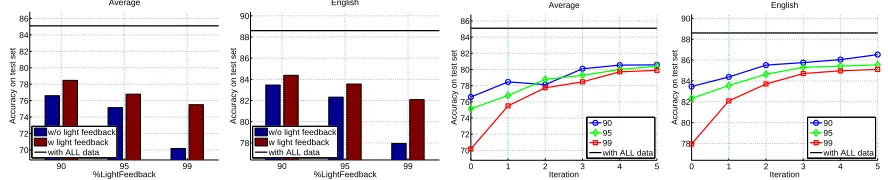
The results of the light-feedback training after only a single iteration are given in the two left plots of Fig. 3. One plot shows the performance averaged over all languages, and second plot show the results for English. The black horizontal line shows the ac-curacy achieved by training the parser on the entire annotated data using the MIRA algorithm for 10 it-erations. The predicted edge accuracy of the parser trained on the entire annotated dataset ranges from
77%on Turkish to93%on Japanese, with an
aver-age of85%. This is ourskyline.
The blue bars in each plot shows the accuracy of a parser trained with only a fraction of the dataset
- 10% (left group), via 5% (middle) to 1% (right
group). As expected reducing the amount of training data causes degradation in performance, from an
ac-curacy of about76.3%(averaged over all languages)
via75%to70.1%when training only with1%of the
data. These performance levels are our baselines, one per specific amount of fully annotated data and lightly annotated data.
The red bar in each pair, shows the contribution of a single training epoch with light-feedback on the performance. We see that training with light
feed-back improves the performance of the final parser.
Most noticeably, is when using only1%of the fully
annotated data for initial training, and the remaining
99% of the training data with light feedback. The
accuracy on test set improves from70.1%to75.6%,
an absolute increase of5.5%. These results are
av-eraged over all languages, individual results for En-glish are also shown. In most languages, including those not shown, these trends remain: when reduc-ing the fraction of data used for fully supervised training the performance decreases, and light feed-back improves it, most substantially for the smallest fraction of1%.
We also evaluated the improvement in accuracy on the test set by allowing more than a single itera-tion over the larger fracitera-tion of the training set. The results are summarized in two right plots of Fig. 3, accuracy averaged over all languages (left), and for English (right). Each line refers to a different ratio of split between full supervised learning and light
feedback learning - blue for90%, green for95%and
red for99%. The x-axis is the number of light
feed-back iterations, from zero up to five. The y-axis is the accuracy. In general more iterations translates to improvement in performance. For example,
build-ing a parser with only1%of the training data yields
70.1%accuracy on the test set, a single iteration of
light-feedback on the remaining99%improves the
performance to 75.6%, each of the next iterations
improves the accuracy by about1−2%up to an
ac-curacy of about80%, which is only5%lower than
the skyline. We note again, that the skyline was ob-tained by using full feedback on the entire training set, while our parser used at most five bits of feed-back per sentence from the annotator, one bit per it-eration.
As noted above, on each sentence, and each it-eration, our algorithm presents a parsing query or
“dilemma”: should word a be assigned to word b
or word c. These queries are generated
90 95 99 70
72 74 76 78 80 82 84 86
Average
%LightFeedback
Accuracy on test set
w/o light feedback w light feedback with ALL data
90 95 99
78 80 82 84 86 88 90
English
%LightFeedback
Accuracy on test set
w/o light feedback w light feedback with ALL data
0 1 2 3 4 5
70 72 74 76 78 80 82 84 86
Average
Iteration
Accuracy on test set 90 95 99 with ALL data
0 1 2 3 4 5
78 80 82 84 86 88 90
English
Iteration
[image:6.612.82.526.65.155.2]Accuracy on test set 90 95 99 with ALL data
Figure 3:Two left plots:Evaluation in Binary-Single light feedback setting. Averaged accuracy over all languages (left) and for English. The horizontal black line shows the accuracy when training the parser on the entire annotated training data - “skyline”. Each pair of bars shows the results for a parser trained with small amount of fully annotated data (left blue bar) and a parser that was then trained with asingleiteration of light feedback on the remaining training data (right red bar).Two right plots:Evaluation of training with up to five iterations of binary-single light feedback. The plots show the average accuracy (left), and for English. Each line refers to a different ratio of split between full supervised learning and light feedback learning. The x-axis is the number of iterations of light feedback, from zero to five.
a query and response using the stored information.
The fraction of new queries, that were actually
presented to the annotator, when light-training with
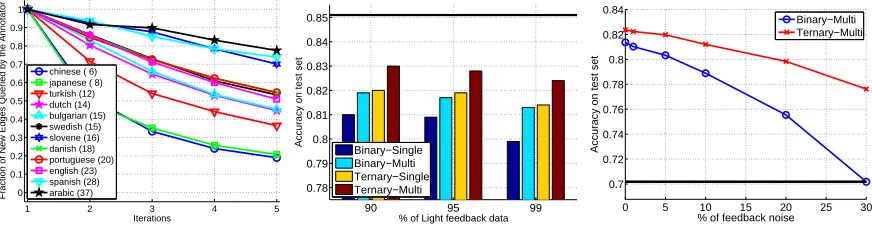
99% of the training set, is shown in the left panel
of Fig. 4. Each line corresponds to one language. The languages are ordered in the legend according to the average number of words per sentence: from
Chinese (6) to Arabic (37). Each point shows the
fraction of new queries (from the total number of sentences with light-feedback) (y-axis) vs. the itera-tion (x-axis). Two trends are observed. First, in later iterations there are less and less new queries (or need for an actual interaction with the annotator). By def-inition, all queries during the first iteration are new, and the fraction of new queries after five iteration
ranges from about20%(Japanese and Chinese) to a
bit less than80%(Arabic).
The second trend is across the average number of words per sentence, the larger this number is, the more new queries there are in multiple iterations. For example, in Arabic (37 words per sentence) and
Spanish (28) about 80% of the light-training
sen-tences induce new queries in the fifth iteration, while
in Chinese (6) and Japanese (8) only about 20%.
As expected, longer sentences require, on average, more queries before getting their parse correctly.
We can also compare the performance improve-ment achieved by light feedbacks with the per-formance achieved by using the same amount of labeled-edges using fully annotated sentences in standard supervised training. The average sentence
length across all languages is 18 words. Thus,
re-ceiving feedback regarding a single word in a
sen-tence equals to about1/18 ≈ 5.5%of the
informa-tion provided by a fully annotated sentence. There-fore, we may view the light-feedback provided for
99%of the dataset as about equal to additional5.5%
of fully annotated data.
From the second plot from the right of Fig. 3, we
see that by training with1%of fully annotated data
and a single iteration of light feedback over the
re-maining 99% of the data, the parser performance
is 75.6% (square markers at x = 1), compared to
75% obtained by training with 5% of fully
anno-tated data (diamond markers at x = 0). A second
iteration of light feedback on 99% of the dataset
can be viewed as additional. 5% of labeled data
(accounting for repeating queries). After the sec-ond light feedback iteration, the parser performance
is 77.8% (square markers at x = 2), compared to
76.3%achieved when training with10%of fully
an-notated data (circle markers atx= 0). Similar
rela-tions can be observed for English in the right plot of Fig. 3. From these observations, we learn that on av-erage, for about the same amount of labeled edges, light feedback learning gains equal, or even better, performance compared with fully labeled sentences.
5 Light Feedback Variants
1 2 3 4 5 0
0.1 0.2 0.3 0.4 0.5 0.6 0.7 0.8 0.9 1
Iterations
Fraction of New Edges Queried by the Annotator
chinese ( 6) japanese ( 8) turkish (12) dutch (14) bulgarian (15) swedish (15) slovene (16) danish (18) portuguese (20) english (23) spanish (28) arabic (37)
90 95 99
0.78 0.79 0.8 0.81 0.82 0.83 0.84 0.85
% of Light feedback data
Accuracy on test set
Binary−Single Binary−Multi Ternary−Single Ternary−Multi
0 5 10 15 20 25 30 0.7
0.72 0.74 0.76 0.78 0.8 0.82 0.84
% of feedback noise
Accuracy on test set
[image:7.612.88.524.61.175.2]Binary−Multi Ternary−Multi
Figure 4:Left:the fraction ofnewqueries presented to the annotator after each of the five iterations (x-axis) for all14languages, when light-training with99%of the entire training data.Middle:comparison of the accuracy achieved using the four light feedback models using different fraction of the data for light feedback stage. The results are averaged over all the languages.Right:Effect of light-feedback noise on the accuracy of the trained model. Results are averaged over all languages for two light feedback settings, the ternary-multi and binary-multi. The plots show the performance measured on test set according the amount of feedback noise added. The black line is the baseline of the initial parser trained on1%of annotated data.
restrictions are relaxed, which may make the work of the annotator harder, but as we shall see, improves performance.
Our first modification is to allow the algorithm to pass the annotator also queries on two alternatives
ˆ
yA andyˆB that differ on more than a single edge.
As mentioned before, we found empirically that this
arises in only∼5%of the instances. In most cases
the two alternatives differ in two edges, but in some cases the alternatives differ in up to five edges. Typ-ically when the alternatives differ on more than a single edge, the words in question are close to each other in the sentence (in terms of word-distance) and are syntactically related to each other. For ex-ample, if changing the edge(i, j) to(i, k)forms a loop in the dependency graph then also another edge
(k, l) must be changed to resolve the loop, so the
two edges different between the alternatives are re-lated. Nevertheless, even if the two alternatives are far from being similar, the annotator is still required
to provide only abinaryfeedback, indicating a strict
preference between the two alternatives. We refer to
this model asBinary-Multi, for binary feedback and
possibly multiple different edge between the alter-natives.
Second, we enrich the number of possible re-sponses of the annotator from two to three, giving the annotator the option to respond that the two al-ternativesyˆAandyˆBare equally good (or bad), and no one should be preferred by the other. In this case
we setβ = 0in the algorithm of Fig. 1, and as can
be seen in the pseudocode, this case does not modify
the weight vectorwassociated with the parser. Such
feedback will be received when both parses have the same number of errors. (We can also imagine a
hu-man annotator using theequalfeedback to indicate
”don’t know”). For the common case of single edge difference between the two parses, this means that both proposed edges are incorrect. Since there are
three possible responds we call this settingternary.
This setting can be combined with the previous one and thus we have in fact two new settings. The third setting is when only single edges are presented to the annotator, yet three possible responds are optional.
We call this settingTernary-Single. The fourth, is
when the two alternatives may differ in more than a
single edgeandthree possible responds are optional
-Ternary-Multisetting.
The accuracy, averaged over all14languages,
af-ter 5 light feedback iterations, for all four settings
is shown in the middle plate of Fig. 4. Each of the three groups summarizes the results for differ-ent split of the training set to full training and
light-training: 90%,95%and99%(left to right; portion
of light training). The horizontal black line shows
the accuracy skyline (85%obtained by using all the
training set in full supervised learning). Each bar in each group shows the results for one of the four set-tings: Binary-Single, Binary-Multi, Ternary-Single and Ternary-Multi. We focus our discussion in the
99% split. The averaged accuracy using
Binary-Single feedback setting is about80%(left bar).
Re-laxing the type of input to include alternatives that differ on more than one edge, improves accuracy by
1.4% (second bar from left). Slightly greater
feed-back, from binary to ternary (third bar from left). Finally, relaxing both constraints yields an
improve-ment of additional 1% to an averaged accuracy of
82.5%which is only2.5%lower than the skyline.
Moving to the other splits of95,90%we observe
that relaxing the feedback from binary to ternary im-proves the accuracy more than requiring to provide a preference of parses that differ on more than a single word.
6 Noisy Light Feedback
In the last section we discussed relaxations that re-quires slightly more effort from the annotator to gain higher test accuracy. The intent of the light feed-back is to build a high-accuracy parser, yet faster and with less human effort compared with full su-pervised learning, or alternatively, allow collecting feedbacks from non-experts. We now evaluate the effect of light-feedback noise, which may be a con-sequence of asking the annotator to perform quick (and rough) light-feedback. We experiment with two settings in which the feedback of the annotator is
either binary or ternary, in themultisettings, when
99%of the training-data is used for light-feedback.
These settings refer to the second and fourth bar in the right group of the middle plate of Fig. 4.
We injected independent feedback errors to a
frac-tion ofof the queries, whereis ranging between
0−30%. In theBinary-Multisetting, we flipped the
binary preference with probability. For example, if
ˆ
yAis better thanyˆBthen with probabilitythe light
feedback was the other way around. In the
Ternary-Multisetting we changed the correct feedback to one of the other two possible feedbacks with
probabil-ity, the specific alternative chosen was chosen
uni-formly. E.g., if indeedyˆAis preferred overyˆB, then with probability/2the feedback was thatyˆBis
pre-ferred and with probability/2that both are equal.
The accuracy vs. noise level for both settings is presented in the right panel of Fig. 4. The black line shows the baseline performance after training an
ini-tial parser on 1% of annotated data. Performance
of the parser trained using theBinary-Multi setting
drops by only1%from81.4%to80.4%at error rate
of5%and eventually as the feedback noise increase
to30%the performance drops to70%- the
perfor-mance level achieved by the initial trained model.
The accuracy of the parser trained in the richer
Ternary-Multisetting suffers only1%performance
decrease at error rate of10%, and eventually5%
de-crease from82.5%to77.5%as the feedback noise
increase to30%, still a7.5%improvement over the
initial trained parser.
We hypothesize that learning with ternary feed-back is more robust to noise, as in half of the noisy feedbacks when there is a strict preference between the alternatives, the effect of the noise is not to update the model and practically ignore the input. Clearly, this is preferable than the other outcome of the noise, that forces the algorithm to make the wrong update with respect to the true preference.
We also experimented with sentence depended noise by training a secondary parser on a subset of the training set, and emulating the feedback-bit us-ing its output. Its averaged test error (=noise level)
is 22%. Yet, the accuracy obtained by our
algo-rithm with it is77%, about the same as achieving
with30%random annotation noise. We hypothesize
this is since the light-feedbacks are requested specif-ically on the edges harder to predict, where the error
rate is higher than the22%average error rate of the
secondary parser.
7 Related work
Weak-supervision, semi-supervised and active
learning (e.g. (Chapelle et al., 2006), (Tong and
Koller, 2001)) are general approaches related to the light-feedback approach. These approaches build on access to a small set of labeled examples and a large set of unlabeled examples.
and then adapted to another domain using partial la-beling. The parts of the data that are labeled are se-lected in one of two approaches. In the first approach phrases are randomly selected to be annotated. In the second approach the phrases are selected accord-ing to their laccord-inguistic categories based on predefined rules. In both cases, the true phrases are provided. In our work, we train the initial parser on small subset of the data from the same domain. Additionally, the feedback queries are selected dynamically according to the edges estimated to be hardest for the parser. Finally, we request only limited feedback and the true parse is never provided directly.
Chang et al. (2007) use a set of domain specific rules as automatic implicit feedback for training in-formation extraction system. For example, they use a set of 15 simple rules to specify the expected for-mats of fields to be extracted from advertisements. The light feedback regarding a prediction is the number of rules that are broken. That feedback is used to update the prediction model.
Baldridge and Osborne (2004) learns an HPSG parser using active learning to choose sentences to be annotated from a large unlabeled pool. Then, like our algorithm the annotator is presented with a proposed parse with several local alternatives
sub-parse-trees. Yet, the annotator manually provides
the correct parse, if it is not found within the pro-posed alternatives. Kristjansson et al. (2004) em-ploy similar approach of combining active learning with corrective feedback for information extraction. Instances with lowest confidence using the current model are chosen to be annotated. Few alternative labels are shown to the user, yet again, the correct
labeling is added manuallyif needed. The
alterna-tives shown to the user are intended to reduce the effort of obtaining the right label, but eventually the algorithm receives the correct prediction. Our al-gorithm is passive about examples (and active only about subset of the labels), while their algorithm uses active learning to also choose examples. We plan to extend our work in this direction. Addition-ally, in these works, the feedback requests involve many alternatives and providing the true annotation, in oppose to the limited binary or ternary feedback. Yet our results show that despite of these limitations the trained parser achieved performance nor far from the performance of a parser training using the entire
annotated dataset.
Finally, our setting is related to bandits (Cesa-Bianchi and Lugosi, 2006) where the feedback is extremely limited, a binary success-failure bit.
8 Summary
We showed in a series of experimental simulations that using light-feedback it is possible to train a de-pendency parser that achieves parsing performance not far from standard supervised training. Further-more, very little amount of fully annotated data, even few tens of sentences, is sufficient for build-ing an initial parser which can then be significantly improved using light-feedbacks.
References
[Baldridge and Osborne2004] J. Baldridge and M. Os-borne. 2004. Active learning and the total cost of annotation. InEMNLP.
[Cesa-Bianchi and Lugosi2006] N. Cesa-Bianchi and G. Lugosi. 2006. Prediction, Learning, and Games. Cambridge University Press, New York, NY, USA. [Chang et al.2007] Ming-Wei Chang, Lev Ratinov, and
Dan Roth. 2007. Guiding semi-supervision with constraint-driven learning. In In Proceedings of the 45th Annual Meeting of the Association for Computa-tional Linguistics.
[Chapelle et al.2006] O. Chapelle, B. Sch¨olkopf, and A. Zien, editors. 2006. Semi-Supervised Learning. MIT Press, Cambridge, MA.
[Crammer et al.2006] K. Crammer, O. Dekel, J. Keshet, S. Shalev-Shwartz, and Y. Singer. 2006. Online passive-aggressive algorithms. JMLR, 7:551–585. [Hall et al.2011] Keith Hall, Ryan McDonald, Jason
Katz-Brown, and Michael Ringgaard. 2011. Training dependency parsers by jointly optimizing multiple ob-jectives. InIn Proceedings of the 45th Annual Meeting of the Association for Computational Linguistics. [Hwa1999] Rebecca Hwa. 1999. Supervised grammar
induction using training data with limited constituent information. CoRR, cs.CL/9905001.
[Kristjansson et al.2004] T. Kristjansson, A. Culotta, P. Viola, and A. McCallum. 2004. Interactive infor-mation extraction with constrained conditional random fields. InAAAI, pages 412–418.
[Marcus et al.1993] Mitchell P. Marcus, Mary Ann Marcinkiewicz, and Beatrice Santorini. 1993. Build-ing a large annotated corpus of english: the penn tree-bank. Comput. Linguist., 19:313–330, June.
[McDonald et al.2005] R. McDonald, F. Pereira, K. Rib-arov, and J. Hajic. 2005. Non-projective depen-dency parsing using spanning tree algorithms. In
HLT/EMNLP.