Volume 2010, Article ID 592960,11pages doi:10.1155/2010/592960
Research Article
A Hierarchical Estimator for Object Tracking
Chin-Wen Wu,
1Yi-Nung Chung,
2and Pau-Choo Chung
11Department of Electrical Engineering, Institute of Computer and Communication Engineering, National Cheng Kung University,
Tainan 701, Taiwan
2Department of Electrical Engineering, National Changhua University of Education, Changhua 500, Taiwan
Correspondence should be addressed to Yi-Nung Chung,[email protected]
Received 17 November 2009; Revised 27 March 2010; Accepted 14 May 2010
Academic Editor: Hsu-Yung Cheng
Copyright © 2010 Chin-Wen Wu et al. This is an open access article distributed under the Creative Commons Attribution License, which permits unrestricted use, distribution, and reproduction in any medium, provided the original work is properly cited.
A closed-loop local-global integrated hierarchical estimator (CLGIHE) approach for object tracking using multiple cameras is proposed. The Kalman filter is used in both the local and global estimates. In contrast to existing approaches where the local and global estimations are performed independently, the proposed approach combines local and global estimates into one for mutual compensation. Consequently, the Kalman-filter-based data fusion optimally adjusts the fusion gain based on environment conditions derived from each local estimator. The global estimation outputs are included in the local estimation process. Closed-loop mutual compensation between the local and global estimations is thus achieved to obtain higher tracking accuracy. A set of image sequences from multiple views are applied to evaluate performance. Computer simulation and experimental results indicate that the proposed approach successfully tracks objects.
1. Introduction
Visual object tracking is an important issue in computer vision. It has applications in many fields, including visual surveillance, human behavior analysis, maneuvering target tracking, and traffic monitoring. The two main types of visual tracking algorithms are target representation and localization algorithms and filtering and data association algorithms [1]. For target representation and localization algorithms, tracking a moving object typically involves matching objects in consecutive frames using features such as edge, region, shape, texture, position, and color. Comaniciu et al. [1] presented a kernel-based framework for tracking nonrigid objects. The mean shift algorithm [2] uses the repeated movement of data points to the sample means. The mean shift algorithm is shown to have effective computation and good tracking performance, but it tends to converge to a local maximum. For filtering and data association algo-rithms, the state estimation method is used for modeling the dynamic system of visual tracking. The state space approach recursively estimates the state vector in two consecutive stages: prediction and updating. In the prediction step, the prior estimate of the current state is derived using a dynamic equation. In the updating step, the posterior estimate of
the state is updated based on measurements. A state space approach which incorporates measurements into existing object tracks within the framework of Kalman filtering was developed in [3]. Cui et al. [4] presented a laser-based dense crowd tracking method. Particle filters, which are based on the Monte Carlo integration method for implementing a recursive Bayesian filter, have also been proposed [5, 6]. The key idea is to represent the required posterior estimate by a set of random samples with associated weights. A particle filter can effectively deal with clutter and ambiguous situations. However, if the dimension of the state vector is high, a particle filter has a very large computational cost [7–
9]. Cheng and Hwang [10] combined a Kalman filter with particle sampling for multiple-object video tracking.
Local estimator Global estimator Camera pair 1
from two-view
Kalman filter based data
fusion Kalman filter
Camera pairN
from two-view
Kalman filter
x+
N(k)
x+ 1(k)
X+(k)
State estimate
X+(k),P+(k) .
. . .
. . .
. .
Figure1: Proposed Kalman-filter-based hierarchical estimator for object tracking.
Gate
O6
Gate
O3
P2 O2
O1 P3
O4
P1 O5
O7 Gate
O1∼O7=Observation positions P1, P2, P3=Predicted target positions
Figure 2: Relationship between predicted objects and measure-ments based on the gating technique.
Occlusion is considered an essential challenge in tracking moving objects. Consequently, a number of recent studies have used multiple views to handle occlusion [13–19]. In [13], a recursive algorithm for stereo was developed. The scheme uses an extended Kalman filter to recursively estimate 3D motion and the depth of moving objects. In [14], a discrete relaxation approach for reducing the intrinsic com-binatorial complexity was introduced. The algorithm uses prior knowledge from 2D tracking of each view to obtain real-time 3D tracking. Hu et al. [15] proposed a framework for tracking multiple people about uncalibrated occlusion reasoning. Khan and Shah [16] presented a tracking system based on the field of views (FOVs) of multiple cameras. Another 3D object tracking method that uses multiple views was presented in [17]. Ercan et al. [18] proposed
0 2 4 6 8 10 12
Po
si
ti
o
n
er
ro
r
0 20 40 60 80 100 120 140 160 180 200 Tracking step
(a)
0 0.2 0.4 0.6 0.8
Ve
lo
ci
ty
er
ro
r
0 20 40 60 80 100 120 140 160 180 200 Tracking step
Proposed Austere fusion
(b)
Figure3: Comparison of the position and velocity errors between proposed method and Austere fusion method.
a particle-based framework for single-object tracking with occlusions in a camera network. This approach requires prior knowledge of the environment and the FOV of each camera for estimating the likelihood of whether the object will be occluded from the view of a camera. Furthermore, they did not address the issue of data fusion. Multiple-view data fusion systems have been investigated in several studies [20,21].
0 5 10 15 20
Po
si
ti
o
n
er
ro
r
0 20 40 60 80 100 120 140 160 180 200 Tracking step
Global MSE Local-1 MSE
(a)
0 5 10 15 20
Po
si
ti
o
n
er
ro
r
0 20 40 60 80 100 120 140 160 180 200 Tracking step
Global MSE Local-2 MSE
(b)
0 5 10 15 20
Po
si
ti
o
n
er
ro
r
0 20 40 60 80 100 120 140 160 180 200 Tracking step
Global MSE Local-3 MSE
(c)
Figure4: Comparison of global and local 3D estimation errors.
using centralized hierarchical fusion. However, the system does not provide feedback to the local filters for modifying their estimate. As such, their approach cannot achieve truly local-global integration to obtain highly accurate estimate. Ajgl et al. [23] discussed various fusion approaches and showed that hierarchical fusion with Millman’s formula has the best performance. Wang et al. [24] developed a two-stage hierarchical framework with partial feedback and applied it to compressed video. Local estimators consist of motion, color, and face detectors. However, the measure-ments of some local estimates in this scheme are not always available due to intracoded frame prediction. Strobel et al. [25] presented a joint audio-video object tracking method based on decentralized Kalman filters. The front end local estimation uses two Kalman filters, one to track objects based on video and the other to track objects based on audio. The results are then passed through two inverse Kalman filters to obtain measurements, which are applied to another Kalman filter for global fusion to obtain the final tracking result. Due to the use of both Kalman filtering and inverse Kalman filtering, the method is relatively time consuming. Furthermore, it is designed as an open-loop mechanism and thus mutual compensation between the global and local estimates cannot be achieved. Medeiros et al. [26] proposed a cluster-based Kalman filter algorithm for a wireless camera
200 300 400
X
0 20 40 60 80 100 120 140 160 180 200 Tracking step
x-real
x-estimate
(a)
−350
−300
−250
Y
0 20 40 60 80 100 120 140 160 180 200 Tracking step
y-real
y-estimate
(b)
40 60 80 100
Z
0 20 40 60 80 100 120 140 160 180 200 Tracking step
z-real
z-estimate
(c)
Figure5: Simulation results of tracking.
(sensor) network for object tracking. In their approach, sensors that detect the same object are grouped into a cluster and the information sensed from each individual sensor in the cluster is sent to the cluster head for aggregation by a Kalman filter. The Kalman filter is divided into blocks to improve the computation efficiency. An innovative protocol procedure between individual sensors and the cluster head was developed. However, how to improve the tracking effi -ciency through a local-global hierarchical fusion mechanism was not discussed.
Camera 1
Camera 3
Camera 2
Figure6: Configuration of the tracking system in the experiment.
the tracking in the optimal estimate. Mutual compensation between the local and global estimates is thus achieved to obtain more accurate position estimation.
The rest of this paper is organized as follows.Section 2
provides a brief overview of the proposed system. The proposed object tracking with hierarchical estimation is described in Section 3. The simulation and experimental results of the proposed approach are described inSection 4. Finally, the conclusions are given inSection 5.
2. System Overview
The proposed hierarchical tracking system (CLGIHE) con-sists of Local Estimator and Global Estimator, as shown in Figure 1. Local Estimator uses data association and the Kalman filter for estimating the 3D position of the object using a camera pair. It should be noted that in the system, every two cameras are considered to be a camera pair. Given 2D images and the camera matrices, the positions of 3D points are computed using the triangulation method presented in [27].
Global Estimator performs data fusion of the estimates obtained by Local Estimator to obtain more accurate 3D global estimates. Object tracking is achieved primarily using measurements received from local estimates that are integrated using a data fusion algorithm to form the global estimate. The fusion algorithm concludes the result considering that different local estimators have different reliability to achieve the best estimation result. Therefore, it can provide increased robustness and accurate estimates. After the global estimate is produced, the estimated 3D position of the tracking object is fed back to local filters for modifying the estimated states.
Suppose that there are N camera pairs and a total of L objects in the system. In the system, the local and global estimates are modeled in world coordinates, whereas 3D measurements are reconstructed by each camera pair. The motion segmentation approach is used in each image plane, for example, background subtraction is used to detect a moving object to obtain a measurement for the local estimate. After the measurement has been recon-structed and assigned to the local estimator, the state estimate is performed for the local filter with the measure-ment.
The following nomenclature is used throughout this study:xidenotes local estimate, “” denotes estimate, “super T” denote transpose, “−” denotes the a priori estimate, “+” denotes the a posteriori estimate, pi denotes the local covariance matrix,ki denotes the Kalman gain of the local estimate, X, P, and K denote the global estimate, the covariance matrix, and the Kalman gain, respectively, In denotes ann×nidentity matrix, andndenotes the dimension of state vectorxi.
3. Proposed Hierarchical Estimator for
Object Tracking
0
−200
−400
−600−400 −200 0
200 400 0
50 100
x
y
z
(a) proposed result
0
−200
−400
−600−400 −200 0
200 400 0
50 100
x
y
z
(b) KIM fusion
0
−200
−400
−600−400 −200 0
200 400 0
50 100
x
y
z
(c) Austere fusion
0
−200
−400
−600−400 −200 0
200 400 0
50 100
x
y
z
(d) Local #1 result
0
−200
−400
−600−400 −200 0
200 400 0
50 100
x
y
z
(e) Local #2 result
0
−200
−400
−600−400 −200 0
200 400 0
50 100
x
y
z
(f) Local #3 result
0
−200
−400
−600−400 −200 0
200 400 60
80 100
x
y
z
(g) ground truth
Figure7: 3D tracking results for sequence 1. (a) Global estimate, (b) Kim’s fusion, (c) Austere’s fusion, (d)–(f) local estimates. (g) Ground truth.
3.1. Local Estimate. The local estimate is computed by the Kalman filters from measurements obtained by a camera pair. Letxibe the estimated state vector in theith Kalman filter at stepkgiven by:
xi(k)=xi(k) ˙xi(k) yi(k) ˙yi(k) zi(k) ˙zi(k)T, (1)
where [xi(k) yi(k) zi(k)] and [ ˙xi(k) yi(k)˙ zi(k)] rep-˙ resent the position and velocity of the tracked object, respec-tively. The Kalman-filter-based local estimate is modeled as
xi(k+ 1)=fi(k)xi(k) +gi(k)wi(k), (2)
wherexi(k+1) andxi(k) are the state vectors at timek+1 and k, respectively, which is the number of camera pairs since one Kalman filter is used for each local estimate from two camera views, andfi(k) andgi(k) are the state transition and noise coupling matrices, respectively. The system noise, wi(k), associated with the moving object at frame k is assumed
to be white Gaussian noise distributed with zero mean and covariance matrixqi(k).
The measurement equation can be expressed as
yi(k)=hi(k)xi(k) +vi(k), (3)
where the measurementyi(k) is formed by a pair of image positions of the ith local estimator at time k, hi(k) is the observation matrix of the filter i, and vi(k) is the measurement error, which is assumed to be white Gaussian noise with zero mean and covariance matrixri(k).
According to the dynamic system defined in (2) and (3), the solution of the Kalman filter for this model for each camera pairiis given by the state prediction in [3].
The updating step is expressed as
x+i(k)=x−i (k) +ki(k)
yi(k)−hi(k)x−i(k)
(4)
with error covariance
p+
200 0
−200
−400−600−100 0 100 200 300 0
100 200
x
y
z
(a) proposed result
200 0
−200
−400−600−100 0 100 200 300 0
100 200
x
y
z
(b) KIM fusion
200
0 −200
−400−600−100 0 100 200 300 0
100 200
x
y
z
(c) Austere fusion
200
0 −200
−400−600−100 0 100 200 300 0
100 200
x
y
z
(d) Local #1 result
200 0
−200
−400−600−100 0 100 200 300 0
100 200
x
y
z
(e) Local #2 result
200 0
−200
−400−600−100 0 100 200 300 0
100 200
x
y
z
(f) Local #3 result
200
0 −200
−400−600−100 0 100 200 300 0
100 200
x
y
z
(g) ground truth
Figure8: 3D tracking results for sequence 2. (a) Global estimate (b) Kim’s fusion (c) Austere’s fusion (d)–(f) local estimates (g) Ground truth.
wherex−i(k)=fi(k)x+
i(k−1) and
p−i(k)=fi(k)p+i(k−1)fiT(k) +gi(k)qi(k)gTi(k). (6)
This process is repeated iteratively at each time instant in all the local tracking processes. The iteration generates one instant-time estimate and the system iteratively updates the estimate.
3.2. Data Association. In a state estimation algorithm, one important procedure is data association, which can be used to determine the relationship between measurements and existing objects. Data association usually consists of two procedural steps: gating and correlation computation logic. If more than one measurement exists, the data association technique can be used to reduce the number of measure-ments.Figure 2shows a typical gate diagram, which consists of three objects, P1, P2, and P3. In this figure, there are three objects and seven observations. The gating technique is
applied to eliminate the least probable observations, such as
O6 andO7. Then, O1,O2,O3,O4, andO5measurements,
whose association with the objects has to be determined, remain. A suboptimal Bayesian approach, denoted as 1-step conditional maximum likelihood, is applied to deter-mine the association between the remaining measurements and the objects. For the above equations, let si(k) =
hi(k)p−i(k)hTi(k) +ri(k) be the residual covariance matrix, andyi(k) = yi(k)−hi(k)x−i (k) the measurement residual vector at timek. In each local estimator, 1-step conditional maximum likelihood is used to obtain the state estimate
xi+(k) from all the valid measurements. The Gaussian likelihoodβj,iof associated measurementiwith objectjis
βj,i= 1
(2π)n|si(k)|exp −
1 2y
T
i(k)s−i1(k)yi(k)
, (7)
0
−200
−400
−600−100 0 100
200 300 0
100 200
x
y
z
(a) proposed result
0
−200
−400
−600−100 0 100
200 300 0
100 200
x
y
z
(b) KIM fusion
0
−200
−400
−600−100 0 100
200 300 0
100 200
x
y
z
(c) Austere fusion
0
−200
−400
−600−100 0 100
200 300 0
100 200
x
y
z
(d) Local #1 result
0
−200
−400
−600−100 0 100
200 300 0
100 200
x
y
z
(e) Local #2 result
0
−200
−400
−600−100 0 100
200 300 0
100 200
x
y
z
(f) Local #3 result
0
−200
−400
−600−100 0 100
200 300 0
100 200
x
y
z
(g) ground truth
Figure9: 3D tracking results for sequence 3. (a) Global estimate, (b) Kim’s fusion, (c) Austere’s fusion, (d)–(f) local estimates, (g) Ground truth.
estimates, the local estimates are sent to the global estimate to obtain a fused final result.
3.3. Global Estimate with Data Fusion. The global esti-mate is composed of the information integrated from the local estimators for tracking and identification. The estimated state of the object at time k is X(k), where
X(k) = [X(k) ˙X(k) Y(k) ˙Y(k) Z(k) ˙Z(k)]T contains the object position [X(k) Y(k) Z(k)] and velocity [ ˙X(k)
˙
Y(k) ˙Z(k)]. The discrete-time global dynamic and meas-urement models of the tracking object are, respectively, defined as
X(k+ 1)=F(k)X(k) +G(k)W(k),
Y(k)=C(k)X(k) +V(k). (8)
Assume that
Y(k)= ⎡ ⎢ ⎢ ⎢ ⎢ ⎣
y1(k)
y2(k)
.. .
yN(k)
⎤ ⎥ ⎥ ⎥ ⎥
⎦, C(k)= ⎡ ⎢ ⎢ ⎢ ⎢ ⎣
C1(k)
C2(k)
.. .
CN(k)
⎤ ⎥ ⎥ ⎥ ⎥
⎦, i=1, 2,. . .,N,
(9)
whereNis the total number of measurements obtained from Nlocal estimators for the tracked object. The system noise,
W(k), associated with the moving object at stepkis assumed to be white Gaussian noise distributed with zero mean and covariance matrixQ(k).C(k) is the global observation matrix, andV(k) is the measurement error, which is assumed to be white Gaussian noise with zero mean and covariance matrixR(k).
Table1: Average geometric error for test sequences.
Sequence Average geometric error (pixels)
View-1 View-2 View-3 Positionx Positiony
1 5.4674 6.8053
2 5.8902 7.2142
3 6.5584 8.6403
defined. LetMj,i(k) be the mapping matrix of the object j
seen by camera pairiat timek. It is defined as follows:
Mj,i(k)=
⎧ ⎨ ⎩
I6, jth object is seen by camera pairi,
06, otherwise,
(10)
whereI6is a 6-by-6 identity matrix,06is a 6-by-6 matrix of
zeros,j=1, 2,. . .,L, andi=1, 2,. . .,N.
The proposed data fusion algorithm in the tracking system is applied to combine the local estimate with mapping matrix Mj,i(k). Thus, recording the output of the local
estimators andMj,i(k) to form global measurement, matrix
C(k) is expressed as
Ci(k)=hi(k)Mj,i(k), i=1, 2,. . .,N. (11)
If object jis seen by camera pairiin the local estimate, the output of the local estimate is fed into the global estimate with global estimate matrixCi(k)=hi(k). Otherwise, there is no need to be updated for none measurement provided.
In order to derive the estimation algorithm, local esti-mates are combined to form the global estimate. The goal is to computeX(k) in each time step. The global estimate,X(k), for a tracking object can be computed with the Kalman filter as
X+(k)=X−(k) +B(k)N
i=1
ki(k)yi(k)−Ci(k)X−(k), (12)
Table2: Average MSE for test sequences.
Method Sequence
Sequence 1 Sequence 2 Sequence 3
Proposed 12.9327 13.2828 13.5486
Kim 13.0883 13.3073 13.5314
Austere 13.1239 13.5741 13.8357
Local 1 14.4163 14.6282 15.9262
Local 2 14.4579 15.9337 16.7499
Local 3 13.9209 13.4702 13.8708
where B(k) is a normalizing matrix for a tracking object, defined as
B(k)= ⎡ ⎣N
i=1
Mj,i(k)
⎤ ⎦
−1
. (13)
The global error covariance is update by
P+(k)= ⎡
⎣I−B(k)N
i=1
ki(k)Ci(k)
⎤
⎦P−(k). (14)
The global priori estimate and its prediction error covariance are computed as
Then, combining (12) and (15), the global estimate for the object becomes
X+(k)=A(k)X+(k−1) +B(k)
N
i=1
ki(k)yi(k), (16)
where
A(k)= ⎡
⎣I−B(k)N
i=1
ki(k)Ci(k)
⎤
⎦F(k). (17)
The local estimates are combined to produce the global estimate, X+(k). The local estimates are computed by the
Kalman filters and rearranged as
x+
i(k)=ai(k)xi+(k−1) +ki(k)yi(k), (18)
where
ai(k)=[I−ki(k)hi(k)]fi(k). (19)
By rewriting (18), one can obtain
ki(k)yi(k)=xi+(k)−ai(k)xi+(k−1). (20)
Let Φi(k) = P+(k)−1
MTj,i(k)p+i(k), where Φi(k) can be considered as the adjusting factor between the local and global error covariance. Then, in the global estimate,
Ki(k)Yi(k)=Φi
x+i(k)−ai(k)x+i(k−1)
(21)
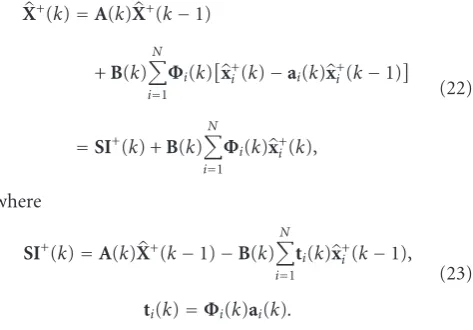
Therefore, the final result of the global estimate for the tracking object,X+(k), in (16) is
X+(k)=A(k)X+(k−1)
+B(k) N
i=1
Φi(k)x+
i(k)−ai(k)xi+(k−1)
=SI+(k) +B(k) N
i=1 Φi(k)x+
i(k),
(22)
where
SI+(k)=A(k)X+(k−1)−B(k) N
i=1
ti(k)xi+(k−1),
ti(k)=Φi(k)ai(k).
(23)
The global estimateX+(k) is fed back to local filters for
improving the local estimates using
x+
i(k)=X+(k), i=1, 2,. . .,N. (24)
In summary, each local estimate,x+
i(k), is computed by each local estimator using (4) and then all local estimates are sent to the global estimator. The global estimate,X+(k) in (22),
is obtained after performing the data fusion process in the global estimator. The global estimateX+(k) is then sent to
each local estimator to update the estimate of the local state vector. When the global estimate is fed back,Mj,i(k) can be
determined.
4. Experimental Results
To evaluate performance, the proposed CLGIHE algorithm was compared with Austere’s method and Kim’s method [28] using computer simulation and real image sequences. Since Austere’s method and Kim’s method use the fusion method without specifying the local filters, to provide an accurate comparison, the Kalman filter was used as the local filter for Austere’s fusion and Kim’s fusion algorithms.
In the simulation, the state noise, measurement noise, and 3D object positions were created using synthetic data generators. The measurement data were obtained via a homogeneous transformation of the two-camera model in addition to measurement errors. Kalman filters were used to estimate the local state vectors. Once the measurement data was received, the corresponding probability was calculated based on each hypothesis. The conditional estimate of the object states was evaluated and combined with the individual estimate for each hypothesis, weighted by the corresponding probability function. The performance of multiple-view tracking was simulated under epipolar geometry.
After several Monte Carlo runs, the results of position and velocity errors for the proposed method and Austere’s method were obtained. A comparison is shown inFigure 3. The horizontal axis indicates the tracking steps, and the vertical axis indicates the position or velocity errors. The position and velocity errors are defined as the mean squared errors. The results indicate that the proposed method has lower MSE values than those of Austere’s method. The average MSE values for the proposed method and Austere’s fusion method are 4.4750 and 4.8893, respectively.
In order to determine the effect of global fusion, the proposed system’s performance was measured with and without global fusion. Figures 4(a)–4(c) show the 3D estimation error comparisons between the global estimator and three local estimators (local 1, local 2, and local 3). The global estimator has lower MSE values than those of each of the three local estimators. The average MSE values obtained for local 1, local 2, and local 3 are 4.7982, 5.0101, and 4.8596, respectively, whereas that for the global estimator is 4.4750. The performance in terms of measured positions of the object compared with the ground truth is shown in
Figure 5. The results show that the estimates ofx, y, andz coordinates are close to those of the object trajectory.
the sum of the projection error in each camera view for a pair of correspondence points. Before the experiment, a self-made calibrated board was used for camera calibration. The calibration uses a set of control points whose coordinates are already known. Then, several reconstructions and re-projections are used to tune the camera matrices by adjusting geometric error.
When the objects are occluded, observations are unavail-able. If there is no measurement to obtain, the object is seen by neither camera. In this situation, the local predicted state is not updated until new observations are generated and the global estimate is updated using only available camera pairs. In the initial step of the experiment, the local and global estimators were initialized, and background subtraction [30] was used to separate the moving foreground objects. The measurement of the local estimator was obtained from two camera views, that is, a camera pair. The local estimate performed its Kalman filter with the estimated state and the Kalman gain was updated. Each output of the local estimator was sent to the global estimator. The global estimator and estimated 3D positions of the tracked object were computed using (22).
For evaluation, three sequences, for which sample images are shown in the three rows of Table 1, were used for the test. The 3D tracking results obtained for the person wearing blue clothes (sequence 1) are shown in Figure 7(a). For comparison, the results obtained with Kim’s fusion and Austere’s fusion algorithms are shown in Figures7(b) and
7(c), respectively. The average MSE values for the proposed method, Kim’s fusion, and Austere’s fusion are 12.9327, 13.0883, and 13.1239, respectively, (see Table 2). Results show that the proposed method has lower MSE values than those of the other fusion methods. To show the fusion effect, the results obtained from local estimates are shown in Figures7(d)–7(f). The average MSE values for the three local estimates are 14.4163, 14.4579, and 13.9209, respectively, (see
Table 2). The results were also evaluated by mapping the obtained 3D positions onto 2D image planes for comparison. The average errors in thex- andy-directions are listed in the last column of the first row inTable 1.
Similarly, the obtained 3D tracking results for sequence 2 and sequence 3 are shown in Figures8and9, respectively. The average errors in thex- andy-directions of the projected 2D images are shown in the last column of the second and the third row inTable 1, respectively. The MSE values of 3D positions obtained using the proposed approach, Austere’s method, Kim’s method, and the three local estimators for sequence 2 and sequence 3 are listed inTable 2.
5. Conclusion
A closed-loop local-global integrated hierarchical estimator (CLGIHE) approach was proposed for object tracking using multiple cameras. CLGIHE adopts the Kalman filter to build an integrated hierarchical fusion estimator because it allows the local and global estimates to be combined into one estimate for mutual compensation. Compared to existing multiple-camera Kalman-filter-based object track-ing approaches, CLGIHE has the followtrack-ing advantages.
Firstly, it is implemented with a feedback loop to achieve iterative optimization-based improvement from both the local and global mutual compensation. Secondly, local and global estimates are integrated into one estimate to allow the optimal adjustment of the fusion gain based on environment conditions from each local estimator to obtain accurate and smooth tracking results. The simulation and experimental results show that the proposed algorithm is capable of tracking objects in various situations. Moreover, the data fusion algorithm applied to the multiple-view images reduces the probability of misdetection.
Acknowledgment
This work was supported in part by National Science Council, Taiwan, under Grant NSC 98-2218-E-006-004.
References
[1] D. Comaniciu, V. Ramesh, and P. Meer, “Kernel-based object
tracking,”IEEE Transactions on Pattern Analysis and Machine
Intelligence, vol. 25, no. 5, pp. 564–577, 2003.
[2] D. Comaniciu, V. Ramesh, and P. Meer, “Real-time tracking
of non-rigid objects using mean shift,” inProceedings of IEEE
Conference on Computer Vision and Pattern Recognition (CVPR ’00), pp. 142–149, June 2000.
[3] M. S. Gerwal and A. P. Andrews,Kalman Filtering Theory and
Practice, Prentice Hall, Englewood Cliffs, NJ, USA, 1993.
[4] J. Cui, H. Zha, H. Zhao, and R. Shibasaki, “Laser-based
detec-tion and tracking of multiple people in crowds,” Computer
Vision and Image Understanding, vol. 106, no. 2-3, pp. 300– 312, 2007.
[5] J. Czyz, B. Ristic, and B. Macq, “A particle filter for joint
detection and tracking of color objects,” Image and Vision
Computing, vol. 25, no. 8, pp. 1271–1281, 2007.
[6] C. Hue, J.-P. Le Cadre, and P. P´erez, “Sequential Monte Carlo
methods for multiple target tracking and data fusion,”IEEE
Transactions on Signal Processing, vol. 50, no. 2, pp. 309–325, 2002.
[7] C. Chang and R. Ansari, “Kernel particle filter: iterative
sampling for efficient visual tracking,” inProceedings of the
International Conference on Image Processing (ICIP ’03), pp. 977–980, September 2003.
[8] N. Bouaynaya, W. Qu, and D. Schonfeld, “An online motion-based particle filter for head tracking applications,” in Proceed-ings of IEEE International Conference on Acoustics, Speech, and Signal Processing (ICASSP ’05), pp. 225–228, March 2005. [9] C. Shan, Y. Wei, T. Tan, and F. Ojardias, “Real time hand
tracking by combining particle filtering and mean shift,” in Proceedings of the 6th IEEE International Conference on Automatic Face and Gesture Recognition (FGR ’04), pp. 669– 674, May 2004.
[10] H.-Y. Cheng and J.-N. Hwang, “Adaptive particle sampling and adaptive appearance for multiple video object tracking,”
Signal Processing, vol. 89, no. 9, pp. 1844–1849, 2009.
[11] Y. Bar-shalom and T. Fortmann,Tracking and Data
Associa-tion, Academic Press, New York, NY, USA, 1988.
[12] D. J. Kershaw and R. J. Evans, “Waveform selective
proba-bilistic data association,”IEEE Transactions on Aerospace and
[13] J.-W. Yi and J.-H. Oh, “Recursive resolving algorithm for
multiple stereo and motion matches,” Image and Vision
Computing, vol. 15, no. 3, pp. 181–196, 1997.
[14] Y. Li, A. Hilton, and J. Illingworth, “A relaxation algorithm
for real-time multiple view 3D-tracking,” Image and Vision
Computing, vol. 20, no. 12, pp. 841–859, 2002.
[15] W. Hu, X. Zhou, M. Hu, and S. Maybank, “Occlusion
reasoning for tracking multiple people,”IEEE Transactions on
Circuits and Systems for Video Technology, vol. 19, no. 1, pp. 114–121, 2009.
[16] S. Khan and M. Shah, “Consistent labeling of tracked objects
in multiple cameras with overlapping fields of view,” IEEE
Transactions on Pattern Analysis and Machine Intelligence, vol. 25, no. 10, pp. 1355–1360, 2003.
[17] J. Black and T. Ellis, “Multi camera image tracking,”Image and
Vision Computing, vol. 24, no. 11, pp. 1256–1267, 2006. [18] A. O. Ercan, A. El Gamal, and L. J. Guibas, “Object tracking
in the presence of occlusions via a camera network,” in
Proceedings of the 6th International Symposium on Information Processing in Sensor Networks (IPSN ’07), pp. 509–518, April 2007.
[19] A. Senior, A. Hampapur, Y.-L. Tian, L. Brown, S. Pankanti, and
R. Bolle, “Appearance models for occlusion handling,”Image
and Vision Computing, vol. 24, no. 11, pp. 1233–1243, 2006. [20] S. L. Dockstader and A. M. Tekalp, “Multiple camera fusion
for multi-object tracking,” inProceedings of IEEE Workshop on
Multi-Object Tracking, pp. 95–102, July 2001.
[21] Q. Zhou and J. K. Aggarwal, “Object tracking in an outdoor
environment using fusion of features and cameras,”Image and
Vision Computing, vol. 24, no. 11, pp. 1244–1255, 2006. [22] M. Majji, J. J. Davis, and J. L. Junkins, “Hierarchical multi-rate
measurement fusion for estimation of dynamical systems,” in
AIAA Guidance, Navigation, and Control Conference 2007, pp. 3967–3978, usa, August 2007.
[23] J. Ajgl, et al., “Millman’s formula in data fusion,” inProceedings of the 10th International PhD Workshop on Systems and Control, pp. 1–6, Prague, Czech Republic, 2009.
[24] J. Wang, R. Achanta, M. Kankanhalli, and P. Mulhem, “A hier-archical framework for face tracking using state vector fusion
for compressed video,” in Proceedings of IEEE International
Conference on Accoustics, Speech, and Signal Processing, pp. 209–212, April 2003.
[25] N. Strobel, S. Spors, and R. Rabenstein, “Joint audio-video object localization and tracking: a presentation general
methodology,”IEEE Signal Processing Magazine, vol. 18, no. 1,
pp. 22–31, 2001.
[26] H. Medeiros, J. Park, and A. C. Kak, “Distributed object tracking using a cluster-based Kalman filter in wireless camera networks,”IEEE Journal on Selected Topics in Signal Processing, vol. 2, no. 4, pp. 448–463, 2008.
[27] R. Hartlry and A. Zisserman, Multiple View Geometry in
Computer Vision, Cambridge University Press, Cambridge, Mass, USA, 2nd edition, 2003.
[28] K. H. Kim, “Development of track to track fusion algorithms,” inProceedings of the American Control Conference, pp. 1037– 1041, July 1994.
[29] D. J. Bardsley and L. Bai, “3D surface reconstruction and
recognition,” inBiometric Technology for Human Identification
IV, vol. 6539 ofProceedings of SPIE, Orlando, Fla, USA, April 2007.
[30] R. Cucchiara, C. Grana, M. Piccardi, and A. Prati, “Detecting
moving objects, ghosts, and shadows in video streams,”IEEE