Cognitive Packet Networks for the Secure Internet of
Things
Joanna Doma ´nska1,†,‡ ID, Tadeusz Czachórski1,‡ ID, Mateusz Nowak1,‡ ID, Slawomir Nowak1,‡ ID
1 IITIS-PAN, Bałtycka 5, 44-100 Gliwice, Poland; {joanna,tadek,mateusz,snowak}@iitis.pl
* Correspondence: [email protected]; Tel.: +48 32 231 73 19
† Current address: IITIS-PAN, Bałtycka 5, 44-100 Gliwice, Poland ‡ These authors contributed equally to this work.
1. Introduction 1
Viewed for a long time as a peripheral issue, Cybersecurity is now at the forefront of everyday 2
computer system and network operations, and of research in Computer Science and Engineering. 3
Indeed cyberattacks, even when they are detected and mitigated, have a very large cost to systems 4
operations including the degradation of the commercial image or trust of the and in 2017 the European 5
Union published its recommendation for security and privacy. In addition, the organisations that 6
operate systems that come under cyberattack can not only lose market share and lose the trust of 7
the end users, but they also have to increase their operating costs both in terms of means to defend 8
themselves but also in increased energy consumption and operating costs [1] and CO2impact [2,3]. 9
The SerIoT Project [4] finds its origins in early work started over a decade ago on Distributed 10
Denial of Service (DDoS) Attacks [5,6] and on using routing with the Cognitive Packet Network 11
protocol (CPN) [7] to detect DDoS, and trace the attacking traffic so as to use CPN’s ACK packets to 12
drop the attacking traffic packets at upstream routers that carry the attacking traffic, and also detect 13
worm attacks [8–11]. More recently, the EU FP7 Project NEMESYS [12–14] provided the opportunity to 14
examine the cybersecurity of mobile networks including the control plane which is used to establish 15
and keep track of calls. Since the control plane is a critical element that enables the mobile network to 16
function, some attacks aim in particular at this part of the system [15,16]. Further work on the security 17
of cyber-physical systems has considered vulnerabilities that address the physical infrastructure, the 18
decision algorithms that manage the system when it operates normally or under threat, and the 19
communication system used to convey data, information and commands between different system 20
components [17–22]. 21
1.1. European Research in Cybersecurity in Recent Years 22
In [23], some recent research on cybersecurity in Europe has been summarised regarding the 23
several projects funded by the European Commission. A core issue that diffuses through all layers of 24
information technology concerns cybersecurity for mobile telephony. Because most modern mobile 25
phones offer opportunistic access [24] to WIFI and other wireless networks, the resulting security 26
vulnerabilities should be constantly monitored both at the network and control plane levels, and in 27
the mobile device. Thus recent [25] has investigated the use of neural network and machine learning 28
methods to discuss this issue. The research in [26,27], addresses attacks that manipulate the signalling 29
plane of the backbone network and directly concerns the mobile network operator as well as the end 30
user, and the project NEMESYS addressed many of these issues [28,29] using techniques from Queuing 31
Theory [30,31]. 32
KONFIDO [32] concentrates on the security of communications and data transfers for 33
interconnected European national or regional health services. Since travellers from European countries 34
must often access health services in another European country, the health informatics systems will 35
have to access remote patient data in a secure manner [32] and the related technical and ethical issues 36
are addressed in a series of recent papers [33–35]. 37
The GHOST project [36] addresses security in the IoT system market [37] for homes, and focuses 38
on the design of a secure home IoT gateway including the attack detection techniques [38], and 39
the analysis of attack methods that try to bring down the energy supply of the devices by draining 40
their batteries [39]. The detection techniques that are proposed are based on Deep Learning [40] and 41
recurrent Random Neural Neworks [41,42] that have been used previously in a variety of applications 42
[43,44]. GHOST also investigates blockchain based methods to track and improve the security of the 43
home IoT system[45]. 44
2. The SerIoT Project 45
The SerIoT project started in January of 2018 [4], and further details regarding can also be found in 46
a forthcoming paper [46]. The project’s Technical Objectives include means to understand the threats 47
to a IoT based economy and understand how distributed ledgers (Blockchain) may improve IoT based 48
systems. It will design and implement virtualised self-aware honeypots to attract and analyse attacks. 49
The project will design SerCPN [47], a network that manages specific distributed IoT devices based 50
on the Cognitive Packet Network (CPN). It will use the implementation of Software Defined Networks 51
(SDN) based on CPN [48–50] using measurements that create the system self-awareness [7,51–54]. 52
These SDNs will use “Smart” Packets (SP) to search [21,55] for secure multi-hop routes having good 53
quality of service (QoS) and measure their security and performance, and will use Reinforcement 54
Learning with Random Neural Networks [56] to improve the network overall performance, including 55
all three criteria of high security, good QoS and low energy consumption [57,58]. It may be possible 56
to extend these schemes with genetic algorithms which use an analogy between network paths and 57
genotypes [59–61]. Several SerCPN network clusters may be interconnected via end overlay network 58
[62], with adaptive connections to Cloud and Fog servers [63,64] for network data analysis and 59
visualisation. 60
Combining energy aware routing and QoS [65,66] with security, we can also address network 61
admission [67] to enhance security. Wireless IoT device traffic may also be specifically monitored and 62
adaptively routed in a similar manner as it accesses SerCPN [68–70]. 63
The project will deliver a number of platforms that comprise the main technical outputs of 64
the project, including Platforms for (i) IoT Data Acquisition, (ii) Ad-hoc Anomaly Detection, (iii) 65
Interactive Visual Analytics and Decision Support Tools, and (iv) Mitigation and Counteraction that 66
will orchestrate, synchronise and implement the decisions taken by the various components. 67
3. Use Cases 68
The SerIoT project’s outcomes will be evaluated in a number of significant use cases. These 69
include four main areas. The first one is Surveillance, where physical security in bus depots will be 70
monitored through the infrastructure of OASA which is the largest transport authority in Greece. 71
The second one involves Intelligent Transport Systems in Smart Cities, in particular in areas such as 72
collision avoidance, where we will demonstrate how SerIoT can enhance the cybersecurity of such 73
systems with infrastructures proveded by OASA, Austria-Tech (ATECH), and TECNALIA for vehicle 74
safety. The third use case will involve Flexible Manufacturing Systems (Industry 4.0), which will 75
monitor physical attacks to wireless sensor networks in Industry 4.0 with the help of DT/T-Sys., for 76
situations related to automated warehouses where different attack vectors may be used for breaking or 77
jamming communication lines. The fourth use case will address Food Chains which require end-to-end 78
security through multiple communication channels, including device authentication, detection and 79
avoidance of DDoS and replication attacks, and detection of functionality anomalies and disabling of 80
IoT devices. In the food chain, IoT devices may be critical to notify perishability of food items that use 81
“on board sensing and communications” for food. This Use Case will be supported by third parties. 83
We take into account diverse, numerous and powerful cyber attacks. 84
Thus the confrontation in SerIoT of the physical world with issues of Cybersecurity, creates a rich 85
opportunity to move forward from traditional work in this area that focuses on cryptography and the 86
management of cryptographic keys [71–74], or the security of software [75] and physical structures 87
[76,77], to broad issues regarding security and system efficiency in the presence of cyberattacks to the 88
integrated cyber and physical infrastructure. 89
4. Secure Routing 90
One of the objectives of the project is to design, implement and test a secure network infrastructure 91
for the IoT, based on Software Defined Networks (SDN) and a smart SDN-Controller with online 92
cognitive security surveillance and reporting, and with the ability to establish and dynamically modify 93
paths to enhance security for IoT devices and end users, while offering a quasi-optimal level of 94
quality of service (QoS) within the required security constraints. The online cognitive surveillance 95
and path management of the network is based on the CPN (Cognitive Packet Network) principle that 96
was discussed in [78] and detailed in [79]. CPNs routing level implementation and performance is 97
presented in various papers such as [55,63]. CPN’s implementation as an overlay network is discussed 98
in [62], and its use as a software defined network (SDN) is discussed in [80]. 99
The smart SDN network designated “SerIoT CPN network” or SerCPN that we will develop in 100
the SerIoT project, starts with some designs discussed in [62,80]. 101
4.1. The SerCPN within the SerIoT Project 102
SerCPN is a general secure, QoS aware and energy-aware network solution, suitable for use in 103
various application contexts, and in particular for the IoT domain, such as: 104
1. Virtual network over operator’s backbone.Telecommunication companies are starting to offer 105
IoT solutions for their customers. The IoT network can be a separate part of the backbone 106
network, managed by the use of virtualization techniques. SerCPN will offer SerIoT solutions to 107
ensure the security of many customers operating IoT networks. 108
2. Overlay over the public Internet.In this case leased links are not used, but instead the resources 109
of the public Internet will be used to create a virtual network [62] of IoT appliances. SerCPNs 110
dynamic and distributed approach will be useful for management of the network. 111
3. Local communication within the IoT network. Some IoT networks may be very large and 112
dynamic (e.g. vehicular networks). In such cases, the use of SDN and SerCPN [80] offer a way 113
forward for a number of security and QoS issues. 114
Every node taking part in data exchange within SerCPN should be cryptographically verified, 115
and communication should be secured. Therefore the PKI infrastructure will be implemented for 116
authorization of the parties exchanging information and encoding of transmitted data. 117
SerCPN should be easily scalable to thousands of edge nodes. To achieve this scalability without 118
loss of performance SerCPN should be decomposable into sub-networks, and coould use a distributed 119
controller architecture, also allowing for hierarchical network structures based on Software Defined 120
Networks (SDN) [81,82] and possible also distributed SDN [83] and hierarchical SDN [84]. 121
4.2. Design goals 122
SerCPN utilises and extends the classic SDN approach. It has an architecture of separated data 123
and control planes, and uses the OpenFlow protocol for communication between them. 124
Decisions about the routes the packets move are made according to the following criteria, ordered 125
by priority: 126
1. Security and Safety.Data must be delivered in reliable way, minimizing the risk of being lost 127
hi-jacking the switches and the controller, and against attempts to feed the controller (or other 129
network components) with wrong information. 130
2. Quality of Service. An important criterion for choosing the paths for packet delivery are the 131
QoS parameters such as throughput, delay and jitter and this can be carried out using CPN as 132
well [85], possible using Composite Goal Functions (CGF) [85] that include both security, QoS 133
and possibly energy as indicated below. Indeed, SerCPN must be secure but its QoS must be 134
attractive to customers. 135
3. Energy usage. Energy usage will be taken into account when deciding about packet routes. 136
Using the known nodes characteristic of energy usage as a function of the load, the load of 137
switches will be adjusted to minimise energy usage, while traffic will be distributed on paths 138
with a view to minimizing the energy consumption per packet or per connection; this can be 139
achieved either by using a heuristic based on CPN [86] or by a computed optimization solution 140
as in [87]. 141
5. Architecture of the SerCPN network 142
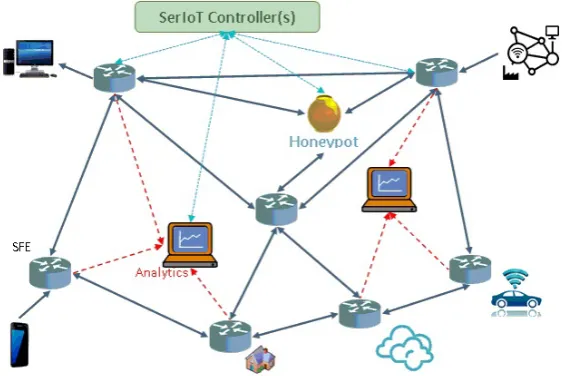
SerCPN’s components include: 143
1. SerCPN Forwarding Element (SFE), 144
2. SerCPN Controller(s), 145
3. SerIoT Analytics Nodes will exploit data collected by SerCPN, 146
4. SerIoT Honeypots will also attempt to attract attacks and inform SerCPN about the network 147
state. 148
SerCPN’s Forwarding Element(SFE) is a basic component of the network. It is a Network 149
Forwarding Element (NFE, referred often imprecisely as SDN switch or SDN router) modified for 150
the needs of SerCPN. SFE performs normal NFE tasks - switching of SDN flows according to rules 151
sent from a controller with use of the OpenFlow protocol. In addition, SFE does the task related to 152
gathering security, QoS and energy usage data, which cannot be done by the SerIoT controller alone. 153
SFE may have the client devices connected (edge node/edge SFE) or may be an intermediate node 154
This piece of open-source software we will extend to achieve required features and functionalities is 155
Open vSwitch (https://www.openvswitch.org/) 156
The SerCPN controller(SerCon) will be based on an advanced, up-to-date, open-source SDN 157
controller. Consistent, modular and easy to extend internal architecture, along with required features – 158
ability to work in distributed mode – caused that we chose ONOS (https://onosproject.org/) as the 159
basis for SerCon. Controllers in SerCPN will be distributed or at least mirrored (with ability to take 160
over tasks of disabled host), to avoid having single point of failure. 161
The aim of theSerIoT Analyticsmodule (SAM) is to provide evaluation of flows in the SerCPN 162
by statistical comparison with historical data. Flows having characteristics different than expected may 163
be blocked, or directed towards a Honeypot, or put under observation for a later decision. The number, 164
placement and interfaces of SAMs will be discussed with partners responsible for their implementation 165
in the project. 166
The SerIoT Honeypot (SH) is a system which mimics the functions of certain devices; it is 167
connected to SerCPN and analyzes the attacks that are conducted on itself. It can be taken over by an 168
attacker without any harm to other nodes of SerCPN. The number, placement and interfaces of SHs to 169
be discussed with partners responsible for their implementation in the project. 170
The Analytics and Honeypot modules will be developed in WP4 and WP5. Their interfaces will 171
be agreed between IITIS (responsible for WP3) and partners responsible for the specific work packages 172
and tasks that deal with these components of the SerIoT project. Further details of the of analytics and 173
Figure 1.An example of a basic SerCPN network (single domain)
5.1. Types of SFEs 175
Looking at use cases, which include both stationary and mobile nodes, with different requirements 176
(from simple messages to continuous video streaming), we can distinguish the following types of 177
SerCPN Forwarding Elements: 178
1. Intermediate nodes, connected only to other SFEs; intermediate nodes are responsible of 179
forwarding packets according to rules sent by SerCon and of providing data to SerCon, by 180
direct communication or via SPs. Special case of intermediate node isborder node, connected 181
with SFE belonging to another subnet. 182
2. Edge nodes; every edge node does the same tasks as the intermediate node; in addition it 183
contains a prevention module, doing simple checking of flows against predefined conditions; 184
edge nodes may be: 185
• stationary, having one or more cable or wireless connection, 186
• mobile, having one or more wireless connections; main characteristics of mobile node is 187
rapidly changing QoS and high probability of temporary connection losing. 188
Every edge SFE may be a: 189
• Full SerCPN nodewhich has more than one physical communication channel, such as cable 190
or wireless for stationary SFEs; wireless channels only in case of mobile SFEs, usually cellular 191
and/or satellite. It may use several physical channels, e.g., GPRS/LTE and satellite, or GPRS to 192
different operators, with distinct SIM cards and transceivers, 193
• Limited SerCPN nodewhich could be a lightweight mobile node, implementing SerIoT features 194
(SPs, prevention), but connected with the core network only through a single Virtual Private 195
Network (VPN) connection, thus doing no routing. Optionally, the VPN can be dynamically 196
reconfigurable. 197
In the SerIoT use cases, full mobile nodes will be installed in buses having high QoS demands (e.g., live 198
video surveillance, plus data from sensors). Changing the wireless interface when current connection 199
conditions are degraded will help to maintain the required QoS level. In the case of wearable sensors 200
or simple monitoring of temperature in a food delivery van, the capabilities of a limited node will be 201
5.2. Hierarchical architecture of SerCPN 203
Due to required size of SerCPN, introduction of hierarchical architecture is necessary. The SerCPN 204
is divided into domains, called subnets. Every subnet constitutes autonomic SDN network, controlled 205
by First Level SerCon as shown in Figure2. The First Level SerCon is responsible for the routing within 206
the subnet, thanks to data gathered from its SFEs. It will also be able to route packets to neighbouring 207
subnets (via the appropriate border node). In the case of flows having destinations outside their own 208
subnet and neighbouring subnets, routing requests will be sent to a Second Level controller. 209
Second (and higher) level SerCPN controllers will see the lower level subnet as a single meta-node. 210
They will be able to designate routing paths via meta-nodes that they control. Security and QoS 211
meta-data are gathered via lower level SerCons. The paths through subnets, found by higher level 212
SerCons are called meta-flows. The detailed path within a subnet is found by First Level SerCons. 213
A flat structure of domains is also possible in some cases for middle-scale networks. Details of 214
data exchange between SerCons connected in a flat structure will be further discussed and investigated 215
in future work. 216
Figure 2.The Hierarchical Architecture of the SerCPN
6. Routing Criteria 217
In the case of a SDN based implementation for SerCPN, routing decisions are reflected by creating 218
appropriate rules for given flows. The routing decisions will be taken by an “oracle”, which is fed with 219
security, QoS and energy data, which will be stored in a Cognitive Security Memory (CM). As in CPN 220
[78][79] the “oracle” will be implemented using Random Neural Networks (RNN) [88][89] which will 221
specifically exploit a real-time learning algorithm such as Reinforcement Learning (RL). RNNs will be 222
placed in the controller plugin, and the CM data will be used in the RNN learning process. Let us note 223
that the RL based learning process of CPN not only exploits the ongoing measurement data, but it also 224
generates data such as the comparison between short or long-term history regarding measurements, 225
and the QoS, Energy or Security state of paths [85] that may be exploited by the analytics modules of 226
SerCPN. 227
CM data will belong to three groups, according to the criteria listed in4.2. A detailed list of used 228
values, as well as their meaning for final evaluation of paths and intermediate nodes will be worked 229
1. Security (trust level) of devices connected to given edge SFE – likeliness of being the source or 231
destination of the attack. 232
2. Security (trust level) of the SFEs, both edge and intermediate – likeliness of the node being 233
attacked and disabled or intercepted. 234
3. Security (trust level) of particular flows – likeliness of being part of attack. 235
4. QoS parameters provided by particular paths. 236
5. Power consumption and energy usage of particular nodes for specific measured traffic values. 237
In all cases we will focus on, and obtain, quantitative metrics and evaluations, and these values 238
will be used for learning by the RNNs, and transferred for exploitation by the analytics modules of 239
SerIoT. 240
Group 1includes preventive actions. Simple verifications may include the verification of default 241
credentials, which are the biggest IoT threats due to devices having set default passwords, also the 242
fingerprinting the firmware version (with comparisons vis-a-vis of a database containing known 243
vulnerabilities of particular firmware versions), and more advanced – automatic active penetration 244
testing of connected devices (one time or periodic). 245
Group 2actions depend on the details of the implementation of a given network. If all SFEs are 246
not administered by the same owner, actions similar to those regarding Group 1 should be used. In the 247
opposite case, when all nodes are under the administration of single unit, some similar actions, e.g. 248
pointing at the necessity of firmware upgrades, should be considered. In addition, we may use the 249
availability rate of the nodes, independently of the reasons such as attacks or technical failure, as a 250
way to modify the trust level of a node. More advanced methods can include the ability to learn the IP 251
addresses and ports used by IoT devices connected to a given edge node, and – after some time of 252
observation (e.g. a week) – firewall rules can be set to block or report traffic that does not match the 253
known addresses or ports. 254
The widest group of security measures will be taken as part ofGroup 3, requiring an estimate of 255
the probability that a given flow is part of network attack. Some of the verifications that may be used 256
include: 257
• Checking if the source or destination of the flow is on the public blacklist of IP addresses known 258
to be sources of attack. 259
• Checking if a DNS name appearing in a DNS request of a customer appliance is on the public 260
blacklist of domains known to be sources of attack. 261
• Introducing simple (lightweight) prevention without using statistics, e.g.: 262
– Detection of very high bitrate (exceeding predefined threshold) 263
– Detection of access to random IP addresses (IP scan) 264
– Detection of non-standard use of protocols (ssh, DNS, NTP etc.) 265
– Spam detection (e-mails sent from devices we don’t expect doing so, or in amounts 266
exceeding expected numbers) 267
We should also consider gathering information about whether a given node (SFE or client device) is 268
often the aim of unsuccessful attacks. Such data may be useful for evaluating its trust level. 269
The next group, Group 4, considers criteria for routing decisions based on QoS parameters. 270
Throughput of given links, delay and jitter, loss rates in case of wireless links should be measured and 271
forwarded to the CM. 272
Group 5includes data on power consumption and energy usage. Since energy awareness is not a 273
of primary concern to WP3, we will not focus on this point but keep it in mind for further work. 274
Thus the factors listed in Group 1 through Group 4 will be used to create the CGF [85] for SerCPN 275
optimisation. 276
The data listed above are directly used by 1st level SerCon(s). Data gathered by the higher level 277
SerCon(s) will be meta-data describing the subnet as a whole. Its detailed content will be worked 278
out during the course of the project. Still, the higher level SerCon(s) will use the same concept of 279
RNNs and CSMs, carrying out meta-routing decisions in the same manner and according to the same 280
7. Implementation of data acquisition and routing decisions 282
The SerCPN Routing Engine (SRE) will be distributed in one or more SDN controllers as a plugin 283
module, using the RNNs to implement the decision oracles, enabling a semi-distributed way of taking 284
decisions, but using the advantages of the semi-centralisation of the SDN architecture. Linking specific 285
RNNs to SFEs will reflect the physical network topology. The role of a single RNN will be to specify, 286
at the time of decision making, which output node should be used for a given SFE, regarding a flow 287
having a given destination. Data will be gathered by the SRE in three ways: 288
1. Upon request from the controller, 289
2. As unsolicited (asynchronous) messages from SFE to controllers, and 290
3. In the form of Smart Packets (SPs). 291
Requests from controller may be implemented in OpenFlow or other standard protocols, e.g. SNMP. 292
The same applies to asynchronous messages from the SFEs. 293
The Cognitive Packet Network (CP) [55] uses Smart Packets (SPs) that travel from one node to 294
another towards their destination, gathering measured data that is provided by the nodes that are 295
visited, and the data is returned to the source node that generated the SP in ACK (acknowledgement 296
packets) that use the inverse of the route that was effectively used by the SPs. Normally, the path of 297
the SPs is provided by the SFEs of the nodes visited by the SPs, and the path of ACKs is source routed 298
from the destination node back to the source. Thus in CPN [85] each of the nodes visited by a SP is 299
able to receive and copy from the corresponding ACK, the data that was collected by a SP on its path. 300
Such nodes can then store and exploit the data that has been collected by each SP that visited the node. 301
On the other hand, in SerCPN, sending of SPs and routing over the network is controlled by the SREs, 302
each of which have a CDE. 303
SPs will be used for data which is not available otherwise, such as delay on the link or total delay 304
between two adjacent nodes including the delay inside nodes, and for data which can be sent by nodes 305
directly (asynchronously or by request) but which are less urgent (e.g. energy usage). SPs aggregate 306
the data from many nodes on their path and send them back in a single ACK message, reducing the 307
potential communication overhead. The use of SPs could be limited to first-level SerCons. Controllers 308
of higher level meta-networks could then use data provide by lower level controllers. 309
7.1. Implementation of SPs 310
Introducing SPs into the SDN network requires extending of Open vSwitch implementation, as 311
in [80], and is the main difference between SFE and a standard SDN switch. SPs do not exist in any 312
standard protocol handled by Open vSwitch, so their implementation will be part of our work. SPs 313
must be recognised and handled in an appropriate way, and sent by SFEs, which may be achieved 314
by standard OpenFlow commands. The node at the end of SP route sends an ACK back to the 315
corresponding controller, which may be carried out with standard OF commands. However, in every 316
node that is visited, new data is added to the SP so that mechanisms to recognise SPs and handle them 317
according to SerCPN requirements will be implemented. 318
7.2. SRE: The SerCPN Routing Engine 319
The SRE will be implemented as an ONOS plugin, and will include the RNNs. The approach will 320
combine advantages of the centralised and distributed approaches. The SFEs have access to their own 321
share of data about the network, gathered in their CM for short-term real-time decision making. Some 322
of this data may be transformed into historical data that is shared remotely with the Analytical Engines 323
in the system, or with other SFEs. Thus a section of the SFE’s CM may also store data regarding remote 324
parts of the network, perhaps on a longer-term basis. Decisions about routing in a particular SFEs are 325
taken for each node by its own RNN. Thus, bad decision will not affect the whole network, but only 326
a local part of network, surrounding the affected node which will temporarily provide sub-optimal 327
Thus our approach is to enable a distributed architecture for SerCPN, with many domains and 329
controllers which may be organized either in a flat structure, or in a hierarchical structure, or both, 330
operating at different areas and time scales. 331
A lightweight prevention module (LPM) will be implemented for SFE. It may be part (extension) 332
of Open vSwitch or it may be a standalone Linux kernel module interfaced with OvS. Data from this 333
module may be sent to the controller directly or via SPs. 334
7.3. Modelling studies 335
It is common practice while designing a communication network to use queueing network models 336
to provide a preliminary evaluation of the consequences of design choices and alternatives [90,91]. The 337
topology of the queueing network reflects the physical or logical structure of the real network and 338
the nodes of the network are modelled by service stations with queues corresponding to the packet 339
buffers at nodes, waiting to be sent toward their destination. Service times correspond to the time 340
needed to send a packet and are proportional to packet length, and will also incorporate any packet 341
processing time at the nodes. Such models help to evaluate the random part of the transmission delays 342
introduced by network traffic and congestion, in addition to the propagation delays. This evaluation 343
process will also be carried out during the design of SerCPN. 344
We will consider both discrete event simulation models and analytical queueing models that 345
will reflect the specific features of this network. Simulation may be more detailed but it is more 346
time consuming, especially in the case of transient analysis where the simulation must be repeated 347
thousands of times to obtain statistically credible distributions as a function of time. We may also 348
adapt existing and well documented simulation tools such as OMNeT++ [92] or ns-3 [93]. 349
When analytical methods are considered, we see in particular the potential use of diffusion 350
approximation [94] where the stochastic process representing the queue size is replaced by diffusion 351
process, and its probability density function serves as an approximation of the queue length distribution. 352
The features that are in favour of the diffusion approximation are: 353
• The diffusion model of a single server assumes general interarrival and service time distributions, 354
going beyond “Markov-exponential” models, 355
• Mathematical network models may have any topology, including a hierarchical topology, and 356
are scalable to any number of nodes, 357
• The results are obtained in form of queue length and waiting time distributions, that make 358
it easier to analyse the QoS of paths, e.g. jitter. An alternative method, the fluid -flow 359
approximation, which is frequently used for large topologies and transient analysis, delivers 360
only mean performance parameters and introduces larger errors but may also be considered, 361
• Easy separation (decomposability) of each node within a network model. Indeed, the interactions 362
among nodes are reduced to computation of the input flow parameters at each node [95], 363
• The model may include “classes” of packets that have distinct routing probabilities and distinct 364
characteristics (such as length and processing time at nodes, e.g., allowing to separate the 365
behaviour of smart packets (SPs) and dumb or payload data packets. For instance, a distinct 366
mathematical model may be used for SPs due to the “search” type behaviour that is imposed on 367
their routing schemes [21,96]. 368
• Natural ease to analyse transient states based on the solution of diffusion equations, 369
• The transient model can be solved step-by-step, in small time intervals, with parameters specific 370
to these intervals; any decision of smart SDN controller concerning the dynamic routing of 371
packets, as well as changes in the flows due to attacks and control mechanisms, may be easily 372
reflected in time-dependent and state-dependent diffusion parameters and time-depended 373
routing probabilities in the equations that model the flows. 374
In addition, numerical problems and development of software related to the solution of these large 375
energy-aware routing, can also considered using classical Markov models and their extensions to 377
G-Networks [87,98]. 378
Acknowledgements 379
The authors gratefully acknowledge the support of the SerIoT Research and Innovation Action, 380
funded by the European Commission under the H2020-IOT-2016-2017 (H2020-IOT-2017) Program 381
through Grant Agreement 780139. This paper presents the views of the authors and does not engage 382
the views of the European Commission. The authors thank Erol Gelenbe for his contributions to an 383
earlier version of this paper. 384
References 385
1. Gelenbe, E.; Caseau, Y. The impact of information technology on energy consumption and carbon emissions. 386
Ubiquity2015,2015, 1. 387
2. Jiang, H.; Liu, F.; Thulasiram, R.K.; Gelenbe, E. Guest Editorial: Special Issue on Green Pervasive and 388
Ubiquitous Systems. IEEE Systems Journal2017,11, 806–812. doi:10.1109/JSYST.2017.2673218. 389
3. François, F.; Abdelrahman, O.H.; Gelenbe, E. Impact of Signaling Storms on Energy Consumption and 390
Latency of LTE User Equipment. 17th IEEE International Conference on High Performance Computing 391
and Communications, HPCC 2015, 7th IEEE International Symposium on Cyberspace Safety and Security, 392
CSS 2015, and 12th IEEE International Conference on Embedded Software and Systems, ICESS 2015, New 393
York, NY, USA, August 24-26, 2015, 2015, pp. 1248–1255. doi:10.1109/HPCC-CSS-ICESS.2015.84. 394
4. Domanska, J.; Gelenbe, E.; Czachorski, T.; Drosou, A.; Tzovaras, D. Research and Innovation Action for the 395
Security of the Internet of Things: The SerIoT Project. Recent Cybersecurity Research in Europe, EURO 396
Cybersec 2018; Gelenbe, E.; Campegiani, P.; Czachorski, T.; Katsikas, S.; Komnios, I.; Romano, L.; Tzovaras, 397
D., Eds. Lecture Notes CCIS No. 821, Springer Verlag, 2018. 398
5. Gelenbe, E. Dealing with software viruses: a biological paradigm.information security technical report2007, 399
12, 242–250. 400
6. Gelenbe, E.; Loukas, G. A self-aware approach to denial of service defence. Computer Networks2007, 401
51, 1299–1314. 402
7. Gelenbe, E.; Lent, R.; Nunez, A. Self-aware networks and QoS.Proceedings of the IEEE2004,92, 1478–1489. 403
8. Oke, G.; Loukas, G.; Gelenbe, E. Detecting denial of service attacks with bayesian classifiers and the 404
random neural network. Fuzzy Systems Conference, 2007. FUZZ-IEEE 2007. IEEE International. IEEE, 405
2007, pp. 1–6. 406
9. Sakellari, G.; Hey, L.; Gelenbe, E. Adaptability and failure resilience of the cognitive packet network. 407
DemoSession of the 27th IEEE Conference on Computer Communications (INFOCOM2008), Phoenix, Arizona, 408
USA2008. 409
10. Sakellari, G.; Gelenbe, E. Adaptive resilience of the cognitive packet network in the presence of network 410
worms. Proceedings of the NATO Symposium on C3I for Crisis, Emergency and Consequence Management, 411
2009, pp. 11–12. 412
11. Sakellari, G.; Gelenbe, E. Demonstrating cognitive packet network resilience to worm attacks. Proceedings 413
of the 17th ACM conference on Computer and communications security. ACM, 2010, pp. 636–638. 414
12. Gelenbe, E.; Görbil, G.; Tzovaras, D.; Liebergeld, S.; Garcia, D.; Baltatu, M.; Lyberopoulos, G. NEMESYS: 415
Enhanced network security for seamless service provisioning in the smart mobile ecosystem. InInformation 416
Sciences and Systems 2013; Springer International Publishing, 2013; pp. 369–378. 417
13. Gelenbe, E.; Gorbil, G.; Tzovaras, D.; Liebergeld, S.; Garcia, D.; Baltatu, M.; Lyberopoulos, G. Security for 418
smart mobile networks: The NEMESYS approach. Privacy and Security in Mobile Systems (PRISMS), 2013 419
International Conference on. IEEE, 2013, pp. 1–8. 420
14. Abdelrahman, O.H.; Gelenbe, E.; Görbil, G.; Oklander, B. Mobile network anomaly detection and 421
mitigation: The NEMESYS approach. InInformation Sciences and Systems 2013; Springer International 422
Publishing, 2013; pp. 429–438. 423
15. Görbil, G.; Abdelrahman, O.H.; Gelenbe, E. Storms in mobile networks. Q2SWinet’14, Proceedings 424
Canada, September 21-22, 2014; Mueller, P.; Foschini, L.; Yu, R., Eds. ACM, 2014, pp. 119–126. 426
doi:10.1145/2642687.2642688. 427
16. Abdelrahman, O.H.; Gelenbe, E. Signalling storms in 3G mobile networks. IEEE International 428
Conference on Communications, ICC 2014, Sydney, Australia, June 10-14, 2014. IEEE, 2014, pp. 1017–1022. 429
doi:10.1109/ICC.2014.6883453. 430
17. Desmet, A.; Gelenbe, E. Graph and analytical models for emergency evacuation. 2013 IEEE International 431
Conference on Pervasive Computing and Communications Workshops, PERCOM 2013 Workshops, San 432
Diego, CA, USA, March 18-22, 2013, 2013, pp. 523–527. doi:10.1109/PerComW.2013.6529552. 433
18. Gelenbe, E.; Wu, F.J. Future research on cyber-physical emergency management systems. Future Internet 434
2013,5, 336–354. 435
19. Gelenbe, E. Steady-state solution of probabilistic gene regulatory networks. Physical Review E2007, 436
76, 031903. 437
20. Gelenbe, E. Search in unknown random environments.Physical Review E2010,82, 061112. 438
21. Gelenbe, E. A diffusion model for packet travel time in a random multihop medium.ACM Transactions on 439
Sensor Networks (TOSN)2007,3, 10. 440
22. Akinwande, O.J.; Bi, H.; Gelenbe, E. Managing crowds in hazards with dynamic grouping.IEEE Access 441
2015,3, 1060–1070. 442
23. Gelenbe, E.; Campegiani, P.; Czachórski, T.; Katsikas, S.; Komnios, I.; Romano, L.; Tzovaras, D., Eds. 443
Proceedings of the 2018 ISCIS Security Workshop: Recent Cybersecurity Research in Europe, Vol. 821. Lecture 444
Notes CCIS, Springer Verlag, 2018. 445
24. Gorbil, G.; Gelenbe, E. Opportunistic communications for emergency support systems. Procedia Computer 446
Science2011,5, 39–47. 447
25. Geneiatakis, D.; Baldini, G.; Fovino, I.N.; Vakalis, I. Towards a mobile malware detection framework with 448
the support of machine learning. Recent Cybersecurity Research in Europe: Proceedings of the 2018 ISCIS 449
Security Workshop, Imperial College London; Gelenbe, E.; Campegiani, P.; Czachorski, T.; Katsikas, S.; 450
Komnios, I.; Romano, L.; Tzovaras, D., Eds. Lecture Notes CCIS No. 821, Springer Verlag, 2018. 451
26. Pavloski, M. Signalling Attacks in Mobile Telephony. Recent Cybersecurity Research in Europe: 452
Proceedings of the 2018 ISCIS Security Workshop, Imperial College London; Gelenbe, E.; Campegiani, 453
P.; Czachorski, T.; Katsikas, S.; Komnios, I.; Romano, L.; Tzovaras, D., Eds. Lecture Notes CCIS No. 821, 454
Springer Verlag, 2018. 455
27. Gorbil, G.; Abdelrahman, A.H.; Pavloski, M.; Gelenbe, E. Modeling and analysis of RRC-based signaling 456
storms in 3G networks. IEEE Transactions on Emerging Topics in Computing2016,4, 113–127. 457
28. Pavloski, M.; Gelenbe, E. Signaling Attacks in Mobile Telephony. SECRYPT 2014 - Proceedings of the 11th 458
International Conference on Security and Cryptography, Vienna, Austria, 28-30 August, 2014, 2014, pp. 459
206–212. doi:10.5220/0005019802060212. 460
29. Pavloski, M.; Gelenbe, E. Mitigating for Signalling Attacks in UMTS Networks. InInformation Sciences and 461
Systems 2014; Springer International Publishing, 2014; pp. 159–165. 462
30. Gelenbe, E.; Pujolle, G. Introduction aux réseaux de files d’attente; Edition Hommes et Techniques et 463
Techniques, Eyrolles, 1982. 464
31. Czachórski, T.; Gelenbe, E.; Lent, R.Information Sciences and Systems 2014; Springer International Publishing, 465
2014. 466
32. Staffa, M.; Coppolino, L.; Sgaglione, L.; Gelenbe, E.; Komnios, I.; Grivas, E.; Stan, O.; Castaldo, L. KONFIDO: 467
An OpenNCP-based Secure eHealth Data Exchange System. Recent Cybersecurity Research in Europe: 468
Proceedings of the 2018 ISCIS Security Workshop, Imperial College London; Gelenbe, E.; Campegiani, 469
P.; Czachorski, T.; Katsikas, S.; Komnios, I.; Romano, L.; Tzovaras, D., Eds. Lecture Notes CCIS No. 821, 470
Springer Verlag, 2018. 471
33. Faiella, G.; Komnios, I.; Voss-Knude, M.; Cano, I.; Duquenoy, P.; Nalin, M.; Baroni, I.; Matrisciano, F.; 472
Clemente, F. Building an ethical framework for cross-border applications: the KONFIDO Project. Recent 473
Cybersecurity Research in Europe: Proceedings of the 2018 ISCIS Security Workshop, Imperial College 474
London; Gelenbe, E.; Campegiani, P.; Czachorski, T.; Katsikas, S.; Komnios, I.; Romano, L.; Tzovaras, D., 475
Eds. Lecture Notes CCIS No. 821, Springer Verlag, 2018. 476
34. Akriotou, M.; Mesaritakis, C.; Grivas, E.; Chaintoutis, C.; Fragkos, A.; Syvridis, D. Random number 477
in Europe: Proceedings of the 2018 ISCIS Security Workshop, Imperial College London; Gelenbe, E.; 479
Campegiani, P.; Czachorski, T.; Katsikas, S.; Komnios, I.; Romano, L.; Tzovaras, D., Eds. Lecture Notes 480
CCIS No. 821, Springer Verlag, 2018. 481
35. Castaldo, L.; Cinque, V. Blockchain based logging for the cross-border exchange of eHealth data in 482
Europe. Recent Cybersecurity Research in Europe: Proceedings of the 2018 ISCIS Security Workshop, 483
Imperial College London; Gelenbe, E.; Campegiani, P.; Czachorski, T.; Katsikas, S.; Komnios, I.; Romano, 484
L.; Tzovaras, D., Eds. Lecture Notes CCIS No. 821, Springer Verlag, 2018. 485
36. Collen, A.; Nijdam, N.A.; Augusto-Gonzalez, J.; Katsikas, S.K.; Giannoutakis, K.M.; Spathoulas, G.; 486
Gelenbe, E.; Votis, K.; Tzovaras, D.; Ghavami, N.; Volkamer, M.; Haller, P.; Sánchez, A.; Dimas, M. GHOST 487
- Safe-Guarding Home IoT Environments with Personalised Real-time Risk Control. Recent Cybersecurity 488
Research in Europe: Proceedings of the 2018 ISCIS Security Workshop, Imperial College London; Gelenbe, 489
E.; Campegiani, P.; Czachorski, T.; Katsikas, S.; Komnios, I.; Romano, L.; Tzovaras, D., Eds. Lecture Notes 490
CCIS No. 821, Springer Verlag, 2018. 491
37. Horváth, M.; Buttyán, L. Problem Domain Analysis of IoT-Driven Secure Data Markets. Recent 492
Cybersecurity Research in Europe: Proceedings of the 2018 ISCIS Security Workshop, Imperial College 493
London; Gelenbe, E.; Campegiani, P.; Czachorski, T.; Katsikas, S.; Komnios, I.; Romano, L.; Tzovaras, D., 494
Eds. Lecture Notes CCIS No. 821, Springer Verlag, 2018. 495
38. Brun, O.; Yin, Y.; Gelenbe, E.; Kadioglu, Y.M.; Augusto-Gonzalez, J.; Ramos, M. Deep Learning with Dense 496
Random Neural Networks for Detecting Attacks against IoT-connected Home Environments. Recent 497
Cybersecurity Research in Europe: Proceedings of the 2018 ISCIS Security Workshop, Imperial College 498
London; Gelenbe, E.; Campegiani, P.; Czachorski, T.; Katsikas, S.; Komnios, I.; Romano, L.; Tzovaras, D., 499
Eds. Lecture Notes CCIS No. 821, Springer Verlag, 2018. 500
39. Gelenbe, E.; Kadioglu, Y.M. Energy Life-Time of Wireless Nodes with Network Attacks and Mitigation. 501
Proceedings of ICC 2018, 20-24 May 2018, W04: IEEE Workshop on Energy Harvesting Wireless 502
Communications. IEEE, 2018. 503
40. Gelenbe, E.; Yin, Y. Deep learning with random neural networks. Neural Networks (IJCNN), 2016 504
International Joint Conference on. IEEE, 2016. doi:10.1109/IJCNN.2016.7727393. 505
41. Gelenbe, E. Réseaux neuronaux aléatoires stables. Comptes Rendus de l’Académie des sciences. Série 21990, 506
310, 177–180. 507
42. Gelenbe, E. Learning in the recurrent random neural network. Neural Computation1993,5, 154–164. 508
43. Gelenbe, E.; Cramer, C. Oscillatory corticothalamic response to somatosensory input. Biosystems1998, 509
48, 67–75. 510
44. Cramer, C.E.; Gelenbe, E. Video quality and traffic QoS in learning-based subsampled and 511
receiver-interpolated video sequences. IEEE Journal on Selected Areas in Communications2000,18, 150–167. 512
45. Kouzinopoulos, C.S.; Spathoulas, G.; Giannoutakis, K.M.; Votis, K.; Pandey, P.; Tzovaras, D.; Katsikas, 513
S.K.; Collen, A.; Nijdam, N.A. Using Blockchains to strengthen the security of Internet of Things. Recent 514
Cybersecurity Research in Europe: Proceedings of the 2018 ISCIS Security Workshop, Imperial College 515
London; Gelenbe, E.; Campegiani, P.; Czachorski, T.; Katsikas, S.; Komnios, I.; Romano, L.; Tzovaras, D., 516
Eds. Lecture Notes CCIS No. 821, Springer Verlag, 2018. 517
46. Gelenbe, E.; Domanska, J.; Czachorski, T.; Drosou, A.; Tzovaras, D. Security for Internet of Things: The 518
SerIoT Project. International Symposium on Networks, Computers and Communications, Proceedings of 519
the. IEEE, 2018. 520
47. Domanska, J.; Czachòrski, T.; Nowak, M.; Nowak, S.; Gelenbe, E. SerCPN: Smart Software Defined 521
Network for IoT. To appear, 2018. 522
48. Gelenbe, E. A Software Defined Self-Aware Network: The Cognitive Packet Network. IEEE 3rd Symposium 523
on Network Cloud Computing and Applications, NCCA 2014, Rome, Italy, February 5-7, 2014, 2014, pp. 524
9–14. doi:10.1109/NCCA.2014.9. 525
49. François, F.; Gelenbe, E. Towards a cognitive routing engine for software defined networks. 2016 IEEE 526
International Conference on Communications, ICC 2016, Kuala Lumpur, Malaysia, May 22-27, 2016, 2016, 527
pp. 1–6. doi:10.1109/ICC.2016.7511138. 528
50. François, F.; Gelenbe, E. Optimizing Secure SDN-Enabled Inter-Data Centre Overlay Networks through 529
Computer and Telecommunication Systems, MASCOTS 2016, London, United Kingdom, September 19-21, 531
2016, 2016, pp. 283–288. doi:10.1109/MASCOTS.2016.26. 532
51. Gelenbe, E.; Lent, R.; Xu, Z. Measurement and performance of a cognitive packet network. Computer 533
Networks2001,37, 691–701. 534
52. Gelenbe, E.; Lent, R.; Xu, Z. Design and performance of cognitive packet networks. Performance Evaluation 535
2001,46, 155–176. 536
53. Gelenbe, E.; Lent, R.; Montuori, A.; Xu, Z. Cognitive packet networks: QoS and performance. 537
Modeling, Analysis and Simulation of Computer and Telecommunications Systems, 2002. MASCOTS 2002. 538
Proceedings. 10th IEEE International Symposium on. IEEE, 2002, pp. 3–9. 539
54. Gelenbe, E.; Liu, P. QoS and routing in the cognitive packet network. World of Wireless Mobile and 540
Multimedia Networks, 2005. WoWMoM 2005. Sixth IEEE International Symposium on a. IEEE, 2005, pp. 541
517–521. 542
55. Gelenbe, E. Steps toward self-aware networks. Communications of the ACM2009,52, 66–75. 543
56. Gelenbe, E. Random neural networks with negative and positive signals and product form solution.Neural 544
Computation1989,1, 502–510. 545
57. Gelenbe, E.; Lent, R.; Xu, Z. Towards networks with cognitive packets. InPerformance and QoS of next 546
generation networking; Springer, 2001; pp. 3–17. 547
58. Gelenbe, E.; Lent, R. Power-aware ad hoc cognitive packet networks. Ad Hoc Networks2004,2, 205–216. 548
59. Gelenbe, E. Genetic algorithms with analytical solution. Proceedings of the 1st annual conference on 549
genetic programming. MIT Press, 1996, pp. 437–443. 550
60. Gelenbe, E.; Liu, P.; Laine, J. Genetic algorithms for route discovery.IEEE Transactions on Systems, Man, and 551
Cybernetics, Part B (Cybernetics)2006,36, 1247–1254. 552
61. Liu, P.; Gelenbe, E. Recursive routing in the cognitive packet network. Testbeds and Research Infrastructure 553
for the Development of Networks and Communities, 2007. TridentCom 2007. 3rd International Conference 554
on. IEEE, 2007, pp. 1–6. 555
62. Brun, O.; Wang, L.; Gelenbe, E. Big data for autonomic intercontinental communications. IEEE Transactions 556
on Selected Areas in Communications2016,34, 575–583. 557
63. Wang, L.; Gelenbe, E. Adaptive dispatching of tasks in the Cloud. IEEE Transactions on Cloud Computing 558
2018,6, 33–45. 559
64. Wang, L.; Brun, O.; Gelenbe, E. Adaptive workload distribution for local and remote clouds. Systems, 560
Man, and Cybernetics (SMC), 2016 IEEE International Conference on. IEEE, 2016, pp. 003984–003988. 561
65. Gelenbe, E.; Mahmoodi, T. Energy-aware routing in the cognitive packet network. Energy2011, pp. 7–12. 562
66. Gelenbe, E.; Mahmoodi, T. Distributed Energy-Aware Routing Protocol. InComputer and Information 563
Sciences II; Springer London, 2012; pp. 149–154. 564
67. Gelenbe, E.; Sakellari, G.; D’arienzo, M. Admission of QoS aware users in a smart network. ACM 565
Transactions on Autonomous and Adaptive Systems (TAAS)2008,3, 4. 566
68. Gelenbe, E.; Ngai, E.C.H. Adaptive qos routing for significant events in wireless sensor networks. Mobile 567
Ad Hoc and Sensor Systems, 2008. MASS 2008. 5th IEEE International Conference on. IEEE, 2008, pp. 568
410–415. 569
69. Ngai, E.C.; Gelenbe, E.; Humber, G. Information-aware traffic reduction for wireless sensor networks. 570
Local Computer Networks, 2009. LCN 2009. IEEE 34th Conference on. IEEE, 2009, pp. 451–458. 571
70. Gelenbe, E.; Ngai, E.C.; Yadav, P. Routing of High-Priority Packets in Wireless Sensor Networks. IEEE 572
Second International Conference on Computer and Network Technology, IEEE2010. 573
71. Levi, A.; Çaglayan, M.U.; Koç, Ç.K. Use of nested certificates for efficient, dynamic, and trust preserving 574
public key infrastructure.ACM Trans. Inf. Syst. Secur.2004,7, 21–59. doi:10.1145/984334.984336. 575
72. Ermis, O.; Bahtiyar, S.; Anarim, E.; Çaglayan, M.U. A key agreement protocol with partial backward 576
confidentiality. Computer Networks2017,129, 159–177. doi:10.1016/j.comnet.2017.09.008. 577
73. Yu, C.M.; Ni, G.K.; Chen, Y.; Gelenbe, E.; Kuo, S.Y. Top-k query result completeness verification in sensor 578
networks. Communications Workshops (ICC), 2013 IEEE International Conference on. IEEE, 2013, pp. 579
1026–1030. 580
74. Yu, C.; Ni, G.; Chen, I.; Gelenbe, E.; Kuo, S. Top-k Query Result Completeness Verification in 581
Tiered Sensor Networks. IEEE Transactions on Information Forensics and Security 2014, 9, 109–124. 582
75. Siavvas, M.; Gelenbe, E.; Kehagias, D.; Tzovaras, D. Static analysis-based approaches for secure software 584
development. Proceedings of the 2018 ISCIS Security Workshop: Recent Cybersecurity Research in Europe; 585
Gelenbe, E.; Campegiani, P.; Czachorski, T.; Katsikas, S.; Komnios, I.; Romano, L.; Tzovaras, D., Eds. 586
Lecture Notes CCIS, Springer Verlag, 2018, Vol. 821. 587
76. Gelenbe, E.; Wu, F.J. Large scale simulation for human evacuation and rescue. Computers & Mathematics 588
with Applications2012,64, 3869–3880. 589
77. Gelenbe, E.; Bi, H. Emergency navigation without an infrastructure.Sensors2014,14, 15142–15162. 590
78. Gelenbe, E.; Xu, Z.; Seref, E. Cognitive packet networks. Tools with Artificial Intelligence 1999. Proceedings. 591
11th IEEE International Conference on, 1999, pp. 47–54. 592
79. Gelenbe, E. Cognitive Packet Network. US Patent 6,804,2012004. 593
80. François, F.; Gelenbe, E. Towards a cognitive routing engine for software defined networks. ICC 2016. 594
IEEE Xplore, 2016, pp. 1–6. 595
81. Jammal, M.; Singh, T.; Shami, A.; Asal, R.; Li, Y. Software defined networking: State of the art and research 596
challenges.Computer Networks2014,72, 74–98. 597
82. Stallings, W.Foundations of modern networking: SDN, NFV, QoE, IoT, and Cloud; Pearson Education, 2015. 598
83. Bannour, F.; et al.. Distributed SDN Control: Survey, Taxonomy and Challenges. IEEE Communications 599
Surveys and Tutorials2017. 600
84. Liu, Y.; et al.. A SDN-based architecture for horizontal Internet of Things services. Proc. IEEE Int. Conf. on 601
Communications (ICC), 2015, pp. 5374–5379. 602
85. Gelenbe, E. Steps toward self-aware networks. Commun. ACM2009,52, 66–75. 603
86. Gelenbe, E.; Mahmoodi, T. Energy-aware routing in the cognitive packet network. ENERGY, 2011, pp. 604
7–12. 605
87. Gelenbe, E.; Morfopoulou, C. A Framework for Energy-Aware Routing in Packet Networks. Computer 606
Journal2011,54, 850–859. 607
88. Gelenbe, E. Reseaux neuronaux aléatoires stables.Comptes Rendus de l’Académie des Sciences. Série 21990, 608
310, 177–180. 609
89. Gelenbe, E. Learning in the recurrent random neural network. Neural Computation1993,5, 154–164. 610
90. Gelenbe, E.; Pujolle, G.Introduction aux Réseaux de Files d’Attente; Editions Hommes et Techniques, Eyrolles, 611
1982. 612
91. Czachórski, T.; Pekergin, F. Diffusion Approximation as a Modelling Tool. Network Performance 613
Engineering – A Handbook on Convergent Multi-Service Networks and Next Generation Internet; 614
D.Kouvatsos., Ed. Springer, 2011, pp. 447– 476. 615
92. Webpage. OMNeT++ Discrete Event Simulator. 616
93. WNS3 ’16: Proceedings of the Workshop on Ns-3, New York, NY, USA, 2016. ACM. 617
94. Gelenbe, E. On Approximate Computer Systems Models.Journal ACM1975,22, 261–269. 618
95. Gelenbe, E.; Pujolle, G. The Behaviour of a Single Queue in a General Queueing Network. Acta Informatica 619
1976,7, 123–136. 620
96. Gelenbe, E. Search in unknown random environments.Physical Review E2010,82, 061112. 621
97. Czachórski, T. Queueing models for performance evaluation of computer networks, transient state analysis. 622
Analytic Methods in Interdisciplinary Applications. Springer Proceedings in Mathematics & Statistics, 623
2015, Vol. 116, pp. 51–80. 624
98. Gelenbe, E.; Morfopoulou, C. Routing and G-Networks to Optimise Energy and Quality of Service in 625