A Prashanth kumar*
Prasad institute of pharmaceutical sciences, Jangaon, Warangal, Andhra Pradesh, India. *Corresponding author’s E-mail: [email protected]
Accepted on: 27-01-2014; Finalized on: 28-02-2014. ABSTRACT
The objective of the present study is to develop suitable gastro retentive floating microspheres of Hydrochlorothiazide and to study release kinetics of drug with a view to reduce the dose frequency and to achieve a controlled drug release via gastric retention with improved bioavailability. Formulations were evaluated for dimensional stability study, in vitro drug release profile, buoyancy properties. The optimized formulation also tested for stability studies as per ICH guidelines. The dimensional stability of the formulation and the drug release rate was prolonged with increasing the concentration and viscosity of the polymer. Floating microspheres loaded with hydrochlorothiazide were prepared by Emulsion solvent evaporation method. The prepared microspheres were evaluated by micromeritics properties, in vitro drug release, floating ability and drug entrapment efficiency. Kollidone SR, cellulose acetate, Acrycoat S 100, Methocel K4M, Methocel K15M, Methocel K100M, are used as polymers, Ethanol and Acetone are used as solvents and liquid paraffine is used as oil phase in the preparation of floating microspheres. SEM is used to determine the surface morphology of microspheres.
Keywords: Emulsion solvent evaporation, Floating ability and drug entrapment efficiency, Gastro retentive floating microspheres,
Hydrochlorothiazide, In vitro drug release.
INTRODUCTION
icrospheres can be defined as solid, approximately spherical particles ranging in size from 1 to 1000 micrometer. The Microspheres are characteristically free flowing powders consisting of proteins or synthetic polymers, which are biodegradable in nature. Solid biodegradable microspheres incorporating a drug dispersed or dissolved throughout particle matrix have the potential for controlled release of drugs.1 Microspheres are small in size and therefore have large surface to volume ratios. The concept of incorporating microscopic quantities of materials within microspheres dates back to the 1930s and to the work of Bungerberg de joing and co-workers on the entrapment of substances within coacervates. The potential uses of microspheres in the pharmaceutical have been considered since the 1960’s and have a number of applications.2,3 The use of microspheres in pharmaceuticals have a number of advantages Viz., Taste and odor masking, conversion of oils and other liquids to solids for ease of handling, protection of drugs against environment (moisture, heat, light and oxidation), separation of incompatible materials, to improve flow of powders, production of sustained release, controlled release and targeted medications.4 The most important physico-chemical characteristics that may be controlled in microspheres manufacture are; particle size and distribution, polymer molecular weight, ratio of drug to polymer, total mass of drug and polymer.5,6,7 A number of different substances both biodegradable as well as non-biodegradable have been investigated for the preparation of microspheres; these materials include polymers of natural origin or synthetic origin and also
modified natural substances.8 A range of microspheres prepared using both hydrophilic and hydrophobic polymers. Hydrophilic polymers includes gelatin, agar, egg albumin, starch, chitosan, cellulose derivatives; HPMC, DEAE cellulose.9,10
Advantages of Floating Microspheres
Improves patient compliance by decreasing dosing frequency.
Bioavailability enhances despite first pass effect because fluctuations in plasma drug concentration is avoided, a desirable plasma drug concentration is maintained by continuous drug release.
Better therapeutic effect of short half-life drugs can be achieved.
Gastric retention time is increased because of buoyancy.11
Drug releases in controlled manner for prolonged period.
Site-specific drug delivery to stomach can be achieved.
Enhanced absorption of drugs which solubilizes only in stomach.
Superior to single unit floating dosage forms as such microspheres releases drug uniformly and there is no risk of dose dumping.12
Avoidance of gastric irritation, because of sustained release effect, floatability and uniform release of drug through multiparticulate system.13
The flow characteristics and packability of the resultant microballoons are much improved when compared with the raw crystals of the drug.
Formulation and Development of Hydrochlorothiazide Floating Microspheres
M
Drug targeting to stomach can be attractive for several other reasons. 14
For the weakly basic drugs with poor solubility in the basic environment, the floating systems may avoid any chance of solubility to become the rate-limiting step in the release by restricting the drug to the stomach. Any solute released in the stomach will empty along with the fluids such that the whole surface of the small intestine is available for absorption. This is particularly useful when an absorption window exists in the proximal small intestine.15 The positioned gastric release is useful for all substances intended to produce a lasting local action onto the gastroduodenal wall.
Limitations of floating Microspheres
The major disadvantage of floating systems is requirement of sufficiently high levels of fluids in the stomach for the drug delivery.16,17
The dosage form should be administered with a minimum of glass full of water.
Floating system is not feasible for those drugs that have solubility or stability problems in gastric fluids.18-19
Single unit floating capsules or tablets are associated with an “all or none concept,” but this can be overcome by formulating multiple unit systems like floating microspheres or microballoons.20
Drugs that irritate the mucosa, those that have multiple absorption sites in the gastrointestinal tract, and those that are not stable at gastric pH are not suitable candidates to be formulated as floating dosage forms.21
MATERIALS AND METHODS
Materials
Verapamil hydrochloride is gift sample from aurobindo chemicals pvt. Ltd, Kollidone SR, cellulose acetate, Acrycoat S 100, Methocel K4M, Methocel K15M, Methocel K100M, are procured from Hi Media labs Pvt Ltd, Ethanol, Acetone, liquid paraffine are collected from Micro labs.
Preparation method
Floating microspheres loaded with Verapamil hydrochloride were prepared by Emulsion solvent evaporation method as shown in figure 1. 22-23 Formulations were formulated using different polymers Kollidone SR, cellulose acetate, Acrycoat S 100, Methocel K4M, Methocel K15M, Methocel K100M.
Overall six formulations were formulated using different polymers, Methocel K4M (code F1), Methocel K15 (code F2) and Methocel K100M (code F3), Cellulose acetate (code F4), Acrycoat S100 (code F5), Kollidone SR (code F6) as shown in Table 1.
Table 1: Composition of floating microspheres of Hydrochlorothiazide (preliminary batches)
‘F’ code Drug : Polymer Organic solvent Continuous Phase
F1 1:2 Ethanol Liquid paraffin containing 0.01% tween 80
F2 1:2 Ethanol Liquid paraffin containing 0.01% tween 80
F3 1:2 Ethanol Liquid paraffin containing 0.01% tween 80
F4 1:2 Acetone Liquid paraffin containing 0.01% tween 80
F5 1:2 Ethanol Liquid paraffin containing 0.01% tween 80
F6 1:2 Acetone Liquid paraffin containing 0.01% tween 80
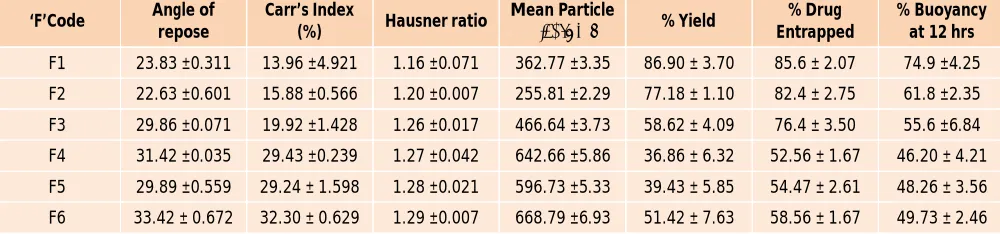
Table 2: Micromeritics Properties and Characterization of prepared floating microspheres (preliminary batches)
‘F’Code Angle of repose
Carr’s Index
(%) Hausner ratio
Mean Particle
Size(µm) % Yield
% Drug Entrapped
% Buoyancy at 12 hrs
F1 23.83 ±0.311 13.96 ±4.921 1.16 ±0.071 362.77 ±3.35 86.90 ± 3.70 85.6 ± 2.07 74.9 ±4.25 F2 22.63 ±0.601 15.88 ±0.566 1.20 ±0.007 255.81 ±2.29 77.18 ± 1.10 82.4 ± 2.75 61.8 ±2.35 F3 29.86 ±0.071 19.92 ±1.428 1.26 ±0.017 466.64 ±3.73 58.62 ± 4.09 76.4 ± 3.50 55.6 ±6.84
F4 31.42 ±0.035 29.43 ±0.239 1.27 ±0.042 642.66 ±5.86 36.86 ± 6.32 52.56 ± 1.67 46.20 ± 4.21 F5 29.89 ±0.559 29.24 ± 1.598 1.28 ±0.021 596.73 ±5.33 39.43 ± 5.85 54.47 ± 2.61 48.26 ± 3.56 F6 33.42 ± 0.672 32.30 ± 0.629 1.29 ±0.007 668.79 ±6.93 51.42 ± 7.63 58.56 ± 1.67 49.73 ± 2.46
RESULTS AND DISCUSSION
From the results of evaluation of the floating microspheres for preliminary screening it was found above in the table 2 that the microspheres prepared with cellulose acetate, Acrycoat and Eudragit S 100 were not showing the satisfactory results. The micromeritics properties of the prepared floating microspheres with
F3 were found to be 52.56 ± 1.67, 54.47 ± 2.61 and 58.56 ± 1.67 respectively. % Buoyancy at 12 h of the formulation F1, F2 and F3 were found to be 46.20 ± 4.21, 48.26 ± 3.56 and 49.73 ± 2.46 respectively. % yield, Drug entrapment efficiency and % Buoyancy at 12 hrs of the formulation F1, F2 and F3 were found to be comparatively less than formulation F4, F5 and F6. So formulation F4, F5 and F6 were selected for further studies with modifications.
Selection of the Formulations for Further Studies
The screening of microspheres formulations were based on different physicochemical and evaluation parameters. The optimistic formulations from above all are F4, F5 and F6. These formulations shows satisfactory results of different physicochemical parameters and evaluation parameters therefore modifications in these three
formulations were made by varying the drug: polymer ratio, solvent systems and change in aqueous phase also investigated.
Optimization of the Selected Formulations
Optimization of the formulations F4, F5 and F6
Modification of all above formulations were affected by preparing the microspheres using different ratio of drug and polymer, combine effect of solvent system and change in aqueous phase also investigated. The floating microspheres were prepared according to the method given in the figure 1. They are designated as K1,K2, K3, A1, A2, A3, C1, C2, and C3. The detailed composition was given in the Table 3.
Table 3: Compositions of optimized formulations of floating microspheres
‘F’ code Drug : Polymer Ratio Organic solvent system [1:1] Continuous Phase
K1 1:1 Ethyl acetate: acetone Liquid paraffin containing 0.01% tween 80
K2 1:2 Ethyl acetate: acetone Liquid paraffin containing 0.01% tween 80
K3 1:1 Ethyl acetate: acetone Liquid paraffin containing 0.01% tween 80
A1 1:1 Dichloromethane: ethanol Liquid paraffin containing 0.01% tween 80
A2 1:2 Dichloromethane: ethanol Liquid paraffin containing 0.01% tween 80
A3 1:1 Dichloromethane: ethanol Liquid paraffin containing 0.01% tween 80
C1 1:1 Ethyl acetate: acetone Liquid paraffin containing 0.01% tween 80
C2 1:2 Ethyl acetate: acetone Liquid paraffin containing 0.01% tween 80
C3 1:1 Dichloromethane: ethanol Liquid paraffin containing 0.01% tween 80
NOTE: Formulations K1, K2 and K3 containing Kollidone SR. Formulations A1, A2 and A3 containing Acrycoat S 100. Formulations C1,
C2 and C3 containing Cellulose acetate.
Table 4: Micromeritics properties and Characteristics of Hydrochlorothiazide floating microspheres
F code Mean Particle
Size(µm) % Compressibility
Hausner Ratio
Angle of
Repose % Yield
% Drug Entrapped
% Buoyancy at 12 hrs
K1 344.70 ±3.81 13.86 ±0.26 1.17 ±0.041 25.42 ±0.67 97.40 83.8 % 72.2 ±2.687
K2 360.75 ±3.30 14.30 ±0.62 1.19 ±0.007 24.42 ±0.03 84.85 84.7 % 73.8 ±3.253
K3 382.50 ±3.09 16.43 ±0.23 1.24 ±0.017 23.89 ±0.55 87.16 82.6 % 68.6 ±2.121
A1 252.45 ±4.63 16.25 ±1.59 1.24 ±0.028 22.83 ±0.31 77.14 82.9 % 62.7 ±0.849
A2 253.80 ±2.27 15.86 ±2.92 1.21 ±0.028 22.63 ±0.60 75.15 81.3 % 61.8 ±1.273
A3 279.00 ±1.27 17.78 ±0.56 1.26 ±0.07 29.88 ±0.07 73.59 80.6 % 63.6 ±0.636
C1 418.95±8.81 17.92 ±1.42 1.26 ±0.016 29.46 ±0.58 44.93 75.6 % 47.0± 1.344
C2 463.64 ±3.68 19.36 ±2.10 1.27 ±0.017 30.23 ±0.28 55.60 77.8 % 50.6 ±0.849
C3 411.61 ±4.86 21.55 ±1.88 1.29 ±0.041 30.48 ±0.68 68.00 72.9 % 53.9 ±1.273
Characterization of optimized formulations
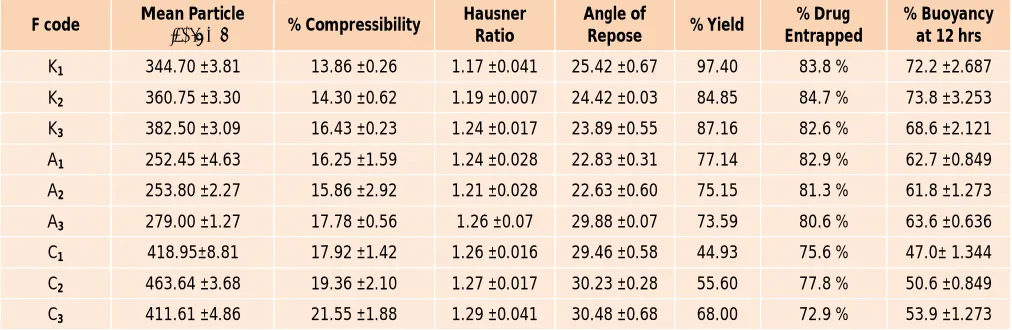
Micromeritics propertiesand evaluations like Yield of microspheres, Drug entrapment efficiency and in vitro floating ability of the optimized formulations were done and results are given in Table 4.
In vitro drug release studies24-25
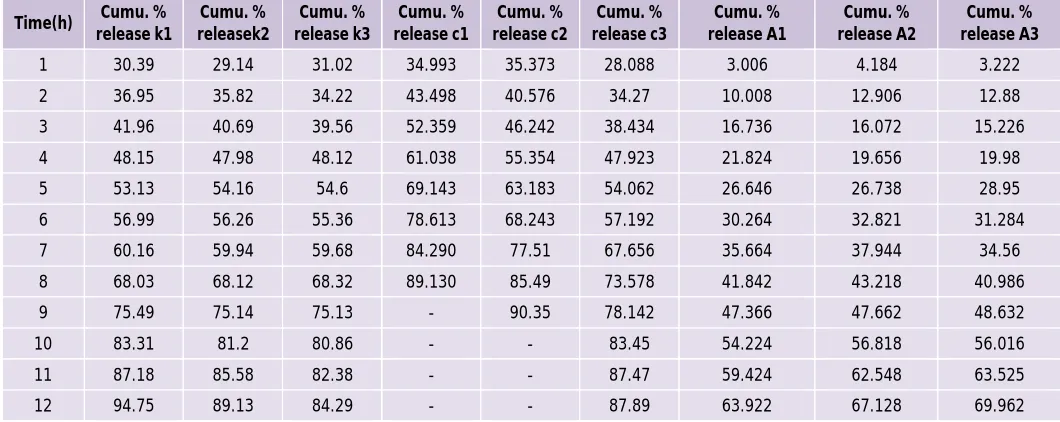
intervals, 5 ml aliquots were withdrawn and analyzed by UV spectrophotometer at the respective lmax value 271 nm after suitable dilution against suitable blank. The withdrawn volume was replaced with an equal volume of fresh 0.1 N hydrochloric acid. The dissolution data of all nine formulations are given in Table 5.
Surface Topography (SEM) 26
The surface morphology, shape and to confirm the hollow nature, microspheres were analyzed by scanning electron microscopy for selected batches as in figure 2. Photomicrographs were observed at required magnification operated with an acceleration voltage of 15 kV and working distance of 19 mm was maintained. Microspheres were mounted on the standard specimen-mounting stubs and were coated with a thin layer (20 nm) of gold by a sputter-coater unit to make the surface conductive.
Figure 1: Preparation method of floating microspheres
Figure 2: SEM of the kollidone SR microspheres (a), Acrycoat S100 microspheres (b) and cellulose acetate microspheres (c).
Kinetic Modeling of Drug Dissolution Profiles
The dissolution profile of all the batches was fitted to Zero order, First order27-28 Higuchi29-30 and Korsemeyer and Peppas30-35 models to ascertain the kinetic modeling of drug release explained in table 6. The method of Bamba et al. was adopted for deciding the most appropriate model.36
Stability Study of the Optimized Batches
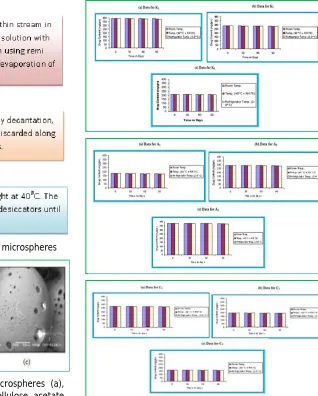
With the recent trend towards globalization of manufacturing operation, it is imperative that the final product be sufficiently rugged for marketing world wide under various climatic conditions including tropical, sub tropical and temperate. Stability studies were carried out as per ICH guidelines.48 The floating microspheres were placed in a screw capped glass containers and stored at room temperature, (25 ± 2°C), Humidity chamber (40°C, 75 % RH), and in Refrigerator (2-8°C) for a period of 90 days. The samples were assayed for drug content at regular intervals. The graph of percent drug content versus time (in days) was plotted as in figure 3.
Table 5: Dissolution data of formulation K1, K2, K3, C1, C2, C3, A1, A2, and A3
Time(h) Cumu. % release k1
Cumu. % releasek2
Cumu. % release k3
Cumu. % release c1
Cumu. % release c2
Cumu. % release c3
Cumu. % release A1
Cumu. % release A2
Cumu. % release A3
1 30.39 29.14 31.02 34.993 35.373 28.088 3.006 4.184 3.222
2 36.95 35.82 34.22 43.498 40.576 34.27 10.008 12.906 12.88
3 41.96 40.69 39.56 52.359 46.242 38.434 16.736 16.072 15.226
4 48.15 47.98 48.12 61.038 55.354 47.923 21.824 19.656 19.98
5 53.13 54.16 54.6 69.143 63.183 54.062 26.646 26.738 28.95
6 56.99 56.26 55.36 78.613 68.243 57.192 30.264 32.821 31.284
7 60.16 59.94 59.68 84.290 77.51 67.656 35.664 37.944 34.56
8 68.03 68.12 68.32 89.130 85.49 73.578 41.842 43.218 40.986
9 75.49 75.14 75.13 - 90.35 78.142 47.366 47.662 48.632
10 83.31 81.2 80.86 - - 83.45 54.224 56.818 56.016
11 87.18 85.58 82.38 - - 87.47 59.424 62.548 63.525
12 94.75 89.13 84.29 - - 87.89 63.922 67.128 69.962
Table 6: Kinetic data of drug release from various formulations
Code Zero order
First order
Higuchi’s kinetics
Peppas
plots n value
C1 0.9438 0.8541 0.9753 0.9543 0.5614
C2 0.9401 0.9399 0.9852 0.9695 0.5673
C3 0.9257 0.9647 0.9842 0.9542 0.5475
K1 0.9468 0.9518 0.9858 0.9790 0.5896
K2 0.9240 0.9223 0.9734 0.9527 0.5276
K3 0.9310 0.9691 0.9863 0.9693 0.5644
A1 0.9977 0.9779 0.915 0.982 1.1545
A2 0.9962 0.9657 0.9073 0.9873 1.0592
A3 0.9899 0.9416 0.8916 0.9741 1.1317
Several Preformulation trials were undertaken for various proportions of drug and polymer by variation of the ethyl acetate-acetone ratio and dichloromethane-ethanol ratio. Kollidone SR, Acrycoat S 100 and Cellulose acetate were selected as matrixing agent considering its widespread applicability and excellent gelling activity in sustain release formulations and also having the pH-independent and reproducible drug release profile. It was found that Kollidone SR microspheres show desirable high drug content, yield, floatation and adequate release characteristics and hence was suitable for development of a controlled release system. The surface morphology and internal texture of floating microspheres were determined by scanning electron microscopy (SEM). Presence of pores were detected on the microspheres surface which increased in number and size after dissolution, it shows that the drug leach out through these channels.
The prepared microspheres were evaluated for the micromeritics properties. The average of three readings was taken. The mean particle size, flow properties and
standard deviation were calculated. The low standard deviation of the measured mean particle size, % Compressibility, Hausner’s Ratio and Angle of Repose of all the 9 formulations ensures the uniformity of the microspheres prepared by emulsion solvent evaporation method. The mean particle size was found to be in the
range of 252.45 ±4.63 µm to 463.64 ±3.68 µm. The
variation in mean particle size could be due to variation in drug-polymer ratio. The % Compressibility of all the microspheres was found to be in the range of 13.86 ±0.26 to 21.55 ±1.88. The Hausner’s Ratio of all the microspheres was found to be in the range of 1.17 ±0.041 to 1.29 ±0.041. The Angle of Repose of all the microspheres was found to be in the range of 22.63 ±0.60 to 30.48 ±0.68. For the all formulations, % drug entrapped was found to vary from 72.9 % to 84.7 % and it shows that the drug entrapment is higher in microspheres containing Kollidone SR and lower in microspheres containing cellulose acetate. For the all formulations, % yield was found to vary 44.93 % to 97.40 % and it shows that the yield is higher in microspheres containing Kollidone SR and lower in microspheres containing cellulose acetate.
The in vitro release data of all formulations were also subjected to model fitting analysis to know the mechanism of drug release from the formulations by treating the data according to zero order, first order, Higuchi and Korsmeyer-Peppas equation. The results are shown in Table. It can be interpreted from the result that the release of drug from the microspheres followed zero order kinetics. Further, the higuchi plot revealed that the drug release from the microspheres obeyed diffusion mechanism. It can be concluded that the formulation of microspheres (K1) containing Hydrochlorothiazide and Kollidone SR (1:1) seems to be promising and further in vivo study must be carried out to check the efficacy of preparations. In vivo floating ability of microspheres was studied; X-ray photograph of dog stomach with barium sulphate containing floating microspheres is shown in figure. Stability studies for all formulations were performed for three months, at room temperature (25 ± 2ºC), at refrigeration temperature (2 to 8ºC), and at 40ºC / RH 75%. The floating microspheres were stored at various above mentioned temperatures. The prepared microspheres were subjected for drug content analysis after every one month interval. Histogram was plotted between drug content (mg/gm) and time (In days), stability profile of different formulations at various temperatures is shown in figure. The data depicts that the floating microspheres stored at room temperature, refrigeration temperature, were found to be comparatively stable and at 40ºC / RH 75 % there was less than 5% degradation at the end of three months.
CONCLUSION
Multi unit gastroretentive drug delivery system has additional advantage of absence of dose dumping as in single unit drug delivery. The present investigation described the influence of viscosity and drug: polymer ratio on Hydrochlorothiazide release. The release and drug entrapment efficiency of the microspheres were affected by the different grade of Methocel. It was found that the Kollidone SR had a dominant role in the drug release from microspheres rather than Acrycoat S 100 and Cellulose acetate. And it can be given in hard gelatin capsule form. Therefore, it may be concluded that drug loaded floating microspheres in combination with Kollidone SR are a suitable drug delivery system for Hydrochlorothiazide and may be used for effective treatment of several cardiovascular disorders.
REFERENCES
1. Goodman and Gillman’s book, The pharmacological basis of therapeutics, Eleventh edition, CBS Publishers and Distributors, New Delhi, 2001, 832-834.
2. Yeole PG, Khan S, Patel VF, Floating drug delivery systems,Need and development, Indian. J. Pharm. Sci., 67(3), 2005, 265-272.
3. Arora S, Ali J, Ahuja A, Khar RK, Baboota S, Floating drug delivery systems, A review, AAPS PharmaScitech., 06(03), 2005, 47.
4. Vyas SP, Khar RK, Targeted and Controlled Drug Delivery Novel Carrier System, first edition, CBS Publishers and Distributors, New Delhi, 2002, 417.
5. Soppimath KS, Kulkarni AR, Aminabhavi TM, Development of Hollow Microspheres as Floating Controlled- Release Systems for Cardio-vascular Drugs, Drug Dev. Ind. Pharm, 27(6), 2001, 507-515.
6. Sato Y, Kawashima Y, Takeuchi H, Yama moto H, In-vitro Evaluation of Floating and Drug Releasing Behavior of Hollow Microspheres (Microballons) Prepared by Emulsion Solvent Diffusion Method, Eur. J. Pharm. Biopharm, 57(2), 2004, 235-243.
7. Kumaresh SS, Anand Rao RK, Floating drug delivery systems, Drug dev. Ind. Pharm., 27(6), 2001, 507-517.
8. Jain NK, Controlled Novel Drug Delivery, first edition, CBS Publishers and Distributors, New Delhi, 2002, 236-255.
9. Whitehead L, Fell JT, Collett JH, Development of a Gastro Retentive Dosage Forms, Eur. J. Pharm. Sci, 4(1), 1996, 182.
10. Chawla G, Gupta P, Koradia V, Bansal AK, Gastroretention- A means to address regional variability in intestinal drug absorption, Pharm. Tech, 27(7), 2003, 50-51.
11. Jose GR, Omidian H, Shah K, Progress in Gastroretentive Drug Delivery Systems, Pharm. Tech, 2003, 152-154.
12. Garg S, Sharma S, Gastro retentive drug delivery systems, Pharm. Tech, 13(1), 2003, 160.
13. Gennaro AR, Remington, The Science and Practice of Pharmacy, Mack Publishing Company, Eastern, Pennysylvania, 19, 1995, 963.
14. Clarckson P, Skinner J, Hughes B, Newborn Services Drug Protocol.Drug Today, 2000, 56.
15. Kale R, Rao BS, Sharma S, Ramanmurthy KV, Preparation and Evaluation of Floatable Drug Delivery System of Ketorolac Tromethamine, Int. J. Pharm, 2001, 64-65.
16. Patel A, Ray S, Thakur R, In vitro evaluation and optimization of floating drug delivery system of metformin hydrochloride, DARU, 14, 2006, 57-64.
17. Rawat M et al., Influence of Selected Formulation Variables on the Preparation of Enzyme-entrapped Eudragit S100 Microspheres, AAPS pharmscitech, 8(4), 2007, E1-E9.
18. Martin A, Physical Pharmaceutics, fourth edition, Lea Febiger, Philadelphia, 431-432.
19. Srivastava AK, Floating microspheres of cimetidine, Formulation, characterization and in vitro evaluation, Acta Pharm, 55, 2005, 277–285.
20. Jain SK, Evaluation of porous carrier-based floating orlistat microspheres for gastric delivery, AAPS pharmscitech, 7(4), 2006, E1-E9.
21. Lannuccelli V, Coppi G, Camaroni R, Air compartment multiple unit system for prolonged gastric residence, Part I, formulation study, Int. J. Pharm, 174, 1998, 47-54.
22. Lee JH, Park TG, Development of oral drug delivery system using floating microspheres, J. Microencapsul, 16(6), 1999, 715-729.
containing tranilast and their drug release characteristics and floating behavior, J. Control Rel, 16, 1991, 279-290.
24. Elkheshen SA, Eldeen B, Alsuwayeh S, AlkhaIed A, In vitro and in vivo Evaluation of Floating Controlled Release Dosage Forms, Pharm. Ind, 66, 2004, 1364-1372.
25. Klausner EA, Lavy V, Friedman M, Hoffman A, Expandable gastroretentive dosage forms, J of Control, 90, 2003, 143– 162.
26. Behera BC, Sahoo SK, Dhal S, Gupta BK, Characterization of glipizide-loaded polymethacrylate microspheres prepared by an emulsion solvent evaporation method, Tropical J. of Pharm.Res, 7(1), 2003, 879-885.
27. Wagner JG, Interpretation of percent dissolved-time plots derived from in vitro testing of conventional tablets and capsules, J.pharm.Sci, 58(10), 1969, 1253-1257.
28. Gibaldi M, Feldman S, Establishment of sink conditions in dissolution rate determinations-theoretical considerations and application to non disintegrating dosage forms, J. Pharm. Sci., 56(10), 1967, 1238-1242.
29. Higuchi T, Rate of Release of medicaments from ointment bases containing drugs in suspension, J. Pharm. Sci, 50(10), 1961, 874-875.
30. Higuchi T, Mechanism of Sustained –Action Medication, Theoretical analysis of rate of release of solid drugs dispersed in solid matrices, J. Pharm. Sci, 52(12), 1963, 1145-1149.
31. Cobby J, Mayersohn M, Walker GC, Influence of shape factors on kinetics of drugs release from matrix tablets II Experimental, J. Pharm. Sci, 63(5), 1974, 732-737.
32. Korsemeyer R, Gurny R, Peppas N, Mechanisms of solute release from porous hydrophilic polymers, Int. J. Pharm, 15, 1983, 25-35.
33. Peppas NA, Analysis of fickian and non-fickian drug release from polymers, Pharm. Acta Helv, 60, 1985, 110-111.
34. Harland RS, Sangalli ME, Colombo P, Peppas NA, Drug/polymer matrix swelling and dissolution, Pharm. Res, 5, 1988, 488-494.
35. Bamba M, Puisieusx F, Release mechanisms in gel forming sustained release preparations, Int. J. Pharm, 2, 1979, 307-315.
36. Carstensen JT, Drug stability: Principle and practices, Marcal Dekker, New York, USA, 2, 1995, 538-550.