Biometric Gait Authentication
Using Accelerometer Sensor
Davrondzhon Gafurov, Kirsi Helkala, and Torkjel Søndrol
Norwegian Information Security Lab - NISlab
Department of Computer Science and Media Technology
Gjøvik University College
P.O. Box 191, 2802 Gjøvik, NORWAY
{davrondzhon.gafurov, kirsi.helkala}@hig.no, [email protected]
Abstract— This paper presents a biometric user authenti-cation based on a person’s gait. Unlike most previous gait recognition approaches, which are based on machine vision techniques, in our approach gait patterns are extracted from a physical device attached to the lower leg. From the output of the device accelerations in three directions: vertical, forward-backward, and sideways motion of the lower leg are obtained. A combination of these accelerations is used for authentication. Applying two different methods, histogram similarity and cycle length, equal error rates (EER) of 5% and 9% were achieved, respectively.
Index Terms— security, biometric, gait recognition, sensor-based gait, unobtrusive authentication, leg acceleration
I. INTRODUCTION
With advances in miniaturization techniques, perfor-mance of the mobile and portable devices is rapidly increasing. This enables to use such devices not only as communication tools but also in an applications like m-banking [1] or m-government [2]. This means that they can store and process valuable information such as financial or private data. This also increases the risk of being target of attacks. According to UK statistics in every three minutes a mobile phone is stolen [3]. The current protection mechanisms of these devices are usually based on PIN codes or passwords. Nowadays a ”heavy” user has on average 21 passwords to remember [4]. Unfortunately, 81% of the users select common words as a passwords and 30% of users write their passwords down, which equally compromises security [4]. Recently, biometric modalities such as fingerprints [5], [6] have been proposed for mobile devices. However, both fingerprints and password entry are obtrusive and require explicit action from the user, which is not convenient in a frequent use. In order to improve security in mobile and portable devices, an unobtrusive mechanisms of authentication is desirable.
This paper presents a biometric authentication of in-dividuals based on their gait. Gait is a person’s manner of walking. Unlike most of the previous gait recognition
This paper based on ”Gait Recognition Using Acceleration from MEMS” by D. Gafurov, K. Helkala and T. Søndrol which appeared in the Proceedings of the 1st IEEE International Conference on Availability, Reliability and Security 2006, Vienna, Austria, April 2006. c2006 IEEE
approaches, in our approach gait patterns are extracted from a physical device attached to the lower leg. From the output of the device accelerations in three directions: vertical, forward-backward and sideways motion of the lower leg are obtained. A combination of these accelera-tions is used for authentication.
Most of previous works in gait recognition are based on machine vision techniques, i.e. they process video or sequence of images to extract gait patterns. We will refer to this type of gait recognition as vision-based. Recently, a new direction in biometric gait recognition has emerged [7], [8], [9]. This direction significantly differs from vision-based methods in terms of technology. Instead of the camera, a physical device attached to the body is used for collecting gait patterns. We call this direction a sensor-based gait recognition. The work presented in this paper belongs to the sensor-based gait recognition group. Usually accelerometers are used as a sensor [7], [8], [9]. An inherent advantage of vision-based gait system is to capture gait of the person from the distance when other types of biometrics (e.g. fingerprints) are not available. A primary advantage of the sensor-based gait biometric over other type of biometric is that it enables unobtrusive user authentication.
The remainder of the paper is structured as follow sec-tion 2 briefly introduces biometric system and basic terms used in the paper, and section 3 presents previous work both on vision-based and sensor-based gait recognition. Section 4 contains a description of the the device and acceleration signals, while section 5 describes two applied methods. Section 6 presents experiments and results, and section 7 contains discussion and outlines some possible application areas for the sensor-based gait authentication. Finally, section 8 concludes the paper with the direction for future works.
II. BIOMETRIC SYSTEM
stored in the database. A verification sample of the user is the one which needs to be compared with enrolment sample(s) stored in the database in order to verify (or identify) the identity of the user. There are essentially two types of submitting biometric data, a genuine attempt and impostor attempt. The genuine attempt is a self-verification attempt when a user’s submitted sample is compared to his own enrolment sample in the database. The impostor attempt is a nonself-verification attempt when user’s verification sample is compared against an-other user’s enrolment sample. A similarity or matching score is an output value from a recognition algorithm that represents how similar two biometric samples are. Based on the similarity score, the biometric systems decides whether to accept or reject a user.
Biometric systems operate in two modes: identification or authentication (also called verification). In the authen-tication mode, the system validates a person’s identity by comparing the captured biometric data with his own biometric enrolled in the database. In this mode, the sys-tem conducts an one to one comparison. In identification mode, the system recognizes an individual by searching the enrolment samples of all users in the database for a match. In this mode, the system conducts one to many comparisons. In other words, the aim of authentication is to answer for the question ”Am I who I claim I am?”, while identification looks for the answer to the question ”Who am I?”. The focus of this paper is primarily on authentication.
III. RELATED WORK
A. Vision-based gait recognition
First studies on the recognition of human gait were reported from medicine and psychology [11], [12]. Jo-hansson [11] demonstrated the ability of humans to recog-nize human locomotion from other types of motions. In addition, it was shown that people can also recognize friends from moving light displays (MLD) [12]. Barclay et al. [13] showed that humans can also recognize the gender of the walker from MLD. Earlier studies on vision-based gait recognition showed promising results, usually with small sample sizes [14], [15], [16], [17], [18], [19]. For instance, with a database of 16 gait samples from 4 subjects and 42 gait samples from 6 subjects, Hayfron-Acquah et al. [14] achieved correct classification rates of 100% and 97%, respectively. Furthermore, recent studies with a larger sample size (more than 100 subjects in the database) confirm gait as having discriminating power from which individuals can be identified [20], [21], [22], [23]. For example, Lam and Lee [20] achieved recognition rate over 80% with the database of 115 subjects and 2,128 walking sequences. Traditionally, gait recognition methods are grouped into two classes: model-based and model-free. Model-based approaches focus on recovering a structural model of the motion [18], [15], [24]. For example, in [18] static parameters of the body, such as the height, the distance between head and pelvis, the maximum distance between pelvis and feet, and the
distance between feet are used for recognition. Model-free techniques aim to extract statistical features from a subject’s silhouette [25], [26], [27]. For instance, Kale et al. [25] use the widths of the silhouette as a basic image feature, and then extract other gait features from it. Unlike model-free techniques, model-based approaches are, in general, view and scale invariant [28]. In a multi-biometric system, gait can improve performance of the system when combined with other type of biometrics, for example with face recognition [29], [30], [31] or foot ground reaction force [32]. For instance, in [29] recognition rates with gait and face profile separately were 85.7% and 64.3%, respectively. However, when they were integrated, performance increased up to 100%.
B. Sensor-based gait recognition
First works on sensor-based gait authentication were reported by Ailisto et al. [7] and M¨antyj¨arvi et al. [8]. They utilized acceleration of the waist for authentication. In our recent work [9], we investigated acceleration characteristics in hip movement for authentication. Sensor placements in [7] and [9] are shown in Figure 1 and Figure 2, respectively. Accelerometer sensors used in [7], [8] measure acceleration at the rate of 256 samples per second, while the sensor used in [9] records acceleration at the rate of about 100 samples/sec. Both in [7], [8] and [9] accelerometers record accelerations in three orthogo-nal directions. However, in [7], [8] accelerations only in two directions, forward-backward and vertical were used, while in [9] resultant acceleration of all three orthogo-nal directions were aorthogo-nalyzed. As a way for unobtrusive multimodal biometric authentication, a combination of a sensor-based gait and voice biometric is proposed. Such fusion enabled to increase the performance of the recog-nition system in a noisy environment [33]. In addition, accelerometer sensor was tested in three different places, hip pocket, chest pocket and in the hand while walking [33], as shown in Figure 3.
Figure 2. Pen-resembling accelerometer sensor attached to the hip [9].
Figure 3. Accelerometer module in hip pocket, chest pocket and hand (used with permission from [33]).
IV. GAITRECOGNITIONTECHNOLOGY
A. The Motion Recording (MR) device
The Motion Recording (MR) device used to collect gait data for the data analysis consists of an AVR Butterfly evaluation board from Atmel Corporation [34] which has been equipped with two ADXL 202 dual axis accelerom-eters from Analog Devices [35]. The acceleromaccelerom-eters have been positioned perpendicular to each other, making it possible to detect accelerations in three directions: vertical, backward-forward and sideways, as shown in Figure 4. An architecture of the MR device consists of a ATmega169 micro controller, an RS-232 interface for data transfer, a 4.5 Volt battery supply and a 4Mbit data flash for storage purposes as shown in Figure 5. The MR device is able to collect acceleration data between ±2g (g ≈ 9.8m/sec2) and has a sampling rate of 16 samples per second. The output from the accelerometers is a digital signal, whose duty cycles are proportional with the acceleration.
The Motion Recording device was encapsulated in a plastic box measuring 5.4 cm × 8.2 cm × 3 cm for protection, and straps were used to ensure a firm
attachment to the leg.
Figure 4. The MR device measures acceleration in three orthogonal directions: vertical, forward-backward and sideways.
Figure 5. Architecture of Motion Recording device.
B. A combined acceleration signal
From the output of the Motion Recording device, acceleration signals in three orthogonal directions: X, Y, and Z are obtained. Instead of considering these raw acceleration signals separately, which might be sensitive to the device’s attachment, we use a combined signal. Several combinations of these signals were tested and the combined gait signal, which is constructed as follows, has shown best performance:
Ri=arcsin(p Zi
X2
i +Yi2+Zi2
), i= 1, ..., k
Figure 6. Fragments of gait acceleration signals: a) vertical X, b) backward-forward Y, c) sideways Z, and d) combined C.
signal. The combined gait signal represents the alignment of the resultant gait signal (i.e.pX2
i +Yi2+Zi2) to the sideway axis (i.e.Z). An example of acceleration signals in three directions and the combined gait signal is shown in Figure 6.
V. GAIT RECOGNITION ALGORITHMS
A. Histogram similarity
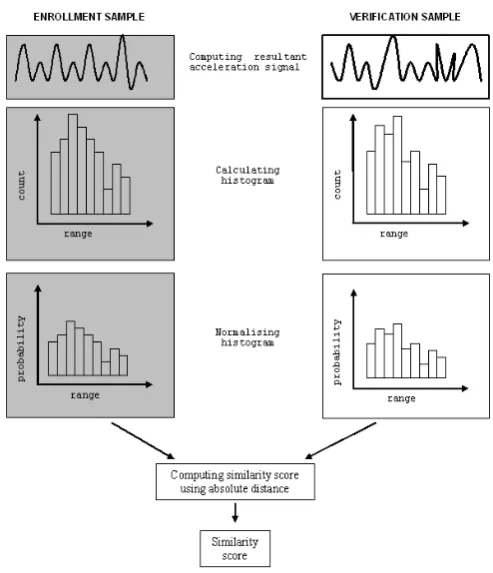
An-bin histogram of the combined gait signal is com-puted. Then, histograms are normalized by the number of recorded observations. As the distance metric between two histograms we use the absolute distance,
dist(x, y) = n
X
i=1
|xi−yi|.
Here xi is the probability of a data point falling into bin iof the enrollment’s normalized histogramx, and yi is the probability of a data point falling into bin iof the verification’s normalized histogramy. This distance value represents similarity score between two gait samples. Ideally, for genuine attempts the similarity scores should be smaller than for impostor attempts.
The steps involved in comparing two gait samples using the histogram similarity method are visualized in Figure 7.
Figure 7. The process of applying the histogram similarity method.
B. Cycle length
The method is based on the comparison of gait cycle groups. The cycles are detected from the gait signal with help of the cycle length. The cycle groups are then created based on the observations point inside cycles. The cycle groups represent gait cycles as populations of general observation points. The idea of the comparison is to calculate similarity scores between corresponding groups and to create the similarity vector. The final comparison score is then determined based on the similarity vector.
Finding the cycles: The gait cycles are easiest to detect from the vertical acceleration signal. The data is first scaled by the formula
xif =xio −x,¯
wherexif is a scaled value,xio is an observed value and
¯
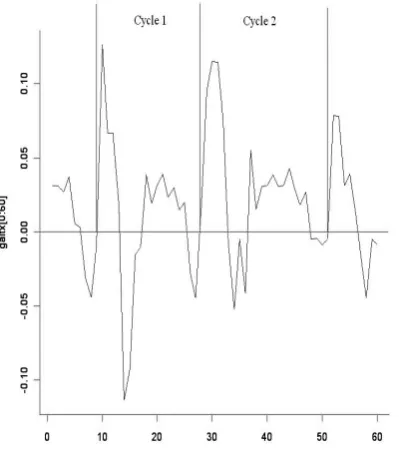
x is the mean value of the data set. After scaling the starting points of each cycle are observed, as shown in Figure 8.
In theory the cycle starts at the point where the ac-celeration is zero. In practice the zero points are rarely found. Therefore the starting point is decided to be a negative value which is followed by a positive value. After the first starting point is detected the autocorrelation function is used to estimate the cycle length. By using the cycle length and observations made from the vertical acceleration data, the combined gait signal is divided to the cycles.
Figure 8. Gait cycles.
points there are in one cycle. In this experiment the cycle length varies from 16 to 22 observations per cycle. In order to compare all individuals only the first 16 observations from each cycle were used for comparison. This means that 16 groups were constructed for each individual. The first observation points (points where acceleration is zero) from each cycle were collected to the first group G1, the second observations from each cycle created the second groupG2, and so on untilG16. An example of the groups is presented in Figure 9.
Comparison of groups: The ideal situation is that the person walks in a similar style all the time. His speed would be constant and his walking pattern would be the same. This would lead to equal gait cycles and therefore normally distributed gait groups because the values of the observation points at the same phase of the curve would be very close to each other. The variance of the cycle group would be very small and the mean value of the group could be used for comparison of the two different gait signals. Even though our experimental data represents a far from ideal data set, the mean of the groups were still tested for comparison.
The similarity of the equal means for each groupGi of persons A and B were calculated by two sample t-tests:
Ti = ¯
GAi−G¯Bi
qs2
Ai
NAi +
s2
Bi
NBi
.
The variances sAi andsBiof the groups were consid-ered to be unequal. The sample size N is the same in all groups. After comparison between two persons datasets, the statistic value vectorT contains 16 probability scores. In order to compare the statistical vectors, the final score valueS was calculated. The final score comparisons were
Figure 9. Cycle groups.
made based on the probability 0.27,
S=
16 X
i=1
si,
where
si= 1, if Ti≥0.27, si = 0, otherwise.
The final similarity scoreS is then a value between 0 and 16.
VI. EXPERIMENT ANDRESULTS
A. Experiment
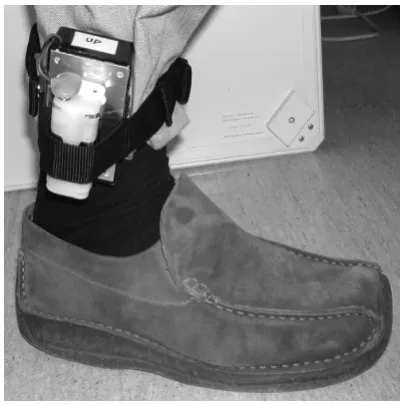
Both analysis methods described were applied to the same sets of gait data. These data sets were collected using a population of 21 participants; 12 male and 9 female aged between 20 and 40 years. The MR device was attached to the participants’ right leg as shown in Figure 10. Before the walking trials, the subjects ensured that the device was firmly attached, so it did not shift too much. They walked on a level and tiled surface in an indoor environment. After each walking trail collected acceleration data were transferred to the computer for analysis.
Figure 10. Motion Recording device attached to the lower leg.
sample, while the second one was used as a verification sample. When the data analysis methods were tested, each of the enrolment samples was compared to each of the verification samples. This way, it was possible to simulate one genuine trial and 20 impostor trials for each subject, which in total generated 21 genuine and 420 impostor attempts.
B. Results
The performances of the methods in terms of Decision Error Trade-off curve (DET) are shown in Figure 11. The DET curve represents a plot of False Accept Rate (FAR) versus False Reject Rate (FRR), and characterizes performance of the biometric authentication system under different operating points (thresholds). For a given thresh-old, if the similarity score is less or equal to the threshold then the user is accepted, otherwise rejected. Error rates F AR andF RR are calculated as
F AR=N accepted impostors total N impostors ,
and
F RR=N rejected genuines total N genuines ,
respectively. In general,F ARrelates to the security of the system, while F RRto the usability. An interesting point in the DET curve is the EER (equal error rate) where F AR=F RR. EER of the histogram similarity and cycle length are about 5% and 9%, respectively. For instance, an EER of 5% means that out of 21 genuine trials one is wrongfully rejected, and out of 420 impostor trials 21 are wrongfully accepted.
VII. DISCUSSION ANDAPPLICATION
A. Discussion
The mode of operation of the vision-based and sensor-based gait recognition systems is usually dif-ferent. Sensor-based systems operate in authentication
Figure 11. Performance of the methods in terms of the DET curves.
TABLE I.
SUMMARY ON SENSOR-BASED GAIT RECOGNITION WORKS
Placement Rate, sam/sec.
N sub-jects
Performance, EER %
Ailisto et al. [7]
waist 256 36 6.4
M¨antyj¨arvi et al. [8]
waist 256 36 7, 10, 18, 19
Gafurov et al. [9]
hip 100 22 16
Vildjiounaite et al. [33] (gait+voice)
hip and chest pockets, hand
256 31 2-12
This paper lower leg 16 21 5, 9
of them. In general, performances of the sensor-based and vision-based gait recognition systems are comparable on a small sample size. However, it should be noted that these comparisons are incommensurable as all the reported results are based on different data sets. The best way to compare different algorithms is to test them on the same sets of gait data.
Unlike, for example voice [39], [40] or handwritten signature [41], [42] biometrics, for which impersonation attacks have been studied, the security of gait biometrics has not received much attention. Only recently it has been hypothesized that minimal-effort impersonation attacks (mimicking someone’s else walking style) on gait might not be successful. The hypotheses was based on the analysis of the passive and active impostor distributions [9]. Although this finding presents another advantage of the gait biometric, further analysis are required in this direction. For example, it is important to verify if impersonation attack can be improved by training of the hostile users; Are there such users whose walking style is relatively easy to mimic? Are there such attackers who can easily mimic other people? In Doddington et al. [43] terms, whether there are any ”lambs” or ”wolves” users in gait mimicking.
Though our aim was to investigate whether acceleration of the lower leg movement can be used for authenticating people, placement of the MR device has limitations from an application point of view. More appropriate placement of the device would be body segments used in [7], [9]. In the current version of the MR device the data transfer to the PC is done manually. Future versions of it should include a module for wireless communication, e.g. Bluetooth module. This may enable to conduct an on-line authentication of the users. In our approach, verification and enrolment samples were obtained in one session. In a realistic setting, they are obtained in separate sessions with at least few days time interval between sessions. In general, sensor-based gait recognition approach lacks difficulties of the vision-based system such as background subtraction, lighting conditions, viewing angles etc. Nev-ertheless, it shares common factors that can alter gait of the person like carrying load, surface, injury and so on. It should be noted that wearing Motion Recording device does not affect gait of the person significantly. Graves et al. [44] reported that lower extremity kinematics was
insignificantly affected by the addition of loads 0.5 kg and 1 kg added to each foot. The Motion Recording device weighed about 350 gram.
B. Application
Generally, applications of the vision-based gait recog-nition focus on surveillance and forensics, whereas appli-cation of the sensor-based gait recognition system can be authentication and access control. For example, sensor-based gait biometrics have been proposed to improve security mechanisms in mobile devices [7], [8]. Another application area for sensor-based gait authentication sys-tem can be in the area of wearable computing. Wearable computers are computational devices that can be worn effortlessly, run continuously and be operated hands-free [45]. An iris-based user authentication is proposed for wearable computers [46]. Although performance of the iris-based user recognition is high, however, the iris-based systems require user cooperation. The issues of unobtru-siveness and user’s attention are important in wearable computing environment [47]. Therefore gait can be a good candidate for authentication to wearable devices, provided that error rates can achieve satisfactory levels. Nevertheless, performance of the sensor-based gait system can be improved when it is combined with other types of authenticators (e.g. voice [33]), or using more than one sensor on different body parts.
VIII. CONCLUSION AND FUTURE WORK
A sensor-based gait recognition is a recent topic in the area of biometric gait recognition. In a sensor-based gait recognition approach, gait patterns are extracted using a sensor attached to the body. Despite technological differences between vision-based and sensor-based gait recognition system, their performances on small sample sizes are comparable. A primary advantage of sensor-based (or accelerometric) gait recognition over other type of biometric modalities is the ability to enable unobtrusive user authentication. In this paper we presented evidence towards sensor-based gait authentication by using accel-eration of the lower leg. Although results with the small sample size are promising, however further work with larger sample size is necessary. It is also important to develop better algorithms to lower error rates. At the same time such algorithms should be robust against factors that can alter gait of the human, such as footwear, surface, carrying load, etc. Unlike vision-based systems, to our knowledge there is no established database for sensor-based gait recognition, which contains gait samples from at least 100 persons. Such database will allow to com-pare performances of different algorithms under common bases. All these topics will constitute the basis for our future work.
ACKNOWLEDGMENT
REFERENCES
[1] K. Pousttchi and M. Schurig, “Assessment of today’s mobile banking applications from the view of customer requirements.” in37th Annual Hawaii International Con-ference on System Sciences (HICSS’04), 2004.
[2] Y. Kim, J. Yoon, S. Park, and J. Han, “Architecture for implementing the mobile government services in Korea,” in First International Workshop on Digital Government: Systems and Technologies (DGOV 2004), Shanghai, China, November 2004.
[3] “Huge surge in mobile phone thefts,” http://news.bbc.co.uk/1/hi/uk/1748258.stm,
Last visit: 04.09.2006.
[4] “2002 NTA Monitor password survey,” http://www.out-law.com/page-3193,
Last visit: 04.09.2006.
[5] Q. Su, J. Tian, X. Chen, and X. Yang, “A fingerprint authentication system based on mobile phone,” in 5th International Conference on Audio- and Video-Based Bio-metric Person Authentication, July 2005.
[6] X. Chen, J. Tian, Q. Su, X. Yang, and F. Y. Wang, “A secured mobile phone based on embedded fingerprint recognition systems,” inIEEE International Conference on Intelligence and Security Informatics, May 2005. [7] H. J. Ailisto, M. Lindholm, J. M¨antyj¨arvi, E. Vildjiounaite,
and S.-M. M¨akel¨a, “Identifying people from gait pattern with accelerometers,” in Proceedings of SPIE Volume: 5779; Biometric Technology for Human Identification II, March 2005, pp. 7–14.
[8] J. M¨antyj¨arvi, M. Lindholm, E. Vildjiounaite, S.-M. M¨akel¨a, and H. J. Ailisto, “Identifying users of portable devices from gait pattern with accelerometers,” in IEEE International Conference on Acoustics, Speech, and Signal Processing, March 2005.
[9] D. Gafurov, E. Snekkenes, and T. E. Buvarp, “Robust-ness of biometric gait authentication against imperson-ation attack,” inFirst International Workshop on Informa-tion Security (IS’06), OnTheMove Federated Conferences (OTM’06), Montpellier, France, Oct 30 - Nov 1, 2006, Springer LNCS, to appear.
[10] A. K. Jain, A. Ross, and S. Prabhakar, “An introduction to biometric recognition,”IEEE Transactions on Circuits and Systems for Video Technology, Special Issue on Image- and Video-Based Biometrics, vol. 14, pp. 4–20, January 2004. [11] G. Johansson, “Visual motion perception,” in Scientific
Am., 1976, pp. 75–88, vol.32.
[12] J. Cutting and L. Kozlowski, “Recognizing friends by their walk: gait perception without familiarity cues,” inBulletin of the Psychonomic Society 9, 1977, pp. 353–356. [13] C. Barclay, J. Cutting, and L. Kozlowski, “Temporal and
spatial factors in gait perception that influence gender recognition,”Perception and Psychophysics 23, pp. 145– 152, 1978.
[14] J. B. Hayfron-Acquah, M. S. Nixon, and J. N. Carter, “Automatic gait recognition by symmetry analysis.” in
Audio- and Video-Based Biometric Person Authentication, 2001, pp. 272–277.
[15] D. Cunado, M. Nixon, and J. Carter, “Automatic extraction and description of human gait models for recognition purposes,” inComputer Vision and Image Understanding, 2003, pp. 1 – 41.
[16] L. Wang, W. Hu, and T. Tan, “A new attempt to gait-based human identification.” in International Conference on Pattern Recognition, 2002, pp. 115–118.
[17] C. BenAbdelkader, R. Cutler, H. Nanda, and L. Davis, “Eigengait: Motion-based recognition of people using im-age self-similarity.” in Thrid International Conference on Audio- and Video-Based Biometric Person Authentication, 2001.
[18] A. Y. Johnson and A. F. Bobick, “A multi-view method for gait recognition using static body parameters,” in
Third International Conference on Audio- and Video-Based Biometric Person Authentication, June 2001, pp. 301–311. [19] J. Shutler and M. Nixon, “Zernike velocity moments for description and recognition of moving shapes.” in British Machine Vision Conference, 2001, pp. 11/1 – 11/4, session 8: Modelling Behaviour.
[20] T. H. W. Lam and R. S. T. Lee, “A new representation for human gait recognition: Motion silhouettes image (MSI),” inInternational Conference on Biometrics, 2006, pp. 612– 618.
[21] S. Sarkar, P. J. Phillips, Z. Liu, I. R. Vega, P. Grother, and K. W. Bowyer, “The humanID gait challenge problem: Data sets, performance, and analysis.”IEEE Trans. Pattern Anal. Mach. Intell., vol. 27, no. 2, pp. 162–177, 2005. [22] Y. Wang, S. Yu, Y. Wang, and T. Tan, “Gait recognition
based on fusion of multi-view gait sequences.” in Interna-tional Conference on Biometrics, 2006, pp. 605–611. [23] M. S. Nixon, T. N. Tan, and R. Chapella, Human
Identi-fication Based on Gait, D. D. Zhang and A. K. Jain, Eds. Springer, 2006.
[24] D. Wagg and M. Nixon, “On automated model-based extraction and analysis of gait.” in IEEE International Conference on Automatic Face and Gesture Recognition, 2004, pp. 11–16.
[25] A. Kale, N. P. Cuntoor, B. Yegnanarayana, A. N. Ra-jagopalan, and R. Chellappa, “Gait analysis for human identification.” in4th International Conference on Audio-and Video-Based Biometric Person Authentication, June 2003, pp. 706–714.
[26] P. Huang, C. Harris, and M. Nixon, “Human gait recogni-tion in canonical space using temporal templates.” inVision Image and Signal Processing, 1999, pp. 93–100. [27] H. Murase and R. Sakai, “Moving object recognition in
eigenspace representation: gait analysis and lip reading,” in Pattern Recognition Letters, 1996, pp. 155–162. [28] N. Boulgouris, D. Hatzinakos, and K. Plataniotis, “Gait
recognition: A challenging signal processing technology for biometric identification,” in IEEE Signal Processing Magazine, November 2005, pp. 78–90.
[29] X. Zhou, B. Bhanu, and J. Han, “Human recognition at a distance in video by integrating face profile and gait.” in
5th International Conference on Audio- and Video-Based Biometric Person Authentication, July 2005, pp. 533–543. [30] X. Zhou and B. Bhanu, “Integrating face and gait for human recognition,” in Conference on Computer Vision and Pattern Recognition Workshop, June 2006.
[31] A. Kale, A. Roychowdhury, and R. Chellappa, “Fusion of gait and face for human identification,” in IEEE In-ternational Conference on Acoustics, Speech, and Signal Processing, 2004. Proceedings. (ICASSP ’04)., May 2004. [32] P. Cattin, D. Zlatnik, and R. Borer, “Sensor fusion for a biometric system using gait,” inInternational Conference on Multisensor Fusion and Integration for Intelligent Sys-tems, August 2001, pp. 233 – 238.
[33] E. Vildjiounaite, S.-M. M¨akel¨a, M. Lindholm, R. Ri-ihim¨aki, V. Kyll¨onen, J. M¨antyj¨arvi, and H. Ailisto, “Un-obtrusive multimodal biometrics for ensuring privacy and information security with personal devices,” inPervasive, May 2006, pp. 187–201, Springer LNCS.
[34] “Atmel corp.” http://www.atmel.com, Last visit: 29.08.2006.
[35] “Analog devices,” http://www.analog.com, Last visit: 29.08.2006.
[37] L. Wang, T. Tan, W. Hu, and H. Ning;, “Automatic gait recognition based on statistical shape analysis,” in IEEE Transactions on Image Processing, Sept. 2003, pp. 1120 – 1131, volume 12, Issue 9.
[38] A. Bobick and A. Johnson, “Gait recognition using static, activity-specific parameters,” in Proceedings of the 2001 IEEE Computer Computer Vision and Pattern Recognition, 2001, pp. I–423 – I–430, vol.1.
[39] J. Lindberg and M. Blomberg, “Vulnerability in speaker verification - a study of technical impostor techniques,” in
Eurospeech, 1999, pp. 1211–1214.
[40] Y. W. Lau, M. Wagner, and D. Tran, “Vulnerability of speaker verification to voice mimicking,” inInternational Symposium on Intelligent Multimedia, Video and Speech Processing, October 2004, pp. 145 – 148.
[41] J. Guo, D. Doermann, and A. Rosenfield, “Off-line skilled forgery detection using stroke and sub-stroke properties,” in 15th International Conference on Pattern Recognition, September 2000, pp. 355 – 358.
[42] S.-H. Cha and C. Tappert, “Automatic detection of hand-writing forgery,” in Eighth International Workshop on Frontiers in Handwriting Recognition, August 2002, pp. 264 – 267.
[43] G. Doddington, W. Liggett, A. Martin, M. Przybocki, and D. Reynolds, “Sheep, goats, lambs and wolves a statistical analysis of speaker performance in the NIST 1998 speaker recognition evaluation,” in5th International Conference on Spoken Language Processing, 1998.
[44] J. Graves, A. Martin, L. Miltenberger, and M. Pollock, “Physiological responses to walking with hand weights, wrist weights, and ankle weights.” in Journal of Or-thopaedics and Traumatology, 1988, pp. 265–271, med Sci Sports Exerc. June:20(3).
[45] P. Huang, “Promoting Wearable Computing: A Survey and Future Agenda,” in In Proc. of International Conference on Information Society in The 21st Century: Emerging Technologies and New Challenges, November 2000. [46] J. J. Lee, S. Noh, K. R. Park, and J. Kim, “Iris recognition
in wearable computer,” in First International Conference on Biometric Authentication, July 2004, pp. 475–483. [47] T. Starner, “Attention, memory, and wearable interfaces,”
Pervasive Computing, IEEE, vol. 1, Issue 4, pp. 88–91, Oct.-Dec. 2002.
Davrondzhon Gafurov received his MSc degree in computer engineering from Technological University of Tajikistan (TUT), Khujand, Tajikistan, in 2000. During 2000-2004 he worked as an engineer-programmer at the Computer Center of Technological University of Tajikistan (CCTUT), and at the same time he was a lecturer at the department of Programming and Information Technology at TUT. He is currently a Ph.D. candidate at the department of Computer Science and Media Technology at Gjøvik University College, Norway. His current research interest is in the area of information security, particularly biometrics systems and robustness of biometrics against attacks.
Kirsi Helkalareceived her MSc in mathematics from Univer-sity of Joensuu, Finland, in 2001. After graduating she has worked as an assistant at the departement of Mathematics at University of Joensuu and then as a mathematics, physics and chemistry teacher in Kes¨am¨aenrinteen Koulu in Lappeenranta, Finland. She is currently a PhD student at Gjøvik University College, Norway. Her work interest is personnel authentication, especially in a health service context.
![Figure 1. Placement of the accelerometer sensor in the waist (used withpermission from [7]).](https://thumb-us.123doks.com/thumbv2/123dok_us/8356853.1669286/2.595.310.536.555.740/figure-placement-accelerometer-sensor-waist-used-withpermission.webp)
![Figure 2. Pen-resembling accelerometer sensor attached to the hip [9].](https://thumb-us.123doks.com/thumbv2/123dok_us/8356853.1669286/3.595.81.265.78.264/figure-pen-resembling-accelerometer-sensor-attached-hip.webp)