needed on the quantity of Cotton- seed cake required to produce this more efficient use of the forage. Other types of protein supplement such as dehydrated alfalfa should also be tested. If the same results could be obtained with less than two pounds of cottonseed cake per day, the time required to bring the cattle to a lower supplement intake would be reduced. Both these fac- tors could lower the amount of the supplement required. A certain amount of time is required to en- able the microflora of the rumen to adjust to the changed diet. The adjustment period required for dif- ferent types of protein supplement should be determined, and the sup-
8
plement feeding started in suffi- cient time for the microflora to have completed their adjustment to the new diet by October 1.
In this study the cost of the cake, not considering the cost of labor required to feed it, was not recov- ered in the sale price of the cattle. In view of the characteristic low October gains and the customary decline in late October and early November feeder cattle prices, cattle for the market should either be sold from shortgrass ranges by late September or early October or sup- plemented with protein.
A decision to supplement with cottonseed cake, as fed in this study, should be based on the current
Grazing Habits, Diet and Performance of Sheep
_on Alpine Range+
2C. A. STRASIA,s M. THORN, R. W. RICE, AND D. R. SMITH Research Assistant, Division of Animal Science, Research Assistant, Division
of Plant Science and Associate Professor, Division of Animal Science, University of Wyoming; and Principal Plant Ecologist, Rocky
Mountain Forest and Range Experiment Station, Forest Service, U.S. Department of Agriculture, Laramie.
Highlight
An Alpine range, average elevation 3,20Om, was divided. One portion was fenced and sheep were allowed to graze it freely, the other was managed by a herder. The grazing season was for 60 days during July and August. Diet samples for botanical analyses were collected by esophageal fistulated sheep. Generally the grazing behavior of the free sheep was similar to the herded group except that the band was somewhat more loosely organized in the absence of a herder. Nitrogen and in vitro digestibility of diet samples were slightly lower and fiber and cellulose slightly higher from the free grazed sheep. There were no differences in the botanical composition of diet samples from the two groups. The sheep ate more forbs early in the grazing period. They were more selective in choice of grass and sedge species than in choice of forb species eaten. There were no differences in lamb gains during the grazing period.
Alpine range in the central Rocky Mountains is an important rang;
resource consisting of more than two million hectaies. In 1959 al- pine ranges were included in over lA cooperative study by the Wyoming
Agricultural Experiment Station and 300 sheep and 40 cattle allotments Rocky Mountain Forest and Range on National Forests (Wasser and Experiment Station, Forest Service, Re tzer, 1966). Despite widespread U.S. Department of Agriculture. use of the alpine by sheep, little is 2 Approved as Journal Paper No. 381
by the Director, Wyoming Agricul- known of their diet, habits, and tural Experiment Station. Received performance.
June 2, 1969; accepted for publication Sheep producers have constant September 27, 1969.
3 Present address: Dep artment of Ani- problems in obtaining competent ma1 Science, Purdue University, La- labor to herd sheep. Methods of favette. Indiana. management are needed which re-
price of cottonseed cake in relation to expected feeder cattle prices and gains.
Literature Cited
HYDER, D. N., R. E. BEMENT, J. J. NORRIS, AND M. J. MORRIS. 1966. Evaluating herbage species by graz- ing cattle, Part I, Food intake. Proc., X Int. Grassland Congr., p. 970-974. HYDER, D. N. 1967. Pounds of for-
age per pound of beef. Proc., Ranch Manage. Conf., Texas Technol. Col- lege, Lubbock, Texas, October 13, p. 83-91.
KLIPPLE, G. E., AND JOHN L. RETZER. 1959. Response of native vegetation of the Central Great Plains to ap- plications of corral manure and com- mercial fertilizer. J. Range Manage.
12:239.
9
duce the labor requirements, yet maintain the productivity of the sheep herd and the range.
The objectives of this study were: (1) To determine grazing activities, diet, and performance of sheep on alpine ranges and (2) to evaluate these characteristics under herder and herderless management.
Experimental Procedures This study was conducted on the Shoshone National Forest near Cody, Wyoming. Two sheep al- lotments were used. The Meete- etse Creek Allotment was grazed by herded sheep while the Carter Mountain Allotment was fenced and sheep grazed it freely. Each sheep allotment consisted of about 648 hectares of alpine range. The mean elevation of the range was 3,200 meters. The topography was a steeply rolling mountain top sur- rounded by a rim which dropped precipitously about 300 meters to a forested foothill area (Fig. 1).
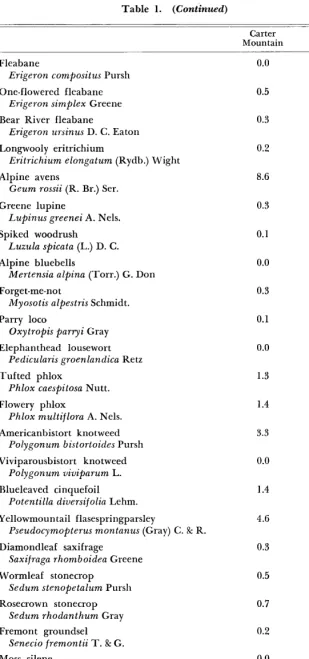
Vegetation on the area was typ- ical of much of the alpine zone in this region. The number of plant species present on the area was large (Table 1). Whiproot clover,4 alpine avens, and dwarf clover dom-
202
STRASIA
ET AL.
FIG. 1. A view of the Carter Mountain allotment. Note the sheep grazing in a loosely organized band and the rim rock in the background.
inated the foliage cover on both September. Each band grazed, un- allotments. der the supervision of a herder, for About 1,200 Rambouillet ewes the remainder of the year on the and their lambs grazed on each surrounding foothills and deserts. allotment from early July to mid- Diet samples were obtained peri-
FORBS -.-.-.
GRASSES - .**- '*.
FESCUES ---
CAREX ELYNOIDES ---
AMERICAN BISTORT
WHIPROOT & DWARF CLOVERS es... s...
x
l- w -
n
80 -
1966 60 -\.\
'1 .'
'\ ./" 'v" - .*' .a* '\
40 '\
0 '\
'\ '\
20 -
0 I
7-27 8-17
DATE
1967
. ‘.
.I
I
7-13 8-'10 8!20
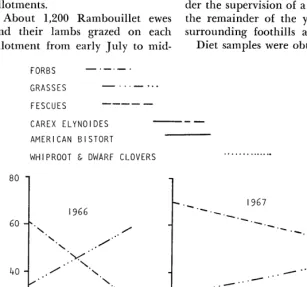
FIG. 2. Seasonal composition of the diet of free grazing sheep on Carter Mountain allotment.
odically from five esophageal-fistu- lated wethers in each band. The wethers remained with the bands throughout the summer. There were 8 diet samples obtained per period per collector wether on the free group and 4 samples per period per collector wether on the herded group. Samples were collected al- ternately in the early morning or evening when the bands of sheep were normally observed to graze.
Sulfuric acid was added to the samples in 1966 to limit bacterial digestion until the samples could be placed in cold storage. In 1967, the samples were washed with cold water until saliva was removed and then refrigerated immediately. They were later divided into halves for botanical and chemical analyses. Botanical composition was deter- mined by the microscopic point method of Heady and Tore11 (1959) using 100 points per sample. Our data (unpublished) would indicate that 100 points were adequate if percentage composition was re- ported. Ash and Kjeldahl nitrogen were determined by AOAC (1960) methods. Cellulose was determined by a modification of the Crampton and Maynard (1939) procedure in which the alcohol and benzene washes were omitted. Fiber and lignin were determined by the ADF method described by Van Soest (1963). Digestible dry matter was estimated by the in vitro method of Tilley and Terry (1963).
Behavior
In 1966, the unherded sheep be- haved in much the same manner as herded sheep. However, the flock occasionally split into three groups; later regrouping to form a single band. The herd frequently used the same areas for bedgrounds.
of more than a square mile. When bedding they tended to band to- gether in one group.
The behavior of unherded sheep on Carter Mountain was in con- trast to that observed by Jones and Paddock (1966) on an alpine range in Colorado. Their sheep devel- oped a very loosely organized be- havior when left unherded for the entire year. Band integrity was not maintained. Behavioral patterns of the unherded sheep in our study may have been conditioned by herding during the remaining 10 months of the year. The breed of sheep may also have been influ- ential. Rambouillets, which were used in this study, have pronounced gregarious habits. Jones and Pad- dock (1966) reported the behavior of Columbia sheep which may not have as strong a herding instinct. Botanical Composition of the Diet
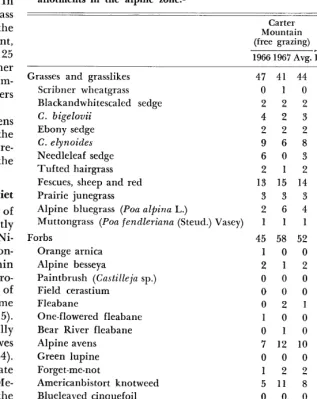
The average diet of sheep on the two allotments was very similar. The diet was composed of a large number of species, no one of which was dominant (Table 2). The most important species included whip- root clover, dwarf clover, American bistort, alpine avens, and the fes- cues. Of the two fescues, red fescue was by far the most abundant in the diet. This group of seven spe- cies accounted for about 67 percent of the average diet.
None of these species were placed high in Johnson’s (1962) preference rating of alpine forage species in Wyoming. Only Carex elynoides was found to be a major producer of sheep forage on alpine ranges in the central Rocky Mountains (Paulsen, 1960).
Forbs made up 52 percent of the diet on the Carter Mountain Allot- ment and 65 percent on the Me- eteetse Creek Allotment. The forb- grass ratio was higher in 1967 than in 1966. This discrepancy may have been related to the relatively warm, dry summer of 1966 which resulted in early disintegration of the forbs.
Foliage cover is related to the abundance (Table 1), but the re-
Table 1. Plant species and foliage cover (%) on the Meeteetse Creek (free grazing) and Carter Mountain (herded) allotments1
Carter Meetectse
Mountain Creek
Grasses
Scribner wheatgrass
Agropyron scribneri Vasey Tufted hairgrass
Deschumpsia caespitosa (L.) Beauv.
6.8 0.3
0.4
Fescues, sheep and red
Festuca ovinu L. and F.
Prairie junegrass
Koeleriu cristutu (L.) Pers.
0.8 0.9
rubru L.
Bluegrasses Pou spp. Spike trisetum
Trisetum spicatum
0.0
w
Richt.Ebony sedge C. ebeneu Rydb. C. elynoides Holm Needle leaf sedge
C. obtusutu Lilj Liddon sedge
C. pe tusa tu Deway
1.0
4.0
Other grasses
Sedges
Black and white scaled sedge
Curex ulbo-nigru Mack
Forbs
Western yarrow
Achilleu lunulosu Nutt. Pale agoseris
Agoseris gluucu (Pursh) Raf. Alpine pussytoes
An tennuriu ulpinu
Ballhead sandwort
Arenariu congestu
0.1 0.0
3.9 7.3
0.6 1.6
0.0
1.2 1.5
1.6 3.3
0.1
43.1 36.9
0.0 0.2
1.0
0.4
w
Gaertn.0.7
Nutt. Twinflower sandwort
Arenariu obtusilobu (Rydb.) Fern.
2.6 1.5
Orange arnica
Arnicu fulgens
0.5 0.6
Pursh Alpine sagewort
Artemisiu scopulorum
0.2 Gray
Alpine kittentails
Besseyu ulpinu (Gray) Rydb.
1.0 0.6
Field cerastium
Cerastium uruense
0.2
L. Tiny hawksbeard
Crepis nuna Richards Darkthroat shooting-star
Dodecatheon pulchellum (Raf.) Merr.
0.1
0.4
7.9
0.4
0.4
1.3
4.5
0.1
0.5
0.1
1.2
0.5
0.1
2.2
0.3
0.7
204
STRASIA
ET AL.
Table 1. (Continued)
Carter Meeteetse
Mountain Creek
Fleabane
Erigeron compositus Pursh
One-flowered fleabane Erigeron simplex Greene Bear River fleabane
Erigeron ursinus D. C. Eaton Longwooly eritrichium
Eritrichium elongatum (Rydb.) Wight Alpine avens
Geum rossii (R. Br.) Ser. Greene lupine
Lupinus greenei A. Nels. Spiked woodrush
Luzula spicata (L.) D. C. Alpine bluebells
Mertensia alpina (Torr.) G. Don Forget-me-not
Myosotis alpestris Schmidt. Parry loco
Oxy tropis parry i Gray Elephanthead lousewort
Pedicularis groenlandica Retz Tufted phlox
Phlox caespilosa Nutt. Flowery phlox
Phlox multiflora A. Nels. Americanbistort knotweed
Polygonum bistortoides Pursh Viviparousbistort knotweed
Polygonum viviparum L. Blueleaved cinquefoil
Potentilla diversifolia Lehm. Yellowmountail flasespringparsley
Pseudocymopterus montanus (Gray) C. & R. Diamondleaf saxifrage
Saxifraga rhomboidea Greene Wormleaf stonecrop
Sedum stenopetalum Pursh Rosecrown stonecrop
Sedum rhodanthum Gray Fremont groundsel
Senecio fremontii T. & G. Moss silene
Silene acaulis L. Whiproot clover
Trifolium dasyphyllum T. & G. Dwarf clover
Trifolium nanum Torr. Parry clover
Trifolium parryi Gray
0.0 0.2
0.5 0.6
0.3 0.1
0.2 0.2
8.6 12.3
0.3 0.8
0.1 0.2
0.0 0.1
0.3 0.2
0.1 0.2
0.0 0.1
1.3 1.0
1.4 1.1
3.3 3.5
0.0 0.2
1.4 1.5
4.6 1.6
0.3
0.5
0.7
0.2
0.0
13.1
6.6
0.8
0.2
1.0
0.1
0.3
0.1
7.9
7.7
1.5
lationship is inexact because of variations among life forms. In order to relate the foliage cover to the botanical composition of sheep diets determined by esophageal- fistulated sheep, simple correlations were caluclated between the per- centage cover and the percent found in esophageal-fistula samples. The items correlated are shown in Table 3. There was a significant (P < .05) simple correlation of 0.675 between percent cover and the percent of the plants found in the esophageal sam- ples.
In addition simple correlations were calculated by dividing the forage cover and the esophageal data into two groups. The corre- lations between percent cover and the percent found in esophageal samples were .003 for grasses and sedges (P > .05) and 0.848 for forbs (P < .05). Thus, the sheep appar- ently ate grasses and sedges accord- ing to preference and not in rela- tionship to abundance. The fescues were preferred to other grasses and sedges even though their abun- dance was much less than the blue- grasses or the sedges. The sheep ap- parently ate the forbs according to their abundance as measured by foliage cover. However, the sheep selectively ate appreciable amounts of only seven of the 14 forbs which were available in considerable amounts according to cover mea- surements.
Seasonal selectivity of the sheep was generally pronounced (Figs. 2 and 3). Forbs furnished 66 percent of the diet in the early summer of
1966. This decreased to 31 percent in late summer. Forbs generally furnished more of the diet in 1967 than in 1966. On the herded Me- eteetse Creek Allotment in 1967 no seasonal decrease was noted. This may be related to the increased availability of forbs throughout the season with the relatively cool moist climate of 1967.
to a change from American bistort to fescues and Carex elynoides. In 1967, however, when the forb/grass ratio remained constant on the herded Meeteetse Creek Allotment, American bistort decreased from 25 percent of the diet in mid-summer to 1 percent of the diet in late sum- mer. Dwarf and whiproot clovers increased proportionately.
The abundance of alpine avens in the diet did not vary during the season. Instead, it made up a re- markably constant 10 percent of the diet.
Chemical Composition of the Diet Average chemical composition of the diet did not vary significantly between allotments (Table 4). Ni- trogen was the only chemical con- stituent to vary significantly within the grazing season. Dietary nitro- gen was high in the early part of the season and decreased with time on both allotments (Figs. 4 and 5). The nitrogen level was generally above the requirements for ewes and fattening lambs (NRC 1964). However, the nitrogen level in late August, 1967, on the herded Me- eteetse Creek allotment was at the minimum requirement for lambs.
The in vitro dry matter digesti- bilities of the 1967 dietary samples are shown in Figure 6. Early sam- ples were not taken in the Meeteetse Creek Allotment (herded) because the band of sheep had not reached the alpine portion of the range at that time. The in vitro digestibility was higher in the herded Meeteetse Creek Allotment than in the free grazing Carter Mountain Allotment in the early and later August sam- pling periods. The dry matter di- gestibility of the forages was rela- tively high throughout the grazing period which is an indication of the high quality of alpine range. The lowest dry matter digestibility (50%) was at the earliest sampling date. Since the fistulated sheep had been on the range for a period of only 5 days, this may be too soon for adaptation to a new diet. The ni- trogen content and in vitro digesti-
Table 2. Botanical composition (%) of the diet of sheep on two sheep allotments in the alpine zone.1
Carter Meeteetse Mountain Creek (free grazing) (herded) 1966 1967 Avg. 1966 1967 Avg. Avg.
Grasses and grasslikes 47 41 44 41 22 32 32
Scribner wheatgrass 0100000
Blackandwhitescaled sedge 2 2 2 1 1 1 2
C. bigelouii 4231322
Ebony sedge 2221001
C. elynoides 9 6 8 11 2 6 7
Needleleaf sedge 6 0 3 6 0 3 3
Tufted hairg-rass 2 1 2 1 1 1 2
Fescues, sheep and red 13 15 14 14 10 12 13
Prairie junegrass 3 3 3 1 2 2 2
Alpine bluegrass (Pea alpina L.) 2 6 4 2 2 2 3 Muttongrass (Pea fendleriunu (Steud.) Vasey) 1 1 1 0 0 0 0
Forbs 45 58 52 52 77 65 58
Orange arnica 1001110
Alpine besseya 2 1 2 1 3 2 2
Paintbrush (Castilleju sp.) 0 0 0 1 0 1 0
Field cerastium 0001000
Fleabane 0210100
One-flowered fleabane 1001110
Bear River fleabane 0100100
Alpine avens 7 12 10 10 11 10 10
Green lupine 0 0 0 0 1 0 0
Forge t-me-not 1 221112
Americanbistort knotweed 5 11 8 14 15 14 11
Blueleaved cinquefoil 0001000
Yellowmountain falsespringparsley 0 1 0 1 0 0 0
Wormleaf stonecrop 0 3 2 1 4 2 2
Whiproot clover 11 17 14 8 19 14 14
Dwarf clover 10 5 8 8 18 13 10
Parry clover 0 2 1 0 0 0 0
ISpecies representing less than 1% of the diet have been omitted from the table.
Table 3. Relation between botanical composition (%) of esophageal samples and the cover (%) of plants.1
Use order Esophageal samples estimate Cover
Grasses and sedges Fescues, sheep and red Curex elynoides Needleleaf sedge Alpine bluegrass
Blackandwhitescaled sedge C. bigelovii
Tufted hairgrass Prairie junegrass Ebony sedge
Total 35
0.85 1.40 2.50 4.30 1.10 0.10 0.40 1.15 0.25 12.05
206 STRASIA ET AL.
Table 3. (Continued) herded Meeteetse Creek Allotment were selecting a higher quality diet Esophageal Cover
Use order samples estimate since the nitrogen higher and fibrous tended components to be
Forbs lower in these samples.
Whiproo t clover 14 10.50
Americanbistort knotweed 11 3.40 Sheep Performance
Alpine avens 10 10.45
Dwarf clover 10 7.15
Alpine besseya 2 0.80
Forge t-me-not 2 0.25
Wormleaf stonecrop 2 0.25
Pale agoseris 0 1.10
Twinflower sandwort 0 2.05
Alpine sagewort 0 1.20
Flowery phlox 0 1.25
Tufted phlox 0 1.15
Blueleaved cinquefoil 0 1.45
Yellowmountain falsespringparsley 0 3.20
Total 51 41.20
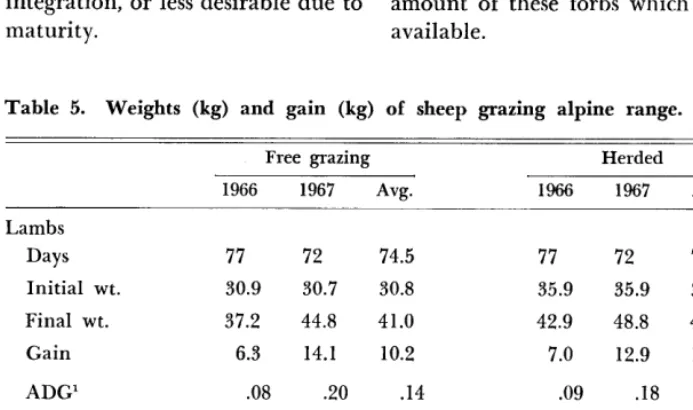
There were no significant differ- ences in the weight gains of lambs or ewes due to management of sheep (Table 5). Performance was not as good in 1966 as in 1967 for both groups. This was probably due to differences in forage produc- tion as influenced by environmental differences between the two years. The lamb gains in 1967 were good for lambs of this weight and age, but in 1966 the lamb gains were adequate but less than is usually bility of dietary samples indicated in the herded Meeteetse Creek expected on alpine range.
that the sheep were able to select samples particularly at the later managed It is apparent that sheep can be successfully under fence a high quality diet on alpine range. dates (Figs. 2 and 3).
The dietary digestibility differences on alpine range with no loss of per- on the two allotments may be a dietary samples (Table The chemical composition 4) also in- of formance. ate a higher The quality sheep apparently diet on reflection of the higher forb content dicated that the sheep on the the Meeteetse Creek Allotment
(herded) as indicated by chemical
FORBS _._.-.-
GRASSES _.. . - . . .
composition and in vitro dry matter digestibility. However, these dif- ferences were not great enough to
FESCUES --- affect the performance of sheep.
They could have overcome these
CAREX ELYNOIDES --- differences by eating a greater
AMERICAN BISTORT quantity of forage on Carter Moun-
WHIPROOT & DWARF CLOVERS . . . *.- tain (free). The differences in diet quality were probably more a re- flection of differences in the allot- 80
1
-L
*_._.-.-*-*-._.-.L.
ments than of management prac-1967
7-27 8-17
DATE
l
8-V a'-23
tices.
Summary and Conclusions
A two year study on the dietary habits and behavior of sheep under the supervision of a herder (herded) or grazed under fence (free) on alpine summer range indicated that:
1. Lamb gains and ewe weights were similar in herded and free bands of sheep. Gains in 1967 were good and reflected the per- formance usually expected on al- pine ranges.
Table 4. Chemical composition (%) of the diet of sheep grazing alpine range.1 CARTER MT. - MEETEETSE CR. -_---
Carter Mountain Meeteetse Creek 70-
(free grazing) (herded) ” __-- _-
’
Mean SE Mean SE 6 60-
:
Ash 14.1 4.0 13.5 3.8 ;
Nitrogen 1.9 0.6 2.3 0.6 ; 50-
Fiber 42.3 11.6 38.2 10.5 5
’
Cellulose 30.2 8.4 28.7 7.8 40 ;A+
Lignin 11.9 2.1 11.0 3.3 00
IData were averaged over all sampling periods in 1966 and 1967. 7-15 8-Y 8-22 DATE
FREE
RCQUIlitMtNT LEVtL
JULY AUG. AUG. 13 7 20
FIG. 6. Dietary in vitro dry matter di- gestibility of sheep. (The vertical lines are one standard deviation).
5. A
two month period of graz- ing without a herder did not result in a large difference in the grazing habits of sheep.6. Where feasible, sheep can be managed successfully without a herder on alpine ranges.
FIG. 4. Dietary nitrogen of herded and FIG. 5. Dietary nitrogen of herded and
free sheep in 1966 on two alpine ranges. free sheep in 1967 on two alpine ranges. Literature Cited
Assoc1.4~10~ OF OFFICIAL AGRICULTURAL
vitro dry matter digestibility and 4. The sheep were more selective CHEMISTS. 1960. Official Methods nitrogen content. in their choice of grass and sedge of Analysis (9th Ed.). D. c. Washington,
3.
A
shift from forbs to grassoccurred when forbs became less species than for individual forb BROWN, D. available due to utilization or dis- species. The proportion of forbs in
1954. Method of survey- ing and measuring vegetation. Com- the diet was related to the relative
integration, or less desirable due to amount of these forbs which were monweatlh Agr. Bur. Commonwealth Bur. Pastures Field Crops Bull. 42.
maturity. available. 223 p.
CRAMPTON, E. W., AND L. A. MAYNARD.
1938. The relation of cellulose and Table 5. Weights (kg) and gain (kg) of sheep g-razing alpine range. lignin content to the nutritive value
of animal feeds. J. Nutr. 15:383-
Free grazing Herded 395.
1966 1967 Avg. 1966 1967 Avg. HEADY, H. F., AND D. T. TORELL. 1959. Forage preference exhibited by sheep
Lambs with esophageal fistulas. J. Range
Days 77 72 74.5 77 72 74.5 Manage. 12:28-34.
Initial wt. 30.9 30.7 30.8 35.9 35.9 35.9 JOHNSON, W. M. 1962. Vegetation of
Final wt. 37.2 44.8 41.0 42.9 48.8 45.9 high-altitude ranges in Wyoming as related to use by game and domestic
Gain 6.3 14.1 10.2 7.0 12.9 10.0 sheep. Wyo. Agr. Exp. Sta. Bull.
ADG’ .08 .20 .I4 .09 .I8 .13 387. 31 p.
JONES, D. A., AND R. PADDOCK. 1966. Ewes
Initial wt. Final wt. Gain
ADGl
l Average daily gain.
61.6 66.9
70.5 75.9
8.9 9.0
.13 .12
You can’t turn ‘em loose . . . or can you? J. Range Manage. 19:96-98. NATIONAL RESEARCH COUNCIL. 1964.
208 MCCONNELL AND SMITH
ranges in the central Rocky Moun- feed. II. A rapid method for the taini. Iowa State Coll. J. ‘Sci. 34:
73 l-748.
determination Gf fiber and lignin.
1. Ass. Offic. Agr. Chem. 46:829-
Longmont Seed Co.
TILLEY, J. M., AND R. A. TERRY. 1963. Ys35. We Buy & Sell Western Range Grass
A two-stage technique for the in WASSER, C. H., AND J. L. RETZER. & Legume Seeds
vitro digestion of forage crops. J. 1966. Ecology and utility of the CONFRONT US with your RANGE
British Grassland Sot. 18: 104-l 11. central Rocky Mountain alpine zone. PROBLEMS: phone: 303 + 776-1320 VAN SOEST, P. J. 1963. Use of de- Proc. 9th Int. Grassland Congr., p. LONGMONT, COLORADO 80501
tergents in the analysis of fibrous 357-361.
Response of Understory Vegetation
to Ponderosa Pine Thinning in
Eastern Washington1
BURT R. MCCONNELL AND JUSTIN G. SMITH
Range Scientists, Pacific Northwest Forest and Range
Experiment Station, Forest Seroice, U.S. Depart-
ment of Agriculture, La Grande, Oregon.
Highlight
Pine thinning caused highly significant increases in understory vegetation. After eight growing seasons, total understory yield increments ranged from 75 lb/acre on the unthinned plots to 417 lb under 26-foot pine spacing. The increase comprised 51% grasses, 37% forbs, and 12% shrubs. When pine canopy exceeded about 45%, forbs produced more than grasses; below 45%, grasses were superior producers.
all levels. Shrubs were the least productive at
There are extensive acreages of overstocked ponderosa pine (Pinus fionderosa)2 in the Pacific Northwest. In their present condition, these stands produce little timber or forage, but with improved management their productive capacities can be greatly increased. Large-scale thinning programs are currently underway, but specific tree spacing guides for optimum timber production are limited. Since thinned stands are also potential sources of forage for game and livestock, a joint pine spacing- growth increment and forage production study was initiated in 1959 by the Washington State Depart- ment of Game; U.S. Soil Conservation Service; and Okanogan National Forest and Pacific Northwest
l In cooperation with the Washington State Department of Game and Soil Conservation Service and Okanogan Na- tional Forest, U.S. Department of Agriculture. The authors are indebted to the Washington Department of Game for furnishing a portion of its Methow Game Range for the study and contributing all of the labor for thinning the study plots. Received May 5, 1969; accepted for publica- tion November 26, 1969.
2Scientific names for grasses and sedges are according to Hitchcock (1950); f or forbs and shrubs, Hitchcock et al. (1955-64); for trees, Little (1953). Taxonomic assistance was provided by the Department of Forestry and Range Management, Washington State University.
Forest and Range Experiment Station of the Forest Service, U.S. Department of Agriculture. This re- port describes changes that have occurred in under- story vegetation during the eight growing seasons between 1959 and 1966. McConnell and Smith (1965) reported on the initial changes in under- story vegetation following thinning, and Barrett (1968) presented data on the growth increment of pine.
Study Area and Methods
The study was made in the upper Methow River Valley near Winthrop, in north-central Washington. The actual study site was located on the Methow Game Range, which is owned and managed by the Washington State Depart- ment of Game.
Elevation of the study area is 2,350 feet. Temperature extremes range from 100 F to -30 F with average July temperatures of about 70 F. The frost-free growing period extends from mid-May until late September. Approximately 60% of the average annual precipitation of 14.5 inches falls between October and February and includes 73 inches of snow.
Soils in this locality have been typed by the U.S. Soil Conservation Service as Katar, stony, sandy loams, 0 to 25% slopes. Katar soils are described as deep, somewhat exces- sively drained, moderately coarse-textured (Western Brown) forest soils, intergrading to regosols developed from granitic ablation till. The series model has characteristic stony sur- face layers and is common on many sloping glacial plains in the area. On the study site itself, however, the soils have stonefree surface layers and are a phase of the model recognized as Katar sandy loams, 3 to 15% slopes.
A vigorous 4%year-old stand of pine saplings was selected for study. The stand originated from natural seeding about 1911 following logging and fire. Surviving trees of the original stand, unmerchantable at the time of logging, in- dicated an above average site V. The area is not grazed by livestock, but it receives light deer use.
Prethinning vegetation consisted of thick pine regenera- tion with a sparse understory of poorly growing shrubs and scattered grasses and forbs (Fig. 1). Treatments consisted of thinning trees to the following spacings, each replicated three times in a randomized block experimental design: